"7b46a695175d8694"{"id":"1001484","slug":"lighting-vol-1-interior-nanite-and-low-poly","title":"Lighting VOL.1 - Interior (Nanite and Low Poly)","category":"Lighting","engine":"5.1+","assetVersion":"","engineVersion":"Engine Version: 5.1+","tag":"Lighting","accent":"blue","visual":"mech","summary":"Examine Lighting VOL.1 - Interior, featuring 90 Nanite and low poly meshes, 4K channel-packed textures, emissive toggles, and Lumen support for Unreal Engine.","platform":"Unreal Engine","publishedAt":"2026-10-08T09:11:51.572Z","updatedAt":"2026-10-08T09:11:51.572Z","sourceNotes":[],"fileContents":[],"compatibility":["Unreal Engine","Engine Version: 5.1+"],"featuredImage":{"alt":"Lighting VOL.1 - Interior (Nanite and Low Poly)","src":"/wp-content/uploads/published/2026/10/49b718415c33-df3f065a-9ca5-4365-8cf4-3fe985ecd18c-86e1f180d7.webp"},"hasDownloadLink":true,"downloads":0,"terms":[{"taxonomy":"category","slug":"lighting","name":"Lighting"}],"galleryImages":[{"src":"/wp-content/uploads/published/2026/10/3b33e8be2df3-50ab5bba-f9d0-4cb5-9f07-bf958f73bff0-e500949884.webp","alt":"Lighting VOL.1 - Interior (Nanite and Low Poly)"},{"src":"/wp-content/uploads/published/2026/10/4f3a773fc741-a6d85893-db11-4a69-a368-5cc9b6dd5623-0d99a31748.webp","alt":"Lighting VOL.1 - Interior (Nanite and Low Poly)"},{"src":"/wp-content/uploads/published/2026/10/d3a5f233738d-04d59bb4-81c4-40b2-b8c3-217642e2fcef-3985296753.webp","alt":"Lighting VOL.1 - Interior (Nanite and Low Poly)"},{"src":"/wp-content/uploads/published/2026/10/53139af838e3-f95d09b4-209f-4592-82ae-8bfd3eec2567-3a3ea47c0a.webp","alt":"Lighting VOL.1 - Interior (Nanite and Low Poly)"},{"src":"/wp-content/uploads/published/2026/10/8e2e6584d9f2-e5dbbd04-65d6-4f0c-8a28-c3f5b455c3e8-1c253bcc9e.webp","alt":"Lighting VOL.1 - Interior (Nanite and Low Poly)"},{"src":"/wp-content/uploads/published/2026/10/5af650fd6837-2287a6ff-c22d-4866-8a5b-2eacd31bb2fb-c3da321595.webp","alt":"Lighting VOL.1 - Interior (Nanite and Low Poly)"},{"src":"/wp-content/uploads/published/2026/10/bedaf276ed04-f21b8970-1f54-4972-9dff-dbf0789f896b-ae956a4e48.webp","alt":"Lighting VOL.1 - Interior (Nanite and Low Poly)"},{"src":"/wp-content/uploads/published/2026/10/8c3c9a674b3f-d8711fe4-080f-491c-b993-fa66ad011f1c-26366221dd.webp","alt":"Lighting VOL.1 - Interior (Nanite and Low Poly)"},{"src":"/wp-content/uploads/published/2026/10/1674e61823b6-2b17b060-0a87-4675-9106-c5636905acc3-30b1076efa.webp","alt":"Lighting VOL.1 - Interior (Nanite and Low Poly)"}],"accessPanel":{"kind":"resource","title":"Download this resource","eyebrow":"Free Download","message":"Log in or create a free account to start your download.","fileName":"Content.7z","safetyNote":"Resources are manually reviewed before listing to improve quality and reduce obvious risks.","actionLabel":"Download Free","resourceType":"Resource archive"},"contentHtml":"\u003ch2\u003eIntegrating Nanite and Low Poly Interior Lighting Meshes\u003c/h2\u003e\u003cp\u003eDeploying interior light sources in Unreal Engine requires balancing polygon density against frame budgets. Lighting VOL.1 - Interior addresses this distribution by supplying 90 meshes split evenly between high-fidelity Nanite meshes and standard low poly variants for each asset. Incorporating dual-mesh formats gives developers direct choice over their geometric pipeline. Nanite meshes handle micro-bevels, intricate mounting hardware, and curved fixture shades without aggressive geometric reduction or manual LOD generation steps.\u003c/p\u003e\u003cp\u003eProjects targeting strict hardware baselines or legacy render pipelines can drop the alternative low poly meshes directly into scenes instead. Because both versions share the same asset forms and material mappings, swapping between high-poly Nanite assets and low poly equivalents does not disrupt scene composition. The mesh collection spans home lighting fixtures, ceiling installations, standing lamps, and electrical fittings suited for mundane residential spaces, retro rooms, and worn apocalyptic interiors.\u003c/p\u003e\u003ch2\u003eMaster Material Pipeline and Channel-Packed Texture Workflows\u003c/h2\u003e\u003cp\u003eTexturing across the collection relies on 4K texture sets managed by an overarching master material structure. Instead of isolated material networks for every fixture, the centralized master material governs the bulk of all props and models in the project. This centralization maintains clean shader organization and uniform parameter handling across domestic lamps and overhead fixtures alike.\u003c/p\u003e\u003cp\u003eMemory footprint and texture sample calls remain constrained through packed channel maps. Roughness, Metalness, and Ambient Occlusion are combined into a single texture file (RMA), reserving individual color channels for specific physical properties:\u003c/p\u003e\u003cul\u003e\u003cli\u003eRed Channel: Ambient Occlusion, supplying localized contact shading and crevice darkness.\u003c/li\u003e\u003cli\u003eGreen Channel: Roughness, governing surface micro-wear and finish glossiness.\u003c/li\u003e\u003cli\u003eBlue Channel: Metalness, differentiating raw metallic components from coated, painted, or plastic surfaces.\u003c/li\u003e\u003c/ul\u003e\u003cp\u003eThe master material exposes exposed parameter controls for roughness intensity, albedo coloration adjustments, and normal map strengths. Artists can tune how reflective an enameled lamp hood appears, desaturate painted finishes, or tweak the perceived depth of stamped metal seams directly within material instances without modifying raw source files.\u003c/p\u003e\u003ch2\u003eEmissive Controls and Dynamic Lighting via Unreal Engine Lumen\u003c/h2\u003e\u003cp\u003eLight fixtures require quick adjustment between inactive states and fully powered illumination. The material pipeline incorporates dedicated emissive controls capable of switching light bulbs and glowing elements on or off. By toggling these material parameters, a fixture transforms instantly from an unpowered decorative prop into an active illumination housing.\u003c/p\u003e\u003cp\u003eBuilt to operate seamlessly within Unreal Engine 5.0 and newer versions, the package fully supports Lumen dynamic global illumination. When emissive materials are turned on, Lumen reads the fixture surface as an active bounce source, casting indirect light into the surrounding interior volume. Alternatively, standard Unreal Engine point, spot, or rect lights can be parented into the fixture geometry to project primary directional illumination while the emissive material handles bulb glow and shade bloom.\u003c/p\u003e\u003cp\u003eBecause the collection targets realistic AAA quality visuals, materials respond accurately to global indirect lighting. The 4K normal maps preserve fine details—such as electrical switches, bracket screws, and manufacturing seams—ensuring that grazing light across ceiling plates and walls produces believable surface relief.\u003c/p\u003e\u003ch2\u003eInteractive Ceiling Fan Blueprint Execution\u003c/h2\u003e\u003cp\u003eBeyond static lamps and hanging lights, the collection features a dedicated ceiling fan Blueprint to manage moving mechanical parts. Setting up dynamic rotation manually across distinct blade and housing meshes often requires repetitive actor setup. The included Blueprint encapsulates the spinning ceiling fan components into a single pre-configured object.\u003c/p\u003e\u003cp\u003ePlacing the fan Blueprint into an interior environment enables rotating motion without requiring custom timeline construction or separate tick management. It functions alongside the broader fixture lineup, allowing developers to dress domestic living rooms, neglected basements, or post-apocalyptic shelters with active kinetic movement that matches the visual style and scale of surrounding electrical fixtures.\u003c/p\u003e\u003ch2\u003eProduction Clearance and Deployment Across Real-Time Environments\u003c/h2\u003e\u003cp\u003eAsset adoption in commercial production often stalls over licensing concerns and trademarked design cues. Every fixture label, brand insignia, and graphic marking across this set was custom-created by Dekogon Studios artists. The assets are completely free of real-world legal branding issues, allowing immediate deployment across commercial game releases, interactive visualizations, and rendered cinematics without clearance delays.\u003c/p\u003e\u003cp\u003eThe package contains all assets, test maps, and materials configured directly inside Unreal Engine. Whether populating a retro mid-century apartment, a modern family home, or an abandoned electrical substation, the balanced split between Nanite fidelity and low poly optimization offers a flexible baseline for interior lighting placement.\u003c/p\u003e\n\n\u003ch2\u003eMore From The Same Workflow\u003c/h2\u003e\n\u003cul\u003e\n\u003cli\u003e\u003ca href=\"https://3dcghub.com/medieval-furniture-props-gothic-props-victorian-props-medieval-furniture/\" title=\"Medieval Furniture Props (Gothic Props, Victorian Props, Medieval, Furniture)\"\u003eMedieval Furniture Props (Gothic Props, Victorian Props, Medieval, Furniture)\u003c/a\u003e\u003c/li\u003e\n\u003cli\u003e\u003ca href=\"https://3dcghub.com/foliage-vol-23-ivy-low-poly/\" title=\"Foliage VOL.23 - Ivy (Low Poly)\"\u003eFoliage VOL.23 - Ivy (Low Poly)\u003c/a\u003e\u003c/li\u003e\n\u003cli\u003e\u003ca href=\"https://3dcghub.com/trash-vol-1-city-streets-nanite-and-low-poly-versions/\" title=\"Trash VOL.1 - City Streets (Nanite and Low Poly Versions)\"\u003eTrash VOL.1 - City Streets (Nanite and Low Poly Versions)\u003c/a\u003e\u003c/li\u003e\n\u003cli\u003e\u003ca href=\"https://3dcghub.com/safe-house-vol-1-supplies-and-guns-nanite-and-low-poly/\" title=\"Safe House VOL.1 - Supplies and Guns (Nanite and Low Poly)\"\u003eSafe House VOL.1 - Supplies and Guns (Nanite and Low Poly)\u003c/a\u003e\u003c/li\u003e\n\u003cli\u003e\u003ca href=\"https://3dcghub.com/suburbs-vol-8-retro-decor-nanite-and-low-poly/\" title=\"Suburbs VOL.8 - Retro Decor (Nanite and Low Poly)\"\u003eSuburbs VOL.8 - Retro Decor (Nanite and Low Poly)\u003c/a\u003e\u003c/li\u003e\n\u003c/ul\u003e","contentTextLength":5668,"navigation":{"current":63,"total":3481,"previous":{"id":"1001485","slug":"modular-swamp-shack-pack","title":"Modular Swamp Shack Pack","category":"Medieval","platform":"Unreal Engine","updatedAt":"2026-10-08T09:15:20.140Z"},"next":{"id":"1001483","slug":"katana-animation-set","title":"Katana Animation Set","category":"Combat","platform":"Unreal Engine","updatedAt":"2026-10-08T09:08:56.082Z"}},"relatedResources":[{"id":"1000633","slug":"medieval-furniture-props-gothic-props-victorian-props-medieval-furniture","title":"Medieval Furniture Props (Gothic Props, Victorian Props, Medieval, Furniture)","category":"Lighting","engine":"5.1+","assetVersion":"","engineVersion":"Engine Version: 5.1+","tag":"Lighting","accent":"blue","visual":"mech","summary":"A 70-prop Unreal Engine interior pack covering medieval, gothic, and Victorian furniture with PBR materials, smoke VFX, cloth physics, and Nanite/Lumen support.","platform":"Unreal Engine","publishedAt":"2026-07-21T14:59:59.227Z","updatedAt":"2026-07-21T20:37:19.504Z","sourceNotes":[],"fileContents":[],"compatibility":["Unreal Engine","Engine Version: 5.1+"],"featuredImage":{"alt":"Medieval Furniture Props (Gothic Props, Victorian Props, Medieval, Furniture)","src":"/wp-content/uploads/published/2026/07/6e5783304c0a-2d34ddc2-41a6-4621-8d8a-1a236c14981d-d9e79dc841.webp"},"hasDownloadLink":true,"downloads":0},{"id":"1001441","slug":"foliage-vol-23-ivy-low-poly","title":"Foliage VOL.23 - Ivy (Low Poly)","category":"Plants","engine":"5.1+","assetVersion":"","engineVersion":"Engine Version: 5.1+","tag":"Plants","accent":"blue","visual":"mech","summary":"Deploy and optimize Foliage VOL.23 - Ivy (Low Poly) in Unreal Engine with 49 meshes, Lumen support, modular branching, and vertex paint wall textures.","platform":"Unreal Engine","publishedAt":"2026-10-07T08:34:14.081Z","updatedAt":"2026-10-07T08:34:14.081Z","sourceNotes":[],"fileContents":[],"compatibility":["Unreal Engine","Engine Version: 5.1+"],"featuredImage":{"alt":"Foliage VOL.23 - Ivy (Low Poly)","src":"/wp-content/uploads/published/2026/10/ab74fe532ca8-53fce03b-c635-4bb2-ba66-1d26d6d4c521-0b026bd542.webp"},"hasDownloadLink":true,"downloads":2},{"id":"1001494","slug":"suburbs-vol-9-kitchen-appliances-nanite-and-low-poly","title":"Suburbs VOL.9 - Kitchen Appliances (Nanite and Low Poly)","category":"Tools, Objects \u0026 Decor","engine":"5.1+","assetVersion":"","engineVersion":"Engine Version: 5.1+","tag":"Tools","accent":"blue","visual":"mech","summary":"Explore Suburbs VOL.9 - Kitchen Appliances featuring 100 Nanite and low-poly meshes, 4K channel-packed textures, master materials, and Lumen support in UE5.","platform":"Unreal Engine","publishedAt":"2026-10-08T12:59:10.109Z","updatedAt":"2026-10-08T12:59:10.109Z","sourceNotes":[],"fileContents":[],"compatibility":["Unreal Engine","Engine Version: 5.1+"],"featuredImage":{"alt":"Suburbs VOL.9 - Kitchen Appliances (Nanite and Low Poly)","src":"/wp-content/uploads/published/2026/10/3979285da268-cfab6cc0-906e-4d64-b5c0-261f887167a6-7b5e04d362.webp"},"hasDownloadLink":true,"downloads":1}]}
Lighting
Lighting VOL.1 - Interior (Nanite and Low Poly)
Examine Lighting VOL.1 - Interior, featuring 90 Nanite and low poly meshes, 4K channel-packed textures, emissive toggles, and Lumen support for Unreal Engine.
Category:Unreal Engine,LightingPlatform: Unreal EngineEngine Version: 5.1+Published: Oct 8, 2026
Lighting
Resource overview
Integrating Nanite and Low Poly Interior Lighting Meshes
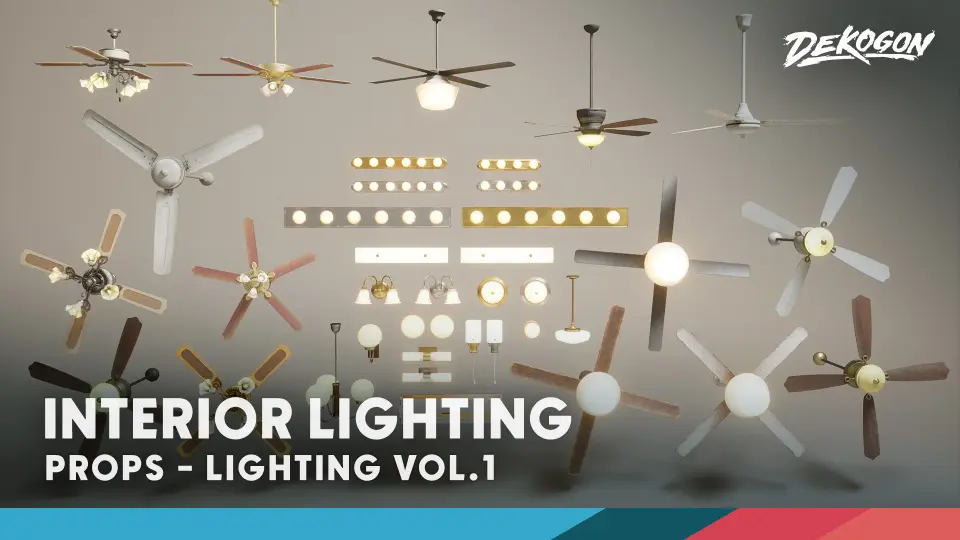
Deploying interior light sources in Unreal Engine requires balancing polygon density against frame budgets. Lighting VOL.1 - Interior addresses this distribution by supplying 90 meshes split evenly between high-fidelity Nanite meshes and standard low poly variants for each asset. Incorporating dual-mesh formats gives developers direct choice over their geometric pipeline. Nanite meshes handle micro-bevels, intricate mounting hardware, and curved fixture shades without aggressive geometric reduction or manual LOD generation steps.
Projects targeting strict hardware baselines or legacy render pipelines can drop the alternative low poly meshes directly into scenes instead. Because both versions share the same asset forms and material mappings, swapping between high-poly Nanite assets and low poly equivalents does not disrupt scene composition. The mesh collection spans home lighting fixtures, ceiling installations, standing lamps, and electrical fittings suited for mundane residential spaces, retro rooms, and worn apocalyptic interiors.
Master Material Pipeline and Channel-Packed Texture Workflows
Texturing across the collection relies on 4K texture sets managed by an overarching master material structure. Instead of isolated material networks for every fixture, the centralized master material governs the bulk of all props and models in the project. This centralization maintains clean shader organization and uniform parameter handling across domestic lamps and overhead fixtures alike.
Memory footprint and texture sample calls remain constrained through packed channel maps. Roughness, Metalness, and Ambient Occlusion are combined into a single texture file (RMA), reserving individual color channels for specific physical properties:
Red Channel: Ambient Occlusion, supplying localized contact shading and crevice darkness.
Green Channel: Roughness, governing surface micro-wear and finish glossiness.
Blue Channel: Metalness, differentiating raw metallic components from coated, painted, or plastic surfaces.
The master material exposes exposed parameter controls for roughness intensity, albedo coloration adjustments, and normal map strengths. Artists can tune how reflective an enameled lamp hood appears, desaturate painted finishes, or tweak the perceived depth of stamped metal seams directly within material instances without modifying raw source files.
Emissive Controls and Dynamic Lighting via Unreal Engine Lumen
Light fixtures require quick adjustment between inactive states and fully powered illumination. The material pipeline incorporates dedicated emissive controls capable of switching light bulbs and glowing elements on or off. By toggling these material parameters, a fixture transforms instantly from an unpowered decorative prop into an active illumination housing.
Built to operate seamlessly within Unreal Engine 5.0 and newer versions, the package fully supports Lumen dynamic global illumination. When emissive materials are turned on, Lumen reads the fixture surface as an active bounce source, casting indirect light into the surrounding interior volume. Alternatively, standard Unreal Engine point, spot, or rect lights can be parented into the fixture geometry to project primary directional illumination while the emissive material handles bulb glow and shade bloom.
Because the collection targets realistic AAA quality visuals, materials respond accurately to global indirect lighting. The 4K normal maps preserve fine details—such as electrical switches, bracket screws, and manufacturing seams—ensuring that grazing light across ceiling plates and walls produces believable surface relief.
Interactive Ceiling Fan Blueprint Execution
Beyond static lamps and hanging lights, the collection features a dedicated ceiling fan Blueprint to manage moving mechanical parts. Setting up dynamic rotation manually across distinct blade and housing meshes often requires repetitive actor setup. The included Blueprint encapsulates the spinning ceiling fan components into a single pre-configured object.
Placing the fan Blueprint into an interior environment enables rotating motion without requiring custom timeline construction or separate tick management. It functions alongside the broader fixture lineup, allowing developers to dress domestic living rooms, neglected basements, or post-apocalyptic shelters with active kinetic movement that matches the visual style and scale of surrounding electrical fixtures.
Production Clearance and Deployment Across Real-Time Environments
Asset adoption in commercial production often stalls over licensing concerns and trademarked design cues. Every fixture label, brand insignia, and graphic marking across this set was custom-created by Dekogon Studios artists. The assets are completely free of real-world legal branding issues, allowing immediate deployment across commercial game releases, interactive visualizations, and rendered cinematics without clearance delays.
The package contains all assets, test maps, and materials configured directly inside Unreal Engine. Whether populating a retro mid-century apartment, a modern family home, or an abandoned electrical substation, the balanced split between Nanite fidelity and low poly optimization offers a flexible baseline for interior lighting placement.
 Lighting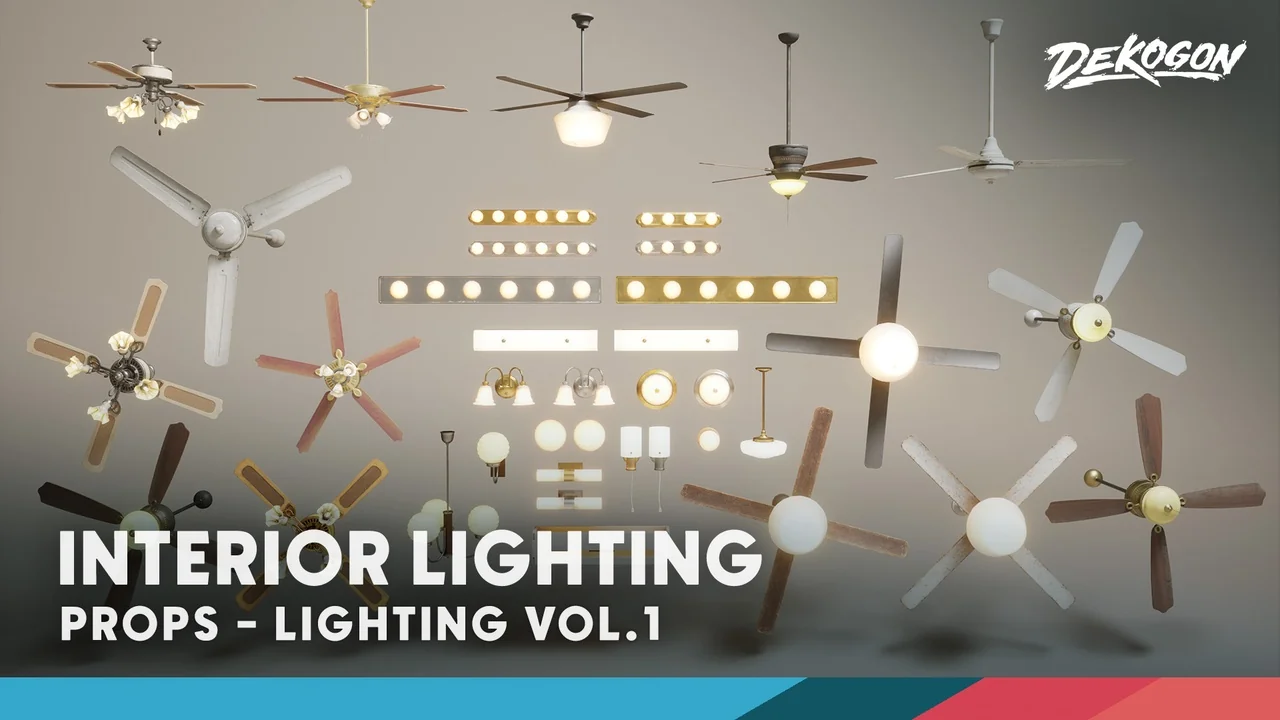
 Lighting
 Plants
 Tools
Tools