"0283a5a6392d9fd6"{"id":"1000006","slug":"foliage-vol-24-farming-plants-low-poly","title":"Foliage VOL.24 - Farming Plants (Low Poly)","category":"Trees","engine":"5.1+","assetVersion":"","engineVersion":"5.1+","tag":"Trees","accent":"blue","visual":"mech","summary":"A collection of 54 optimized farming plant meshes featuring 4K textures, Nanite geometry, Lumen support, and a master material setup for Unreal Engine 5.0+.","platform":"Unreal Engine","publishedAt":"2026-05-19T16:47:59.873Z","updatedAt":"2026-05-19T16:47:59.873Z","sourceNotes":[],"fileContents":[],"compatibility":["Unreal Engine","Engine version: 5.1+"],"featuredImage":{"alt":"Foliage VOL.24 - Farming Plants (Low Poly)","src":"/wp-content/uploads/published/2026/05/3b7fd447288f-8c01c0ae-718e-494f-9a1e-7a7d7b92b157-c5d9fedc75.webp"},"hasDownloadLink":true,"downloads":0,"terms":[{"taxonomy":"category","slug":"trees","name":"Trees"}],"galleryImages":[{"src":"/wp-content/uploads/published/2026/05/6a31c8d4677b-3134ab0a-9049-445d-a8cc-90df373c92ef-54bd79f473.webp","alt":"Foliage VOL.24 - Farming Plants (Low Poly)"},{"src":"/wp-content/uploads/published/2026/05/cbe4ec2e590b-f952f88e-98b7-4c78-a1ce-a41668144bda-f7dd5ea874.webp","alt":"Foliage VOL.24 - Farming Plants (Low Poly)"},{"src":"/wp-content/uploads/published/2026/05/051674d09788-92c5178d-2c83-42ae-90de-5a801f587b64-65b206c499.webp","alt":"Foliage VOL.24 - Farming Plants (Low Poly)"},{"src":"/wp-content/uploads/published/2026/05/873ad1de4090-d6812e2a-2f23-4758-ae9b-fc8693df0623-226b591041.webp","alt":"Foliage VOL.24 - Farming Plants (Low Poly)"},{"src":"/wp-content/uploads/published/2026/05/084722eb24ac-c9b2affa-6006-44a6-baf3-832a3ce9902f-3de9a62dfe.webp","alt":"Foliage VOL.24 - Farming Plants (Low Poly)"},{"src":"/wp-content/uploads/published/2026/05/0c352df4f4fd-87dc1957-388a-4164-88f6-5525ed11f428-7305686179.webp","alt":"Foliage VOL.24 - Farming Plants (Low Poly)"},{"src":"/wp-content/uploads/published/2026/05/5550da53a390-d9a797ef-71f9-4f2c-91ea-ca37633d5b1a-601c5eac59.webp","alt":"Foliage VOL.24 - Farming Plants (Low Poly)"},{"src":"/wp-content/uploads/published/2026/05/af94e04d16b3-0339caec-49a1-4c23-a367-70eab65c674d-2e67532fe3.webp","alt":"Foliage VOL.24 - Farming Plants (Low Poly)"},{"src":"/wp-content/uploads/published/2026/05/da067727803b-12c818f4-8597-47fc-962e-47b630dfe057-7d24745ad2.webp","alt":"Foliage VOL.24 - Farming Plants (Low Poly)"},{"src":"/wp-content/uploads/published/2026/05/24361e8b8aa3-af34f2b6-5e45-4dbd-b6bd-936f585daef0-fe7712977f.webp","alt":"Foliage VOL.24 - Farming Plants (Low Poly)"}],"accessPanel":{"kind":"resource","title":"Access this resource","eyebrow":"Free Download","message":"Log in or create a free account to start your download.","fileName":"Content.7z","safetyNote":"Resources are manually reviewed before listing to improve quality and reduce obvious risks.","actionLabel":"Download Free","resourceType":"Resource archive"},"contentHtml":"\u003ch2\u003ePopulating Realistic Agricultural Scenes\u003c/h2\u003e\n\u003cp\u003eCreating convincing agricultural environments often presents a significant optimization challenge, especially when populating vast fields or detailed greenhouse setups. Balancing realistic visuals with performance budgets requires assets that maintain high fidelity without overwhelming the rendering pipeline. Foliage VOL.24 - Farming Plants (Low Poly) provides a structural foundation for these environments, supplying developers with a collection of 54 specific meshes tailored for cultivation and harvest scenes.\u003c/p\u003e\n\u003cp\u003eThe collection encompasses a variety of agricultural staples, including general farming plants, trees, herbs, lettuce, and tomatoes. By providing fully detailed models from all sides, the geometry ensures that visual fidelity remains intact regardless of the camera angle. In scenarios where players crouch to inspect produce or navigate through dense crop rows, the multi-sided detailing prevents the immersion-breaking thinness often associated with standard optimized foliage planes. Every vegetable, plant, and piece of produce is designed to meet AAA quality visuals while adhering to strict performance budgets.\u003c/p\u003e\n\u003ch2\u003eIntegrating 4K Textures and Master Materials\u003c/h2\u003e\n\u003cp\u003eManaging the visual properties of dozens of different plant species across a large field requires a centralized approach to shading. To facilitate rapid iteration, the collection utilizes a comprehensive master material setup that controls the majority of all included props and models. This unified shading architecture allows environment artists to make global adjustments to the entire crop yield simultaneously, rather than tweaking individual plant instances.\u003c/p\u003e\n\u003cp\u003eThe material system is driven by high-quality, high-fidelity 4K texture sets. To minimize memory overhead and streamline the rendering process, the textures utilize a channel-packed workflow. Roughness, Metalness, and Ambient Occlusion data are consolidated into a single texture map, significantly reducing the number of texture calls required during runtime. Within the master material, developers have access to additional parameter controls to fine-tune roughness, albedo, and normals. This granular control makes it easy to adjust the localized wetness of a lettuce leaf, the specific color value of a ripening tomato, or the ambient occlusion depth of clustered herbs to match specific environmental conditions.\u003c/p\u003e\n\u003ch2\u003eNanite Geometry and Lumen in UE 5.0+\u003c/h2\u003e\n\u003cp\u003eWhile the assets are built upon an optimized, low-poly foundation, they are engineered specifically to leverage the advanced rendering capabilities of Unreal Engine 5.0 and beyond. The projects utilize Nanite-based geometry meshes and models, allowing the engine to dynamically scale the level of detail across massive farm fields without the traditional pop-in associated with standard LOD transitions.\u003c/p\u003e\n\u003cp\u003eThis implementation of Nanite geometry is paired directly with full support for Lumen. As Lumen calculates real-time global illumination, the fully detailed geometry of the farming plants interacts accurately with bounce lighting. Light scattering through the canopy of a tomato plant or reflecting off the broad leaves of a lettuce crop behaves predictably, grounding the foliage within the scene's dynamic lighting environment. The combination of Nanite and Lumen ensures that the low-poly base structures still deliver complex, realistic shadowing and illumination across dense agricultural simulations.\u003c/p\u003e\n\u003ch2\u003eRealistic Post Process and Custom Branding\u003c/h2\u003e\n\u003cp\u003eAchieving a cohesive visual style often requires tuning the final image output after the geometry and lighting are established. To assist in unifying the scene's aesthetic, the collection includes a realistic Post Process setup and a dedicated Look Up Table (LUT). These integrated post-processing tools help map the colors and contrast of the 4K albedo textures into a photorealistic color space, ensuring the greens of the herbs and the reds of the produce render naturally under the engine's lighting conditions.\u003c/p\u003e\n\u003cp\u003eBeyond the technical rendering setup, the collection addresses a common logistical hurdle in commercial game development: legal clearance. Modern agricultural environments often require crates, seed packets, or produce labels to feel authentic, but using real-world trademarks introduces significant legal risk. To ensure the package is completely free of all legal issues, every piece of branding and every label included in the project has been custom-made. Studios can deploy these assets directly into commercial projects without needing to audit the textures for accidental real-world copyright infringement.\u003c/p\u003e\n\u003ch2\u003eDeploying Assets in Survival and Simulation Projects\u003c/h2\u003e\n\u003cp\u003eThe specific combination of optimized geometry, 4K texture fidelity, and interactive detailing makes these assets highly applicable to mechanics-driven genres. Survival games, where players frequently interact with individual plants to gather food, require foliage that holds up to extreme close-up inspection. Similarly, dedicated farm simulation titles demand large-scale fields of produce that can be rendered efficiently without sacrificing the realistic appearance of the crops.\u003c/p\u003e\n\u003cp\u003eBy organizing the 54 meshes around a centralized master material and channel-packed textures, the collection provides a highly scalable solution. The integration of UE 5.0+ technologies like Nanite and Lumen allows technical artists to populate dense, realistic fields of tomatoes, lettuce, and herbs while maintaining the strict optimization standards required for complex simulation environments.\u003c/p\u003e\n\n\u003ch2\u003eRelated Resources Worth Checking\u003c/h2\u003e\n\u003cul\u003e\n\u003cli\u003e\u003ca href=\"https://3dcghub.com/foliage-vol-13-southern-oak-trees-nanite-and-low-poly/\" title=\"Foliage VOL.13 - Southern Oak Trees (Nanite and Low Poly)\"\u003eFoliage VOL.13 - Southern Oak Trees (Nanite and Low Poly)\u003c/a\u003e\u003c/li\u003e\n\u003cli\u003e\u003ca href=\"https://3dcghub.com/foliage-vol-6-broom-bushes-nanite-and-low-poly/\" title=\"Foliage VOL.6 - Broom Bushes (Nanite and Low Poly)\"\u003eFoliage VOL.6 - Broom Bushes (Nanite and Low Poly)\u003c/a\u003e\u003c/li\u003e\n\u003cli\u003e\u003ca href=\"https://3dcghub.com/foliage-vol-21-cypress-trees-low-poly/\" title=\"Foliage VOL.21 - Cypress Trees ( Low Poly)\"\u003eFoliage VOL.21 - Cypress Trees ( Low Poly)\u003c/a\u003e\u003c/li\u003e\n\u003cli\u003e\u003ca href=\"https://3dcghub.com/foliage-vol-9-coyote-bushes-nanite-and-low-poly/\" title=\"Foliage VOL.9 - Coyote Bushes (Nanite and Low Poly)\"\u003eFoliage VOL.9 - Coyote Bushes (Nanite and Low Poly)\u003c/a\u003e\u003c/li\u003e\n\u003cli\u003e\u003ca href=\"https://3dcghub.com/foliage-vol-2-pines-nanite-and-low-poly/\" title=\"Foliage VOL.2 - Pines (Nanite and Low Poly)\"\u003eFoliage VOL.2 - Pines (Nanite and Low Poly)\u003c/a\u003e\u003c/li\u003e\n\u003c/ul\u003e","contentTextLength":5841,"navigation":{"current":1482,"total":3354,"previous":{"id":"1000007","slug":"foliage-vol-32-dead-forest-nanite","title":"Foliage VOL.32 - Dead Forest (Nanite)","category":"Forest","platform":"Unreal Engine","updatedAt":"2026-05-19T16:59:40.123Z"},"next":{"id":"1000005","slug":"foliage-vol-21-cypress-trees-low-poly","title":"Foliage VOL.21 - Cypress Trees ( Low Poly)","category":"Trees","platform":"Unreal Engine","updatedAt":"2026-05-19T16:43:40.681Z"}},"relatedResources":[{"id":"1000829","slug":"foliage-vol-19-scraggly-bushes-nanite-and-low-poly","title":"Foliage VOL.19 - Scraggly Bushes (Nanite and Low Poly)","category":"Trees","engine":"5.1+","assetVersion":"","engineVersion":"Engine Version: 5.1+","tag":"Trees","accent":"blue","visual":"mech","summary":"A foliage pack of 20 scraggly bush meshes built for Unreal Engine 5.0+, featuring Nanite and low poly variants, 4k textures, Lumen support, and master material","platform":"Unreal Engine","publishedAt":"2026-08-03T12:04:08.713Z","updatedAt":"2026-08-03T12:04:08.713Z","sourceNotes":[],"fileContents":[],"compatibility":["Unreal Engine","Engine Version: 5.1+"],"featuredImage":{"alt":"Foliage VOL.19 - Scraggly Bushes (Nanite and Low Poly)","src":"/wp-content/uploads/published/2026/08/4b3cc7f7b16f-c9417b0e-a1e6-4c4c-b734-092e1fe4283a-e6bdcf0441.webp"},"hasDownloadLink":true,"downloads":0},{"id":"1000609","slug":"foliage-vol-37-tree-stumps-nanite-low-poly","title":"Foliage VOL.37- Tree Stumps (NANITE + LOW POLY)","category":"Trees","engine":"5.3+","assetVersion":"","engineVersion":"Engine Version: 5.3+","tag":"Trees","accent":"blue","visual":"mech","summary":"Unreal Engine tree stump foliage pack with 20 Nanite and low poly meshes, 4K textures, master material controls, channel-packed maps, and Lumen support.","platform":"Unreal Engine","publishedAt":"2026-07-20T19:45:12.049Z","updatedAt":"2026-07-20T19:45:12.049Z","sourceNotes":[],"fileContents":[],"compatibility":["Unreal Engine","Engine Version: 5.3+"],"featuredImage":{"alt":"Foliage VOL.37- Tree Stumps (NANITE + LOW POLY)","src":"/wp-content/uploads/published/2026/07/eb55bb3c1eab-f8ea7966-29a2-41b9-9c11-23bf42af068d-995cff7b57.webp"},"hasDownloadLink":true,"downloads":0},{"id":"1000510","slug":"foliage-vol-11-bushes-nanite-and-low-poly","title":"Foliage VOL.11 - Bushes (Nanite and Low Poly)","category":"Trees","engine":"5.1+","assetVersion":"","engineVersion":"Engine Version: 5.1+","tag":"Trees","accent":"blue","visual":"mech","summary":"Unreal Engine 5.1–5.7 foliage pack by Dekogon Studios featuring 10 Nanite and 10 low poly bush meshes with 4K PBR textures, Lumen support, and master material c","platform":"Unreal Engine","publishedAt":"2026-07-13T13:27:29.344Z","updatedAt":"2026-07-13T13:27:29.344Z","sourceNotes":[],"fileContents":[],"compatibility":["Unreal Engine","Engine Version: 5.1+"],"featuredImage":{"alt":"Foliage VOL.11 - Bushes (Nanite and Low Poly)","src":"/wp-content/uploads/published/2026/07/4d90cddf8dd5-4ffb6a90-6638-45c7-b9eb-3ec7e7ffc26f-b177be19c7.webp"},"hasDownloadLink":true,"downloads":0}]}
Trees
Foliage VOL.24 - Farming Plants (Low Poly)
A collection of 54 optimized farming plant meshes featuring 4K textures, Nanite geometry, Lumen support, and a master material setup for Unreal Engine 5.0+.
Category:Unreal Engine,TreesPlatform: Unreal EngineEngine version: 5.1+Published: May 19, 2026
Trees
Resource overview
Populating Realistic Agricultural Scenes
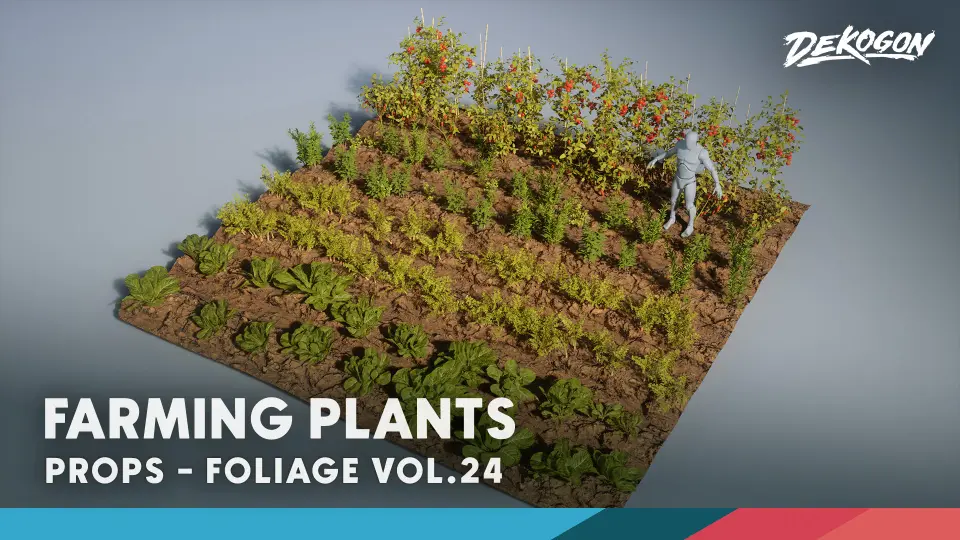
Creating convincing agricultural environments often presents a significant optimization challenge, especially when populating vast fields or detailed greenhouse setups. Balancing realistic visuals with performance budgets requires assets that maintain high fidelity without overwhelming the rendering pipeline. Foliage VOL.24 - Farming Plants (Low Poly) provides a structural foundation for these environments, supplying developers with a collection of 54 specific meshes tailored for cultivation and harvest scenes.
The collection encompasses a variety of agricultural staples, including general farming plants, trees, herbs, lettuce, and tomatoes. By providing fully detailed models from all sides, the geometry ensures that visual fidelity remains intact regardless of the camera angle. In scenarios where players crouch to inspect produce or navigate through dense crop rows, the multi-sided detailing prevents the immersion-breaking thinness often associated with standard optimized foliage planes. Every vegetable, plant, and piece of produce is designed to meet AAA quality visuals while adhering to strict performance budgets.
Integrating 4K Textures and Master Materials
Managing the visual properties of dozens of different plant species across a large field requires a centralized approach to shading. To facilitate rapid iteration, the collection utilizes a comprehensive master material setup that controls the majority of all included props and models. This unified shading architecture allows environment artists to make global adjustments to the entire crop yield simultaneously, rather than tweaking individual plant instances.
The material system is driven by high-quality, high-fidelity 4K texture sets. To minimize memory overhead and streamline the rendering process, the textures utilize a channel-packed workflow. Roughness, Metalness, and Ambient Occlusion data are consolidated into a single texture map, significantly reducing the number of texture calls required during runtime. Within the master material, developers have access to additional parameter controls to fine-tune roughness, albedo, and normals. This granular control makes it easy to adjust the localized wetness of a lettuce leaf, the specific color value of a ripening tomato, or the ambient occlusion depth of clustered herbs to match specific environmental conditions.
Nanite Geometry and Lumen in UE 5.0+
While the assets are built upon an optimized, low-poly foundation, they are engineered specifically to leverage the advanced rendering capabilities of Unreal Engine 5.0 and beyond. The projects utilize Nanite-based geometry meshes and models, allowing the engine to dynamically scale the level of detail across massive farm fields without the traditional pop-in associated with standard LOD transitions.
This implementation of Nanite geometry is paired directly with full support for Lumen. As Lumen calculates real-time global illumination, the fully detailed geometry of the farming plants interacts accurately with bounce lighting. Light scattering through the canopy of a tomato plant or reflecting off the broad leaves of a lettuce crop behaves predictably, grounding the foliage within the scene's dynamic lighting environment. The combination of Nanite and Lumen ensures that the low-poly base structures still deliver complex, realistic shadowing and illumination across dense agricultural simulations.
Realistic Post Process and Custom Branding
Achieving a cohesive visual style often requires tuning the final image output after the geometry and lighting are established. To assist in unifying the scene's aesthetic, the collection includes a realistic Post Process setup and a dedicated Look Up Table (LUT). These integrated post-processing tools help map the colors and contrast of the 4K albedo textures into a photorealistic color space, ensuring the greens of the herbs and the reds of the produce render naturally under the engine's lighting conditions.
Beyond the technical rendering setup, the collection addresses a common logistical hurdle in commercial game development: legal clearance. Modern agricultural environments often require crates, seed packets, or produce labels to feel authentic, but using real-world trademarks introduces significant legal risk. To ensure the package is completely free of all legal issues, every piece of branding and every label included in the project has been custom-made. Studios can deploy these assets directly into commercial projects without needing to audit the textures for accidental real-world copyright infringement.
Deploying Assets in Survival and Simulation Projects
The specific combination of optimized geometry, 4K texture fidelity, and interactive detailing makes these assets highly applicable to mechanics-driven genres. Survival games, where players frequently interact with individual plants to gather food, require foliage that holds up to extreme close-up inspection. Similarly, dedicated farm simulation titles demand large-scale fields of produce that can be rendered efficiently without sacrificing the realistic appearance of the crops.
By organizing the 54 meshes around a centralized master material and channel-packed textures, the collection provides a highly scalable solution. The integration of UE 5.0+ technologies like Nanite and Lumen allows technical artists to populate dense, realistic fields of tomatoes, lettuce, and herbs while maintaining the strict optimization standards required for complex simulation environments.
 Trees
Trees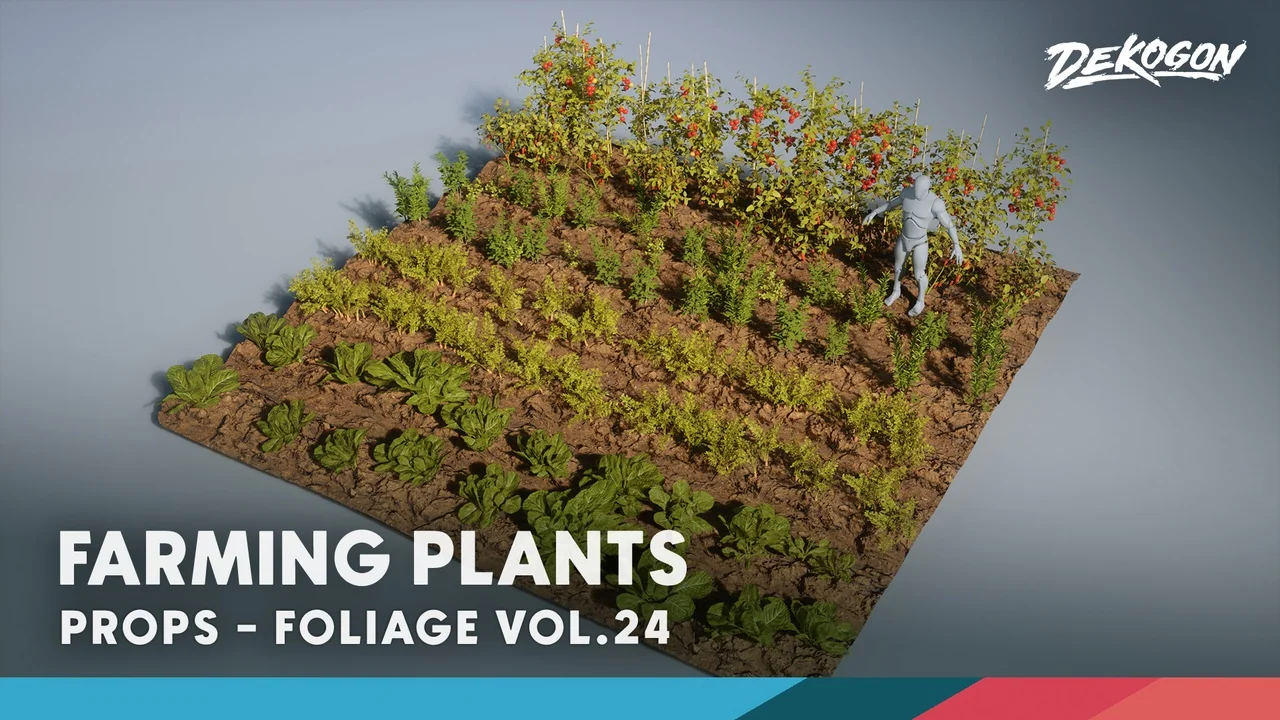
 Trees
Trees Trees
Trees Trees
Trees