"0283a5a6392d9fd6"{"id":"1000029","slug":"suburbs-vol-2-couches-and-sofas-nanite-and-low-poly","title":"Suburbs VOL.2 - Couches and Sofas (Nanite and Low Poly)","category":"Seating","engine":"5.1+","assetVersion":"","engineVersion":"5.1+","tag":"Seating","accent":"blue","visual":"mech","summary":"A close look at an Unreal Engine furniture set with 48 couch and sofa meshes, Nanite and low poly variants, 4K textures, Lumen support, and tintable materials.","platform":"Unreal Engine","publishedAt":"2026-05-20T17:18:05.305Z","updatedAt":"2026-05-20T17:18:05.305Z","sourceNotes":[],"fileContents":[],"compatibility":["Unreal Engine","Engine version: 5.1+"],"featuredImage":{"alt":"Suburbs VOL.2 - Couches and Sofas (Nanite and Low Poly)","src":"/wp-content/uploads/published/2026/05/de34d98c9e00-eb65d217-73ce-4f69-8b5d-dde42d2c8dba-a8f14b442b.webp"},"hasDownloadLink":true,"downloads":2,"terms":[{"taxonomy":"category","slug":"seating","name":"Seating"}],"galleryImages":[{"src":"/wp-content/uploads/published/2026/05/c2dcf6434651-ffc706cc-2355-40eb-a68c-7a5e4940d51f-d639ed2b1f.webp","alt":"Suburbs VOL.2 - Couches and Sofas (Nanite and Low Poly)"},{"src":"/wp-content/uploads/published/2026/05/9559140a95ff-2940cd1a-b107-456b-9977-077354d64420-6bc56db868.webp","alt":"Suburbs VOL.2 - Couches and Sofas (Nanite and Low Poly)"},{"src":"/wp-content/uploads/published/2026/05/e13c918f5d3c-14d98959-5d8e-4ebf-88e6-519b29ddf9d6-837c247ab0.webp","alt":"Suburbs VOL.2 - Couches and Sofas (Nanite and Low Poly)"},{"src":"/wp-content/uploads/published/2026/05/29d87ec71d22-a5a0243a-7221-402b-b9dd-b4dc14b6cb51-a358303431.webp","alt":"Suburbs VOL.2 - Couches and Sofas (Nanite and Low Poly)"},{"src":"/wp-content/uploads/published/2026/05/473413b5413a-bb1d471d-51ae-49c1-b0b2-056a8d566455-f2e9c80f9b.webp","alt":"Suburbs VOL.2 - Couches and Sofas (Nanite and Low Poly)"},{"src":"/wp-content/uploads/published/2026/05/2b86942aa874-665ed0ae-7af4-4c52-92e7-b4d13f2f4a09-2b1bc2b8a3.webp","alt":"Suburbs VOL.2 - Couches and Sofas (Nanite and Low Poly)"},{"src":"/wp-content/uploads/published/2026/05/e060e1f57330-741cf652-14f4-4dfe-8516-de721b48d6e2-99d72c75f5.webp","alt":"Suburbs VOL.2 - Couches and Sofas (Nanite and Low Poly)"},{"src":"/wp-content/uploads/published/2026/05/7e8c9981efeb-bda7e840-0bb6-4219-82b1-58f568dcfb97-6c56c360e8.webp","alt":"Suburbs VOL.2 - Couches and Sofas (Nanite and Low Poly)"},{"src":"/wp-content/uploads/published/2026/05/510d361e929f-e8f36462-27b4-464b-a1b1-08bdd7739218-f338d27e3a.webp","alt":"Suburbs VOL.2 - Couches and Sofas (Nanite and Low Poly)"},{"src":"/wp-content/uploads/published/2026/05/cf25cef32226-488f8745-0290-4cf0-a0b6-bca99d697b03-9701720b14.webp","alt":"Suburbs VOL.2 - Couches and Sofas (Nanite and Low Poly)"}],"accessPanel":{"kind":"resource","title":"Access this resource","eyebrow":"Free Download","message":"Log in or create a free account to start your download.","fileName":"Content.7z","safetyNote":"Resources are manually reviewed before listing to improve quality and reduce obvious risks.","actionLabel":"Download Free","resourceType":"Resource archive"},"contentHtml":"\u003cp\u003eInterior scene work often stalls at a familiar point: the room layout is in place, but the furniture still needs to carry both visual weight and production practicality. \u003cstrong\u003eSuburbs VOL.2 - Couches and Sofas (Nanite and Low Poly)\u003c/strong\u003e Addresses that part of the pipeline with a focused seating collection for Unreal Engine, covering the assets, maps, and materials needed to place couch and sofa pieces into a scene without building that layer from scratch.\u003c/p\u003e\u003cp\u003eThe set includes everything pictured, and all assets, maps, and materials were created in Unreal Engine. Its stated target is realistic AAA quality in visuals, style, and budget, which gives the pack a clear role inside environment production: believable residential or lived-in spaces where seating is not just background filler, but a major visual anchor within the room.\u003c/p\u003e\u003ch2\u003eSetting up Suburbs VOL.2 in an Unreal interior workflow\u003c/h2\u003e\u003cp\u003eThis collection is focused on furniture, decor, and home-oriented seating, making it a direct fit for living room and house scenes. The included tags point toward interiors and domestic environments, with sofas, armchairs, recliners, chairs, and decor forming the visual territory around the set.\u003c/p\u003e\u003cp\u003eWhat matters during setup is that the pack does not stop at raw models. It includes maps and materials, and a master material setup controls the majority of the props and models. That kind of shared material structure changes how the pack slots into production. Instead of treating every piece as an isolated object with separate shader logic, much of the scene can be adjusted through a broader material system. For teams or solo artists dressing multiple rooms, that helps keep the seating assets visually coherent while still allowing changes where needed.\u003c/p\u003e\u003cp\u003eThe assets are also described as fully detailed from all sides. For production work, that makes them easier to place in open room layouts where a camera may move around the furniture rather than only framing it from a single hero angle. A couch placed in the center of a room, near a hallway transition, or opposite a window wall benefits from that full-sided treatment because it does not rely on hidden faces being ignored.\u003c/p\u003e\u003ch2\u003eNanite and low poly versions for the same couch-and-sofa scenes\u003c/h2\u003e\u003cp\u003eThe defining production choice here is the inclusion of both Nanite and low poly versions of each mesh. The project contains 48 meshes, split between Nanite and low poly versions of each mesh, and that gives the collection a dual-use structure rather than forcing one geometric approach across every scene.\u003c/p\u003e\u003cp\u003eNanite construction is used for high-fidelity polycounts, which places the set comfortably in scenes that prioritize close-up visual quality. A couch with visible contour, shape, and form benefits from that kind of density, especially in interior work where seating often sits near the camera and occupies a large part of the frame. At the same time, low poly versions are included as well, giving the same collection a more flexible role in game-oriented production. That matters when an environment needs to balance visual quality with broader optimization needs, or when different spaces in the same project call for different mesh strategies.\u003c/p\u003e\u003cp\u003eBecause both versions are present, the pack can support several kinds of scene planning without changing style families. A detailed hero corner of a room can lean on the Nanite side, while a larger playable space with more repeated furniture placement can pull from the low poly counterparts. The stated optimization for games fits naturally with that split. It is not framed as a purely cinematic furniture library, nor as a stripped-down placeholder set. The collection sits in the practical middle ground where fidelity and production constraints both matter.\u003c/p\u003e\u003ch2\u003e4K textures, channel packing, and material controls\u003c/h2\u003e\u003cp\u003eTexture quality is a major part of how upholstered furniture reads on screen, and this set includes high-quality, high-fidelity texture sets in 4K. For couches and sofas, that affects more than surface sharpness. It influences how seams, fabric variation, wear direction, and broader material definition hold up under interior lighting and camera proximity.\u003c/p\u003e\u003cp\u003eThe material side goes beyond basic assignment. Additional controls are included for roughness, albedo, normals, and more, with many assets being tintable through the material instance. That opens up a useful level of variation without moving away from the shared structure of the pack. In a practical scene-building workflow, tintable assets let artists shift the character of a room while staying inside the same furniture family. A more muted or more saturated seating tone can be dialed in through material instances instead of requiring separate bespoke assets.\u003c/p\u003e\u003cp\u003eThe textures also use channel-packed Roughness, Metalness, and Ambient Occlusion. That detail points to an organized technical setup rather than a loose collection of standalone maps. It is relevant during implementation because seating rarely exists alone; it interacts with flooring, wall color, nearby lighting, and other decor. Having roughness and occlusion behave consistently across the collection helps couches and sofas sit naturally inside those broader room relationships.\u003c/p\u003e\u003cp\u003eThe master material setup then ties these controls together. Since it handles the majority of the props and models, the material system becomes one of the pack’s main workflow advantages. Instead of spending setup time rebuilding standard material behavior for each item, artists can focus on scene look and adjustment inside an existing framework.\u003c/p\u003e\u003ch2\u003eLumen support and the included post-process look\u003c/h2\u003e\u003cp\u003eLighting makes or breaks interior furniture presentation, especially for large upholstered forms that depend on soft highlight response and believable shading. This product supports Lumen for Unreal Engine 5.0+, placing it squarely within modern real-time interior rendering workflows.\u003c/p\u003e\u003cp\u003eLumen support is particularly relevant for seating because sofas and couches often occupy the spaces where bounced light is most visible: near walls, windows, rugs, tables, and lamps. The set also includes a realistic post process and Look Up Table, which means the visual presentation is not limited to model and texture fidelity alone. There is attention to the rendered mood and final image treatment as part of the package. In practice, that can help maintain a more unified interior look when blocking out a room and evaluating whether the furniture is reading as intended under the scene’s lighting conditions.\u003c/p\u003e\u003cp\u003eThis does not turn the collection into a complete environment by itself, but it does provide more of the visual foundation than a bare mesh pack would. A couch or recliner is rarely judged in isolation. It is judged by how it absorbs, reflects, and responds to the room around it. Support for Lumen and the presence of a realistic post-process setup make that response part of the asset’s usable context.\u003c/p\u003e\u003ch2\u003eWhere the couches and sofas fit creatively\u003c/h2\u003e\u003cp\u003eThe tag set gives a clear picture of the kinds of scenes this collection can support: furniture, decor, house, home, living room, interior, sofa, seat, armchair, recliner, and even horror. That range is useful not because it suggests radically different asset categories, but because it shows how the same seating library can move between calm residential spaces and more tense or dramatic interior staging.\u003c/p\u003e\u003cp\u003eA suburban living room can use the pack as a central furnishing layer, with couches and sofas acting as the largest soft-surface elements in the frame. An abandoned or unsettling domestic scene can draw on the same furniture forms while changing tint, lighting, and scene dressing around them. Since many assets are tintable through material instances, the pack allows some movement in mood without departing from the core models. The presence of custom-made branding and labels also means the assets avoid legal issues tied to recognizable real-world markings, which is useful when furniture is placed prominently in a playable or cinematic space.\u003c/p\u003e\u003cp\u003eThe collection’s focus on realistic AAA-quality visuals, combined with optimization for games, gives it a practical place in production. It is not trying to cover every type of furniture or every room object. It works best as a targeted seating layer for interior environments where the sofas, couches, and related home pieces need to read clearly, hold up from multiple angles, and remain flexible across Nanite and low poly usage.\u003c/p\u003e\u003cp\u003eFor environment work that needs residential seating with a ready-made Unreal material framework, 4K texture support, and both high-fidelity and lighter mesh paths, this set fits most naturally at the stage where a room stops being a shell and starts looking inhabited.\u003c/p\u003e\n\n\u003ch2\u003eContinue Browsing Similar Packs\u003c/h2\u003e\n\u003cul\u003e\n\u003cli\u003e\u003ca href=\"https://3dcghub.com/foliage-vol-13-southern-oak-trees-nanite-and-low-poly/\" title=\"Foliage VOL.13 - Southern Oak Trees (Nanite and Low Poly)\"\u003eFoliage VOL.13 - Southern Oak Trees (Nanite and Low Poly)\u003c/a\u003e\u003c/li\u003e\n\u003cli\u003e\u003ca href=\"https://3dcghub.com/foliage-vol-6-broom-bushes-nanite-and-low-poly/\" title=\"Foliage VOL.6 - Broom Bushes (Nanite and Low Poly)\"\u003eFoliage VOL.6 - Broom Bushes (Nanite and Low Poly)\u003c/a\u003e\u003c/li\u003e\n\u003cli\u003e\u003ca href=\"https://3dcghub.com/signage-vol-2-town-and-city-nanite-and-low-poly/\" title=\"Signage VOL.2 - Town and City (Nanite and Low Poly)\"\u003eSignage VOL.2 - Town and City (Nanite and Low Poly)\u003c/a\u003e\u003c/li\u003e\n\u003cli\u003e\u003ca href=\"https://3dcghub.com/signage-vol-1-town-and-city-nanite-and-low-poly/\" title=\"Signage VOL.1 - Town and City (Nanite and Low Poly)\"\u003eSignage VOL.1 - Town and City (Nanite and Low Poly)\u003c/a\u003e\u003c/li\u003e\n\u003cli\u003e\u003ca href=\"https://3dcghub.com/foliage-vol-24-farming-plants-low-poly/\" title=\"Foliage VOL.24 - Farming Plants (Low Poly)\"\u003eFoliage VOL.24 - Farming Plants (Low Poly)\u003c/a\u003e\u003c/li\u003e\n\u003c/ul\u003e","contentTextLength":8999,"navigation":{"current":1463,"total":3354,"previous":{"id":"1000030","slug":"suburbs-vol-3-retro-furniture-nanite-and-low-poly","title":"Suburbs VOL.3 - Retro Furniture (Nanite and Low Poly)","category":"Tables","platform":"Unreal Engine","updatedAt":"2026-05-21T08:29:38.749Z"},"next":{"id":"1000028","slug":"stylized-castle-ruins","title":"Stylized Castle Ruins","category":"Mountain","platform":"Unreal Engine","updatedAt":"2026-05-20T15:17:40.049Z"}},"relatedResources":[{"id":"1000489","slug":"suburbs-vol-19-retro-office-nanite-and-low-poly","title":"Suburbs VOL.19 - Retro Office (Nanite and Low Poly)","category":"Seating","engine":"5.1+","assetVersion":"","engineVersion":"Engine Version: 5.1+","tag":"Seating","accent":"blue","visual":"mech","summary":"Retro office environment asset pack for Unreal Engine with 350 Nanite and low poly meshes, 4K textures, master material controls, and Lumen support.","platform":"Unreal Engine","publishedAt":"2026-07-13T02:42:02.972Z","updatedAt":"2026-07-13T02:42:02.972Z","sourceNotes":[],"fileContents":[],"compatibility":["Unreal Engine","Engine Version: 5.1+"],"featuredImage":{"alt":"Suburbs VOL.19 - Retro Office (Nanite and Low Poly)","src":"/wp-content/uploads/published/2026/07/6894ddc8fa53-d0ea6e33-981c-4569-af3f-dbffd1f2e28e-f495b0f805.webp"},"hasDownloadLink":true,"downloads":0},{"id":"1000203","slug":"seaside-docks-vol-2-boats-nanite-low-poly","title":"Seaside Docks VOL.2 - Boats (Nanite + Low Poly)","category":"Boats","engine":"5.0+","assetVersion":"","engineVersion":"Engine Version: 5.0+","tag":"Boats","accent":"blue","visual":"mech","summary":"A high-fidelity collection of 27 nautical meshes featuring both Nanite and low poly geometry, 4K channel-packed textures, and UE5 Lumen support.","platform":"Unreal Engine","publishedAt":"2026-06-23T19:20:38.557Z","updatedAt":"2026-10-03T14:08:37.868Z","sourceNotes":[],"fileContents":[],"compatibility":["Unreal Engine","Engine Version: 5.0+"],"featuredImage":{"alt":"Seaside Docks VOL.2 - Boats (Nanite + Low Poly)","src":"/wp-content/uploads/published/2026/06/d684f0e4f9c1-22285801-a327-4f53-9831-d2f8c0ca6177-e06f28898e.webp"},"hasDownloadLink":true,"downloads":0},{"id":"1001066","slug":"roadside-vol-1-blockades-nanite-and-low-poly-versions-2","title":"Roadside VOL.1 - Blockades (Nanite and Low Poly Versions)","category":"Rocks \u0026 Stones","engine":"5.1+","assetVersion":"","engineVersion":"Engine Version: 5.1+","tag":"Rocks \u0026 Stones","accent":"blue","visual":"mech","summary":"32 roadside blockades in nanite and low poly builds, 4k textures, master materials, tintable paint, and Lumen support for UE5.","platform":"Unreal Engine","publishedAt":"2026-09-03T16:20:18.807Z","updatedAt":"2026-09-03T16:20:18.807Z","sourceNotes":[],"fileContents":[],"compatibility":["Unreal Engine","Engine Version: 5.1+"],"featuredImage":{"alt":"Roadside VOL.1 - Blockades (Nanite and Low Poly Versions)","src":"/wp-content/uploads/published/2026/09/7e32db5224fe-4e57f163-4d06-4444-ac91-032f3e20b6ac-0c5421b26d.webp"},"hasDownloadLink":true,"downloads":1}]}
Seating
Suburbs VOL.2 - Couches and Sofas (Nanite and Low Poly)
A close look at an Unreal Engine furniture set with 48 couch and sofa meshes, Nanite and low poly variants, 4K textures, Lumen support, and tintable materials.
Category:Unreal Engine,SeatingPlatform: Unreal EngineEngine version: 5.1+Published: May 20, 2026
Seating
Resource overview
Interior scene work often stalls at a familiar point: the room layout is in place, but the furniture still needs to carry both visual weight and production practicality. Suburbs VOL.2 - Couches and Sofas (Nanite and Low Poly) Addresses that part of the pipeline with a focused seating collection for Unreal Engine, covering the assets, maps, and materials needed to place couch and sofa pieces into a scene without building that layer from scratch.
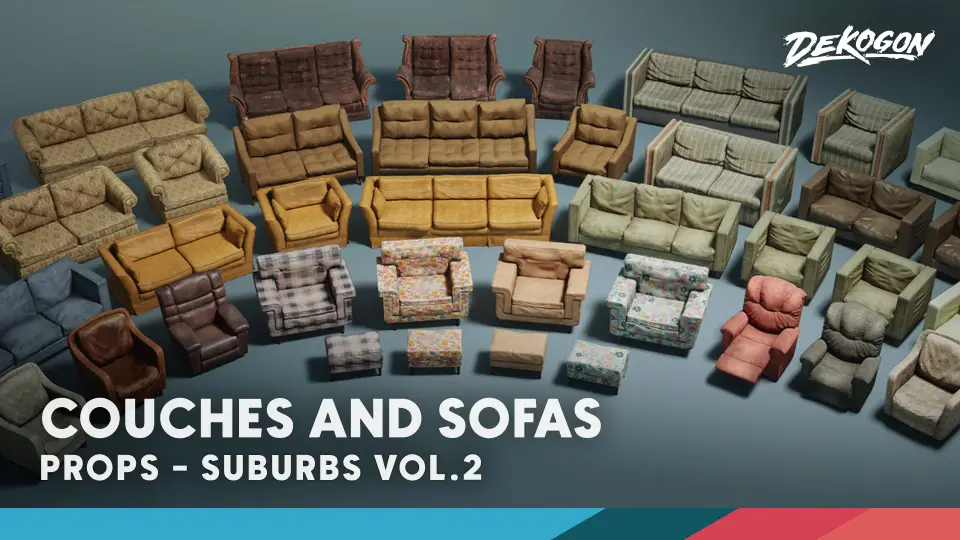
The set includes everything pictured, and all assets, maps, and materials were created in Unreal Engine. Its stated target is realistic AAA quality in visuals, style, and budget, which gives the pack a clear role inside environment production: believable residential or lived-in spaces where seating is not just background filler, but a major visual anchor within the room.
Setting up Suburbs VOL.2 in an Unreal interior workflow
This collection is focused on furniture, decor, and home-oriented seating, making it a direct fit for living room and house scenes. The included tags point toward interiors and domestic environments, with sofas, armchairs, recliners, chairs, and decor forming the visual territory around the set.
What matters during setup is that the pack does not stop at raw models. It includes maps and materials, and a master material setup controls the majority of the props and models. That kind of shared material structure changes how the pack slots into production. Instead of treating every piece as an isolated object with separate shader logic, much of the scene can be adjusted through a broader material system. For teams or solo artists dressing multiple rooms, that helps keep the seating assets visually coherent while still allowing changes where needed.
The assets are also described as fully detailed from all sides. For production work, that makes them easier to place in open room layouts where a camera may move around the furniture rather than only framing it from a single hero angle. A couch placed in the center of a room, near a hallway transition, or opposite a window wall benefits from that full-sided treatment because it does not rely on hidden faces being ignored.
Nanite and low poly versions for the same couch-and-sofa scenes
The defining production choice here is the inclusion of both Nanite and low poly versions of each mesh. The project contains 48 meshes, split between Nanite and low poly versions of each mesh, and that gives the collection a dual-use structure rather than forcing one geometric approach across every scene.
Nanite construction is used for high-fidelity polycounts, which places the set comfortably in scenes that prioritize close-up visual quality. A couch with visible contour, shape, and form benefits from that kind of density, especially in interior work where seating often sits near the camera and occupies a large part of the frame. At the same time, low poly versions are included as well, giving the same collection a more flexible role in game-oriented production. That matters when an environment needs to balance visual quality with broader optimization needs, or when different spaces in the same project call for different mesh strategies.
Because both versions are present, the pack can support several kinds of scene planning without changing style families. A detailed hero corner of a room can lean on the Nanite side, while a larger playable space with more repeated furniture placement can pull from the low poly counterparts. The stated optimization for games fits naturally with that split. It is not framed as a purely cinematic furniture library, nor as a stripped-down placeholder set. The collection sits in the practical middle ground where fidelity and production constraints both matter.
4K textures, channel packing, and material controls
Texture quality is a major part of how upholstered furniture reads on screen, and this set includes high-quality, high-fidelity texture sets in 4K. For couches and sofas, that affects more than surface sharpness. It influences how seams, fabric variation, wear direction, and broader material definition hold up under interior lighting and camera proximity.
The material side goes beyond basic assignment. Additional controls are included for roughness, albedo, normals, and more, with many assets being tintable through the material instance. That opens up a useful level of variation without moving away from the shared structure of the pack. In a practical scene-building workflow, tintable assets let artists shift the character of a room while staying inside the same furniture family. A more muted or more saturated seating tone can be dialed in through material instances instead of requiring separate bespoke assets.
The textures also use channel-packed Roughness, Metalness, and Ambient Occlusion. That detail points to an organized technical setup rather than a loose collection of standalone maps. It is relevant during implementation because seating rarely exists alone; it interacts with flooring, wall color, nearby lighting, and other decor. Having roughness and occlusion behave consistently across the collection helps couches and sofas sit naturally inside those broader room relationships.
The master material setup then ties these controls together. Since it handles the majority of the props and models, the material system becomes one of the pack’s main workflow advantages. Instead of spending setup time rebuilding standard material behavior for each item, artists can focus on scene look and adjustment inside an existing framework.
Lumen support and the included post-process look
Lighting makes or breaks interior furniture presentation, especially for large upholstered forms that depend on soft highlight response and believable shading. This product supports Lumen for Unreal Engine 5.0+, placing it squarely within modern real-time interior rendering workflows.
Lumen support is particularly relevant for seating because sofas and couches often occupy the spaces where bounced light is most visible: near walls, windows, rugs, tables, and lamps. The set also includes a realistic post process and Look Up Table, which means the visual presentation is not limited to model and texture fidelity alone. There is attention to the rendered mood and final image treatment as part of the package. In practice, that can help maintain a more unified interior look when blocking out a room and evaluating whether the furniture is reading as intended under the scene’s lighting conditions.
This does not turn the collection into a complete environment by itself, but it does provide more of the visual foundation than a bare mesh pack would. A couch or recliner is rarely judged in isolation. It is judged by how it absorbs, reflects, and responds to the room around it. Support for Lumen and the presence of a realistic post-process setup make that response part of the asset’s usable context.
Where the couches and sofas fit creatively
The tag set gives a clear picture of the kinds of scenes this collection can support: furniture, decor, house, home, living room, interior, sofa, seat, armchair, recliner, and even horror. That range is useful not because it suggests radically different asset categories, but because it shows how the same seating library can move between calm residential spaces and more tense or dramatic interior staging.
A suburban living room can use the pack as a central furnishing layer, with couches and sofas acting as the largest soft-surface elements in the frame. An abandoned or unsettling domestic scene can draw on the same furniture forms while changing tint, lighting, and scene dressing around them. Since many assets are tintable through material instances, the pack allows some movement in mood without departing from the core models. The presence of custom-made branding and labels also means the assets avoid legal issues tied to recognizable real-world markings, which is useful when furniture is placed prominently in a playable or cinematic space.
The collection’s focus on realistic AAA-quality visuals, combined with optimization for games, gives it a practical place in production. It is not trying to cover every type of furniture or every room object. It works best as a targeted seating layer for interior environments where the sofas, couches, and related home pieces need to read clearly, hold up from multiple angles, and remain flexible across Nanite and low poly usage.
For environment work that needs residential seating with a ready-made Unreal material framework, 4K texture support, and both high-fidelity and lighter mesh paths, this set fits most naturally at the stage where a room stops being a shell and starts looking inhabited.
 Seating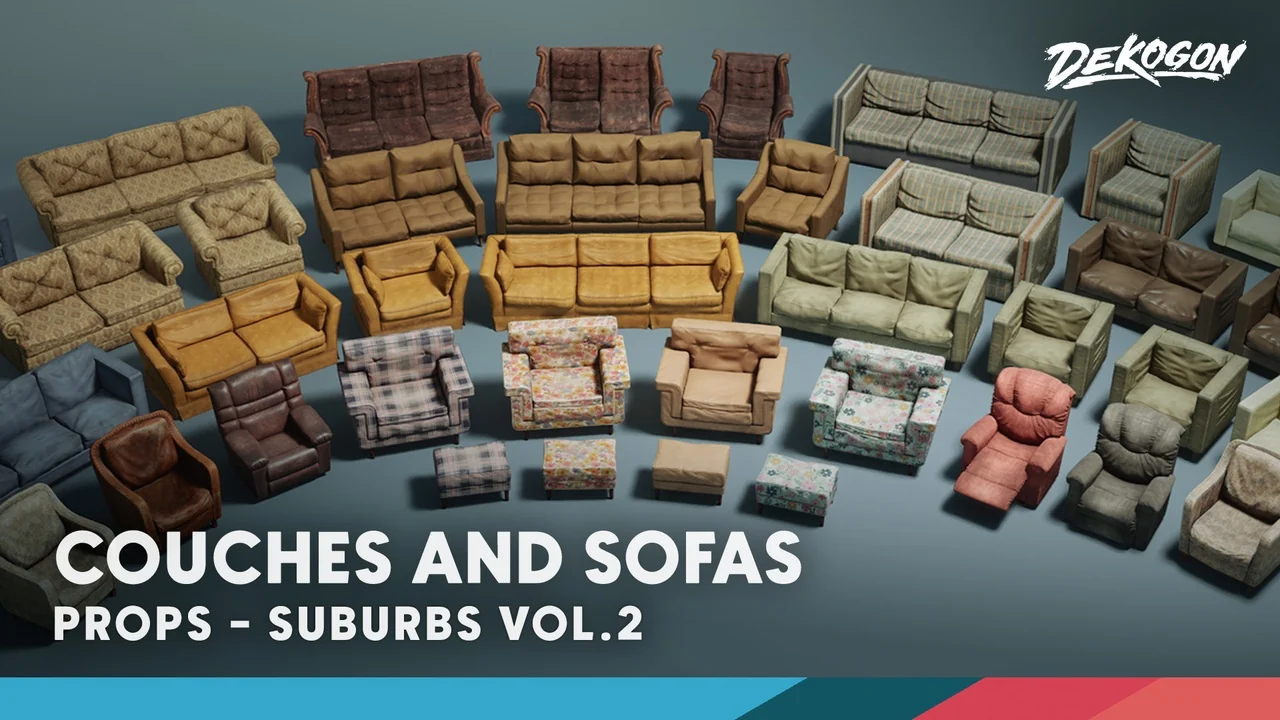
 Seating
 Boats
Boats Rocks & Stones