"6989f03aa91a233c"{"id":"1000024","slug":"signage-vol-2-town-and-city-nanite-and-low-poly","title":"Signage VOL.2 - Town and City (Nanite and Low Poly)","category":"Cities","engine":"5.1+","assetVersion":"","engineVersion":"5.1+","tag":"Cities","accent":"blue","visual":"city","summary":"A city signage collection for Unreal Engine with 230 meshes, Nanite and low poly versions, 4K textures, tint controls, and Lumen support.","platform":"Unreal Engine","publishedAt":"2026-05-20T12:08:20.801Z","updatedAt":"2026-05-20T12:08:20.801Z","sourceNotes":[],"fileContents":[],"compatibility":["Unreal Engine","Engine version: 5.1+"],"featuredImage":{"alt":"Signage VOL.2 - Town and City (Nanite and Low Poly)","src":"/wp-content/uploads/published/2026/05/5dae48205fe5-4cfef502-1be5-4a89-bab8-b50cc0a5fc66-d5fee08561.webp"},"hasDownloadLink":true,"downloads":0,"terms":[{"taxonomy":"category","slug":"cities","name":"Cities"}],"galleryImages":[{"src":"/wp-content/uploads/published/2026/05/a40c84dbd755-ecb98f9a-98ca-44a1-8266-04cc50b25775-221e0e7cd9.webp","alt":"Signage VOL.2 - Town and City (Nanite and Low Poly)"},{"src":"/wp-content/uploads/published/2026/05/07eb3092d727-b5feaf44-c84a-436b-8351-bee51340ee72-c956d56ed7.webp","alt":"Signage VOL.2 - Town and City (Nanite and Low Poly)"},{"src":"/wp-content/uploads/published/2026/05/a4c5f5bcf5a3-e31cbf90-52ff-45d4-9e01-42686cb6e5d2-b9e3058872.webp","alt":"Signage VOL.2 - Town and City (Nanite and Low Poly)"},{"src":"/wp-content/uploads/published/2026/05/b775ee14c8b7-2dfb8f72-2ff3-41fc-897f-54e92bc4f345-1749f651de.webp","alt":"Signage VOL.2 - Town and City (Nanite and Low Poly)"},{"src":"/wp-content/uploads/published/2026/05/554ba19fe3c8-436ab0a7-62cc-4c4e-a8d2-b1b0a03d65b1-a4126e6749.webp","alt":"Signage VOL.2 - Town and City (Nanite and Low Poly)"},{"src":"/wp-content/uploads/published/2026/05/7568fbd06de4-efe9bd7a-e913-4133-baec-6667a217dc5b-dd88965356.webp","alt":"Signage VOL.2 - Town and City (Nanite and Low Poly)"},{"src":"/wp-content/uploads/published/2026/05/1ce7f550ce30-49394f8a-682c-48af-806d-fade024d72d2-b0d6ff2c00.webp","alt":"Signage VOL.2 - Town and City (Nanite and Low Poly)"},{"src":"/wp-content/uploads/published/2026/05/d4b1882d3205-293ac9b4-a059-4da0-aa71-5c39e3b99597-d27a862ae5.webp","alt":"Signage VOL.2 - Town and City (Nanite and Low Poly)"},{"src":"/wp-content/uploads/published/2026/05/c306f356b95c-134d6ba1-846c-4f15-96ab-fb0fdbae8d44-243ad111c9.webp","alt":"Signage VOL.2 - Town and City (Nanite and Low Poly)"},{"src":"/wp-content/uploads/published/2026/05/a8d01f3e9065-98abb78d-95f1-4044-9be1-18dbc1129e70-ebcaba974c.webp","alt":"Signage VOL.2 - Town and City (Nanite and Low Poly)"}],"accessPanel":{"kind":"resource","title":"Access this resource","eyebrow":"Free Download","message":"Log in or create a free account to start your download.","fileName":"Content.7z","safetyNote":"Resources are manually reviewed before listing to improve quality and reduce obvious risks.","actionLabel":"Download Free","resourceType":"Resource archive"},"contentHtml":"\u003cp\u003eGetting this set into a scene starts with a complete Unreal Engine project package that includes the pictured assets, maps, and materials. That immediately shapes how it can be used in production: instead of treating the collection as a loose folder of props, artists can approach it as a ready environment component with matching materials and a consistent visual target. The work aims at realistic AAA-quality visuals, style, and budget, so the signage is positioned to sit naturally in urban streets, roadside setups, business exteriors, and denser town layouts where signs do more than fill space.\u003c/p\u003e \u003cp\u003eThe identity of the pack is clear from its subject matter. This is signage for town and city scenes, with tags pointing toward gas, street, post, sign, poster, business, display, flag, motel, metalworking, realistic, and even apocalyptic uses. That range makes the set useful for more than one type of location dressing. A clean commercial district can use business signs and display elements. A worn roadside block can lean on motel and gas station cues. A harsher or abandoned setting can reuse the same visual language in a more distressed context, especially when signage becomes part of navigation, storytelling, or environmental repetition along streets and storefronts.\u003c/p\u003e \u003ch2\u003eSetting up Signage VOL.2 - Town and City in a scene\u003c/h2\u003e\n\u003cp\u003eThe project includes 230 meshes, split between Nanite and low poly versions of each mesh, with additional variant meshes also included. That mesh count matters less as a raw number and more as a practical sign of coverage. A town or city scene usually needs repetition without obvious cloning, and variant meshes help break up the look while staying within the same visual family. Since both Nanite and low poly versions are part of the package, the same signage language can be carried across scenes with different performance targets or rendering priorities.\u003c/p\u003e \u003cp\u003eThat dual-path setup gives environment teams a straightforward way to decide how each area should be assembled. A hero street, close camera pass, or highly detailed corner can use the Nanite versions for higher-fidelity polycounts. A broader gameplay space or more budget-conscious pass can switch to the low poly versions while preserving the same asset lineup. Because both versions exist for each mesh, the pack supports consistency across different parts of a project instead of forcing a separate art direction for high-end and lighter scenes.\u003c/p\u003e \u003cp\u003eThe fully detailed models also help these signs carry more of the scene on their own. In production, signage often serves as a bridge between architecture and storytelling. A sign on a post, a business front marker, a hanging display, or a poster-style element can define an area’s purpose quickly. This collection is well suited to that role because the details are not limited to flat placeholders; the set is presented as a complete visual package with models, maps, and materials all authored inside Unreal Engine.\u003c/p\u003e \u003ch2\u003eNanite and low poly versions for different production targets\u003c/h2\u003e\n\u003cp\u003eThe most important technical distinction in the collection is the inclusion of both Nanite and low poly meshes. The Nanite side is there for high-quality fidelity polycounts, while the low poly side gives a lighter alternative using the same core assets. For artists, that means the pack is not locked to one rendering strategy. It can serve high-detail presentation work and game-focused scene building at the same time.\u003c/p\u003e \u003cp\u003eThis is especially useful for signage because signs sit at many different distances from the player or camera. Some are seen up close, filling the frame and needing stronger geometric fidelity. Others sit in the background as repeating city texture. Having both mesh approaches available makes it easier to choose where visual density should be spent. The collection is also described as optimized for games, which fits this flexible use: dense visual dressing can stay grounded in practical runtime concerns.\u003c/p\u003e \u003cp\u003eSupport for Lumen in Unreal Engine 5.0+ strengthens that production angle. Urban signage often depends on how materials respond to lighting, especially in scenes filled with storefront surfaces, roadside metal, weathered posts, and layered street clutter. Lumen support means the pack is prepared for modern Unreal Engine lighting workflows where signs need to sit convincingly in dynamic environments instead of reading like detached set dressing.\u003c/p\u003e \u003ch2\u003eMaterial controls that keep city signs flexible\u003c/h2\u003e\n\u003cp\u003eThe material side of the pack is structured through a master material setup that controls the majority of props and models. In practice, that makes the collection easier to manage once it is spread across a larger environment. Instead of every sign behaving like an isolated object with unrelated shading logic, most of the set can be handled through a more unified material workflow. That is useful both for initial scene assembly and for later revisions when a project needs broader visual adjustments across many props.\u003c/p\u003e \u003cp\u003eAdditional controls are included for roughness, albedo, normals, and more. Those controls matter because signage lives at the intersection of graphic design and physical surface response. Roughness can push a sign toward a cleaner painted finish or a more worn industrial feel. Albedo adjustments can help signs sit within a particular district palette. Normal control affects how surface detail reads under scene lighting. Even without inventing extra functions, these named controls already point to a workflow where the assets can be tuned rather than simply dropped in unchanged.\u003c/p\u003e \u003cp\u003eMost assets that have color are tintable, which expands the creative range further. A set like this can support multiple districts or visual themes without losing cohesion. A business-lined street can take one color direction, a gas station corner another, and a harsher roadside strip a third. Tintability is also helpful when repeated signage appears in one map and needs variation to avoid the cloned look that often weakens urban dressing.\u003c/p\u003e \u003cp\u003eThe texture pipeline supports that material flexibility with high-quality 4K texture sets. Channel-packed roughness, metalness, and ambient occlusion are also included, giving the set a production-ready material structure for Unreal Engine work. This combination suggests a pack that is meant to hold up visually while remaining practical to manage inside the engine.\u003c/p\u003e \u003ch2\u003eTown and City signage that helps scenes read instantly\u003c/h2\u003e\n\u003cp\u003eThe town-and-city theme is broad enough to cover several types of environments while staying visually specific. Gas, street, post, sign, poster, business, display, and flag point to a pack that can populate both civic and commercial spaces. Metal and metalworking suggest a harder industrial edge within that same family. Motel adds a roadside identity. Apocalyptic opens the door to more distressed scene dressing without changing asset category. Those tags do not turn the set into separate themed packs; they show how one signage library can support very different readings depending on placement and context.\u003c/p\u003e \u003cp\u003eIn a game environment, that is useful because signage often carries wayfinding and world-building at the same time. Street signs and posts can shape navigation. Business displays and posters can establish local identity. Flags and branded elements can add rhythm to facades and streetscapes. Roadside signs around gas or motel spaces can quickly communicate the type of neighborhood the player has entered. Since the branding and labels are custom made by the studio, the collection stays clear of legal issues while still preserving the role that branded visual language usually plays in urban environments.\u003c/p\u003e \u003cp\u003eThat custom branding is not a small detail. It means signs can contribute to believable city dressing without introducing conflicts around recognizable real-world marks. For teams building commercial, cinematic, or portfolio scenes, that kind of clearance supports smoother use of the assets in finished work.\u003c/p\u003e \u003ch2\u003eProduction-readiness in Unreal Engine\u003c/h2\u003e\n\u003cp\u003eSeveral details combine to make the set feel ready for active environment work rather than only static display. The project includes all assets, maps, and materials inside Unreal Engine. The meshes are available in both Nanite and low poly forms. The models are fully detailed. The texture sets are high quality and 4K. The material system centralizes control across most props and models, while still exposing roughness, albedo, normal, and related adjustments. Many colored assets can be tinted. The textures use channel-packed roughness, metalness, and ambient occlusion. A realistic post process and look up table are also included.\u003c/p\u003e \u003cp\u003eThat last point is especially relevant for teams trying to get from assembly to presentation quickly. Signage does not operate in isolation; it depends on how the whole scene is graded and lit. Including a realistic post process and look up table supports a more complete visual result, particularly when signs are expected to read as part of a believable street environment instead of as disconnected props.\u003c/p\u003e \u003cp\u003eFor practical use, the collection fits projects that need a strong urban signage layer with room for both close-up fidelity and game-minded optimization. It supports modern Unreal Engine rendering through Lumen for Unreal Engine 5.0+, provides a broad set of town and city sign types, and gives artists enough material control to adapt the set across multiple neighborhoods or visual tones while keeping the same core asset base.\u003c/p\u003e\n\n\u003ch2\u003eMore From The Same Workflow\u003c/h2\u003e\n\u003cul\u003e\n\u003cli\u003e\u003ca href=\"https://3dcghub.com/a-futuristic-city-lake-town/\" title=\"A Futuristic City - LAKE TOWN\"\u003eA Futuristic City - LAKE TOWN\u003c/a\u003e\u003c/li\u003e\n\u003cli\u003e\u003ca href=\"https://3dcghub.com/stylized-solarpunk-city-stylized-solar-city-solarpunk-city-solar-3d-stylised/\" title=\"Stylized Solarpunk City ( Stylized Solar City Solarpunk City Solar 3D Stylised )\"\u003eStylized Solarpunk City ( Stylized Solar City Solarpunk City Solar 3D Stylised )\u003c/a\u003e\u003c/li\u003e\n\u003cli\u003e\u003ca href=\"https://3dcghub.com/post-apocalyptic-city/\" title=\"Post Apocalyptic City\"\u003ePost Apocalyptic City\u003c/a\u003e\u003c/li\u003e\n\u003cli\u003e\u003ca href=\"https://3dcghub.com/the-projects-modular-city-pack-nanite/\" title=\"The Projects - Modular City Pack - Nanite\"\u003eThe Projects - Modular City Pack - Nanite\u003c/a\u003e\u003c/li\u003e\n\u003cli\u003e\u003ca href=\"https://3dcghub.com/cyberpunk-buildings-pack/\" title=\"Cyberpunk Buildings Pack\"\u003eCyberpunk Buildings Pack\u003c/a\u003e\u003c/li\u003e\n\u003c/ul\u003e","contentTextLength":9698,"navigation":{"current":1467,"total":3353,"previous":{"id":"1000025","slug":"signage-vol-4-small-town","title":"Signage VOL.4 - Small Town","category":"Buildings \u0026 Architecture","platform":"Unreal Engine","updatedAt":"2026-05-20T13:23:30.361Z"},"next":{"id":"1000023","slug":"signage-vol-1-town-and-city-nanite-and-low-poly","title":"Signage VOL.1 - Town and City (Nanite and Low Poly)","category":"Tools, Objects \u0026 Decor","platform":"Unreal Engine","updatedAt":"2026-05-20T10:04:31.664Z"}},"relatedResources":[{"id":"1000485","slug":"suburbs-vol-13-roof-antennas-nanite-and-low-poly","title":"Suburbs VOL.13 - Roof Antennas (Nanite and Low Poly)","category":"Cities","engine":"5.1+","assetVersion":"","engineVersion":"Engine Version: 5.1+","tag":"Cities","accent":"blue","visual":"mech","summary":"Roof Antennas asset pack featuring 52 Nanite and low poly meshes, 4K textures, channel-packed maps, and Lumen support for Unreal Engine 5.1–5.8.","platform":"Unreal Engine","publishedAt":"2026-07-12T06:42:31.146Z","updatedAt":"2026-07-12T06:42:31.146Z","sourceNotes":[],"fileContents":[],"compatibility":["Unreal Engine","Engine Version: 5.1+"],"featuredImage":{"alt":"Suburbs VOL.13 - Roof Antennas (Nanite and Low Poly)","src":"/wp-content/uploads/published/2026/07/c46d93fa27de-4d02617a-5b0b-49e8-a072-88429d966f84-360ab59254.webp"},"hasDownloadLink":true,"downloads":0},{"id":"7001","slug":"a-futuristic-city-lake-town","title":"A Futuristic City - LAKE TOWN","category":"Cities","engine":"5.3+","assetVersion":"Engine version: 5.3+","engineVersion":"5.1","tag":"Cities","accent":"blue","visual":"city","summary":"Transform your project with A Futuristic City - LAKE TOWN, a comprehensive urban environment featuring realistic PBR textures and animated structures.","platform":"Unreal Engine","publishedAt":"2026-02-20T16:35:07.000Z","updatedAt":"2026-04-19T15:56:04.000Z","sourceNotes":[],"fileContents":[],"compatibility":["Unreal Engine","Engine version: 5.3+"],"featuredImage":{"alt":"A Futuristic City - LAKE TOWN","src":"https://3dcghub.com/wp-content/uploads/2026/02/17422937-7f0e-4494-991b-e97abafc44b2.webp"},"hasDownloadLink":true,"downloads":1},{"id":"1000384","slug":"modular-seaside-town","title":"Modular Seaside Town","category":"Cities","engine":"4.26+,5.0+","assetVersion":"","engineVersion":"Engine Version: 4.26+,5.0+","tag":"Cities","accent":"blue","visual":"mech","summary":"A collection of stylized, modular brick and wood structures featuring customizable shaders, vertex paintable weathering, and translucent water surfaces.","platform":"Unreal Engine","publishedAt":"2026-07-07T08:43:02.678Z","updatedAt":"2026-07-07T08:43:02.678Z","sourceNotes":[],"fileContents":[],"compatibility":["Unreal Engine","Engine Version: 4.26+,5.0+"],"featuredImage":{"alt":"Modular Seaside Town","src":"/wp-content/uploads/published/2026/07/ed61494c2ca9-32de6340-6873-44a1-87fe-144005c12c63-97f014c81f.webp"},"hasDownloadLink":true,"downloads":0}]}
Cities
Signage VOL.2 - Town and City (Nanite and Low Poly)
A city signage collection for Unreal Engine with 230 meshes, Nanite and low poly versions, 4K textures, tint controls, and Lumen support.
Category:Unreal Engine,CitiesPlatform: Unreal EngineEngine version: 5.1+Published: May 20, 2026
Cities
Resource overview
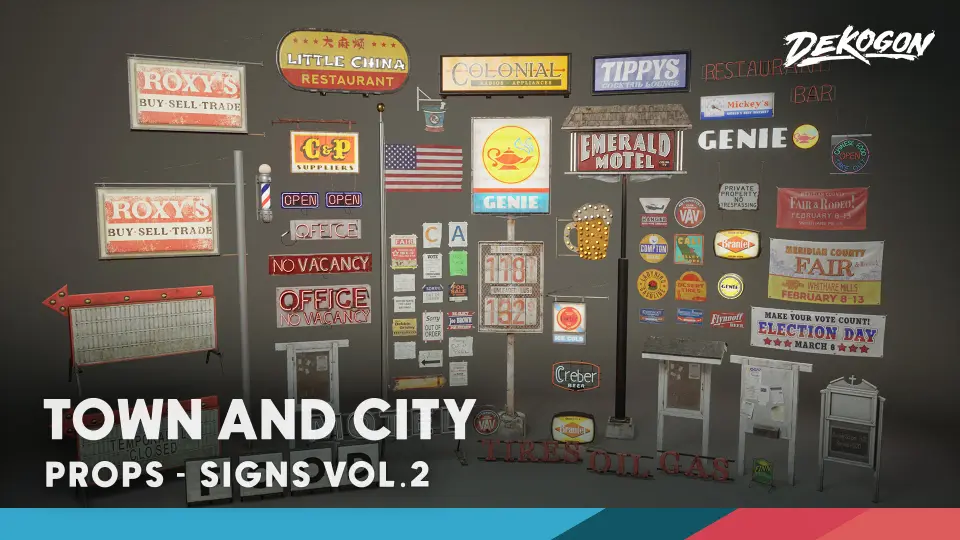
Getting this set into a scene starts with a complete Unreal Engine project package that includes the pictured assets, maps, and materials. That immediately shapes how it can be used in production: instead of treating the collection as a loose folder of props, artists can approach it as a ready environment component with matching materials and a consistent visual target. The work aims at realistic AAA-quality visuals, style, and budget, so the signage is positioned to sit naturally in urban streets, roadside setups, business exteriors, and denser town layouts where signs do more than fill space.
The identity of the pack is clear from its subject matter. This is signage for town and city scenes, with tags pointing toward gas, street, post, sign, poster, business, display, flag, motel, metalworking, realistic, and even apocalyptic uses. That range makes the set useful for more than one type of location dressing. A clean commercial district can use business signs and display elements. A worn roadside block can lean on motel and gas station cues. A harsher or abandoned setting can reuse the same visual language in a more distressed context, especially when signage becomes part of navigation, storytelling, or environmental repetition along streets and storefronts.
Setting up Signage VOL.2 - Town and City in a scene
The project includes 230 meshes, split between Nanite and low poly versions of each mesh, with additional variant meshes also included. That mesh count matters less as a raw number and more as a practical sign of coverage. A town or city scene usually needs repetition without obvious cloning, and variant meshes help break up the look while staying within the same visual family. Since both Nanite and low poly versions are part of the package, the same signage language can be carried across scenes with different performance targets or rendering priorities.
That dual-path setup gives environment teams a straightforward way to decide how each area should be assembled. A hero street, close camera pass, or highly detailed corner can use the Nanite versions for higher-fidelity polycounts. A broader gameplay space or more budget-conscious pass can switch to the low poly versions while preserving the same asset lineup. Because both versions exist for each mesh, the pack supports consistency across different parts of a project instead of forcing a separate art direction for high-end and lighter scenes.
The fully detailed models also help these signs carry more of the scene on their own. In production, signage often serves as a bridge between architecture and storytelling. A sign on a post, a business front marker, a hanging display, or a poster-style element can define an area’s purpose quickly. This collection is well suited to that role because the details are not limited to flat placeholders; the set is presented as a complete visual package with models, maps, and materials all authored inside Unreal Engine.
Nanite and low poly versions for different production targets
The most important technical distinction in the collection is the inclusion of both Nanite and low poly meshes. The Nanite side is there for high-quality fidelity polycounts, while the low poly side gives a lighter alternative using the same core assets. For artists, that means the pack is not locked to one rendering strategy. It can serve high-detail presentation work and game-focused scene building at the same time.
This is especially useful for signage because signs sit at many different distances from the player or camera. Some are seen up close, filling the frame and needing stronger geometric fidelity. Others sit in the background as repeating city texture. Having both mesh approaches available makes it easier to choose where visual density should be spent. The collection is also described as optimized for games, which fits this flexible use: dense visual dressing can stay grounded in practical runtime concerns.
Support for Lumen in Unreal Engine 5.0+ strengthens that production angle. Urban signage often depends on how materials respond to lighting, especially in scenes filled with storefront surfaces, roadside metal, weathered posts, and layered street clutter. Lumen support means the pack is prepared for modern Unreal Engine lighting workflows where signs need to sit convincingly in dynamic environments instead of reading like detached set dressing.
Material controls that keep city signs flexible
The material side of the pack is structured through a master material setup that controls the majority of props and models. In practice, that makes the collection easier to manage once it is spread across a larger environment. Instead of every sign behaving like an isolated object with unrelated shading logic, most of the set can be handled through a more unified material workflow. That is useful both for initial scene assembly and for later revisions when a project needs broader visual adjustments across many props.
Additional controls are included for roughness, albedo, normals, and more. Those controls matter because signage lives at the intersection of graphic design and physical surface response. Roughness can push a sign toward a cleaner painted finish or a more worn industrial feel. Albedo adjustments can help signs sit within a particular district palette. Normal control affects how surface detail reads under scene lighting. Even without inventing extra functions, these named controls already point to a workflow where the assets can be tuned rather than simply dropped in unchanged.
Most assets that have color are tintable, which expands the creative range further. A set like this can support multiple districts or visual themes without losing cohesion. A business-lined street can take one color direction, a gas station corner another, and a harsher roadside strip a third. Tintability is also helpful when repeated signage appears in one map and needs variation to avoid the cloned look that often weakens urban dressing.
The texture pipeline supports that material flexibility with high-quality 4K texture sets. Channel-packed roughness, metalness, and ambient occlusion are also included, giving the set a production-ready material structure for Unreal Engine work. This combination suggests a pack that is meant to hold up visually while remaining practical to manage inside the engine.
Town and City signage that helps scenes read instantly
The town-and-city theme is broad enough to cover several types of environments while staying visually specific. Gas, street, post, sign, poster, business, display, and flag point to a pack that can populate both civic and commercial spaces. Metal and metalworking suggest a harder industrial edge within that same family. Motel adds a roadside identity. Apocalyptic opens the door to more distressed scene dressing without changing asset category. Those tags do not turn the set into separate themed packs; they show how one signage library can support very different readings depending on placement and context.
In a game environment, that is useful because signage often carries wayfinding and world-building at the same time. Street signs and posts can shape navigation. Business displays and posters can establish local identity. Flags and branded elements can add rhythm to facades and streetscapes. Roadside signs around gas or motel spaces can quickly communicate the type of neighborhood the player has entered. Since the branding and labels are custom made by the studio, the collection stays clear of legal issues while still preserving the role that branded visual language usually plays in urban environments.
That custom branding is not a small detail. It means signs can contribute to believable city dressing without introducing conflicts around recognizable real-world marks. For teams building commercial, cinematic, or portfolio scenes, that kind of clearance supports smoother use of the assets in finished work.
Production-readiness in Unreal Engine
Several details combine to make the set feel ready for active environment work rather than only static display. The project includes all assets, maps, and materials inside Unreal Engine. The meshes are available in both Nanite and low poly forms. The models are fully detailed. The texture sets are high quality and 4K. The material system centralizes control across most props and models, while still exposing roughness, albedo, normal, and related adjustments. Many colored assets can be tinted. The textures use channel-packed roughness, metalness, and ambient occlusion. A realistic post process and look up table are also included.
That last point is especially relevant for teams trying to get from assembly to presentation quickly. Signage does not operate in isolation; it depends on how the whole scene is graded and lit. Including a realistic post process and look up table supports a more complete visual result, particularly when signs are expected to read as part of a believable street environment instead of as disconnected props.
For practical use, the collection fits projects that need a strong urban signage layer with room for both close-up fidelity and game-minded optimization. It supports modern Unreal Engine rendering through Lumen for Unreal Engine 5.0+, provides a broad set of town and city sign types, and gives artists enough material control to adapt the set across multiple neighborhoods or visual tones while keeping the same core asset base.
 Cities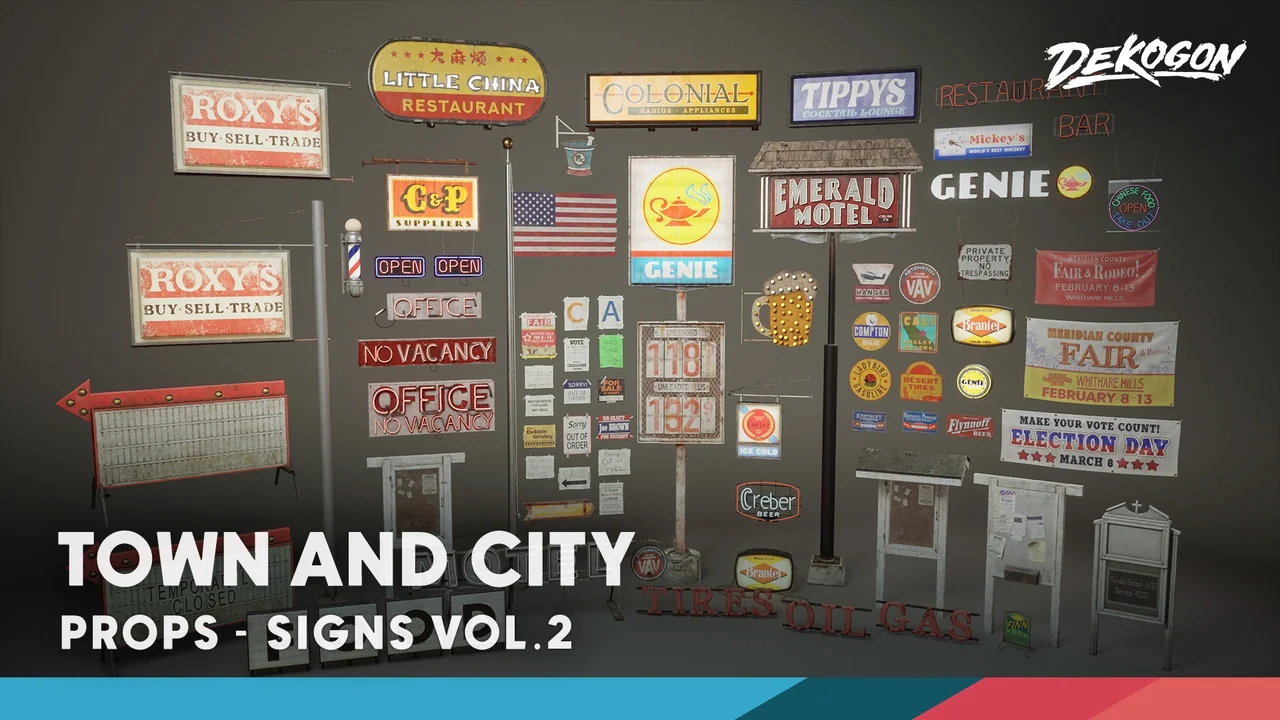
 Cities
 Cities
 Cities