"6989f03aa91a233c"{"id":"1000025","slug":"signage-vol-4-small-town","title":"Signage VOL.4 - Small Town","category":"Buildings \u0026 Architecture","engine":"5.1+","assetVersion":"","engineVersion":"5.1+","tag":"Buildings","accent":"blue","visual":"mech","summary":"A small-town signage collection for Unreal Engine with 416 meshes, 4K textures, Nanite and low poly versions, master materials, and Lumen support.","platform":"Unreal Engine","publishedAt":"2026-05-20T13:23:30.361Z","updatedAt":"2026-05-20T13:23:30.361Z","sourceNotes":[],"fileContents":[],"compatibility":["Unreal Engine","Engine version: 5.1+"],"featuredImage":{"alt":"Signage VOL.4 - Small Town","src":"/wp-content/uploads/published/2026/05/06d30df1da7b-994ddd19-8eac-4094-a2c8-3b1bc01234cb-7bf0bec89d.webp"},"hasDownloadLink":true,"downloads":0,"terms":[{"taxonomy":"category","slug":"buildings-and-architecture","name":"Buildings \u0026 Architecture"}],"galleryImages":[{"src":"/wp-content/uploads/published/2026/05/fd80fd94daa3-c8197b4f-dc6b-43d4-87d3-c9aeba0b8cf5-468deb2ea3.webp","alt":"Signage VOL.4 - Small Town"},{"src":"/wp-content/uploads/published/2026/05/8be563783663-dd6c4cc7-2fa6-4079-a5fd-650ae2794108-72ee6fb854.webp","alt":"Signage VOL.4 - Small Town"},{"src":"/wp-content/uploads/published/2026/05/f6510e23b2c3-ce527202-fe28-488f-8c26-b8c6adb2a500-14934288b5.webp","alt":"Signage VOL.4 - Small Town"},{"src":"/wp-content/uploads/published/2026/05/ebc6b8936bda-08d27cef-76dc-485f-94cb-a60fc4c95987-1bbb6f7f15.webp","alt":"Signage VOL.4 - Small Town"},{"src":"/wp-content/uploads/published/2026/05/ad9fa8150ef2-8e60c129-c9de-4045-97d2-42e1c3cfe5c2-a206c8abda.webp","alt":"Signage VOL.4 - Small Town"},{"src":"/wp-content/uploads/published/2026/05/b389113a3ca2-579cbbd5-b444-4ef3-bd0d-bdab9e5e74a2-abf5425570.webp","alt":"Signage VOL.4 - Small Town"},{"src":"/wp-content/uploads/published/2026/05/b1006b68a245-7a35b144-09c0-4ef9-9f3d-86d4d2f3263f-d8a2639709.webp","alt":"Signage VOL.4 - Small Town"},{"src":"/wp-content/uploads/published/2026/05/7c0a09818d57-7172c366-50cf-414c-95f4-5506d9dfdd71-d35f5632fd.webp","alt":"Signage VOL.4 - Small Town"},{"src":"/wp-content/uploads/published/2026/05/54a5ac584105-739b6268-fa98-48d1-ac45-9cbccb333a6a-06ce69e94b.webp","alt":"Signage VOL.4 - Small Town"},{"src":"/wp-content/uploads/published/2026/05/d897fca56eb8-e0cd66e1-34ec-4aba-bbf4-025052ac06db-763d267ee9.webp","alt":"Signage VOL.4 - Small Town"}],"accessPanel":{"kind":"resource","title":"Access this resource","eyebrow":"Free Download","message":"Log in or create a free account to start your download.","fileName":"Content.7z","safetyNote":"Resources are manually reviewed before listing to improve quality and reduce obvious risks.","actionLabel":"Download Free","resourceType":"Resource archive"},"contentHtml":"\u003cp\u003eSmall-town streets rarely come together through major landmarks alone. What usually sells the setting is the layer of everyday commercial detail: storefront names, advertising boards, sale signs, food-related branding, flags, business markers, and the kind of visual clutter that makes a town feel occupied and local. \u003cstrong\u003eSignage VOL.4 - Small Town\u003c/strong\u003e Is driven by exactly that part of environment building, gathering the pictured assets, maps, and materials into one Unreal Engine project aimed at realistic AAA-quality visuals, style, and budget.\u003c/p\u003e\u003cp\u003eThe package is broad in raw volume, with \u003cstrong\u003e416 meshes\u003c/strong\u003e In total. That count is split into \u003cstrong\u003e247 LP\u003c/strong\u003e And \u003cstrong\u003e169 NN\u003c/strong\u003e, giving the collection a dual-structure that supports different scene requirements. The project is also explicit about image quality and rendering intent: the assets use \u003cstrong\u003eHigh quality and fidelity 4K texture sets\u003c/strong\u003e, fully detailed models, and a material workflow that goes beyond static surface assignment.\u003c/p\u003e\u003ch2\u003eSignage VOL.4 - Small Town in street-level scene building\u003c/h2\u003e\u003cp\u003eThe strongest use of this collection is in environments that need visible commercial identity without leaning on real-world brands. Tags attached to the project point toward signs, sale displays, advertising, business naming, billboards, food, ice, dairy, fast food, flags, logos, and town or city props. That makes the set especially relevant for scenes where the camera spends time at pedestrian height or roadside distance, where signage carries much of the visual storytelling.\u003c/p\u003e\u003cp\u003eA small-town setting benefits from this kind of asset concentration because signs perform more than one job at once. They define storefront purpose, break up repeated architecture, add color variation, reinforce local commerce, and help establish whether a scene feels active, practical, or slightly nostalgic. A food stand, dairy shop, fast-food exterior, roadside business front, or mixed-use town block all rely on signage to read quickly. This pack concentrates on that layer of environment dressing rather than on structural architecture, which makes it useful as a scene-enrichment set for artists who already have buildings and need believable business-facing detail.\u003c/p\u003e\u003cp\u003eThe inclusion of custom-made branding and labels is also important for these kinds of scenes. All branding and labels are custom made by the studio, and the collection is noted as free of legal issues. For projects that need town signage, logos, and advertising-style surfaces without introducing real commercial trademarks, that removes a common friction point while preserving the look of branded spaces.\u003c/p\u003e\u003ch2\u003e416 meshes, Nanite fidelity, and low poly coverage\u003c/h2\u003e\u003cp\u003eThe collection does not present its mesh count as a single undifferentiated number. It specifies both \u003cstrong\u003eNanite-based construction\u003c/strong\u003e For high-fidelity polycounts and the inclusion of \u003cstrong\u003eLow poly versions\u003c/strong\u003e As well. That matters in practical production terms because signage assets often appear in several different ways across a project. Some are hero pieces near the camera, where surface form, edge quality, and dimensional detail need to hold up. Others sit deeper in the environment, repeating across streets or commercial strips where efficiency becomes just as important as detail.\u003c/p\u003e\u003cp\u003eBy providing both mesh approaches, the set supports those two common scene conditions without forcing one fixed geometry strategy. The Nanite side is there for high-quality fidelity, while the low poly side keeps the collection useful in more performance-conscious setups. The product also states that it includes both Nanite and low poly versions of each mesh, which gives the pack a consistent structure across the asset library instead of making that flexibility available only to a subset of props.\u003c/p\u003e\u003cp\u003eFor environment artists, that consistency can shape how the pack is used across a town block or roadside stretch. A foreground sign, a cluster of food business graphics, and mid-distance advertising boards can remain visually related while being placed according to different fidelity needs. Since the project is also described as optimized for games, the low poly inclusion does not feel like an afterthought; it sits alongside the more detailed Nanite approach as part of the package’s intended production use.\u003c/p\u003e\u003ch2\u003eMaterials, 4K texture sets, and the master material setup\u003c/h2\u003e\u003cp\u003eVisual variety in signage work depends as much on surface control as on mesh variety. This collection includes \u003cstrong\u003e4K texture sets\u003c/strong\u003e And a \u003cstrong\u003eMaster material setup\u003c/strong\u003e That controls the majority of props and models. That combination suggests a workflow based on centralized adjustment rather than isolated material handling on every individual asset.\u003c/p\u003e\u003cp\u003eThe material controls are described in concrete terms. There are additional controls for \u003cstrong\u003eRoughness, albedo, normals, and more\u003c/strong\u003e, along with channel-packed \u003cstrong\u003eRoughness, Metalness, and Ambient Occlusion\u003c/strong\u003e. In use, that gives artists a cleaner way to tune how signage surfaces read under lighting, whether they need flatter painted panels, more reflective commercial finishes, more worn-looking surfaces, or stronger normal response across embossed or layered details. The exact options are not expanded beyond those controls, but the presence of a master material system and those adjustable properties points to a pack intended for active scene integration, not just drag-and-drop placement.\u003c/p\u003e\u003cp\u003eBecause signage sits at the intersection of color, readability, and material response, these controls are especially valuable in town scenes where many props compete in the same frame. A billboard, hanging business sign, sale placard, or food-related board may all need slight balancing so they belong to one lighting environment without losing individual identity. The master material setup gives the collection a practical backbone for that kind of harmonizing work.\u003c/p\u003e\u003ch2\u003eLumen support and the included post process look\u003c/h2\u003e\u003cp\u003eLighting and atmosphere play a major role in whether signage feels grounded in a place or pasted onto it. The project supports \u003cstrong\u003eLumen for Unreal Engine 5.0+\u003c/strong\u003e And also includes a \u003cstrong\u003eRealistic Post Process and Look Up Table\u003c/strong\u003e. That pairing places the pack firmly within a modern Unreal Engine rendering workflow, where signage is expected to respond convincingly to scene lighting while still benefiting from a defined overall look.\u003c/p\u003e\u003cp\u003eSigns and advertising props often rely on contrast, saturation, and material response to read well. A realistic post-process treatment can help unify a town scene made of many separate visual elements, while a LUT can shape the tonal character of the environment in a more directed way. The project does not overstate this as a cinematic system or a broad environment toolkit; it simply includes those pieces as part of the asset package, which makes sense for a collection focused on believable presentation.\u003c/p\u003e\u003cp\u003eFor developers working in Unreal Engine 5.0 and above, Lumen support means the signage can live inside scenes that already depend on that lighting pipeline. For production work, that makes the pack easier to fit into current UE5 environment work where reflections, bounce, and overall scene response are part of the visual target rather than separate considerations.\u003c/p\u003e\u003ch2\u003eWhere Small Town signage fits best\u003c/h2\u003e\u003cp\u003eThis collection is a close fit for projects building out town centers, roadside business areas, small commercial strips, diner and dairy surroundings, fast-food exteriors, local advertising clusters, and street scenes that need a heavier layer of business-facing detail. The tags attached to the resource make that scope fairly clear: sale, advertising, name, business, town, flag, fast food, prop, billboard, food, ice, dairy, city, and logo all point toward places where commerce and public-facing identity are visible parts of the environment.\u003c/p\u003e\u003cp\u003eIt is also a good match for artists who want signage that feels complete as a system rather than as a handful of isolated props. The mesh count is large, the branding is custom-made, the models are fully detailed, and the package includes not only the assets themselves but also the maps and materials created in Unreal Engine. That structure supports a scene-building process where signs are not treated as filler, but as a meaningful layer of realism.\u003c/p\u003e\u003cp\u003eThe best fit is likely developers and environment artists working on realistic town or city scenes in Unreal Engine who need a substantial signage library with both high-fidelity and lower poly options. For projects that depend on storefront identity, roadside advertising, and custom branded detail without legal complications, this pack is most useful when signage is expected to do real visual work across the scene rather than merely occupy empty wall space.\u003c/p\u003e\n\n\u003ch2\u003eContinue Browsing Similar Packs\u003c/h2\u003e\n\u003cul\u003e\n\u003cli\u003e\u003ca href=\"https://3dcghub.com/ghost-town-vol-4-abandoned-houses/\" title=\"Ghost Town VOL.4 - Abandoned Houses\"\u003eGhost Town VOL.4 - Abandoned Houses\u003c/a\u003e\u003c/li\u003e\n\u003cli\u003e\u003ca href=\"https://3dcghub.com/elven-modular-architecture/\" title=\"Elven Modular Architecture\"\u003eElven Modular Architecture\u003c/a\u003e\u003c/li\u003e\n\u003cli\u003e\u003ca href=\"https://3dcghub.com/ghost-town-vol-3-modular-fences/\" title=\"Ghost Town VOL.3 - Modular Fences\"\u003eGhost Town VOL.3 - Modular Fences\u003c/a\u003e\u003c/li\u003e\n\u003cli\u003e\u003ca href=\"https://3dcghub.com/signage-vol-2-town-and-city-nanite-and-low-poly/\" title=\"Signage VOL.2 - Town and City (Nanite and Low Poly)\"\u003eSignage VOL.2 - Town and City (Nanite and Low Poly)\u003c/a\u003e\u003c/li\u003e\n\u003cli\u003e\u003ca href=\"https://3dcghub.com/signage-vol-1-town-and-city-nanite-and-low-poly/\" title=\"Signage VOL.1 - Town and City (Nanite and Low Poly)\"\u003eSignage VOL.1 - Town and City (Nanite and Low Poly)\u003c/a\u003e\u003c/li\u003e\n\u003c/ul\u003e","contentTextLength":8854,"navigation":{"current":1466,"total":3353,"previous":{"id":"1000026","slug":"skills-indicators-customizable","title":"Skills Indicators (Customizable)","category":"Network \u0026 Multiplayer","platform":"Unreal Engine","updatedAt":"2026-05-20T13:26:31.858Z"},"next":{"id":"1000024","slug":"signage-vol-2-town-and-city-nanite-and-low-poly","title":"Signage VOL.2 - Town and City (Nanite and Low Poly)","category":"Cities","platform":"Unreal Engine","updatedAt":"2026-05-20T12:08:20.801Z"}},"relatedResources":[{"id":"1000013","slug":"ghost-town-vol-4-abandoned-houses","title":"Ghost Town VOL.4 - Abandoned Houses","category":"Buildings \u0026 Architecture","engine":"5.1+","assetVersion":"","engineVersion":"5.1+","tag":"Buildings","accent":"blue","visual":"mech","summary":"A 146-mesh Unreal Engine 5.4 pack of abandoned wooden houses and modular parts for ghost towns, horror scenes, and cinematic environment work.","platform":"Unreal Engine","publishedAt":"2026-05-19T18:11:54.983Z","updatedAt":"2026-05-22T20:13:21.456Z","sourceNotes":[],"fileContents":[],"compatibility":["Unreal Engine","Engine version: 5.1+"],"featuredImage":{"alt":"Ghost Town VOL.4 - Abandoned Houses","src":"/wp-content/uploads/published/2026/05/c2a9f8a13b62-88496c60-0822-49e7-8648-63135b487172-ca279bfeae.webp"},"hasDownloadLink":true,"downloads":1},{"id":"27618","slug":"elven-modular-architecture","title":"Elven Modular Architecture","category":"Buildings \u0026 Architecture","engine":"5.0+","assetVersion":"Engine version: 5.0+","engineVersion":"5.0","tag":"Buildings","accent":"blue","visual":"mech","summary":"Elven Modular Architecture brings together modular fantasy building pieces for towns, houses, mansions, castles, and city scenes. It combines Nanite-ready meshes, custom collision, and material controls for moss, dirt, and debris so the look can be adjusted...","platform":"Unreal Engine","publishedAt":"2026-04-26T13:27:49.000Z","updatedAt":"2026-04-26T13:27:50.000Z","sourceNotes":[],"fileContents":[],"compatibility":["Unreal Engine","Engine version: 5.0+"],"featuredImage":{"alt":"Elven Modular Architecture","src":"https://3dcghub.com/wp-content/uploads/2026/04/f362aaf7e1bd_188b6bc3-ef8d-4595-8ec8-e273f7835607.webp"},"hasDownloadLink":true,"downloads":0},{"id":"1135","slug":"ghost-town-vol-3-modular-fences","title":"Ghost Town VOL.3 - Modular Fences","category":"Buildings \u0026 Architecture","engine":"5.1+","assetVersion":"Engine version:5.1+","engineVersion":"5.1","tag":"Buildings","accent":"blue","visual":"city","summary":"Create immersive environments with 254 high-quality modular fence meshes. Includes a custom fence generator and cinematic textures for Unreal Engine 5.4.","platform":"Unreal Engine","publishedAt":"2026-02-06T16:39:09.000Z","updatedAt":"2026-04-19T15:58:13.000Z","sourceNotes":[],"fileContents":[],"compatibility":["Unreal Engine","Engine version: 5.1+"],"featuredImage":{"alt":"Ghost Town VOL.3 - Modular Fences","src":"https://3dcghub.com/wp-content/uploads/2026/02/cc890fe3-3f4c-42ee-a7d1-a5239637cf58.jpg"},"hasDownloadLink":true,"downloads":0}]}
Buildings
Signage VOL.4 - Small Town
A small-town signage collection for Unreal Engine with 416 meshes, 4K textures, Nanite and low poly versions, master materials, and Lumen support.
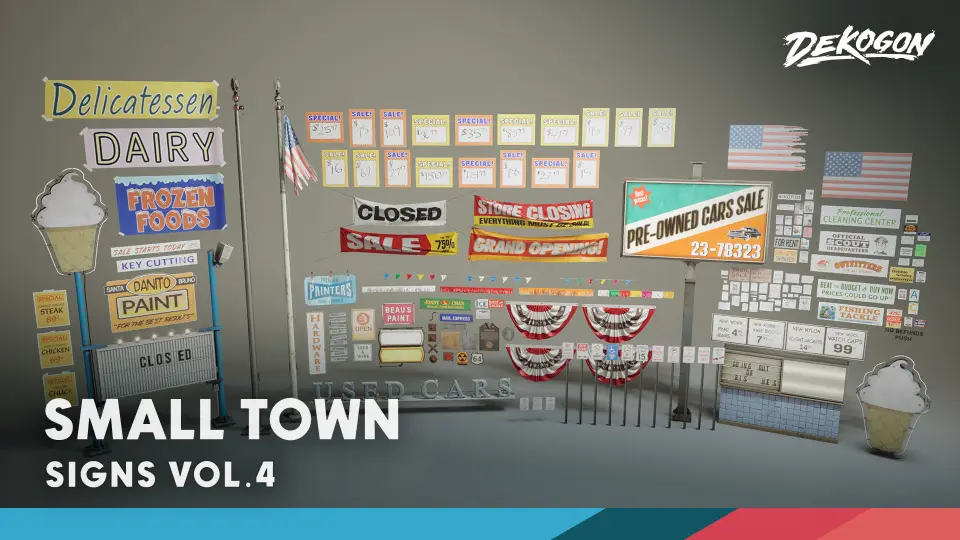
Small-town streets rarely come together through major landmarks alone. What usually sells the setting is the layer of everyday commercial detail: storefront names, advertising boards, sale signs, food-related branding, flags, business markers, and the kind of visual clutter that makes a town feel occupied and local. Signage VOL.4 - Small Town Is driven by exactly that part of environment building, gathering the pictured assets, maps, and materials into one Unreal Engine project aimed at realistic AAA-quality visuals, style, and budget.
The package is broad in raw volume, with 416 meshes In total. That count is split into 247 LP And 169 NN, giving the collection a dual-structure that supports different scene requirements. The project is also explicit about image quality and rendering intent: the assets use High quality and fidelity 4K texture sets, fully detailed models, and a material workflow that goes beyond static surface assignment.
Signage VOL.4 - Small Town in street-level scene building
The strongest use of this collection is in environments that need visible commercial identity without leaning on real-world brands. Tags attached to the project point toward signs, sale displays, advertising, business naming, billboards, food, ice, dairy, fast food, flags, logos, and town or city props. That makes the set especially relevant for scenes where the camera spends time at pedestrian height or roadside distance, where signage carries much of the visual storytelling.
A small-town setting benefits from this kind of asset concentration because signs perform more than one job at once. They define storefront purpose, break up repeated architecture, add color variation, reinforce local commerce, and help establish whether a scene feels active, practical, or slightly nostalgic. A food stand, dairy shop, fast-food exterior, roadside business front, or mixed-use town block all rely on signage to read quickly. This pack concentrates on that layer of environment dressing rather than on structural architecture, which makes it useful as a scene-enrichment set for artists who already have buildings and need believable business-facing detail.
The inclusion of custom-made branding and labels is also important for these kinds of scenes. All branding and labels are custom made by the studio, and the collection is noted as free of legal issues. For projects that need town signage, logos, and advertising-style surfaces without introducing real commercial trademarks, that removes a common friction point while preserving the look of branded spaces.
416 meshes, Nanite fidelity, and low poly coverage
The collection does not present its mesh count as a single undifferentiated number. It specifies both Nanite-based construction For high-fidelity polycounts and the inclusion of Low poly versions As well. That matters in practical production terms because signage assets often appear in several different ways across a project. Some are hero pieces near the camera, where surface form, edge quality, and dimensional detail need to hold up. Others sit deeper in the environment, repeating across streets or commercial strips where efficiency becomes just as important as detail.
By providing both mesh approaches, the set supports those two common scene conditions without forcing one fixed geometry strategy. The Nanite side is there for high-quality fidelity, while the low poly side keeps the collection useful in more performance-conscious setups. The product also states that it includes both Nanite and low poly versions of each mesh, which gives the pack a consistent structure across the asset library instead of making that flexibility available only to a subset of props.
For environment artists, that consistency can shape how the pack is used across a town block or roadside stretch. A foreground sign, a cluster of food business graphics, and mid-distance advertising boards can remain visually related while being placed according to different fidelity needs. Since the project is also described as optimized for games, the low poly inclusion does not feel like an afterthought; it sits alongside the more detailed Nanite approach as part of the package’s intended production use.
Materials, 4K texture sets, and the master material setup
Visual variety in signage work depends as much on surface control as on mesh variety. This collection includes 4K texture sets And a Master material setup That controls the majority of props and models. That combination suggests a workflow based on centralized adjustment rather than isolated material handling on every individual asset.
The material controls are described in concrete terms. There are additional controls for Roughness, albedo, normals, and more, along with channel-packed Roughness, Metalness, and Ambient Occlusion. In use, that gives artists a cleaner way to tune how signage surfaces read under lighting, whether they need flatter painted panels, more reflective commercial finishes, more worn-looking surfaces, or stronger normal response across embossed or layered details. The exact options are not expanded beyond those controls, but the presence of a master material system and those adjustable properties points to a pack intended for active scene integration, not just drag-and-drop placement.
Because signage sits at the intersection of color, readability, and material response, these controls are especially valuable in town scenes where many props compete in the same frame. A billboard, hanging business sign, sale placard, or food-related board may all need slight balancing so they belong to one lighting environment without losing individual identity. The master material setup gives the collection a practical backbone for that kind of harmonizing work.
Lumen support and the included post process look
Lighting and atmosphere play a major role in whether signage feels grounded in a place or pasted onto it. The project supports Lumen for Unreal Engine 5.0+ And also includes a Realistic Post Process and Look Up Table. That pairing places the pack firmly within a modern Unreal Engine rendering workflow, where signage is expected to respond convincingly to scene lighting while still benefiting from a defined overall look.
Signs and advertising props often rely on contrast, saturation, and material response to read well. A realistic post-process treatment can help unify a town scene made of many separate visual elements, while a LUT can shape the tonal character of the environment in a more directed way. The project does not overstate this as a cinematic system or a broad environment toolkit; it simply includes those pieces as part of the asset package, which makes sense for a collection focused on believable presentation.
For developers working in Unreal Engine 5.0 and above, Lumen support means the signage can live inside scenes that already depend on that lighting pipeline. For production work, that makes the pack easier to fit into current UE5 environment work where reflections, bounce, and overall scene response are part of the visual target rather than separate considerations.
Where Small Town signage fits best
This collection is a close fit for projects building out town centers, roadside business areas, small commercial strips, diner and dairy surroundings, fast-food exteriors, local advertising clusters, and street scenes that need a heavier layer of business-facing detail. The tags attached to the resource make that scope fairly clear: sale, advertising, name, business, town, flag, fast food, prop, billboard, food, ice, dairy, city, and logo all point toward places where commerce and public-facing identity are visible parts of the environment.
It is also a good match for artists who want signage that feels complete as a system rather than as a handful of isolated props. The mesh count is large, the branding is custom-made, the models are fully detailed, and the package includes not only the assets themselves but also the maps and materials created in Unreal Engine. That structure supports a scene-building process where signs are not treated as filler, but as a meaningful layer of realism.
The best fit is likely developers and environment artists working on realistic town or city scenes in Unreal Engine who need a substantial signage library with both high-fidelity and lower poly options. For projects that depend on storefront identity, roadside advertising, and custom branded detail without legal complications, this pack is most useful when signage is expected to do real visual work across the scene rather than merely occupy empty wall space.
 Buildings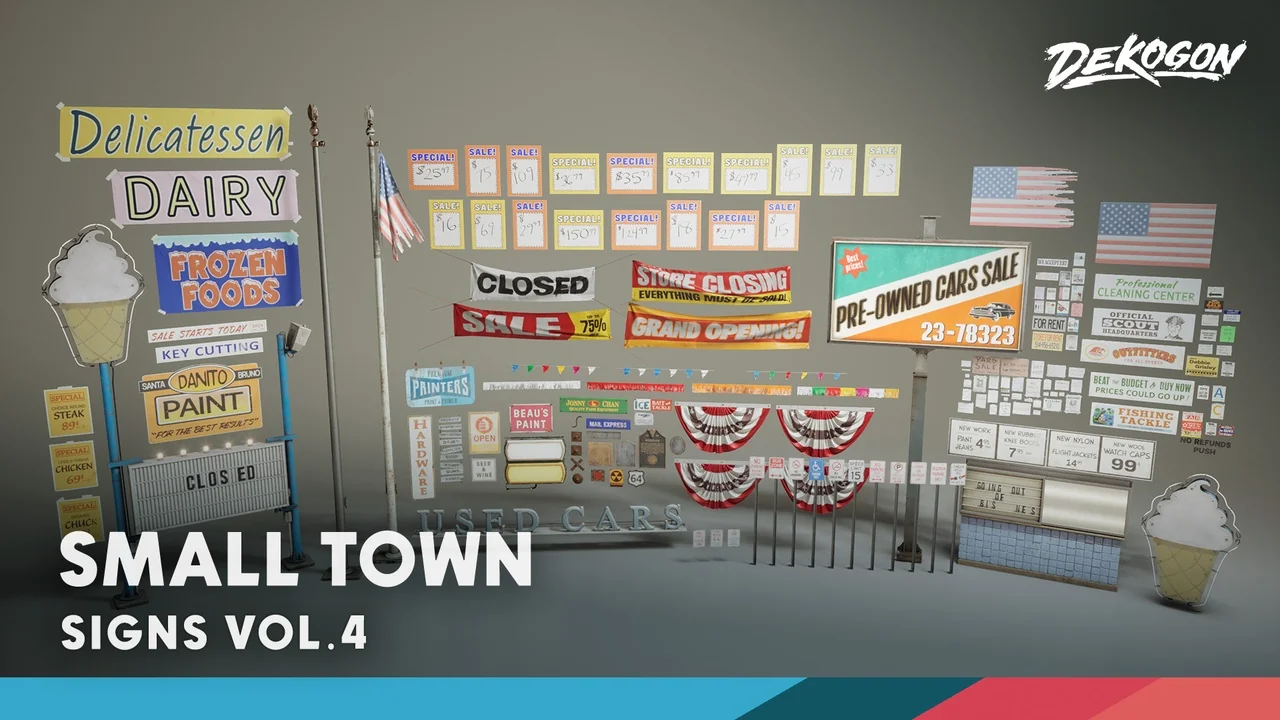
 Buildings
 Buildings
 Buildings