"6989f03aa91a233c"{"id":"1000026","slug":"skills-indicators-customizable","title":"Skills Indicators (Customizable)","category":"Network \u0026 Multiplayer","engine":"5.2 - 5.7","assetVersion":"1.2","engineVersion":"5.2 - 5.7","tag":"Network","accent":"blue","visual":"mech","summary":"Customizable skill indicators for pre-spell area previews, using Decal Actors and material-based shapes without textures for flexible game scenes.","platform":"Unreal Engine","publishedAt":"2026-05-20T13:26:31.858Z","updatedAt":"2026-05-20T13:26:31.858Z","sourceNotes":[],"fileContents":[],"compatibility":["Unreal Engine","Asset Version: 1.2","Engine version: 5.2 - 5.7"],"featuredImage":{"alt":"Skills Indicators (Customizable)","src":"/wp-content/uploads/published/2026/05/75732276e43d-e05f80a5-651c-48b4-b48c-98d666a3f970-dfb3b4a00e.webp"},"hasDownloadLink":true,"downloads":0,"terms":[{"taxonomy":"category","slug":"network-and-multiplayer-tools-and-plugins","name":"Network \u0026 Multiplayer"}],"galleryImages":[{"src":"/wp-content/uploads/published/2026/05/309c0fc0dfab-d4c89e6d-1164-4ff3-88f4-bc7f29f0fec8-bc56d61999.webp","alt":"Skills Indicators (Customizable)"},{"src":"/wp-content/uploads/published/2026/05/32ea685e6649-caccb25d-e157-478a-91f6-64cc063d0aff-976de6c9df.webp","alt":"Skills Indicators (Customizable)"}],"accessPanel":{"kind":"resource","title":"Access this resource","eyebrow":"Free Download","message":"Log in or create a free account to start your download.","fileName":"Skills Indicators (Customizable).7z","safetyNote":"Resources are manually reviewed before listing to improve quality and reduce obvious risks.","actionLabel":"Download Free","resourceType":"Resource archive"},"contentHtml":"\u003cp\u003eClear anticipation can change how a combat scene feels. When players need to read where a skill will land before the action happens, a visible pre-spell marker gives that information early and turns a vague attack into something understandable. Skills Indicators (Customizable) centers on that moment, providing indicators intended to act as pre-spell notificators so the area of effect is easier to read before a skill resolves.\u003c/p\u003e\n\u003cp\u003eThat purpose gives the asset a strong visual identity from the start. It is not just a decorative effect placed on the ground for style alone. Its role is communicative. The indicator exists to tell the player where a spell or skill is about to matter, making space, timing, and threat easier to interpret inside active gameplay. Because it can be used in any type of games, that communication can fit many different scene types, from fast encounters that need quick readable warnings to slower systems where telegraphing an action supports planning and response.\u003c/p\u003e \u003ch2\u003ePre-Spell indicators that make area of effect easier to read\u003c/h2\u003e\n\u003cp\u003eThe central use here is straightforward: showing a pre-spell area before the effect happens. That makes the asset especially relevant wherever attacks, skills, or triggered abilities need a visible warning zone. Instead of leaving impact space ambiguous, the indicator gives it a defined presence on the scene.\u003c/p\u003e\n\u003cp\u003eThat function opens up a creative range without changing the core job. A developer can use a pre-spell marker as a danger zone, a targeting preview, or a placement guide for skill-driven actions, as long as the purpose remains tied to showing an area of effect. The word customizable matters here because indicator work is rarely one-size-fits-all. Different games may want a cleaner marker, a more assertive warning shape, or a style that feels subtle rather than loud. Even with very little information on exact presets or controls, the verified details make it clear that the asset is meant to be adjusted rather than treated as a fixed single-purpose visual.\u003c/p\u003e\n\u003cp\u003eFor artists, this also means the indicator can take on a scene-support role instead of competing with everything else in view. In one game, a pre-spell notification might need to read as a tactical marker. In another, it may simply need to sit under an action and define the affected ground. The asset’s focus on indicating area of effect gives it a practical place in the visual language of gameplay.\u003c/p\u003e \u003ch2\u003eUsing Decal Actors for ground-based Skills Indicators\u003c/h2\u003e\n\u003cp\u003eThe indicators are based on Decal Actors. That is one of the most concrete implementation details available, and it says a lot about how the asset presents itself in a scene. These indicators are meant to exist as projected ground visuals rather than as separate modeled objects or texture cards described in some other way.\u003c/p\u003e\n\u003cp\u003eThat choice fits the asset’s role well. A skill indicator usually needs to sit where the player is already looking during combat or interaction: on the affected surface. A decal-based approach supports that kind of placement, keeping the warning anchored to the relevant area rather than detached from it. For a creator building encounters, this makes the indicator feel like part of the environment-space where the action is about to occur, not merely an abstract UI callout floating away from the point of impact.\u003c/p\u003e\n\u003cp\u003eFrom a creative standpoint, Decal Actors also reinforce the idea of situational use across many game types. A projected indicator can serve as a compact visual note under a character, a broader zone across part of the floor, or a shape that signals controlled space in a scene. The exact final look will depend on how the developer chooses to use the resource, but the decal basis keeps the indicator connected to location and area, which is essential when the goal is clearer area-of-effect communication.\u003c/p\u003e\n\u003cp\u003eThat makes this resource feel especially suited to scenes where placement matters. A pre-spell warning has to be read in relation to the world around it. Basing the system on Decal Actors supports that relationship directly.\u003c/p\u003e \u003ch2\u003eMaterial-based shapes without textures\u003c/h2\u003e\n\u003cp\u003eAll shapes are done completely via materials. No textures are used. This is the defining technical character of the asset.\u003c/p\u003e\n\u003cp\u003eThat detail gives the resource a distinct workflow identity. Instead of relying on a texture set to define the indicator shapes, the visual forms are material-driven. For developers and artists, that points to a cleaner, more procedural-feeling approach to the indicator itself. The customization suggested by the name is supported by this material-based construction, because the shapes are not described as painted texture assets but as forms generated through materials.\u003c/p\u003e\n\u003cp\u003eEven without a list of individual controls or shape variants, the absence of textures is meaningful. It tells you what the resource is not trying to be. It is not a texture collection for warning circles, cones, or overlays. It is a set of indicators whose shapes come from the material side of the workflow. That can be especially appealing in projects where creators want indicators that feel systematic and adjustable rather than locked to a bitmap-driven look.\u003c/p\u003e\n\u003cp\u003eThere is also a visual consistency implied by that setup. Material-based shapes can help keep a family of indicators feeling related, since the underlying method of creating them stays the same. When a game uses several pre-spell markers, that consistency matters. Players often learn gameplay language visually, and a unified material-driven indicator set can help reinforce the idea that these warnings belong to the same gameplay system.\u003c/p\u003e \u003ch3\u003eCustomizable indicator work across different game types\u003c/h3\u003e\n\u003cp\u003eThe asset is stated to work in any type of games. That breadth does not mean every project will use it the same way. It means the core concept—pre-spell indication of an area of effect—is general enough to travel across genres and presentation styles.\u003c/p\u003e\n\u003cp\u003eIn practice, that flexibility is useful for teams solving different readability problems. One project may want a direct and obvious skill telegraph. Another may want an understated placement cue that still communicates space clearly. Because the resource is framed as customizable and because the shapes are material-based, the same underlying asset can support different visual intentions while staying rooted in the same job: showing where a skill matters before it happens.\u003c/p\u003e\n\u003cp\u003eThis also makes the resource easy to think about as part of a broader gameplay communication system rather than as a narrow genre-only effect. Any game that benefits from clearer pre-action spatial cues can make use of an indicator like this. The asset does not tie itself to a single combat style, camera style, or setting in the verified details. Its role remains focused, but its application remains open.\u003c/p\u003e \u003ch2\u003eWhere Skills Indicators fit in production\u003c/h2\u003e\n\u003cp\u003eSome resources exist mainly to add spectacle. Skills Indicators (Customizable) fits a more functional layer of production. It is about communicating intent in the space where an action will occur. That makes it relevant not only to visual polish, but also to encounter clarity and player understanding.\u003c/p\u003e\n\u003cp\u003eFor artists, the appeal is in shaping visible anticipation on the ground without leaning on texture-based shapes. For developers, the appeal is in presenting area-of-effect information before a spell resolves, using Decal Actors as the basis. For teams working across different kinds of games, the broad applicability keeps the resource from feeling locked into one style of project. Its strongest fit is any production that needs customizable pre-spell indicators to mark area of effect clearly and keep that information grounded in the scene.\u003c/p\u003e\n\n\u003ch2\u003eContinue Browsing Similar Packs\u003c/h2\u003e\n\u003cul\u003e\n\u003cli\u003e\u003ca href=\"https://3dcghub.com/fps-first-person-shooter-framework-skg-shooter-framework-v2/\" title=\"FPS First Person Shooter Framework (SKG Shooter Framework V2)\"\u003eFPS First Person Shooter Framework (SKG Shooter Framework V2)\u003c/a\u003e\u003c/li\u003e\n\u003cli\u003e\u003ca href=\"https://3dcghub.com/quest-editor-plugin/\" title=\"Quest Editor Plugin\"\u003eQuest Editor Plugin\u003c/a\u003e\u003c/li\u003e\n\u003cli\u003e\u003ca href=\"https://3dcghub.com/universal-mp-indicator/\" title=\"Universal MP Indicator\"\u003eUniversal MP Indicator\u003c/a\u003e\u003c/li\u003e\n\u003cli\u003e\u003ca href=\"https://3dcghub.com/mysql-and-mariadb-integration/\" title=\"MySQL and MariaDB Integration\"\u003eMySQL and MariaDB Integration\u003c/a\u003e\u003c/li\u003e\n\u003cli\u003e\u003ca href=\"https://3dcghub.com/blueprint-web-communication-helper-http-websocket/\" title=\"[Blueprint] Web Communication Helper (Http / Websocket)\"\u003e[Blueprint] Web Communication Helper (Http / Websocket)\u003c/a\u003e\u003c/li\u003e\n\u003c/ul\u003e","contentTextLength":7906,"navigation":{"current":1465,"total":3353,"previous":{"id":"1000027","slug":"storage-units-set","title":"Storage Units Set","category":"Variety","platform":"Unreal Engine","updatedAt":"2026-05-20T13:31:00.653Z"},"next":{"id":"1000025","slug":"signage-vol-4-small-town","title":"Signage VOL.4 - Small Town","category":"Buildings \u0026 Architecture","platform":"Unreal Engine","updatedAt":"2026-05-20T13:23:30.361Z"}},"relatedResources":[{"id":"1000632","slug":"kronos-matchmaking","title":"Kronos Matchmaking","category":"Network \u0026 Multiplayer","engine":"5.2,5.5","assetVersion":"Asset Version: 1.9.0 - 2.6.0","engineVersion":"Engine Version: 5.2,5.5","tag":"Network","accent":"blue","visual":"mech","summary":"Complete Unreal Engine matchmaking plugin with skill-based pairing, party and reservation systems, Steam and EOS support, and listen-server hosting.","platform":"Unreal Engine","publishedAt":"2026-07-21T14:46:21.329Z","updatedAt":"2026-07-21T14:46:21.329Z","sourceNotes":[],"fileContents":[],"compatibility":["Unreal Engine","Asset Version: 1.9.0 - 2.6.0","Engine Version: 5.2,5.5"],"featuredImage":{"alt":"Kronos Matchmaking","src":"/wp-content/uploads/published/2026/07/3bf316672af3-3dc1eaef-3090-47e4-9779-b8a8509d071a-31efec86de.webp"},"hasDownloadLink":true,"downloads":0},{"id":"15136","slug":"fps-first-person-shooter-framework-skg-shooter-framework-v2","title":"FPS First Person Shooter Framework (SKG Shooter Framework V2)","category":"Network \u0026 Multiplayer","engine":"5.5 - 5.7","assetVersion":"Engine version: 5.5 - 5.7","engineVersion":"Asset Version:1.4.1 - 1.4.3","tag":"Network","accent":"blue","visual":"city","summary":"The SKG Shooter Framework V2 is a performant, modular, component-based solution for building realistic first-person shooters in Unreal Engine 5.3 and beyond.","platform":"Unreal Engine","publishedAt":"2026-03-12T08:01:31.000Z","updatedAt":"2026-04-19T15:44:53.000Z","sourceNotes":[],"fileContents":[],"compatibility":["Unreal Engine","Engine version: 5.5 - 5.7","Asset Version: 1.4.1 - 1.4.3"],"featuredImage":{"alt":"FPS First Person Shooter Framework (SKG Shooter Framework V2)","src":"https://3dcghub.com/wp-content/uploads/2026/03/1ef8f873-5cad-4190-b092-53ba5e385464.webp"},"hasDownloadLink":true,"downloads":8},{"id":"15167","slug":"universal-mp-indicator","title":"Universal MP Indicator","category":"Network \u0026 Multiplayer","engine":"4.27 - 5.8","assetVersion":"Asset Version:1.0 - 1.4","engineVersion":"Engine version: 4.27 - 5.8","tag":"Network","accent":"blue","visual":"character","summary":"The Universal MP Indicator is a high-performance C++ plugin designed for tracking targets in 2D screen space. It offers versatile on-screen and off-screen modes with deep customization for any game project.","platform":"Unreal Engine","publishedAt":"2026-03-12T08:08:42.000Z","updatedAt":"2026-09-30T04:40:38.530Z","sourceNotes":[],"fileContents":[],"compatibility":["Unreal Engine","Asset Version:1.0 - 1.4","Engine version: 4.27 - 5.8"],"featuredImage":{"alt":"Universal MP Indicator","src":"https://3dcghub.com/wp-content/uploads/2026/03/425f1a5c-f01e-46ad-8217-6e746d0a12fd.webp"},"hasDownloadLink":true,"downloads":0}]}
Network
Skills Indicators (Customizable)
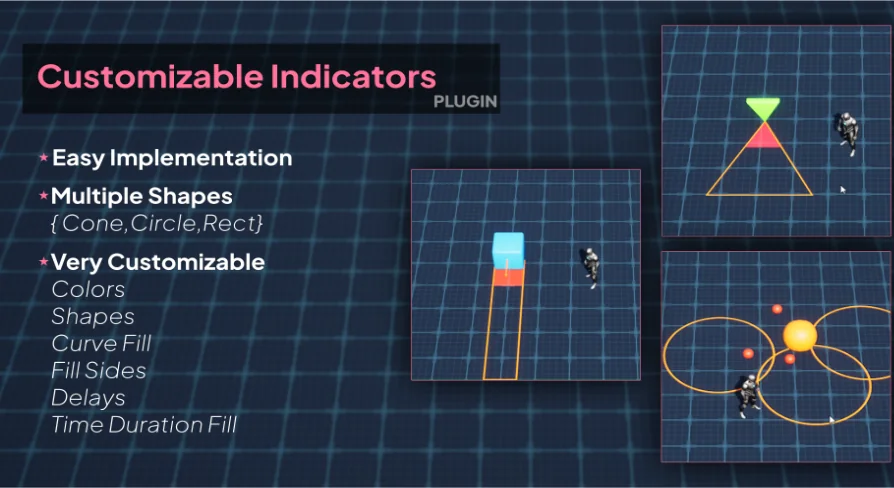
Customizable skill indicators for pre-spell area previews, using Decal Actors and material-based shapes without textures for flexible game scenes.
Clear anticipation can change how a combat scene feels. When players need to read where a skill will land before the action happens, a visible pre-spell marker gives that information early and turns a vague attack into something understandable. Skills Indicators (Customizable) centers on that moment, providing indicators intended to act as pre-spell notificators so the area of effect is easier to read before a skill resolves.
That purpose gives the asset a strong visual identity from the start. It is not just a decorative effect placed on the ground for style alone. Its role is communicative. The indicator exists to tell the player where a spell or skill is about to matter, making space, timing, and threat easier to interpret inside active gameplay. Because it can be used in any type of games, that communication can fit many different scene types, from fast encounters that need quick readable warnings to slower systems where telegraphing an action supports planning and response.
Pre-Spell indicators that make area of effect easier to read
The central use here is straightforward: showing a pre-spell area before the effect happens. That makes the asset especially relevant wherever attacks, skills, or triggered abilities need a visible warning zone. Instead of leaving impact space ambiguous, the indicator gives it a defined presence on the scene.
That function opens up a creative range without changing the core job. A developer can use a pre-spell marker as a danger zone, a targeting preview, or a placement guide for skill-driven actions, as long as the purpose remains tied to showing an area of effect. The word customizable matters here because indicator work is rarely one-size-fits-all. Different games may want a cleaner marker, a more assertive warning shape, or a style that feels subtle rather than loud. Even with very little information on exact presets or controls, the verified details make it clear that the asset is meant to be adjusted rather than treated as a fixed single-purpose visual.
For artists, this also means the indicator can take on a scene-support role instead of competing with everything else in view. In one game, a pre-spell notification might need to read as a tactical marker. In another, it may simply need to sit under an action and define the affected ground. The asset’s focus on indicating area of effect gives it a practical place in the visual language of gameplay.
Using Decal Actors for ground-based Skills Indicators
The indicators are based on Decal Actors. That is one of the most concrete implementation details available, and it says a lot about how the asset presents itself in a scene. These indicators are meant to exist as projected ground visuals rather than as separate modeled objects or texture cards described in some other way.
That choice fits the asset’s role well. A skill indicator usually needs to sit where the player is already looking during combat or interaction: on the affected surface. A decal-based approach supports that kind of placement, keeping the warning anchored to the relevant area rather than detached from it. For a creator building encounters, this makes the indicator feel like part of the environment-space where the action is about to occur, not merely an abstract UI callout floating away from the point of impact.
From a creative standpoint, Decal Actors also reinforce the idea of situational use across many game types. A projected indicator can serve as a compact visual note under a character, a broader zone across part of the floor, or a shape that signals controlled space in a scene. The exact final look will depend on how the developer chooses to use the resource, but the decal basis keeps the indicator connected to location and area, which is essential when the goal is clearer area-of-effect communication.
That makes this resource feel especially suited to scenes where placement matters. A pre-spell warning has to be read in relation to the world around it. Basing the system on Decal Actors supports that relationship directly.
Material-based shapes without textures
All shapes are done completely via materials. No textures are used. This is the defining technical character of the asset.
That detail gives the resource a distinct workflow identity. Instead of relying on a texture set to define the indicator shapes, the visual forms are material-driven. For developers and artists, that points to a cleaner, more procedural-feeling approach to the indicator itself. The customization suggested by the name is supported by this material-based construction, because the shapes are not described as painted texture assets but as forms generated through materials.
Even without a list of individual controls or shape variants, the absence of textures is meaningful. It tells you what the resource is not trying to be. It is not a texture collection for warning circles, cones, or overlays. It is a set of indicators whose shapes come from the material side of the workflow. That can be especially appealing in projects where creators want indicators that feel systematic and adjustable rather than locked to a bitmap-driven look.
There is also a visual consistency implied by that setup. Material-based shapes can help keep a family of indicators feeling related, since the underlying method of creating them stays the same. When a game uses several pre-spell markers, that consistency matters. Players often learn gameplay language visually, and a unified material-driven indicator set can help reinforce the idea that these warnings belong to the same gameplay system.
Customizable indicator work across different game types
The asset is stated to work in any type of games. That breadth does not mean every project will use it the same way. It means the core concept—pre-spell indication of an area of effect—is general enough to travel across genres and presentation styles.
In practice, that flexibility is useful for teams solving different readability problems. One project may want a direct and obvious skill telegraph. Another may want an understated placement cue that still communicates space clearly. Because the resource is framed as customizable and because the shapes are material-based, the same underlying asset can support different visual intentions while staying rooted in the same job: showing where a skill matters before it happens.
This also makes the resource easy to think about as part of a broader gameplay communication system rather than as a narrow genre-only effect. Any game that benefits from clearer pre-action spatial cues can make use of an indicator like this. The asset does not tie itself to a single combat style, camera style, or setting in the verified details. Its role remains focused, but its application remains open.
Where Skills Indicators fit in production
Some resources exist mainly to add spectacle. Skills Indicators (Customizable) fits a more functional layer of production. It is about communicating intent in the space where an action will occur. That makes it relevant not only to visual polish, but also to encounter clarity and player understanding.
For artists, the appeal is in shaping visible anticipation on the ground without leaning on texture-based shapes. For developers, the appeal is in presenting area-of-effect information before a spell resolves, using Decal Actors as the basis. For teams working across different kinds of games, the broad applicability keeps the resource from feeling locked into one style of project. Its strongest fit is any production that needs customizable pre-spell indicators to mark area of effect clearly and keep that information grounded in the scene.
 Network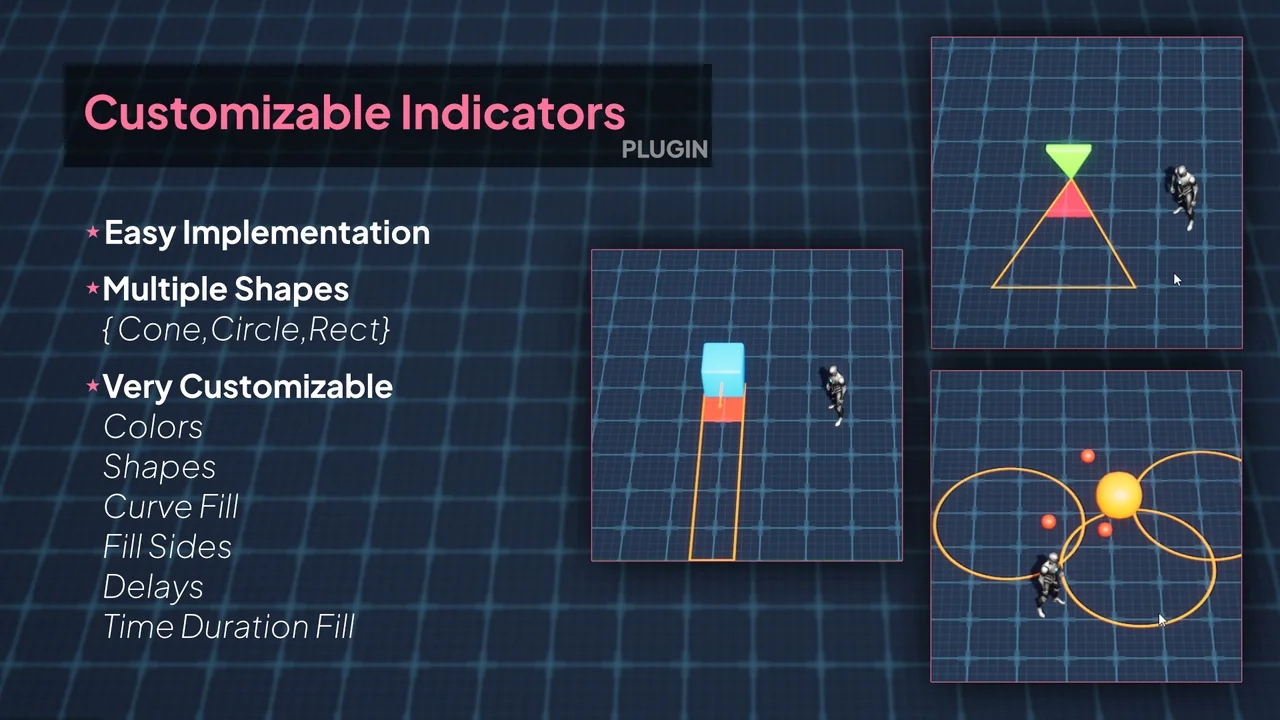
 Network
 Network
 Network