"0283a5a6392d9fd6"{"id":"1000027","slug":"storage-units-set","title":"Storage Units Set","category":"Variety","engine":"5.0+","assetVersion":"","engineVersion":"5.0+","tag":"Variety","accent":"blue","visual":"mech","summary":"Storage Units Set delivers 108 character interaction files for lockers, chests, drawers, cupboards, cabinets, and wardrobes with open, close, and locked actions","platform":"Unreal Engine","publishedAt":"2026-05-20T13:31:00.653Z","updatedAt":"2026-05-20T13:31:00.653Z","sourceNotes":[],"fileContents":[],"compatibility":["Unreal Engine","Engine version: 5.0+"],"featuredImage":{"alt":"Storage Units Set","src":"/wp-content/uploads/published/2026/05/19402ef34696-414a7f1d-3131-4332-a720-f5fe068b6d5a-60719338e8.webp"},"hasDownloadLink":true,"downloads":2,"terms":[{"taxonomy":"category","slug":"variety-animations","name":"Variety"}],"galleryImages":[{"src":"/wp-content/uploads/published/2026/05/cf95b741cf96-e3b7bf0b-c86f-41a6-8672-d32f0fa784b6-2046205217.webp","alt":"Storage Units Set"},{"src":"/wp-content/uploads/published/2026/05/54a34859cb5f-38de6cc0-6542-4e09-9d97-5411b4dab08c-d1387b8ff0.webp","alt":"Storage Units Set"},{"src":"/wp-content/uploads/published/2026/05/836ff0a59a95-96a35df9-7a92-4d89-8637-90916f9e7b68-5a334c84d1.webp","alt":"Storage Units Set"},{"src":"/wp-content/uploads/published/2026/05/166f3b2c5019-ca71313f-5c23-492b-90e9-652c1a808041-d5b7bea147.webp","alt":"Storage Units Set"},{"src":"/wp-content/uploads/published/2026/05/6419262b309f-471b8466-9b1d-4063-a39f-388767c1881b-93fa2c7a18.webp","alt":"Storage Units Set"},{"src":"/wp-content/uploads/published/2026/05/7cf6ea22fcd8-80161bdd-42b4-4210-9939-b7e76c0f50de-9d9d502d60.webp","alt":"Storage Units Set"}],"accessPanel":{"kind":"resource","title":"Access this resource","eyebrow":"Free Download","message":"Log in or create a free account to start your download.","fileName":"Content.7z","safetyNote":"Resources are manually reviewed before listing to improve quality and reduce obvious risks.","actionLabel":"Download Free","resourceType":"Resource archive"},"contentHtml":"\u003cp\u003eLockers, chests, drawers, cupboards, cabinets, and wardrobes are the center of Storage Units Set. This package focuses on character interactions for searching and looting containers, bringing together a broad group of animation files that cover the kinds of repeated environmental actions many projects rely on. Instead of treating storage interaction as a single generic motion, the set concentrates on the full loop around approaching a unit, opening it, searching it, and closing it again.\u003c/p\u003e\n\u003cp\u003eThe pack contains 108 files in total. Its scope makes it relevant anywhere container interaction needs to feel like a real part of play or scene behavior rather than a placeholder action. A storage unit is often a small object in the world, but the animation attached to it shapes pacing, responsiveness, and how believable a search sequence feels. This set is aimed directly at that layer of production.\u003c/p\u003e \u003ch2\u003eLockers, Drawers, Cabinets, and Wardrobes\u003c/h2\u003e\n\u003cp\u003eThe included interactions are grouped around several storage unit types: lockers, drawers, cabinets, and wardrobes. The broader description also places chests and cupboards within the pack’s interaction focus, which gives the set a wide spread across common environmental container categories. That matters in use because these units do not all carry the same visual or gameplay expectation. A locker suggests a tall vertical interaction, while a drawer or cabinet implies a lower, more compartment-based search motion. Wardrobes and cupboards occupy another space again, often reading as larger and more deliberate environmental objects.\u003c/p\u003e\n\u003cp\u003eBy covering multiple storage forms, the pack fits projects where looting is dispersed across different room layouts and prop types. A single scene may contain several kinds of searchable furniture, and using one package that addresses those interactions helps keep character behavior consistent across the environment. It also gives teams a cleaner way to handle repeated gameplay beats without treating every container as the same object.\u003c/p\u003e\n\u003cp\u003eThis makes the set easy to place in real production contexts such as interior exploration, survival spaces, scavenging sequences, narrative rooms, or any game situation where opening storage is part of progression. The focus stays on the character side of the interaction, which is often the piece that sells the action even when the container itself is relatively simple.\u003c/p\u003e \u003ch2\u003eOpen, Close, and Locked reactions\u003c/h2\u003e\n\u003cp\u003eThe core actions in Storage Units Set are clearly defined. Opening animations include a standard version along with variations. That gives a project more than one way to handle the start of a storage interaction, which can help avoid overusing a single repeated movement. Even modest variation matters when players search multiple containers in close succession, because the rhythm of looting can otherwise become mechanical very quickly.\u003c/p\u003e\n\u003cp\u003eClosing is covered with smooth closing transitions. This is a useful detail because the end of an interaction often gets less attention than the start, even though it affects how polished the whole sequence feels. A clean closing transition supports the sense that the animation is a complete interaction rather than an isolated gesture. It also helps maintain continuity when the player or character returns to a neutral state after searching a container.\u003c/p\u003e\n\u003cp\u003eThe set also includes locked actions in the form of failed attempts, described as jammed or unopenable reactions. Those motions are especially important in production because not every container in a game or scene should resolve the same way. A failed opening attempt communicates state without requiring the environment to do all the work on its own. When a unit is inaccessible, the character response becomes part of the feedback system. The player sees not just that the object stays shut, but that the character has actively tried and failed to open it.\u003c/p\u003e\n\u003cp\u003eTaken together, the open, close, and locked motions form a practical interaction cycle. A searchable unit can be opened, examined, and closed. A blocked one can produce a jammed response instead. That range gives designers and animators enough behavioral coverage to support ordinary looting, controlled access, and simple environmental gating using the same pack.\u003c/p\u003e \u003ch2\u003eSearching and looting in the gameplay loop\u003c/h2\u003e\n\u003cp\u003eStorage Units Set sits in a very specific place in a production workflow: the repeated moment where a character interacts with world props for inventory, scavenging, or scene exploration. These actions are not combat moves or traversal clips. They are interaction animations, and their role is to make prop-based searching readable and convincing.\u003c/p\u003e\n\u003cp\u003eThat puts the set in the middle of systems that often involve object state, interaction prompts, and short environmental pauses. In a looting sequence, the character needs to do more than touch a container and trigger an item result. The action has to suggest searching behavior, acknowledge the physical form of the storage object, and transition back out cleanly so the game or scene can continue. This package is aimed at that exact need.\u003c/p\u003e\n\u003cp\u003eIts value in workflow terms comes from handling a category of motions that tends to appear across many levels. Once a project includes lockers, drawers, cabinets, wardrobes, chests, or cupboards as interactive props, the animation requirement can spread quickly. Teams then need consistent behavior across many instances of the same idea. A dedicated set for searching and looting containers gives that behavior a shared foundation rather than piecing it together one object at a time.\u003c/p\u003e\n\u003cp\u003eThe pack also supports the kind of environmental storytelling where a room’s contents matter. Searching storage units can indicate urgency, routine scavenging, domestic exploration, or a more methodical inspection of a space. The animation does not need to explain the whole narrative on its own, but it anchors the physical action that the narrative depends on.\u003c/p\u003e \u003ch2\u003eEpic Skeleton, Root Motion, and In-Place options\u003c/h2\u003e\n\u003cp\u003eOn the technical side, Storage Units Set uses the Epic Skeleton for the UE5 Mannequin. That gives the animations a clearly stated rig target, which is an important production detail for teams working inside Unreal Engine pipelines. The rig choice helps define where the set is intended to fit and how it aligns with established character setups based on that skeleton standard.\u003c/p\u003e\n\u003cp\u003eAll assets include both Root Motion and In-Place motion. Having both approaches available broadens how the pack can be integrated into gameplay systems and animation setups. Root Motion can support interactions where character movement is authored directly into the animation, while In-Place versions support workflows where movement is handled externally. The key point is that the package includes both for all assets, so teams are not locked into just one interaction method.\u003c/p\u003e\n\u003cp\u003eIK Bones are included as well. That detail matters because storage interactions often involve close contact with world objects, and contact points are where animation quality is judged most quickly. Any setup that supports more controlled alignment at the hands or body level becomes useful when characters need to appear engaged with doors, handles, drawers, or panels.\u003c/p\u003e\n\u003cp\u003eSource files are included in both.FBX and MotionBuilder form. That gives the set a practical handoff point for teams that want to work directly with the animation data in common production formats. For a resource anchored in interaction loops, access to those source files can matter during implementation, adjustment, or pipeline integration.\u003c/p\u003e \u003ch2\u003eWhere the 108 files fit best\u003c/h2\u003e\n\u003cp\u003eThe total count of 108 files suggests a pack with enough breadth to cover a range of interaction states and storage categories rather than just a handful of one-off motions. In day-to-day production, that kind of coverage helps when container interactions are not isolated set pieces but recurring parts of the experience. A project with many searchable props benefits from a package that can support repetition without collapsing everything into one identical action.\u003c/p\u003e\n\u003cp\u003eStorage Units Set is best understood as a dedicated interaction library for container-based scenes. It is not trying to cover every kind of character movement. Its lane is much narrower and more useful than that: searching and looting storage units in a way that acknowledges the object being used and the state it is in. Some units open, some close, some resist with a jammed or unopenable response. That range is exactly what many environmental interaction systems need.\u003c/p\u003e\n\u003cp\u003eThe practical takeaway is straightforward. If a project includes lockers, drawers, cabinets, wardrobes, chests, or cupboards that players or characters are meant to search, this set is structured to handle that loop with a substantial file count, defined action coverage, Epic Skeleton support for the UE5 Mannequin, and both Root Motion and In-Place versions across the full pack.\u003c/p\u003e\n\n\u003ch2\u003eRelated Resources Worth Checking\u003c/h2\u003e\n\u003cul\u003e\n\u003cli\u003e\u003ca href=\"https://3dcghub.com/roll-dodge-dash-set/\" title=\"Roll Dodge Dash Set\"\u003eRoll Dodge Dash Set\u003c/a\u003e\u003c/li\u003e\n\u003cli\u003e\u003ca href=\"https://3dcghub.com/cover-set/\" title=\"Cover Set\"\u003eCover Set\u003c/a\u003e\u003c/li\u003e\n\u003cli\u003e\u003ca href=\"https://3dcghub.com/pool-dives-animation-set/\" title=\"Pool Dives Animation Set\"\u003ePool Dives Animation Set\u003c/a\u003e\u003c/li\u003e\n\u003cli\u003e\u003ca href=\"https://3dcghub.com/arabian-fusion-mocap-dance-set/\" title=\"Arabian Fusion MoCap Dance Set\"\u003eArabian Fusion MoCap Dance Set\u003c/a\u003e\u003c/li\u003e\n\u003cli\u003e\u003ca href=\"https://3dcghub.com/rolls-and-dodges-animation-set/\" title=\"Rolls and Dodges Animation Set\"\u003eRolls and Dodges Animation Set\u003c/a\u003e\u003c/li\u003e\n\u003c/ul\u003e","contentTextLength":9051,"navigation":{"current":1465,"total":3354,"previous":{"id":"1000028","slug":"stylized-castle-ruins","title":"Stylized Castle Ruins","category":"Mountain","platform":"Unreal Engine","updatedAt":"2026-05-20T15:17:40.049Z"},"next":{"id":"1000026","slug":"skills-indicators-customizable","title":"Skills Indicators (Customizable)","category":"Network \u0026 Multiplayer","platform":"Unreal Engine","updatedAt":"2026-05-20T13:26:31.858Z"}},"relatedResources":[{"id":"6265","slug":"cover-set","title":"Cover Set","category":"Variety","engine":"5.0+","assetVersion":"Engine version: 5.0+","engineVersion":"5.0","tag":"Variety","accent":"blue","visual":"animation","summary":"Enhance your tactical shooter with 242 high-fidelity cover animations. Features Root Motion, UE5 Mannequin support, and seamless transitions for 3D games.","platform":"Unreal Engine","publishedAt":"2026-02-19T14:23:33.000Z","updatedAt":"2026-04-19T15:56:28.000Z","sourceNotes":[],"fileContents":[],"compatibility":["Unreal Engine","Engine version: 5.0+"],"featuredImage":{"alt":"Cover Set","src":"https://3dcghub.com/wp-content/uploads/2026/02/8f892424-1835-46bf-822c-fa70ca0fc8f5.webp"},"hasDownloadLink":true,"downloads":2},{"id":"6401","slug":"roll-dodge-dash-set","title":"Roll Dodge Dash Set","category":"Variety","engine":"5.0+","assetVersion":"Engine version: 5.0+","engineVersion":"5.0","tag":"Variety","accent":"blue","visual":"animation","summary":"Enhance your game's mobility with the Roll Dodge Dash Set. This pack offers 72 high-fidelity animations for fluid, 8-directional character movement.","platform":"Unreal Engine","publishedAt":"2026-02-19T15:11:36.000Z","updatedAt":"2026-04-19T15:56:25.000Z","sourceNotes":[],"fileContents":[],"compatibility":["Unreal Engine","Engine version: 5.0+"],"featuredImage":{"alt":"Roll Dodge Dash Set","src":"https://3dcghub.com/wp-content/uploads/2026/02/77b185b3-8be2-47da-83c8-c5acb74acbb5.webp"},"hasDownloadLink":true,"downloads":1},{"id":"6390","slug":"pool-dives-animation-set","title":"Pool Dives Animation Set","category":"Variety","engine":"4.26+,5.0+","assetVersion":"Engine version: 4.26+,5.0+","engineVersion":"4.17","tag":"Variety","accent":"blue","visual":"animation","summary":"Upgrade your character movement with the Pool Dives Animation Set. Features 9 hand-crafted animations including dives, cannonballs, and pencil jumps for 3D game","platform":"Unreal Engine","publishedAt":"2026-02-19T15:03:12.000Z","updatedAt":"2026-04-19T15:56:25.000Z","sourceNotes":[],"fileContents":[],"compatibility":["Unreal Engine","Engine version: 4.26+,5.0+"],"featuredImage":{"alt":"Pool Dives Animation Set","src":"https://3dcghub.com/wp-content/uploads/2026/02/75b20724-5f4f-483c-b657-078d58a2645a.webp"},"hasDownloadLink":true,"downloads":3}]}
Variety
Storage Units Set
Storage Units Set delivers 108 character interaction files for lockers, chests, drawers, cupboards, cabinets, and wardrobes with open, close, and locked actions
Category:Unreal Engine,VarietyPlatform: Unreal EngineEngine version: 5.0+Published: May 20, 2026
Variety
Resource overview
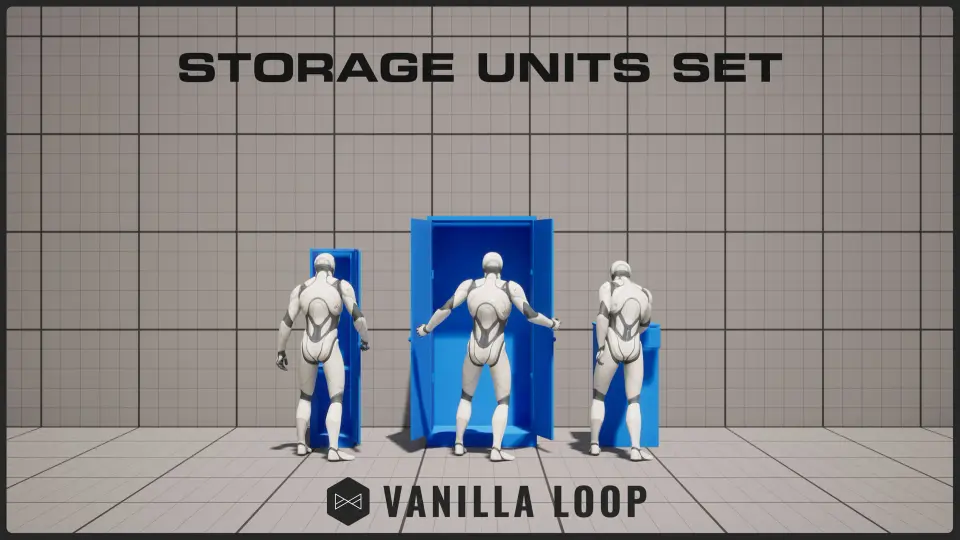
Lockers, chests, drawers, cupboards, cabinets, and wardrobes are the center of Storage Units Set. This package focuses on character interactions for searching and looting containers, bringing together a broad group of animation files that cover the kinds of repeated environmental actions many projects rely on. Instead of treating storage interaction as a single generic motion, the set concentrates on the full loop around approaching a unit, opening it, searching it, and closing it again.
The pack contains 108 files in total. Its scope makes it relevant anywhere container interaction needs to feel like a real part of play or scene behavior rather than a placeholder action. A storage unit is often a small object in the world, but the animation attached to it shapes pacing, responsiveness, and how believable a search sequence feels. This set is aimed directly at that layer of production.
Lockers, Drawers, Cabinets, and Wardrobes
The included interactions are grouped around several storage unit types: lockers, drawers, cabinets, and wardrobes. The broader description also places chests and cupboards within the pack’s interaction focus, which gives the set a wide spread across common environmental container categories. That matters in use because these units do not all carry the same visual or gameplay expectation. A locker suggests a tall vertical interaction, while a drawer or cabinet implies a lower, more compartment-based search motion. Wardrobes and cupboards occupy another space again, often reading as larger and more deliberate environmental objects.
By covering multiple storage forms, the pack fits projects where looting is dispersed across different room layouts and prop types. A single scene may contain several kinds of searchable furniture, and using one package that addresses those interactions helps keep character behavior consistent across the environment. It also gives teams a cleaner way to handle repeated gameplay beats without treating every container as the same object.
This makes the set easy to place in real production contexts such as interior exploration, survival spaces, scavenging sequences, narrative rooms, or any game situation where opening storage is part of progression. The focus stays on the character side of the interaction, which is often the piece that sells the action even when the container itself is relatively simple.
Open, Close, and Locked reactions
The core actions in Storage Units Set are clearly defined. Opening animations include a standard version along with variations. That gives a project more than one way to handle the start of a storage interaction, which can help avoid overusing a single repeated movement. Even modest variation matters when players search multiple containers in close succession, because the rhythm of looting can otherwise become mechanical very quickly.
Closing is covered with smooth closing transitions. This is a useful detail because the end of an interaction often gets less attention than the start, even though it affects how polished the whole sequence feels. A clean closing transition supports the sense that the animation is a complete interaction rather than an isolated gesture. It also helps maintain continuity when the player or character returns to a neutral state after searching a container.
The set also includes locked actions in the form of failed attempts, described as jammed or unopenable reactions. Those motions are especially important in production because not every container in a game or scene should resolve the same way. A failed opening attempt communicates state without requiring the environment to do all the work on its own. When a unit is inaccessible, the character response becomes part of the feedback system. The player sees not just that the object stays shut, but that the character has actively tried and failed to open it.
Taken together, the open, close, and locked motions form a practical interaction cycle. A searchable unit can be opened, examined, and closed. A blocked one can produce a jammed response instead. That range gives designers and animators enough behavioral coverage to support ordinary looting, controlled access, and simple environmental gating using the same pack.
Searching and looting in the gameplay loop
Storage Units Set sits in a very specific place in a production workflow: the repeated moment where a character interacts with world props for inventory, scavenging, or scene exploration. These actions are not combat moves or traversal clips. They are interaction animations, and their role is to make prop-based searching readable and convincing.
That puts the set in the middle of systems that often involve object state, interaction prompts, and short environmental pauses. In a looting sequence, the character needs to do more than touch a container and trigger an item result. The action has to suggest searching behavior, acknowledge the physical form of the storage object, and transition back out cleanly so the game or scene can continue. This package is aimed at that exact need.
Its value in workflow terms comes from handling a category of motions that tends to appear across many levels. Once a project includes lockers, drawers, cabinets, wardrobes, chests, or cupboards as interactive props, the animation requirement can spread quickly. Teams then need consistent behavior across many instances of the same idea. A dedicated set for searching and looting containers gives that behavior a shared foundation rather than piecing it together one object at a time.
The pack also supports the kind of environmental storytelling where a room’s contents matter. Searching storage units can indicate urgency, routine scavenging, domestic exploration, or a more methodical inspection of a space. The animation does not need to explain the whole narrative on its own, but it anchors the physical action that the narrative depends on.
Epic Skeleton, Root Motion, and In-Place options
On the technical side, Storage Units Set uses the Epic Skeleton for the UE5 Mannequin. That gives the animations a clearly stated rig target, which is an important production detail for teams working inside Unreal Engine pipelines. The rig choice helps define where the set is intended to fit and how it aligns with established character setups based on that skeleton standard.
All assets include both Root Motion and In-Place motion. Having both approaches available broadens how the pack can be integrated into gameplay systems and animation setups. Root Motion can support interactions where character movement is authored directly into the animation, while In-Place versions support workflows where movement is handled externally. The key point is that the package includes both for all assets, so teams are not locked into just one interaction method.
IK Bones are included as well. That detail matters because storage interactions often involve close contact with world objects, and contact points are where animation quality is judged most quickly. Any setup that supports more controlled alignment at the hands or body level becomes useful when characters need to appear engaged with doors, handles, drawers, or panels.
Source files are included in both.FBX and MotionBuilder form. That gives the set a practical handoff point for teams that want to work directly with the animation data in common production formats. For a resource anchored in interaction loops, access to those source files can matter during implementation, adjustment, or pipeline integration.
Where the 108 files fit best
The total count of 108 files suggests a pack with enough breadth to cover a range of interaction states and storage categories rather than just a handful of one-off motions. In day-to-day production, that kind of coverage helps when container interactions are not isolated set pieces but recurring parts of the experience. A project with many searchable props benefits from a package that can support repetition without collapsing everything into one identical action.
Storage Units Set is best understood as a dedicated interaction library for container-based scenes. It is not trying to cover every kind of character movement. Its lane is much narrower and more useful than that: searching and looting storage units in a way that acknowledges the object being used and the state it is in. Some units open, some close, some resist with a jammed or unopenable response. That range is exactly what many environmental interaction systems need.
The practical takeaway is straightforward. If a project includes lockers, drawers, cabinets, wardrobes, chests, or cupboards that players or characters are meant to search, this set is structured to handle that loop with a substantial file count, defined action coverage, Epic Skeleton support for the UE5 Mannequin, and both Root Motion and In-Place versions across the full pack.
 Variety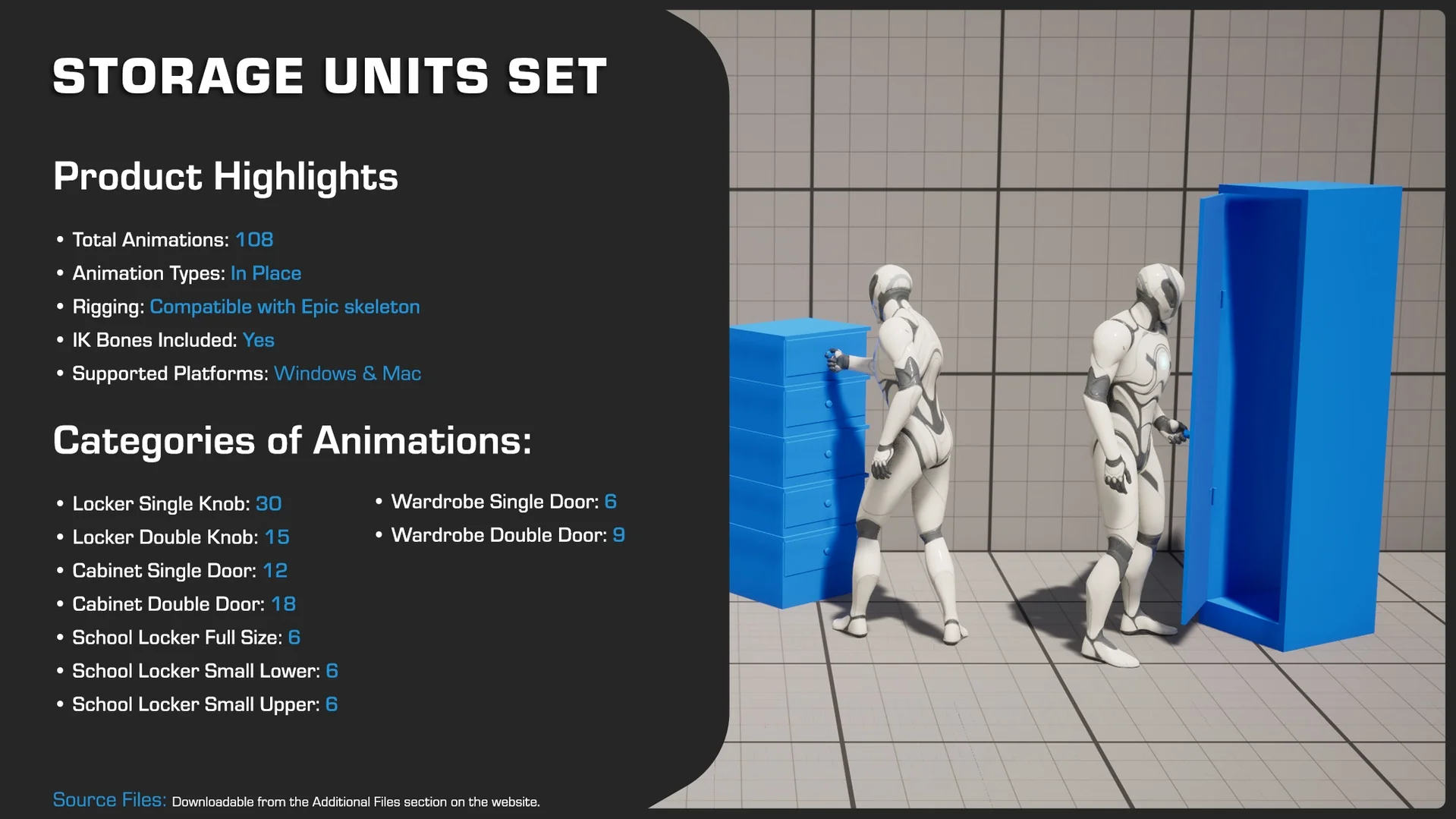
 Variety
 Variety
 Variety