"0283a5a6392d9fd6"{"id":"1000028","slug":"stylized-castle-ruins","title":"Stylized Castle Ruins","category":"Mountain","engine":"5.2+","assetVersion":"","engineVersion":"5.2+","tag":"Mountain","accent":"blue","visual":"mech","summary":"Stylized Castle Ruins brings together 114 environment assets, example levels, and ULAT support for building and polishing ancient castle scenes.","platform":"Unreal Engine","publishedAt":"2026-05-20T15:17:40.049Z","updatedAt":"2026-05-20T15:17:40.049Z","sourceNotes":[],"fileContents":[],"compatibility":["Unreal Engine","Engine version: 5.2+"],"featuredImage":{"alt":"Stylized Castle Ruins","src":"/wp-content/uploads/published/2026/05/87843fe93e16-823703a8-2488-4cdd-9942-a42d16e772ae-c8a69251a2.webp"},"hasDownloadLink":true,"downloads":3,"terms":[{"taxonomy":"category","slug":"mountain","name":"Mountain"}],"galleryImages":[{"src":"/wp-content/uploads/published/2026/05/23d7fe26a993-930c756a-a193-4e33-a27c-6730ab8bf441-a5d2a2211a.webp","alt":"Stylized Castle Ruins"},{"src":"/wp-content/uploads/published/2026/05/2562fe4f9c67-036f659f-fbe4-47f7-aa9f-917c2f8cd229-8ff74abcdc.webp","alt":"Stylized Castle Ruins"},{"src":"/wp-content/uploads/published/2026/05/ec5f4a51d56e-950896cd-c167-48cb-b2de-198c22421785-e5c655591a.webp","alt":"Stylized Castle Ruins"},{"src":"/wp-content/uploads/published/2026/05/5262f85cd4ad-3c93da68-e3fa-4aa0-9c26-db820718bec3-2f4aed68dc.webp","alt":"Stylized Castle Ruins"},{"src":"/wp-content/uploads/published/2026/05/8530ed775898-993d7741-c062-4cb6-80c5-ab7dcd798203-6e98beae87.webp","alt":"Stylized Castle Ruins"}],"accessPanel":{"kind":"resource","title":"Access this resource","eyebrow":"Free Download","message":"Log in or create a free account to start your download.","fileName":"Stylized Castle Ruins.7z","safetyNote":"Resources are manually reviewed before listing to improve quality and reduce obvious risks.","actionLabel":"Download Free","resourceType":"Resource archive"},"contentHtml":"\u003cp\u003eCastle remains, broken stonework, and stylized environmental details tend to shape a scene by layering forms rather than relying on one centerpiece. \u003cstrong\u003eStylized Castle Ruins\u003c/strong\u003e Approaches that process with a set of 114 assets meant to help create or polish environments, giving teams a collection of ruin-themed pieces that can be arranged into broader level spaces. The pack also includes showcased example levels in the project, which shifts it from being only a library of individual assets into something that can also be examined in assembled form.\u003c/p\u003e \u003cp\u003eThe overall direction is clear from the name and the included tags: stylized, castle, ruin, stone, water, level, ancient, blueprint, and Lumen. That places the pack in a fantasy-leaning environment space where ruined architecture and surrounding scene dressing matter as much as any single object. Instead of treating the environment as a blank technical setup, it emphasizes assets with unique concepts and high attention to detail, aiming at a stylized ruin setting that can read quickly in a scene while still carrying enough variation to support level building.\u003c/p\u003e \u003ch2\u003eStylized Castle Ruins in scene assembly\u003c/h2\u003e\n\u003cp\u003eThe pack contains many different types of assets, and that variety is one of its most practical qualities. Environment work usually involves two overlapping tasks: establishing the main visual identity of a place, then refining it until the scene feels finished. Stylized Castle Ruins is framed around both of those needs. It can be used to create an environment from the ground up, or to polish an existing space by adding ruin elements, stone-based structures, and supporting details that strengthen the ancient castle theme.\u003c/p\u003e \u003cp\u003eBecause the project includes showcased example levels, the pack is not limited to disconnected pieces. There is a direct reference for how the assets can sit together inside a built environment. That matters during setup, since example levels often give artists and level teams a quicker way to understand spacing, visual density, and how stylized forms can be combined into a more complete scene. Here, the included levels reinforce the pack’s role as an environment-building set rather than a loose folder of props.\u003c/p\u003e \u003cp\u003eThe verified details also point to a demo map. In use, that supports implementation by giving the environment a presented layout, making it easier to inspect the assets in context and judge how the ruin theme carries across a larger level space. Between the raw asset count and the presence of assembled examples, the pack appears structured for both direct use and reference-driven iteration.\u003c/p\u003e \u003ch2\u003e114 assets for creating or polishing environments\u003c/h2\u003e\n\u003cp\u003eThe asset count is one of the clearest concrete details available: 114 assets are included. The pack is described as containing many different types of assets, which suggests a broader environment set rather than repeated variations of one object class. Since the purpose is to help create or polish environments, the collection is aimed at scene construction and refinement at multiple stages of production.\u003c/p\u003e \u003cp\u003eThat scale changes how the pack can be approached. A smaller set often fills a narrow role, but 114 assets can support a more layered workflow. Early on, they can block out the tone of a ruined castle area. Later, they can add secondary forms and details that make the level feel less sparse. The wording also highlights unique concepts of assets, which suggests that visual variety is treated as a core part of the set rather than an afterthought.\u003c/p\u003e \u003cp\u003eHigh attention to detail and high-quality assets are both explicitly called out. Those phrases are broad, but within this context they point to assets intended to hold up as visible environment pieces, not just background placeholders. Combined with the stylized and ancient tags, the pack is positioned to deliver a deliberate look instead of neutral modular architecture. The focus is still on usability inside a level, though, since the assets are also described as game-ready and optimized.\u003c/p\u003e \u003cp\u003eThat pairing is important for implementation. Environment assets need to read well visually, but they also need to function as production-ready pieces. The pack’s stated balance between quality and optimization suggests that it is meant to be used as working level content, not only as visual showcase material.\u003c/p\u003e \u003ch2\u003eMaterial Instances and controllable parameters\u003c/h2\u003e\n\u003cp\u003eOne of the more concrete setup details is the inclusion of controllable parameters in material instances. That adds a layer of flexibility beyond static placement. In an environment pack focused on castle ruins, material controls can affect how consistently the assets fit together across a level, especially when artists need to tune the look of stone, surrounding surfaces, or other stylized environmental elements to suit a particular scene.\u003c/p\u003e \u003cp\u003eEven without expanding beyond the verified details, this tells you that the pack is not locked into a single untouched presentation. Material instance controls allow adjustment at the material level, which supports implementation work after the assets have already been placed. That can be useful when moving from rough environment assembly into visual polish, since the same set of assets can be pushed toward a more unified result through parameter changes rather than replacement.\u003c/p\u003e \u003cp\u003eIn a practical workflow, that means Stylized Castle Ruins does not stop at providing pieces to drop into a map. It also provides some room to tune those pieces after placement. For teams or solo creators working on stylized scenes, that flexibility can help maintain cohesion across larger spaces where repeated ruin elements might otherwise feel too rigid.\u003c/p\u003e \u003ch2\u003eULAT and fast custom modular buildings\u003c/h2\u003e\n\u003cp\u003eThis project includes ULAT, short for \u003cstrong\u003eUltimate Level Art Tool\u003c/strong\u003e. ULAT is also described by its original expanded project name as a modular design development tool for mobile and web-based systems. Within this pack, the important point is what ULAT does in practice: it allows fast creation of custom modular buildings and offers a seamless, distinctive way to populate scenes naturally.\u003c/p\u003e \u003cp\u003eThat makes ULAT the most significant workflow-focused part of the package. Stylized Castle Ruins is not only a set of environment assets; it also ties into a tool-centered approach to building space. For ruined castle scenes, modular building speed matters because these environments often depend on arranging repeated structural language into layouts that still feel site-specific. ULAT directly supports that by accelerating custom modular construction.\u003c/p\u003e \u003cp\u003eThe mention of natural scene population is equally relevant. Castle ruin environments rarely succeed through architecture alone. They also depend on how surrounding pieces are distributed through the level so the area feels composed rather than mechanically filled. ULAT is presented as a way to populate scenes in a seamless and distinctive manner, which places it between pure construction and environmental dressing.\u003c/p\u003e \u003cp\u003eThe pack is also stated to be compatible with the Ultimate Level Art Tool. Since ULAT is included and the environment pack works with it, the relationship between asset library and workflow tool is central rather than optional. For implementation, that means the project is suited to users who want both premade stylized ruin content and a system for arranging modular building elements more quickly.\u003c/p\u003e \u003ch2\u003eAncient stone, water, blueprint, and level-focused usage\u003c/h2\u003e\n\u003cp\u003eThe tag set adds a useful final layer to how the pack can be interpreted in actual use. Stone, water, castle, ruin, and ancient define the visual and thematic territory. Blueprint and level point to production context, suggesting relevance to level-building workflows rather than standalone rendering only. Lumen appears as another tag attached to the asset, though no further technical detail is provided beyond its presence.\u003c/p\u003e \u003cp\u003eTaken together, those details point to a pack that fits best when a project needs a stylized ruined castle environment assembled as a playable or explorable space. The strength is not one isolated claim or one technical specification. It is the combination of a 114-asset environment set, example levels included in the project, material instance controls, and integrated ULAT support for modular building and scene population.\u003c/p\u003e \u003cp\u003eFor teams evaluating it strictly on practical use, the clearest takeaway is straightforward: Stylized Castle Ruins provides a sizable stylized ruin set with included example levels and a built-in ULAT workflow, making it easier to move from loose scene ideas to assembled ancient castle environments.\u003c/p\u003e\n\n\u003ch2\u003eRelated Resources Worth Checking\u003c/h2\u003e\n\u003cul\u003e\n\u003cli\u003e\u003ca href=\"https://3dcghub.com/sharurs-stylized-viking-ruins/\" title=\"Sharur\u0026#039;s Stylized Viking Ruins\"\u003eSharur\u0026#039;s Stylized Viking Ruins\u003c/a\u003e\u003c/li\u003e\n\u003cli\u003e\u003ca href=\"https://3dcghub.com/medieval-castle-city/\" title=\"Medieval Castle City\"\u003eMedieval Castle City\u003c/a\u003e\u003c/li\u003e\n\u003cli\u003e\u003ca href=\"https://3dcghub.com/fantasy-gothic-pack/\" title=\"Fantasy Gothic Pack\"\u003eFantasy Gothic Pack\u003c/a\u003e\u003c/li\u003e\n\u003cli\u003e\u003ca href=\"https://3dcghub.com/volcano-land-environment-w-terrain-scatter-tool-exterior-natural-vfx/\" title=\"Volcano Land Environment w/ Terrain Scatter Tool (Exterior, Natural, VFX)\"\u003eVolcano Land Environment w/ Terrain Scatter Tool (Exterior, Natural, VFX)\u003c/a\u003e\u003c/li\u003e\n\u003cli\u003e\u003ca href=\"https://3dcghub.com/mountain-ancient-mountain-mount-shrine-mountain-environment/\" title=\"Mountain (Ancient Mountain, Mount, Shrine, Mountain Environment)\"\u003eMountain (Ancient Mountain, Mount, Shrine, Mountain Environment)\u003c/a\u003e\u003c/li\u003e\n\u003c/ul\u003e","contentTextLength":8806,"navigation":{"current":1464,"total":3354,"previous":{"id":"1000029","slug":"suburbs-vol-2-couches-and-sofas-nanite-and-low-poly","title":"Suburbs VOL.2 - Couches and Sofas (Nanite and Low Poly)","category":"Seating","platform":"Unreal Engine","updatedAt":"2026-05-20T17:18:05.305Z"},"next":{"id":"1000027","slug":"storage-units-set","title":"Storage Units Set","category":"Variety","platform":"Unreal Engine","updatedAt":"2026-05-20T13:31:00.653Z"}},"relatedResources":[{"id":"1001086","slug":"fantasy-medieval-kingdom-stylized-castle-town-village-dungeon-kingdom","title":"Fantasy Medieval Kingdom (Stylized Castle, Town, Village, Dungeon, Kingdom)","category":"Fantasy","engine":"5.0+","assetVersion":"","engineVersion":"Engine Version: 5.0+","tag":"Fantasy","accent":"blue","visual":"mech","summary":"Fully playable 2x2 km stylized medieval open world with castle city, village, magic forest, dungeons, docks, underwater zones, modular buildings, and full inter","platform":"Unreal Engine","publishedAt":"2026-09-04T16:54:26.409Z","updatedAt":"2026-09-04T16:54:26.409Z","sourceNotes":[],"fileContents":[],"compatibility":["Unreal Engine","Engine Version: 5.0+"],"featuredImage":{"alt":"Fantasy Medieval Kingdom (Stylized Castle, Town, Village, Dungeon, Kingdom)","src":"/wp-content/uploads/published/2026/09/a67503d4b022-dd68fe93-0fdf-41df-bcd0-363d13ef92f5-d48693974f.webp"},"hasDownloadLink":true,"downloads":4},{"id":"1000440","slug":"stylized-island-castle-environment-stylized-island-castle-land-isle-isle-3d","title":"Stylized Island Castle Environment ( Stylized Island Castle Land Isle Isle 3D )","category":"Island","engine":"5.1+","assetVersion":"","engineVersion":"Engine Version: 5.1+","tag":"Island","accent":"blue","visual":"city","summary":"Build stylized isle and castle scenes with 262 unique NANITE meshes, Lumen GI support, and Ultimate Level Art Tool compatibility for Unreal Engine game projects","platform":"Unreal Engine","publishedAt":"2026-07-10T22:39:35.403Z","updatedAt":"2026-07-10T22:39:35.403Z","sourceNotes":[],"fileContents":[],"compatibility":["Unreal Engine","Engine Version: 5.1+"],"featuredImage":{"alt":"Stylized Island Castle Environment ( Stylized Island Castle Land Isle Isle 3D )","src":"/wp-content/uploads/published/2026/07/22e6cc19bd19-cd7c5e36-919d-4683-8f75-f3e8c9aa0c5e-a1ec065d76.webp"},"hasDownloadLink":true,"downloads":1},{"id":"9189","slug":"medieval-castle-city","title":"Medieval Castle City","category":"Medieval","engine":"4.26+,5.0+","assetVersion":"Engine version: 4.26+,5.0+","engineVersion":"4.24","tag":"Medieval","accent":"blue","visual":"city","summary":"Transform your project with the Medieval Castle City asset pack, featuring over 80 high-quality models. This collection includes a majestic castle, stylized houses, and lush nature assets to build a living, breathing world.","platform":"Unreal Engine","publishedAt":"2026-03-01T15:17:48.000Z","updatedAt":"2026-04-19T15:51:18.000Z","sourceNotes":[],"fileContents":[],"compatibility":["Unreal Engine","Engine version: 4.26+,5.0+"],"featuredImage":{"alt":"Medieval Castle City","src":"https://3dcghub.com/wp-content/uploads/2026/03/a114db4a-08e6-466f-9c3c-ec928c03a93c.webp"},"hasDownloadLink":true,"downloads":0}]}
Mountain
Stylized Castle Ruins
Stylized Castle Ruins brings together 114 environment assets, example levels, and ULAT support for building and polishing ancient castle scenes.
Category:Unreal Engine,MountainPlatform: Unreal EngineEngine version: 5.2+Published: May 20, 2026
Mountain
Resource overview
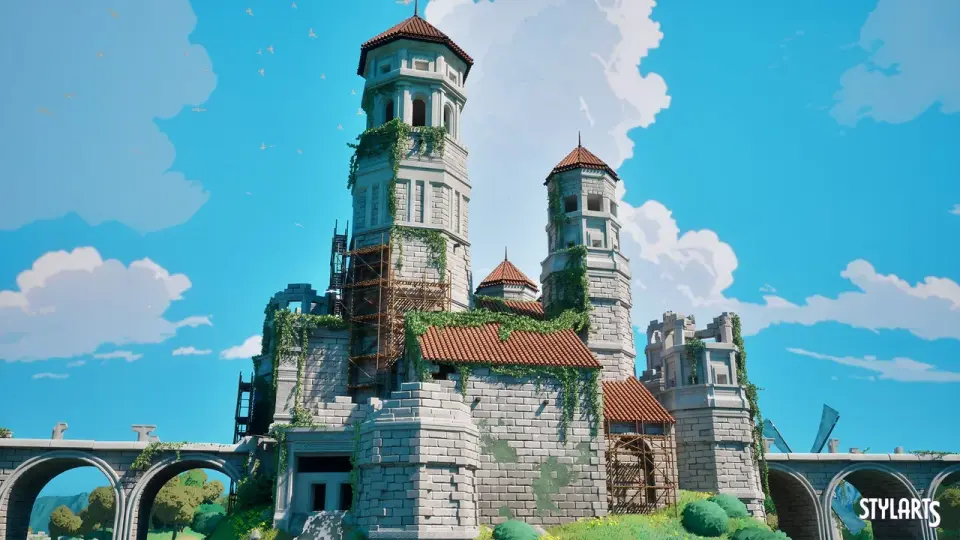
Castle remains, broken stonework, and stylized environmental details tend to shape a scene by layering forms rather than relying on one centerpiece. Stylized Castle Ruins Approaches that process with a set of 114 assets meant to help create or polish environments, giving teams a collection of ruin-themed pieces that can be arranged into broader level spaces. The pack also includes showcased example levels in the project, which shifts it from being only a library of individual assets into something that can also be examined in assembled form.
The overall direction is clear from the name and the included tags: stylized, castle, ruin, stone, water, level, ancient, blueprint, and Lumen. That places the pack in a fantasy-leaning environment space where ruined architecture and surrounding scene dressing matter as much as any single object. Instead of treating the environment as a blank technical setup, it emphasizes assets with unique concepts and high attention to detail, aiming at a stylized ruin setting that can read quickly in a scene while still carrying enough variation to support level building.
Stylized Castle Ruins in scene assembly
The pack contains many different types of assets, and that variety is one of its most practical qualities. Environment work usually involves two overlapping tasks: establishing the main visual identity of a place, then refining it until the scene feels finished. Stylized Castle Ruins is framed around both of those needs. It can be used to create an environment from the ground up, or to polish an existing space by adding ruin elements, stone-based structures, and supporting details that strengthen the ancient castle theme.
Because the project includes showcased example levels, the pack is not limited to disconnected pieces. There is a direct reference for how the assets can sit together inside a built environment. That matters during setup, since example levels often give artists and level teams a quicker way to understand spacing, visual density, and how stylized forms can be combined into a more complete scene. Here, the included levels reinforce the pack’s role as an environment-building set rather than a loose folder of props.
The verified details also point to a demo map. In use, that supports implementation by giving the environment a presented layout, making it easier to inspect the assets in context and judge how the ruin theme carries across a larger level space. Between the raw asset count and the presence of assembled examples, the pack appears structured for both direct use and reference-driven iteration.
114 assets for creating or polishing environments
The asset count is one of the clearest concrete details available: 114 assets are included. The pack is described as containing many different types of assets, which suggests a broader environment set rather than repeated variations of one object class. Since the purpose is to help create or polish environments, the collection is aimed at scene construction and refinement at multiple stages of production.
That scale changes how the pack can be approached. A smaller set often fills a narrow role, but 114 assets can support a more layered workflow. Early on, they can block out the tone of a ruined castle area. Later, they can add secondary forms and details that make the level feel less sparse. The wording also highlights unique concepts of assets, which suggests that visual variety is treated as a core part of the set rather than an afterthought.
High attention to detail and high-quality assets are both explicitly called out. Those phrases are broad, but within this context they point to assets intended to hold up as visible environment pieces, not just background placeholders. Combined with the stylized and ancient tags, the pack is positioned to deliver a deliberate look instead of neutral modular architecture. The focus is still on usability inside a level, though, since the assets are also described as game-ready and optimized.
That pairing is important for implementation. Environment assets need to read well visually, but they also need to function as production-ready pieces. The pack’s stated balance between quality and optimization suggests that it is meant to be used as working level content, not only as visual showcase material.
Material Instances and controllable parameters
One of the more concrete setup details is the inclusion of controllable parameters in material instances. That adds a layer of flexibility beyond static placement. In an environment pack focused on castle ruins, material controls can affect how consistently the assets fit together across a level, especially when artists need to tune the look of stone, surrounding surfaces, or other stylized environmental elements to suit a particular scene.
Even without expanding beyond the verified details, this tells you that the pack is not locked into a single untouched presentation. Material instance controls allow adjustment at the material level, which supports implementation work after the assets have already been placed. That can be useful when moving from rough environment assembly into visual polish, since the same set of assets can be pushed toward a more unified result through parameter changes rather than replacement.
In a practical workflow, that means Stylized Castle Ruins does not stop at providing pieces to drop into a map. It also provides some room to tune those pieces after placement. For teams or solo creators working on stylized scenes, that flexibility can help maintain cohesion across larger spaces where repeated ruin elements might otherwise feel too rigid.
ULAT and fast custom modular buildings
This project includes ULAT, short for Ultimate Level Art Tool. ULAT is also described by its original expanded project name as a modular design development tool for mobile and web-based systems. Within this pack, the important point is what ULAT does in practice: it allows fast creation of custom modular buildings and offers a seamless, distinctive way to populate scenes naturally.
That makes ULAT the most significant workflow-focused part of the package. Stylized Castle Ruins is not only a set of environment assets; it also ties into a tool-centered approach to building space. For ruined castle scenes, modular building speed matters because these environments often depend on arranging repeated structural language into layouts that still feel site-specific. ULAT directly supports that by accelerating custom modular construction.
The mention of natural scene population is equally relevant. Castle ruin environments rarely succeed through architecture alone. They also depend on how surrounding pieces are distributed through the level so the area feels composed rather than mechanically filled. ULAT is presented as a way to populate scenes in a seamless and distinctive manner, which places it between pure construction and environmental dressing.
The pack is also stated to be compatible with the Ultimate Level Art Tool. Since ULAT is included and the environment pack works with it, the relationship between asset library and workflow tool is central rather than optional. For implementation, that means the project is suited to users who want both premade stylized ruin content and a system for arranging modular building elements more quickly.
Ancient stone, water, blueprint, and level-focused usage
The tag set adds a useful final layer to how the pack can be interpreted in actual use. Stone, water, castle, ruin, and ancient define the visual and thematic territory. Blueprint and level point to production context, suggesting relevance to level-building workflows rather than standalone rendering only. Lumen appears as another tag attached to the asset, though no further technical detail is provided beyond its presence.
Taken together, those details point to a pack that fits best when a project needs a stylized ruined castle environment assembled as a playable or explorable space. The strength is not one isolated claim or one technical specification. It is the combination of a 114-asset environment set, example levels included in the project, material instance controls, and integrated ULAT support for modular building and scene population.
For teams evaluating it strictly on practical use, the clearest takeaway is straightforward: Stylized Castle Ruins provides a sizable stylized ruin set with included example levels and a built-in ULAT workflow, making it easier to move from loose scene ideas to assembled ancient castle environments.
 Mountain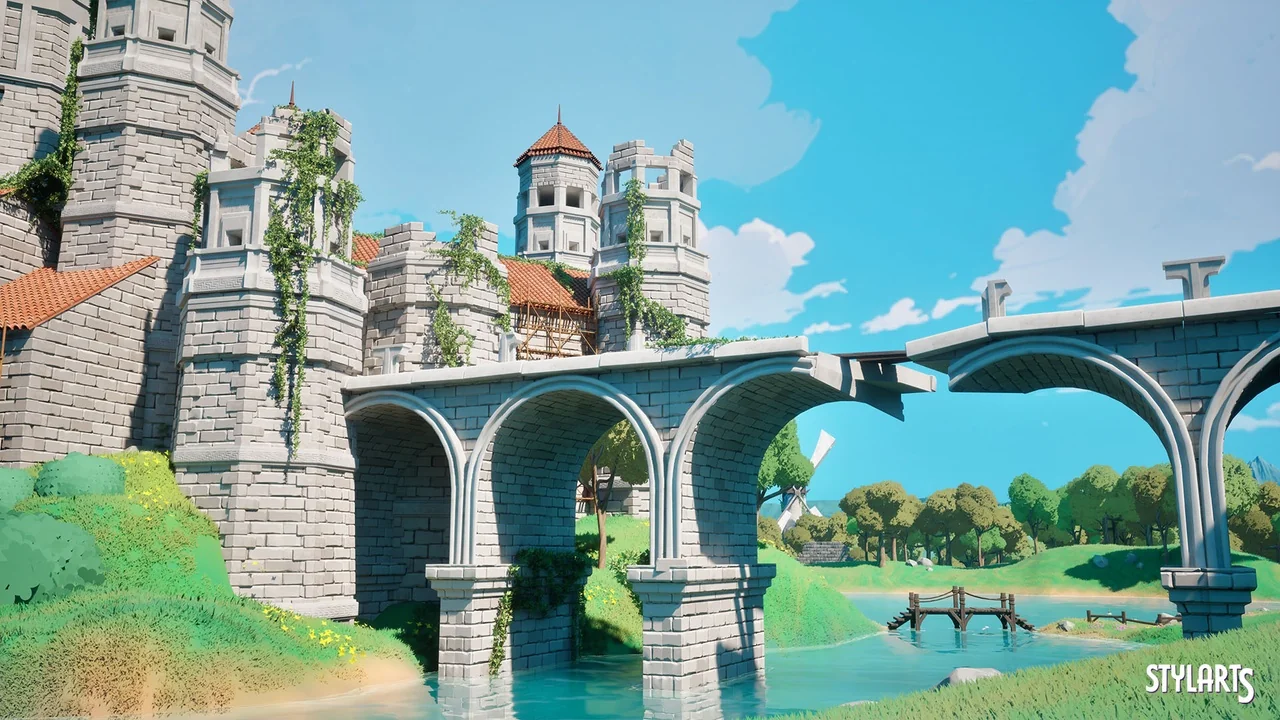
 Fantasy
 Island
 Medieval