"7066dd76da796369"{"id":"27618","slug":"elven-modular-architecture","title":"Elven Modular Architecture","category":"Buildings \u0026 Architecture","engine":"5.0+","assetVersion":"Engine version: 5.0+","engineVersion":"5.0","tag":"Buildings","accent":"blue","visual":"mech","summary":"Elven Modular Architecture brings together modular fantasy building pieces for towns, houses, mansions, castles, and city scenes. It combines Nanite-ready meshes, custom collision, and material controls for moss, dirt, and debris so the look can be adjusted...","platform":"Unreal Engine","publishedAt":"2026-04-26T13:27:49.000Z","updatedAt":"2026-04-26T13:27:50.000Z","sourceNotes":[],"fileContents":[],"compatibility":["Unreal Engine","Engine version: 5.0+"],"featuredImage":{"alt":"Elven Modular Architecture","src":"https://3dcghub.com/wp-content/uploads/2026/04/f362aaf7e1bd_188b6bc3-ef8d-4595-8ec8-e273f7835607.webp"},"hasDownloadLink":true,"downloads":1,"terms":[{"taxonomy":"category","slug":"buildings-and-architecture","name":"Buildings \u0026 Architecture"},{"taxonomy":"post_tag","slug":"environment","name":"Environment"},{"taxonomy":"post_tag","slug":"materials","name":"Materials"},{"taxonomy":"post_tag","slug":"unreal-engine-5","name":"Unreal Engine 5"}],"galleryImages":[{"src":"https://3dcghub.com/wp-content/uploads/2026/04/0ae9ff7654b9_fbac98e5-9946-4ce0-aba4-520a3af3e10c.webp","alt":"Elven Modular Architecture"},{"src":"https://3dcghub.com/wp-content/uploads/2026/04/bf533427f937_0080ce4c-a399-4cde-a92f-f3efbe89aa35.webp","alt":"Elven Modular Architecture"},{"src":"https://3dcghub.com/wp-content/uploads/2026/04/096f189cb757_97b7f749-5909-4b08-b6f9-2769cae96118.webp","alt":"Elven Modular Architecture"},{"src":"https://3dcghub.com/wp-content/uploads/2026/04/f90ef2a1cffd_affe810b-c20f-4e30-86a9-9fb45af359e2.webp","alt":"Elven Modular Architecture"},{"src":"https://3dcghub.com/wp-content/uploads/2026/04/187700eb8714_683ed25f-52f7-49e0-9b00-d4bc9c41e4d3.webp","alt":"Elven Modular Architecture"},{"src":"https://3dcghub.com/wp-content/uploads/2026/04/9e587e32c23e_e4db1663-4bc6-422e-af87-0954237ffd5c.webp","alt":"Elven Modular Architecture"},{"src":"https://3dcghub.com/wp-content/uploads/2026/04/469808aa8edb_dd212215-dce5-4e10-bdf3-1785e24a47fb.webp","alt":"Elven Modular Architecture"},{"src":"https://3dcghub.com/wp-content/uploads/2026/04/786966aca480_d10c942f-cb74-4d51-935e-64614b9b15f8.webp","alt":"Elven Modular Architecture"},{"src":"https://3dcghub.com/wp-content/uploads/2026/04/cb79ab006331_daaa2642-b74c-42ee-aedc-81d0d1d64a87.webp","alt":"Elven Modular Architecture"},{"src":"https://3dcghub.com/wp-content/uploads/2026/04/47472fa15a50_0b41bf97-c241-4520-a0e3-a49fc993edd0.webp","alt":"Elven Modular Architecture"}],"accessPanel":{"kind":"resource","title":"Access this resource","eyebrow":"Free Download","message":"Log in or create a free account to start your download.","fileName":"Content.7z","safetyNote":"All resources are 100% manually reviewed to eliminate all risks.","actionLabel":"Download Free","resourceType":"Resource archive"},"contentHtml":"\u003ch2\u003eElven Modular Architecture for fantasy towns, houses, and castles\u003c/h2\u003e\u003cp\u003eThis modular set provides elven-style architecture that can be assembled into fantasy scenes ranging from small houses to mansions, castles, towns, and cities. It is built to support scene construction where the shape of the environment matters as much as the surface finish. In practice, that means the pieces can form the structural backbone of a settlement before any extra dressing is added.\u003c/p\u003e\u003cp\u003eThe visual direction leans into detail and weathering rather than clean, untouched surfaces. Moss, dirt, and debris can be adjusted globally and per material instance, so the same base pieces can hold up in different parts of a level without looking identical. That flexibility matters in a production workflow where one district might feel older, wetter, or more worn than another.\u003c/p\u003e\u003cp\u003eThe asset also fits naturally into fantasy production needs because the tag set points to a broad mix of scene types: modular, mansion, fantasy, town, house, elf, building, castle, elven, architecture, and city. Those keywords line up with how the pieces can be used in a level that needs both character and repetition control.\u003c/p\u003e\u003ch2\u003eNanite meshes with grid snapping on “Mod” pieces\u003c/h2\u003e\u003cp\u003eEvery mesh is intended for Nanite use, and that changes how the asset fits into a scene build. Instead of depending on traditional LOD setup, the meshes are presented as Nanite meshes with no LODs. That makes the set straightforward to place in a UE5 workflow where high-detail geometry is being handled through Nanite rather than manual level-of-detail chains.\u003c/p\u003e\u003cp\u003ePlacement is also supported by grid snapping on every mesh with \u003cem\u003eMod\u003c/em\u003e In its name. Those pieces snap to a 1 meter grid, with some snapping to 0.5 meter. For environment artists, that makes modular assembly more predictable when blocking out walls, roofs, structural segments, or other repeated architectural forms. The snapping behavior helps the scene stay aligned while still allowing the layout to feel varied.\u003c/p\u003e\u003cp\u003eCustom collision is included as well. That gives the set a practical role beyond visual dressing, since collision is part of how the environment behaves during navigation and interaction. When a modular architectural asset includes collision from the start, it is easier to move from visual assembly into an actual playable space without rebuilding every piece by hand.\u003c/p\u003e\u003ch2\u003eWeathering masks and Material Instance controls\u003c/h2\u003e\u003cp\u003eThe strongest visual control in this set comes from the weathering system. Moss, dirt, and debris can be adjusted both globally and per material instance, which gives the same architecture a wider range of presentation options. One version can read as cleaner and more maintained, while another can push the sense of age and exposure without changing the underlying mesh layout.\u003c/p\u003e\u003cp\u003eMaterial Instance parameters add another layer of control, including Contrast, Brightness, Roughness, and similar surface adjustments. Those controls make it easier to tune how the materials react within a scene, especially when different parts of an environment need to sit under different lighting or mood conditions. The asset is rendered in UE5 using Lumen and Ray Tracing, so these surface settings are part of a lighting setup that already aims for a detailed look.\u003c/p\u003e\u003cp\u003eFor production, that means the asset can move through several stages without becoming locked into one final appearance too early. A level artist can use the same architecture for blockout, then shift the weathering and material response as the rest of the scene develops. That is especially useful in fantasy environments where age, damage, and dampness help define the story of the location.\u003c/p\u003e\u003ch2\u003eUE5 coverage, texture set, and scene fit\u003c/h2\u003e\u003cp\u003eThe package includes 89 unique meshes, 141 materials and material instances, and 87 textures. Texture resolutions are listed at 2048 and 4096, which points to a mixed texture set aimed at detailed architectural surfaces. The combination of unique meshes and a sizable material library suggests a set that is meant to support a broad range of arrangement and surface variation without relying on one repetitive look.\u003c/p\u003e\u003cp\u003eSupported development platforms include Windows and Mac. That makes the asset usable across both platforms listed for development, while the core rendering workflow remains tied to UE5, Lumen, and Ray Tracing. The example map is not included, and the scene shown in the preview uses Megascans assets, so the practical focus stays on the modular architecture itself rather than on a packaged demo environment.\u003c/p\u003e\u003cp\u003eIn a real workflow, this is the kind of asset that can carry the built structure of an elven district, a castle frontage, or a fantasy town scene while leaving room for surrounding dressing and world-building. The most useful takeaway is simple: it gives teams a modular architectural base with Nanite-ready meshes, snap-friendly pieces, custom collision, and adjustable weathering, all centered on UE5 scene assembly.\u003c/p\u003e\n\n\u003ch2\u003eExplore Similar Assets\u003c/h2\u003e\n\u003cul\u003e\n\u003cli\u003e\u003ca href=\"https://3dcghub.com/56-fabric-textile-materials-4k-pbr-collection/\" title=\"56 Fabric \u0026amp;amp; Textile Materials (4K PBR Collection)\"\u003e56 Fabric \u0026amp; Textile Materials (4K PBR Collection)\u003c/a\u003e\u003c/li\u003e\n\u003cli\u003e\u003ca href=\"https://3dcghub.com/advanced-road-materials/\" title=\"Advanced road materials\"\u003eAdvanced road materials\u003c/a\u003e\u003c/li\u003e\n\u003cli\u003e\u003ca href=\"https://3dcghub.com/master-materials-and-layer-system-for-daz3d-imports/\" title=\"Master Materials and Layer System for Daz3D Imports\"\u003eMaster Materials and Layer System for Daz3D Imports\u003c/a\u003e\u003c/li\u003e\n\u003cli\u003e\u003ca href=\"https://3dcghub.com/realistic-materials-vol-7-water-ice-25-materials/\" title=\"Realistic Materials Vol. 7 – Water \u0026amp;amp; Ice (25+ Materials)\"\u003eRealistic Materials Vol. 7 – Water \u0026amp; Ice (25+ Materials)\u003c/a\u003e\u003c/li\u003e\n\u003cli\u003e\u003ca href=\"https://3dcghub.com/stylized-250-materials-bundle/\" title=\"Stylized 250 Materials Bundle\"\u003eStylized 250 Materials Bundle\u003c/a\u003e\u003c/li\u003e\n\u003c/ul\u003e","contentTextLength":5222,"navigation":{"current":2245,"total":4016,"previous":{"id":"27635","slug":"elven-girl-belle","title":"Elven Girl Belle","category":"Characters \u0026 Creatures","platform":"Unreal Engine","updatedAt":"2026-04-27T16:47:46.000Z"},"next":{"id":"27605","slug":"electrocomponents-kitbash","title":"Electrocomponents kitbash","category":"Hardware","platform":"Unreal Engine","updatedAt":"2026-04-26T13:25:03.000Z"}},"relatedResources":[{"id":"27765","slug":"wedding-hall","title":"Wedding Hall","category":"Buildings \u0026 Architecture","engine":"5.1+","assetVersion":"Engine version: 5.1+","engineVersion":"","tag":"Buildings","accent":"blue","visual":"city","summary":"Wedding Hall centers on a classic ceremony space with a realistic appearance and a style shaped by Arabic, baroque, and golden details. It also includes carefully prepared textures and collisions, with Nanite support for Unreal Engine 5.0+.","platform":"Unreal Engine","publishedAt":"2026-04-28T17:30:55.000Z","updatedAt":"2026-04-28T17:30:56.000Z","sourceNotes":[],"fileContents":[],"compatibility":["Unreal Engine","Engine version: 5.1+"],"featuredImage":{"alt":"Wedding Hall","src":"https://3dcghub.com/wp-content/uploads/2026/04/42022b8fbc4e_34e2c74f-b872-4ac6-89c9-9fb29f677fba.webp"},"hasDownloadLink":true,"downloads":1},{"id":"1001459","slug":"suburbs-vol-11-rugs-nanite-and-low-poly","title":"Suburbs VOL.11 - Rugs (Nanite and Low Poly)","category":"Buildings \u0026 Architecture","engine":"5.1+","assetVersion":"","engineVersion":"Engine Version: 5.1+","tag":"Buildings","accent":"blue","visual":"mech","summary":"Explore Suburbs VOL.11 - Rugs featuring 30 Nanite and low-poly meshes, 4K channel-packed textures, master materials, and Lumen support in Unreal Engine.","platform":"Unreal Engine","publishedAt":"2026-10-08T01:04:12.761Z","updatedAt":"2026-10-08T01:04:12.761Z","sourceNotes":[],"fileContents":[],"compatibility":["Unreal Engine","Engine Version: 5.1+"],"featuredImage":{"alt":"Suburbs VOL.11 - Rugs (Nanite and Low Poly)","src":"/wp-content/uploads/published/2026/10/0586d3855e14-a9bb8f28-4c7f-4dd4-916f-6d288e7880b4-2b15276468.webp"},"hasDownloadLink":true,"downloads":1},{"id":"1001564","slug":"ucreate-fractal-toolkit","title":"UCreate - Fractal Toolkit","category":"Buildings \u0026 Architecture","engine":"5.3+","assetVersion":"","engineVersion":"Engine Version: 5.3+","tag":"Buildings","accent":"blue","visual":"mech","summary":"Explore UCreate - Fractal Toolkit for Unreal Engine, featuring 43 materials, procedural deformation blueprints, and modular architectural setups.","platform":"Unreal Engine","publishedAt":"2026-10-10T03:55:40.075Z","updatedAt":"2026-10-10T03:55:40.075Z","sourceNotes":[],"fileContents":[],"compatibility":["Unreal Engine","Engine Version: 5.3+"],"featuredImage":{"alt":"UCreate - Fractal Toolkit","src":"/wp-content/uploads/published/2026/10/e35586eedaeb-85a00bc5-fc61-4b36-8410-f9b57967ce59-4a9eac4256.webp"},"hasDownloadLink":true,"downloads":0}]}
Buildings
Elven Modular Architecture
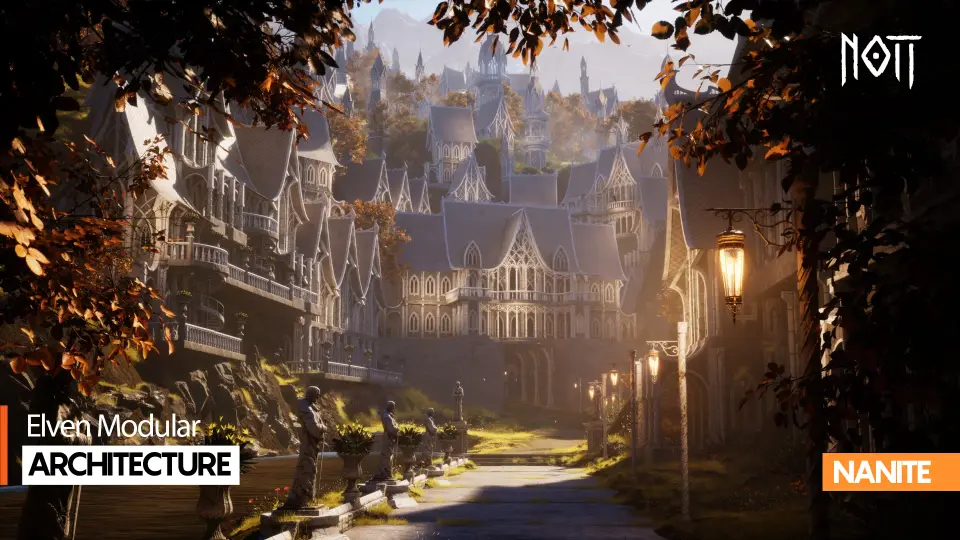
Elven Modular Architecture brings together modular fantasy building pieces for towns, houses, mansions, castles, and city scenes. It combines Nanite-ready meshes, custom collision, and material controls for moss, dirt, and debris so the look can be adjusted...
Elven Modular Architecture for fantasy towns, houses, and castles
This modular set provides elven-style architecture that can be assembled into fantasy scenes ranging from small houses to mansions, castles, towns, and cities. It is built to support scene construction where the shape of the environment matters as much as the surface finish. In practice, that means the pieces can form the structural backbone of a settlement before any extra dressing is added.
The visual direction leans into detail and weathering rather than clean, untouched surfaces. Moss, dirt, and debris can be adjusted globally and per material instance, so the same base pieces can hold up in different parts of a level without looking identical. That flexibility matters in a production workflow where one district might feel older, wetter, or more worn than another.
The asset also fits naturally into fantasy production needs because the tag set points to a broad mix of scene types: modular, mansion, fantasy, town, house, elf, building, castle, elven, architecture, and city. Those keywords line up with how the pieces can be used in a level that needs both character and repetition control.
Nanite meshes with grid snapping on “Mod” pieces
Every mesh is intended for Nanite use, and that changes how the asset fits into a scene build. Instead of depending on traditional LOD setup, the meshes are presented as Nanite meshes with no LODs. That makes the set straightforward to place in a UE5 workflow where high-detail geometry is being handled through Nanite rather than manual level-of-detail chains.
Placement is also supported by grid snapping on every mesh with Mod In its name. Those pieces snap to a 1 meter grid, with some snapping to 0.5 meter. For environment artists, that makes modular assembly more predictable when blocking out walls, roofs, structural segments, or other repeated architectural forms. The snapping behavior helps the scene stay aligned while still allowing the layout to feel varied.
Custom collision is included as well. That gives the set a practical role beyond visual dressing, since collision is part of how the environment behaves during navigation and interaction. When a modular architectural asset includes collision from the start, it is easier to move from visual assembly into an actual playable space without rebuilding every piece by hand.
Weathering masks and Material Instance controls
The strongest visual control in this set comes from the weathering system. Moss, dirt, and debris can be adjusted both globally and per material instance, which gives the same architecture a wider range of presentation options. One version can read as cleaner and more maintained, while another can push the sense of age and exposure without changing the underlying mesh layout.
Material Instance parameters add another layer of control, including Contrast, Brightness, Roughness, and similar surface adjustments. Those controls make it easier to tune how the materials react within a scene, especially when different parts of an environment need to sit under different lighting or mood conditions. The asset is rendered in UE5 using Lumen and Ray Tracing, so these surface settings are part of a lighting setup that already aims for a detailed look.
For production, that means the asset can move through several stages without becoming locked into one final appearance too early. A level artist can use the same architecture for blockout, then shift the weathering and material response as the rest of the scene develops. That is especially useful in fantasy environments where age, damage, and dampness help define the story of the location.
UE5 coverage, texture set, and scene fit
The package includes 89 unique meshes, 141 materials and material instances, and 87 textures. Texture resolutions are listed at 2048 and 4096, which points to a mixed texture set aimed at detailed architectural surfaces. The combination of unique meshes and a sizable material library suggests a set that is meant to support a broad range of arrangement and surface variation without relying on one repetitive look.
Supported development platforms include Windows and Mac. That makes the asset usable across both platforms listed for development, while the core rendering workflow remains tied to UE5, Lumen, and Ray Tracing. The example map is not included, and the scene shown in the preview uses Megascans assets, so the practical focus stays on the modular architecture itself rather than on a packaged demo environment.
In a real workflow, this is the kind of asset that can carry the built structure of an elven district, a castle frontage, or a fantasy town scene while leaving room for surrounding dressing and world-building. The most useful takeaway is simple: it gives teams a modular architectural base with Nanite-ready meshes, snap-friendly pieces, custom collision, and adjustable weathering, all centered on UE5 scene assembly.
 Buildings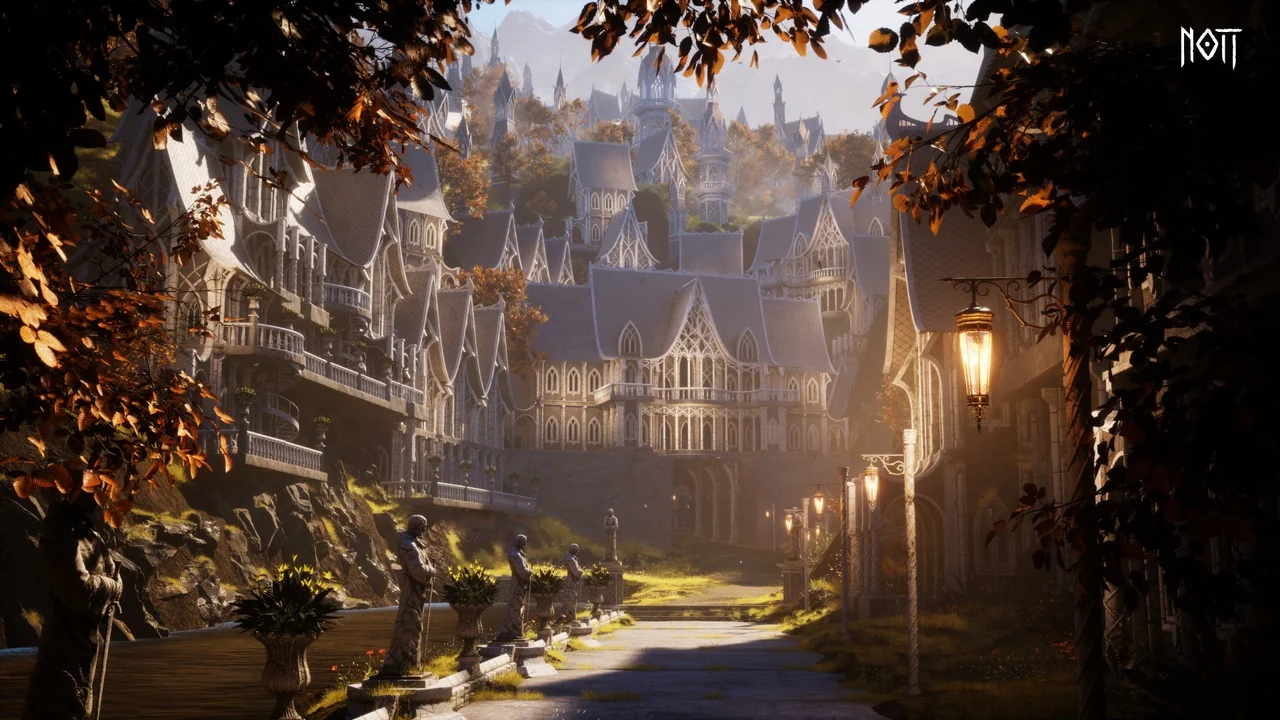
 Buildings
 Buildings
 Buildings