"7b46a695175d8694"{"id":"1000388","slug":"the-abandoned-library","title":"The Abandoned Library","category":"Victorian","engine":"5.1+","assetVersion":"","engineVersion":"Engine Version: 5.1+","tag":"Victorian","accent":"blue","visual":"mech","summary":"Build eerie, neglected environments with 80+ PBR library props, featuring custom dirt materials, runtime stacking Blueprints, and real-time clock mechanics.","platform":"Unreal Engine","publishedAt":"2026-07-07T14:29:08.766Z","updatedAt":"2026-07-07T14:29:08.766Z","sourceNotes":[],"fileContents":[],"compatibility":["Unreal Engine","Engine Version: 5.1+"],"featuredImage":{"alt":"The Abandoned Library","src":"/wp-content/uploads/published/2026/07/de984685fb55-197e4358-4440-421e-b5d7-d644942f922e-005844a0ad.webp"},"hasDownloadLink":true,"downloads":1,"terms":[{"taxonomy":"category","slug":"victorian","name":"Victorian"}],"galleryImages":[{"src":"/wp-content/uploads/published/2026/07/daad79bf8d6d-87391c4b-26e7-44ac-943e-c583aac4f38a-e74d7807ae.webp","alt":"The Abandoned Library"},{"src":"/wp-content/uploads/published/2026/07/76fc9badc8d0-0e53e652-43ca-4c45-860a-054a2a3806f5-4ea05aafcc.webp","alt":"The Abandoned Library"},{"src":"/wp-content/uploads/published/2026/07/3059607b0b6d-24c003d6-3539-4fb0-864d-fa9c3cc74257-93a2deb977.webp","alt":"The Abandoned Library"},{"src":"/wp-content/uploads/published/2026/07/ac3393a23c08-9f308d98-6a3e-4f25-a711-59bc086de3c3-f90882aab7.webp","alt":"The Abandoned Library"},{"src":"/wp-content/uploads/published/2026/07/6b917ac7b24e-e5363016-0e5c-47ee-bd51-237bd201d212-ee231ba6af.webp","alt":"The Abandoned Library"},{"src":"/wp-content/uploads/published/2026/07/922faa2201f0-3b5aaba2-4244-460b-a52c-931931c55b14-84c6c97aee.webp","alt":"The Abandoned Library"},{"src":"/wp-content/uploads/published/2026/07/23226c5fb8c8-4367c65f-ab99-4b1a-9598-c64fce13ce59-9c8355896b.webp","alt":"The Abandoned Library"},{"src":"/wp-content/uploads/published/2026/07/2ed63bcf6728-769c6999-fb2b-4555-8dc9-f6c23fede8f1-aa8b4d4418.webp","alt":"The Abandoned Library"},{"src":"/wp-content/uploads/published/2026/07/8ee641a5e665-40a8a0e5-958e-485e-bbc9-9e35f087ae3a-6262bcdbfe.webp","alt":"The Abandoned Library"},{"src":"/wp-content/uploads/published/2026/07/dfe7ef933b0b-ed483cd6-fb47-4f97-a9ec-0a7c42638919-8ee739371e.webp","alt":"The Abandoned Library"}],"accessPanel":{"kind":"resource","title":"Download this resource","eyebrow":"Free Download","message":"Log in or create a free account to start your download.","fileName":"Content.7z","safetyNote":"Resources are manually reviewed before listing to improve quality and reduce obvious risks.","actionLabel":"Download Free","resourceType":"Resource archive"},"contentHtml":"\u003ch2\u003ePopulating the Neglected Interior\u003c/h2\u003e\n\u003cp\u003eConstructing an eerie, forgotten interior requires a versatile set of structural and decorative assets. Implementing The Abandoned Library into an Unreal Engine environment starts with laying out its foundational furniture. The collection provides over 80 individual meshes, focusing heavily on the core architecture of a reading room or study. Developers can block out the primary space using the provided bookcases, heavy wooden tables, and chairs. Because the structural pieces are separated, the layout can be customized to fit tight, claustrophobic haunted corridors or expansive, medieval fantasy archives.\u003c/p\u003e\n\u003cp\u003eOnce the primary furniture is placed, the implementation shifts to detailed set dressing. The atmosphere of a space frozen in time is achieved through the specific thematic props included in the set. Dusty shelves can be populated with an array of old books, including specialized demonology texts that push the narrative toward horror or dark fantasy. A neglected Ouija board serves as a focal point for environmental storytelling, hinting at past mysteries and occult activities. By combining the standard library furniture with these cinematic, creepy accents, the environment quickly establishes a detailed, haunted aesthetic suitable for both interactive levels and rendered sequences.\u003c/p\u003e\n\u003ch2\u003eConfiguring Custom Dirt Materials\u003c/h2\u003e\n\u003cp\u003eAfter the spatial layout is complete, adjusting the visual wear and tear is the next step in the workflow. Rather than relying on static textures that look identical across multiple instances of a prop, the assets utilize custom material parameters built into their PBR workflow. These parameters grant direct control over the environmental decay of the objects, ensuring that a room filled with identical bookcases still feels organic and unevenly aged.\u003c/p\u003e\n\u003cp\u003eDevelopers can adjust the specific amount of dirt applied to the surfaces of the tables, chairs, and books. This flexibility is crucial when optimizing a scene; a chair placed near a broken window might require a heavier accumulation of grime compared to a book tucked safely inside a closed shelf. Additionally, the color of the dirt can be modified. This allows the assets to adapt to different environmental contexts, shifting easily from dry, gray dust in a sealed medieval keep to dark, damp soil in a rotting haunted mansion. Controlling these PBR material parameters directly within the engine eliminates the need to export assets to external texturing software just to iterate on the level of neglect.\u003c/p\u003e\n\u003ch2\u003eRuntime Stacking and Blueprint Mechanics\u003c/h2\u003e\n\u003cp\u003eBeyond static meshes and material instances, the environment incorporates interactive elements through included Blueprint functionality. A key technical feature is the ability to handle item stacking at runtime. In many level designs, props like old books are merged into single static meshes to save performance, but this limits player interaction and makes the environment feel rigid.\u003c/p\u003e\n\u003cp\u003eThe included Blueprint logic allows items to be dynamically stacked while the application is running. This functionality is particularly useful for physics-based puzzles, interactive horror exploration, or any scenario where a player needs to manipulate the clutter of the abandoned space. It shifts the assets from being purely visual background elements to active components of the gameplay environment. Implementing this Blueprint allows developers to create messy, disorganized piles of demonology books that respond to the physics of the game world, reinforcing the chaotic, neglected state of the library.\u003c/p\u003e\n\u003ch2\u003eSynchronizing the Real-Time Grandfather Clock\u003c/h2\u003e\n\u003cp\u003eOne of the most distinct technical implementations in the collection is the grandfather clock. Rather than operating on a pre-baked animation loop or a static mesh display, the clock is designed to capture and display the local time. This feature requires specific attention during setup, as it pulls data directly from the host machine to drive the visual state of the prop.\u003c/p\u003e\n\u003cp\u003eThis real-time synchronization adds a unique layer of immersion to the environment. When placed in a cinematic scene or a playable level, the grandfather clock reads the actual system time of the local hardware and updates its hands accordingly. In a horror or eerie fantasy setting, tying a digital prop to the real-world clock bridges the gap between the player's physical environment and the virtual space. It provides a highly specific, functional prop that operates independently of the engine's internal game-time logic, making it a standout set piece for atmospheric world-building.\u003c/p\u003e\n\u003ch2\u003eLumen Integration for Unreal Engine 5.1+\u003c/h2\u003e\n\u003cp\u003eEnsuring these detailed props and dynamic materials render correctly requires specific lighting setups, particularly when dealing with the heavy occlusion found in a dense library. The collection is explicitly built to support Lumen, Unreal Engine's fully dynamic global illumination and reflections system, with verified compatibility for Unreal Engine 5.1 and higher.\u003c/p\u003e\n\u003cp\u003eUtilizing Lumen in conjunction with these PBR meshes means that light bouncing off the dusty bookcases or the polished wood of the grandfather clock will react accurately to the custom dirt parameters. If a developer dynamically changes the dirt color to a dark, matte grime, Lumen will naturally reduce the specular reflections in that area without the need to rebake lightmaps. Setting up Lumen for this environment involves enabling global illumination and reflections in the project settings, ensuring that the intricate details of the demonology books and the subtle wear on the chairs are accurately illuminated.\u003c/p\u003e\n\u003ch2\u003eProduction Readiness\u003c/h2\u003e\n\u003cp\u003eStructuring a level with The Abandoned Library provides a complete pipeline from initial block-out to final dynamic lighting. By combining the 80+ architectural meshes with runtime Blueprint stacking, real-time localized time tracking, and customizable dirt materials, the assets are prepared for immediate integration into complex projects. The native support for Lumen in Unreal Engine 5.1+ ensures that the transition from placing medieval furniture to finalizing the atmospheric lighting of a haunted interior remains a streamlined, engine-native process.\u003c/p\u003e\n\n\u003ch2\u003eRelated Resources Worth Checking\u003c/h2\u003e\n\u003cul\u003e\n\u003cli\u003e\u003ca href=\"https://3dcghub.com/victorian-market-in-abandoned-factory-building-victorian-market-abandoned/\" title=\"Victorian Market in Abandoned Factory Building ( Victorian Market Abandoned )\"\u003eVictorian Market in Abandoned Factory Building ( Victorian Market Abandoned )\u003c/a\u003e\u003c/li\u003e\n\u003cli\u003e\u003ca href=\"https://3dcghub.com/abandoned-industrial-tunnel/\" title=\"Abandoned Industrial Tunnel\"\u003eAbandoned Industrial Tunnel\u003c/a\u003e\u003c/li\u003e\n\u003cli\u003e\u003ca href=\"https://3dcghub.com/abandoned-shed/\" title=\"Abandoned shed\"\u003eAbandoned shed\u003c/a\u003e\u003c/li\u003e\n\u003cli\u003e\u003ca href=\"https://3dcghub.com/highschool-classroom/\" title=\"HighSchool Classroom\"\u003eHighSchool Classroom\u003c/a\u003e\u003c/li\u003e\n\u003cli\u003e\u003ca href=\"https://3dcghub.com/abandoned-gas-station-post-apocalyptic/\" title=\"Abandoned Gas Station - Post Apocalyptic\"\u003eAbandoned Gas Station - Post Apocalyptic\u003c/a\u003e\u003c/li\u003e\n\u003c/ul\u003e","contentTextLength":6415,"navigation":{"current":1232,"total":3481,"previous":{"id":"1000389","slug":"pedestrians","title":"Pedestrians","category":"Gestures","platform":"Unreal Engine","updatedAt":"2026-07-07T14:36:23.705Z"},"next":{"id":"1000387","slug":"norwegian-winter-island-village-megapack","title":"Norwegian Winter Island Village Megapack","category":"Forest \u0026 Jungle","platform":"Unreal Engine","updatedAt":"2026-07-07T13:18:53.504Z"}},"relatedResources":[{"id":"1001163","slug":"auge-mountaintop-observatory","title":"Auge Mountaintop Observatory","category":"Victorian","engine":"5.2+","assetVersion":"","engineVersion":"Engine Version: 5.2+","tag":"Victorian","accent":"blue","visual":"mech","summary":"Technical breakdown of the Auge Mountaintop Observatory environment for Unreal Engine, covering Nanite foliage, master materials, and Lumen support.","platform":"Unreal Engine","publishedAt":"2026-09-11T14:10:48.446Z","updatedAt":"2026-09-11T14:10:48.446Z","sourceNotes":[],"fileContents":[],"compatibility":["Unreal Engine","Engine Version: 5.2+"],"featuredImage":{"alt":"Auge Mountaintop Observatory","src":"/wp-content/uploads/published/2026/09/0c65b7aa82d4-ca18a121-ba99-4635-ab99-6a85c43a0203-928d2f0860.webp"},"hasDownloadLink":true,"downloads":3},{"id":"10231","slug":"victorian-market-in-abandoned-factory-building-victorian-market-abandoned","title":"Victorian Market in Abandoned Factory Building ( Victorian Market Abandoned )","category":"Victorian","engine":"5.0+","assetVersion":"Engine version: 5.0+","engineVersion":"5.0","tag":"Victorian","accent":"blue","visual":"city","summary":"Discover a high-quality environment pack featuring 230 unique meshes and the Ultimate Level Art Tool for rapid scene creation. This Victorian Market set is optimized for game-ready projects and virtual production.","platform":"Unreal Engine","publishedAt":"2026-03-02T17:27:13.000Z","updatedAt":"2026-04-19T15:50:05.000Z","sourceNotes":[],"fileContents":[],"compatibility":["Unreal Engine","Engine version: 5.0+"],"featuredImage":{"alt":"Victorian Market in Abandoned Factory Building ( Victorian Market Abandoned )","src":"https://3dcghub.com/wp-content/uploads/2026/03/a4f20d56-7cf2-4d80-a187-e528838d5e6f.webp"},"hasDownloadLink":true,"downloads":0},{"id":"1000678","slug":"sicka-mansion","title":"SICKA MANSION","category":"Victorian","engine":"5.2+","assetVersion":"","engineVersion":"Engine Version: 5.2+","tag":"Victorian","accent":"blue","visual":"mech","summary":"SICKA MANSION delivers a full Victorian horror environment with nearly 200 props, character system, object inspection, hybrid lighting, and Niagara particles fo","platform":"Unreal Engine","publishedAt":"2026-07-22T14:53:18.949Z","updatedAt":"2026-07-22T14:53:18.949Z","sourceNotes":[],"fileContents":[],"compatibility":["Unreal Engine","Engine Version: 5.2+"],"featuredImage":{"alt":"SICKA MANSION","src":"/wp-content/uploads/published/2026/07/fa310693b10c-f45a39a2-9014-4980-bf08-dffeba55ee22-3178646f95.webp"},"hasDownloadLink":true,"downloads":0}]}
Victorian
The Abandoned Library
Build eerie, neglected environments with 80+ PBR library props, featuring custom dirt materials, runtime stacking Blueprints, and real-time clock mechanics.
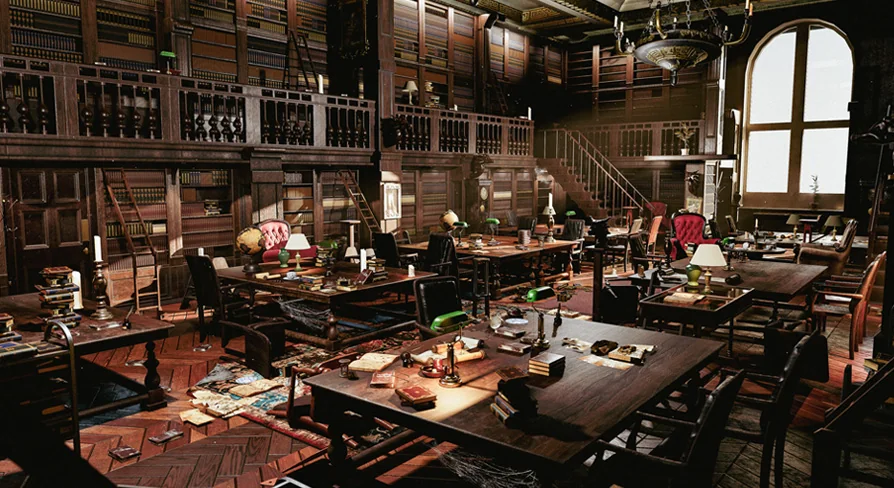
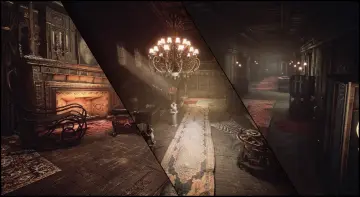
Constructing an eerie, forgotten interior requires a versatile set of structural and decorative assets. Implementing The Abandoned Library into an Unreal Engine environment starts with laying out its foundational furniture. The collection provides over 80 individual meshes, focusing heavily on the core architecture of a reading room or study. Developers can block out the primary space using the provided bookcases, heavy wooden tables, and chairs. Because the structural pieces are separated, the layout can be customized to fit tight, claustrophobic haunted corridors or expansive, medieval fantasy archives.
Once the primary furniture is placed, the implementation shifts to detailed set dressing. The atmosphere of a space frozen in time is achieved through the specific thematic props included in the set. Dusty shelves can be populated with an array of old books, including specialized demonology texts that push the narrative toward horror or dark fantasy. A neglected Ouija board serves as a focal point for environmental storytelling, hinting at past mysteries and occult activities. By combining the standard library furniture with these cinematic, creepy accents, the environment quickly establishes a detailed, haunted aesthetic suitable for both interactive levels and rendered sequences.
Configuring Custom Dirt Materials
After the spatial layout is complete, adjusting the visual wear and tear is the next step in the workflow. Rather than relying on static textures that look identical across multiple instances of a prop, the assets utilize custom material parameters built into their PBR workflow. These parameters grant direct control over the environmental decay of the objects, ensuring that a room filled with identical bookcases still feels organic and unevenly aged.
Developers can adjust the specific amount of dirt applied to the surfaces of the tables, chairs, and books. This flexibility is crucial when optimizing a scene; a chair placed near a broken window might require a heavier accumulation of grime compared to a book tucked safely inside a closed shelf. Additionally, the color of the dirt can be modified. This allows the assets to adapt to different environmental contexts, shifting easily from dry, gray dust in a sealed medieval keep to dark, damp soil in a rotting haunted mansion. Controlling these PBR material parameters directly within the engine eliminates the need to export assets to external texturing software just to iterate on the level of neglect.
Runtime Stacking and Blueprint Mechanics
Beyond static meshes and material instances, the environment incorporates interactive elements through included Blueprint functionality. A key technical feature is the ability to handle item stacking at runtime. In many level designs, props like old books are merged into single static meshes to save performance, but this limits player interaction and makes the environment feel rigid.
The included Blueprint logic allows items to be dynamically stacked while the application is running. This functionality is particularly useful for physics-based puzzles, interactive horror exploration, or any scenario where a player needs to manipulate the clutter of the abandoned space. It shifts the assets from being purely visual background elements to active components of the gameplay environment. Implementing this Blueprint allows developers to create messy, disorganized piles of demonology books that respond to the physics of the game world, reinforcing the chaotic, neglected state of the library.
Synchronizing the Real-Time Grandfather Clock
One of the most distinct technical implementations in the collection is the grandfather clock. Rather than operating on a pre-baked animation loop or a static mesh display, the clock is designed to capture and display the local time. This feature requires specific attention during setup, as it pulls data directly from the host machine to drive the visual state of the prop.
This real-time synchronization adds a unique layer of immersion to the environment. When placed in a cinematic scene or a playable level, the grandfather clock reads the actual system time of the local hardware and updates its hands accordingly. In a horror or eerie fantasy setting, tying a digital prop to the real-world clock bridges the gap between the player's physical environment and the virtual space. It provides a highly specific, functional prop that operates independently of the engine's internal game-time logic, making it a standout set piece for atmospheric world-building.
Lumen Integration for Unreal Engine 5.1+
Ensuring these detailed props and dynamic materials render correctly requires specific lighting setups, particularly when dealing with the heavy occlusion found in a dense library. The collection is explicitly built to support Lumen, Unreal Engine's fully dynamic global illumination and reflections system, with verified compatibility for Unreal Engine 5.1 and higher.
Utilizing Lumen in conjunction with these PBR meshes means that light bouncing off the dusty bookcases or the polished wood of the grandfather clock will react accurately to the custom dirt parameters. If a developer dynamically changes the dirt color to a dark, matte grime, Lumen will naturally reduce the specular reflections in that area without the need to rebake lightmaps. Setting up Lumen for this environment involves enabling global illumination and reflections in the project settings, ensuring that the intricate details of the demonology books and the subtle wear on the chairs are accurately illuminated.
Production Readiness
Structuring a level with The Abandoned Library provides a complete pipeline from initial block-out to final dynamic lighting. By combining the 80+ architectural meshes with runtime Blueprint stacking, real-time localized time tracking, and customizable dirt materials, the assets are prepared for immediate integration into complex projects. The native support for Lumen in Unreal Engine 5.1+ ensures that the transition from placing medieval furniture to finalizing the atmospheric lighting of a haunted interior remains a streamlined, engine-native process.
 Victorian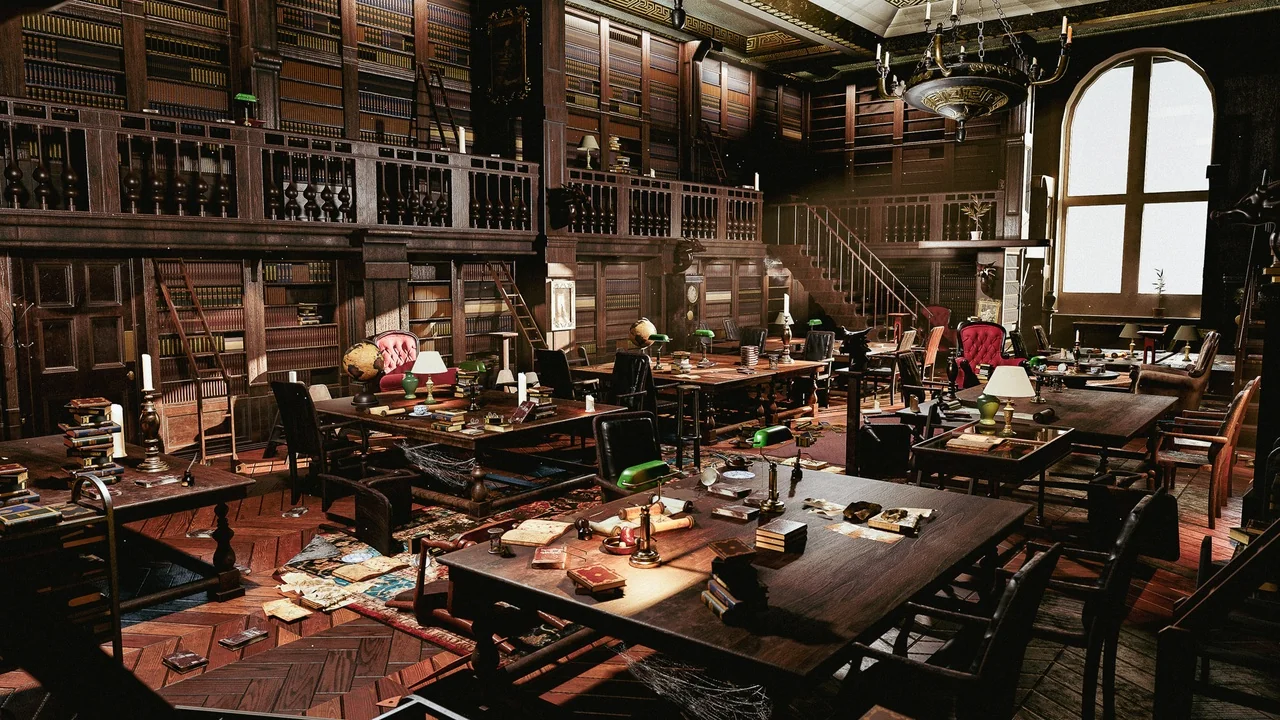
 Victorian
 Victorian
 Victorian