"031373f479d9561a"{"id":"28590","slug":"buildings-vol-3-attachments-nanite-and-low-poly","title":"Buildings VOL.3 - Attachments (Nanite and Low Poly)","category":"Packs","engine":"5.1+","assetVersion":"Engine version: 5.1+","engineVersion":"","tag":"Packs","accent":"blue","visual":"audio","summary":"Buildings VOL.3 - Attachments (Nanite and Low Poly) focuses on the smaller structural and utility pieces that give interiors and exteriors believable function. With matching Nanite and low poly versions, 4K textures, and a shared material setup, it fits pro...","platform":"Unreal Engine","publishedAt":"2026-05-17T13:14:04.000Z","updatedAt":"2026-05-17T13:14:05.000Z","sourceNotes":[],"fileContents":[],"compatibility":["Unreal Engine","Engine version: 5.1+"],"featuredImage":{"alt":"Buildings VOL.3 - Attachments (Nanite and Low Poly)","src":"https://3dcghub.com/wp-content/uploads/2026/05/8a5e8006583e_2f3d4470-56b3-4748-9407-11317273be5e.webp"},"hasDownloadLink":true,"downloads":0,"terms":[{"taxonomy":"category","slug":"packs","name":"Packs"},{"taxonomy":"post_tag","slug":"environment","name":"Environment"},{"taxonomy":"post_tag","slug":"prop","name":"Prop"},{"taxonomy":"post_tag","slug":"unreal-engine-5","name":"Unreal Engine 5"}],"galleryImages":[{"src":"https://3dcghub.com/wp-content/uploads/2026/05/a3fddee72fce_e5c8550e-8299-4446-af75-2c725c8d2c1c.webp","alt":"Buildings VOL.3 - Attachments (Nanite and Low Poly)"},{"src":"https://3dcghub.com/wp-content/uploads/2026/05/7a23972965bc_477360fd-f265-4254-8a17-a0dcf029ae67.webp","alt":"Buildings VOL.3 - Attachments (Nanite and Low Poly)"},{"src":"https://3dcghub.com/wp-content/uploads/2026/05/b0505571d217_80cfc946-1b58-4689-8284-892c69bd7952.webp","alt":"Buildings VOL.3 - Attachments (Nanite and Low Poly)"},{"src":"https://3dcghub.com/wp-content/uploads/2026/05/c74f4d95db04_25548ded-2509-4649-8a70-bd7a72f50463.webp","alt":"Buildings VOL.3 - Attachments (Nanite and Low Poly)"},{"src":"https://3dcghub.com/wp-content/uploads/2026/05/7a2ca7367f83_319e7d25-e84e-47b2-9856-c4e2f0470418.webp","alt":"Buildings VOL.3 - Attachments (Nanite and Low Poly)"},{"src":"https://3dcghub.com/wp-content/uploads/2026/05/781e04762132_ba88a6f6-c490-4de0-8c46-ff8c74c88e7c.webp","alt":"Buildings VOL.3 - Attachments (Nanite and Low Poly)"},{"src":"https://3dcghub.com/wp-content/uploads/2026/05/a2491ab496fb_ffe5642e-d084-4be8-a301-ea8c9570aa4f.webp","alt":"Buildings VOL.3 - Attachments (Nanite and Low Poly)"},{"src":"https://3dcghub.com/wp-content/uploads/2026/05/b6af5aa2014d_70771cbc-dce4-4737-9ea2-808cefc48690.webp","alt":"Buildings VOL.3 - Attachments (Nanite and Low Poly)"},{"src":"https://3dcghub.com/wp-content/uploads/2026/05/fec18e123cb1_e510dc1b-fe80-45ea-827a-e07ea1118aff.webp","alt":"Buildings VOL.3 - Attachments (Nanite and Low Poly)"},{"src":"https://3dcghub.com/wp-content/uploads/2026/05/3cdf9de98706_a43b1332-2d58-4bb0-9558-f8f506550929.webp","alt":"Buildings VOL.3 - Attachments (Nanite and Low Poly)"}],"accessPanel":{"kind":"resource","title":"Access this resource","eyebrow":"Free Download","message":"Log in or create a free account to start your download.","fileName":"Content.7z","safetyNote":"All resources are 100% manually reviewed to eliminate all risks.","actionLabel":"Download Free","resourceType":"Resource archive"},"contentHtml":"\u003cp\u003eScene realism often comes from the parts that do not dominate the frame. Vents, ducts, doors, circulation pieces, exit elements, extinguishers, and other building attachments are the details that make an environment feel used, navigable, and credible. \u003cstrong\u003eBuildings VOL.3 - Attachments (Nanite and Low Poly)\u003c/strong\u003e Leans directly into that layer of production, supplying a large collection of supporting assets, maps, and materials created in Unreal Engine for realistic AAA-quality visuals, style, and budget.\u003c/p\u003e \u003cp\u003eThe set includes everything pictured and approaches those pieces as more than filler. These are fully detailed models from all sides, which makes them suitable for scenes where the camera may move close, orbit around props, or catch them from unexpected angles. For artists building houses, larger building exteriors, or interior spaces with visible utility infrastructure, that full-sided treatment matters. A vent fixed high on a wall, a duct crossing a ceiling, or an attachment placed near an exit can appear in the foreground or background and still hold up as part of the environment rather than reading like a shortcut.\u003c/p\u003e \u003ch2\u003eBuilding attachments that shape how a space functions\u003c/h2\u003e\n\u003cp\u003eThe identity of this set is practical and architectural. The tag set points to vents, ventilation, ducts, structures, doors, exits, circulation elements, house details, exterior pieces, interior pieces, and attachments that support everyday building logic. That gives the pack a clear role inside environment work: it helps spaces look operational.\u003c/p\u003e \u003cp\u003eIn a scene, these kinds of assets do two jobs at once. First, they add visual density. A bare hallway, roofline, utility room, or service corridor can feel unfinished until smaller fixtures and attachments explain how air moves, where maintenance access happens, or how safety equipment is placed. Second, they help sell purpose. A building with doors, ducts, vents, and extinguishers feels structured around use, not just shape.\u003c/p\u003e \u003cp\u003eThat makes the collection useful across both interior and exterior composition. Exterior walls can gain surface complexity through attached structural and ventilation elements. Interior rooms can be pushed closer to believable occupancy by mixing functional pieces into corners, ceilings, access routes, and transitional spaces. Even when these props are not the focal point, they influence how a player or viewer reads the environment.\u003c/p\u003e \u003ch2\u003e290 meshes with Nanite and low poly versions\u003c/h2\u003e\n\u003cp\u003eScale is one of the strongest practical points here. The project includes \u003cstrong\u003e290 meshes\u003c/strong\u003e, split into \u003cstrong\u003e145 Nanite versions\u003c/strong\u003e And \u003cstrong\u003e145 low poly versions\u003c/strong\u003e. That one-to-one pairing gives teams two paths through the same visual category of assets.\u003c/p\u003e \u003cp\u003eThe Nanite versions are constructed for high-fidelity polycounts, which suits scenes where geometric richness is part of the look. If an environment depends on close inspection or wants those smaller structural pieces to carry sharper physical presence, the Nanite side of the set supports that direction. At the same time, the inclusion of low poly versions keeps the pack practical for broader game production needs. It means artists and developers are not locked into one geometry strategy when dressing a level.\u003c/p\u003e \u003cp\u003eThis dual structure also helps when the same building language needs to serve different scene demands. One area may benefit from the higher-fidelity Nanite approach, while another may call for the low poly version as part of a more performance-conscious setup. Because both versions exist across the same 145 asset types, the pack offers consistency in subject matter without forcing a single technical route.\u003c/p\u003e \u003cp\u003eThe collection is also described as optimized for games, which places those mesh options in a production-minded context. The point is not just to provide detailed attachments, but to make them usable in interactive environments where visual quality and scene efficiency both matter.\u003c/p\u003e \u003ch2\u003e4K textures and a master material setup for consistent scene dressing\u003c/h2\u003e\n\u003cp\u003eTexture quality plays a major role in how support props sit inside a realistic environment, especially when the objects are familiar and easy to judge. This project includes high-quality, high-fidelity texture sets at \u003cstrong\u003e4K\u003c/strong\u003e, giving surfaces enough resolution to carry convincing material definition across building attachments and utility pieces.\u003c/p\u003e \u003cp\u003eThat texture work is paired with a \u003cstrong\u003eMaster material setup\u003c/strong\u003e That controls the majority of props and models. In production terms, that is a meaningful part of the package. A shared material framework helps maintain visual consistency across many object types, which is especially helpful when working with an attachment-heavy set. Small structural props often appear in groups, and inconsistencies between them become visible quickly. A master material approach supports a more unified result.\u003c/p\u003e \u003cp\u003eThe material system also includes additional controls for \u003cstrong\u003eRoughness, albedo, normals, and more\u003c/strong\u003e. That gives artists room to tune the appearance of assets to better match a specific scene treatment while staying within the existing material structure. A cleaner residential space, a harsher industrial corner, or a slightly altered lighting context can all benefit from controlled adjustment rather than one locked surface response.\u003c/p\u003e \u003cp\u003eThe project also uses channel-packed \u003cstrong\u003eRoughness, Metalness, and Ambient Occlusion\u003c/strong\u003e. That detail speaks to a workflow that is organized for game-ready use inside Unreal Engine. It keeps the texture and material side grounded in established production practice rather than treating these props as isolated showcase models.\u003c/p\u003e \u003ch2\u003eLumen support and the Unreal Engine look\u003c/h2\u003e\n\u003cp\u003eEverything in the project, including assets, maps, and materials, is created in Unreal Engine, and the set supports \u003cstrong\u003eLumen for Unreal Engine 5.0+\u003c/strong\u003e. This helps because building attachments are strongly affected by lighting. Vents, ducts, doors, and structural add-ons gain much of their presence through subtle shadowing, reflected light, edge definition, and the way they break up otherwise flat surfaces.\u003c/p\u003e \u003cp\u003eThe inclusion of a \u003cstrong\u003eRealistic Post Process and Look Up Table\u003c/strong\u003e Pushes that even further. Instead of treating the attachments as neutral objects only, the project includes the image treatment needed to support the intended visual tone. For teams exploring realistic environment presentation, that pairing of detailed assets with a defined post-processing look can help the whole set read as part of a finished scene language.\u003c/p\u003e \u003cp\u003eLumen support also makes sense for this particular category of props because they often live in transitional light conditions: under overhangs, inside hallways, near doors, against exterior walls, or in interior service areas. These are places where indirect light and subtle contrast can determine whether the environment feels convincing. The set is positioned to work within that lighting model inside Unreal Engine 5.0 and above.\u003c/p\u003e \u003ch2\u003eRealistic AAA quality without borrowed branding\u003c/h2\u003e\n\u003cp\u003eThe assets are created for \u003cstrong\u003eRealistic AAA-quality visuals, style, and budget\u003c/strong\u003e, which defines the aesthetic target clearly. This is not a stylized or abstract attachment collection. The emphasis is on believable, production-oriented building details that can support grounded environments.\u003c/p\u003e \u003cp\u003eAnother useful point is that the branding and labels are custom made by the studio, with the set described as free of legal issues on that front. For environment artists, that means the included details are not relying on outside real-world branding to create authenticity. The pack aims for realism through original production work rather than borrowed identity marks.\u003c/p\u003e \u003cp\u003eThat can be important for props like extinguishers, signage-adjacent pieces, and utility fixtures where labels and surface markings often become part of the visual read. Here, those elements are handled as custom-made content while still fitting the realistic direction of the set.\u003c/p\u003e \u003ch2\u003eWhere Buildings VOL.3 - Attachments fits best\u003c/h2\u003e\n\u003cp\u003eThis collection fits projects that need the connective tissue of a believable built space: the pieces that sit on walls, hang overhead, guide circulation, mark exits, support ventilation, or complete a room that would otherwise feel too clean and too empty. Because it includes both Nanite and low poly versions, it can serve teams balancing fidelity and game-focused optimization inside the same Unreal Engine workflow.\u003c/p\u003e \u003cp\u003eThe 290-mesh scope, 4K texture sets, shared material controls, channel-packed maps, realistic post process treatment, and Lumen support all reinforce the same idea. This is a utility-driven environment set with a realistic target, meant to help interiors and exteriors look fully equipped rather than merely assembled from large structural forms. The strongest takeaway is simple: if a scene needs the functional attachments that make a building feel complete, this pack addresses that layer directly and at substantial scale.\u003c/p\u003e\n\n\u003ch2\u003eMore From The Same Workflow\u003c/h2\u003e\n\u003cul\u003e\n\u003cli\u003e\u003ca href=\"https://3dcghub.com/mountain-village-environment-village-modular-village-houses-village-props/\" title=\"Mountain Village Environment (Village, Modular Village Houses, Village Props)\"\u003eMountain Village Environment (Village, Modular Village Houses, Village Props)\u003c/a\u003e\u003c/li\u003e\n\u003cli\u003e\u003ca href=\"https://3dcghub.com/medieval-props-kit/\" title=\"Medieval Props Kit\"\u003eMedieval Props Kit\u003c/a\u003e\u003c/li\u003e\n\u003cli\u003e\u003ca href=\"https://3dcghub.com/medieval-props-pack/\" title=\"Medieval Props Pack\"\u003eMedieval Props Pack\u003c/a\u003e\u003c/li\u003e\n\u003cli\u003e\u003ca href=\"https://3dcghub.com/military-props-pack-high-quality-3d-assets-for-game-dev/\" title=\"Military Props Pack\"\u003eMilitary Props Pack\u003c/a\u003e\u003c/li\u003e\n\u003c/ul\u003e","contentTextLength":9026,"navigation":{"current":1359,"total":3223,"previous":{"id":"28577","slug":"bren-light-machine-gun-lmg","title":"Bren Light Machine Gun LMG","category":"Action-Adventure","platform":"Unreal Engine","updatedAt":"2026-05-17T13:14:20.000Z"},"next":{"id":"28564","slug":"art-of-shader-film-and-special-effects","title":"Art of Shader - Film And Special Effects","category":"Variety","platform":"Unreal Engine","updatedAt":"2026-05-17T13:13:54.000Z"}},"relatedResources":[{"id":"28222","slug":"musical-instruments-vol-1-nanite-and-low-poly","title":"Musical Instruments VOL.1 (Nanite and Low Poly)","category":"Musical","engine":"5.1+","assetVersion":"Engine version: 5.1+","engineVersion":"","tag":"Musical","accent":"blue","visual":"audio","summary":"Musical Instruments VOL.1 focuses on a common production need: populating scenes with detailed instruments without being locked into a single geometry workflow. The pack combines Nanite and low poly versions of each mesh, alongside 4K textures, master mater...","platform":"Unreal Engine","publishedAt":"2026-05-06T15:31:53.000Z","updatedAt":"2026-05-06T15:31:54.000Z","sourceNotes":[],"fileContents":[],"compatibility":["Audio","Engine version: 5.1+"],"featuredImage":{"alt":"Musical Instruments VOL.1 (Nanite and Low Poly)","src":"https://3dcghub.com/wp-content/uploads/2026/05/d655fc2d4c69_00ad2886-c47d-41c1-9c09-ae5f5219c404.webp"},"hasDownloadLink":true,"downloads":0},{"id":"28248","slug":"holidays-vol-1-halloween-decor-nanite-and-low-poly","title":"Holidays VOL.1 - Halloween Decor (Nanite and Low Poly)","category":"Holiday","engine":"5.2+","assetVersion":"Engine version: 5.2+","engineVersion":"","tag":"Holiday","accent":"blue","visual":"city","summary":"This Halloween decor collection is aimed at scenes that need a strong spooky read without sacrificing material control or game-focused optimization. It includes 76 meshes with both Nanite and low poly versions, plus shared texture sheets, 4K texture sets, a...","platform":"Unreal Engine","publishedAt":"2026-05-06T15:39:46.000Z","updatedAt":"2026-05-06T15:39:52.000Z","sourceNotes":[],"fileContents":[],"compatibility":["Unreal Engine","Engine version: 5.2+"],"featuredImage":{"alt":"Holidays VOL.1 - Halloween Decor (Nanite and Low Poly)","src":"https://3dcghub.com/wp-content/uploads/2026/05/02367722e94b_bcc0b98c-b4e7-4e54-a933-28c2a4250747.webp"},"hasDownloadLink":true,"downloads":0},{"id":"27674","slug":"foliage-vol-6-broom-bushes-nanite-and-low-poly","title":"Foliage VOL.6 - Broom Bushes (Nanite and Low Poly)","category":"Trees","engine":"5.1+","assetVersion":"Engine version: 5.1+","engineVersion":"","tag":"Trees","accent":"blue","visual":"luts","summary":"Foliage VOL.6 – Broom Bushes focuses on outdoor plant coverage for fields, landscapes, and natural exterior scenes. The pack combines Nanite and low poly versions of the same vegetation set, backed by 4K textures, master materials, and Lumen support.","platform":"Unreal Engine","publishedAt":"2026-04-28T08:13:57.000Z","updatedAt":"2026-04-28T08:13:58.000Z","sourceNotes":[],"fileContents":[],"compatibility":["Unreal Engine","Engine version: 5.1+"],"featuredImage":{"alt":"Foliage VOL.6 - Broom Bushes (Nanite and Low Poly)","src":"https://3dcghub.com/wp-content/uploads/2026/04/e662cdc0cb88_d9e62228-571b-4121-b9aa-b4f305510fa7.webp"},"hasDownloadLink":true,"downloads":0}]}
Packs
Buildings VOL.3 - Attachments (Nanite and Low Poly)
Buildings VOL.3 - Attachments (Nanite and Low Poly) focuses on the smaller structural and utility pieces that give interiors and exteriors believable function. With matching Nanite and low poly versions, 4K textures, and a shared material setup, it fits pro...
Category:Unreal Engine,PacksPlatform: Unreal EngineEngine version: 5.1+Published: May 17, 2026
Packs
Resource overview
Scene realism often comes from the parts that do not dominate the frame. Vents, ducts, doors, circulation pieces, exit elements, extinguishers, and other building attachments are the details that make an environment feel used, navigable, and credible. Buildings VOL.3 - Attachments (Nanite and Low Poly) Leans directly into that layer of production, supplying a large collection of supporting assets, maps, and materials created in Unreal Engine for realistic AAA-quality visuals, style, and budget.
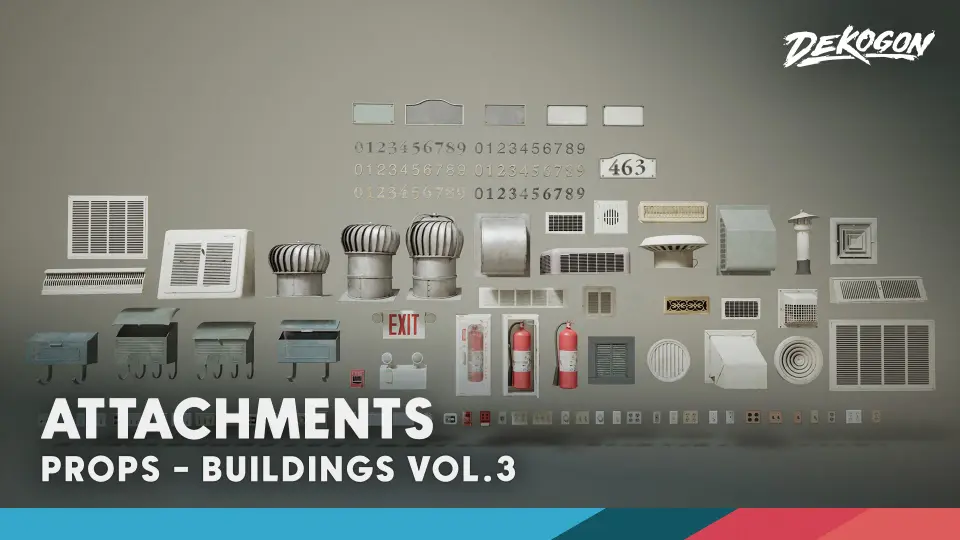
The set includes everything pictured and approaches those pieces as more than filler. These are fully detailed models from all sides, which makes them suitable for scenes where the camera may move close, orbit around props, or catch them from unexpected angles. For artists building houses, larger building exteriors, or interior spaces with visible utility infrastructure, that full-sided treatment matters. A vent fixed high on a wall, a duct crossing a ceiling, or an attachment placed near an exit can appear in the foreground or background and still hold up as part of the environment rather than reading like a shortcut.
Building attachments that shape how a space functions
The identity of this set is practical and architectural. The tag set points to vents, ventilation, ducts, structures, doors, exits, circulation elements, house details, exterior pieces, interior pieces, and attachments that support everyday building logic. That gives the pack a clear role inside environment work: it helps spaces look operational.
In a scene, these kinds of assets do two jobs at once. First, they add visual density. A bare hallway, roofline, utility room, or service corridor can feel unfinished until smaller fixtures and attachments explain how air moves, where maintenance access happens, or how safety equipment is placed. Second, they help sell purpose. A building with doors, ducts, vents, and extinguishers feels structured around use, not just shape.
That makes the collection useful across both interior and exterior composition. Exterior walls can gain surface complexity through attached structural and ventilation elements. Interior rooms can be pushed closer to believable occupancy by mixing functional pieces into corners, ceilings, access routes, and transitional spaces. Even when these props are not the focal point, they influence how a player or viewer reads the environment.
290 meshes with Nanite and low poly versions
Scale is one of the strongest practical points here. The project includes 290 meshes, split into 145 Nanite versions And 145 low poly versions. That one-to-one pairing gives teams two paths through the same visual category of assets.
The Nanite versions are constructed for high-fidelity polycounts, which suits scenes where geometric richness is part of the look. If an environment depends on close inspection or wants those smaller structural pieces to carry sharper physical presence, the Nanite side of the set supports that direction. At the same time, the inclusion of low poly versions keeps the pack practical for broader game production needs. It means artists and developers are not locked into one geometry strategy when dressing a level.
This dual structure also helps when the same building language needs to serve different scene demands. One area may benefit from the higher-fidelity Nanite approach, while another may call for the low poly version as part of a more performance-conscious setup. Because both versions exist across the same 145 asset types, the pack offers consistency in subject matter without forcing a single technical route.
The collection is also described as optimized for games, which places those mesh options in a production-minded context. The point is not just to provide detailed attachments, but to make them usable in interactive environments where visual quality and scene efficiency both matter.
4K textures and a master material setup for consistent scene dressing
Texture quality plays a major role in how support props sit inside a realistic environment, especially when the objects are familiar and easy to judge. This project includes high-quality, high-fidelity texture sets at 4K, giving surfaces enough resolution to carry convincing material definition across building attachments and utility pieces.
That texture work is paired with a Master material setup That controls the majority of props and models. In production terms, that is a meaningful part of the package. A shared material framework helps maintain visual consistency across many object types, which is especially helpful when working with an attachment-heavy set. Small structural props often appear in groups, and inconsistencies between them become visible quickly. A master material approach supports a more unified result.
The material system also includes additional controls for Roughness, albedo, normals, and more. That gives artists room to tune the appearance of assets to better match a specific scene treatment while staying within the existing material structure. A cleaner residential space, a harsher industrial corner, or a slightly altered lighting context can all benefit from controlled adjustment rather than one locked surface response.
The project also uses channel-packed Roughness, Metalness, and Ambient Occlusion. That detail speaks to a workflow that is organized for game-ready use inside Unreal Engine. It keeps the texture and material side grounded in established production practice rather than treating these props as isolated showcase models.
Lumen support and the Unreal Engine look
Everything in the project, including assets, maps, and materials, is created in Unreal Engine, and the set supports Lumen for Unreal Engine 5.0+. This helps because building attachments are strongly affected by lighting. Vents, ducts, doors, and structural add-ons gain much of their presence through subtle shadowing, reflected light, edge definition, and the way they break up otherwise flat surfaces.
The inclusion of a Realistic Post Process and Look Up Table Pushes that even further. Instead of treating the attachments as neutral objects only, the project includes the image treatment needed to support the intended visual tone. For teams exploring realistic environment presentation, that pairing of detailed assets with a defined post-processing look can help the whole set read as part of a finished scene language.
Lumen support also makes sense for this particular category of props because they often live in transitional light conditions: under overhangs, inside hallways, near doors, against exterior walls, or in interior service areas. These are places where indirect light and subtle contrast can determine whether the environment feels convincing. The set is positioned to work within that lighting model inside Unreal Engine 5.0 and above.
Realistic AAA quality without borrowed branding
The assets are created for Realistic AAA-quality visuals, style, and budget, which defines the aesthetic target clearly. This is not a stylized or abstract attachment collection. The emphasis is on believable, production-oriented building details that can support grounded environments.
Another useful point is that the branding and labels are custom made by the studio, with the set described as free of legal issues on that front. For environment artists, that means the included details are not relying on outside real-world branding to create authenticity. The pack aims for realism through original production work rather than borrowed identity marks.
That can be important for props like extinguishers, signage-adjacent pieces, and utility fixtures where labels and surface markings often become part of the visual read. Here, those elements are handled as custom-made content while still fitting the realistic direction of the set.
Where Buildings VOL.3 - Attachments fits best
This collection fits projects that need the connective tissue of a believable built space: the pieces that sit on walls, hang overhead, guide circulation, mark exits, support ventilation, or complete a room that would otherwise feel too clean and too empty. Because it includes both Nanite and low poly versions, it can serve teams balancing fidelity and game-focused optimization inside the same Unreal Engine workflow.
The 290-mesh scope, 4K texture sets, shared material controls, channel-packed maps, realistic post process treatment, and Lumen support all reinforce the same idea. This is a utility-driven environment set with a realistic target, meant to help interiors and exteriors look fully equipped rather than merely assembled from large structural forms. The strongest takeaway is simple: if a scene needs the functional attachments that make a building feel complete, this pack addresses that layer directly and at substantial scale.
 Packs
Packs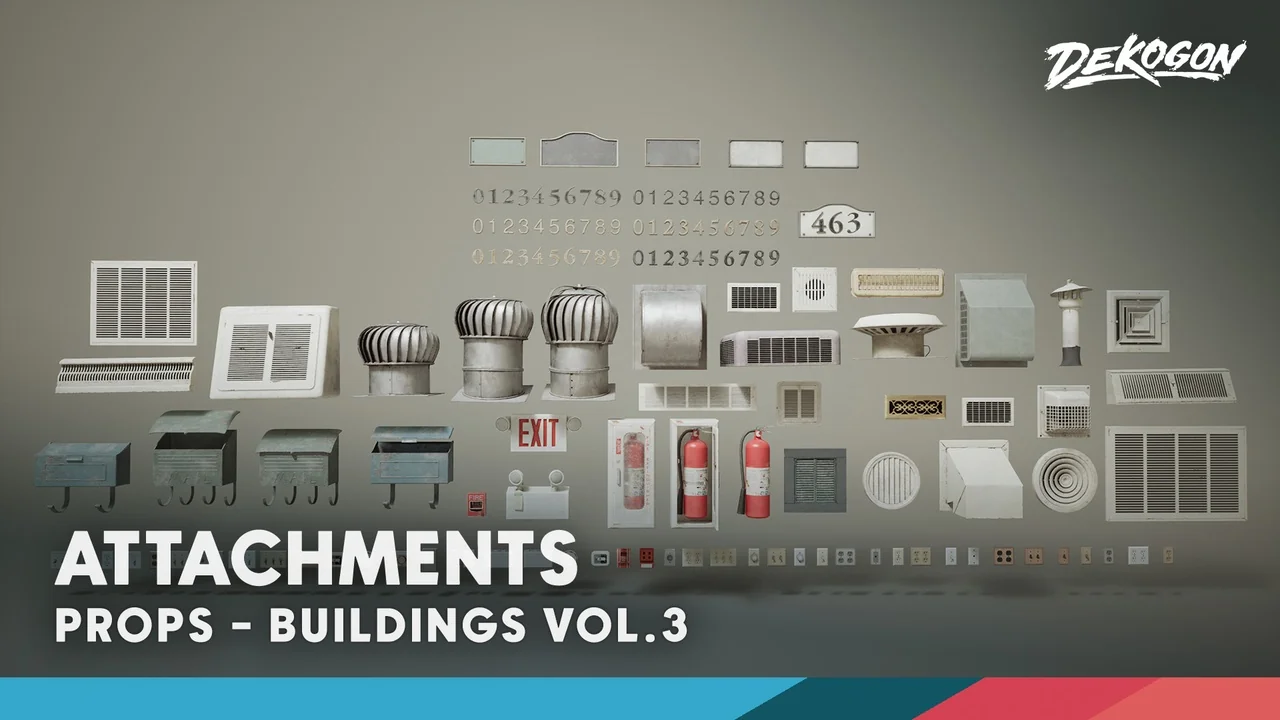
 Musical
 Holiday
 Trees
Trees