"120d4d938bde251c"{"id":"28577","slug":"bren-light-machine-gun-lmg","title":"Bren Light Machine Gun LMG","category":"Action-Adventure","engine":"5.1+","assetVersion":"Engine version: 5.1+","engineVersion":"","tag":"Action-Adventure","accent":"blue","visual":"character","summary":"Shots, dry-fire states, chambering, and reload transitions are already part of the workflow here, which makes this weapon asset easier to place into an active gameplay scene. Bren Light Machine Gun LMG combines a game-ready setup with detachable parts, UV-m...","platform":"Unreal Engine","publishedAt":"2026-05-17T13:14:19.000Z","updatedAt":"2026-05-17T13:14:20.000Z","sourceNotes":[],"fileContents":[],"compatibility":["Unreal Engine","Engine version: 5.1+"],"featuredImage":{"alt":"Bren Light Machine Gun LMG","src":"https://3dcghub.com/wp-content/uploads/2026/05/9371e1542e57_c654e93a-e6cc-4144-a7d3-d636bae1b5f6.webp"},"hasDownloadLink":true,"downloads":0,"terms":[{"taxonomy":"category","slug":"action-adventure","name":"Action-Adventure"},{"taxonomy":"post_tag","slug":"unity","name":"Unity"},{"taxonomy":"post_tag","slug":"unreal-engine-5","name":"Unreal Engine 5"},{"taxonomy":"post_tag","slug":"weapons","name":"Weapons"}],"galleryImages":[{"src":"https://3dcghub.com/wp-content/uploads/2026/05/5f673c1b6b9b_fc083bc3-9ee3-4b3e-8851-003310cb51f3.webp","alt":"Bren Light Machine Gun LMG"},{"src":"https://3dcghub.com/wp-content/uploads/2026/05/68e2cda1388d_3ba2d805-b0ca-46d5-9ff5-0c0d18e175bc.webp","alt":"Bren Light Machine Gun LMG"},{"src":"https://3dcghub.com/wp-content/uploads/2026/05/430101fdb9d0_c669a206-faa5-41b5-8b86-3cd5bd13441b.webp","alt":"Bren Light Machine Gun LMG"},{"src":"https://3dcghub.com/wp-content/uploads/2026/05/9e05d7c4c2c1_76bcd28c-48e2-4a02-9d7f-e32fe19341e5.webp","alt":"Bren Light Machine Gun LMG"},{"src":"https://3dcghub.com/wp-content/uploads/2026/05/da968bfe0745_1ba5f8f8-055c-4e22-bcbc-185ef43ea5b3.webp","alt":"Bren Light Machine Gun LMG"},{"src":"https://3dcghub.com/wp-content/uploads/2026/05/fb25b65e30b0_6d42e750-2b1d-423f-99a2-802338ba8ac9.webp","alt":"Bren Light Machine Gun LMG"},{"src":"https://3dcghub.com/wp-content/uploads/2026/05/41553b80f9a6_2bf6ef96-6513-4f22-8c66-f83f8bd6eaf0.webp","alt":"Bren Light Machine Gun LMG"},{"src":"https://3dcghub.com/wp-content/uploads/2026/05/7ff89dfc3607_cf46417f-1c16-42ec-962d-9521c4966257.webp","alt":"Bren Light Machine Gun LMG"},{"src":"https://3dcghub.com/wp-content/uploads/2026/05/7598b3288bc7_7deff94e-6cea-4857-bf63-f4a86d50606d.webp","alt":"Bren Light Machine Gun LMG"},{"src":"https://3dcghub.com/wp-content/uploads/2026/05/e26f9633cf97_1710a141-fed6-4f04-bc72-171280a0e64e.webp","alt":"Bren Light Machine Gun LMG"}],"accessPanel":{"kind":"resource","title":"Access this resource","eyebrow":"Free Download","message":"Log in or create a free account to start your download.","fileName":"Content.7z","safetyNote":"All resources are 100% manually reviewed to eliminate all risks.","actionLabel":"Download Free","resourceType":"Resource archive"},"contentHtml":"\u003cp\u003eA weapon scene often lives or dies by its state changes. Idle handling, firing, running dry, chambering a round, and shifting into a reload all need to read clearly once the gun is in motion. Bren Light Machine Gun LMG addresses that practical side first, with a game-ready, plug-and-play setup and a defined set of weapon animations that cover both active fire and the transitions around empty and reloaded states.\u003c/p\u003e \u003cp\u003eThe animation set includes Weapon Pose, Fire Pose, Fire To Dry, Chamber round, Reload, Reload From Dry, and Dual Reload. That gives the asset a clear behavioral range inside a real-time project. Instead of stopping at a single firing action, it reaches into the moments that usually make weapon implementation feel incomplete: what happens when the weapon runs dry, how the chambering step is handled, and how reload behavior changes when ammunition is exhausted. Those are the kinds of actions that shape timing and feedback in first-person and third-person weapon work.\u003c/p\u003e \u003ch2\u003eBren Light Machine Gun LMG in active gameplay\u003c/h2\u003e\n\u003cp\u003eThe most immediate strength here is how the asset can move through recognizable weapon states rather than existing as a static model. A firing pose and a weapon pose establish basic handling, while Fire To Dry introduces a transition from active use into an empty condition. Chamber round adds another distinct step, making the sequence more than a simple trigger-and-reload loop.\u003c/p\u003e \u003cp\u003eReload and Reload From Dry are separated as their own actions, which matters in implementation. A reload performed under normal conditions does not necessarily behave the same way as a reload triggered after the weapon has run empty. Having both states defined gives teams room to preserve that distinction in gameplay presentation. Dual Reload is also part of the set, extending the animation coverage beyond a minimal baseline.\u003c/p\u003e \u003cp\u003eFor scene work, this means the asset is suited to situations where the firearm needs to communicate more than presence. It can signal state through action. That is useful whether the focus is direct combat, cinematic weapon handling, or a more systems-driven setup where animation cues support reloading logic and weapon feedback.\u003c/p\u003e \u003ch2\u003ePlug-and-play setup with a fully customizable structure\u003c/h2\u003e\n\u003cp\u003eBren Light Machine Gun LMG is presented as game-ready and plug-and-play, with full customization as part of the core setup. That combination points to an asset intended for immediate implementation while still leaving room for project-specific changes. Inside a project, it is not limited to a locked presentation.\u003c/p\u003e \u003cp\u003eSeveral construction details support that flexibility. Elements requiring animation are detached and correctly named. This is one of the more implementation-focused details in the asset. Detached animated parts make it easier to work with moving weapon components because the parts that need to react are already separated instead of being fused into a single static piece. Correct naming also supports cleaner handling during setup, especially when connecting movement or checking animated elements inside an engine pipeline.\u003c/p\u003e \u003cp\u003eDetachable meshes continue that same direction. A detachable structure gives teams more control over how the weapon is assembled, displayed, or adapted inside a scene. Replaceable coating expands the visual side of customization, allowing the finish to be changed without discarding the underlying weapon model. A removable logo pushes the asset further away from a fixed look and toward a version that can be adapted more cleanly to a project's own visual identity.\u003c/p\u003e \u003cp\u003eThose details make the asset easier to treat as a working part of a game scene rather than as a showcase object that must remain untouched. The setup supports implementation, iteration, and visual adjustment at the same time.\u003c/p\u003e \u003ch2\u003eUV-mapped textures and manually unwrapped surfaces\u003c/h2\u003e\n\u003cp\u003eThe model work is supported by a texture layout pipeline that is clearly aimed at real-time use. All objects are fully UV-mapped and matched with their respective textures. That means the different parts of the weapon are already aligned with the texture work intended for them, reducing ambiguity during scene integration.\u003c/p\u003e \u003cp\u003eThe models are also manually unwrapped to maximize UV space usage. This is a specific production detail rather than a generic quality claim. Efficient UV space usage matters because it affects how much of the available texture area is dedicated to visible surface detail. In a weapon asset, where viewers often spend a lot of screen time close to the object, that kind of texture organization can shape how clean and intentional the final result appears in motion and at inspection distance.\u003c/p\u003e \u003cp\u003eThe visual description also calls out high quality models and low poly models. Taken together with the optimization note, this suggests the asset is prepared with real-time use in mind rather than only static presentation. The presence of both high quality and low poly versions gives teams a practical choice in how they place the weapon into a scene, depending on how they want to balance visual richness and runtime demands.\u003c/p\u003e \u003ch2\u003eUnreal Engine 4, Unreal Engine 5, and Unity compatibility\u003c/h2\u003e\n\u003cp\u003eThe skeletal system is fully compatible with Unreal Engine 4, Unreal Engine 5, and Unity. That compatibility is one of the asset's clearest production-facing traits. It places the weapon across two major engine ecosystems without narrowing it to a single toolchain.\u003c/p\u003e \u003cp\u003eFor implementation, that matters in a straightforward way. Teams working in Unreal Engine 4 or Unreal Engine 5 can evaluate it within established real-time pipelines, while Unity users are not excluded from the same core rigging direction. The wording focuses on skeletal compatibility, which pairs naturally with the included animation coverage. Since the asset already includes weapon-specific animated states, the skeletal setup is not an isolated technical note; it connects directly to how the firearm is expected to behave once imported into a project.\u003c/p\u003e \u003cp\u003eThe broader overview reinforces that engine-facing intent. The asset is optimized for real-time engines, and its game-ready status is stated plainly. These are not abstract claims attached to an undefined model. They sit alongside detached animated elements, named parts, UV-mapped objects, and a listed animation set, all of which point to an implementation path anchored in active use inside a runtime environment.\u003c/p\u003e \u003ch2\u003eScaled for existing in-game models and optimized for real-time engines\u003c/h2\u003e\n\u003cp\u003eScale consistency is another concrete part of the package. The weapon is scaled accurately to match existing in-game models. That detail is easy to overlook until a weapon has to sit beside characters, other firearms, props, or established first-person hands. Once assets begin sharing the same space, incorrect scale becomes obvious very quickly. Matching existing in-game models makes this Bren setup easier to evaluate as part of a wider project rather than as an isolated piece.\u003c/p\u003e \u003cp\u003eThe optimization note supports the same practical direction. This is a weapon asset prepared for real-time engines, not one framed around offline rendering. Combined with the plug-and-play positioning, the detachable animated parts, and the compatibility across Unreal Engine 4, Unreal Engine 5, and Unity, the package reads as an implementation-ready firearm resource with room for visual adjustments.\u003c/p\u003e \u003cp\u003eThere is also a useful balance in how the asset handles appearance. High quality models, low poly models, detachable meshes, replaceable coating, and a removable logo create a setup that can serve either a more finished presentation or a more project-specific one. The asset does not rely on a single locked exterior treatment to define its usefulness.\u003c/p\u003e \u003ch2\u003eWhere the Bren setup is most concrete\u003c/h2\u003e\n\u003cp\u003eThe strongest case for Bren Light Machine Gun LMG is not a vague promise of flexibility. It is the combination of defined weapon-state animations, detached and correctly named animated elements, full UV mapping with matched textures, and compatibility with Unreal Engine 4, Unreal Engine 5, and Unity. Add accurate in-game scaling and real-time optimization, and the asset becomes easiest to judge as a working gameplay weapon that is ready to be set up, customized, and placed into a live scene.\u003c/p\u003e\n\n\u003ch2\u003eMore From The Same Workflow\u003c/h2\u003e\n\u003cul\u003e\n\u003cli\u003e\u003ca href=\"https://3dcghub.com/post-apocalyptic-melee-weapons/\" title=\"Post Apocalyptic Melee Weapons\"\u003ePost Apocalyptic Melee Weapons\u003c/a\u003e\u003c/li\u003e\n\u003cli\u003e\u003ca href=\"https://3dcghub.com/post-apocalyptic-melee-weapons-vol-2-post-apocalyptic-melee-weapons-weapon-old/\" title=\"Post Apocalyptic Melee Weapons VOL.2 (Post Apocalyptic Melee Weapons Weapon Old)\"\u003ePost Apocalyptic Melee Weapons VOL.2 (Post Apocalyptic Melee Weapons Weapon Old)\u003c/a\u003e\u003c/li\u003e\n\u003cli\u003e\u003ca href=\"https://3dcghub.com/stylized-staves-rpg-weapons/\" title=\"Stylized Staves – RPG Weapons\"\u003eStylized Staves – RPG Weapons\u003c/a\u003e\u003c/li\u003e\n\u003c/ul\u003e","contentTextLength":8410,"navigation":{"current":1360,"total":3225,"previous":{"id":"28604","slug":"crossroad-generator","title":"Crossroad Generator","category":"Procedural Systems","platform":"Unreal Engine","updatedAt":"2026-05-17T14:06:53.000Z"},"next":{"id":"28590","slug":"buildings-vol-3-attachments-nanite-and-low-poly","title":"Buildings VOL.3 - Attachments (Nanite and Low Poly)","category":"Packs","platform":"Unreal Engine","updatedAt":"2026-05-17T13:14:05.000Z"}},"relatedResources":[{"id":"1001227","slug":"animation-ecosystem-for-game-development","title":"Animation Ecosystem for Game Development","category":"Action-Adventure","engine":"5.0+","assetVersion":"","engineVersion":"Engine Version: 5.0+","tag":"Action-Adventure","accent":"blue","visual":"animation","summary":"Master the Unreal Engine animation ecosystem, covering retargeting, State Machines, Blendspace Analysis, Control Rig sockets, and Sequencer baking.","platform":"Unreal Engine","publishedAt":"2026-09-21T03:23:50.196Z","updatedAt":"2026-09-21T03:23:50.196Z","sourceNotes":[],"fileContents":[],"compatibility":["Unreal Engine","Engine Version: 5.0+"],"featuredImage":{"alt":"Animation Ecosystem for Game Development","src":"/wp-content/uploads/published/2026/09/7a1b518e4865-68ca6e0f-a439-4bff-b84c-0a567ea78963-8fdbbd6d5f.webp"},"hasDownloadLink":true,"downloads":0},{"id":"11640","slug":"dynamic-combat-system-bundle","title":"Dynamic Combat System - Bundle","category":"Action-Adventure","engine":"5.5+","assetVersion":"Engine version: 5.5+","engineVersion":"4.22","tag":"Action-Adventure","accent":"blue","visual":"city","summary":"This comprehensive bundle merges all Dynamic Combat System modules into one powerful package. It features advanced melee, ranged, magic, and gun mechanics alongside robust AI and inventory systems.","platform":"Unreal Engine","publishedAt":"2026-03-05T18:06:26.000Z","updatedAt":"2026-04-19T15:48:09.000Z","sourceNotes":[],"fileContents":[],"compatibility":["Unreal Engine"],"featuredImage":{"alt":"Dynamic Combat System - Bundle","src":"https://3dcghub.com/wp-content/uploads/2026/03/a6965a98-758d-43ef-8c8c-e6641181aacc.webp"},"hasDownloadLink":true,"downloads":1},{"id":"14896","slug":"npc-eyes-sight-system-pro-accurate-npc-vision-with-light-shadow-body-points","title":"NPC Eyes Sight System PRO – Accurate NPC Vision with Light, Shadow, Body Points","category":"Game Mechanics","engine":"5.5 - 5.7","assetVersion":"Engine version: 5.5 - 5.7","engineVersion":"Asset Version:1.35","tag":"Game Mechanics","accent":"blue","visual":"city","summary":"Enhance your game's AI with the NPC Eyes Sight System PRO. This tool provides realistic vision detection based on light, shadows, and specific body points for immersive gameplay.","platform":"Unreal Engine","publishedAt":"2026-03-11T19:59:40.000Z","updatedAt":"2026-04-19T15:45:38.000Z","sourceNotes":[],"fileContents":[],"compatibility":["Unreal Engine","Engine version: 5.5 - 5.7","Asset Version: 1.35"],"featuredImage":{"alt":"NPC Eyes Sight System PRO – Accurate NPC Vision with Light, Shadow, Body Points","src":"https://3dcghub.com/wp-content/uploads/2026/03/4c9b5e8f-e7c4-4881-9f39-32d39055487e.webp"},"hasDownloadLink":true,"downloads":0}]}
Action-Adventure
Bren Light Machine Gun LMG
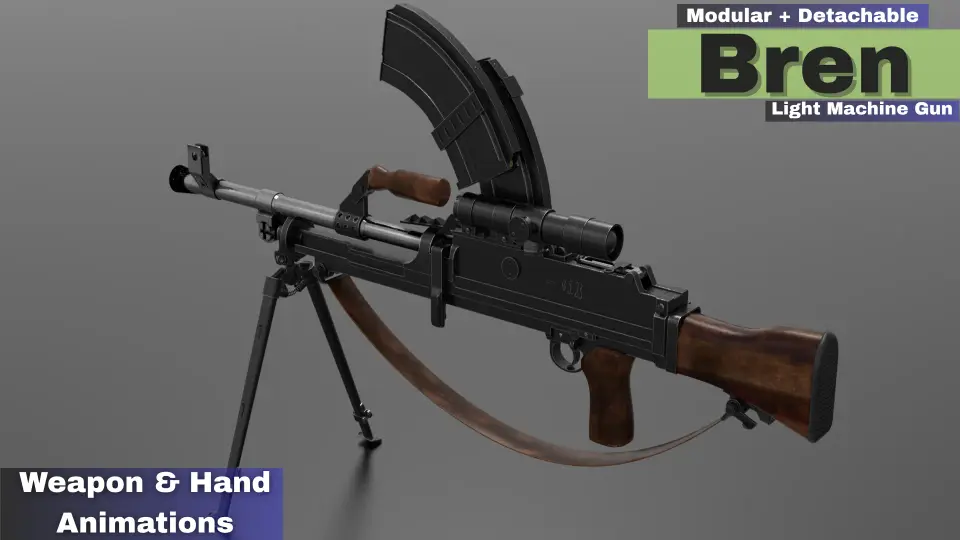
Shots, dry-fire states, chambering, and reload transitions are already part of the workflow here, which makes this weapon asset easier to place into an active gameplay scene. Bren Light Machine Gun LMG combines a game-ready setup with detachable parts, UV-m...
A weapon scene often lives or dies by its state changes. Idle handling, firing, running dry, chambering a round, and shifting into a reload all need to read clearly once the gun is in motion. Bren Light Machine Gun LMG addresses that practical side first, with a game-ready, plug-and-play setup and a defined set of weapon animations that cover both active fire and the transitions around empty and reloaded states.
The animation set includes Weapon Pose, Fire Pose, Fire To Dry, Chamber round, Reload, Reload From Dry, and Dual Reload. That gives the asset a clear behavioral range inside a real-time project. Instead of stopping at a single firing action, it reaches into the moments that usually make weapon implementation feel incomplete: what happens when the weapon runs dry, how the chambering step is handled, and how reload behavior changes when ammunition is exhausted. Those are the kinds of actions that shape timing and feedback in first-person and third-person weapon work.
Bren Light Machine Gun LMG in active gameplay
The most immediate strength here is how the asset can move through recognizable weapon states rather than existing as a static model. A firing pose and a weapon pose establish basic handling, while Fire To Dry introduces a transition from active use into an empty condition. Chamber round adds another distinct step, making the sequence more than a simple trigger-and-reload loop.
Reload and Reload From Dry are separated as their own actions, which matters in implementation. A reload performed under normal conditions does not necessarily behave the same way as a reload triggered after the weapon has run empty. Having both states defined gives teams room to preserve that distinction in gameplay presentation. Dual Reload is also part of the set, extending the animation coverage beyond a minimal baseline.
For scene work, this means the asset is suited to situations where the firearm needs to communicate more than presence. It can signal state through action. That is useful whether the focus is direct combat, cinematic weapon handling, or a more systems-driven setup where animation cues support reloading logic and weapon feedback.
Plug-and-play setup with a fully customizable structure
Bren Light Machine Gun LMG is presented as game-ready and plug-and-play, with full customization as part of the core setup. That combination points to an asset intended for immediate implementation while still leaving room for project-specific changes. Inside a project, it is not limited to a locked presentation.
Several construction details support that flexibility. Elements requiring animation are detached and correctly named. This is one of the more implementation-focused details in the asset. Detached animated parts make it easier to work with moving weapon components because the parts that need to react are already separated instead of being fused into a single static piece. Correct naming also supports cleaner handling during setup, especially when connecting movement or checking animated elements inside an engine pipeline.
Detachable meshes continue that same direction. A detachable structure gives teams more control over how the weapon is assembled, displayed, or adapted inside a scene. Replaceable coating expands the visual side of customization, allowing the finish to be changed without discarding the underlying weapon model. A removable logo pushes the asset further away from a fixed look and toward a version that can be adapted more cleanly to a project's own visual identity.
Those details make the asset easier to treat as a working part of a game scene rather than as a showcase object that must remain untouched. The setup supports implementation, iteration, and visual adjustment at the same time.
UV-mapped textures and manually unwrapped surfaces
The model work is supported by a texture layout pipeline that is clearly aimed at real-time use. All objects are fully UV-mapped and matched with their respective textures. That means the different parts of the weapon are already aligned with the texture work intended for them, reducing ambiguity during scene integration.
The models are also manually unwrapped to maximize UV space usage. This is a specific production detail rather than a generic quality claim. Efficient UV space usage matters because it affects how much of the available texture area is dedicated to visible surface detail. In a weapon asset, where viewers often spend a lot of screen time close to the object, that kind of texture organization can shape how clean and intentional the final result appears in motion and at inspection distance.
The visual description also calls out high quality models and low poly models. Taken together with the optimization note, this suggests the asset is prepared with real-time use in mind rather than only static presentation. The presence of both high quality and low poly versions gives teams a practical choice in how they place the weapon into a scene, depending on how they want to balance visual richness and runtime demands.
Unreal Engine 4, Unreal Engine 5, and Unity compatibility
The skeletal system is fully compatible with Unreal Engine 4, Unreal Engine 5, and Unity. That compatibility is one of the asset's clearest production-facing traits. It places the weapon across two major engine ecosystems without narrowing it to a single toolchain.
For implementation, that matters in a straightforward way. Teams working in Unreal Engine 4 or Unreal Engine 5 can evaluate it within established real-time pipelines, while Unity users are not excluded from the same core rigging direction. The wording focuses on skeletal compatibility, which pairs naturally with the included animation coverage. Since the asset already includes weapon-specific animated states, the skeletal setup is not an isolated technical note; it connects directly to how the firearm is expected to behave once imported into a project.
The broader overview reinforces that engine-facing intent. The asset is optimized for real-time engines, and its game-ready status is stated plainly. These are not abstract claims attached to an undefined model. They sit alongside detached animated elements, named parts, UV-mapped objects, and a listed animation set, all of which point to an implementation path anchored in active use inside a runtime environment.
Scaled for existing in-game models and optimized for real-time engines
Scale consistency is another concrete part of the package. The weapon is scaled accurately to match existing in-game models. That detail is easy to overlook until a weapon has to sit beside characters, other firearms, props, or established first-person hands. Once assets begin sharing the same space, incorrect scale becomes obvious very quickly. Matching existing in-game models makes this Bren setup easier to evaluate as part of a wider project rather than as an isolated piece.
The optimization note supports the same practical direction. This is a weapon asset prepared for real-time engines, not one framed around offline rendering. Combined with the plug-and-play positioning, the detachable animated parts, and the compatibility across Unreal Engine 4, Unreal Engine 5, and Unity, the package reads as an implementation-ready firearm resource with room for visual adjustments.
There is also a useful balance in how the asset handles appearance. High quality models, low poly models, detachable meshes, replaceable coating, and a removable logo create a setup that can serve either a more finished presentation or a more project-specific one. The asset does not rely on a single locked exterior treatment to define its usefulness.
Where the Bren setup is most concrete
The strongest case for Bren Light Machine Gun LMG is not a vague promise of flexibility. It is the combination of defined weapon-state animations, detached and correctly named animated elements, full UV mapping with matched textures, and compatibility with Unreal Engine 4, Unreal Engine 5, and Unity. Add accurate in-game scaling and real-time optimization, and the asset becomes easiest to judge as a working gameplay weapon that is ready to be set up, customized, and placed into a live scene.
 Action-Adventure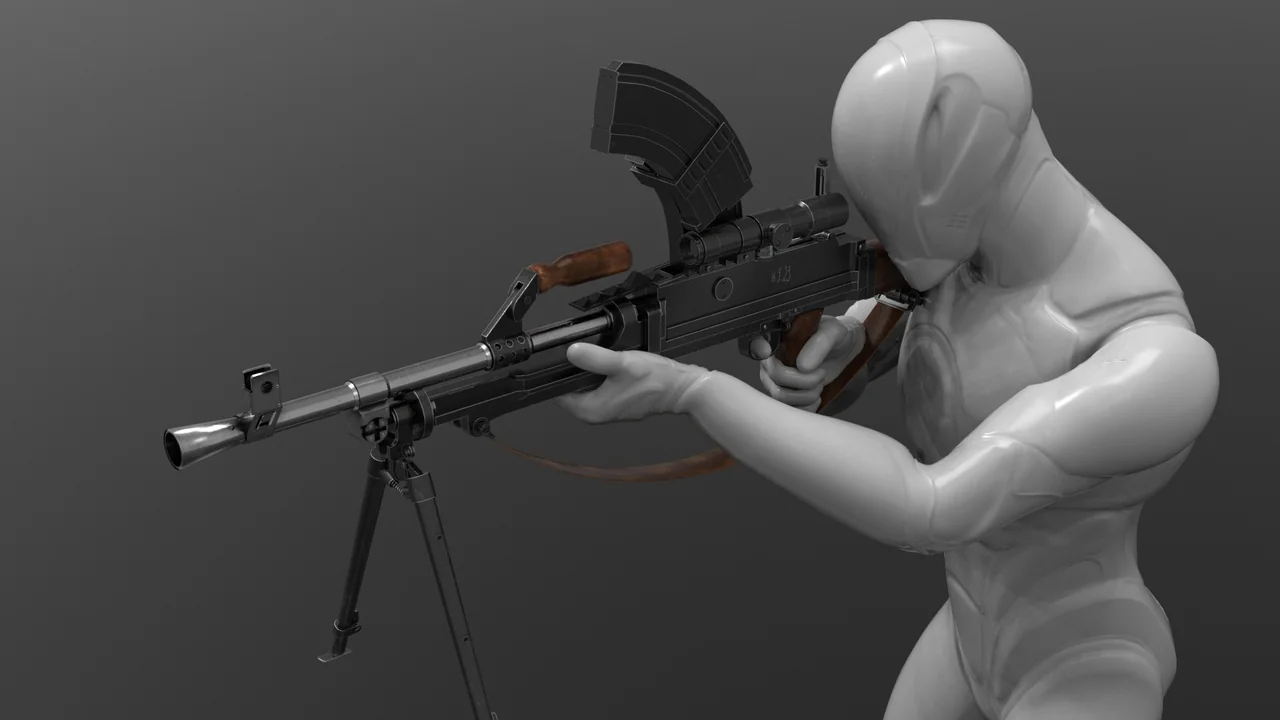
 Action-Adventure
 Action-Adventure
 Game Mechanics