"7ad89cffa44984cf"{"id":"1002574","slug":"advanced-asymmetrical-multiplayer-template","title":"Advanced Asymmetrical Multiplayer Template","category":"Action-Adventure","engine":"5.0+","assetVersion":"","engineVersion":"Engine Version: 5.0+","tag":"Action-Adventure","accent":"blue","visual":"mech","summary":"Explore the Advanced Asymmetrical Multiplayer Template, offering a 4 vs 1 survival horror framework, custom perspectives, and Blueprint networking.","platform":"Unreal Engine","indexPolicy":"index","publishedAt":"2026-11-13T20:13:09.696Z","updatedAt":"2026-11-13T20:13:09.696Z","sourceNotes":[],"fileContents":[],"compatibility":["Unreal Engine","Engine Version: 5.0+"],"featuredImage":{"alt":"Advanced Asymmetrical Multiplayer Template","src":"/wp-content/uploads/published/2026/11/0ee25474a0b8-3617e541-bae5-451b-8057-c9ae9698bff4-2480d8ee2f.webp"},"hasDownloadLink":true,"downloads":0,"terms":[{"taxonomy":"category","slug":"action-adventure","name":"Action-Adventure"}],"galleryImages":[{"src":"/wp-content/uploads/published/2026/11/bb262cd5c4f3-88be1c50-5b7a-4718-b240-12c0a229e0b4-4a72fc0999.webp","alt":"Advanced Asymmetrical Multiplayer Template"},{"src":"/wp-content/uploads/published/2026/11/458484753cea-d523a398-98b3-40aa-979a-bcdd92c8ea9d-2aef24656e.webp","alt":"Advanced Asymmetrical Multiplayer Template"},{"src":"/wp-content/uploads/published/2026/11/a7699a4f8d5b-380c8b72-867a-4364-b9cb-aa9d606efb65-d7cad89fc2.webp","alt":"Advanced Asymmetrical Multiplayer Template"},{"src":"/wp-content/uploads/published/2026/11/ae7d8bd4e30e-74902c6d-e194-4f26-8fed-5158afbdf1ad-838b90ce9a.webp","alt":"Advanced Asymmetrical Multiplayer Template"},{"src":"/wp-content/uploads/published/2026/11/b7d2032d7e72-dfac8c01-cbf9-4616-98aa-c1daed501fe4-a60edd0416.webp","alt":"Advanced Asymmetrical Multiplayer Template"},{"src":"/wp-content/uploads/published/2026/11/cf642aa43bcb-4e5478d2-bdf2-4091-9a60-520d19546652-04e61b52cc.webp","alt":"Advanced Asymmetrical Multiplayer Template"},{"src":"/wp-content/uploads/published/2026/11/06d1730d5617-16dfdf35-309e-41e5-8d48-74dcde90b1b8-cd730342bb.webp","alt":"Advanced Asymmetrical Multiplayer Template"},{"src":"/wp-content/uploads/published/2026/11/fdf32ed45254-84714a01-4e48-4b2c-9f95-6c0581ab6a22-6dee7657fd.webp","alt":"Advanced Asymmetrical Multiplayer Template"},{"src":"/wp-content/uploads/published/2026/11/87b7a106439c-f4c890d2-c963-442c-9b9f-a18d5cf087f6-ea9d5516c2.webp","alt":"Advanced Asymmetrical Multiplayer Template"},{"src":"/wp-content/uploads/published/2026/11/07e4823f9317-ceda135c-fb83-44ba-a48c-8a92558e815b-ef1972a50e.webp","alt":"Advanced Asymmetrical Multiplayer Template"}],"accessPanel":{"kind":"resource","title":"Get this resource","eyebrow":"Free resource","message":"Download this resource in your browser.","fileName":"AdvancedAsymmetricalMultiplayer.7z","safetyNote":"Resources are manually reviewed before listing to improve quality and reduce obvious risks.","actionLabel":"Get this resource","resourceType":"Resource archive","versions":[]},"contentHtml":"\u003ch2\u003eNetwork Architecture in the Advanced Framework\u003c/h2\u003e\u003cp\u003eAsymmetrical action games depend heavily on synchronized game state information between isolated participant roles. In projects where four survivors oppose a single formidable antagonist, network authority must consistently resolve conflicting player locations, environmental reactions, and round objectives. The Advanced Asymmetrical Multiplayer Template establishes this core infrastructure by utilizing an authoritative network loop where a player can host matches directly in the role of the killer while others join ongoing sessions as survivors. Replicated systems govern character interactions across both participant types, handling everything from basic locomotion updates to round initiation without relying on custom third-party networking layers.\u003c/p\u003e\u003cp\u003eLobby navigation and connection handling form an integral stage of asymmetrical match flow. The template incorporates dedicated lobby logic alongside a fully realized main menu configuration, allowing participants to assemble, configure match settings, and establish network handshakes prior to spawning. Because the project leverages Unreal Engine Blueprints and Animation Blueprints throughout its modular layout, developers can examine and modify how player controllers register with the game state. Every connection event remains cleanly separated between survivor slots and the single host-controlled killer slot, preventing synchronization mismatches during runtime transitions between the lobby interface and active gameplay arenas.\u003c/p\u003e\u003ch2\u003eManaging Asymmetrical Perspectives: Killer versus Survivor\u003c/h2\u003e\u003cp\u003ePlayer perspective defines the balance of power, visibility, and psychological tension in survival horror titles. The Advanced Asymmetrical Multiplayer Template enforces asymmetrical field-of-view mechanics tailored to each specific team dynamic. Survivors are restricted exclusively to a third-person camera setup. This viewpoint anchors the survivor in their immediate physical surroundings, letting players observe nearby obstacles, gauge escape paths, and survey surrounding corridors while managing the vulnerability of their characters during high-stakes pursuit encounters.\u003c/p\u003e\u003cp\u003eThe killer role possesses unique camera flexibility to create distinct tactical advantages. Developers can set or allow the killer to switch between first-person and third-person perspectives depending on project balance goals. In first-person mode, the killer experiences an intimate, predatory viewpoint that narrows peripheral awareness while focusing attention directly on pursuit trajectories and immediate target interaction. Alternatively, enabling a third-person view gives the killer broader spatial tracking over the environment to counter survivor evasion techniques. Managing these differing camera setups within the same replicated gameplay session ensures each participant experiences the correct degree of tension or dominance without breaking synchronization across client displays.\u003c/p\u003e\u003ch2\u003eBlueprint Systems and Animation Assets in the Template\u003c/h2\u003e\u003cp\u003eBeneath the gameplay layer, the framework organizes mechanics into modular Blueprints and Animation Blueprints suited to rapid iteration. Rather than hardcoding behavior trees or interaction checks into rigid classes, the core framework relies on discrete logic graphs that handle character states, movement profiles, and input interpretation. The asset package also includes out-of-the-box gamepad support, ensuring that both thumbstick control schemes and standard keyboard-and-mouse inputs translate smoothly into replicated movement commands across survivor and killer archetypes.\u003c/p\u003e\u003cp\u003eCharacter movement and visual fidelity rely on an integrated library of rigged content. The template incorporates default animations from Unreal Engine alongside specialized Paragon character animations provided by Epic Games, restricted to Unreal Engine projects. These movement sets supply realistic blends, turns, and action transitions through dedicated Animation Blueprints, ensuring that both survivor evasions and killer actions display believable weight. Because animation states are wired directly to replicated gameplay variables, visual execution remains consistent across local screens and remote client views, preventing the visual jitter commonly found when animation states fall out of sync with replicated network velocities.\u003c/p\u003e\u003ch2\u003eIntegrating Sound, 3D Models, and Project Documentation\u003c/h2\u003e\u003cp\u003eBeyond logic and animation, atmospheric execution requires complete audiovisual assets that communicate spatial tension. The package includes a collection of 3D models and accompanying sound effects distributed under the CC0 license. These realistic baseline assets populate the included demo project, offering game-ready reference points for physical props, environmental dressing, and audio cues that trigger during gameplay events. Complete sourcing details for all bundled CC0 materials are maintained directly within the asset documentation, simplifying asset tracking and legal attribution across active commercial development pipelines.\u003c/p\u003e\u003cp\u003eOngoing project maintenance is supported through detailed documentation, clear patch notes, and playable demo builds that illustrate how individual systems fit together. Developers can review the exact data flow that binds the main menu, session initialization, replicated player controllers, and game-ready character assets. For teams evaluating multi-template production workflows, the system also maintains explicit compatibility with the Rail Shooter Template, demonstrating how its Blueprint structures can coexist alongside complementary genre frameworks.\u003c/p\u003e\u003ch2\u003eProduction Context for Multiplayer Game Creators\u003c/h2\u003e\u003cp\u003eEngineering a stable 4 vs 1 game loop from raw engine classes demands extensive troubleshooting around network prediction, variable replication, camera logic, and unbalanced team states. Small development teams and independent studios tackling survival horror often spend substantial production cycles wrestling with network lobby logic and split perspective handling before reaching functional gameplay iteration.\u003c/p\u003e\u003cp\u003eThis framework resolves those foundational bottlenecks by packaging a fully replicated action horror loop into an accessible Blueprint format. By supplying both sides of the asymmetrical equation—the resourceful, third-person survivor and the perspective-adaptable killer—the package delivers a verified starting point for custom game rules, custom art replacement, and targeted multiplayer testing.\u003c/p\u003e\n\n\u003ch2\u003eMore From The Same Workflow\u003c/h2\u003e\n\u003cul\u003e\n\u003cli\u003e\u003ca href=\"https://3dcghub.com/cooperative-horror/\" rel=\"noopener noreferrer\"\u003eCooperative Horror\u003c/a\u003e\u003c/li\u003e\n\u003cli\u003e\u003ca href=\"https://3dcghub.com/multiplayer-ragdoll/\" rel=\"noopener noreferrer\"\u003eMultiplayer Ragdoll\u003c/a\u003e\u003c/li\u003e\n\u003cli\u003e\u003ca href=\"https://3dcghub.com/asymmetric-multiplayer-horror/\" rel=\"noopener noreferrer\"\u003eAsymmetric Multiplayer Horror\u003c/a\u003e\u003c/li\u003e\n\u003cli\u003e\u003ca href=\"https://3dcghub.com/parkour-race-multiplayer-blueprint-game-template-platformer-by-kekdot/\" rel=\"noopener noreferrer\"\u003eParkour Race - Multiplayer Blueprint Game Template - Platformer - By Kekdot\u003c/a\u003e\u003c/li\u003e\n\u003cli\u003e\u003ca href=\"https://3dcghub.com/thief-simulator-starter-kit/\" rel=\"noopener noreferrer\"\u003eThief Simulator Starter Kit\u003c/a\u003e\u003c/li\u003e\n\u003c/ul\u003e","contentTextLength":6693,"navigation":{"current":3,"total":4499,"previous":{"id":"1002575","slug":"bodycam-backroom-vhs-effect","title":"Bodycam Backroom VHS Effect","category":"Action-Adventure","platform":"Unreal Engine","updatedAt":"2026-11-13T20:13:51.555Z"},"next":{"id":"1002573","slug":"led-light-generator","title":"Led Light Generator","category":"Building \u0026 Human-made","platform":"Unreal Engine","updatedAt":"2026-11-13T19:38:16.469Z"}},"relatedResources":[{"id":"1001990","slug":"cooperative-horror","title":"Cooperative Horror","category":"Action-Adventure","engine":"5.1+","assetVersion":"","engineVersion":"Engine Version: 5.1+","tag":"Action-Adventure","accent":"blue","visual":"mech","summary":"Examine the Cooperative Horror multiplayer Unreal Engine template, featuring 1-4 player co-op, AI ghosts, altar objectives, and dedicated server support.","platform":"Unreal Engine","indexPolicy":"index","publishedAt":"2026-10-26T12:09:35.259Z","updatedAt":"2026-10-26T12:09:35.259Z","sourceNotes":[],"fileContents":[],"compatibility":["Unreal Engine","Engine Version: 5.1+"],"featuredImage":{"alt":"Cooperative Horror","src":"/wp-content/uploads/published/2026/10/55ed249c0436-4e0f0b5d-36eb-4ab0-864f-fb33ff943e2b-dbe793dbb1.webp"},"hasDownloadLink":true,"downloads":0},{"id":"1001241","slug":"multiplayer-ragdoll","title":"Multiplayer Ragdoll","category":"Action-Adventure","engine":"5.0+","assetVersion":"","engineVersion":"Engine Version: 5.0+","tag":"Action-Adventure","accent":"blue","visual":"mech","summary":"Networked physics system for Unreal Engine synchronizing server-calculated ragdoll poses across clients, complete with forward and backward recovery states.","platform":"Unreal Engine","indexPolicy":"index","publishedAt":"2026-09-23T14:47:54.395Z","updatedAt":"2026-09-23T14:47:54.395Z","sourceNotes":[],"fileContents":[],"compatibility":["Unreal Engine","Engine Version: 5.0+"],"featuredImage":{"alt":"Multiplayer Ragdoll","src":"/wp-content/uploads/published/2026/09/238b83edb3e0-b7fc37f2-e54c-49a3-afb2-b2f4548f972d-90f1b39ecc.webp"},"hasDownloadLink":true,"downloads":0},{"id":"1000977","slug":"asymmetric-multiplayer-horror","title":"Asymmetric Multiplayer Horror","category":"Action-Adventure","engine":"5.0+","assetVersion":"","engineVersion":"Engine Version: 5.0+","tag":"Action-Adventure","accent":"blue","visual":"mech","summary":"Blueprint template for asymmetric multiplayer horror with 4 vs 1 play, AI or player monsters, first/third person views, and a Cursed Forest demo.","platform":"Unreal Engine","indexPolicy":"index","publishedAt":"2026-08-17T17:19:51.833Z","updatedAt":"2026-08-17T17:19:51.833Z","sourceNotes":[],"fileContents":[],"compatibility":["Unreal Engine","Engine Version: 5.0+"],"featuredImage":{"alt":"Asymmetric Multiplayer Horror","src":"/wp-content/uploads/published/2026/08/d3e8d4559426-f968b340-50b9-4a59-9fa7-7cdea14f055c-e0904bd06f.webp"},"hasDownloadLink":true,"downloads":1}]}
Action-Adventure
Advanced Asymmetrical Multiplayer Template
Explore the Advanced Asymmetrical Multiplayer Template, offering a 4 vs 1 survival horror framework, custom perspectives, and Blueprint networking.
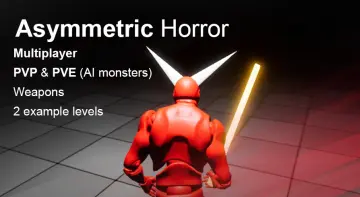
Asymmetrical action games depend heavily on synchronized game state information between isolated participant roles. In projects where four survivors oppose a single formidable antagonist, network authority must consistently resolve conflicting player locations, environmental reactions, and round objectives. The Advanced Asymmetrical Multiplayer Template establishes this core infrastructure by utilizing an authoritative network loop where a player can host matches directly in the role of the killer while others join ongoing sessions as survivors. Replicated systems govern character interactions across both participant types, handling everything from basic locomotion updates to round initiation without relying on custom third-party networking layers.
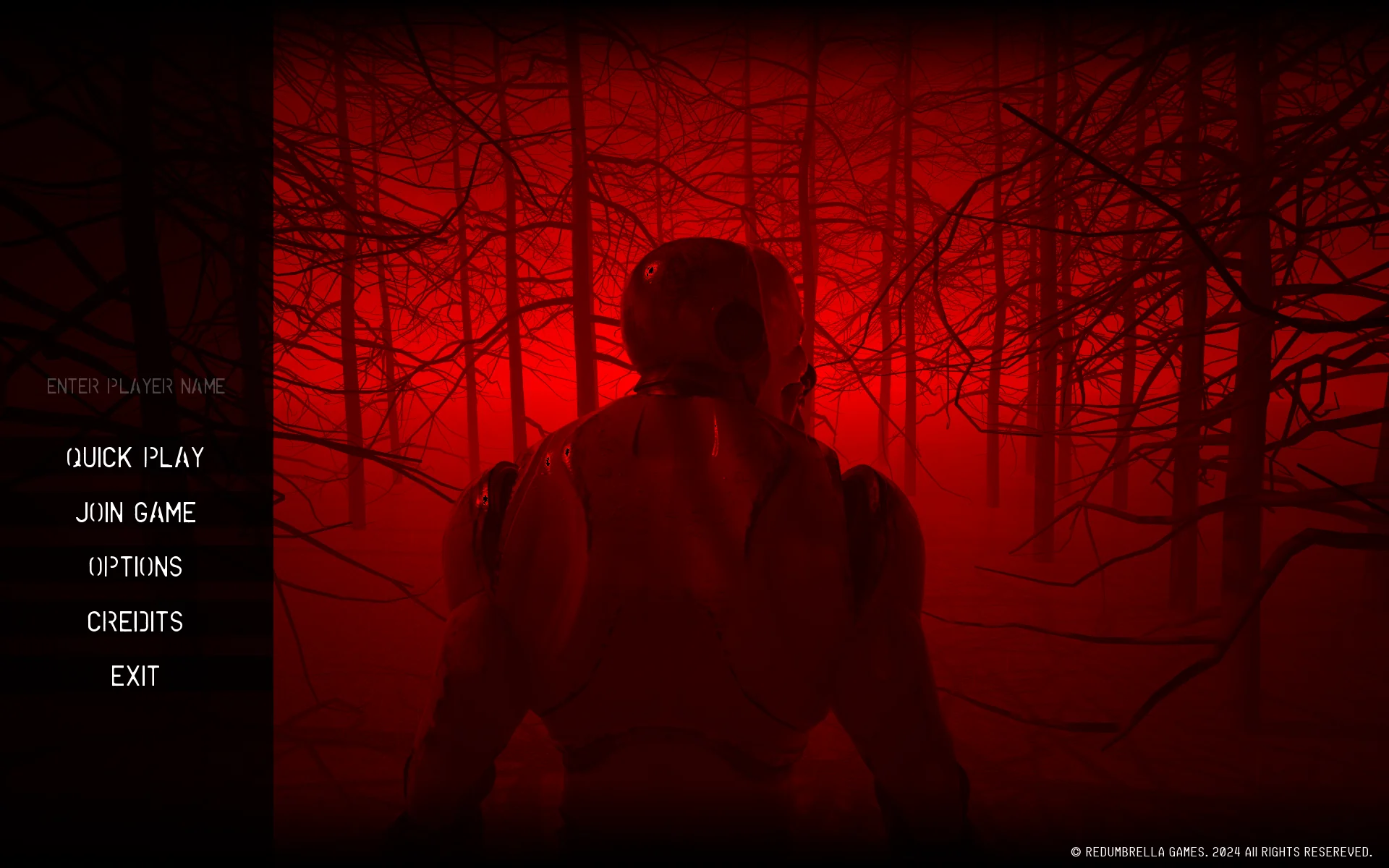
Lobby navigation and connection handling form an integral stage of asymmetrical match flow. The template incorporates dedicated lobby logic alongside a fully realized main menu configuration, allowing participants to assemble, configure match settings, and establish network handshakes prior to spawning. Because the project leverages Unreal Engine Blueprints and Animation Blueprints throughout its modular layout, developers can examine and modify how player controllers register with the game state. Every connection event remains cleanly separated between survivor slots and the single host-controlled killer slot, preventing synchronization mismatches during runtime transitions between the lobby interface and active gameplay arenas.
Managing Asymmetrical Perspectives: Killer versus Survivor
Player perspective defines the balance of power, visibility, and psychological tension in survival horror titles. The Advanced Asymmetrical Multiplayer Template enforces asymmetrical field-of-view mechanics tailored to each specific team dynamic. Survivors are restricted exclusively to a third-person camera setup. This viewpoint anchors the survivor in their immediate physical surroundings, letting players observe nearby obstacles, gauge escape paths, and survey surrounding corridors while managing the vulnerability of their characters during high-stakes pursuit encounters.
The killer role possesses unique camera flexibility to create distinct tactical advantages. Developers can set or allow the killer to switch between first-person and third-person perspectives depending on project balance goals. In first-person mode, the killer experiences an intimate, predatory viewpoint that narrows peripheral awareness while focusing attention directly on pursuit trajectories and immediate target interaction. Alternatively, enabling a third-person view gives the killer broader spatial tracking over the environment to counter survivor evasion techniques. Managing these differing camera setups within the same replicated gameplay session ensures each participant experiences the correct degree of tension or dominance without breaking synchronization across client displays.
Blueprint Systems and Animation Assets in the Template
Beneath the gameplay layer, the framework organizes mechanics into modular Blueprints and Animation Blueprints suited to rapid iteration. Rather than hardcoding behavior trees or interaction checks into rigid classes, the core framework relies on discrete logic graphs that handle character states, movement profiles, and input interpretation. The asset package also includes out-of-the-box gamepad support, ensuring that both thumbstick control schemes and standard keyboard-and-mouse inputs translate smoothly into replicated movement commands across survivor and killer archetypes.
Character movement and visual fidelity rely on an integrated library of rigged content. The template incorporates default animations from Unreal Engine alongside specialized Paragon character animations provided by Epic Games, restricted to Unreal Engine projects. These movement sets supply realistic blends, turns, and action transitions through dedicated Animation Blueprints, ensuring that both survivor evasions and killer actions display believable weight. Because animation states are wired directly to replicated gameplay variables, visual execution remains consistent across local screens and remote client views, preventing the visual jitter commonly found when animation states fall out of sync with replicated network velocities.
Integrating Sound, 3D Models, and Project Documentation
Beyond logic and animation, atmospheric execution requires complete audiovisual assets that communicate spatial tension. The package includes a collection of 3D models and accompanying sound effects distributed under the CC0 license. These realistic baseline assets populate the included demo project, offering game-ready reference points for physical props, environmental dressing, and audio cues that trigger during gameplay events. Complete sourcing details for all bundled CC0 materials are maintained directly within the asset documentation, simplifying asset tracking and legal attribution across active commercial development pipelines.
Ongoing project maintenance is supported through detailed documentation, clear patch notes, and playable demo builds that illustrate how individual systems fit together. Developers can review the exact data flow that binds the main menu, session initialization, replicated player controllers, and game-ready character assets. For teams evaluating multi-template production workflows, the system also maintains explicit compatibility with the Rail Shooter Template, demonstrating how its Blueprint structures can coexist alongside complementary genre frameworks.
Production Context for Multiplayer Game Creators
Engineering a stable 4 vs 1 game loop from raw engine classes demands extensive troubleshooting around network prediction, variable replication, camera logic, and unbalanced team states. Small development teams and independent studios tackling survival horror often spend substantial production cycles wrestling with network lobby logic and split perspective handling before reaching functional gameplay iteration.
This framework resolves those foundational bottlenecks by packaging a fully replicated action horror loop into an accessible Blueprint format. By supplying both sides of the asymmetrical equation—the resourceful, third-person survivor and the perspective-adaptable killer—the package delivers a verified starting point for custom game rules, custom art replacement, and targeted multiplayer testing.
 Action-Adventure
 Action-Adventure
 Action-Adventure
 Action-Adventure