"7ad89cffa44984cf"{"id":"1002573","slug":"led-light-generator","title":"Led Light Generator","category":"Building \u0026 Human-made","engine":"5.3+","assetVersion":"","engineVersion":"Engine Version: 5.3+","tag":"Building","accent":"blue","visual":"mech","summary":"Explore the procedural PBR workflows, engine setup, and character customization available in Led Light Generator for signs, UI, and sci-fi displays.","platform":"Unreal Engine","indexPolicy":"index","publishedAt":"2026-11-13T19:38:16.469Z","updatedAt":"2026-11-13T19:38:16.469Z","sourceNotes":[],"fileContents":[],"compatibility":["Unreal Engine","Engine Version: 5.3+"],"featuredImage":{"alt":"Led Light Generator","src":"/wp-content/uploads/published/2026/11/70858bdfb0b0-a7e70ae0-b372-4dc3-ac6b-1d28b1d1c89d-f1a3cf94f7.webp"},"hasDownloadLink":true,"downloads":0,"terms":[{"taxonomy":"category","slug":"building-and-human-made","name":"Building \u0026 Human-made"}],"galleryImages":[{"src":"/wp-content/uploads/published/2026/11/3ba318e06cc6-eb06e6cb-a955-48d4-be97-6ae81a0a8f19-2861689d49.webp","alt":"Led Light Generator"},{"src":"/wp-content/uploads/published/2026/11/0a31a7f5a547-c1760312-0b8e-44d3-9912-dab8f0f5e791-56c8ededfb.webp","alt":"Led Light Generator"},{"src":"/wp-content/uploads/published/2026/11/540fb236f4c4-27177c0e-4667-4672-902b-7f9494229317-e7af3e312b.webp","alt":"Led Light Generator"},{"src":"/wp-content/uploads/published/2026/11/0d9cee3a7c29-da58cbb1-a6c3-46cc-b53d-dabf41538eff-92c6ce678b.webp","alt":"Led Light Generator"},{"src":"/wp-content/uploads/published/2026/11/0c4278efb44a-0dab3e23-dfed-45be-8a7a-e65d88542048-5894dd5469.webp","alt":"Led Light Generator"},{"src":"/wp-content/uploads/published/2026/11/189d64b58ba1-50529beb-b08d-4330-bc6b-c253c8b6a809-27f7bef221.webp","alt":"Led Light Generator"},{"src":"/wp-content/uploads/published/2026/11/d12eecfc8fda-f59e73fe-c6cf-41a8-8d86-2c745144861e-d70e1a97a7.webp","alt":"Led Light Generator"},{"src":"/wp-content/uploads/published/2026/11/6102bcdb8b9d-c0f2ee74-2f8b-46b5-a1ab-a56e7a5a7adc-b1d3647d35.webp","alt":"Led Light Generator"},{"src":"/wp-content/uploads/published/2026/11/3d2960bd5229-469ee15a-3986-4d39-bb3f-e405f2be452f-d68e12e02e.webp","alt":"Led Light Generator"},{"src":"/wp-content/uploads/published/2026/11/f97afbc9aedb-bdc0badf-b6fb-406c-962f-bf56563e0002-af4eb7132b.webp","alt":"Led Light Generator"}],"accessPanel":{"kind":"resource","title":"Get this resource","eyebrow":"Free resource","message":"Download this resource in your browser.","fileName":"Content.7z","safetyNote":"Resources are manually reviewed before listing to improve quality and reduce obvious risks.","actionLabel":"Get this resource","resourceType":"Resource archive","versions":[]},"contentHtml":"\u003cp\u003eIntegrating digital displays, illuminated street signage, and interactive user interface readouts often requires juggling static texture sheets or custom shader networks for each individual character. Led Light Generator approaches this challenge through a procedural PBR material workflow packaged in the Substance SBSAR format. By exposing real-time typographic inputs, geometric frame selection, and physical material parameters, it allows technical artists, UI designers, and environment creators to generate customized digital screens without having to paint individual alphanumeric variations manually.\u003c/p\u003e\u003ch2\u003eProcedural Character Generation in Led Light Generator\u003c/h2\u003e\u003cp\u003eThe core mechanic of the generator is its Alphabet Input Mode. Rather than relying on static UV-mapped atlases where characters must be placed by hand, the material allows creators to type any letter or number directly into an input field. Once entered, the internal procedural graph shifts to construct the matching alphanumeric pattern across the simulated diode matrix.\u003c/p\u003e\u003cp\u003eBecause the construction happens procedurally, the output avoids seams, pixel bleeding, and texture edge artifacts that commonly occur when manual UV coordinates sample from tight texture sheets. This procedural generation produces clean, readable readouts whether configured as single-digit status indicators on sci-fi control consoles, sequential roadway lane markers, or alphanumeric digital billboards. The direct input pipeline makes generating sequential graphics, customized logos, title cards, and specialized in-game interface assets straightforward, ensuring that characters retain uniform diode spacing and consistent illumination across every generated variation.\u003c/p\u003e\u003ch2\u003eConfiguring Frame Profiles and Surface Roughness\u003c/h2\u003e\u003cp\u003eBeyond the illuminated characters themselves, digital panels require distinct structural housings depending on their architectural or industrial setting. The generator provides four selectable frame styles directly within its parameter controls: Square, Circle, Triangle, and Octagon shapes. Selecting between these contours reshapes the perimeter bounds of the display surface, making it possible to produce traditional rectangular advertising billboards, circular sci-fi UI readouts, triangular hazard warnings, and octagonal traffic control signs using the exact same underlying asset.\u003c/p\u003e\u003cp\u003eSurrounding the diode array, the structural housing features advanced physically based rendering adjustments. Users have direct control over both roughness and metalness channels. Increasing the metallic value yields an industrial, chassis-grade finish suitable for heavy road signs or spacecraft instrumentation, while adjusting roughness controls the micro-surface glossiness of the display cover. High-roughness configurations replicate weathered, matte industrial plastics or worn display glass, whereas low-roughness settings produce sharp environmental reflections across unlit panel areas. Balancing these physical attributes ensures that the material responds naturally to ambient environment lights and directional shadows when the display elements are inactive or viewed under bright daylight.\u003c/p\u003e\u003ch2\u003eDynamic Light Color and Emissive Emission\u003c/h2\u003e\u003cp\u003eDisplay realism relies on the balance between physical surface reflection and emissive light intensity. Led Light Generator includes dynamic LED light color controls that allow creators to adjust the exact glow tint of the diodes. This flexibility enables instantaneous transitions between amber traffic notifications, monochromatic green retro terminal monitors, clean white commercial signage, and saturated neon displays used in stylized motion graphics.\u003c/p\u003e\u003cp\u003eBecause the emissive output is driven by dedicated PBR channels, it operates alongside modern real-time global illumination setups such as Unreal Engine's Lumen. The light generated by the diodes contributes realistic color bleeding onto nearby architectural meshes, metallic chassis walls, and interior prop surfaces. When placed in low-light environments, the emissive elements project their adjusted hue into the scene, while the reflective and metallic areas of the chosen frame ground the panel within the environment through physically accurate ambient reflections.\u003c/p\u003e\u003ch2\u003eSubstance Pipeline Implementation Across Engines\u003c/h2\u003e\u003cp\u003eThe material is delivered as a compiled.SBSAR file, enabling several deployment routes depending on team production requirements. For projects operating in Unreal Engine or Unity, the asset functions through the official Substance Plugin. When loaded into these engine environments with the plugin active, the exposed parameters—such as the text input field, frame shapes, glow colors, and surface sliders—remain interactive inside the engine editor, allowing level designers to populate diverse display styles without leaving their primary scene viewport.\u003c/p\u003e\u003cp\u003eFor pipelines that do not maintain active Substance Plugins in runtime builds, or for projects utilizing external PBR-ready rendering packages, the material can be configured inside Substance Player. Because Substance Player is accessible standalone without requiring a paid Substance subscription, artists can open the.SBSAR file, customize the desired text, shapes, and color settings, and export standard PBR texture map sets. The material also maintains compatibility with stylized material pack setups, allowing developers working on non-photorealistic or retro aesthetics to blend the generator's output smoothly into stylized scene art.\u003c/p\u003e\u003ch2\u003eResolution Scaling from Mobile to High-End Displays\u003c/h2\u003e\u003cp\u003eProduction targets vary significantly across platforms, from low-poly mobile applications to high-density desktop and cinematic environments. Led Light Generator provides native resolution scaling that exports textures from as low as 32×32 pixels up to 8192×8192 pixels. This wide operational range allows the tool to serve distinct optimization tiers without manual downsampling or asset recreation.\u003c/p\u003e\u003cp\u003eLow-resolution exports down to 32×32 or 64×64 are suited for background lowpoly props, miniature vehicle dashboard screens, distant traffic signals, or memory-restricted mobile interfaces where minimal texture footprints are critical. Conversely, scaling up to 4096×4096 or 8192×8192 preserves crisp diode boundaries, razor-sharp letterforms, and high-fidelity surface reflections on massive hero billboards, detailed title screens, and cinematic close-up shots. Because the generation graph operates procedurally, expanding the canvas size avoids the blurriness and pixelation typically introduced when scaling rasterized text textures, retaining clean edge definitions and precise emissive diode structures across all supported dimensions.\u003c/p\u003e\n\n\u003ch2\u003eRelated Resources Worth Checking\u003c/h2\u003e\n\u003cul\u003e\n\u003cli\u003e\u003ca href=\"https://3dcghub.com/neon-led-generator/\" rel=\"noopener noreferrer\"\u003eNeon Led Generator\u003c/a\u003e\u003c/li\u003e\n\u003cli\u003e\u003ca href=\"https://3dcghub.com/ultimate-engine-copilot-formerly-ultimate-blueprint-generator/\" rel=\"noopener noreferrer\"\u003eUltimate Engine CoPilot (formerly Ultimate Blueprint Generator)\u003c/a\u003e\u003c/li\u003e\n\u003cli\u003e\u003ca href=\"https://3dcghub.com/blueprint-generator-ai-kibibyte-labs-engine-assistant/\" rel=\"noopener noreferrer\"\u003eAI Engine Assistant - Kibibyte Labs (Blueprint Generator \u0026amp; More!)\u003c/a\u003e\u003c/li\u003e\n\u003cli\u003e\u003ca href=\"https://3dcghub.com/automotive-extras/\" rel=\"noopener noreferrer\"\u003eAutomotive Extras\u003c/a\u003e\u003c/li\u003e\n\u003cli\u003e\u003ca href=\"https://3dcghub.com/4k-materials-wood-flooring-vol-01/\" rel=\"noopener noreferrer\"\u003e4K Materials: Wood Flooring Vol.01\u003c/a\u003e\u003c/li\u003e\n\u003c/ul\u003e","contentTextLength":6910,"navigation":{"current":4,"total":4499,"previous":{"id":"1002574","slug":"advanced-asymmetrical-multiplayer-template","title":"Advanced Asymmetrical Multiplayer Template","category":"Action-Adventure","platform":"Unreal Engine","updatedAt":"2026-11-13T20:13:09.696Z"},"next":{"id":"1002572","slug":"lens-flare-vfx-advanced-sprite-based-lens-flares","title":"LENS FLARE VFX | ADVANCED SPRITE BASED LENS FLARES","category":"Shaders","platform":"Unreal Engine","updatedAt":"2026-11-13T18:09:14.803Z"}},"relatedResources":[{"id":"1001690","slug":"neon-led-generator","title":"Neon Led Generator","category":"Building \u0026 Human-made","engine":"4.26+,5.0+","assetVersion":"","engineVersion":"Engine Version: 4.26+,5.0+","tag":"Building","accent":"blue","visual":"mech","summary":"Explore the Neon Led Generator, featuring 10 templates, alpha input mode, 5 fonts, adjustable colors, and Substance Plugin compatibility.","platform":"Unreal Engine","indexPolicy":"index","publishedAt":"2026-10-14T09:08:09.069Z","updatedAt":"2026-10-14T09:08:09.069Z","sourceNotes":[],"fileContents":[],"compatibility":["Unreal Engine","Engine Version: 4.26+,5.0+"],"featuredImage":{"alt":"Neon Led Generator","src":"/wp-content/uploads/published/2026/10/77b8e7d252f6-c01e3027-dfb1-4f4f-972a-9eafc8916bea-b1616c771b.webp"},"hasDownloadLink":true,"downloads":0},{"id":"27256","slug":"ultimate-engine-copilot-formerly-ultimate-blueprint-generator","title":"Ultimate Engine CoPilot (formerly Ultimate Blueprint Generator)","category":"Automations","engine":"0.3.5 - 1.3.5","assetVersion":"Engine version: 5.4 - 5.7","engineVersion":"Asset Version:0.3.5 - 1.3.5","tag":"Automations","accent":"blue","visual":"city","summary":"Ultimate Engine CoPilot keeps Blueprint setup, VFX work, UI creation, and other editor tasks inside Unreal Engine. It responds to natural language, supports voice input, and can run multiple AI agents while you work.","platform":"Unreal Engine","indexPolicy":"index","publishedAt":"2026-04-23T06:55:26.000Z","updatedAt":"2026-07-05T09:41:32.225Z","sourceNotes":[],"fileContents":[],"compatibility":["Unreal Engine","Engine version: 5.4 - 5.7","Asset Version:0.3.5 - 1.3.5"],"featuredImage":{"alt":"Ultimate Engine CoPilot (formerly Ultimate Blueprint Generator)","src":"https://3dcghub.com/wp-content/uploads/2026/04/fd75d459aa77_025b3508-1406-4cd3-96bf-9537f34d3d5f.webp"},"hasDownloadLink":true,"downloads":23},{"id":"13760","slug":"blueprint-generator-ai-kibibyte-labs-engine-assistant","title":"AI Engine Assistant - Kibibyte Labs (Blueprint Generator \u0026 More!)","category":"Engine Tools","engine":"0.1.4","assetVersion":"Engine version: 5.2 - 5.7","engineVersion":"Asset Version: 0.1.4","tag":"Engine Tools","accent":"blue","visual":"character","summary":"Blueprint Generator Ai - Kibibyte Labs (Engine Assistant) is a powerful tool designed to transform natural language into functional Unreal Engine Blueprints. It offers a suite of modules for generating logic, explaining complex nodes, and optimizing the dev...","platform":"Unreal Engine","indexPolicy":"index","publishedAt":"2026-03-11T09:58:02.000Z","updatedAt":"2026-07-09T21:24:04.089Z","sourceNotes":[],"fileContents":[],"compatibility":["Unreal Engine","Engine version: 5.2 - 5.7","Asset Version: 0.1.4"],"featuredImage":{"alt":"Blueprint Generator Ai - Kibibyte Labs (Engine Assistant)","src":"https://3dcghub.com/wp-content/uploads/2026/03/ff365004-07a8-4633-90ac-7c9a038cc81d.webp"},"hasDownloadLink":true,"downloads":2}]}
Building
Led Light Generator
Explore the procedural PBR workflows, engine setup, and character customization available in Led Light Generator for signs, UI, and sci-fi displays.
Integrating digital displays, illuminated street signage, and interactive user interface readouts often requires juggling static texture sheets or custom shader networks for each individual character. Led Light Generator approaches this challenge through a procedural PBR material workflow packaged in the Substance SBSAR format. By exposing real-time typographic inputs, geometric frame selection, and physical material parameters, it allows technical artists, UI designers, and environment creators to generate customized digital screens without having to paint individual alphanumeric variations manually.
Procedural Character Generation in Led Light Generator
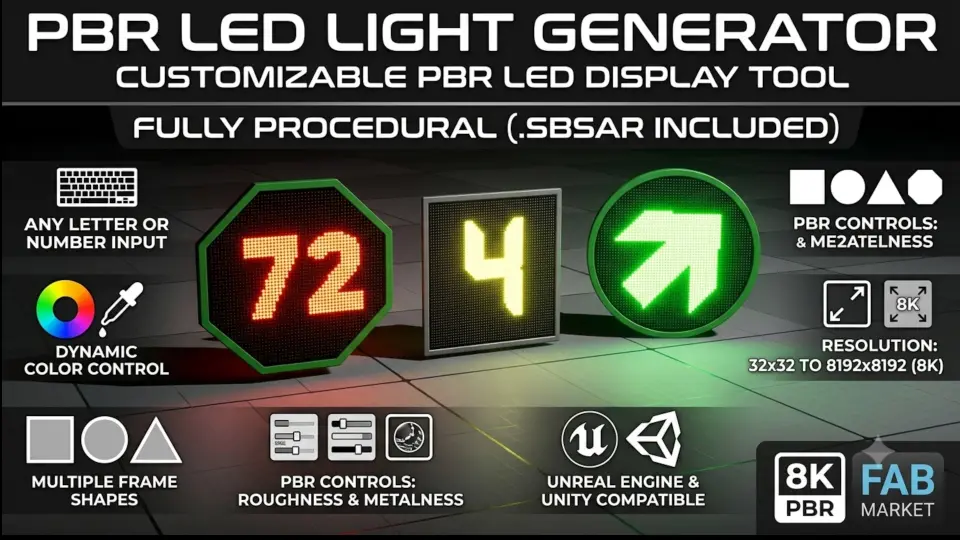
The core mechanic of the generator is its Alphabet Input Mode. Rather than relying on static UV-mapped atlases where characters must be placed by hand, the material allows creators to type any letter or number directly into an input field. Once entered, the internal procedural graph shifts to construct the matching alphanumeric pattern across the simulated diode matrix.
Because the construction happens procedurally, the output avoids seams, pixel bleeding, and texture edge artifacts that commonly occur when manual UV coordinates sample from tight texture sheets. This procedural generation produces clean, readable readouts whether configured as single-digit status indicators on sci-fi control consoles, sequential roadway lane markers, or alphanumeric digital billboards. The direct input pipeline makes generating sequential graphics, customized logos, title cards, and specialized in-game interface assets straightforward, ensuring that characters retain uniform diode spacing and consistent illumination across every generated variation.
Configuring Frame Profiles and Surface Roughness
Beyond the illuminated characters themselves, digital panels require distinct structural housings depending on their architectural or industrial setting. The generator provides four selectable frame styles directly within its parameter controls: Square, Circle, Triangle, and Octagon shapes. Selecting between these contours reshapes the perimeter bounds of the display surface, making it possible to produce traditional rectangular advertising billboards, circular sci-fi UI readouts, triangular hazard warnings, and octagonal traffic control signs using the exact same underlying asset.
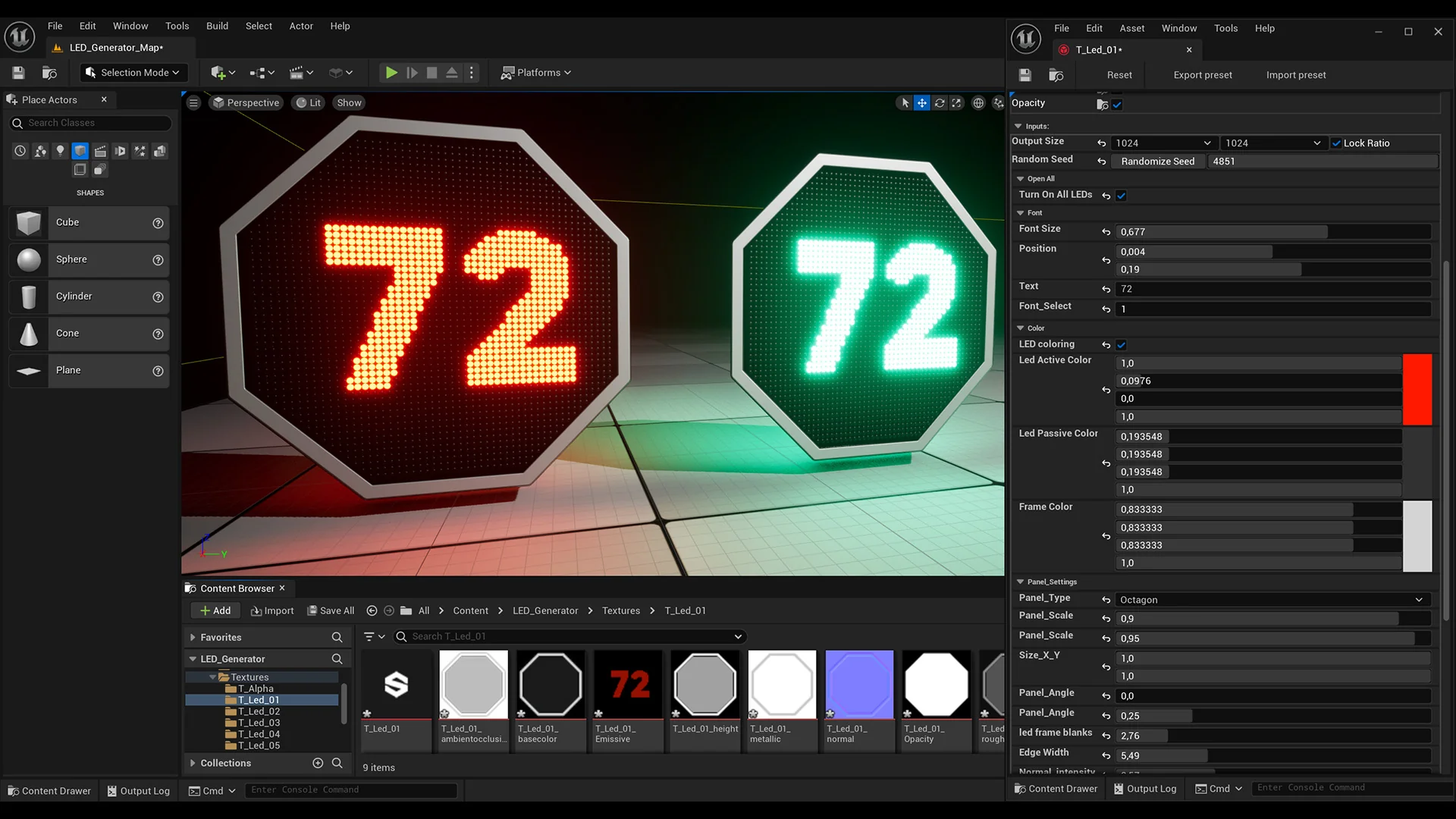
Surrounding the diode array, the structural housing features advanced physically based rendering adjustments. Users have direct control over both roughness and metalness channels. Increasing the metallic value yields an industrial, chassis-grade finish suitable for heavy road signs or spacecraft instrumentation, while adjusting roughness controls the micro-surface glossiness of the display cover. High-roughness configurations replicate weathered, matte industrial plastics or worn display glass, whereas low-roughness settings produce sharp environmental reflections across unlit panel areas. Balancing these physical attributes ensures that the material responds naturally to ambient environment lights and directional shadows when the display elements are inactive or viewed under bright daylight.
Dynamic Light Color and Emissive Emission
Display realism relies on the balance between physical surface reflection and emissive light intensity. Led Light Generator includes dynamic LED light color controls that allow creators to adjust the exact glow tint of the diodes. This flexibility enables instantaneous transitions between amber traffic notifications, monochromatic green retro terminal monitors, clean white commercial signage, and saturated neon displays used in stylized motion graphics.
Because the emissive output is driven by dedicated PBR channels, it operates alongside modern real-time global illumination setups such as Unreal Engine's Lumen. The light generated by the diodes contributes realistic color bleeding onto nearby architectural meshes, metallic chassis walls, and interior prop surfaces. When placed in low-light environments, the emissive elements project their adjusted hue into the scene, while the reflective and metallic areas of the chosen frame ground the panel within the environment through physically accurate ambient reflections.
Substance Pipeline Implementation Across Engines
The material is delivered as a compiled.SBSAR file, enabling several deployment routes depending on team production requirements. For projects operating in Unreal Engine or Unity, the asset functions through the official Substance Plugin. When loaded into these engine environments with the plugin active, the exposed parameters—such as the text input field, frame shapes, glow colors, and surface sliders—remain interactive inside the engine editor, allowing level designers to populate diverse display styles without leaving their primary scene viewport.
For pipelines that do not maintain active Substance Plugins in runtime builds, or for projects utilizing external PBR-ready rendering packages, the material can be configured inside Substance Player. Because Substance Player is accessible standalone without requiring a paid Substance subscription, artists can open the.SBSAR file, customize the desired text, shapes, and color settings, and export standard PBR texture map sets. The material also maintains compatibility with stylized material pack setups, allowing developers working on non-photorealistic or retro aesthetics to blend the generator's output smoothly into stylized scene art.
Resolution Scaling from Mobile to High-End Displays
Production targets vary significantly across platforms, from low-poly mobile applications to high-density desktop and cinematic environments. Led Light Generator provides native resolution scaling that exports textures from as low as 32×32 pixels up to 8192×8192 pixels. This wide operational range allows the tool to serve distinct optimization tiers without manual downsampling or asset recreation.
Low-resolution exports down to 32×32 or 64×64 are suited for background lowpoly props, miniature vehicle dashboard screens, distant traffic signals, or memory-restricted mobile interfaces where minimal texture footprints are critical. Conversely, scaling up to 4096×4096 or 8192×8192 preserves crisp diode boundaries, razor-sharp letterforms, and high-fidelity surface reflections on massive hero billboards, detailed title screens, and cinematic close-up shots. Because the generation graph operates procedurally, expanding the canvas size avoids the blurriness and pixelation typically introduced when scaling rasterized text textures, retaining clean edge definitions and precise emissive diode structures across all supported dimensions.
 Building
 Building
 Automations
 Engine Tools