"0148f1904a9b0d16"{"id":"1002618","slug":"ultimate-character","title":"Ultimate Character","category":"Action-Adventure","engine":"5.0+","assetVersion":"","engineVersion":"Engine Version: 5.0+","tag":"Action-Adventure","accent":"blue","visual":"character","summary":"A fully Blueprint-based combat and character framework featuring AI behavior trees, melee, guns, magic attacks, inventory, dynamic camera, and data tables.","platform":"Unreal Engine","indexPolicy":"index","publishedAt":"2026-11-14T09:13:01.059Z","updatedAt":"2026-11-14T09:13:01.059Z","sourceNotes":[],"fileContents":[],"compatibility":["Unreal Engine","Engine Version: 5.0+"],"featuredImage":{"alt":"Ultimate Character","src":"/wp-content/uploads/published/2026/11/879d8d74ce55-23aefc68-afef-4a3b-8b2c-7ea2c27c89c8-3e62ddab61.webp"},"hasDownloadLink":true,"downloads":0,"terms":[{"taxonomy":"category","slug":"action-adventure","name":"Action-Adventure"}],"galleryImages":[{"src":"/wp-content/uploads/published/2026/11/dd10bbb0e1c3-1732a406-9de1-4b00-88d4-90909f61c51b-b62d85cd06.webp","alt":"Ultimate Character"},{"src":"/wp-content/uploads/published/2026/11/260f7418ec3f-3d8ad967-77b2-4943-bab5-d6038f90f1b7-5dd35bec73.webp","alt":"Ultimate Character"},{"src":"/wp-content/uploads/published/2026/11/46e1f5a6e815-2af05cc0-46a1-4539-9be7-2ac0e867bf61-9d0ee99de7.webp","alt":"Ultimate Character"},{"src":"/wp-content/uploads/published/2026/11/a001fa3d8774-dd5ea99f-ab48-47c4-b904-09d407c1c9b9-341796e6dd.webp","alt":"Ultimate Character"},{"src":"/wp-content/uploads/published/2026/11/1064ffa23675-322f13e2-cb33-4d10-9304-97755fa3f5c9-1d23344aad.webp","alt":"Ultimate Character"},{"src":"/wp-content/uploads/published/2026/11/4abff8eb3414-62e3847c-f327-4ba7-9156-0e97e7081b88-41d2e5af0d.webp","alt":"Ultimate Character"},{"src":"/wp-content/uploads/published/2026/11/1e473c2882c1-ef92a074-a399-4895-9bd0-b32f70c0742b-620ff3a2a8.webp","alt":"Ultimate Character"},{"src":"/wp-content/uploads/published/2026/11/8a455bb2f9a5-efe65e58-b56e-47cd-83bc-1e4a18e2f089-b10319a92a.webp","alt":"Ultimate Character"},{"src":"/wp-content/uploads/published/2026/11/0dd6605e5c8a-6c9cbb5c-5d94-4be9-8b34-2f802c576fd2-518cd1a080.webp","alt":"Ultimate Character"}],"accessPanel":{"kind":"resource","title":"Get this resource","eyebrow":"Free resource","message":"Download this resource in your browser.","fileName":"UltimateCharacter.7z","safetyNote":"Resources are manually reviewed before listing to improve quality and reduce obvious risks.","actionLabel":"Get this resource","resourceType":"Resource archive","versions":[]},"contentHtml":"\u003ch2\u003eCore Mechanics in the Ultimate Character Framework\u003c/h2\u003e\u003cp\u003eUltimate Character establishes a foundational gameplay setup for both player characters and non-player combatants using a pure Blueprint architecture. Because the system runs entirely without C++ or third-party external plugins, every interaction remains visible and directly editable inside standard Unreal Engine graph editors. The project supplies ready-to-use sample setups, allowing creators to drop functional characters into test environments without constructing baseline movement, control, or combat links from scratch.\u003c/p\u003e\u003cp\u003eA core design principle of the framework is configuration through straightforward variables and data tables. Rather than requiring script alterations deep inside character logic graphs to modify base stats or behaviors, key elements such as character attributes, equipped weapons, attack definitions, and consumable or equipment items are managed through organized table entries. This table-driven structure lowers the friction of rebalancing gameplay parameters, testing distinct archetypes, or adding fresh combat options.\u003c/p\u003e\u003cp\u003eFuture planned integration expanding the framework includes merging a motion matching system alongside a sample project featuring over 500 animations, specifically targeted for engine version 5.4 and newer releases. This setup works in tandem with the modular scripting structure, offering an upgrade path toward more nuanced locomotion without abandoning the underlying Blueprint foundation.\u003c/p\u003e\u003ch2\u003eOffense and Defense: Melee, Ranged, and Magic Combat Profiles\u003c/h2\u003e\u003cp\u003eCombat interactions within the project span five distinct player attack types alongside seven AI attack types, with more variants slated for future additions. Both player and AI profiles have access to integrated combo attacks, allowing sequential inputs or programmatic behaviors to chain smoothly from opening strikes into multi-hit strings. Complementing the offensive repertoire, a dedicated blocking system is pre-configured for both player and AI units, offering a simple setup to absorb incoming strikes and establish defensive timing windows.\u003c/p\u003e\u003cp\u003eWeapons are derived from clean base classes that simplify future extensions when designing unique armaments. Melee categories feature close-quarters options such as standard punches, blunt implements like bats, and bladed swords. Ranged loadouts are represented by conventional firearms including rifles and heavy artillery like cannons, along with bombarding systems designed to hit targets over area-of-effect arcs.\u003c/p\u003e\u003cp\u003eMagic attack items introduce varied supernatural offensive capabilities into the combat loop. The magic setup incorporates specialized behaviors such as throwing spells through the air, instantaneous teleportation to shift position across the battlefield, heavy bombarding routines, and summoning mechanics that call characters directly into active play. Because these capabilities tie into the shared item and attack structure, they can be slotted into inventory slots or behavior loops alongside standard martial weaponry.\u003c/p\u003e\u003ch2\u003eModular Behavior Trees and AI Character Orchestration\u003c/h2\u003e\u003cp\u003eOpponents utilize modular behavior trees to handle movement, target acquisition, and offensive pacing. Central to this artificial intelligence is an attack changing system that lets agents swap dynamically between their seven available attack types depending on combat conditions, spatial positioning, or programmed state transitions. This modular tree structure allows developers to unplug, replace, or insert custom decision logic without rewriting the underlying perception or pathfinding routines.\u003c/p\u003e\u003cp\u003eBecause the AI systems share the same combat interfaces as the player, artificial opponents execute combo attacks, trigger blocks, and handle weapons using identical rule sets. This parity ensures that an encounter against an AI opponent wielding a sword, rifle, or magic attack follows the exact collision, damage, and defensive checks executed when the player utilizes those exact assets.\u003c/p\u003e\u003ch2\u003eData Tables, Item Handling, and World Systems\u003c/h2\u003e\u003cp\u003eItem management in the project is structured around an inventory system built to accommodate both limited and unlimited capacity parameters. Items present in the world can be gathered and discarded through a dedicated pickup and drop system, seamlessly updating the inventory state and synchronizing equipped meshes or active status effects. As with the weapon classes, item definitions rely on centralized tables and simple variables to define behavior, stacking properties, and inventory classifications.\u003c/p\u003e\u003cp\u003eBeyond immediate character-level actions, the framework includes essential world-level progression systems. A built-in checkpoint system records player progress across level boundaries or hazardous areas, ensuring predictable respawn positions during gameplay sessions. Tracking performance is handled through an integrated score system, which updates based on game-specific triggers and player achievements.\u003c/p\u003e\u003ch2\u003eCamera Dynamics and Debug Support in Ultimate Character\u003c/h2\u003e\u003cp\u003eTo support responsive action gameplay, the framework implements a dynamic camera system tailored to combat feedback. The camera automatically adjusts its framing, offsets, and field of view during standard attack sequences, defensive blocking states, and when maintaining focus during target lock-on interactions. This dynamic positioning preserves player visibility during tight combos or high-intensity engagements against multiple opponents.\u003c/p\u003e\u003cp\u003eMaintaining and customizing complex combat graphs is reinforced through fully commented blueprints throughout every included system. Logic blocks, function libraries, and event dispatches are annotated to clarify execution paths, input handoffs, and state evaluations. Alongside these clear script annotations, the package includes active debug options, giving developers real-time visual and diagnostic feedback into attack collision states, AI decision paths, camera offsets, and variable values directly within the viewport during play sessions.\u003c/p\u003e\n\n\u003ch2\u003eContinue Browsing Similar Packs\u003c/h2\u003e\n\u003cul\u003e\n\u003cli\u003e\u003ca href=\"https://3dcghub.com/ultimate-game-ready-character-and-enemy-ai/\" rel=\"noopener noreferrer\"\u003eUltimate Game Ready Character and Enemy AI\u003c/a\u003e\u003c/li\u003e\n\u003cli\u003e\u003ca href=\"https://3dcghub.com/demonstrating-animation-blueprints-and-ai-for-gameplay-designers/\" rel=\"noopener noreferrer\"\u003eDemonstrating Animation Blueprints and AI for Gameplay Designers\u003c/a\u003e\u003c/li\u003e\n\u003cli\u003e\u003ca href=\"https://3dcghub.com/classic-survival-horror-framework-v2/\" rel=\"noopener noreferrer\"\u003eClassic Survival Horror Framework V2\u003c/a\u003e\u003c/li\u003e\n\u003cli\u003e\u003ca href=\"https://3dcghub.com/metahuman-lighting/\" rel=\"noopener noreferrer\"\u003eMetaHuman Lighting\u003c/a\u003e\u003c/li\u003e\n\u003cli\u003e\u003ca href=\"https://3dcghub.com/easy-ai-toolkit/\" rel=\"noopener noreferrer\"\u003eEasy AI Toolkit\u003c/a\u003e\u003c/li\u003e\n\u003c/ul\u003e","contentTextLength":6224,"navigation":{"current":23,"total":4543,"previous":{"id":"1002619","slug":"landscaping-mapbox","title":"Landscaping Mapbox","category":"Engine Tools","platform":"Unreal Engine","updatedAt":"2026-11-14T09:54:00.508Z"},"next":{"id":"1002617","slug":"surface-forge-v1-1-5","title":"Surface Forge v1.1.5","category":"Nature \u0026 Terrain","platform":"Unreal Engine","updatedAt":"2026-11-14T09:12:11.306Z"}},"relatedResources":[{"id":"1001473","slug":"ultimate-game-ready-character-and-enemy-ai","title":"Ultimate Game Ready Character and Enemy AI","category":"Action-Adventure","engine":"5.4+","assetVersion":"","engineVersion":"Engine Version: 5.4+","tag":"Action-Adventure","accent":"blue","visual":"character","summary":"Explore the mechanics of Ultimate Game Ready Character and Enemy AI, featuring Behavior Tree combatants, Niagara VFX, and modular player systems.","platform":"Unreal Engine","indexPolicy":"index","publishedAt":"2026-10-08T08:24:45.975Z","updatedAt":"2026-10-08T08:24:45.975Z","sourceNotes":[],"fileContents":[],"compatibility":["Unreal Engine","Engine Version: 5.4+"],"featuredImage":{"alt":"Ultimate Game Ready Character and Enemy AI","src":"https://media.fab.com/image_previews/gallery_images/179897da-4b4e-4fd2-a0e2-f27677b2278e/daaa7fc3-a13a-4879-80a9-5bfe18feb434.png"},"hasDownloadLink":true,"downloads":2},{"id":"1001231","slug":"demonstrating-animation-blueprints-and-ai-for-gameplay-designers","title":"Demonstrating Animation Blueprints and AI for Gameplay Designers","category":"Action-Adventure","engine":"5.0+","assetVersion":"","engineVersion":"Engine Version: 5.0+","tag":"Action-Adventure","accent":"blue","visual":"animation","summary":"Explore the connection between Animation Blueprints, behavior trees, montages, and basic enemy character AI for gameplay designers.","platform":"Unreal Engine","indexPolicy":"index","publishedAt":"2026-09-21T03:35:26.508Z","updatedAt":"2026-09-21T03:35:26.508Z","sourceNotes":[],"fileContents":[],"compatibility":["Unreal Engine","Engine Version: 5.0+"],"featuredImage":{"alt":"Demonstrating Animation Blueprints and AI for Gameplay Designers","src":"/wp-content/uploads/published/2026/09/17ead882c717-6d1822dd-94f6-42cb-bab3-18f794094846-660798aead.webp"},"hasDownloadLink":true,"downloads":0},{"id":"1000358","slug":"fantasy-girls-pack-2","title":"Fantasy Girls Pack","category":"Action-Adventure","engine":"5.3+","assetVersion":"","engineVersion":"Engine Version: 5.3+","tag":"Action-Adventure","accent":"blue","visual":"mech","summary":"A detailed breakdown of the Fantasy Girls Pack, featuring seven rigged, PBR-textured female character models designed for modular RPG and medieval projects.","platform":"Unreal Engine","indexPolicy":"index","publishedAt":"2026-07-05T16:21:43.456Z","updatedAt":"2026-11-14T10:16:05.772Z","sourceNotes":[],"fileContents":[],"compatibility":["Unreal Engine","Engine Version: 5.3+"],"featuredImage":{"alt":"Fantasy Girls Pack","src":"/wp-content/uploads/published/2026/07/6abe5b4a79d3-62ff126b-770f-4bcd-a5cf-bd51cab5c853-9038a655c3.webp"},"hasDownloadLink":true,"downloads":0}]}
Action-Adventure
Ultimate Character
A fully Blueprint-based combat and character framework featuring AI behavior trees, melee, guns, magic attacks, inventory, dynamic camera, and data tables.
Core Mechanics in the Ultimate Character Framework
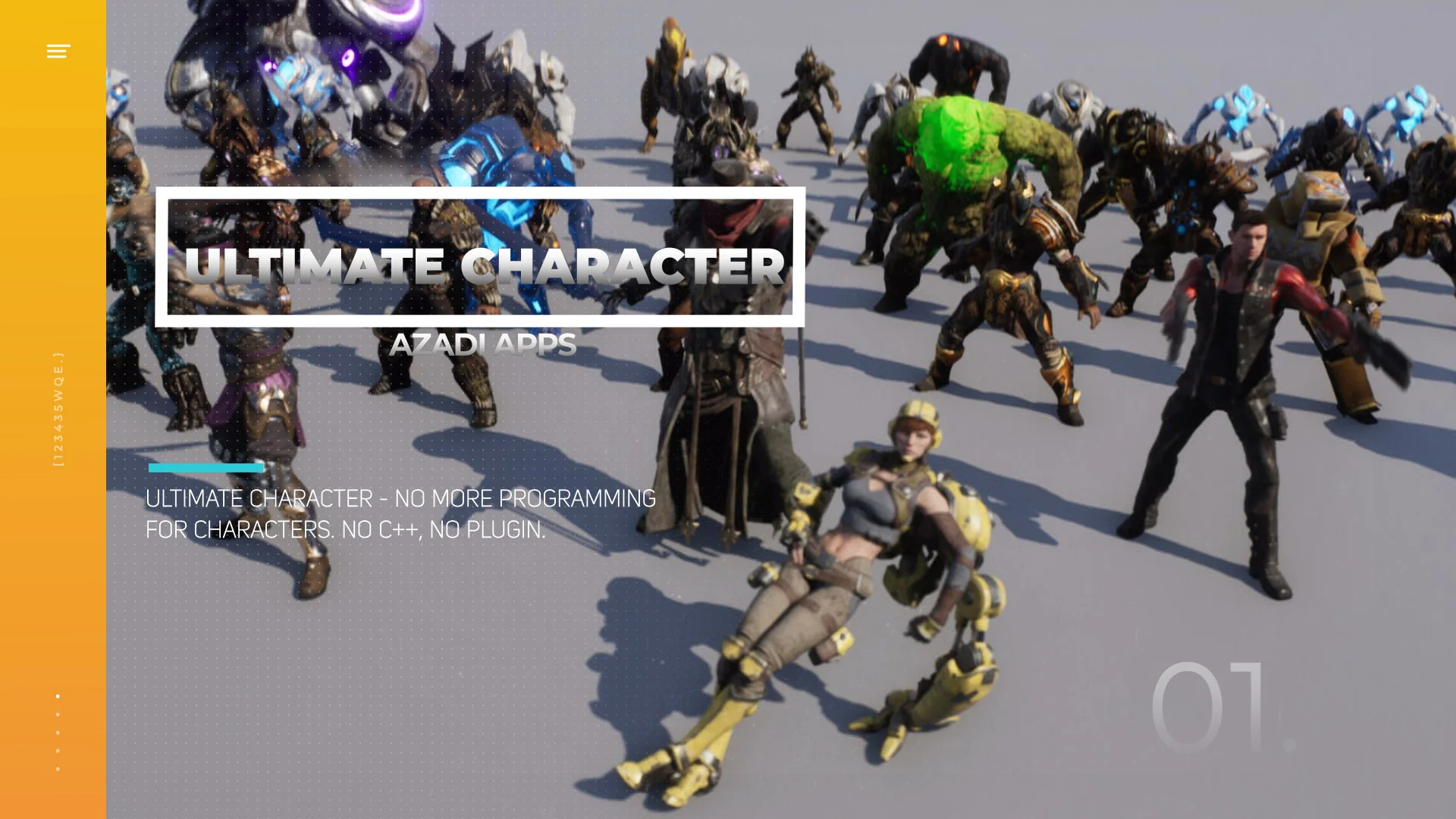
Ultimate Character establishes a foundational gameplay setup for both player characters and non-player combatants using a pure Blueprint architecture. Because the system runs entirely without C++ or third-party external plugins, every interaction remains visible and directly editable inside standard Unreal Engine graph editors. The project supplies ready-to-use sample setups, allowing creators to drop functional characters into test environments without constructing baseline movement, control, or combat links from scratch.
A core design principle of the framework is configuration through straightforward variables and data tables. Rather than requiring script alterations deep inside character logic graphs to modify base stats or behaviors, key elements such as character attributes, equipped weapons, attack definitions, and consumable or equipment items are managed through organized table entries. This table-driven structure lowers the friction of rebalancing gameplay parameters, testing distinct archetypes, or adding fresh combat options.
Future planned integration expanding the framework includes merging a motion matching system alongside a sample project featuring over 500 animations, specifically targeted for engine version 5.4 and newer releases. This setup works in tandem with the modular scripting structure, offering an upgrade path toward more nuanced locomotion without abandoning the underlying Blueprint foundation.
Offense and Defense: Melee, Ranged, and Magic Combat Profiles
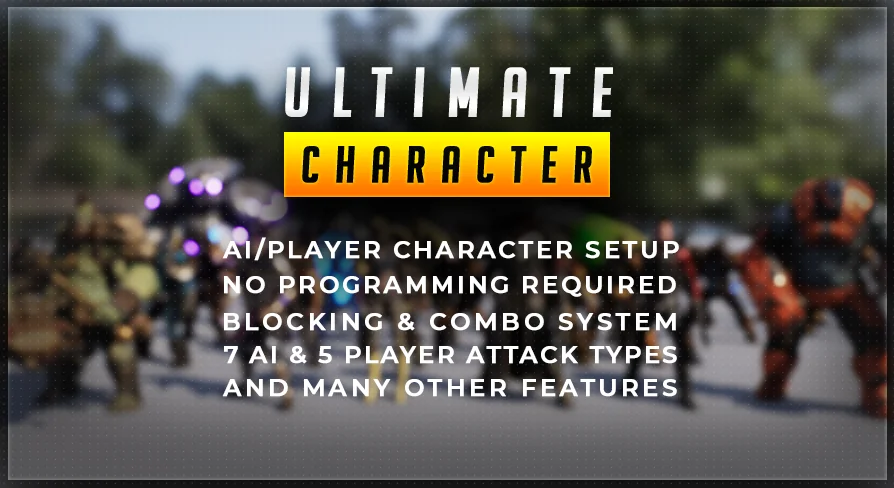
Combat interactions within the project span five distinct player attack types alongside seven AI attack types, with more variants slated for future additions. Both player and AI profiles have access to integrated combo attacks, allowing sequential inputs or programmatic behaviors to chain smoothly from opening strikes into multi-hit strings. Complementing the offensive repertoire, a dedicated blocking system is pre-configured for both player and AI units, offering a simple setup to absorb incoming strikes and establish defensive timing windows.
Weapons are derived from clean base classes that simplify future extensions when designing unique armaments. Melee categories feature close-quarters options such as standard punches, blunt implements like bats, and bladed swords. Ranged loadouts are represented by conventional firearms including rifles and heavy artillery like cannons, along with bombarding systems designed to hit targets over area-of-effect arcs.
Magic attack items introduce varied supernatural offensive capabilities into the combat loop. The magic setup incorporates specialized behaviors such as throwing spells through the air, instantaneous teleportation to shift position across the battlefield, heavy bombarding routines, and summoning mechanics that call characters directly into active play. Because these capabilities tie into the shared item and attack structure, they can be slotted into inventory slots or behavior loops alongside standard martial weaponry.
Modular Behavior Trees and AI Character Orchestration
Opponents utilize modular behavior trees to handle movement, target acquisition, and offensive pacing. Central to this artificial intelligence is an attack changing system that lets agents swap dynamically between their seven available attack types depending on combat conditions, spatial positioning, or programmed state transitions. This modular tree structure allows developers to unplug, replace, or insert custom decision logic without rewriting the underlying perception or pathfinding routines.
Because the AI systems share the same combat interfaces as the player, artificial opponents execute combo attacks, trigger blocks, and handle weapons using identical rule sets. This parity ensures that an encounter against an AI opponent wielding a sword, rifle, or magic attack follows the exact collision, damage, and defensive checks executed when the player utilizes those exact assets.
Data Tables, Item Handling, and World Systems
Item management in the project is structured around an inventory system built to accommodate both limited and unlimited capacity parameters. Items present in the world can be gathered and discarded through a dedicated pickup and drop system, seamlessly updating the inventory state and synchronizing equipped meshes or active status effects. As with the weapon classes, item definitions rely on centralized tables and simple variables to define behavior, stacking properties, and inventory classifications.
Beyond immediate character-level actions, the framework includes essential world-level progression systems. A built-in checkpoint system records player progress across level boundaries or hazardous areas, ensuring predictable respawn positions during gameplay sessions. Tracking performance is handled through an integrated score system, which updates based on game-specific triggers and player achievements.
Camera Dynamics and Debug Support in Ultimate Character
To support responsive action gameplay, the framework implements a dynamic camera system tailored to combat feedback. The camera automatically adjusts its framing, offsets, and field of view during standard attack sequences, defensive blocking states, and when maintaining focus during target lock-on interactions. This dynamic positioning preserves player visibility during tight combos or high-intensity engagements against multiple opponents.
Maintaining and customizing complex combat graphs is reinforced through fully commented blueprints throughout every included system. Logic blocks, function libraries, and event dispatches are annotated to clarify execution paths, input handoffs, and state evaluations. Alongside these clear script annotations, the package includes active debug options, giving developers real-time visual and diagnostic feedback into attack collision states, AI decision paths, camera offsets, and variable values directly within the viewport during play sessions.
 Action-Adventure
 Action-Adventure
 Action-Adventure
 Action-Adventure