"148d1066ed74e216"{"id":"1002953","slug":"flexible-combat-system-melee","title":"Flexible Combat System - Melee","category":"Fighting","engine":"4.27,5.0+","assetVersion":"","engineVersion":"Engine Version: 4.27,5.0+","tag":"Fighting","accent":"blue","visual":"mech","summary":"Explore the Blueprint architecture, multiplayer replication, gamepad radial menus, and modular features of Flexible Combat System - Melee.","platform":"Unreal Engine","indexPolicy":"index","publishedAt":"2026-11-22T07:08:02.838Z","updatedAt":"2026-11-22T07:08:02.838Z","sourceNotes":[],"fileContents":[],"compatibility":["Unreal Engine","Engine Version: 4.27,5.0+"],"featuredImage":{"alt":"Flexible Combat System - Melee","src":"/wp-content/uploads/published/2026/11/a3e9d5d6b304-d7720867-7ffa-4ba4-b58c-f3c405ede03a-813bf08066.webp"},"fileSizeBytes":6333105413,"hasDownloadLink":true,"downloads":0,"terms":[{"taxonomy":"category","slug":"fighting","name":"Fighting"}],"galleryImages":[{"src":"/wp-content/uploads/published/2026/11/f6bf7263e786-cc8bfe5e-85ac-4b14-bcce-f6b89b83f18a-ca881cc928.webp","alt":"Flexible Combat System - Melee"},{"src":"/wp-content/uploads/published/2026/11/15880f944b28-66e2c35e-1eff-4fc9-b412-df68aa078270-8d262c5653.webp","alt":"Flexible Combat System - Melee"},{"src":"/wp-content/uploads/published/2026/11/6c96e2a0f444-be56663e-2c53-477b-8997-20a1e75530ae-6848e2e049.webp","alt":"Flexible Combat System - Melee"},{"src":"/wp-content/uploads/published/2026/11/9688c42b40f2-49784390-abdb-447d-8360-020db8b7008d-6ada8e3286.webp","alt":"Flexible Combat System - Melee"},{"src":"/wp-content/uploads/published/2026/11/10197929efc1-b4b91daf-cbbb-4089-a739-ab6179319155-80e4ab36f5.webp","alt":"Flexible Combat System - Melee"},{"src":"/wp-content/uploads/published/2026/11/452445132aeb-d8ca87e0-e4ed-4a19-8e6e-65bca6f6215c-6f564e67c5.webp","alt":"Flexible Combat System - Melee"},{"src":"/wp-content/uploads/published/2026/11/a9120052542b-cc7ed050-387f-4c61-a86f-4c7d8826cb05-31ad4095ab.webp","alt":"Flexible Combat System - Melee"},{"src":"/wp-content/uploads/published/2026/11/cb9db4b02b28-6a86b97a-f5d2-45c6-988e-c262791f8579-43e0b05387.webp","alt":"Flexible Combat System - Melee"},{"src":"/wp-content/uploads/published/2026/11/6905250ac227-b34d305b-7264-4a2a-a21e-63a5735d232f-1a0e2f8ec5.webp","alt":"Flexible Combat System - Melee"},{"src":"/wp-content/uploads/published/2026/11/ebea9a43bb05-85c62c55-b03c-493b-869e-1a9bad327302-1cc0ab7000.webp","alt":"Flexible Combat System - Melee"}],"accessPanel":{"kind":"resource","title":"Get this resource","safetyNote":"Resources are manually reviewed before listing to improve quality and reduce obvious risks.","fileName":"Flexible Combat System - Melee.7z","resourceType":"Resource archive","versions":[]},"contentHtml":"\u003ch2\u003eConfiguring the Flexible Combat Setup and System Foundations\u003c/h2\u003e\n\u003cp\u003eIntegrating a dedicated melee framework into an existing project begins with mapping core logic to character states and input bindings. The architecture of the Flexible Combat System - Melee is constructed via cleanly organized Blueprints, allowing developers to inspect logic paths, modify state transitions, and adapt core variables without deciphering deeply tangled graphs. Setting up the base character requires anchoring fundamental action RPG modules, including health management, stamina usage, character positioning, and offensive states, within a unified layout.\u003c/p\u003e\n\u003cp\u003eThe package addresses a broad spectrum of game styles. Rather than restricting projects to a single viewpoint, the structural design accommodates first-person, third-person, and top-down camera orientations. This versatility allows the underlying melee calculations, swing timings, and impact responses to remain consistent whether the game operates as an isometric dungeon crawler or an over-the-shoulder action title. In tandem with combat primitives, the framework interacts with interconnected RPG systems including inventory tracking, crafting mechanics, quest states, non-player character dialogue trees, and base artificial intelligence routines.\u003c/p\u003e\n\u003cp\u003eInitial setup relies on a structured Guidelines Document that outlines asset layout and directs developers through the foundational configuration steps. Because the system was established through more than 10,000 hours of development, the Blueprint graph prioritizes modularity. Logic branches governing swing animations, weapon collision traces, hit reactions, and stamina expenditure are separated into digestible components. Developers can bypass unneeded modules or insert custom calculation nodes directly into damage assessment chains without breaking secondary gameplay loops.\u003c/p\u003e \u003ch2\u003eGamepad Navigation and Tactical Selection in Melee Encounters\u003c/h2\u003e\n\u003cp\u003eFluid physical combat demands rapid, uninterrupted control inputs, which can be challenging to configure cleanly on standard controllers. The framework includes native gamepad functionality built directly into the input hierarchy. Controller support extends beyond basic directional movement and light/heavy swings, featuring custom interface schemes engineered specifically for gamepads.\u003c/p\u003e\n\u003cp\u003eCentral to this controller setup are responsive radial menus. These menus govern tactical item consumption, attack selection, and user interface navigation without interrupting the pacing of an active duel. By holding or toggling assigned shoulder buttons or triggers, players can summon on-screen wheels to cycle through weapon stances, trigger specific special attacks, or select quick-slot consumables like potions. The inclusion of dynamic key binding logic ensures that players can reallocate input mappings to match individual accessibility preferences or distinct platform controller standards.\u003c/p\u003e\n\u003cp\u003eAction pacing benefits from ergonomic input mapping. When executing chains of attacks, hit windows and combo branches listen closely to gamepad thumbstick directions and face button inputs. This prevents the sluggish input dropping that often occurs when gamepad signals must route through unconverted keyboard-and-mouse mapping nodes. The user interface elements, targeting toggles, and radial selections operate synchronously, ensuring that character orientation and camera tracking remain locked on hostile targets throughout heavy combat maneuvers.\u003c/p\u003e \u003ch2\u003eReplication Behavior Across Single-Player and Networked Architectures\u003c/h2\u003e\n\u003cp\u003eNetworking considerations dictate how combat logic handles latency, authority, and visual synchronization. Flexible Combat System - Melee is built with multiplayer replication implemented across the vast majority of its underlying actions. Weapon swings, collision tracing, hit confirmation, damage application, defensive blocking, and animation state changes are designed to run through client-server replication structures natively.\u003c/p\u003e\n\u003cp\u003eDespite this broad network synchronization, specific high-level frameworks are deliberately withheld from automatic replication: the save system and the quest system. Game structures vary radically across different formats, meaning a universal replication method for quest data or persistent state saves is impractical. A massively multiplayer online title handles character progression and active quest objectives through dedicated external databases and proprietary server pipelines, whereas a cooperative dungeon brawler might serialize quest progress directly onto a host player's local instance. Leaving quest and save logic unreplicated protects developers from having to dismantle incompatible network assumptions, allowing them to hook their own preferred persistence solutions into the combat core.\u003c/p\u003e\n\u003cp\u003eFor standalone, offline experiences, the network overhead can be ignored entirely. The framework operates cleanly in single-player configurations without demanding active local network emulation or throwing continuous replication errors. Character data, inventory management, AI aggro ranges, and hit-point counters process directly through the local player controller, delivering responsive performance free of client-server round-trip latency.\u003c/p\u003e \u003ch2\u003eAdvanced Mechanics, Locomotion Interfacing, and Pipeline Expansion\u003c/h2\u003e\n\u003cp\u003eOnce base swordplay and defensive stances are established, scaling a combat title requires incorporating sophisticated movement, audio, visual effects, and environmental staging. The system architecture supports advanced integrations, such as linking combat logic to the community-standard Advanced Locomotion System (ALS). By combining ALS locomotion blending with this framework's strike execution and hit traces, characters can maintain fluid footwork, realistic momentum shifts, and responsive directional changes while simultaneously executing attacks.\u003c/p\u003e\n\u003cp\u003eExpanding the visual and mechanical fidelity of the core combat loops naturally involves external production pipelines:\u003c/p\u003e\n\u003cul\u003e \u003cli\u003e\u003cstrong\u003eLocomotion and Combat Animation:\u003c/strong\u003e The Blueprint state machines are designed to accept specialized combat animation libraries, such as assets developed by space.bar.anim, enabling custom motion-captured attacks, evasive rolls, and weapon flourishes to slot directly into combo windows.\u003c/li\u003e \u003cli\u003e\u003cstrong\u003eVisual Effects and Impacts:\u003c/strong\u003e Collision trace points accept particle triggers and Niagara bursts, making it straightforward to attach stylized or realistic visual effects from creators like Rimaye.Std to sword trails, parry sparks, and ground-slam impacts.\u003c/li\u003e \u003cli\u003e\u003cstrong\u003eAudio Feedback:\u003c/strong\u003e Sound trigger nodes are positioned alongside damage assessment events, allowing sound effect libraries—such as those from Magic Sound Effects—and soundtrack stems from composers like Wiktoria to synchronize dynamically with impact events, weapon draws, and dynamic combat states.\u003c/li\u003e \u003cli\u003e\u003cstrong\u003eUser Interface and Character Presentation:\u003c/strong\u003e The menu architecture natively accommodates interface packages like PONETI UI alongside stylized character assets from studios like N-Hance Studio, providing clean integration paths for health bars, action hotbars, and equipment models.\u003c/li\u003e \u003cli\u003e\u003cstrong\u003eEnvironment Setting:\u003c/strong\u003e The collision mechanics interact cleanly across high-fidelity scenes, including realistic environments produced by teams like Freshcan 3D, ensuring accurate weapon surface deflections on stone walls, foliage, or uneven terrain.\u003c/li\u003e\n\u003c/ul\u003e \u003ch2\u003eGuideline Protocols, Documentation, and Long-Term System Maintenance\u003c/h2\u003e\n\u003cp\u003eMaintaining complex Blueprint projects over multi-year production schedules requires rigorous adherence to documentation and standard conventions. To assist developers through each phase of integration, the asset includes comprehensive instructional resources comprising more than 30 detailed video tutorials, with additional material continuously generated to cover fringe technical cases and advanced feature modifications.\u003c/p\u003e\n\u003cp\u003eDirect assistance and community collaboration are centralized through a verified Discord structure. Developers gain entry to technical support tiers and the full extended tutorial library by completing a dedicated verification process. This ensures direct communication channels with the system's creator and other technical developers who are actively modifying the codebase for production titles. Through these avenues, teams can troubleshoot edge-case network discrepancies, refine combo branching logic, and stay informed on best practices when adapting the older melee package alongside modern game frameworks.\u003c/p\u003e\n\n\u003ch2\u003eRelated Resources Worth Checking\u003c/h2\u003e\n\u003cul\u003e\n\u003cli\u003e\u003ca href=\"https://3dcghub.com/basic-multiplayer-melee-combat-system/\" rel=\"noopener noreferrer\"\u003eBasic Multiplayer Melee Combat System\u003c/a\u003e\u003c/li\u003e\n\u003cli\u003e\u003ca href=\"https://3dcghub.com/flexible-combat-system/\" rel=\"noopener noreferrer\"\u003eFlexible Combat System\u003c/a\u003e\u003c/li\u003e\n\u003cli\u003e\u003ca href=\"https://3dcghub.com/takedown-animations-pack/\" rel=\"noopener noreferrer\"\u003eTakedown Animations Pack\u003c/a\u003e\u003c/li\u003e\n\u003cli\u003e\u003ca href=\"https://3dcghub.com/fpp-melee-animset/\" rel=\"noopener noreferrer\"\u003eFPP Melee Animset\u003c/a\u003e\u003c/li\u003e\n\u003cli\u003e\u003ca href=\"https://3dcghub.com/robot-wars-template/\" rel=\"noopener noreferrer\"\u003eRobot Wars Template\u003c/a\u003e\u003c/li\u003e\n\u003c/ul\u003e","contentTextLength":8613,"navigation":{"current":17,"total":4890,"previous":{"id":"1002954","slug":"ultimate-multiplayer-survival-pack-v6","title":"Ultimate Multiplayer Survival Pack V6","category":"Action-Adventure","platform":"Unreal Engine","updatedAt":"2026-11-22T07:09:06.466Z"},"next":{"id":"1002952","slug":"ultimate-movement-system","title":"Ultimate Movement System","category":"Action-Adventure","platform":"Unreal Engine","updatedAt":"2026-11-22T07:07:06.222Z"}},"relatedResources":[{"id":"1001247","slug":"basic-multiplayer-melee-combat-system","title":"Basic Multiplayer Melee Combat System","category":"Fighting","engine":"5.0+","assetVersion":"","engineVersion":"Engine Version: 5.0+","tag":"Fighting","accent":"blue","visual":"mech","summary":"A technical look at the Basic Multiplayer Melee Combat System, featuring modular actor components, hit scan tracing, lock-on targeting, and 3v3 bot support.","platform":"Unreal Engine","indexPolicy":"index","publishedAt":"2026-09-23T15:24:40.286Z","updatedAt":"2026-09-23T15:24:40.286Z","sourceNotes":[],"fileContents":[],"compatibility":["Unreal Engine","Engine Version: 5.0+"],"featuredImage":{"alt":"Basic Multiplayer Melee Combat System","src":"/wp-content/uploads/published/2026/09/035e110571a9-f0a9ce02-9dce-45fd-b0a4-670e3182aabb-234ab47290.webp"},"fileSizeBytes":333605407,"hasDownloadLink":true,"downloads":1},{"id":"11858","slug":"flexible-combat-system","title":"Flexible Combat System","category":"RPG","engine":"5.5+","assetVersion":"Engine version: 5.5+","engineVersion":"5.5","tag":"RPG","accent":"blue","visual":"audio","summary":"The Flexible Combat System is a comprehensive framework designed for high-end game development. It offers full customization, gamepad support, and multiplayer replication for creators of all levels.","platform":"Unreal Engine","indexPolicy":"noindex","publishedAt":"2026-03-05T19:02:58.000Z","updatedAt":"2026-04-19T15:48:06.000Z","sourceNotes":[],"fileContents":[],"compatibility":["Unreal Engine","Engine version: 5.5+"],"featuredImage":{"alt":"Flexible Combat System","src":"https://3dcghub.com/wp-content/uploads/2026/03/938328d5-2143-448d-8393-8ef0812c0c87.webp"},"fileSizeBytes":7439823375,"hasDownloadLink":true,"downloads":11},{"id":"5946","slug":"takedown-animations-pack","title":"Takedown Animations Pack","category":"Combat","engine":"5.1+","assetVersion":"Engine version: 5.1+","engineVersion":"4.22","tag":"Combat","accent":"blue","visual":"animation","summary":"Enhance your game's combat with 40 high-quality takedown animations. Includes melee weapons, multiplayer replication, and advanced HandIK logic for Unreal Engin","platform":"Unreal Engine","indexPolicy":"noindex","publishedAt":"2026-02-18T16:07:36.000Z","updatedAt":"2026-04-19T15:56:35.000Z","sourceNotes":[],"fileContents":[],"compatibility":["Unreal Engine","Engine version: 5.1+"],"featuredImage":{"alt":"Takedown Animations Pack","src":"https://3dcghub.com/wp-content/uploads/2026/02/2bbfe30e-6f63-4330-9bc6-cc001bae4122.webp"},"fileSizeBytes":472076739,"hasDownloadLink":true,"downloads":5}]}[{"id":4225,"sourceId":4225,"taxonomyId":4225,"taxonomy":"category","slug":"asset-library","name":"Asset Library","parentId":null,"count":4744,"hasChildren":true,"href":"/","seoTitle":"Free Game Assets Library | 3DCGHUB","seoDescription":"Browse free Unreal Engine, Unity, Blender assets and game development tutorials on 3DCGHUB with previews, compatibility notes, and secure downloads.","sitemapEnabled":true,"children":[{"id":4227,"sourceId":4227,"taxonomyId":4227,"taxonomy":"category","slug":"blender-add-ons-plugins","name":"Blender Add-ons \u0026 Plugins","parentId":4225,"count":10,"hasChildren":false,"href":"/category/blender-add-ons-plugins/","seoTitle":"Free Blender Add-ons \u0026 Plugins | 3DCGHUB","seoDescription":"Browse free Blender Add-ons \u0026 Plugins tools for Blender on 3DCGHUB: curated downloads with preview images, compatibility notes and secure download access.","sitemapEnabled":true},{"id":514,"sourceId":514,"taxonomyId":514,"taxonomy":"category","slug":"unity-2","name":"Unity","parentId":4225,"count":453,"hasChildren":true,"href":"/category/unity-2/","seoTitle":"Free Unity Assets | 3DCGHUB","seoDescription":"Browse free Unity resources on 3DCGHUB: curated downloads with preview images, compatibility notes and secure download access.","sitemapEnabled":true,"children":[{"id":523,"sourceId":523,"taxonomyId":523,"taxonomy":"category","slug":"2d","name":"2D","parentId":514,"count":1,"hasChildren":true,"href":"/category/2d/","seoTitle":"Free Unity 2D | 3DCGHUB","seoDescription":"Browse free 2D assets for Unity on 3DCGHUB: curated downloads with preview images, compatibility notes and secure download access.","sitemapEnabled":true},{"id":515,"sourceId":515,"taxonomyId":515,"taxonomy":"category","slug":"3d-unity-2","name":"3D","parentId":514,"count":162,"hasChildren":true,"href":"/category/3d-unity-2/","seoTitle":"Free Unity 3D Assets | 3DCGHUB","seoDescription":"Browse free 3D assets for Unity on 3DCGHUB: curated downloads with preview images, compatibility notes and secure download access.","sitemapEnabled":true},{"id":565,"sourceId":565,"taxonomyId":565,"taxonomy":"category","slug":"add-ons","name":"Add-Ons","parentId":514,"count":2,"hasChildren":false,"href":"/category/add-ons/","seoTitle":"Free Unity Add-Ons | 3DCGHUB","seoDescription":"Browse free Add-Ons assets for Unity on 3DCGHUB: curated downloads with preview images, compatibility notes and secure download access.","sitemapEnabled":true},{"id":529,"sourceId":529,"taxonomyId":529,"taxonomy":"category","slug":"audio-unity-2","name":"Audio","parentId":514,"count":1,"hasChildren":true,"href":"/category/audio-unity-2/","seoTitle":"Free Unity Audio | 3DCGHUB","seoDescription":"Browse free Audio for Unity on 3DCGHUB: curated downloads with preview images, compatibility notes and secure download access.","sitemapEnabled":true},{"id":557,"sourceId":557,"taxonomyId":557,"taxonomy":"category","slug":"templates","name":"Templates","parentId":514,"count":36,"hasChildren":true,"href":"/category/templates/","seoTitle":"Free Unity Templates | 3DCGHUB","seoDescription":"Browse free Unity project templates on 3DCGHUB. Starter kits with previews, compatibility notes, and secure download access.","sitemapEnabled":true},{"id":533,"sourceId":533,"taxonomyId":533,"taxonomy":"category","slug":"tools-unity-2","name":"Tools","parentId":514,"count":0,"hasChildren":true,"href":"/category/tools-unity-2/","sitemapEnabled":true},{"id":554,"sourceId":554,"taxonomyId":554,"taxonomy":"category","slug":"vfx-unity-2","name":"VFX","parentId":514,"count":4,"hasChildren":true,"href":"/category/vfx-unity-2/","seoTitle":"Free Unity VFX | 3DCGHUB","seoDescription":"Browse free VFX for Unity on 3DCGHUB: curated downloads with preview images, compatibility notes and secure download access.","sitemapEnabled":true}]},{"id":511,"sourceId":511,"taxonomyId":511,"taxonomy":"category","slug":"unreal-engine-2","name":"Unreal Engine","parentId":4225,"count":4282,"hasChildren":true,"href":"/category/unreal-engine-2/","seoTitle":"Free Unreal Engine Assets | 3DCGHUB","seoDescription":"Browse free Unreal Engine resources on 3DCGHUB: curated downloads with preview images, compatibility notes and secure download access.","sitemapEnabled":true,"children":[{"id":54,"sourceId":54,"taxonomyId":54,"taxonomy":"category","slug":"3d","name":"3D","parentId":511,"count":2428,"hasChildren":true,"href":"/category/3d/","seoTitle":"Free Unreal Engine 3D | 3DCGHUB","seoDescription":"Browse free 3D assets for Unreal Engine on 3DCGHUB: curated downloads with preview images, compatibility notes and secure download access.","sitemapEnabled":true},{"id":441,"sourceId":441,"taxonomyId":441,"taxonomy":"category","slug":"animations","name":"Animations","parentId":511,"count":245,"hasChildren":true,"href":"/category/animations/","seoTitle":"Free Unreal Engine Animations | 3DCGHUB","seoDescription":"Browse free Animations for Unreal Engine on 3DCGHUB: curated downloads with preview images, compatibility notes and secure download access.","sitemapEnabled":true},{"id":446,"sourceId":446,"taxonomyId":446,"taxonomy":"category","slug":"audio","name":"Audio","parentId":511,"count":63,"hasChildren":true,"href":"/category/audio/","seoTitle":"Free Unreal Engine Audio Resources | 3DCGHUB","seoDescription":"Browse free Unreal Engine audio resources including sound effects, voices, dialogue, and ambient sounds. Curated free downloads on 3DCGHUB.","sitemapEnabled":true},{"id":466,"sourceId":466,"taxonomyId":466,"taxonomy":"category","slug":"game-systems","name":"Game Systems","parentId":511,"count":356,"hasChildren":true,"href":"/category/game-systems/","seoTitle":"Free Unreal Engine Game Systems | 3DCGHUB","seoDescription":"Browse free Game Systems tools for Unreal Engine on 3DCGHUB: curated downloads with preview images, compatibility notes and secure download access.","sitemapEnabled":true},{"id":478,"sourceId":478,"taxonomyId":478,"taxonomy":"category","slug":"game-templates","name":"Game Templates","parentId":511,"count":150,"hasChildren":true,"href":"/category/game-templates/","seoTitle":"Free Unreal Engine Game Templates | 3DCGHUB","seoDescription":"Browse free Game Templates for Unreal Engine on 3DCGHUB: curated downloads with preview images, compatibility notes and secure download access.","sitemapEnabled":true},{"id":432,"sourceId":432,"taxonomyId":432,"taxonomy":"category","slug":"hdri","name":"HDRI","parentId":511,"count":6,"hasChildren":true,"href":"/category/hdri/","seoTitle":"Free Unreal Engine HDRI | 3DCGHUB","seoDescription":"Browse free Unreal Engine HDRI skies and lighting maps on 3DCGHUB. Environment lighting with previews and secure downloads.","sitemapEnabled":true},{"id":228,"sourceId":228,"taxonomyId":228,"taxonomy":"category","slug":"material-and-textures","name":"Material \u0026 Textures","parentId":511,"count":172,"hasChildren":true,"href":"/category/material-and-textures/","seoTitle":"Free Unreal Engine Material \u0026 Textures | 3DCGHUB","seoDescription":"Browse free Material \u0026 Textures for Unreal Engine on 3DCGHUB: curated downloads with preview images, compatibility notes and secure download access.","sitemapEnabled":true},{"id":298,"sourceId":298,"taxonomyId":298,"taxonomy":"category","slug":"sprites-and-flipbooks","name":"Sprites \u0026 Flipbooks","parentId":511,"count":17,"hasChildren":true,"href":"/category/sprites-and-flipbooks/","seoTitle":"Free Unreal Engine Sprites \u0026 Flipbooks | 3DCGHUB","seoDescription":"Browse free Sprites \u0026 Flipbooks assets for Unreal Engine on 3DCGHUB: curated downloads with preview images, compatibility notes and secure download access.","sitemapEnabled":true},{"id":489,"sourceId":489,"taxonomyId":489,"taxonomy":"category","slug":"tools-and-plugins","name":"Tools \u0026 Plugins","parentId":511,"count":390,"hasChildren":true,"href":"/category/tools-and-plugins/","seoTitle":"Free Unreal Engine Tools \u0026 Plugins | 3DCGHUB","seoDescription":"Browse free Tools \u0026 Plugins for Unreal Engine on 3DCGHUB: curated downloads with preview images, compatibility notes and secure download access.","sitemapEnabled":true},{"id":459,"sourceId":459,"taxonomyId":459,"taxonomy":"category","slug":"ui","name":"UI","parentId":511,"count":43,"hasChildren":true,"href":"/category/ui/","seoTitle":"Free Unreal Engine UI | 3DCGHUB","seoDescription":"Browse free UI for Unreal Engine on 3DCGHUB: curated downloads with preview images, compatibility notes and secure download access.","sitemapEnabled":true},{"id":450,"sourceId":450,"taxonomyId":450,"taxonomy":"category","slug":"vfx","name":"VFX","parentId":511,"count":412,"hasChildren":true,"href":"/category/vfx/","seoTitle":"Free Unreal Engine VFX | 3DCGHUB","seoDescription":"Browse free VFX for Unreal Engine on 3DCGHUB: curated downloads with preview images, compatibility notes and secure download access.","sitemapEnabled":true}]}]},{"id":4222,"sourceId":4222,"taxonomyId":4222,"taxonomy":"category","slug":"tutorial-library","name":"Tutorial Library","parentId":null,"count":117,"hasChildren":false,"href":"/tutorials/","seoTitle":"Free Game Development Tutorial Library | 3DCGHUB","seoDescription":"Browse free game development tutorials for Unreal Engine, Unity, Blender, and more on 3DCGHUB with practical workflows and secure downloads.","sitemapEnabled":true}]
Resource screenshots
1 / 10
Join our channel
Follow 3DCGHUB on Telegram for new resource drops, migration updates, and community notices.
Configuring the Flexible Combat Setup and System Foundations
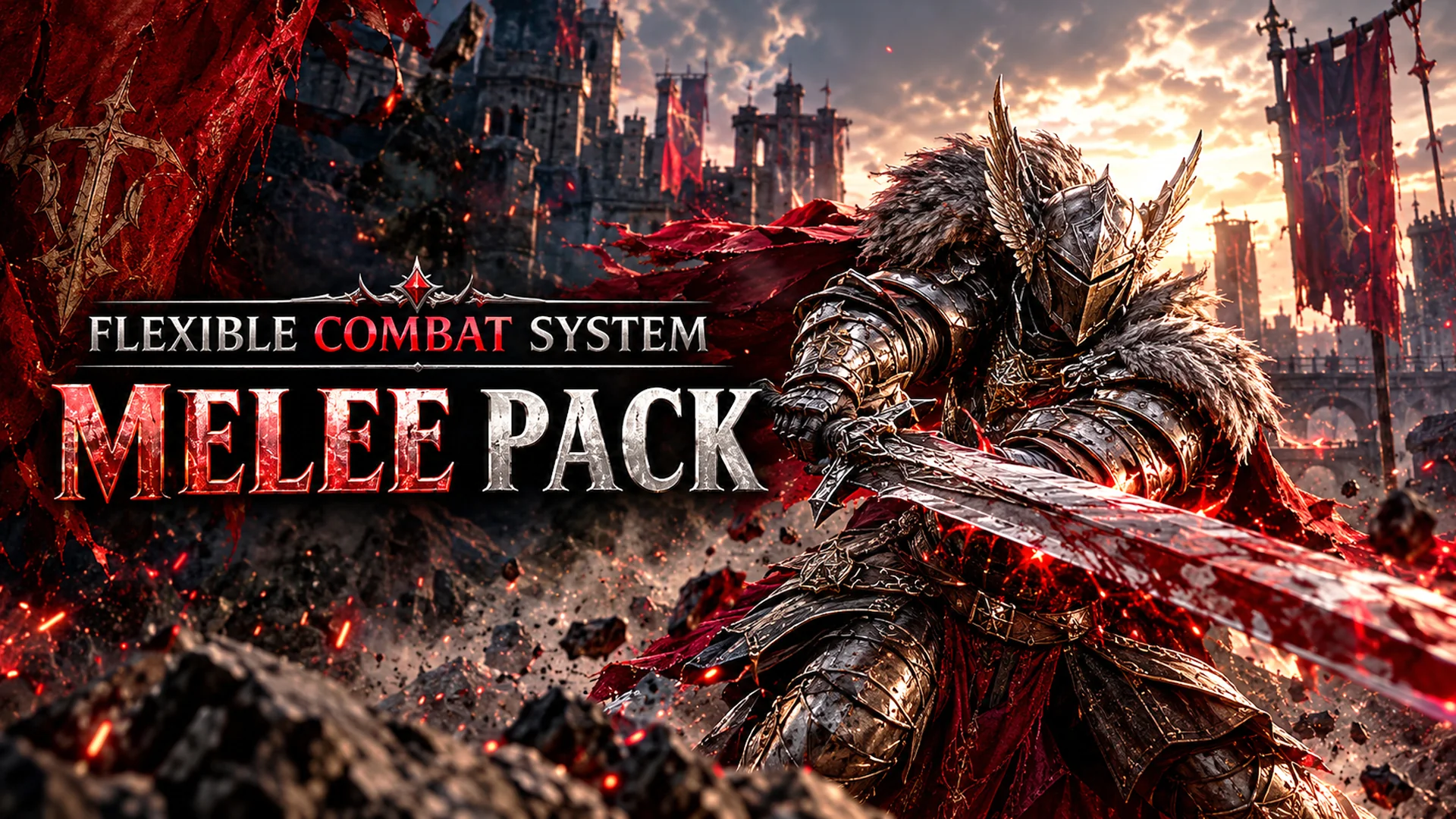
Integrating a dedicated melee framework into an existing project begins with mapping core logic to character states and input bindings. The architecture of the Flexible Combat System - Melee is constructed via cleanly organized Blueprints, allowing developers to inspect logic paths, modify state transitions, and adapt core variables without deciphering deeply tangled graphs. Setting up the base character requires anchoring fundamental action RPG modules, including health management, stamina usage, character positioning, and offensive states, within a unified layout.
The package addresses a broad spectrum of game styles. Rather than restricting projects to a single viewpoint, the structural design accommodates first-person, third-person, and top-down camera orientations. This versatility allows the underlying melee calculations, swing timings, and impact responses to remain consistent whether the game operates as an isometric dungeon crawler or an over-the-shoulder action title. In tandem with combat primitives, the framework interacts with interconnected RPG systems including inventory tracking, crafting mechanics, quest states, non-player character dialogue trees, and base artificial intelligence routines.
Initial setup relies on a structured Guidelines Document that outlines asset layout and directs developers through the foundational configuration steps. Because the system was established through more than 10,000 hours of development, the Blueprint graph prioritizes modularity. Logic branches governing swing animations, weapon collision traces, hit reactions, and stamina expenditure are separated into digestible components. Developers can bypass unneeded modules or insert custom calculation nodes directly into damage assessment chains without breaking secondary gameplay loops.
Gamepad Navigation and Tactical Selection in Melee Encounters
Fluid physical combat demands rapid, uninterrupted control inputs, which can be challenging to configure cleanly on standard controllers. The framework includes native gamepad functionality built directly into the input hierarchy. Controller support extends beyond basic directional movement and light/heavy swings, featuring custom interface schemes engineered specifically for gamepads.
Central to this controller setup are responsive radial menus. These menus govern tactical item consumption, attack selection, and user interface navigation without interrupting the pacing of an active duel. By holding or toggling assigned shoulder buttons or triggers, players can summon on-screen wheels to cycle through weapon stances, trigger specific special attacks, or select quick-slot consumables like potions. The inclusion of dynamic key binding logic ensures that players can reallocate input mappings to match individual accessibility preferences or distinct platform controller standards.
Action pacing benefits from ergonomic input mapping. When executing chains of attacks, hit windows and combo branches listen closely to gamepad thumbstick directions and face button inputs. This prevents the sluggish input dropping that often occurs when gamepad signals must route through unconverted keyboard-and-mouse mapping nodes. The user interface elements, targeting toggles, and radial selections operate synchronously, ensuring that character orientation and camera tracking remain locked on hostile targets throughout heavy combat maneuvers.
Replication Behavior Across Single-Player and Networked Architectures
Networking considerations dictate how combat logic handles latency, authority, and visual synchronization. Flexible Combat System - Melee is built with multiplayer replication implemented across the vast majority of its underlying actions. Weapon swings, collision tracing, hit confirmation, damage application, defensive blocking, and animation state changes are designed to run through client-server replication structures natively.
Despite this broad network synchronization, specific high-level frameworks are deliberately withheld from automatic replication: the save system and the quest system. Game structures vary radically across different formats, meaning a universal replication method for quest data or persistent state saves is impractical. A massively multiplayer online title handles character progression and active quest objectives through dedicated external databases and proprietary server pipelines, whereas a cooperative dungeon brawler might serialize quest progress directly onto a host player's local instance. Leaving quest and save logic unreplicated protects developers from having to dismantle incompatible network assumptions, allowing them to hook their own preferred persistence solutions into the combat core.
For standalone, offline experiences, the network overhead can be ignored entirely. The framework operates cleanly in single-player configurations without demanding active local network emulation or throwing continuous replication errors. Character data, inventory management, AI aggro ranges, and hit-point counters process directly through the local player controller, delivering responsive performance free of client-server round-trip latency.
Advanced Mechanics, Locomotion Interfacing, and Pipeline Expansion
Once base swordplay and defensive stances are established, scaling a combat title requires incorporating sophisticated movement, audio, visual effects, and environmental staging. The system architecture supports advanced integrations, such as linking combat logic to the community-standard Advanced Locomotion System (ALS). By combining ALS locomotion blending with this framework's strike execution and hit traces, characters can maintain fluid footwork, realistic momentum shifts, and responsive directional changes while simultaneously executing attacks.
Expanding the visual and mechanical fidelity of the core combat loops naturally involves external production pipelines:
Locomotion and Combat Animation: The Blueprint state machines are designed to accept specialized combat animation libraries, such as assets developed by space.bar.anim, enabling custom motion-captured attacks, evasive rolls, and weapon flourishes to slot directly into combo windows.
Visual Effects and Impacts: Collision trace points accept particle triggers and Niagara bursts, making it straightforward to attach stylized or realistic visual effects from creators like Rimaye.Std to sword trails, parry sparks, and ground-slam impacts.
Audio Feedback: Sound trigger nodes are positioned alongside damage assessment events, allowing sound effect libraries—such as those from Magic Sound Effects—and soundtrack stems from composers like Wiktoria to synchronize dynamically with impact events, weapon draws, and dynamic combat states.
User Interface and Character Presentation: The menu architecture natively accommodates interface packages like PONETI UI alongside stylized character assets from studios like N-Hance Studio, providing clean integration paths for health bars, action hotbars, and equipment models.
Environment Setting: The collision mechanics interact cleanly across high-fidelity scenes, including realistic environments produced by teams like Freshcan 3D, ensuring accurate weapon surface deflections on stone walls, foliage, or uneven terrain.
Guideline Protocols, Documentation, and Long-Term System Maintenance
Maintaining complex Blueprint projects over multi-year production schedules requires rigorous adherence to documentation and standard conventions. To assist developers through each phase of integration, the asset includes comprehensive instructional resources comprising more than 30 detailed video tutorials, with additional material continuously generated to cover fringe technical cases and advanced feature modifications.
Direct assistance and community collaboration are centralized through a verified Discord structure. Developers gain entry to technical support tiers and the full extended tutorial library by completing a dedicated verification process. This ensures direct communication channels with the system's creator and other technical developers who are actively modifying the codebase for production titles. Through these avenues, teams can troubleshoot edge-case network discrepancies, refine combo branching logic, and stay informed on best practices when adapting the older melee package alongside modern game frameworks.
 Fighting
 RPG
 Combat