"148d1066ed74e216"{"id":"1002954","slug":"ultimate-multiplayer-survival-pack-v6","title":"Ultimate Multiplayer Survival Pack V6","category":"Action-Adventure","engine":"5.5+","assetVersion":"","engineVersion":"Engine Version: 5.5+","tag":"Action-Adventure","accent":"blue","visual":"mech","summary":"Explore the systems, modular mechanics, and environment features inside the Ultimate Multiplayer Survival Pack V6 for Unreal Engine survival games.","platform":"Unreal Engine","indexPolicy":"index","publishedAt":"2026-11-22T07:09:06.466Z","updatedAt":"2026-11-22T07:09:06.466Z","sourceNotes":[],"fileContents":[],"compatibility":["Unreal Engine","Engine Version: 5.5+"],"featuredImage":{"alt":"Ultimate Multiplayer Survival Pack V6","src":"/wp-content/uploads/published/2026/11/fc02fe244546-f33dd80a-7f85-447e-852d-f70d91f404be-6422cb079a.webp"},"fileSizeBytes":430353513,"hasDownloadLink":true,"downloads":0,"terms":[{"taxonomy":"category","slug":"action-adventure","name":"Action-Adventure"}],"galleryImages":[{"src":"/wp-content/uploads/published/2026/11/fa5fee49b175-8cae3279-7efa-4978-872f-a6bc361a6324-f11ed56574.webp","alt":"Ultimate Multiplayer Survival Pack V6"},{"src":"/wp-content/uploads/published/2026/11/7f86509bf689-613ab348-4fe7-41b7-b425-412500f40a8a-0d39f56e29.webp","alt":"Ultimate Multiplayer Survival Pack V6"},{"src":"/wp-content/uploads/published/2026/11/be0bf5c05a95-750ca33a-a7e5-4131-bf31-da5ba5295dcb-2aa3bddf93.webp","alt":"Ultimate Multiplayer Survival Pack V6"},{"src":"/wp-content/uploads/published/2026/11/f7ccd31cb49c-190016a8-c77d-472c-9808-2a6e997f2cc6-08dea189c8.webp","alt":"Ultimate Multiplayer Survival Pack V6"},{"src":"/wp-content/uploads/published/2026/11/7323b38fc234-22a329cc-9b4f-408f-8d32-a723b6fa4b75-6dda27be4a.webp","alt":"Ultimate Multiplayer Survival Pack V6"},{"src":"/wp-content/uploads/published/2026/11/af56334ba313-3b5aa254-6315-42aa-8404-327330422651-12dcd14e00.webp","alt":"Ultimate Multiplayer Survival Pack V6"},{"src":"/wp-content/uploads/published/2026/11/d6cbb0f5b75b-870dcfd8-5297-46c6-84e9-fb237a5ddf06-9abca2c91b.webp","alt":"Ultimate Multiplayer Survival Pack V6"},{"src":"/wp-content/uploads/published/2026/11/0f46956d88ae-7e6b2d64-fda7-4589-87b1-a7ca257cf63e-a0b10691b7.webp","alt":"Ultimate Multiplayer Survival Pack V6"},{"src":"/wp-content/uploads/published/2026/11/9409725fdbd7-654cceda-151f-4174-8f13-085355fa44ca-068285f93b.webp","alt":"Ultimate Multiplayer Survival Pack V6"},{"src":"/wp-content/uploads/published/2026/11/19a6df8d3d27-805337d7-85f5-43f5-b7a5-af72a64564c6-a5080ebdb7.webp","alt":"Ultimate Multiplayer Survival Pack V6"}],"accessPanel":{"kind":"resource","title":"Get this resource","safetyNote":"Resources are manually reviewed before listing to improve quality and reduce obvious risks.","fileName":"Ultimate Multiplayer Survival Pack.7z","resourceType":"Resource archive","versions":[]},"contentHtml":"\u003ch2\u003eBiomes and World Construction in Ultimate Multiplayer Survival Pack\u003c/h2\u003e\u003cp\u003eVast, open terrain demands diverse environmental cues to make exploration meaningful. The environment included with the pack provides a complete low-poly aesthetic spanning classic temperate zones, desert expanses, and frozen snow biomes. Landscape materials accommodate seasonal shifts between summer and winter variants, giving terrain surfaces the appropriate visual tone depending on the intended climate. Interactive foliage populates these scenes, responding dynamically to player presence with dedicated sound effects that heighten the sense of physical immersion while navigating through dense brush.\u003c/p\u003e\u003cp\u003eResource distribution forms the backbone of wilderness exploration. Interactive harvesting points cover tree felling and ore mining, each governed by respawn logic to maintain a sustainable sandbox loop. Players collect timber and mineral yields directly from the landscape, carrying these raw materials into construction or processing pipelines. Alongside natural harvest nodes, the environment supports a fully playable demo map that demonstrates how these biomes, audio assets, and modular low-poly props assemble into a cohesive sandbox.\u003c/p\u003e\u003ch2\u003eCore Locomotion and Character Vitals\u003c/h2\u003e\u003cp\u003eCharacters navigate the world through a modular locomotion system supporting both true first-person and third-person camera configurations. Movement seamlessly adapts to terrain variations, aided by real-time climbing mechanics that allow traversal over physical obstacles. Water volumes feature a dedicated water system with swimming and diving locomotion, complete with matching animations. Beneath the surface, the character rig utilizes the standard UE4 Mannequin layout, incorporating procedural foot inverse kinematics alongside surface-specific footstep audio, while hand IK guarantees accurate alignment with held items and tools.\u003c/p\u003e\u003cp\u003eCharacter identities are shaped by male and female base models, modular body assemblies, and physics-driven hair and beard components. Sustaining these avatars requires monitoring survival vitals, specifically health, hunger, and thirst gauges. Environmental hazards play a direct role through a body temperature mechanic that calculates exposure against prevailing weather states, active biome conditions, and equipped armor layers. When physical danger peaks, a knockout and death flow triggers, offering multiplayer revival sequences before a complete respawn is enforced.\u003c/p\u003e\u003ch2\u003eSnapping Structures, Farming, and Inventory Operations\u003c/h2\u003e\u003cp\u003eSettlement and territory control depend on a modular building system with surface-snapping mechanics. Players secure land using a building privilege structure that governs who can alter, upgrade, or expand a compound. Structural elements carry distinct health pools susceptible to attack, supported by dedicated repair routines to restore damaged walls and foundations. Beyond defensive barriers, interior spaces accommodate placeable furniture, storage crates, and specialized work stations.\u003c/p\u003e\u003cp\u003eDomestic survival loops extend into systematic farming and food gathering. The agriculture setup incorporates multi-stage plant growth, requiring players to sow seeds, maintain crops, and harvest yields over time. Coastal and river shores support a functional fishing system, while hidden loot caches throughout the map require a lockpicking minigame to access high-tier gear. For structured trade, animated humanoid NPC merchants interact through a dialogue interface linked directly to mission distributions, allowing players to exchange goods, buy equipment, and unlock progression milestones.\u003c/p\u003e\u003cp\u003eMaterial management revolves around a grid-based inventory featuring dedicated quickslots and an expandable backpack capacity mechanic. Crafted goods rely on a crafting queue with timed production cycles. Tools and weapons suffer wear during operation through a durability system, requiring targeted repairs before items fracture permanently.\u003c/p\u003e\u003ch2\u003eUltimate Multiplayer Survival Pack Combat, Ballistics, and AI\u003c/h2\u003e\u003cp\u003eHostile encounters introduce tactical variety across ranged and close-quarters engagements. Firearms handle semi-automatic, burst, and fully automatic firing modes, accompanied by animated reloads, procedural aiming, and modular weapon attachments such as suppressors and tactical flashlights. Long-range marksmanship incorporates specialized sniper scoping mechanics, while dynamic crosshairs stretch and settle based on user stability and active fire. Holstering logic animates weapon storage cleanly on the character model, including dynamic arrow quivers that visually track current arrow reserves for bows and spears. Throwables—including fragmentation grenades, Molotov cocktails, and smoke canisters—add tactical control against fortifications.\u003c/p\u003e\u003cp\u003eThreats across the wilderness are driven by modular artificial intelligence. Hostile humanoids coordinate through sight and hearing perception matrices, assembling into organized camps or roaming groups. Specialized zombie AI introduces melee swarms, while wildlife behaviors govern passive and defensive creatures such as chickens and boars. Players can exploit stealth options by crouching within tall grass and heavy foliage to evade enemy perception cones before engaging in coordinated ambushes.\u003c/p\u003e\u003ch2\u003eVehicles, Server Architecture, and Implementation Scope\u003c/h2\u003e\u003cp\u003eTraversing long distances between biomes is handled by land vehicles featuring full mounting logic, chassis customization, and a refuelling infrastructure. Passenger seats allow occupants to lean out and discharge firearms while on the move, paired with physics consequences where players risk falling from speeding transports during sharp maneuvers or collisions.\u003c/p\u003e\u003cp\u003eBehind the gameplay systems sits a networked architecture compatible with online subsystems, including Steam. World persistence relies on a customizable, server-authoritative saving system that records player states, world modifications, and mission progress. Player organization is facilitated through matchmaking lobbies, server browser listings, and interactive player lists. In-game navigation utilizes an optimized minimap that tracks player coordinates alongside points of interest.\u003c/p\u003e\u003cp\u003eGroup progression incorporates shared quest invitations, skill acquisition branches, and a percentual loot division system that allocates combat rewards among squad members based on their actual damage contributions. Because the entire framework is executed within clean, commented Blueprints without compiled C++ dependencies, developers can adjust loot drop percentages, rewrite quest dialogues, attach custom character meshes, or extend crafting tables to fit diverse survival premises ranging from post-apocalyptic roleplay servers to competitive extraction sandboxes.\u003c/p\u003e\n\n\u003ch2\u003eRelated Resources Worth Checking\u003c/h2\u003e\n\u003cul\u003e\n\u003cli\u003e\u003ca href=\"https://3dcghub.com/advanced-asymmetrical-multiplayer-template/\" rel=\"noopener noreferrer\"\u003eAdvanced Asymmetrical Multiplayer Template\u003c/a\u003e\u003c/li\u003e\n\u003cli\u003e\u003ca href=\"https://3dcghub.com/multiplayer-and-single-player-aircraft-battle-system-v2/\" rel=\"noopener noreferrer\"\u003eMultiplayer \u0026amp; Single player Aircraft Battle System V2\u003c/a\u003e\u003c/li\u003e\n\u003cli\u003e\u003ca href=\"https://3dcghub.com/cooperative-horror/\" rel=\"noopener noreferrer\"\u003eCooperative Horror\u003c/a\u003e\u003c/li\u003e\n\u003cli\u003e\u003ca href=\"https://3dcghub.com/multiplayer-ragdoll/\" rel=\"noopener noreferrer\"\u003eMultiplayer Ragdoll\u003c/a\u003e\u003c/li\u003e\n\u003cli\u003e\u003ca href=\"https://3dcghub.com/easy-survival-rpg-v5/\" rel=\"noopener noreferrer\"\u003eEasy Survival RPG V5\u003c/a\u003e\u003c/li\u003e\n\u003c/ul\u003e","contentTextLength":6950,"navigation":{"current":16,"total":4890,"previous":{"id":"1002955","slug":"cross-platform-voice-chat-pro","title":"Cross-Platform Voice Chat Pro","category":"Network \u0026 Multiplayer","platform":"Unreal Engine","updatedAt":"2026-11-22T07:12:51.498Z"},"next":{"id":"1002953","slug":"flexible-combat-system-melee","title":"Flexible Combat System - Melee","category":"Fighting","platform":"Unreal Engine","updatedAt":"2026-11-22T07:08:02.838Z"}},"relatedResources":[{"id":"1002574","slug":"advanced-asymmetrical-multiplayer-template","title":"Advanced Asymmetrical Multiplayer Template","category":"Action-Adventure","engine":"5.0+","assetVersion":"","engineVersion":"Engine Version: 5.0+","tag":"Action-Adventure","accent":"blue","visual":"mech","summary":"Explore the Advanced Asymmetrical Multiplayer Template, offering a 4 vs 1 survival horror framework, custom perspectives, and Blueprint networking.","platform":"Unreal Engine","indexPolicy":"index","publishedAt":"2026-11-13T20:13:09.696Z","updatedAt":"2026-11-13T20:13:09.696Z","sourceNotes":[],"fileContents":[],"compatibility":["Unreal Engine","Engine Version: 5.0+"],"featuredImage":{"alt":"Advanced Asymmetrical Multiplayer Template","src":"/wp-content/uploads/published/2026/11/0ee25474a0b8-3617e541-bae5-451b-8057-c9ae9698bff4-2480d8ee2f.webp"},"fileSizeBytes":529829261,"hasDownloadLink":true,"downloads":0},{"id":"1002926","slug":"multiplayer-and-single-player-aircraft-battle-system-v2","title":"Multiplayer \u0026 Single player Aircraft Battle System V2","category":"Action-Adventure","engine":"5.0+","assetVersion":"","engineVersion":"Engine Version: 5.0+","tag":"Action-Adventure","accent":"blue","visual":"mech","summary":"Examine Multiplayer \u0026 Single player Aircraft Battle System V2, featuring custom network pawn replication, modular radar, and high-density AI combat.","platform":"Unreal Engine","indexPolicy":"index","publishedAt":"2026-11-21T22:54:37.614Z","updatedAt":"2026-11-21T22:54:37.614Z","sourceNotes":[],"fileContents":[],"compatibility":["Unreal Engine","Engine Version: 5.0+"],"featuredImage":{"alt":"Multiplayer \u0026 Single player Aircraft Battle System V2","src":"/wp-content/uploads/published/2026/11/bc3c7404a536-d67261bd-c8a0-42ba-b97c-f2afa54bc9bd-05fc15ed6f.webp"},"fileSizeBytes":930233991,"hasDownloadLink":true,"downloads":0},{"id":"1001990","slug":"cooperative-horror","title":"Cooperative Horror","category":"Action-Adventure","engine":"5.1+","assetVersion":"","engineVersion":"Engine Version: 5.1+","tag":"Action-Adventure","accent":"blue","visual":"mech","summary":"Examine the Cooperative Horror multiplayer Unreal Engine template, featuring 1-4 player co-op, AI ghosts, altar objectives, and dedicated server support.","platform":"Unreal Engine","indexPolicy":"index","publishedAt":"2026-10-26T12:09:35.259Z","updatedAt":"2026-10-26T12:09:35.259Z","sourceNotes":[],"fileContents":[],"compatibility":["Unreal Engine","Engine Version: 5.1+"],"featuredImage":{"alt":"Cooperative Horror","src":"/wp-content/uploads/published/2026/10/55ed249c0436-4e0f0b5d-36eb-4ab0-864f-fb33ff943e2b-dbe793dbb1.webp"},"fileSizeBytes":570021424,"hasDownloadLink":true,"downloads":0}]}[{"id":4225,"sourceId":4225,"taxonomyId":4225,"taxonomy":"category","slug":"asset-library","name":"Asset Library","parentId":null,"count":4744,"hasChildren":true,"href":"/","seoTitle":"Free Game Assets Library | 3DCGHUB","seoDescription":"Browse free Unreal Engine, Unity, Blender assets and game development tutorials on 3DCGHUB with previews, compatibility notes, and secure downloads.","sitemapEnabled":true,"children":[{"id":4227,"sourceId":4227,"taxonomyId":4227,"taxonomy":"category","slug":"blender-add-ons-plugins","name":"Blender Add-ons \u0026 Plugins","parentId":4225,"count":10,"hasChildren":false,"href":"/category/blender-add-ons-plugins/","seoTitle":"Free Blender Add-ons \u0026 Plugins | 3DCGHUB","seoDescription":"Browse free Blender Add-ons \u0026 Plugins tools for Blender on 3DCGHUB: curated downloads with preview images, compatibility notes and secure download access.","sitemapEnabled":true},{"id":514,"sourceId":514,"taxonomyId":514,"taxonomy":"category","slug":"unity-2","name":"Unity","parentId":4225,"count":453,"hasChildren":true,"href":"/category/unity-2/","seoTitle":"Free Unity Assets | 3DCGHUB","seoDescription":"Browse free Unity resources on 3DCGHUB: curated downloads with preview images, compatibility notes and secure download access.","sitemapEnabled":true,"children":[{"id":523,"sourceId":523,"taxonomyId":523,"taxonomy":"category","slug":"2d","name":"2D","parentId":514,"count":1,"hasChildren":true,"href":"/category/2d/","seoTitle":"Free Unity 2D | 3DCGHUB","seoDescription":"Browse free 2D assets for Unity on 3DCGHUB: curated downloads with preview images, compatibility notes and secure download access.","sitemapEnabled":true},{"id":515,"sourceId":515,"taxonomyId":515,"taxonomy":"category","slug":"3d-unity-2","name":"3D","parentId":514,"count":162,"hasChildren":true,"href":"/category/3d-unity-2/","seoTitle":"Free Unity 3D Assets | 3DCGHUB","seoDescription":"Browse free 3D assets for Unity on 3DCGHUB: curated downloads with preview images, compatibility notes and secure download access.","sitemapEnabled":true},{"id":565,"sourceId":565,"taxonomyId":565,"taxonomy":"category","slug":"add-ons","name":"Add-Ons","parentId":514,"count":2,"hasChildren":false,"href":"/category/add-ons/","seoTitle":"Free Unity Add-Ons | 3DCGHUB","seoDescription":"Browse free Add-Ons assets for Unity on 3DCGHUB: curated downloads with preview images, compatibility notes and secure download access.","sitemapEnabled":true},{"id":529,"sourceId":529,"taxonomyId":529,"taxonomy":"category","slug":"audio-unity-2","name":"Audio","parentId":514,"count":1,"hasChildren":true,"href":"/category/audio-unity-2/","seoTitle":"Free Unity Audio | 3DCGHUB","seoDescription":"Browse free Audio for Unity on 3DCGHUB: curated downloads with preview images, compatibility notes and secure download access.","sitemapEnabled":true},{"id":557,"sourceId":557,"taxonomyId":557,"taxonomy":"category","slug":"templates","name":"Templates","parentId":514,"count":36,"hasChildren":true,"href":"/category/templates/","seoTitle":"Free Unity Templates | 3DCGHUB","seoDescription":"Browse free Unity project templates on 3DCGHUB. Starter kits with previews, compatibility notes, and secure download access.","sitemapEnabled":true},{"id":533,"sourceId":533,"taxonomyId":533,"taxonomy":"category","slug":"tools-unity-2","name":"Tools","parentId":514,"count":0,"hasChildren":true,"href":"/category/tools-unity-2/","sitemapEnabled":true},{"id":554,"sourceId":554,"taxonomyId":554,"taxonomy":"category","slug":"vfx-unity-2","name":"VFX","parentId":514,"count":4,"hasChildren":true,"href":"/category/vfx-unity-2/","seoTitle":"Free Unity VFX | 3DCGHUB","seoDescription":"Browse free VFX for Unity on 3DCGHUB: curated downloads with preview images, compatibility notes and secure download access.","sitemapEnabled":true}]},{"id":511,"sourceId":511,"taxonomyId":511,"taxonomy":"category","slug":"unreal-engine-2","name":"Unreal Engine","parentId":4225,"count":4282,"hasChildren":true,"href":"/category/unreal-engine-2/","seoTitle":"Free Unreal Engine Assets | 3DCGHUB","seoDescription":"Browse free Unreal Engine resources on 3DCGHUB: curated downloads with preview images, compatibility notes and secure download access.","sitemapEnabled":true,"children":[{"id":54,"sourceId":54,"taxonomyId":54,"taxonomy":"category","slug":"3d","name":"3D","parentId":511,"count":2428,"hasChildren":true,"href":"/category/3d/","seoTitle":"Free Unreal Engine 3D | 3DCGHUB","seoDescription":"Browse free 3D assets for Unreal Engine on 3DCGHUB: curated downloads with preview images, compatibility notes and secure download access.","sitemapEnabled":true},{"id":441,"sourceId":441,"taxonomyId":441,"taxonomy":"category","slug":"animations","name":"Animations","parentId":511,"count":245,"hasChildren":true,"href":"/category/animations/","seoTitle":"Free Unreal Engine Animations | 3DCGHUB","seoDescription":"Browse free Animations for Unreal Engine on 3DCGHUB: curated downloads with preview images, compatibility notes and secure download access.","sitemapEnabled":true},{"id":446,"sourceId":446,"taxonomyId":446,"taxonomy":"category","slug":"audio","name":"Audio","parentId":511,"count":63,"hasChildren":true,"href":"/category/audio/","seoTitle":"Free Unreal Engine Audio Resources | 3DCGHUB","seoDescription":"Browse free Unreal Engine audio resources including sound effects, voices, dialogue, and ambient sounds. Curated free downloads on 3DCGHUB.","sitemapEnabled":true},{"id":466,"sourceId":466,"taxonomyId":466,"taxonomy":"category","slug":"game-systems","name":"Game Systems","parentId":511,"count":356,"hasChildren":true,"href":"/category/game-systems/","seoTitle":"Free Unreal Engine Game Systems | 3DCGHUB","seoDescription":"Browse free Game Systems tools for Unreal Engine on 3DCGHUB: curated downloads with preview images, compatibility notes and secure download access.","sitemapEnabled":true},{"id":478,"sourceId":478,"taxonomyId":478,"taxonomy":"category","slug":"game-templates","name":"Game Templates","parentId":511,"count":150,"hasChildren":true,"href":"/category/game-templates/","seoTitle":"Free Unreal Engine Game Templates | 3DCGHUB","seoDescription":"Browse free Game Templates for Unreal Engine on 3DCGHUB: curated downloads with preview images, compatibility notes and secure download access.","sitemapEnabled":true},{"id":432,"sourceId":432,"taxonomyId":432,"taxonomy":"category","slug":"hdri","name":"HDRI","parentId":511,"count":6,"hasChildren":true,"href":"/category/hdri/","seoTitle":"Free Unreal Engine HDRI | 3DCGHUB","seoDescription":"Browse free Unreal Engine HDRI skies and lighting maps on 3DCGHUB. Environment lighting with previews and secure downloads.","sitemapEnabled":true},{"id":228,"sourceId":228,"taxonomyId":228,"taxonomy":"category","slug":"material-and-textures","name":"Material \u0026 Textures","parentId":511,"count":172,"hasChildren":true,"href":"/category/material-and-textures/","seoTitle":"Free Unreal Engine Material \u0026 Textures | 3DCGHUB","seoDescription":"Browse free Material \u0026 Textures for Unreal Engine on 3DCGHUB: curated downloads with preview images, compatibility notes and secure download access.","sitemapEnabled":true},{"id":298,"sourceId":298,"taxonomyId":298,"taxonomy":"category","slug":"sprites-and-flipbooks","name":"Sprites \u0026 Flipbooks","parentId":511,"count":17,"hasChildren":true,"href":"/category/sprites-and-flipbooks/","seoTitle":"Free Unreal Engine Sprites \u0026 Flipbooks | 3DCGHUB","seoDescription":"Browse free Sprites \u0026 Flipbooks assets for Unreal Engine on 3DCGHUB: curated downloads with preview images, compatibility notes and secure download access.","sitemapEnabled":true},{"id":489,"sourceId":489,"taxonomyId":489,"taxonomy":"category","slug":"tools-and-plugins","name":"Tools \u0026 Plugins","parentId":511,"count":390,"hasChildren":true,"href":"/category/tools-and-plugins/","seoTitle":"Free Unreal Engine Tools \u0026 Plugins | 3DCGHUB","seoDescription":"Browse free Tools \u0026 Plugins for Unreal Engine on 3DCGHUB: curated downloads with preview images, compatibility notes and secure download access.","sitemapEnabled":true},{"id":459,"sourceId":459,"taxonomyId":459,"taxonomy":"category","slug":"ui","name":"UI","parentId":511,"count":43,"hasChildren":true,"href":"/category/ui/","seoTitle":"Free Unreal Engine UI | 3DCGHUB","seoDescription":"Browse free UI for Unreal Engine on 3DCGHUB: curated downloads with preview images, compatibility notes and secure download access.","sitemapEnabled":true},{"id":450,"sourceId":450,"taxonomyId":450,"taxonomy":"category","slug":"vfx","name":"VFX","parentId":511,"count":412,"hasChildren":true,"href":"/category/vfx/","seoTitle":"Free Unreal Engine VFX | 3DCGHUB","seoDescription":"Browse free VFX for Unreal Engine on 3DCGHUB: curated downloads with preview images, compatibility notes and secure download access.","sitemapEnabled":true}]}]},{"id":4222,"sourceId":4222,"taxonomyId":4222,"taxonomy":"category","slug":"tutorial-library","name":"Tutorial Library","parentId":null,"count":117,"hasChildren":false,"href":"/tutorials/","seoTitle":"Free Game Development Tutorial Library | 3DCGHUB","seoDescription":"Browse free game development tutorials for Unreal Engine, Unity, Blender, and more on 3DCGHUB with practical workflows and secure downloads.","sitemapEnabled":true}]
Resource screenshots
1 / 10
Join our channel
Follow 3DCGHUB on Telegram for new resource drops, migration updates, and community notices.
Biomes and World Construction in Ultimate Multiplayer Survival Pack
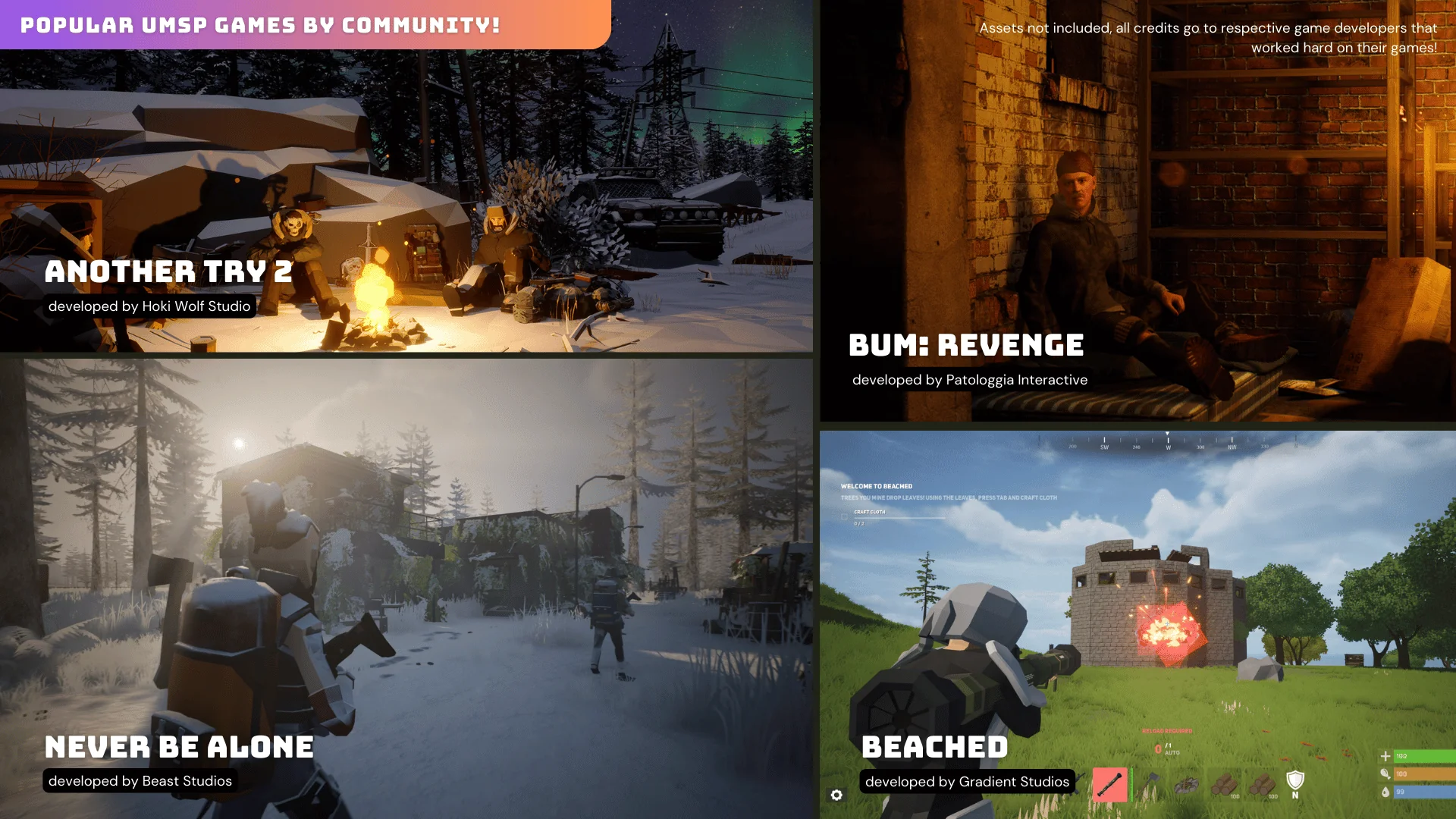
Vast, open terrain demands diverse environmental cues to make exploration meaningful. The environment included with the pack provides a complete low-poly aesthetic spanning classic temperate zones, desert expanses, and frozen snow biomes. Landscape materials accommodate seasonal shifts between summer and winter variants, giving terrain surfaces the appropriate visual tone depending on the intended climate. Interactive foliage populates these scenes, responding dynamically to player presence with dedicated sound effects that heighten the sense of physical immersion while navigating through dense brush.
Resource distribution forms the backbone of wilderness exploration. Interactive harvesting points cover tree felling and ore mining, each governed by respawn logic to maintain a sustainable sandbox loop. Players collect timber and mineral yields directly from the landscape, carrying these raw materials into construction or processing pipelines. Alongside natural harvest nodes, the environment supports a fully playable demo map that demonstrates how these biomes, audio assets, and modular low-poly props assemble into a cohesive sandbox.
Core Locomotion and Character Vitals
Characters navigate the world through a modular locomotion system supporting both true first-person and third-person camera configurations. Movement seamlessly adapts to terrain variations, aided by real-time climbing mechanics that allow traversal over physical obstacles. Water volumes feature a dedicated water system with swimming and diving locomotion, complete with matching animations. Beneath the surface, the character rig utilizes the standard UE4 Mannequin layout, incorporating procedural foot inverse kinematics alongside surface-specific footstep audio, while hand IK guarantees accurate alignment with held items and tools.
Character identities are shaped by male and female base models, modular body assemblies, and physics-driven hair and beard components. Sustaining these avatars requires monitoring survival vitals, specifically health, hunger, and thirst gauges. Environmental hazards play a direct role through a body temperature mechanic that calculates exposure against prevailing weather states, active biome conditions, and equipped armor layers. When physical danger peaks, a knockout and death flow triggers, offering multiplayer revival sequences before a complete respawn is enforced.
Snapping Structures, Farming, and Inventory Operations
Settlement and territory control depend on a modular building system with surface-snapping mechanics. Players secure land using a building privilege structure that governs who can alter, upgrade, or expand a compound. Structural elements carry distinct health pools susceptible to attack, supported by dedicated repair routines to restore damaged walls and foundations. Beyond defensive barriers, interior spaces accommodate placeable furniture, storage crates, and specialized work stations.
Domestic survival loops extend into systematic farming and food gathering. The agriculture setup incorporates multi-stage plant growth, requiring players to sow seeds, maintain crops, and harvest yields over time. Coastal and river shores support a functional fishing system, while hidden loot caches throughout the map require a lockpicking minigame to access high-tier gear. For structured trade, animated humanoid NPC merchants interact through a dialogue interface linked directly to mission distributions, allowing players to exchange goods, buy equipment, and unlock progression milestones.
Material management revolves around a grid-based inventory featuring dedicated quickslots and an expandable backpack capacity mechanic. Crafted goods rely on a crafting queue with timed production cycles. Tools and weapons suffer wear during operation through a durability system, requiring targeted repairs before items fracture permanently.
Ultimate Multiplayer Survival Pack Combat, Ballistics, and AI
Hostile encounters introduce tactical variety across ranged and close-quarters engagements. Firearms handle semi-automatic, burst, and fully automatic firing modes, accompanied by animated reloads, procedural aiming, and modular weapon attachments such as suppressors and tactical flashlights. Long-range marksmanship incorporates specialized sniper scoping mechanics, while dynamic crosshairs stretch and settle based on user stability and active fire. Holstering logic animates weapon storage cleanly on the character model, including dynamic arrow quivers that visually track current arrow reserves for bows and spears. Throwables—including fragmentation grenades, Molotov cocktails, and smoke canisters—add tactical control against fortifications.
Threats across the wilderness are driven by modular artificial intelligence. Hostile humanoids coordinate through sight and hearing perception matrices, assembling into organized camps or roaming groups. Specialized zombie AI introduces melee swarms, while wildlife behaviors govern passive and defensive creatures such as chickens and boars. Players can exploit stealth options by crouching within tall grass and heavy foliage to evade enemy perception cones before engaging in coordinated ambushes.
Vehicles, Server Architecture, and Implementation Scope
Traversing long distances between biomes is handled by land vehicles featuring full mounting logic, chassis customization, and a refuelling infrastructure. Passenger seats allow occupants to lean out and discharge firearms while on the move, paired with physics consequences where players risk falling from speeding transports during sharp maneuvers or collisions.
Behind the gameplay systems sits a networked architecture compatible with online subsystems, including Steam. World persistence relies on a customizable, server-authoritative saving system that records player states, world modifications, and mission progress. Player organization is facilitated through matchmaking lobbies, server browser listings, and interactive player lists. In-game navigation utilizes an optimized minimap that tracks player coordinates alongside points of interest.
Group progression incorporates shared quest invitations, skill acquisition branches, and a percentual loot division system that allocates combat rewards among squad members based on their actual damage contributions. Because the entire framework is executed within clean, commented Blueprints without compiled C++ dependencies, developers can adjust loot drop percentages, rewrite quest dialogues, attach custom character meshes, or extend crafting tables to fit diverse survival premises ranging from post-apocalyptic roleplay servers to competitive extraction sandboxes.
 Action-Adventure
 Action-Adventure
 Action-Adventure