"148d1066ed74e216"{"id":"1002926","slug":"multiplayer-and-single-player-aircraft-battle-system-v2","title":"Multiplayer \u0026 Single player Aircraft Battle System V2","category":"Action-Adventure","engine":"5.0+","assetVersion":"","engineVersion":"Engine Version: 5.0+","tag":"Action-Adventure","accent":"blue","visual":"mech","summary":"Examine Multiplayer \u0026 Single player Aircraft Battle System V2, featuring custom network pawn replication, modular radar, and high-density AI combat.","platform":"Unreal Engine","indexPolicy":"index","publishedAt":"2026-11-21T22:54:37.614Z","updatedAt":"2026-11-21T22:54:37.614Z","sourceNotes":[],"fileContents":[],"compatibility":["Unreal Engine","Engine Version: 5.0+"],"featuredImage":{"alt":"Multiplayer \u0026 Single player Aircraft Battle System V2","src":"/wp-content/uploads/published/2026/11/bc3c7404a536-d67261bd-c8a0-42ba-b97c-f2afa54bc9bd-05fc15ed6f.webp"},"fileSizeBytes":930233991,"hasDownloadLink":true,"downloads":0,"terms":[{"taxonomy":"category","slug":"action-adventure","name":"Action-Adventure"}],"galleryImages":[{"src":"/wp-content/uploads/published/2026/11/155b806fc19c-28be91bb-207f-4533-8bf9-6b43d2b38d1b-c2efb932d7.webp","alt":"Multiplayer \u0026 Single player Aircraft Battle System V2"},{"src":"/wp-content/uploads/published/2026/11/35713c891884-1bebc3b5-fbba-414f-b8aa-36258d89eafc-3660e8fbad.webp","alt":"Multiplayer \u0026 Single player Aircraft Battle System V2"},{"src":"/wp-content/uploads/published/2026/11/a6413d3983d4-d383ec71-d7f1-4e52-b2ec-9640517eff4e-83e028e450.webp","alt":"Multiplayer \u0026 Single player Aircraft Battle System V2"},{"src":"/wp-content/uploads/published/2026/11/9cd2a2602b80-53ab4fc2-ac2c-4fb1-9b3c-6cf9f4fc8d69-4f21a9dfab.webp","alt":"Multiplayer \u0026 Single player Aircraft Battle System V2"},{"src":"/wp-content/uploads/published/2026/11/9127833d73be-1255e787-fa7f-450a-976c-e62d9034fa68-4512f30999.webp","alt":"Multiplayer \u0026 Single player Aircraft Battle System V2"},{"src":"/wp-content/uploads/published/2026/11/4dbb23ea88b6-da5c87b6-0aac-4807-bd5f-9a442d8e8f53-5e7a9f29a3.webp","alt":"Multiplayer \u0026 Single player Aircraft Battle System V2"},{"src":"/wp-content/uploads/published/2026/11/1b9f40f36a3b-ebeaed79-5dd7-45fd-9148-6a3517089386-341e40409c.webp","alt":"Multiplayer \u0026 Single player Aircraft Battle System V2"},{"src":"/wp-content/uploads/published/2026/11/a85438ada071-fb6197ed-9341-4479-9e62-a5a32d9313ba-08641d6a7c.webp","alt":"Multiplayer \u0026 Single player Aircraft Battle System V2"},{"src":"/wp-content/uploads/published/2026/11/32f53507856e-bed021aa-996c-4e81-acdc-75791768f0cb-4579da3048.webp","alt":"Multiplayer \u0026 Single player Aircraft Battle System V2"},{"src":"/wp-content/uploads/published/2026/11/987d1b9d1ee9-aecb0d8a-ed09-4ff0-ac03-29d87baeb01f-94c6e9f4d4.webp","alt":"Multiplayer \u0026 Single player Aircraft Battle System V2"}],"accessPanel":{"kind":"resource","title":"Get this resource","safetyNote":"Resources are manually reviewed before listing to improve quality and reduce obvious risks.","fileName":"Multiplayer \u0026 Single player Aircraft Battle System V2.7z","resourceType":"Resource archive","versions":[]},"contentHtml":"\u003ch2\u003eCustom Pawn Movement Replication in the Multiplayer Aircraft Architecture\u003c/h2\u003e\u003cp\u003eHigh-speed aerial combat places severe demands on real-time network synchronization. Standard pawn movement replication in networked engines is typically tailored for ground-based characters or slower vehicles, often introducing jitter, positional correction snaps, or visual interpolation hitches when applied to aircraft executing high-velocity banks and rolls. To overcome this limitation, Multiplayer \u0026 Single player Aircraft Battle System V2 disables the default engine movement replication on the aircraft pawn entirely.\u003c/p\u003e\u003cp\u003eIn place of the stock pawn movement component, the developer engineered a dedicated, custom replication framework built specifically for aerial kinematics. Flight trajectories, orientation shifts, throttle inputs, and directional vectors are calculated and broadcast manually across the network. By handling replication logic directly rather than relying on automated pawn interpolation, the system maintains exceptionally smooth visual flight paths on all remote client screens. Whether pilots are trailing an opponent through high-G turns or flying in close formation, the visual representation remains stable and free from client-side stutter.\u003c/p\u003e\u003cp\u003eEvery core operational mechanic within the framework is fully replicated for synchronized multiplayer sessions. Active weapon states, targeting engagements, damage tracking, and physical states propagate cleanly between the server and all connected clients. This complete replication pipeline ensures that aerial dogfights maintain hit-registration fidelity and tactical fairness during high-speed, multi-ship engagements.\u003c/p\u003e\u003ch2\u003eProcedural Node-Based Materials Across the Battle System Landscape\u003c/h2\u003e\u003cp\u003eAerial combat games require massive tracts of terrain to allow fighters sufficient airspace to disengage, gain altitude, and set up attack vectors. However, rendering expansive terrains often introduces visual repetition issues, where tiling textures reveal artificial grid-like patterns when observed from thousands of feet above the ground. Standard methods to mask tiling usually involve intensive multi-layer painting across miles of terrain, which increases disk usage, inflates memory footprints, and demands substantial manual art labor.\u003c/p\u003e\u003cp\u003eThe landscape included in this project eliminates texture tiling across its vast expanse purely through shader nodes within the master material. By mathematically breaking up repetitive surface patterns within the material graph, the ground retains natural visual variance across kilometers of open space without requiring hand-painted weightmaps. This node-driven technique keeps the project lightweight and performant while ensuring that pilots flying at high cruising altitudes or skimming low across canyon floors experience cohesive ground visuals devoid of noticeable texture tiling.\u003c/p\u003e\u003ch2\u003eDeploying the Single Player and Dedicated Server Battle Infrastructure\u003c/h2\u003e\u003cp\u003eThe framework is structured to support both single-player engagements and dedicated multiplayer servers without architectural discrepancies. Verifying network stability under heavy computational loads was a central focus of the system's development. Stress tests were conducted on real-world cloud server infrastructure to establish concrete performance baselines under constrained hardware allocations.\u003c/p\u003e\u003cp\u003eIn dedicated server stress testing, the battle system was deployed to an Amazon AWS EC2 free tier cloud instance operating with only a single CPU core and 1 gigabyte of system RAM. Despite these strict hardware limitations, the cloud server successfully hosted a full 50-versus-50 autonomous AI aerial clash, maintaining stability and responsive tick rates without crashing or stalling. In additional dedicated server trials combining human participants with autonomous units, the architecture seamlessly supported four active human players engaged in combat alongside 100 synchronized AI combatants.\u003c/p\u003e\u003cp\u003eFor developers running local simulations or offline single-player skirmishes, the system's processing efficiency scales even further. On a standard desktop development computer, the framework proved capable of running massive 200-versus-200 AI dogfights simultaneously. This high ceiling confirms that the underlying Blueprint calculations—spanning flight dynamics, spatial positioning, weapon firing, and threat assessment—operate with minimal per-agent processing overhead.\u003c/p\u003e\u003cp\u003eTesting multiplayer builds on dedicated servers is streamlined through standard console execution. Developers and testers can verify server connectivity immediately by launching the console interface and typing the connection command followed by the target server address:\u003c/p\u003e\u003cpre\u003e\u003ccode\u003eOpen + ip\u003c/code\u003e\u003c/pre\u003e\u003cp\u003eExecuting this command instantly transitions the local client into the remote session, allowing rapid validation of flight synchronization, weapon replication, and network performance in real-time deployment environments.\u003c/p\u003e\u003ch2\u003eAutonomous Flight Optimization and Radar Performance in V2\u003c/h2\u003e\u003cp\u003eThe V2 iteration brings substantial upgrades over earlier builds, focusing on widespread bug fixes, refined network synchronization, and enhanced AI tactical performance. Computer-controlled pilots do not simply fly along fixed paths; their decision-making logic has been tuned to handle three-dimensional threat evasion, target acquisition, and weapon deployment efficiently. Ongoing updates continue to refine AI behavioral routines to ensure that hundreds of active combatants can maneuver simultaneously without causing CPU performance bottlenecks.\u003c/p\u003e\u003cp\u003eA critical component introduced in this version is the advanced radar system. Operating across both multiplayer matches and offline single-player modes, the radar tracks, categorizes, and displays friendly and hostile contacts across dynamic 3D airspace. The radar logic provides clear situational awareness, enabling pilots to monitor flanking targets and maintain track of engagements occurring outside their immediate forward field of view.\u003c/p\u003e\u003cp\u003eBecause the radar mechanics are constructed as a self-contained Blueprint module, the tracking system offers broad utility beyond aerial dogfighting. Developers can extract the radar logic and integrate it directly into unrelated projects, including naval battle simulations, ground vehicle tracking interfaces, or custom vehicle mechanics, without modifying the underlying sensor math.\u003c/p\u003e\u003ch2\u003eBlueprint Architecture and Project Utility\u003c/h2\u003e\u003cp\u003eMultiplayer \u0026 Single player Aircraft Battle System V2 provides a robust, self-contained foundation for creators developing realistic aerial combat titles. Built completely in Blueprints, the framework allows developers to inspect, modify, and expand flight handling, weapon systems, and interface elements without navigating complex compiled codebases.\u003c/p\u003e\u003cp\u003eThe inclusion of procedural landscape shaders, low-overhead AI decision trees, standalone radar mechanics, and custom pawn network movement creates a scalable production ecosystem. Whether deployed for solo offline missions against computer adversaries or scaled into dedicated-server dogfights hosting large AI fleets and human pilots, the architecture offers reliable performance across constrained hosting hardware and standard consumer systems alike.\u003c/p\u003e\n\n\u003ch2\u003eExplore Similar Assets\u003c/h2\u003e\n\u003cul\u003e\n\u003cli\u003e\u003ca href=\"https://3dcghub.com/cooperative-horror/\" rel=\"noopener noreferrer\"\u003eCooperative Horror\u003c/a\u003e\u003c/li\u003e\n\u003cli\u003e\u003ca href=\"https://3dcghub.com/asymmetric-multiplayer-horror/\" rel=\"noopener noreferrer\"\u003eAsymmetric Multiplayer Horror\u003c/a\u003e\u003c/li\u003e\n\u003cli\u003e\u003ca href=\"https://3dcghub.com/photorealistic-helicopter/\" rel=\"noopener noreferrer\"\u003ePhotorealistic Helicopter\u003c/a\u003e\u003c/li\u003e\n\u003cli\u003e\u003ca href=\"https://3dcghub.com/battle-of-drones-multiplayer/\" rel=\"noopener noreferrer\"\u003eBattle of Drones Multiplayer\u003c/a\u003e\u003c/li\u003e\n\u003cli\u003e\u003ca href=\"https://3dcghub.com/advanced-asymmetrical-multiplayer-template/\" rel=\"noopener noreferrer\"\u003eAdvanced Asymmetrical Multiplayer Template\u003c/a\u003e\u003c/li\u003e\n\u003c/ul\u003e","contentTextLength":7393,"navigation":{"current":46,"total":4890,"previous":{"id":"1002927","slug":"multiplayer-mission-system-v2","title":"Multiplayer Mission System V2","category":"Action-Adventure","platform":"Unreal Engine","updatedAt":"2026-11-21T22:55:07.738Z"},"next":{"id":"1002925","slug":"multi-objects-renaming-tool-rename-assets-and-actors","title":"Multi Objects Renaming Tool (Rename Assets \u0026 Actors)","category":"Engine Tools","platform":"Unreal Engine","updatedAt":"2026-11-21T22:53:51.900Z"}},"relatedResources":[{"id":"1001990","slug":"cooperative-horror","title":"Cooperative Horror","category":"Action-Adventure","engine":"5.1+","assetVersion":"","engineVersion":"Engine Version: 5.1+","tag":"Action-Adventure","accent":"blue","visual":"mech","summary":"Examine the Cooperative Horror multiplayer Unreal Engine template, featuring 1-4 player co-op, AI ghosts, altar objectives, and dedicated server support.","platform":"Unreal Engine","indexPolicy":"index","publishedAt":"2026-10-26T12:09:35.259Z","updatedAt":"2026-10-26T12:09:35.259Z","sourceNotes":[],"fileContents":[],"compatibility":["Unreal Engine","Engine Version: 5.1+"],"featuredImage":{"alt":"Cooperative Horror","src":"/wp-content/uploads/published/2026/10/55ed249c0436-4e0f0b5d-36eb-4ab0-864f-fb33ff943e2b-dbe793dbb1.webp"},"fileSizeBytes":570021424,"hasDownloadLink":true,"downloads":0},{"id":"1000977","slug":"asymmetric-multiplayer-horror","title":"Asymmetric Multiplayer Horror","category":"Action-Adventure","engine":"5.0+","assetVersion":"","engineVersion":"Engine Version: 5.0+","tag":"Action-Adventure","accent":"blue","visual":"mech","summary":"Blueprint template for asymmetric multiplayer horror with 4 vs 1 play, AI or player monsters, first/third person views, and a Cursed Forest demo.","platform":"Unreal Engine","indexPolicy":"index","publishedAt":"2026-08-17T17:19:51.833Z","updatedAt":"2026-08-17T17:19:51.833Z","sourceNotes":[],"fileContents":[],"compatibility":["Unreal Engine","Engine Version: 5.0+"],"featuredImage":{"alt":"Asymmetric Multiplayer Horror","src":"/wp-content/uploads/published/2026/08/d3e8d4559426-f968b340-50b9-4a59-9fa7-7cdea14f055c-e0904bd06f.webp"},"fileSizeBytes":646912915,"hasDownloadLink":true,"downloads":1},{"id":"1002927","slug":"multiplayer-mission-system-v2","title":"Multiplayer Mission System V2","category":"Action-Adventure","engine":"4.26+,5.0+","assetVersion":"","engineVersion":"Engine Version: 4.26+,5.0+","tag":"Action-Adventure","accent":"blue","visual":"mech","summary":"Explore the networking architecture, dynamic objective markers, quest log widgets, and leveling integration of Multiplayer Mission System V2.","platform":"Unreal Engine","indexPolicy":"index","publishedAt":"2026-11-21T22:55:07.738Z","updatedAt":"2026-11-21T22:55:07.738Z","sourceNotes":[],"fileContents":[],"compatibility":["Unreal Engine","Engine Version: 4.26+,5.0+"],"featuredImage":{"alt":"Multiplayer Mission System V2","src":"/wp-content/uploads/published/2026/11/e35d7e453147-af49587a-1b56-4e7e-8bea-9e0a619504f4-3835674d1c.webp"},"fileSizeBytes":16542868,"hasDownloadLink":true,"downloads":0}]}[{"id":4225,"sourceId":4225,"taxonomyId":4225,"taxonomy":"category","slug":"asset-library","name":"Asset Library","parentId":null,"count":4744,"hasChildren":true,"href":"/","seoTitle":"Free Game Assets Library | 3DCGHUB","seoDescription":"Browse free Unreal Engine, Unity, Blender assets and game development tutorials on 3DCGHUB with previews, compatibility notes, and secure downloads.","sitemapEnabled":true,"children":[{"id":4227,"sourceId":4227,"taxonomyId":4227,"taxonomy":"category","slug":"blender-add-ons-plugins","name":"Blender Add-ons \u0026 Plugins","parentId":4225,"count":10,"hasChildren":false,"href":"/category/blender-add-ons-plugins/","seoTitle":"Free Blender Add-ons \u0026 Plugins | 3DCGHUB","seoDescription":"Browse free Blender Add-ons \u0026 Plugins tools for Blender on 3DCGHUB: curated downloads with preview images, compatibility notes and secure download access.","sitemapEnabled":true},{"id":514,"sourceId":514,"taxonomyId":514,"taxonomy":"category","slug":"unity-2","name":"Unity","parentId":4225,"count":453,"hasChildren":true,"href":"/category/unity-2/","seoTitle":"Free Unity Assets | 3DCGHUB","seoDescription":"Browse free Unity resources on 3DCGHUB: curated downloads with preview images, compatibility notes and secure download access.","sitemapEnabled":true,"children":[{"id":523,"sourceId":523,"taxonomyId":523,"taxonomy":"category","slug":"2d","name":"2D","parentId":514,"count":1,"hasChildren":true,"href":"/category/2d/","seoTitle":"Free Unity 2D | 3DCGHUB","seoDescription":"Browse free 2D assets for Unity on 3DCGHUB: curated downloads with preview images, compatibility notes and secure download access.","sitemapEnabled":true},{"id":515,"sourceId":515,"taxonomyId":515,"taxonomy":"category","slug":"3d-unity-2","name":"3D","parentId":514,"count":162,"hasChildren":true,"href":"/category/3d-unity-2/","seoTitle":"Free Unity 3D Assets | 3DCGHUB","seoDescription":"Browse free 3D assets for Unity on 3DCGHUB: curated downloads with preview images, compatibility notes and secure download access.","sitemapEnabled":true},{"id":565,"sourceId":565,"taxonomyId":565,"taxonomy":"category","slug":"add-ons","name":"Add-Ons","parentId":514,"count":2,"hasChildren":false,"href":"/category/add-ons/","seoTitle":"Free Unity Add-Ons | 3DCGHUB","seoDescription":"Browse free Add-Ons assets for Unity on 3DCGHUB: curated downloads with preview images, compatibility notes and secure download access.","sitemapEnabled":true},{"id":529,"sourceId":529,"taxonomyId":529,"taxonomy":"category","slug":"audio-unity-2","name":"Audio","parentId":514,"count":1,"hasChildren":true,"href":"/category/audio-unity-2/","seoTitle":"Free Unity Audio | 3DCGHUB","seoDescription":"Browse free Audio for Unity on 3DCGHUB: curated downloads with preview images, compatibility notes and secure download access.","sitemapEnabled":true},{"id":557,"sourceId":557,"taxonomyId":557,"taxonomy":"category","slug":"templates","name":"Templates","parentId":514,"count":36,"hasChildren":true,"href":"/category/templates/","seoTitle":"Free Unity Templates | 3DCGHUB","seoDescription":"Browse free Unity project templates on 3DCGHUB. Starter kits with previews, compatibility notes, and secure download access.","sitemapEnabled":true},{"id":533,"sourceId":533,"taxonomyId":533,"taxonomy":"category","slug":"tools-unity-2","name":"Tools","parentId":514,"count":0,"hasChildren":true,"href":"/category/tools-unity-2/","sitemapEnabled":true},{"id":554,"sourceId":554,"taxonomyId":554,"taxonomy":"category","slug":"vfx-unity-2","name":"VFX","parentId":514,"count":4,"hasChildren":true,"href":"/category/vfx-unity-2/","seoTitle":"Free Unity VFX | 3DCGHUB","seoDescription":"Browse free VFX for Unity on 3DCGHUB: curated downloads with preview images, compatibility notes and secure download access.","sitemapEnabled":true}]},{"id":511,"sourceId":511,"taxonomyId":511,"taxonomy":"category","slug":"unreal-engine-2","name":"Unreal Engine","parentId":4225,"count":4282,"hasChildren":true,"href":"/category/unreal-engine-2/","seoTitle":"Free Unreal Engine Assets | 3DCGHUB","seoDescription":"Browse free Unreal Engine resources on 3DCGHUB: curated downloads with preview images, compatibility notes and secure download access.","sitemapEnabled":true,"children":[{"id":54,"sourceId":54,"taxonomyId":54,"taxonomy":"category","slug":"3d","name":"3D","parentId":511,"count":2428,"hasChildren":true,"href":"/category/3d/","seoTitle":"Free Unreal Engine 3D | 3DCGHUB","seoDescription":"Browse free 3D assets for Unreal Engine on 3DCGHUB: curated downloads with preview images, compatibility notes and secure download access.","sitemapEnabled":true},{"id":441,"sourceId":441,"taxonomyId":441,"taxonomy":"category","slug":"animations","name":"Animations","parentId":511,"count":245,"hasChildren":true,"href":"/category/animations/","seoTitle":"Free Unreal Engine Animations | 3DCGHUB","seoDescription":"Browse free Animations for Unreal Engine on 3DCGHUB: curated downloads with preview images, compatibility notes and secure download access.","sitemapEnabled":true},{"id":446,"sourceId":446,"taxonomyId":446,"taxonomy":"category","slug":"audio","name":"Audio","parentId":511,"count":63,"hasChildren":true,"href":"/category/audio/","seoTitle":"Free Unreal Engine Audio Resources | 3DCGHUB","seoDescription":"Browse free Unreal Engine audio resources including sound effects, voices, dialogue, and ambient sounds. Curated free downloads on 3DCGHUB.","sitemapEnabled":true},{"id":466,"sourceId":466,"taxonomyId":466,"taxonomy":"category","slug":"game-systems","name":"Game Systems","parentId":511,"count":356,"hasChildren":true,"href":"/category/game-systems/","seoTitle":"Free Unreal Engine Game Systems | 3DCGHUB","seoDescription":"Browse free Game Systems tools for Unreal Engine on 3DCGHUB: curated downloads with preview images, compatibility notes and secure download access.","sitemapEnabled":true},{"id":478,"sourceId":478,"taxonomyId":478,"taxonomy":"category","slug":"game-templates","name":"Game Templates","parentId":511,"count":150,"hasChildren":true,"href":"/category/game-templates/","seoTitle":"Free Unreal Engine Game Templates | 3DCGHUB","seoDescription":"Browse free Game Templates for Unreal Engine on 3DCGHUB: curated downloads with preview images, compatibility notes and secure download access.","sitemapEnabled":true},{"id":432,"sourceId":432,"taxonomyId":432,"taxonomy":"category","slug":"hdri","name":"HDRI","parentId":511,"count":6,"hasChildren":true,"href":"/category/hdri/","seoTitle":"Free Unreal Engine HDRI | 3DCGHUB","seoDescription":"Browse free Unreal Engine HDRI skies and lighting maps on 3DCGHUB. Environment lighting with previews and secure downloads.","sitemapEnabled":true},{"id":228,"sourceId":228,"taxonomyId":228,"taxonomy":"category","slug":"material-and-textures","name":"Material \u0026 Textures","parentId":511,"count":172,"hasChildren":true,"href":"/category/material-and-textures/","seoTitle":"Free Unreal Engine Material \u0026 Textures | 3DCGHUB","seoDescription":"Browse free Material \u0026 Textures for Unreal Engine on 3DCGHUB: curated downloads with preview images, compatibility notes and secure download access.","sitemapEnabled":true},{"id":298,"sourceId":298,"taxonomyId":298,"taxonomy":"category","slug":"sprites-and-flipbooks","name":"Sprites \u0026 Flipbooks","parentId":511,"count":17,"hasChildren":true,"href":"/category/sprites-and-flipbooks/","seoTitle":"Free Unreal Engine Sprites \u0026 Flipbooks | 3DCGHUB","seoDescription":"Browse free Sprites \u0026 Flipbooks assets for Unreal Engine on 3DCGHUB: curated downloads with preview images, compatibility notes and secure download access.","sitemapEnabled":true},{"id":489,"sourceId":489,"taxonomyId":489,"taxonomy":"category","slug":"tools-and-plugins","name":"Tools \u0026 Plugins","parentId":511,"count":390,"hasChildren":true,"href":"/category/tools-and-plugins/","seoTitle":"Free Unreal Engine Tools \u0026 Plugins | 3DCGHUB","seoDescription":"Browse free Tools \u0026 Plugins for Unreal Engine on 3DCGHUB: curated downloads with preview images, compatibility notes and secure download access.","sitemapEnabled":true},{"id":459,"sourceId":459,"taxonomyId":459,"taxonomy":"category","slug":"ui","name":"UI","parentId":511,"count":43,"hasChildren":true,"href":"/category/ui/","seoTitle":"Free Unreal Engine UI | 3DCGHUB","seoDescription":"Browse free UI for Unreal Engine on 3DCGHUB: curated downloads with preview images, compatibility notes and secure download access.","sitemapEnabled":true},{"id":450,"sourceId":450,"taxonomyId":450,"taxonomy":"category","slug":"vfx","name":"VFX","parentId":511,"count":412,"hasChildren":true,"href":"/category/vfx/","seoTitle":"Free Unreal Engine VFX | 3DCGHUB","seoDescription":"Browse free VFX for Unreal Engine on 3DCGHUB: curated downloads with preview images, compatibility notes and secure download access.","sitemapEnabled":true}]}]},{"id":4222,"sourceId":4222,"taxonomyId":4222,"taxonomy":"category","slug":"tutorial-library","name":"Tutorial Library","parentId":null,"count":117,"hasChildren":false,"href":"/tutorials/","seoTitle":"Free Game Development Tutorial Library | 3DCGHUB","seoDescription":"Browse free game development tutorials for Unreal Engine, Unity, Blender, and more on 3DCGHUB with practical workflows and secure downloads.","sitemapEnabled":true}]
Resource screenshots
1 / 10
Join our channel
Follow 3DCGHUB on Telegram for new resource drops, migration updates, and community notices.
Custom Pawn Movement Replication in the Multiplayer Aircraft Architecture
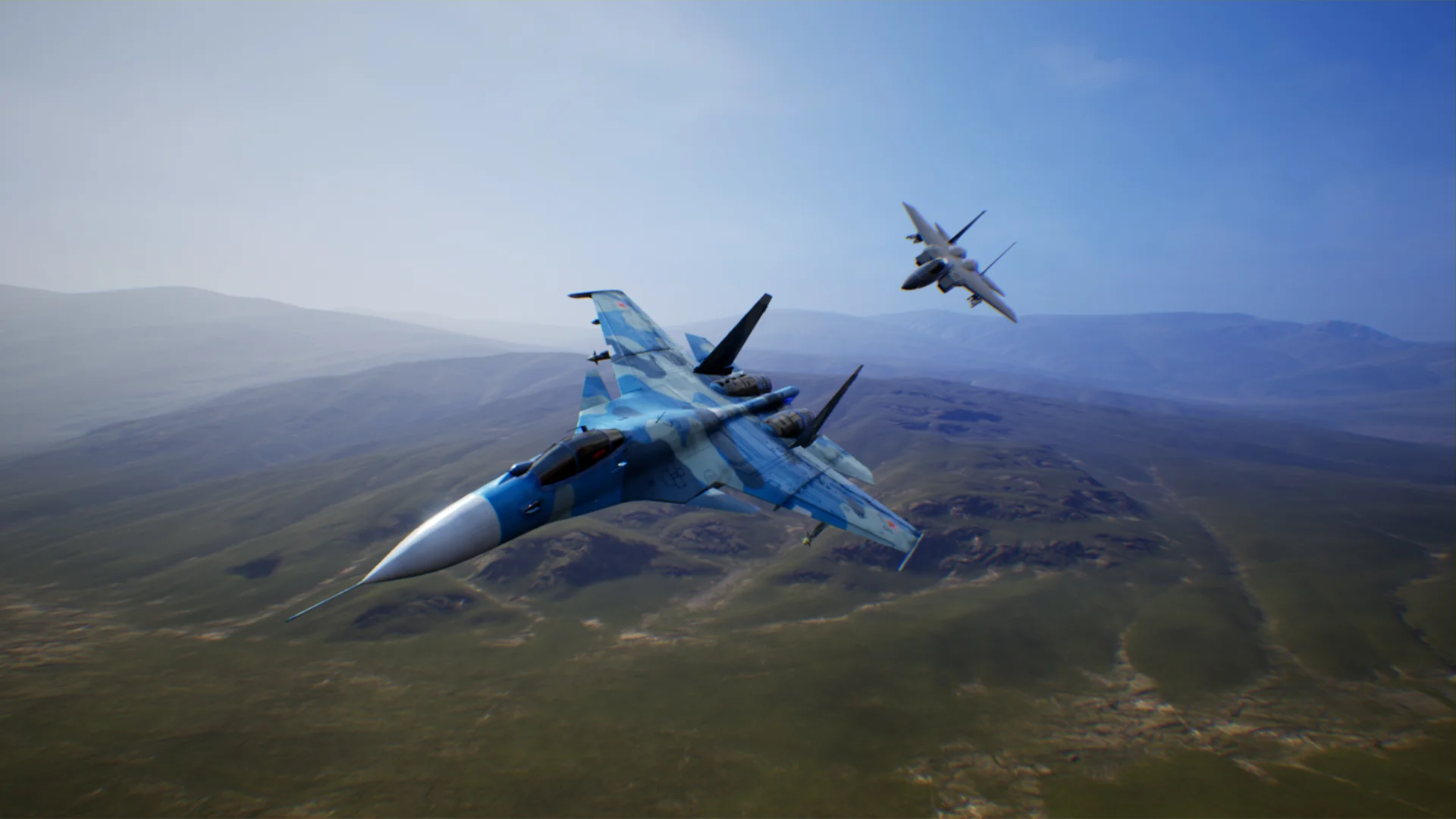
High-speed aerial combat places severe demands on real-time network synchronization. Standard pawn movement replication in networked engines is typically tailored for ground-based characters or slower vehicles, often introducing jitter, positional correction snaps, or visual interpolation hitches when applied to aircraft executing high-velocity banks and rolls. To overcome this limitation, Multiplayer & Single player Aircraft Battle System V2 disables the default engine movement replication on the aircraft pawn entirely.
In place of the stock pawn movement component, the developer engineered a dedicated, custom replication framework built specifically for aerial kinematics. Flight trajectories, orientation shifts, throttle inputs, and directional vectors are calculated and broadcast manually across the network. By handling replication logic directly rather than relying on automated pawn interpolation, the system maintains exceptionally smooth visual flight paths on all remote client screens. Whether pilots are trailing an opponent through high-G turns or flying in close formation, the visual representation remains stable and free from client-side stutter.
Every core operational mechanic within the framework is fully replicated for synchronized multiplayer sessions. Active weapon states, targeting engagements, damage tracking, and physical states propagate cleanly between the server and all connected clients. This complete replication pipeline ensures that aerial dogfights maintain hit-registration fidelity and tactical fairness during high-speed, multi-ship engagements.
Procedural Node-Based Materials Across the Battle System Landscape
Aerial combat games require massive tracts of terrain to allow fighters sufficient airspace to disengage, gain altitude, and set up attack vectors. However, rendering expansive terrains often introduces visual repetition issues, where tiling textures reveal artificial grid-like patterns when observed from thousands of feet above the ground. Standard methods to mask tiling usually involve intensive multi-layer painting across miles of terrain, which increases disk usage, inflates memory footprints, and demands substantial manual art labor.
The landscape included in this project eliminates texture tiling across its vast expanse purely through shader nodes within the master material. By mathematically breaking up repetitive surface patterns within the material graph, the ground retains natural visual variance across kilometers of open space without requiring hand-painted weightmaps. This node-driven technique keeps the project lightweight and performant while ensuring that pilots flying at high cruising altitudes or skimming low across canyon floors experience cohesive ground visuals devoid of noticeable texture tiling.
Deploying the Single Player and Dedicated Server Battle Infrastructure
The framework is structured to support both single-player engagements and dedicated multiplayer servers without architectural discrepancies. Verifying network stability under heavy computational loads was a central focus of the system's development. Stress tests were conducted on real-world cloud server infrastructure to establish concrete performance baselines under constrained hardware allocations.
In dedicated server stress testing, the battle system was deployed to an Amazon AWS EC2 free tier cloud instance operating with only a single CPU core and 1 gigabyte of system RAM. Despite these strict hardware limitations, the cloud server successfully hosted a full 50-versus-50 autonomous AI aerial clash, maintaining stability and responsive tick rates without crashing or stalling. In additional dedicated server trials combining human participants with autonomous units, the architecture seamlessly supported four active human players engaged in combat alongside 100 synchronized AI combatants.
For developers running local simulations or offline single-player skirmishes, the system's processing efficiency scales even further. On a standard desktop development computer, the framework proved capable of running massive 200-versus-200 AI dogfights simultaneously. This high ceiling confirms that the underlying Blueprint calculations—spanning flight dynamics, spatial positioning, weapon firing, and threat assessment—operate with minimal per-agent processing overhead.
Testing multiplayer builds on dedicated servers is streamlined through standard console execution. Developers and testers can verify server connectivity immediately by launching the console interface and typing the connection command followed by the target server address:
Open + ip
Executing this command instantly transitions the local client into the remote session, allowing rapid validation of flight synchronization, weapon replication, and network performance in real-time deployment environments.
Autonomous Flight Optimization and Radar Performance in V2
The V2 iteration brings substantial upgrades over earlier builds, focusing on widespread bug fixes, refined network synchronization, and enhanced AI tactical performance. Computer-controlled pilots do not simply fly along fixed paths; their decision-making logic has been tuned to handle three-dimensional threat evasion, target acquisition, and weapon deployment efficiently. Ongoing updates continue to refine AI behavioral routines to ensure that hundreds of active combatants can maneuver simultaneously without causing CPU performance bottlenecks.
A critical component introduced in this version is the advanced radar system. Operating across both multiplayer matches and offline single-player modes, the radar tracks, categorizes, and displays friendly and hostile contacts across dynamic 3D airspace. The radar logic provides clear situational awareness, enabling pilots to monitor flanking targets and maintain track of engagements occurring outside their immediate forward field of view.
Because the radar mechanics are constructed as a self-contained Blueprint module, the tracking system offers broad utility beyond aerial dogfighting. Developers can extract the radar logic and integrate it directly into unrelated projects, including naval battle simulations, ground vehicle tracking interfaces, or custom vehicle mechanics, without modifying the underlying sensor math.
Blueprint Architecture and Project Utility
Multiplayer & Single player Aircraft Battle System V2 provides a robust, self-contained foundation for creators developing realistic aerial combat titles. Built completely in Blueprints, the framework allows developers to inspect, modify, and expand flight handling, weapon systems, and interface elements without navigating complex compiled codebases.
The inclusion of procedural landscape shaders, low-overhead AI decision trees, standalone radar mechanics, and custom pawn network movement creates a scalable production ecosystem. Whether deployed for solo offline missions against computer adversaries or scaled into dedicated-server dogfights hosting large AI fleets and human pilots, the architecture offers reliable performance across constrained hosting hardware and standard consumer systems alike.
 Action-Adventure
 Action-Adventure
 Action-Adventure