"148d1066ed74e216"{"id":"1002927","slug":"multiplayer-mission-system-v2","title":"Multiplayer Mission System V2","category":"Action-Adventure","engine":"4.26+,5.0+","assetVersion":"","engineVersion":"Engine Version: 4.26+,5.0+","tag":"Action-Adventure","accent":"blue","visual":"mech","summary":"Explore the networking architecture, dynamic objective markers, quest log widgets, and leveling integration of Multiplayer Mission System V2.","platform":"Unreal Engine","indexPolicy":"index","publishedAt":"2026-11-21T22:55:07.738Z","updatedAt":"2026-11-21T22:55:07.738Z","sourceNotes":[],"fileContents":[],"compatibility":["Unreal Engine","Engine Version: 4.26+,5.0+"],"featuredImage":{"alt":"Multiplayer Mission System V2","src":"/wp-content/uploads/published/2026/11/e35d7e453147-af49587a-1b56-4e7e-8bea-9e0a619504f4-3835674d1c.webp"},"fileSizeBytes":16542868,"hasDownloadLink":true,"downloads":0,"terms":[{"taxonomy":"category","slug":"action-adventure","name":"Action-Adventure"}],"galleryImages":[{"src":"/wp-content/uploads/published/2026/11/77cf99878de8-9f1f2ae1-843b-4cd0-9685-7791c4b47d11-f52e97db17.webp","alt":"Multiplayer Mission System V2"},{"src":"/wp-content/uploads/published/2026/11/0730b1e48507-cdab30fd-5a79-46a3-93f2-ea5596ba4bf6-80477186e8.webp","alt":"Multiplayer Mission System V2"},{"src":"/wp-content/uploads/published/2026/11/68a435b72429-1c8d7fe7-97c4-46e3-a20d-6e518615e071-372eb0b1dc.webp","alt":"Multiplayer Mission System V2"},{"src":"/wp-content/uploads/published/2026/11/689ca9080fe2-e12d4052-eb77-4073-92ab-a0163a0be08f-869655b7db.webp","alt":"Multiplayer Mission System V2"},{"src":"/wp-content/uploads/published/2026/11/c921aadba3a6-f5e56d3f-a941-4ceb-b3e2-4628b3617c48-256d260642.webp","alt":"Multiplayer Mission System V2"},{"src":"/wp-content/uploads/published/2026/11/bf9057639ce5-1712acf5-5cd9-4882-96cc-7bee6f468ec4-4e94ea3541.webp","alt":"Multiplayer Mission System V2"},{"src":"/wp-content/uploads/published/2026/11/33e17cb032cc-18ef0e14-0045-47d1-b3d7-f18d81bc201a-6539b14146.webp","alt":"Multiplayer Mission System V2"}],"accessPanel":{"kind":"resource","title":"Get this resource","safetyNote":"Resources are manually reviewed before listing to improve quality and reduce obvious risks.","fileName":"Multiplayer Mission System V2.7z","resourceType":"Resource archive","versions":[]},"contentHtml":"\u003ch2\u003eStructuring Cooperative Encounters in Shared Worlds\u003c/h2\u003e\n\u003cp\u003eCooperative game loops rely heavily on synchronized tasks that bring participants together toward common goals. Whether constructing an open-world exploration title, a tactical shooter, or a party-based role-playing game, developers require mission pipelines that maintain consistency across multiple machines. Multiplayer Mission System V2 addresses these demands by establishing a complete framework for objective assignment, progress tracking, and reward dispersal across both first-person and third-person camera setups.\u003c/p\u003e\n\u003cp\u003eManaging networked tasks introduces technical hurdles that single-player quest systems never encounter. Player join states, party invitations, dropped connections, and divergent progression paths can quickly desynchronize gameplay if the underlying network code lacks stability. By centralizing mission lifecycles within a replicated structure, the framework allows designers to focus on encounter design, narrative pacing, and objective variety rather than building network handshakes from scratch.\u003c/p\u003e \u003ch2\u003eMultiplayer Mission System V2 Networking and Replication Logic\u003c/h2\u003e\n\u003cp\u003eNetwork replication operates as the foundational layer of the framework. Quest logic replicates fully across server-to-client and client-to-client channels, keeping task states, completed steps, and group rosters identical for every participant involved. The underlying architecture has been tested under server-load conditions to verify that performance remains smooth even when multiple players interact with active objectives simultaneously.\u003c/p\u003e\n\u003cp\u003ePlayer coordination centers on a dedicated mission joining workflow. Within this structure, team leaders or session hosts can invite other players to partake in specific assignments. The system incorporates configurable player capacity limits, enabling designers to tune activities for solo participants, tight two-player co-op pairs, or larger squads. Because joining mechanics handle player counts dynamically, teams can assemble at mission hubs or trigger shared encounters directly out in the game world without desynchronizing active quest parameters.\u003c/p\u003e \u003ch2\u003eSpatial Guidance with Dynamic 2D and 3D Markers\u003c/h2\u003e\n\u003cp\u003eGuiding players through expansive environments requires clear, readable wayfinding tools that adjust dynamically to distance and player orientation. Multiplayer Mission System V2 implements both 2D screen-space indicators and in-world 3D markers that track target locations in real time. These visual cues direct players toward relevant waypoints, interaction objects, combat zones, or extraction points without cluttering the viewport.\u003c/p\u003e\n\u003cp\u003eObjective markers update automatically as task parameters change. When a player completes a stage—such as clearing a designated patrol or securing an item—the active marker transitions smoothly to the next coordinate or target actor. Because the marker infrastructure supports diverse objective types, developers can assign dynamic waypoints to stationary targets, roaming entities, or broad territorial zones. This adaptability ensures that wayfinding remains intuitive whether the active gameplay involves close-quarters indoor objectives or long-distance navigation across an open map.\u003c/p\u003e \u003ch2\u003eData Handling, Timers, and Progression in the Mission System\u003c/h2\u003e\n\u003cp\u003eEncounters frequently require structured constraints to generate tension and evaluate player performance. The asset includes a dedicated mission timer component featuring customizable countdown durations. Designers can bind mission success, phase transitions, or penalty states directly to timer expiration, establishing time-attack challenges or defensive survival phases with minimal setup.\u003c/p\u003e\n\u003cp\u003eBeyond active session timing, the system features dedicated events for loading missions alongside existing player progression. Rather than forcing quests to run as isolated, one-off events, the architecture accommodates persistent game states where players log out, transition between levels, or resume previously started campaigns. When combined with the integrated mission rewarding system, the framework automatically dispenses currency, experience, items, or custom progression tags once all required criteria register as complete on the server.\u003c/p\u003e\n\u003cp\u003eThe mission framework is also bundled with an Advanced Multiplayer Leveling System. This complementary inclusion allows developers to tie mission eligibility, objective scaling, and reward distribution directly into character rank, stat progression, or tier thresholds without having to build a separate player experience pipeline.\u003c/p\u003e \u003ch2\u003eInterface Design, Filtering Logs, and Feedback Systems\u003c/h2\u003e\n\u003cp\u003ePlayer comprehension depends heavily on clear user interfaces. Multiplayer Mission System V2 incorporates high-quality designed and animated widgets that deliver visual polish right out of the box. Active assignments populate an interactive quest log equipped with built-in filtering tools, allowing users to categorize tasks by type, status, or priority. This prevents quest lists from overwhelming players as campaigns expand over extended play sessions.\u003c/p\u003e\n\u003cp\u003eComplementing the quest log is an integrated notification system that communicates critical mission events as they happen. State updates—such as objective step completions, roster changes, invitation requests, and timer countdown alerts—display through clean interface notifications. The animated feedback loops give immediate confirmation to every party member when an action advances a shared objective, maintaining communication across the squad without requiring manual chat input.\u003c/p\u003e \u003ch2\u003eExtensibility and Project Implementation\u003c/h2\u003e\n\u003cp\u003eAdaptability across diverse genres is a core characteristic of the framework. Because the Blueprints are fully commented and modular, development teams can inspect the internal logic, trace data pathways, and extend classes to fit proprietary mechanics. Adding new objective targets requires straightforward configuration rather than deep rewrites of the core network replication loops.\u003c/p\u003e\n\u003cp\u003eThe system fits readily into survival sandboxes, competitive shooters, story-driven multiplayer RPGs, and tactical co-op games. Furthermore, it exists as a core component within the larger Ultimate Multiplayer Survival Pack (UMSP), demonstrating its capacity to interface directly with extensive survival loops, resource systems, and larger gameplay ecosystems. Whether deployed as a standalone mission framework or slotted alongside existing character controllers and inventory engines, the system provides a clean, game-ready baseline for all forms of networked quest management.\u003c/p\u003e\n\n\u003ch2\u003eContinue Browsing Similar Packs\u003c/h2\u003e\n\u003cul\u003e\n\u003cli\u003e\u003ca href=\"https://3dcghub.com/multiplayer-and-single-player-aircraft-battle-system-v2/\" rel=\"noopener noreferrer\"\u003eMultiplayer \u0026amp; Single player Aircraft Battle System V2\u003c/a\u003e\u003c/li\u003e\n\u003cli\u003e\u003ca href=\"https://3dcghub.com/multiplayer-topdown-kit/\" rel=\"noopener noreferrer\"\u003eMultiplayer TopDown Kit\u003c/a\u003e\u003c/li\u003e\n\u003cli\u003e\u003ca href=\"https://3dcghub.com/advanced-multiplayer-lobby-system-v2/\" rel=\"noopener noreferrer\"\u003eAdvanced Multiplayer Lobby System V2\u003c/a\u003e\u003c/li\u003e\n\u003cli\u003e\u003ca href=\"https://3dcghub.com/advanced-asymmetrical-multiplayer-template/\" rel=\"noopener noreferrer\"\u003eAdvanced Asymmetrical Multiplayer Template\u003c/a\u003e\u003c/li\u003e\n\u003cli\u003e\u003ca href=\"https://3dcghub.com/cooperative-horror/\" rel=\"noopener noreferrer\"\u003eCooperative Horror\u003c/a\u003e\u003c/li\u003e\n\u003c/ul\u003e","contentTextLength":6772,"navigation":{"current":45,"total":4890,"previous":{"id":"1002928","slug":"multiplayer-server-browser-master-server-server-listing","title":"Multiplayer Server Browser - Master Server - Server Listing","category":"Network \u0026 Multiplayer","platform":"Unreal Engine","updatedAt":"2026-11-21T23:06:05.910Z"},"next":{"id":"1002926","slug":"multiplayer-and-single-player-aircraft-battle-system-v2","title":"Multiplayer \u0026 Single player Aircraft Battle System V2","category":"Action-Adventure","platform":"Unreal Engine","updatedAt":"2026-11-21T22:54:37.614Z"}},"relatedResources":[{"id":"1002926","slug":"multiplayer-and-single-player-aircraft-battle-system-v2","title":"Multiplayer \u0026 Single player Aircraft Battle System V2","category":"Action-Adventure","engine":"5.0+","assetVersion":"","engineVersion":"Engine Version: 5.0+","tag":"Action-Adventure","accent":"blue","visual":"mech","summary":"Examine Multiplayer \u0026 Single player Aircraft Battle System V2, featuring custom network pawn replication, modular radar, and high-density AI combat.","platform":"Unreal Engine","indexPolicy":"index","publishedAt":"2026-11-21T22:54:37.614Z","updatedAt":"2026-11-21T22:54:37.614Z","sourceNotes":[],"fileContents":[],"compatibility":["Unreal Engine","Engine Version: 5.0+"],"featuredImage":{"alt":"Multiplayer \u0026 Single player Aircraft Battle System V2","src":"/wp-content/uploads/published/2026/11/bc3c7404a536-d67261bd-c8a0-42ba-b97c-f2afa54bc9bd-05fc15ed6f.webp"},"fileSizeBytes":930233991,"hasDownloadLink":true,"downloads":0},{"id":"1002126","slug":"multiplayer-topdown-kit","title":"Multiplayer TopDown Kit","category":"Action-Adventure","engine":"4.26+,5.0+","assetVersion":"","engineVersion":"Engine Version: 4.26+,5.0+","tag":"Action-Adventure","accent":"blue","visual":"mech","summary":"Explore the Multiplayer TopDown Kit, featuring networked click-to-move input, light radius fog of war, session management, and replicated AI combat.","platform":"Unreal Engine","indexPolicy":"index","publishedAt":"2026-10-29T09:06:01.569Z","updatedAt":"2026-10-29T09:06:01.569Z","sourceNotes":[],"fileContents":[],"compatibility":["Unreal Engine","Engine Version: 4.26+,5.0+"],"featuredImage":{"alt":"Multiplayer TopDown Kit","src":"/wp-content/uploads/published/2026/10/c896ee074002-faaafb57-a48b-451a-9b09-761c436c6971-bf7b388b98.webp"},"fileSizeBytes":89282490,"hasDownloadLink":true,"downloads":2},{"id":"1002930","slug":"n00dlobby","title":"n00dLobby","category":"Action-Adventure","engine":"4.16+,5.0+","assetVersion":"","engineVersion":"Engine Version: 4.16+,5.0+","tag":"Action-Adventure","accent":"blue","visual":"mech","summary":"Explore n00dLobby, a fully network-replicated multiplayer lobby framework featuring character selection, spectator pawns, chat, and serialized persistence.","platform":"Unreal Engine","indexPolicy":"index","publishedAt":"2026-11-21T23:07:35.774Z","updatedAt":"2026-11-21T23:07:35.774Z","sourceNotes":[],"fileContents":[],"compatibility":["Unreal Engine","Engine Version: 4.16+,5.0+"],"featuredImage":{"alt":"n00dLobby","src":"/wp-content/uploads/published/2026/11/2bd04e491010-581a4174-75d3-4023-b527-b74185264640-ce03f3c6e4.webp"},"fileSizeBytes":39443706,"hasDownloadLink":true,"downloads":0}]}[{"id":4225,"sourceId":4225,"taxonomyId":4225,"taxonomy":"category","slug":"asset-library","name":"Asset Library","parentId":null,"count":4744,"hasChildren":true,"href":"/","seoTitle":"Free Game Assets Library | 3DCGHUB","seoDescription":"Browse free Unreal Engine, Unity, Blender assets and game development tutorials on 3DCGHUB with previews, compatibility notes, and secure downloads.","sitemapEnabled":true,"children":[{"id":4227,"sourceId":4227,"taxonomyId":4227,"taxonomy":"category","slug":"blender-add-ons-plugins","name":"Blender Add-ons \u0026 Plugins","parentId":4225,"count":10,"hasChildren":false,"href":"/category/blender-add-ons-plugins/","seoTitle":"Free Blender Add-ons \u0026 Plugins | 3DCGHUB","seoDescription":"Browse free Blender Add-ons \u0026 Plugins tools for Blender on 3DCGHUB: curated downloads with preview images, compatibility notes and secure download access.","sitemapEnabled":true},{"id":514,"sourceId":514,"taxonomyId":514,"taxonomy":"category","slug":"unity-2","name":"Unity","parentId":4225,"count":453,"hasChildren":true,"href":"/category/unity-2/","seoTitle":"Free Unity Assets | 3DCGHUB","seoDescription":"Browse free Unity resources on 3DCGHUB: curated downloads with preview images, compatibility notes and secure download access.","sitemapEnabled":true,"children":[{"id":523,"sourceId":523,"taxonomyId":523,"taxonomy":"category","slug":"2d","name":"2D","parentId":514,"count":1,"hasChildren":true,"href":"/category/2d/","seoTitle":"Free Unity 2D | 3DCGHUB","seoDescription":"Browse free 2D assets for Unity on 3DCGHUB: curated downloads with preview images, compatibility notes and secure download access.","sitemapEnabled":true},{"id":515,"sourceId":515,"taxonomyId":515,"taxonomy":"category","slug":"3d-unity-2","name":"3D","parentId":514,"count":162,"hasChildren":true,"href":"/category/3d-unity-2/","seoTitle":"Free Unity 3D Assets | 3DCGHUB","seoDescription":"Browse free 3D assets for Unity on 3DCGHUB: curated downloads with preview images, compatibility notes and secure download access.","sitemapEnabled":true},{"id":565,"sourceId":565,"taxonomyId":565,"taxonomy":"category","slug":"add-ons","name":"Add-Ons","parentId":514,"count":2,"hasChildren":false,"href":"/category/add-ons/","seoTitle":"Free Unity Add-Ons | 3DCGHUB","seoDescription":"Browse free Add-Ons assets for Unity on 3DCGHUB: curated downloads with preview images, compatibility notes and secure download access.","sitemapEnabled":true},{"id":529,"sourceId":529,"taxonomyId":529,"taxonomy":"category","slug":"audio-unity-2","name":"Audio","parentId":514,"count":1,"hasChildren":true,"href":"/category/audio-unity-2/","seoTitle":"Free Unity Audio | 3DCGHUB","seoDescription":"Browse free Audio for Unity on 3DCGHUB: curated downloads with preview images, compatibility notes and secure download access.","sitemapEnabled":true},{"id":557,"sourceId":557,"taxonomyId":557,"taxonomy":"category","slug":"templates","name":"Templates","parentId":514,"count":36,"hasChildren":true,"href":"/category/templates/","seoTitle":"Free Unity Templates | 3DCGHUB","seoDescription":"Browse free Unity project templates on 3DCGHUB. Starter kits with previews, compatibility notes, and secure download access.","sitemapEnabled":true},{"id":533,"sourceId":533,"taxonomyId":533,"taxonomy":"category","slug":"tools-unity-2","name":"Tools","parentId":514,"count":0,"hasChildren":true,"href":"/category/tools-unity-2/","sitemapEnabled":true},{"id":554,"sourceId":554,"taxonomyId":554,"taxonomy":"category","slug":"vfx-unity-2","name":"VFX","parentId":514,"count":4,"hasChildren":true,"href":"/category/vfx-unity-2/","seoTitle":"Free Unity VFX | 3DCGHUB","seoDescription":"Browse free VFX for Unity on 3DCGHUB: curated downloads with preview images, compatibility notes and secure download access.","sitemapEnabled":true}]},{"id":511,"sourceId":511,"taxonomyId":511,"taxonomy":"category","slug":"unreal-engine-2","name":"Unreal Engine","parentId":4225,"count":4282,"hasChildren":true,"href":"/category/unreal-engine-2/","seoTitle":"Free Unreal Engine Assets | 3DCGHUB","seoDescription":"Browse free Unreal Engine resources on 3DCGHUB: curated downloads with preview images, compatibility notes and secure download access.","sitemapEnabled":true,"children":[{"id":54,"sourceId":54,"taxonomyId":54,"taxonomy":"category","slug":"3d","name":"3D","parentId":511,"count":2428,"hasChildren":true,"href":"/category/3d/","seoTitle":"Free Unreal Engine 3D | 3DCGHUB","seoDescription":"Browse free 3D assets for Unreal Engine on 3DCGHUB: curated downloads with preview images, compatibility notes and secure download access.","sitemapEnabled":true},{"id":441,"sourceId":441,"taxonomyId":441,"taxonomy":"category","slug":"animations","name":"Animations","parentId":511,"count":245,"hasChildren":true,"href":"/category/animations/","seoTitle":"Free Unreal Engine Animations | 3DCGHUB","seoDescription":"Browse free Animations for Unreal Engine on 3DCGHUB: curated downloads with preview images, compatibility notes and secure download access.","sitemapEnabled":true},{"id":446,"sourceId":446,"taxonomyId":446,"taxonomy":"category","slug":"audio","name":"Audio","parentId":511,"count":63,"hasChildren":true,"href":"/category/audio/","seoTitle":"Free Unreal Engine Audio Resources | 3DCGHUB","seoDescription":"Browse free Unreal Engine audio resources including sound effects, voices, dialogue, and ambient sounds. Curated free downloads on 3DCGHUB.","sitemapEnabled":true},{"id":466,"sourceId":466,"taxonomyId":466,"taxonomy":"category","slug":"game-systems","name":"Game Systems","parentId":511,"count":356,"hasChildren":true,"href":"/category/game-systems/","seoTitle":"Free Unreal Engine Game Systems | 3DCGHUB","seoDescription":"Browse free Game Systems tools for Unreal Engine on 3DCGHUB: curated downloads with preview images, compatibility notes and secure download access.","sitemapEnabled":true},{"id":478,"sourceId":478,"taxonomyId":478,"taxonomy":"category","slug":"game-templates","name":"Game Templates","parentId":511,"count":150,"hasChildren":true,"href":"/category/game-templates/","seoTitle":"Free Unreal Engine Game Templates | 3DCGHUB","seoDescription":"Browse free Game Templates for Unreal Engine on 3DCGHUB: curated downloads with preview images, compatibility notes and secure download access.","sitemapEnabled":true},{"id":432,"sourceId":432,"taxonomyId":432,"taxonomy":"category","slug":"hdri","name":"HDRI","parentId":511,"count":6,"hasChildren":true,"href":"/category/hdri/","seoTitle":"Free Unreal Engine HDRI | 3DCGHUB","seoDescription":"Browse free Unreal Engine HDRI skies and lighting maps on 3DCGHUB. Environment lighting with previews and secure downloads.","sitemapEnabled":true},{"id":228,"sourceId":228,"taxonomyId":228,"taxonomy":"category","slug":"material-and-textures","name":"Material \u0026 Textures","parentId":511,"count":172,"hasChildren":true,"href":"/category/material-and-textures/","seoTitle":"Free Unreal Engine Material \u0026 Textures | 3DCGHUB","seoDescription":"Browse free Material \u0026 Textures for Unreal Engine on 3DCGHUB: curated downloads with preview images, compatibility notes and secure download access.","sitemapEnabled":true},{"id":298,"sourceId":298,"taxonomyId":298,"taxonomy":"category","slug":"sprites-and-flipbooks","name":"Sprites \u0026 Flipbooks","parentId":511,"count":17,"hasChildren":true,"href":"/category/sprites-and-flipbooks/","seoTitle":"Free Unreal Engine Sprites \u0026 Flipbooks | 3DCGHUB","seoDescription":"Browse free Sprites \u0026 Flipbooks assets for Unreal Engine on 3DCGHUB: curated downloads with preview images, compatibility notes and secure download access.","sitemapEnabled":true},{"id":489,"sourceId":489,"taxonomyId":489,"taxonomy":"category","slug":"tools-and-plugins","name":"Tools \u0026 Plugins","parentId":511,"count":390,"hasChildren":true,"href":"/category/tools-and-plugins/","seoTitle":"Free Unreal Engine Tools \u0026 Plugins | 3DCGHUB","seoDescription":"Browse free Tools \u0026 Plugins for Unreal Engine on 3DCGHUB: curated downloads with preview images, compatibility notes and secure download access.","sitemapEnabled":true},{"id":459,"sourceId":459,"taxonomyId":459,"taxonomy":"category","slug":"ui","name":"UI","parentId":511,"count":43,"hasChildren":true,"href":"/category/ui/","seoTitle":"Free Unreal Engine UI | 3DCGHUB","seoDescription":"Browse free UI for Unreal Engine on 3DCGHUB: curated downloads with preview images, compatibility notes and secure download access.","sitemapEnabled":true},{"id":450,"sourceId":450,"taxonomyId":450,"taxonomy":"category","slug":"vfx","name":"VFX","parentId":511,"count":412,"hasChildren":true,"href":"/category/vfx/","seoTitle":"Free Unreal Engine VFX | 3DCGHUB","seoDescription":"Browse free VFX for Unreal Engine on 3DCGHUB: curated downloads with preview images, compatibility notes and secure download access.","sitemapEnabled":true}]}]},{"id":4222,"sourceId":4222,"taxonomyId":4222,"taxonomy":"category","slug":"tutorial-library","name":"Tutorial Library","parentId":null,"count":117,"hasChildren":false,"href":"/tutorials/","seoTitle":"Free Game Development Tutorial Library | 3DCGHUB","seoDescription":"Browse free game development tutorials for Unreal Engine, Unity, Blender, and more on 3DCGHUB with practical workflows and secure downloads.","sitemapEnabled":true}]
Resource screenshots
1 / 7
Join our channel
Follow 3DCGHUB on Telegram for new resource drops, migration updates, and community notices.
Structuring Cooperative Encounters in Shared Worlds
Cooperative game loops rely heavily on synchronized tasks that bring participants together toward common goals. Whether constructing an open-world exploration title, a tactical shooter, or a party-based role-playing game, developers require mission pipelines that maintain consistency across multiple machines. Multiplayer Mission System V2 addresses these demands by establishing a complete framework for objective assignment, progress tracking, and reward dispersal across both first-person and third-person camera setups.
Managing networked tasks introduces technical hurdles that single-player quest systems never encounter. Player join states, party invitations, dropped connections, and divergent progression paths can quickly desynchronize gameplay if the underlying network code lacks stability. By centralizing mission lifecycles within a replicated structure, the framework allows designers to focus on encounter design, narrative pacing, and objective variety rather than building network handshakes from scratch.
Multiplayer Mission System V2 Networking and Replication Logic
Network replication operates as the foundational layer of the framework. Quest logic replicates fully across server-to-client and client-to-client channels, keeping task states, completed steps, and group rosters identical for every participant involved. The underlying architecture has been tested under server-load conditions to verify that performance remains smooth even when multiple players interact with active objectives simultaneously.
Player coordination centers on a dedicated mission joining workflow. Within this structure, team leaders or session hosts can invite other players to partake in specific assignments. The system incorporates configurable player capacity limits, enabling designers to tune activities for solo participants, tight two-player co-op pairs, or larger squads. Because joining mechanics handle player counts dynamically, teams can assemble at mission hubs or trigger shared encounters directly out in the game world without desynchronizing active quest parameters.
Spatial Guidance with Dynamic 2D and 3D Markers
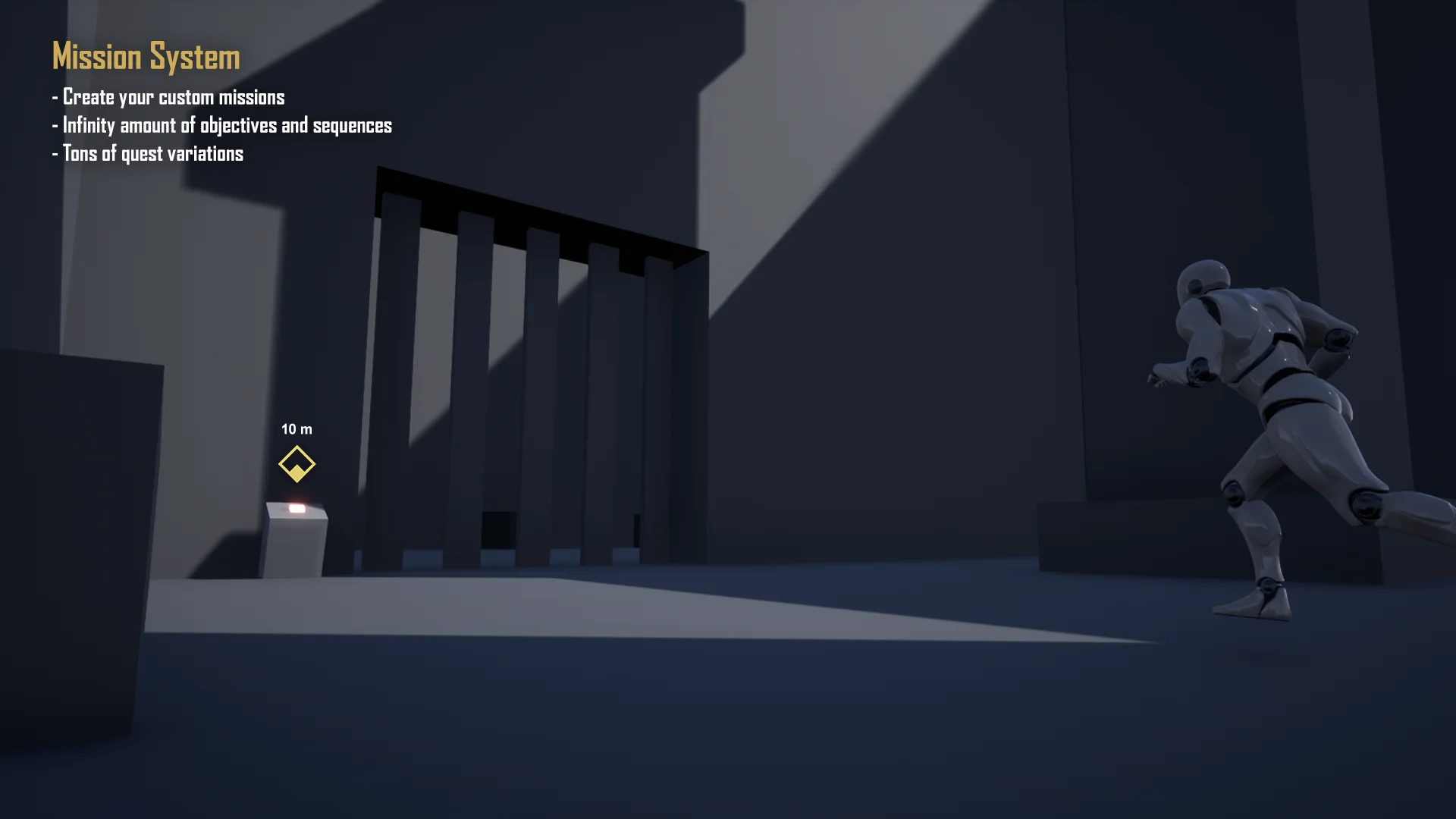
Guiding players through expansive environments requires clear, readable wayfinding tools that adjust dynamically to distance and player orientation. Multiplayer Mission System V2 implements both 2D screen-space indicators and in-world 3D markers that track target locations in real time. These visual cues direct players toward relevant waypoints, interaction objects, combat zones, or extraction points without cluttering the viewport.
Objective markers update automatically as task parameters change. When a player completes a stage—such as clearing a designated patrol or securing an item—the active marker transitions smoothly to the next coordinate or target actor. Because the marker infrastructure supports diverse objective types, developers can assign dynamic waypoints to stationary targets, roaming entities, or broad territorial zones. This adaptability ensures that wayfinding remains intuitive whether the active gameplay involves close-quarters indoor objectives or long-distance navigation across an open map.
Data Handling, Timers, and Progression in the Mission System
Encounters frequently require structured constraints to generate tension and evaluate player performance. The asset includes a dedicated mission timer component featuring customizable countdown durations. Designers can bind mission success, phase transitions, or penalty states directly to timer expiration, establishing time-attack challenges or defensive survival phases with minimal setup.
Beyond active session timing, the system features dedicated events for loading missions alongside existing player progression. Rather than forcing quests to run as isolated, one-off events, the architecture accommodates persistent game states where players log out, transition between levels, or resume previously started campaigns. When combined with the integrated mission rewarding system, the framework automatically dispenses currency, experience, items, or custom progression tags once all required criteria register as complete on the server.
The mission framework is also bundled with an Advanced Multiplayer Leveling System. This complementary inclusion allows developers to tie mission eligibility, objective scaling, and reward distribution directly into character rank, stat progression, or tier thresholds without having to build a separate player experience pipeline.
Interface Design, Filtering Logs, and Feedback Systems
Player comprehension depends heavily on clear user interfaces. Multiplayer Mission System V2 incorporates high-quality designed and animated widgets that deliver visual polish right out of the box. Active assignments populate an interactive quest log equipped with built-in filtering tools, allowing users to categorize tasks by type, status, or priority. This prevents quest lists from overwhelming players as campaigns expand over extended play sessions.
Complementing the quest log is an integrated notification system that communicates critical mission events as they happen. State updates—such as objective step completions, roster changes, invitation requests, and timer countdown alerts—display through clean interface notifications. The animated feedback loops give immediate confirmation to every party member when an action advances a shared objective, maintaining communication across the squad without requiring manual chat input.
Extensibility and Project Implementation
Adaptability across diverse genres is a core characteristic of the framework. Because the Blueprints are fully commented and modular, development teams can inspect the internal logic, trace data pathways, and extend classes to fit proprietary mechanics. Adding new objective targets requires straightforward configuration rather than deep rewrites of the core network replication loops.
The system fits readily into survival sandboxes, competitive shooters, story-driven multiplayer RPGs, and tactical co-op games. Furthermore, it exists as a core component within the larger Ultimate Multiplayer Survival Pack (UMSP), demonstrating its capacity to interface directly with extensive survival loops, resource systems, and larger gameplay ecosystems. Whether deployed as a standalone mission framework or slotted alongside existing character controllers and inventory engines, the system provides a clean, game-ready baseline for all forms of networked quest management.
 Action-Adventure
 Action-Adventure
 Action-Adventure