"148d1066ed74e216"{"id":"1002928","slug":"multiplayer-server-browser-master-server-server-listing","title":"Multiplayer Server Browser - Master Server - Server Listing","category":"Network \u0026 Multiplayer","engine":"4.25 - 5.4","assetVersion":"Asset Version: 1.0","engineVersion":"Engine Version: 4.25 - 5.4","tag":"Network","accent":"blue","visual":"mech","summary":"Implement cross-platform matchmaking and session discovery in Unreal Engine 4 using a lightweight external C master server and native plugin.","platform":"Unreal Engine","indexPolicy":"index","publishedAt":"2026-11-21T23:06:05.910Z","updatedAt":"2026-11-21T23:06:05.910Z","sourceNotes":[],"fileContents":[],"compatibility":["Unreal Engine","Asset Version: 1.0","Engine Version: 4.25 - 5.4"],"featuredImage":{"alt":"Multiplayer Server Browser - Master Server - Server Listing","src":"/wp-content/uploads/published/2026/11/6e68e3276c37-70ddce61-78f9-4cea-af64-cf1df82c5a58-3c019079ba.webp"},"fileSizeBytes":883578,"hasDownloadLink":true,"downloads":0,"terms":[{"taxonomy":"category","slug":"network-and-multiplayer-tools-and-plugins","name":"Network \u0026 Multiplayer"}],"galleryImages":[{"src":"/wp-content/uploads/published/2026/11/50111ddd3244-cb73a6df-f10e-47ce-b9db-8de5e6be50b9-e2a8af4561.webp","alt":"Multiplayer Server Browser - Master Server - Server Listing"},{"src":"/wp-content/uploads/published/2026/11/29e3f7204ea5-cbd7d0d0-c20a-4c2d-897d-b2341aef46e1-814fb30f1b.webp","alt":"Multiplayer Server Browser - Master Server - Server Listing"},{"src":"/wp-content/uploads/published/2026/11/08ffc26eeb39-981f5b7d-899c-46bd-9b66-d12d00e8cdaf-3dedbd6cfc.webp","alt":"Multiplayer Server Browser - Master Server - Server Listing"},{"src":"/wp-content/uploads/published/2026/11/e3c0aac46b05-a75266e6-aa14-4623-9af7-c1069196d997-f0bf15edf4.webp","alt":"Multiplayer Server Browser - Master Server - Server Listing"},{"src":"/wp-content/uploads/published/2026/11/2e6baa8a16e5-26e82d14-2ccc-4e4f-be30-80a7f8c73021-6224ffbb0b.webp","alt":"Multiplayer Server Browser - Master Server - Server Listing"}],"accessPanel":{"kind":"resource","title":"Get this resource","safetyNote":"Resources are manually reviewed before listing to improve quality and reduce obvious risks.","fileName":"Multiplayer Server Browser - Master Server - Server Listing.7z","resourceType":"Resource archive","versions":[]},"contentHtml":"\u003cp\u003eConfiguring network session discovery across disparate platforms often introduces friction when standard ecosystem libraries are missing. The Multiplayer Server Browser - Master Server - Server Listing framework addresses session aggregation by decoupling discovery from proprietary platform infrastructure. Instead of routing traffic through a closed online subsystem, the system establishes a direct communication bridge between an external coordinator and local game instances.\u003c/p\u003e \u003ch2\u003eDeploying the Standalone Master Server Architecture\u003c/h2\u003e\n\u003cp\u003eAt the center of this networking pipeline sits an external master server utility engineered in C. Compiled natively for Windows 10 and Linux environments, this standalone executable operates outside the game runtime, acting as a lightweight traffic controller for hosting nodes and prospective clients. Operating as a headless C program keeps host overhead minimal, allowing teams to run the coordinator on standard Linux or Windows 10 server instances without the resource footprint of an active game engine installation.\u003c/p\u003e\n\u003cp\u003eThe external master server receives inbound traffic from both sides of the multiplayer loop. Game hosts report their operational status directly to the application, while client sessions submit queries whenever players request an index of live games. Because the executable is written in native C, packet processing and connection monitoring proceed independently of game thread tick rates or local engine dependencies. This isolation ensures that host registrations and player connection requests continue to cycle smoothly even during periods of heavy session turnover.\u003c/p\u003e \u003ch2\u003eGame Server Registration and Live Listing Updates\u003c/h2\u003e\n\u003cp\u003eWithin Unreal Engine 4, integration relies on a dedicated plugin that interfaces directly with the central C binary. Both listen hosts and headless dedicated instances utilize this interface to broadcast their availability. When an Unreal Engine 4 game server launches, the plugin initiates an outbound registration call to register the session on the master server. This handshake passes fundamental operational metadata, making the node discoverable to prospective players.\u003c/p\u003e\n\u003cp\u003eSession data delivered to the central coordinator includes the designated server name, the current map name, and dynamic metrics such as the player count. Because match states evolve as rounds progress, hosts do not remain locked to static launch parameters. The plugin permits game logic to push revised data payloads to the master coordinator at any point during active gameplay. When participants enter or exit a match, or when the server loads a different map rotation, the host updates the master server record in real time. This keeps session lists synchronized without forcing complete match re-initializations.\u003c/p\u003e \u003ch2\u003eClient Discovery in the Multiplayer Server Browser Workflow\u003c/h2\u003e\n\u003cp\u003eOn the user side, the plugin translates raw network responses into discoverable session structures. Game clients send an update request to the master application to fetch the complete inventory of active, registered games. The central software parses its internal database and returns the populated index, allowing the local client to view available rooms alongside their runtime variables.\u003c/p\u003e\n\u003cp\u003eBecause the plugin is crafted for direct integration with project game flow, developers can expose this connection cycle inside custom interface menus. Players see live map names, room labels, and available slots directly populated from the retrieved packet arrays. Once the player confirms their selection, the host network address returned by the master program provides the target location necessary to execute standard level travel. The master server simply brokers discovery, keeping network routing direct between players and hosts during actual gameplay.\u003c/p\u003e \u003ch2\u003eCross-Platform Compatibility Across Non-Steam Environments\u003c/h2\u003e\n\u003cp\u003eA primary architectural distinction of this setup is the complete absence of dependencies on an Unreal Engine online subsystem. Native subsystems often tie project functionality to commercial storefront APIs like Steamworks, creating barriers when distributing projects to storefronts or operating systems where those tools do not exist. By bypassing subsystem layers entirely, this tooling establishes consistent session handling across environments that lack native lobby frameworks.\u003c/p\u003e\n\u003cp\u003eHardware compatibility extends across conventional desktop systems, mobile distributions, and virtual reality gear. The plugin functions across Windows, Linux, Mac, Android, iOS, and the Oculus Quest standalone platform. Mobile titles face particular challenges with game discovery due to restrictive sandboxing and the absence of a unified desktop-style platform lobby. Projects such as the released Android and iOS action title Red Storm: Vietnam War utilize this framework to manage cross-platform discovery, validating the pipeline under active mobile network conditions.\u003c/p\u003e \u003ch2\u003eBlueprint and C++ Integration Paradigms\u003c/h2\u003e\n\u003cp\u003eTechnical integration within Unreal Engine 4 supports both visual scripting nodes and native source compilation. The plugin exposes an accessible interface that works directly with visual Blueprint graphs, enabling designers to trigger registration, refresh listings, and read session arrays without writing custom low-level sockets. For programming teams maintaining deep codebases, the underlying C++ calls offer direct programmatic control over message payloads and connection events.\u003c/p\u003e\n\u003cp\u003eNetwork hygiene is maintained through automated server pruning directly within the master server software. Game servers that crash, lose connectivity, or fail to sustain communication are evaluated by the external C binary. The program automatically drops hosts that become unreachable, eliminating stale entries and broken targets from player menus. This automated cleanup loop prevents disconnected or dead nodes from cluttering player search screens, maintaining functional session directories without demanding manual administrative maintenance.\u003c/p\u003e\n\n\u003ch2\u003eExplore Similar Assets\u003c/h2\u003e\n\u003cul\u003e\n\u003cli\u003e\u003ca href=\"https://3dcghub.com/socket-io-client/\" rel=\"noopener noreferrer\"\u003eSocket.IO Client\u003c/a\u003e\u003c/li\u003e\n\u003cli\u003e\u003ca href=\"https://3dcghub.com/gmcv2-advanced-locomotion-and-network-prediction-framework/\" rel=\"noopener noreferrer\"\u003eGMCv2 - Advanced Locomotion \u0026amp; Network Prediction Framework\u003c/a\u003e\u003c/li\u003e\n\u003cli\u003e\u003ca href=\"https://3dcghub.com/kronos-matchmaking/\" rel=\"noopener noreferrer\"\u003eKronos Matchmaking\u003c/a\u003e\u003c/li\u003e\n\u003cli\u003e\u003ca href=\"https://3dcghub.com/network-clock/\" rel=\"noopener noreferrer\"\u003eNetwork Clock\u003c/a\u003e\u003c/li\u003e\n\u003cli\u003e\u003ca href=\"https://3dcghub.com/network-stats/\" rel=\"noopener noreferrer\"\u003eNetwork Stats\u003c/a\u003e\u003c/li\u003e\n\u003c/ul\u003e","contentTextLength":6134,"navigation":{"current":44,"total":4890,"previous":{"id":"1002929","slug":"multiplayer-with-blueprints-aws","title":"Multiplayer with Blueprints (AWS)","category":"Network \u0026 Multiplayer","platform":"Unreal Engine","updatedAt":"2026-11-21T23:06:34.621Z"},"next":{"id":"1002927","slug":"multiplayer-mission-system-v2","title":"Multiplayer Mission System V2","category":"Action-Adventure","platform":"Unreal Engine","updatedAt":"2026-11-21T22:55:07.738Z"}},"relatedResources":[{"id":"1002887","slug":"socket-io-client","title":"Socket.IO Client","category":"Network \u0026 Multiplayer","engine":"4.24 - 5.3","assetVersion":"Asset Version: 1.3.5 - 2.7.3","engineVersion":"Engine Version: 4.24 - 5.3","tag":"Network","accent":"blue","visual":"mech","summary":"Connect Unreal Engine to Node.js servers, websites, phones, and IoT hardware using the real-time C++11 Socket.IO Client plugin for Blueprints and code.","platform":"Unreal Engine","indexPolicy":"index","publishedAt":"2026-11-21T01:55:11.604Z","updatedAt":"2026-11-21T01:55:11.604Z","sourceNotes":[],"fileContents":[],"compatibility":["Unreal Engine","Asset Version: 1.3.5 - 2.7.3","Engine Version: 4.24 - 5.3"],"featuredImage":{"alt":"Socket.IO Client","src":"/wp-content/uploads/published/2026/11/87d11bc6ac94-b0148ab4-a550-48d3-b533-4537828928b3-d75320ea9a.webp"},"fileSizeBytes":349900415,"hasDownloadLink":true,"downloads":0},{"id":"1002912","slug":"gmcv2-advanced-locomotion-and-network-prediction-framework","title":"GMCv2 - Advanced Locomotion \u0026 Network Prediction Framework","category":"Network \u0026 Multiplayer","engine":"5.3","assetVersion":"Asset Version: 2.0.0","engineVersion":"Engine Version: 5.3","tag":"Network","accent":"blue","visual":"animation","summary":"Explore GMCv2, a standalone Blueprint-friendly network prediction framework for custom locomotion, GoldSource physics, and server-authoritative replication.","platform":"Unreal Engine","indexPolicy":"index","publishedAt":"2026-11-21T15:41:06.486Z","updatedAt":"2026-11-21T15:41:06.486Z","sourceNotes":[],"fileContents":[],"compatibility":["Unreal Engine","Asset Version: 2.0.0","Engine Version: 5.3"],"featuredImage":{"alt":"GMCv2 - Advanced Locomotion \u0026 Network Prediction Framework","src":"/wp-content/uploads/published/2026/11/daf75770d009-2ecd996f-ed7b-4300-8774-61d8898fccec-974ce09737.webp"},"fileSizeBytes":41334623,"hasDownloadLink":true,"downloads":0},{"id":"1000632","slug":"kronos-matchmaking","title":"Kronos Matchmaking","category":"Network \u0026 Multiplayer","engine":"5.2 - 5.5","assetVersion":"Asset Version: 1.9.0 - 2.6.0","engineVersion":"Engine Version: 5.2 - 5.5","tag":"Network","accent":"blue","visual":"mech","summary":"Complete Unreal Engine matchmaking plugin with skill-based pairing, party and reservation systems, Steam and EOS support, and listen-server hosting.","platform":"Unreal Engine","indexPolicy":"index","publishedAt":"2026-07-21T14:46:21.329Z","updatedAt":"2026-11-21T10:49:27.825Z","sourceNotes":[],"fileContents":[],"compatibility":["Unreal Engine","Asset Version: 1.9.0 - 2.6.0","Engine Version: 5.2 - 5.5"],"featuredImage":{"alt":"Kronos Matchmaking","src":"/wp-content/uploads/published/2026/07/3bf316672af3-3dc1eaef-3090-47e4-9779-b8a8509d071a-31efec86de.webp"},"fileSizeBytes":61619981,"hasDownloadLink":true,"downloads":0}]}[{"id":4225,"sourceId":4225,"taxonomyId":4225,"taxonomy":"category","slug":"asset-library","name":"Asset Library","parentId":null,"count":4744,"hasChildren":true,"href":"/","seoTitle":"Free Game Assets Library | 3DCGHUB","seoDescription":"Browse free Unreal Engine, Unity, Blender assets and game development tutorials on 3DCGHUB with previews, compatibility notes, and secure downloads.","sitemapEnabled":true,"children":[{"id":4227,"sourceId":4227,"taxonomyId":4227,"taxonomy":"category","slug":"blender-add-ons-plugins","name":"Blender Add-ons \u0026 Plugins","parentId":4225,"count":10,"hasChildren":false,"href":"/category/blender-add-ons-plugins/","seoTitle":"Free Blender Add-ons \u0026 Plugins | 3DCGHUB","seoDescription":"Browse free Blender Add-ons \u0026 Plugins tools for Blender on 3DCGHUB: curated downloads with preview images, compatibility notes and secure download access.","sitemapEnabled":true},{"id":514,"sourceId":514,"taxonomyId":514,"taxonomy":"category","slug":"unity-2","name":"Unity","parentId":4225,"count":453,"hasChildren":true,"href":"/category/unity-2/","seoTitle":"Free Unity Assets | 3DCGHUB","seoDescription":"Browse free Unity resources on 3DCGHUB: curated downloads with preview images, compatibility notes and secure download access.","sitemapEnabled":true,"children":[{"id":523,"sourceId":523,"taxonomyId":523,"taxonomy":"category","slug":"2d","name":"2D","parentId":514,"count":1,"hasChildren":true,"href":"/category/2d/","seoTitle":"Free Unity 2D | 3DCGHUB","seoDescription":"Browse free 2D assets for Unity on 3DCGHUB: curated downloads with preview images, compatibility notes and secure download access.","sitemapEnabled":true},{"id":515,"sourceId":515,"taxonomyId":515,"taxonomy":"category","slug":"3d-unity-2","name":"3D","parentId":514,"count":162,"hasChildren":true,"href":"/category/3d-unity-2/","seoTitle":"Free Unity 3D Assets | 3DCGHUB","seoDescription":"Browse free 3D assets for Unity on 3DCGHUB: curated downloads with preview images, compatibility notes and secure download access.","sitemapEnabled":true},{"id":565,"sourceId":565,"taxonomyId":565,"taxonomy":"category","slug":"add-ons","name":"Add-Ons","parentId":514,"count":2,"hasChildren":false,"href":"/category/add-ons/","seoTitle":"Free Unity Add-Ons | 3DCGHUB","seoDescription":"Browse free Add-Ons assets for Unity on 3DCGHUB: curated downloads with preview images, compatibility notes and secure download access.","sitemapEnabled":true},{"id":529,"sourceId":529,"taxonomyId":529,"taxonomy":"category","slug":"audio-unity-2","name":"Audio","parentId":514,"count":1,"hasChildren":true,"href":"/category/audio-unity-2/","seoTitle":"Free Unity Audio | 3DCGHUB","seoDescription":"Browse free Audio for Unity on 3DCGHUB: curated downloads with preview images, compatibility notes and secure download access.","sitemapEnabled":true},{"id":557,"sourceId":557,"taxonomyId":557,"taxonomy":"category","slug":"templates","name":"Templates","parentId":514,"count":36,"hasChildren":true,"href":"/category/templates/","seoTitle":"Free Unity Templates | 3DCGHUB","seoDescription":"Browse free Unity project templates on 3DCGHUB. Starter kits with previews, compatibility notes, and secure download access.","sitemapEnabled":true},{"id":533,"sourceId":533,"taxonomyId":533,"taxonomy":"category","slug":"tools-unity-2","name":"Tools","parentId":514,"count":0,"hasChildren":true,"href":"/category/tools-unity-2/","sitemapEnabled":true},{"id":554,"sourceId":554,"taxonomyId":554,"taxonomy":"category","slug":"vfx-unity-2","name":"VFX","parentId":514,"count":4,"hasChildren":true,"href":"/category/vfx-unity-2/","seoTitle":"Free Unity VFX | 3DCGHUB","seoDescription":"Browse free VFX for Unity on 3DCGHUB: curated downloads with preview images, compatibility notes and secure download access.","sitemapEnabled":true}]},{"id":511,"sourceId":511,"taxonomyId":511,"taxonomy":"category","slug":"unreal-engine-2","name":"Unreal Engine","parentId":4225,"count":4282,"hasChildren":true,"href":"/category/unreal-engine-2/","seoTitle":"Free Unreal Engine Assets | 3DCGHUB","seoDescription":"Browse free Unreal Engine resources on 3DCGHUB: curated downloads with preview images, compatibility notes and secure download access.","sitemapEnabled":true,"children":[{"id":54,"sourceId":54,"taxonomyId":54,"taxonomy":"category","slug":"3d","name":"3D","parentId":511,"count":2428,"hasChildren":true,"href":"/category/3d/","seoTitle":"Free Unreal Engine 3D | 3DCGHUB","seoDescription":"Browse free 3D assets for Unreal Engine on 3DCGHUB: curated downloads with preview images, compatibility notes and secure download access.","sitemapEnabled":true},{"id":441,"sourceId":441,"taxonomyId":441,"taxonomy":"category","slug":"animations","name":"Animations","parentId":511,"count":245,"hasChildren":true,"href":"/category/animations/","seoTitle":"Free Unreal Engine Animations | 3DCGHUB","seoDescription":"Browse free Animations for Unreal Engine on 3DCGHUB: curated downloads with preview images, compatibility notes and secure download access.","sitemapEnabled":true},{"id":446,"sourceId":446,"taxonomyId":446,"taxonomy":"category","slug":"audio","name":"Audio","parentId":511,"count":63,"hasChildren":true,"href":"/category/audio/","seoTitle":"Free Unreal Engine Audio Resources | 3DCGHUB","seoDescription":"Browse free Unreal Engine audio resources including sound effects, voices, dialogue, and ambient sounds. Curated free downloads on 3DCGHUB.","sitemapEnabled":true},{"id":466,"sourceId":466,"taxonomyId":466,"taxonomy":"category","slug":"game-systems","name":"Game Systems","parentId":511,"count":356,"hasChildren":true,"href":"/category/game-systems/","seoTitle":"Free Unreal Engine Game Systems | 3DCGHUB","seoDescription":"Browse free Game Systems tools for Unreal Engine on 3DCGHUB: curated downloads with preview images, compatibility notes and secure download access.","sitemapEnabled":true},{"id":478,"sourceId":478,"taxonomyId":478,"taxonomy":"category","slug":"game-templates","name":"Game Templates","parentId":511,"count":150,"hasChildren":true,"href":"/category/game-templates/","seoTitle":"Free Unreal Engine Game Templates | 3DCGHUB","seoDescription":"Browse free Game Templates for Unreal Engine on 3DCGHUB: curated downloads with preview images, compatibility notes and secure download access.","sitemapEnabled":true},{"id":432,"sourceId":432,"taxonomyId":432,"taxonomy":"category","slug":"hdri","name":"HDRI","parentId":511,"count":6,"hasChildren":true,"href":"/category/hdri/","seoTitle":"Free Unreal Engine HDRI | 3DCGHUB","seoDescription":"Browse free Unreal Engine HDRI skies and lighting maps on 3DCGHUB. Environment lighting with previews and secure downloads.","sitemapEnabled":true},{"id":228,"sourceId":228,"taxonomyId":228,"taxonomy":"category","slug":"material-and-textures","name":"Material \u0026 Textures","parentId":511,"count":172,"hasChildren":true,"href":"/category/material-and-textures/","seoTitle":"Free Unreal Engine Material \u0026 Textures | 3DCGHUB","seoDescription":"Browse free Material \u0026 Textures for Unreal Engine on 3DCGHUB: curated downloads with preview images, compatibility notes and secure download access.","sitemapEnabled":true},{"id":298,"sourceId":298,"taxonomyId":298,"taxonomy":"category","slug":"sprites-and-flipbooks","name":"Sprites \u0026 Flipbooks","parentId":511,"count":17,"hasChildren":true,"href":"/category/sprites-and-flipbooks/","seoTitle":"Free Unreal Engine Sprites \u0026 Flipbooks | 3DCGHUB","seoDescription":"Browse free Sprites \u0026 Flipbooks assets for Unreal Engine on 3DCGHUB: curated downloads with preview images, compatibility notes and secure download access.","sitemapEnabled":true},{"id":489,"sourceId":489,"taxonomyId":489,"taxonomy":"category","slug":"tools-and-plugins","name":"Tools \u0026 Plugins","parentId":511,"count":390,"hasChildren":true,"href":"/category/tools-and-plugins/","seoTitle":"Free Unreal Engine Tools \u0026 Plugins | 3DCGHUB","seoDescription":"Browse free Tools \u0026 Plugins for Unreal Engine on 3DCGHUB: curated downloads with preview images, compatibility notes and secure download access.","sitemapEnabled":true},{"id":459,"sourceId":459,"taxonomyId":459,"taxonomy":"category","slug":"ui","name":"UI","parentId":511,"count":43,"hasChildren":true,"href":"/category/ui/","seoTitle":"Free Unreal Engine UI | 3DCGHUB","seoDescription":"Browse free UI for Unreal Engine on 3DCGHUB: curated downloads with preview images, compatibility notes and secure download access.","sitemapEnabled":true},{"id":450,"sourceId":450,"taxonomyId":450,"taxonomy":"category","slug":"vfx","name":"VFX","parentId":511,"count":412,"hasChildren":true,"href":"/category/vfx/","seoTitle":"Free Unreal Engine VFX | 3DCGHUB","seoDescription":"Browse free VFX for Unreal Engine on 3DCGHUB: curated downloads with preview images, compatibility notes and secure download access.","sitemapEnabled":true}]}]},{"id":4222,"sourceId":4222,"taxonomyId":4222,"taxonomy":"category","slug":"tutorial-library","name":"Tutorial Library","parentId":null,"count":117,"hasChildren":false,"href":"/tutorials/","seoTitle":"Free Game Development Tutorial Library | 3DCGHUB","seoDescription":"Browse free game development tutorials for Unreal Engine, Unity, Blender, and more on 3DCGHUB with practical workflows and secure downloads.","sitemapEnabled":true}]
Resource screenshots
1 / 5
Join our channel
Follow 3DCGHUB on Telegram for new resource drops, migration updates, and community notices.
Configuring network session discovery across disparate platforms often introduces friction when standard ecosystem libraries are missing. The Multiplayer Server Browser - Master Server - Server Listing framework addresses session aggregation by decoupling discovery from proprietary platform infrastructure. Instead of routing traffic through a closed online subsystem, the system establishes a direct communication bridge between an external coordinator and local game instances.
Deploying the Standalone Master Server Architecture
At the center of this networking pipeline sits an external master server utility engineered in C. Compiled natively for Windows 10 and Linux environments, this standalone executable operates outside the game runtime, acting as a lightweight traffic controller for hosting nodes and prospective clients. Operating as a headless C program keeps host overhead minimal, allowing teams to run the coordinator on standard Linux or Windows 10 server instances without the resource footprint of an active game engine installation.
The external master server receives inbound traffic from both sides of the multiplayer loop. Game hosts report their operational status directly to the application, while client sessions submit queries whenever players request an index of live games. Because the executable is written in native C, packet processing and connection monitoring proceed independently of game thread tick rates or local engine dependencies. This isolation ensures that host registrations and player connection requests continue to cycle smoothly even during periods of heavy session turnover.
Game Server Registration and Live Listing Updates
Within Unreal Engine 4, integration relies on a dedicated plugin that interfaces directly with the central C binary. Both listen hosts and headless dedicated instances utilize this interface to broadcast their availability. When an Unreal Engine 4 game server launches, the plugin initiates an outbound registration call to register the session on the master server. This handshake passes fundamental operational metadata, making the node discoverable to prospective players.
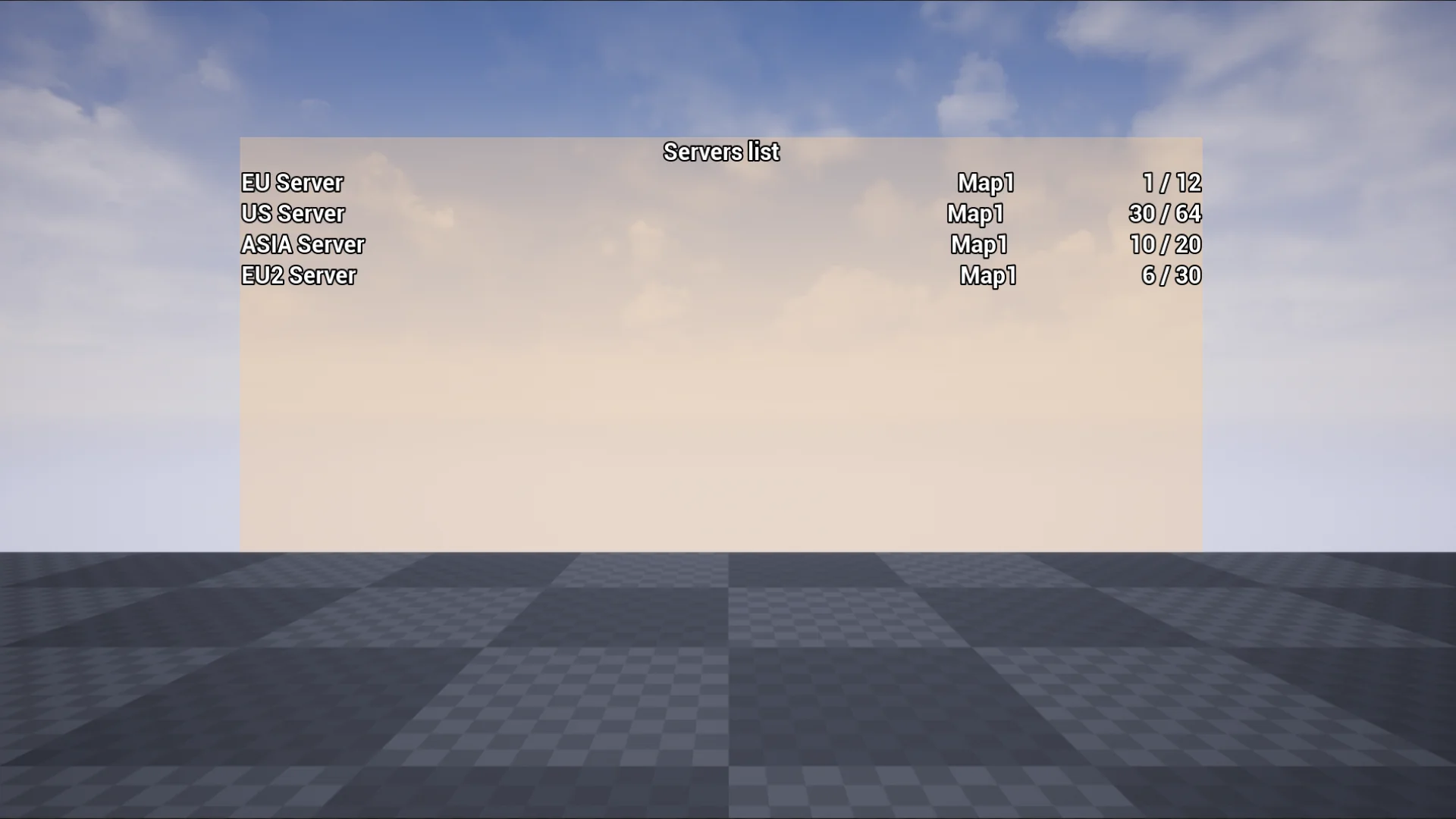
Session data delivered to the central coordinator includes the designated server name, the current map name, and dynamic metrics such as the player count. Because match states evolve as rounds progress, hosts do not remain locked to static launch parameters. The plugin permits game logic to push revised data payloads to the master coordinator at any point during active gameplay. When participants enter or exit a match, or when the server loads a different map rotation, the host updates the master server record in real time. This keeps session lists synchronized without forcing complete match re-initializations.
Client Discovery in the Multiplayer Server Browser Workflow
On the user side, the plugin translates raw network responses into discoverable session structures. Game clients send an update request to the master application to fetch the complete inventory of active, registered games. The central software parses its internal database and returns the populated index, allowing the local client to view available rooms alongside their runtime variables.
Because the plugin is crafted for direct integration with project game flow, developers can expose this connection cycle inside custom interface menus. Players see live map names, room labels, and available slots directly populated from the retrieved packet arrays. Once the player confirms their selection, the host network address returned by the master program provides the target location necessary to execute standard level travel. The master server simply brokers discovery, keeping network routing direct between players and hosts during actual gameplay.
Cross-Platform Compatibility Across Non-Steam Environments
A primary architectural distinction of this setup is the complete absence of dependencies on an Unreal Engine online subsystem. Native subsystems often tie project functionality to commercial storefront APIs like Steamworks, creating barriers when distributing projects to storefronts or operating systems where those tools do not exist. By bypassing subsystem layers entirely, this tooling establishes consistent session handling across environments that lack native lobby frameworks.
Hardware compatibility extends across conventional desktop systems, mobile distributions, and virtual reality gear. The plugin functions across Windows, Linux, Mac, Android, iOS, and the Oculus Quest standalone platform. Mobile titles face particular challenges with game discovery due to restrictive sandboxing and the absence of a unified desktop-style platform lobby. Projects such as the released Android and iOS action title Red Storm: Vietnam War utilize this framework to manage cross-platform discovery, validating the pipeline under active mobile network conditions.
Blueprint and C++ Integration Paradigms
Technical integration within Unreal Engine 4 supports both visual scripting nodes and native source compilation. The plugin exposes an accessible interface that works directly with visual Blueprint graphs, enabling designers to trigger registration, refresh listings, and read session arrays without writing custom low-level sockets. For programming teams maintaining deep codebases, the underlying C++ calls offer direct programmatic control over message payloads and connection events.
Network hygiene is maintained through automated server pruning directly within the master server software. Game servers that crash, lose connectivity, or fail to sustain communication are evaluated by the external C binary. The program automatically drops hosts that become unreachable, eliminating stale entries and broken targets from player menus. This automated cleanup loop prevents disconnected or dead nodes from cluttering player search screens, maintaining functional session directories without demanding manual administrative maintenance.
 Network
 Network
 Network