"2596237520a17fbf"{"id":"1002912","slug":"gmcv2-advanced-locomotion-and-network-prediction-framework","title":"GMCv2 - Advanced Locomotion \u0026 Network Prediction Framework","category":"Network \u0026 Multiplayer","engine":"5.3","assetVersion":"Asset Version: 2.0.0","engineVersion":"Engine Version: 5.3","tag":"Network","accent":"blue","visual":"animation","summary":"Explore GMCv2, a standalone Blueprint-friendly network prediction framework for custom locomotion, GoldSource physics, and server-authoritative replication.","platform":"Unreal Engine","indexPolicy":"index","publishedAt":"2026-11-21T15:41:06.486Z","updatedAt":"2026-11-21T15:41:06.486Z","sourceNotes":[],"fileContents":[],"compatibility":["Unreal Engine","Asset Version: 2.0.0","Engine Version: 5.3"],"featuredImage":{"alt":"GMCv2 - Advanced Locomotion \u0026 Network Prediction Framework","src":"/wp-content/uploads/published/2026/11/daf75770d009-2ecd996f-ed7b-4300-8774-61d8898fccec-974ce09737.webp"},"fileSizeBytes":41334623,"hasDownloadLink":true,"downloads":0,"terms":[{"taxonomy":"category","slug":"network-and-multiplayer-tools-and-plugins","name":"Network \u0026 Multiplayer"}],"galleryImages":[{"src":"/wp-content/uploads/published/2026/11/267899b14d16-b732d0a4-5d21-4867-ba2e-f26647ad618e-ed0b6e363d.webp","alt":"GMCv2 - Advanced Locomotion \u0026 Network Prediction Framework"},{"src":"/wp-content/uploads/published/2026/11/21a8d1f74c77-01c38cfb-acc8-4850-bcc7-4d6e023c3b09-24475f6502.webp","alt":"GMCv2 - Advanced Locomotion \u0026 Network Prediction Framework"},{"src":"/wp-content/uploads/published/2026/11/d0e996a1a156-12ca6a86-2159-4577-a394-367cde2d8f9a-1e0777540a.webp","alt":"GMCv2 - Advanced Locomotion \u0026 Network Prediction Framework"},{"src":"/wp-content/uploads/published/2026/11/12313420c667-5a6bf465-f474-4a7f-bce3-c7b9ce657a8a-c792023b34.webp","alt":"GMCv2 - Advanced Locomotion \u0026 Network Prediction Framework"},{"src":"/wp-content/uploads/published/2026/11/2b32e49bde4f-c1cbb1d3-5ffe-4958-9411-ed9ebcd1251c-cd05d93c7d.webp","alt":"GMCv2 - Advanced Locomotion \u0026 Network Prediction Framework"},{"src":"/wp-content/uploads/published/2026/11/dd06d5d0d0f7-b6d81af2-946b-4cc0-a77e-7964688ed1f1-39ac6144b9.webp","alt":"GMCv2 - Advanced Locomotion \u0026 Network Prediction Framework"}],"contentHtml":"\u003ch2\u003eHandling Advanced Movement Dynamics in GMCv2\u003c/h2\u003e\u003cp\u003eEngineering responsive character motion requires handling edge cases that default engine toolkits often struggle to accommodate. Standard templates can rapidly hit architectural ceilings when a project calls for specialized mechanics such as high-velocity momentum shifts, directional sliding, or non-standard trajectory calculations. GMCv2 - Advanced Locomotion \u0026 Network Prediction Framework approaches this problem by delivering a completely standalone locomotion system designed to construct movement archetypes of any style and complexity.\u003c/p\u003e\u003cp\u003eRather than constraining developers to standard walking or flying states, the framework enables the creation of custom locomotion behaviors tailored to specialized genres. Projects featuring GoldSource-style physics demonstrate this technical adaptability. Both classic bunny hopping and surfing mechanics can be faithfully reconstructed, proving that the toolset handles sensitive, velocity-retaining air acceleration, precise surface friction, and complex collision sweeps. The toolkit is fully Blueprint-friendly, allowing technical designers and gameplay programmers to test and adjust low-level physics parameters without dropping into deep engine modifications every time an iteration is needed.\u003c/p\u003e\u003cp\u003eThe speed of iteration plays a central role in motion design. Because the framework exposes its mechanics through an innovative, modular design, designers can prototype intricate locomotion behaviors, custom gravitational pulls, and tailored ground checks directly in visual scripting. This flexibility serves single-player titles seeking robust, deeply customized character physics that run far beyond baseline engine defaults.\u003c/p\u003e\u003ch2\u003eNetwork Prediction Framework and Multiplayer Authority\u003c/h2\u003e\u003cp\u003eMultiplayer gameplay exposes movement systems to latency, packet loss, and desynchronization. Creating a movement component capable of handling server-authoritative calculations while providing instantaneous client-side feedback is notoriously demanding. Without proper client-side prediction and server reconciliation, players experience disruptive rubberbanding, visual jitter, and sluggish inputs.\u003c/p\u003e\u003cp\u003eGMCv2 tackles these challenges directly by embedding an automated network prediction framework. The system manages the complex pipeline of input buffering, state generation, server validation, correction, and smoothing behind the scenes. When a client performs a movement action, the framework executes the prediction locally while communicating identical inputs to the server. If a discrepancy arises between the client simulation and the server-authoritative verification, the framework automates state rewinding and reconciliation without forcing developers to write custom netcode from scratch.\u003c/p\u003e\u003cp\u003eThis level of network replication is critical for high-speed first-person shooters, competitive arenas, and technical platformers where spatial precision governs core balance. By decoupling developers from the tedious process of writing custom correction algorithms, the toolkit lets gameplay teams focus on tactile mechanics, weapon integration, and level interactions while maintaining lag-free synchronization across varied network conditions.\u003c/p\u003e\u003ch2\u003eSeparation from the Standard Character Component Pipeline\u003c/h2\u003e\u003cp\u003eAn essential technical aspect of GMCv2 is its complete architectural independence. The framework is engineered entirely from scratch and does not inherit from or rely upon Unreal's native Character or CharacterMovementComponent classes. This absolute detachment gives the system its high degree of flexibility and networking stability, as it is unburdened by legacy movement code and pre-existing engine assumptions.\u003c/p\u003e\u003cp\u003eThis structural independence introduces a vital technical reality during production planning. Because it operates outside the native character hierarchy, the framework is not directly compatible with third-party assets, Marketplace packages, or built-in engine functions that explicitly depend on the default Character or CharacterMovementComponent. Any project bringing GMCv2 into its pipeline must treat it as a foundational movement architecture rather than a drop-in modifier for existing character blueprints.\u003c/p\u003e\u003cp\u003eTeams adopting the system build their pawn logic around its specialized components from the project's inception. While this requires establishing movement logic directly within the framework's workflow, it eliminates the rigid constraints of native classes, giving developers direct authority over spatial checks, tick execution, collision response, and component replication.\u003c/p\u003e\u003ch2\u003eCommunity Extensions and the GMC Ecosystem\u003c/h2\u003e\u003cp\u003eDue to the framework's broad mechanical footprint, several community-led companion tools have emerged to bridge specific systems into its workflow. These community-developed resources extend the baseline locomotion toolkit into broader gameplay structures:\u003c/p\u003e\u003cul\u003e\u003cli\u003e\u003cstrong\u003eGMC Ability System (GMAS):\u003c/strong\u003e Developed by Reznok, this integration facilitates gameplay ability management tailored around the framework's predictive movement architecture.\u003c/li\u003e\u003cli\u003e\u003cstrong\u003eGMC Extended:\u003c/strong\u003e Authored by Packetdancer, this resource builds out additional feature sets, helpers, and workflow enhancements on top of the base plugin.\u003c/li\u003e\u003cli\u003e\u003cstrong\u003eGMC x ALS:\u003c/strong\u003e Maintained by Dixon, this bridge facilitates the coordination between Advanced Locomotion System behaviors and the GMC framework.\u003c/li\u003e\u003c/ul\u003e\u003cp\u003eThese supplementary layers demonstrate how the core architecture adapts to complex game logic. Developers can draw from these community modules when constructing deep action role-playing systems, expanded traversal options, or complex animation states that must align with predictive netcode.\u003c/p\u003e\u003ch2\u003eSetup Routines and Development Workflows\u003c/h2\u003e\u003cp\u003eIntegrating a custom movement foundation into an active production cycle demands structured onboarding. Once access to the framework is secured, developers enter a dedicated support environment to verify setup requirements and review step-by-step guidance found in documentation and specialized first-steps channels. Detailed technical documentation and dedicated frequently asked questions outline the exact processes needed to set up custom pawns, bind inputs, and configure replicated variables.\u003c/p\u003e\u003cp\u003eThe dedicated support server functions as an active technical exchange. Developers can access preview builds of upcoming versions, evaluate community-generated templates, showcase working builds, and troubleshoot complex replication scenarios with peers. Independent developer devlogs and community showcases highlight the practical execution of the plugin across community games, offering real-world blueprints for production pipelines.\u003c/p\u003e\u003cp\u003eGMCv2 is best suited for teams developing precision-driven single-player experiences or competitive multiplayer games that cannot compromise on responsive client prediction. By bypassing native movement classes in favor of a specialized, server-authoritative replication engine, the framework establishes a reliable technical base for titles where motion fidelity determines the quality of the entire game.\u003c/p\u003e\n\n\u003ch2\u003eRelated Resources Worth Checking\u003c/h2\u003e\n\u003cul\u003e\n\u003cli\u003e\u003ca href=\"https://3dcghub.com/n00dinteract/\" rel=\"noopener noreferrer\"\u003en00dInteract\u003c/a\u003e\u003c/li\u003e\n\u003cli\u003e\u003ca href=\"https://3dcghub.com/fps-first-person-shooter-framework-skg-shooter-framework-v2/\" rel=\"noopener noreferrer\"\u003eFPS First Person Shooter Framework (SKG Shooter Framework V2)\u003c/a\u003e\u003c/li\u003e\n\u003cli\u003e\u003ca href=\"https://3dcghub.com/kronos-matchmaking/\" rel=\"noopener noreferrer\"\u003eKronos Matchmaking\u003c/a\u003e\u003c/li\u003e\n\u003cli\u003e\u003ca href=\"https://3dcghub.com/multiplayer-fps-procedural-animation-toolkit/\" rel=\"noopener noreferrer\"\u003eMultiplayer FPS Procedural Animation Toolkit\u003c/a\u003e\u003c/li\u003e\n\u003cli\u003e\u003ca href=\"https://3dcghub.com/network-clock/\" rel=\"noopener noreferrer\"\u003eNetwork Clock\u003c/a\u003e\u003c/li\u003e\n\u003c/ul\u003e","contentTextLength":7217,"navigation":{"current":7,"total":4839,"previous":{"id":"1002913","slug":"graph-formatter","title":"Graph Formatter","category":"Engine Tools","platform":"Unreal Engine","updatedAt":"2026-11-21T15:41:54.149Z"},"next":{"id":"1002911","slug":"fighting-camera-manager","title":"Fighting Camera Manager","category":"Fighting","platform":"Unreal Engine","updatedAt":"2026-11-21T15:40:09.100Z"}},"relatedResources":[{"id":"1001823","slug":"n00dinteract","title":"n00dInteract","category":"Network \u0026 Multiplayer","engine":"5.7","assetVersion":"Asset Version: 1.0.3","engineVersion":"Engine Version: 5.7","tag":"Network","accent":"blue","visual":"mech","summary":"Explore n00dInteract, a network-replicated interaction framework for desktop platforms featuring four distinct interaction types and conditional handling.","platform":"Unreal Engine","indexPolicy":"index","publishedAt":"2026-10-21T08:16:16.707Z","updatedAt":"2026-10-21T08:16:16.707Z","sourceNotes":[],"fileContents":[],"compatibility":["Unreal Engine","Asset Version: 1.0.3","Engine Version: 5.7"],"featuredImage":{"alt":"n00dInteract","src":"/wp-content/uploads/published/2026/10/a0427d38698b-07865053-9aa4-4296-bcf2-40b9855fca88-f9c12817cb.webp"},"fileSizeBytes":182620575,"hasDownloadLink":true,"downloads":0},{"id":"15136","slug":"fps-first-person-shooter-framework-skg-shooter-framework-v2","title":"FPS First Person Shooter Framework (SKG Shooter Framework V2)","category":"Network \u0026 Multiplayer","engine":"5.5 - 5.7","assetVersion":"Engine version: 5.5 - 5.7","engineVersion":"Asset Version:1.4.1 - 1.4.3","tag":"Network","accent":"blue","visual":"city","summary":"The SKG Shooter Framework V2 is a performant, modular, component-based solution for building realistic first-person shooters in Unreal Engine 5.3 and beyond.","platform":"Unreal Engine","indexPolicy":"noindex","publishedAt":"2026-03-12T08:01:31.000Z","updatedAt":"2026-04-19T15:44:53.000Z","sourceNotes":[],"fileContents":[],"compatibility":["Unreal Engine","Engine version: 5.5 - 5.7","Asset Version: 1.4.1 - 1.4.3"],"featuredImage":{"alt":"FPS First Person Shooter Framework (SKG Shooter Framework V2)","src":"https://3dcghub.com/wp-content/uploads/2026/03/1ef8f873-5cad-4190-b092-53ba5e385464.webp"},"fileSizeBytes":744335055,"hasDownloadLink":true,"downloads":15},{"id":"1000632","slug":"kronos-matchmaking","title":"Kronos Matchmaking","category":"Network \u0026 Multiplayer","engine":"5.2 - 5.5","assetVersion":"Asset Version: 1.9.0 - 2.6.0","engineVersion":"Engine Version: 5.2 - 5.5","tag":"Network","accent":"blue","visual":"mech","summary":"Complete Unreal Engine matchmaking plugin with skill-based pairing, party and reservation systems, Steam and EOS support, and listen-server hosting.","platform":"Unreal Engine","indexPolicy":"index","publishedAt":"2026-07-21T14:46:21.329Z","updatedAt":"2026-11-21T10:49:27.825Z","sourceNotes":[],"fileContents":[],"compatibility":["Unreal Engine","Asset Version: 1.9.0 - 2.6.0","Engine Version: 5.2 - 5.5"],"featuredImage":{"alt":"Kronos Matchmaking","src":"/wp-content/uploads/published/2026/07/3bf316672af3-3dc1eaef-3090-47e4-9779-b8a8509d071a-31efec86de.webp"},"fileSizeBytes":61619981,"hasDownloadLink":true,"downloads":0}]}
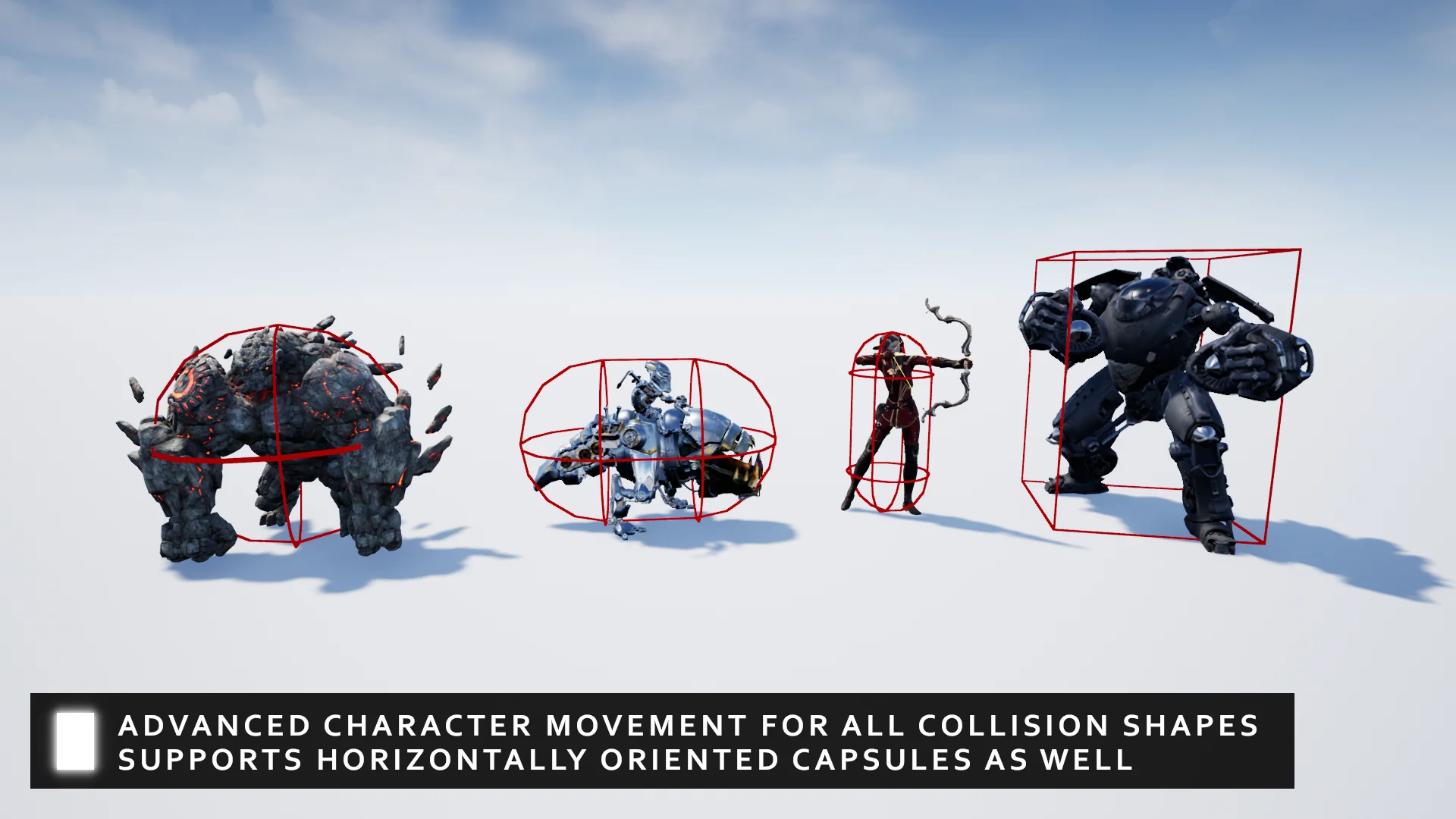
Resource screenshots
1 / 6
Join our channel
Follow 3DCGHUB on Telegram for new resource drops, migration updates, and community notices.
Engineering responsive character motion requires handling edge cases that default engine toolkits often struggle to accommodate. Standard templates can rapidly hit architectural ceilings when a project calls for specialized mechanics such as high-velocity momentum shifts, directional sliding, or non-standard trajectory calculations. GMCv2 - Advanced Locomotion & Network Prediction Framework approaches this problem by delivering a completely standalone locomotion system designed to construct movement archetypes of any style and complexity.
Rather than constraining developers to standard walking or flying states, the framework enables the creation of custom locomotion behaviors tailored to specialized genres. Projects featuring GoldSource-style physics demonstrate this technical adaptability. Both classic bunny hopping and surfing mechanics can be faithfully reconstructed, proving that the toolset handles sensitive, velocity-retaining air acceleration, precise surface friction, and complex collision sweeps. The toolkit is fully Blueprint-friendly, allowing technical designers and gameplay programmers to test and adjust low-level physics parameters without dropping into deep engine modifications every time an iteration is needed.
The speed of iteration plays a central role in motion design. Because the framework exposes its mechanics through an innovative, modular design, designers can prototype intricate locomotion behaviors, custom gravitational pulls, and tailored ground checks directly in visual scripting. This flexibility serves single-player titles seeking robust, deeply customized character physics that run far beyond baseline engine defaults.
Network Prediction Framework and Multiplayer Authority
Multiplayer gameplay exposes movement systems to latency, packet loss, and desynchronization. Creating a movement component capable of handling server-authoritative calculations while providing instantaneous client-side feedback is notoriously demanding. Without proper client-side prediction and server reconciliation, players experience disruptive rubberbanding, visual jitter, and sluggish inputs.
GMCv2 tackles these challenges directly by embedding an automated network prediction framework. The system manages the complex pipeline of input buffering, state generation, server validation, correction, and smoothing behind the scenes. When a client performs a movement action, the framework executes the prediction locally while communicating identical inputs to the server. If a discrepancy arises between the client simulation and the server-authoritative verification, the framework automates state rewinding and reconciliation without forcing developers to write custom netcode from scratch.
This level of network replication is critical for high-speed first-person shooters, competitive arenas, and technical platformers where spatial precision governs core balance. By decoupling developers from the tedious process of writing custom correction algorithms, the toolkit lets gameplay teams focus on tactile mechanics, weapon integration, and level interactions while maintaining lag-free synchronization across varied network conditions.
Separation from the Standard Character Component Pipeline
An essential technical aspect of GMCv2 is its complete architectural independence. The framework is engineered entirely from scratch and does not inherit from or rely upon Unreal's native Character or CharacterMovementComponent classes. This absolute detachment gives the system its high degree of flexibility and networking stability, as it is unburdened by legacy movement code and pre-existing engine assumptions.
This structural independence introduces a vital technical reality during production planning. Because it operates outside the native character hierarchy, the framework is not directly compatible with third-party assets, Marketplace packages, or built-in engine functions that explicitly depend on the default Character or CharacterMovementComponent. Any project bringing GMCv2 into its pipeline must treat it as a foundational movement architecture rather than a drop-in modifier for existing character blueprints.
Teams adopting the system build their pawn logic around its specialized components from the project's inception. While this requires establishing movement logic directly within the framework's workflow, it eliminates the rigid constraints of native classes, giving developers direct authority over spatial checks, tick execution, collision response, and component replication.
Community Extensions and the GMC Ecosystem
Due to the framework's broad mechanical footprint, several community-led companion tools have emerged to bridge specific systems into its workflow. These community-developed resources extend the baseline locomotion toolkit into broader gameplay structures:
GMC Ability System (GMAS): Developed by Reznok, this integration facilitates gameplay ability management tailored around the framework's predictive movement architecture.
GMC Extended: Authored by Packetdancer, this resource builds out additional feature sets, helpers, and workflow enhancements on top of the base plugin.
GMC x ALS: Maintained by Dixon, this bridge facilitates the coordination between Advanced Locomotion System behaviors and the GMC framework.
These supplementary layers demonstrate how the core architecture adapts to complex game logic. Developers can draw from these community modules when constructing deep action role-playing systems, expanded traversal options, or complex animation states that must align with predictive netcode.
Setup Routines and Development Workflows
Integrating a custom movement foundation into an active production cycle demands structured onboarding. Once access to the framework is secured, developers enter a dedicated support environment to verify setup requirements and review step-by-step guidance found in documentation and specialized first-steps channels. Detailed technical documentation and dedicated frequently asked questions outline the exact processes needed to set up custom pawns, bind inputs, and configure replicated variables.
The dedicated support server functions as an active technical exchange. Developers can access preview builds of upcoming versions, evaluate community-generated templates, showcase working builds, and troubleshoot complex replication scenarios with peers. Independent developer devlogs and community showcases highlight the practical execution of the plugin across community games, offering real-world blueprints for production pipelines.
GMCv2 is best suited for teams developing precision-driven single-player experiences or competitive multiplayer games that cannot compromise on responsive client prediction. By bypassing native movement classes in favor of a specialized, server-authoritative replication engine, the framework establishes a reliable technical base for titles where motion fidelity determines the quality of the entire game.
 Network
 Network
 Network