"1a0e4ac4dc71d030"{"id":"1001247","slug":"basic-multiplayer-melee-combat-system","title":"Basic Multiplayer Melee Combat System","category":"Fighting","engine":"5.0+","assetVersion":"","engineVersion":"Engine Version: 5.0+","tag":"Fighting","accent":"blue","visual":"mech","summary":"A technical look at the Basic Multiplayer Melee Combat System, featuring modular actor components, hit scan tracing, lock-on targeting, and 3v3 bot support.","platform":"Unreal Engine","publishedAt":"2026-09-23T15:24:40.286Z","updatedAt":"2026-09-23T15:24:40.286Z","sourceNotes":[],"fileContents":[],"compatibility":["Unreal Engine","Engine Version: 5.0+"],"featuredImage":{"alt":"Basic Multiplayer Melee Combat System","src":"/wp-content/uploads/published/2026/09/035e110571a9-f0a9ce02-9dce-45fd-b0a4-670e3182aabb-234ab47290.webp"},"hasDownloadLink":true,"downloads":0,"terms":[{"taxonomy":"category","slug":"fighting","name":"Fighting"}],"galleryImages":[{"src":"/wp-content/uploads/published/2026/09/49b6453649ee-3bcfc45d-fcab-47cb-ab64-c3cb8f83dc76-047306ce08.webp","alt":"Basic Multiplayer Melee Combat System"},{"src":"/wp-content/uploads/published/2026/09/1d12677a7377-8345d57e-7150-4683-ba51-1d26e824817d-b529f9e3b0.webp","alt":"Basic Multiplayer Melee Combat System"},{"src":"/wp-content/uploads/published/2026/09/9016ce31a97c-b42b1f74-de08-4280-aa5b-499097aff316-727ccdd293.webp","alt":"Basic Multiplayer Melee Combat System"},{"src":"/wp-content/uploads/published/2026/09/873068c77812-208148be-ac48-4d50-962d-04a491313d13-9e056a37cd.webp","alt":"Basic Multiplayer Melee Combat System"},{"src":"/wp-content/uploads/published/2026/09/af27cb932930-4c768f4d-da20-4a13-b670-f3a34d7f4fab-1f0c04b24e.webp","alt":"Basic Multiplayer Melee Combat System"},{"src":"/wp-content/uploads/published/2026/09/3615ba9f52b4-1f1de823-13b5-45bc-ac9f-fc0c1e437ebe-c703643333.webp","alt":"Basic Multiplayer Melee Combat System"},{"src":"/wp-content/uploads/published/2026/09/4a526843b5e6-e841b581-b0c1-44fb-8275-6b1300bc1db6-84e2519d71.webp","alt":"Basic Multiplayer Melee Combat System"}],"accessPanel":{"kind":"resource","title":"Download this resource","eyebrow":"Free Download","message":"Log in or create a free account to start your download.","fileName":"Content.7z","safetyNote":"Resources are manually reviewed before listing to improve quality and reduce obvious risks.","actionLabel":"Download Free","resourceType":"Resource archive"},"contentHtml":"\u003ch2\u003eImplementing the Modular Actor Component Architecture\u003c/h2\u003e\n\u003cp\u003eIntegrating a multiplayer melee pipeline often requires separating distinct gameplay tasks so that individual characters do not become weighed down by monolithic blueprints. Basic Multiplayer Melee Combat System approaches this challenge by isolating each core mechanic into dedicated actor components. This design allows developers to selectively attach or omit capabilities depending on character archetypes, making the toolset adaptable for rapid prototyping as well as structured game production.\u003c/p\u003e\n\u003cp\u003eThe foundational setup relies on four primary components:\u003c/p\u003e\n\u003cul\u003e\n\u003cli\u003e\u003cstrong\u003eBasic Montage Sequence Manager:\u003c/strong\u003e Controls montage section playback, transition triggers, and character animation timing during strikes.\u003c/li\u003e\n\u003cli\u003e\u003cstrong\u003eCombat State Manager:\u003c/strong\u003e Regulates hit scan evaluations, registers outgoing and incoming damage, and processes guard states such as active blocking.\u003c/li\u003e\n\u003cli\u003e\u003cstrong\u003eRagdoll State Manager:\u003c/strong\u003e Dictates physics-driven reaction events when characters receive decisive hits or enter incapacitation states.\u003c/li\u003e\n\u003cli\u003e\u003cstrong\u003eSimple Lock-on:\u003c/strong\u003e Guides character facing direction and camera alignment toward acquired targets.\u003c/li\u003e\n\u003c/ul\u003e\n\u003cp\u003eBy decoupling these responsibilities, changes to damage logic within the Combat State Manager do not risk breaking montage playback queues or physics blending. Characters can share identical hit detection code while pulling different animation logic from distinct montage manager setups.\u003c/p\u003e \u003ch2\u003eCombat State Manager Tracing and Defensive Actions\u003c/h2\u003e\n\u003cp\u003eMelee collisions in multiplayer projects frequently suffer from latency or frame drops, turning imprecise weapon collision volumes into missed attacks. The Combat State Manager mitigates this issue by employing four selectable modes of hit scan tracing for damage. Rather than relying on simple continuous overlapping shapes, these tracing modes allow creators to tailor the hit detection approach to specific weapon geometries and swing speeds.\u003c/p\u003e\n\u003cp\u003eFor scenarios where client or server performance drops, the system incorporates an option to bake tracing locations directly into arrays. This pre-calculated path data supplies consistent trace coordinates during low frame rate situations, ensuring swings register hits cleanly even when rendering frames dip below normal thresholds.\u003c/p\u003e\n\u003cp\u003eOffensive strikes interact directly with target alignment through an integrated Aim Offset system. Melee attacks orient along the player's current view vector rather than remaining locked to character capsule rotation alone. This enables precise high, low, or angled strikes depending on where the reticle or camera points.\u003c/p\u003e\n\u003cp\u003eOn the receiving end of an engagement, defensive mechanics shift the state of the Combat State Manager. Characters can mitigate incoming damage through active blocking, evade swings completely using directional dodging, or counter defensive postures by delivering an aggressive shield bash.\u003c/p\u003e \u003ch2\u003eCamera Perspectives and Simple Lock-on Controls\u003c/h2\u003e\n\u003cp\u003ePlayer orientation dictates how melee combat feels in practice, especially in fast-paced encounters. The project incorporates a camera toggle setup that switches smoothly between first-person and third-person viewpoints. This flexibility allows designers to evaluate combat readability from close, immersive angles or wide, tactical vantages without reconstructing character rigs or spring-arm configurations.\u003c/p\u003e\n\u003cp\u003eThe Simple Lock-on component anchors third-person navigation during close-quarters duels. Activating target lock directs the camera toward the opponent while reorienting character movement mechanics around that focal target. Striking, dodging, and sidestepping maintain the target within the frame, ensuring attacks shaped by the Aim Offset remain focused on the opponent without constant manual mouse or stick corrections.\u003c/p\u003e\n\u003cp\u003eMontage handling remains synchronized with target management. The Basic Montage Sequence Manager oversees attack strings and manages transitions between combo sections, giving designers granular control over execution windows, cancel frames, and recovery states directly within standard montage structures.\u003c/p\u003e \u003ch2\u003eVersion 2.0 Additions: Projectile Spawner and Animation Sync Finishers\u003c/h2\u003e\n\u003cp\u003eThe system expands beyond standard hand-to-hand and bladed engagements through auxiliary components introduced in Version 2.0. These additions expand character options to include ranged skirmishing and cinematic melee conclusions without modifying the primary combat components.\u003c/p\u003e\n\u003cp\u003eThe Projectile Spawner component introduces functionality for ranged weaponry. It regulates projectile generation, ammo counters, and reload sequences directly. Characters utilizing this component can alternate between melee engagements and projectile deployment, using the same underlying damage and hit-reporting networks handled by the main framework.\u003c/p\u003e\n\u003cp\u003eClose-quarters engagements can conclude through high-impact takedowns powered by the Animation Sync component. This module manages paired character positioning and synchronized montage playback, allowing attackers and defenders to lock into coordinated combat finishers. When lethal thresholds are met, the Animation Sync component aligns both skeletal meshes to execute the finisher animation cleanly across the network before handing the defeated character over to the Ragdoll State Manager.\u003c/p\u003e \u003ch2\u003eNetwork Replication and the 3v3 Demonstration Mode\u003c/h2\u003e\n\u003cp\u003eBecause the framework is built specifically for networked titles, all hit registrations, defensive blocks, state transitions, and ragdoll events are fully replicated across client and server boundaries. The system avoids client-authoritative vulnerabilities by ensuring that damage events, guard checks, and lock-on verifications execute reliably within a synchronized multiplayer environment.\u003c/p\u003e\n\u003cp\u003eTo provide immediate testing grounds, the package includes an out-of-the-box three-versus-three game mode. The match environment does not require a full roster of human testers to evaluate balance; integrated AI bots automatically spawn to fill remaining slots on both teams. This automated match populator lets creators immediately benchmark hit tracing accuracy, projectile replication, and synced finishers under active match conditions.\u003c/p\u003e\n\u003cp\u003eThe system serves as a multiplayer adaptation of the single-player beat 'em up framework found in the Basic Melee Combat System, streamlining certain single-player mechanics while introducing replication, bot integration, and modular component structures. For teams managing broader combat workflows, the system also functions alongside the Advanced Action Combat System, providing a reliable blueprint foundation for networked action prototypes.\u003c/p\u003e\n\n\u003ch2\u003eExplore Similar Assets\u003c/h2\u003e\n\u003cul\u003e\n\u003cli\u003e\u003ca href=\"https://3dcghub.com/multiplayer-shooter-template-with-ai/\" title=\"Multiplayer Shooter Template With AI\"\u003eMultiplayer Shooter Template With AI\u003c/a\u003e\u003c/li\u003e\n\u003cli\u003e\u003ca href=\"https://3dcghub.com/generic-combat-system-advanced-gas-based-multiplayer-combat-framework/\" title=\"Generic Combat System - Advanced GAS based Multiplayer combat framework.\"\u003eGeneric Combat System - Advanced GAS based Multiplayer combat framework.\u003c/a\u003e\u003c/li\u003e\n\u003cli\u003e\u003ca href=\"https://3dcghub.com/flexible-combat-system/\" title=\"Flexible Combat System\"\u003eFlexible Combat System\u003c/a\u003e\u003c/li\u003e\n\u003cli\u003e\u003ca href=\"https://3dcghub.com/takedown-animations-pack/\" title=\"Takedown Animations Pack\"\u003eTakedown Animations Pack\u003c/a\u003e\u003c/li\u003e\n\u003cli\u003e\u003ca href=\"https://3dcghub.com/true-fighting-game-engine/\" title=\"TRUE Fighting Game Engine\"\u003eTRUE Fighting Game Engine\u003c/a\u003e\u003c/li\u003e\n\u003c/ul\u003e","contentTextLength":6784,"navigation":{"current":11,"total":3200,"previous":{"id":"1001248","slug":"adventurer-s-inventory-kit","title":"Adventurer's Inventory Kit","category":"RPG","platform":"Unreal Engine","updatedAt":"2026-09-23T15:27:24.258Z"},"next":{"id":"1001246","slug":"visual-novel-framework-full-system","title":"Visual Novel Framework - Full System","category":"Action-Adventure","platform":"Unreal Engine","updatedAt":"2026-09-23T15:22:43.488Z"}},"relatedResources":[{"id":"1001143","slug":"multiplayer-shooter-template-with-ai","title":"Multiplayer Shooter Template With AI","category":"Weapons \u0026 Combat","engine":"5.0+","assetVersion":"","engineVersion":"Engine Version: 5.0+","tag":"Weapons \u0026 Combat","accent":"blue","visual":"mech","summary":"Multiplayer Shooter Template With AI delivers full network replication, custom sensory AI, dynamic radar capture, and direct MetaHuman skeleton compatibility.","platform":"Unreal Engine","publishedAt":"2026-09-09T05:42:58.481Z","updatedAt":"2026-09-09T05:42:58.481Z","sourceNotes":[],"fileContents":[],"compatibility":["Unreal Engine","Engine Version: 5.0+"],"featuredImage":{"alt":"Multiplayer Shooter Template With AI","src":"/wp-content/uploads/published/2026/09/f9ce64bcb73f-d891bb99-f96d-4bc3-b423-edb9bcc0bf46-4cce92b723.webp"},"hasDownloadLink":true,"downloads":0},{"id":"1000614","slug":"generic-combat-system-advanced-gas-based-multiplayer-combat-framework","title":"Generic Combat System - Advanced GAS based Multiplayer combat framework.","category":"Game Mechanics","engine":"5.6","assetVersion":"Asset Version: 1.4","engineVersion":"Engine Version: 5.6","tag":"Game Mechanics","accent":"blue","visual":"mech","summary":"Advanced multiplayer combat framework built on GAS with blueprint-friendly C++ architecture, Souls-like combat reference, and modular integration for Unreal Eng","platform":"Unreal Engine","publishedAt":"2026-07-20T20:41:12.096Z","updatedAt":"2026-07-20T20:41:12.096Z","sourceNotes":[],"fileContents":[],"compatibility":["Unreal Engine","Asset Version: 1.4","Engine Version: 5.6"],"featuredImage":{"alt":"Generic Combat System - Advanced GAS based Multiplayer combat framework.","src":"/wp-content/uploads/published/2026/07/b66bcc866bd3-eade1298-40b5-4a64-a0a7-797c3d973d00-b9b68723ec.webp"},"hasDownloadLink":true,"downloads":2},{"id":"11858","slug":"flexible-combat-system","title":"Flexible Combat System","category":"RPG","engine":"5.5+","assetVersion":"Engine version: 5.5+","engineVersion":"5.5","tag":"RPG","accent":"blue","visual":"audio","summary":"The Flexible Combat System is a comprehensive framework designed for high-end game development. It offers full customization, gamepad support, and multiplayer replication for creators of all levels.","platform":"Unreal Engine","publishedAt":"2026-03-05T19:02:58.000Z","updatedAt":"2026-04-19T15:48:06.000Z","sourceNotes":[],"fileContents":[],"compatibility":["Unreal Engine","Engine version: 5.5+"],"featuredImage":{"alt":"Flexible Combat System","src":"https://3dcghub.com/wp-content/uploads/2026/03/938328d5-2143-448d-8393-8ef0812c0c87.webp"},"hasDownloadLink":true,"downloads":8}]}
Fighting
Basic Multiplayer Melee Combat System
A technical look at the Basic Multiplayer Melee Combat System, featuring modular actor components, hit scan tracing, lock-on targeting, and 3v3 bot support.
Implementing the Modular Actor Component Architecture
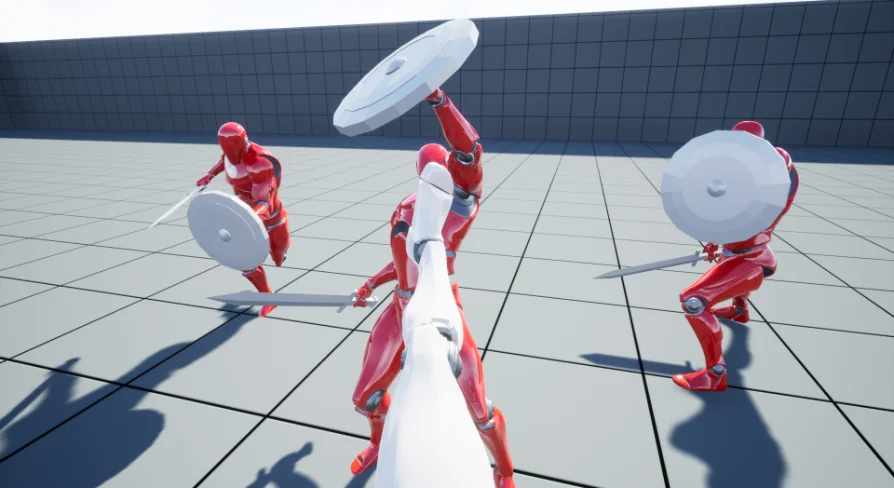
Integrating a multiplayer melee pipeline often requires separating distinct gameplay tasks so that individual characters do not become weighed down by monolithic blueprints. Basic Multiplayer Melee Combat System approaches this challenge by isolating each core mechanic into dedicated actor components. This design allows developers to selectively attach or omit capabilities depending on character archetypes, making the toolset adaptable for rapid prototyping as well as structured game production.
The foundational setup relies on four primary components:
Basic Montage Sequence Manager: Controls montage section playback, transition triggers, and character animation timing during strikes.
Combat State Manager: Regulates hit scan evaluations, registers outgoing and incoming damage, and processes guard states such as active blocking.
Ragdoll State Manager: Dictates physics-driven reaction events when characters receive decisive hits or enter incapacitation states.
Simple Lock-on: Guides character facing direction and camera alignment toward acquired targets.
By decoupling these responsibilities, changes to damage logic within the Combat State Manager do not risk breaking montage playback queues or physics blending. Characters can share identical hit detection code while pulling different animation logic from distinct montage manager setups.
Combat State Manager Tracing and Defensive Actions
Melee collisions in multiplayer projects frequently suffer from latency or frame drops, turning imprecise weapon collision volumes into missed attacks. The Combat State Manager mitigates this issue by employing four selectable modes of hit scan tracing for damage. Rather than relying on simple continuous overlapping shapes, these tracing modes allow creators to tailor the hit detection approach to specific weapon geometries and swing speeds.
For scenarios where client or server performance drops, the system incorporates an option to bake tracing locations directly into arrays. This pre-calculated path data supplies consistent trace coordinates during low frame rate situations, ensuring swings register hits cleanly even when rendering frames dip below normal thresholds.
Offensive strikes interact directly with target alignment through an integrated Aim Offset system. Melee attacks orient along the player's current view vector rather than remaining locked to character capsule rotation alone. This enables precise high, low, or angled strikes depending on where the reticle or camera points.
On the receiving end of an engagement, defensive mechanics shift the state of the Combat State Manager. Characters can mitigate incoming damage through active blocking, evade swings completely using directional dodging, or counter defensive postures by delivering an aggressive shield bash.
Camera Perspectives and Simple Lock-on Controls
Player orientation dictates how melee combat feels in practice, especially in fast-paced encounters. The project incorporates a camera toggle setup that switches smoothly between first-person and third-person viewpoints. This flexibility allows designers to evaluate combat readability from close, immersive angles or wide, tactical vantages without reconstructing character rigs or spring-arm configurations.
The Simple Lock-on component anchors third-person navigation during close-quarters duels. Activating target lock directs the camera toward the opponent while reorienting character movement mechanics around that focal target. Striking, dodging, and sidestepping maintain the target within the frame, ensuring attacks shaped by the Aim Offset remain focused on the opponent without constant manual mouse or stick corrections.
Montage handling remains synchronized with target management. The Basic Montage Sequence Manager oversees attack strings and manages transitions between combo sections, giving designers granular control over execution windows, cancel frames, and recovery states directly within standard montage structures.
Version 2.0 Additions: Projectile Spawner and Animation Sync Finishers
The system expands beyond standard hand-to-hand and bladed engagements through auxiliary components introduced in Version 2.0. These additions expand character options to include ranged skirmishing and cinematic melee conclusions without modifying the primary combat components.
The Projectile Spawner component introduces functionality for ranged weaponry. It regulates projectile generation, ammo counters, and reload sequences directly. Characters utilizing this component can alternate between melee engagements and projectile deployment, using the same underlying damage and hit-reporting networks handled by the main framework.
Close-quarters engagements can conclude through high-impact takedowns powered by the Animation Sync component. This module manages paired character positioning and synchronized montage playback, allowing attackers and defenders to lock into coordinated combat finishers. When lethal thresholds are met, the Animation Sync component aligns both skeletal meshes to execute the finisher animation cleanly across the network before handing the defeated character over to the Ragdoll State Manager.
Network Replication and the 3v3 Demonstration Mode
Because the framework is built specifically for networked titles, all hit registrations, defensive blocks, state transitions, and ragdoll events are fully replicated across client and server boundaries. The system avoids client-authoritative vulnerabilities by ensuring that damage events, guard checks, and lock-on verifications execute reliably within a synchronized multiplayer environment.
To provide immediate testing grounds, the package includes an out-of-the-box three-versus-three game mode. The match environment does not require a full roster of human testers to evaluate balance; integrated AI bots automatically spawn to fill remaining slots on both teams. This automated match populator lets creators immediately benchmark hit tracing accuracy, projectile replication, and synced finishers under active match conditions.
The system serves as a multiplayer adaptation of the single-player beat 'em up framework found in the Basic Melee Combat System, streamlining certain single-player mechanics while introducing replication, bot integration, and modular component structures. For teams managing broader combat workflows, the system also functions alongside the Advanced Action Combat System, providing a reliable blueprint foundation for networked action prototypes.
 Fighting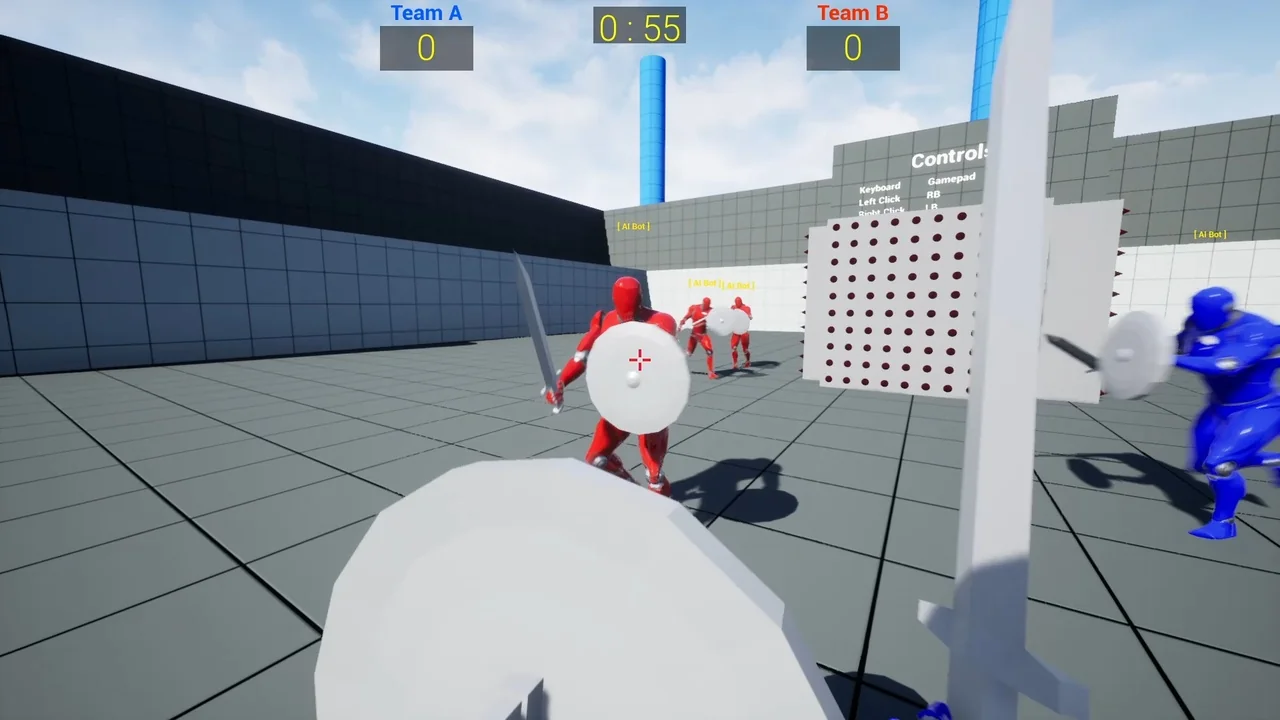
 Weapons & Combat
 Game Mechanics
 RPG
RPG