"1a0e4ac4dc71d030"{"id":"1001248","slug":"adventurer-s-inventory-kit","title":"Adventurer's Inventory Kit","category":"RPG","engine":"5.0+","assetVersion":"","engineVersion":"Engine Version: 5.0+","tag":"RPG","accent":"blue","visual":"mech","summary":"A modular blueprint framework featuring separate item structures, dedicated data tables, global function libraries, and verified ALSv4 integration.","platform":"Unreal Engine","publishedAt":"2026-09-23T15:27:24.258Z","updatedAt":"2026-09-23T15:27:24.258Z","sourceNotes":[],"fileContents":[],"compatibility":["Unreal Engine","Engine Version: 5.0+"],"featuredImage":{"alt":"Adventurer's Inventory Kit","src":"/wp-content/uploads/published/2026/09/60274b30d80b-218f83cc-01d1-40e2-855f-b8e5003fa432-c500e617b3.webp"},"hasDownloadLink":true,"downloads":0,"terms":[{"taxonomy":"category","slug":"rpg","name":"RPG"}],"galleryImages":[{"src":"/wp-content/uploads/published/2026/09/c87001e37cfd-e82af454-8cb6-4dd5-854d-69915f7623b8-d65db49577.webp","alt":"Adventurer's Inventory Kit"},{"src":"/wp-content/uploads/published/2026/09/fa27bcf21d71-de4bdca4-e8aa-4784-aa4e-2cb9b4f37608-17c4c81087.webp","alt":"Adventurer's Inventory Kit"},{"src":"/wp-content/uploads/published/2026/09/d657152c1f7a-7df20650-a2d9-4854-97b9-7598fccbb6db-08236fea0e.webp","alt":"Adventurer's Inventory Kit"},{"src":"/wp-content/uploads/published/2026/09/65e38031a186-ff2044e6-81e6-483d-a722-681df15b5f8c-60201a4f98.webp","alt":"Adventurer's Inventory Kit"},{"src":"/wp-content/uploads/published/2026/09/fda3aaea2550-dcfa3366-3c95-4071-ad4b-dfcfe477c94e-fc7ec12927.webp","alt":"Adventurer's Inventory Kit"},{"src":"/wp-content/uploads/published/2026/09/2c3d3f246473-c34b2250-d8ab-418e-9cfd-ef9a5b1bedbe-370d4c0130.webp","alt":"Adventurer's Inventory Kit"},{"src":"/wp-content/uploads/published/2026/09/48827b18197d-e48063cf-c68e-491f-b830-fc345a1eae98-e356a691c3.webp","alt":"Adventurer's Inventory Kit"},{"src":"/wp-content/uploads/published/2026/09/be9de2f8a5ef-6bcd1bc5-c902-4dc1-81b2-de7bdb3ec822-a1cb6c7b28.webp","alt":"Adventurer's Inventory Kit"},{"src":"/wp-content/uploads/published/2026/09/c51c405230ad-59cda3b5-ac2f-4f43-b4b2-cb6b66f4dcca-d3f45469f1.webp","alt":"Adventurer's Inventory Kit"},{"src":"/wp-content/uploads/published/2026/09/2d0dac5b12eb-884e0bf9-9b48-4a1b-a294-47ded0b293bc-66af3c508f.webp","alt":"Adventurer's Inventory Kit"}],"accessPanel":{"kind":"resource","title":"Download this resource","eyebrow":"Free Download","message":"Log in or create a free account to start your download.","fileName":"Content.7z","safetyNote":"Resources are manually reviewed before listing to improve quality and reduce obvious risks.","actionLabel":"Download Free","resourceType":"Resource archive"},"contentHtml":"\u003ch2\u003eCore Architecture of the Adventurer's Inventory Kit\u003c/h2\u003e\n\u003cp\u003eAdventurer's Inventory Kit establishes an advanced inventory and equipment framework engineered entirely within Unreal Engine blueprints. Rather than coupling storage logic, slot interactions, and item attributes into monolithic character classes, the kit utilizes a distinctly modular approach. Blueprints handle the runtime state of character belongings, sorting logic, item interaction, and active equipment slots without requiring compiled C++ code. Because the architecture relies on modular separation, developers can introduce project-specific item mechanics without rewriting the primary inventory manager.\u003c/p\u003e\n\u003cp\u003eInternal logic across the toolkit comes commented and neatly structured out of the box. Nodes are arranged into intelligible execution blocks, making routine debugging and project auditing straightforward. This level of clarity helps developers decipher the flow of data across inventory actions, from simple slot transfers to complex equipment updates. Teams integrating the system can trace how events move through player controllers, user interface elements, and character pawns without deciphering tangled graphs.\u003c/p\u003e \u003ch2\u003eItem Definition Through Separate Structures and Data Tables\u003c/h2\u003e\n\u003cp\u003eThe foundation of the asset rests on a decoupled data schema. In Adventurer's Inventory Kit, items do not force all possible variables—such as weapon damage, consumable healing values, or armor ratings—into a single unwieldy definition. Instead, items use completely separate structures paired with individual data tables. This structural isolation guarantees that distinct item categories maintain only the data fields relevant to their gameplay function.\u003c/p\u003e\n\u003cp\u003eSetting up custom equipment or inventory items involves editing existing schemas or introducing entirely new structures to the framework. If a project requires specialized attributes, a new structure can be linked to its corresponding data table without breaking standard item interactions. For fast verification and reference, a selection of premade example item types is included with the kit. These working examples demonstrate practical implementations of differing structures, providing a clear template for authoring bespoke categories like consumables, weapons, or wearable gear.\u003c/p\u003e \u003ch2\u003eBlueprint Function Library and Logic Distribution\u003c/h2\u003e\n\u003cp\u003eCentral to the ease of use across the Adventurer's Inventory Kit is its blueprint function library. Rather than binding utility routines to a single inventory component or player character blueprint, the majority of core functions reside in a global function library. This design choice ensures that logic can be called directly from virtually any blueprint across a project, whether inside a user interface widget, an interactive world actor, a loot chest, or a pawn controller.\u003c/p\u003e\n\u003cp\u003eDistributing operations through a function library streamlines everyday game-logic scripting. Routine calculations, inventory validation checks, and data queries can execute anywhere without maintaining complex interface calls or casting chains across unrelated actors. Because these functions are modular and standalone, maintaining and extending inventory rules requires updates to isolated library routines rather than refactoring multiple blueprint graphs distributed throughout the asset directory.\u003c/p\u003e \u003ch2\u003eALSv4 Integration and Pose Overlay Compatibility\u003c/h2\u003e\n\u003cp\u003eA frequent hurdle when implementing equipment frameworks in third-person titles is handling movement systems and character animation states. Adventurer's Inventory Kit accounts for this through established support for ALSv4 (Advanced Locomotion System v4). Dedicated integration instructions detail how to link the kit's inventory and equipment triggers directly into the ALSv4 locomotion state machine and character controllers.\u003c/p\u003e\n\u003cp\u003eBeyond locomotion integration, the kit supports pose overlay handling. This ensures that when items, weapons, or gear pieces are actively equipped to character sockets, the appropriate upper-body or full-body pose overlays can engage smoothly without fighting base movement logic. Connecting inventory actions directly to equipment sockets and animation overlays bridges the gap between raw data storage and active on-screen character performance.\u003c/p\u003e \u003ch2\u003eExpanding Custom Item Types Across Project Pipelines\u003c/h2\u003e\n\u003cp\u003eBuilding onto the Adventurer's Inventory Kit follows a predictable, repeatable pipeline. Because the data framework isolates item structures, developers can introduce complex mechanics—ranging from specialized quest markers to multi-slot armor pieces—by defining a new structure and populating a corresponding data table. The core inventory logic automatically handles these entries as long as the base item contracts are satisfied.\u003c/p\u003e\n\u003cp\u003eThe included premade example item types provide working proof of how different data tables feed into the central equipment logic. Teams can examine how example weapons register equipment states or how consumable items trigger gameplay effects before constructing their own custom libraries. By keeping UI handling, data definition, and execution logic separated across clean blueprints and global library functions, the toolkit functions as a resilient framework capable of scaling alongside evolving project requirements.\u003c/p\u003e\n\n\u003ch2\u003eExplore Similar Assets\u003c/h2\u003e\n\u003cul\u003e\n\u003cli\u003e\u003ca href=\"https://3dcghub.com/huge-arpg/\" title=\"Huge ARPG\"\u003eHuge ARPG\u003c/a\u003e\u003c/li\u003e\n\u003cli\u003e\u003ca href=\"https://3dcghub.com/action-rpg-template/\" title=\"Action RPG Template\"\u003eAction RPG Template\u003c/a\u003e\u003c/li\u003e\n\u003cli\u003e\u003ca href=\"https://3dcghub.com/soulslike-framework-complete-soulslike-kit/\" title=\"Soulslike Framework - Complete Soulslike Kit\"\u003eSoulslike Framework - Complete Soulslike Kit\u003c/a\u003e\u003c/li\u003e\n\u003cli\u003e\u003ca href=\"https://3dcghub.com/survival-game-kit-v2/\" title=\"Survival Game Kit V2\"\u003eSurvival Game Kit V2\u003c/a\u003e\u003c/li\u003e\n\u003cli\u003e\u003ca href=\"https://3dcghub.com/modern-rpg-bundle-v7-0-1/\" title=\"Modern RPG BUNDLE v7.0.1\"\u003eModern RPG BUNDLE v7.0.1\u003c/a\u003e\u003c/li\u003e\n\u003c/ul\u003e","contentTextLength":5402,"navigation":{"current":10,"total":3200,"previous":{"id":"1001249","slug":"moore-s-rpg-template","title":"Moore's RPG Template","category":"RPG","platform":"Unreal Engine","updatedAt":"2026-09-23T15:30:22.716Z"},"next":{"id":"1001247","slug":"basic-multiplayer-melee-combat-system","title":"Basic Multiplayer Melee Combat System","category":"Fighting","platform":"Unreal Engine","updatedAt":"2026-09-23T15:24:40.286Z"}},"relatedResources":[{"id":"28288","slug":"huge-arpg","title":"Huge ARPG","category":"RPG","engine":"5.2+","assetVersion":"Engine version: 5.2+","engineVersion":"","tag":"RPG","accent":"blue","visual":"character","summary":"Huge ARPG packages a broad set of action RPG systems into one integrated game kit. It covers play modes, menus, inventory, quests, mounts, combat support, and progression-related systems that help shape a full gameplay loop.","platform":"Unreal Engine","publishedAt":"2026-05-06T16:44:53.000Z","updatedAt":"2026-05-06T16:44:54.000Z","sourceNotes":[],"fileContents":[],"compatibility":["Unreal Engine","Engine version: 5.2+"],"featuredImage":{"alt":"Huge ARPG","src":"https://3dcghub.com/wp-content/uploads/2026/05/8b181149ff89_43501a1c-97dd-48e0-8030-559f6590cba8.webp"},"hasDownloadLink":true,"downloads":0},{"id":"11758","slug":"action-rpg-template","title":"Action RPG Template","category":"RPG","engine":"5.4+","assetVersion":"Engine version: 5.4+","engineVersion":"5.2","tag":"RPG","accent":"blue","visual":"mech","summary":"The Action RPG Template provides a feature-rich foundation for building complex role-playing games. It includes advanced AI, a deep ability system, and full multiplayer support.","platform":"Unreal Engine","publishedAt":"2026-03-05T18:37:57.000Z","updatedAt":"2026-04-19T15:48:07.000Z","sourceNotes":[],"fileContents":[],"compatibility":["Unreal Engine","Engine version: 5.4+"],"featuredImage":{"alt":"Action RPG Template","src":"https://3dcghub.com/wp-content/uploads/2026/03/662441eb-6898-48e4-9482-ac459f1156e7.webp"},"hasDownloadLink":true,"downloads":4},{"id":"11881","slug":"soulslike-framework-complete-soulslike-kit","title":"Soulslike Framework - Complete Soulslike Kit","category":"RPG","engine":"5.5+","assetVersion":"Engine version: 5.5+","engineVersion":"5.5","tag":"RPG","accent":"blue","visual":"character","summary":"The Soulslike Framework (SLF) provides a comprehensive, Blueprint-friendly foundation for creating immersive action RPGs in Unreal Engine with modular combat and AI systems.","platform":"Unreal Engine","publishedAt":"2026-03-05T19:01:02.000Z","updatedAt":"2026-04-19T15:48:06.000Z","sourceNotes":[],"fileContents":[],"compatibility":["Unreal Engine","Engine version: 5.5+"],"featuredImage":{"alt":"Soulslike Framework - Complete Soulslike Kit","src":"https://3dcghub.com/wp-content/uploads/2026/03/da862253-c281-4116-a85e-822abc2b158c.webp"},"hasDownloadLink":true,"downloads":1}]}
RPG
Adventurer's Inventory Kit
A modular blueprint framework featuring separate item structures, dedicated data tables, global function libraries, and verified ALSv4 integration.
Core Architecture of the Adventurer's Inventory Kit
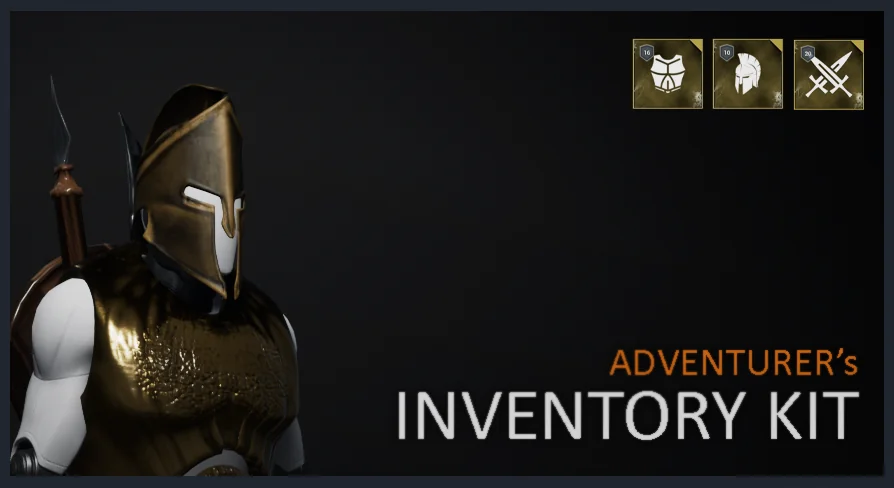
Adventurer's Inventory Kit establishes an advanced inventory and equipment framework engineered entirely within Unreal Engine blueprints. Rather than coupling storage logic, slot interactions, and item attributes into monolithic character classes, the kit utilizes a distinctly modular approach. Blueprints handle the runtime state of character belongings, sorting logic, item interaction, and active equipment slots without requiring compiled C++ code. Because the architecture relies on modular separation, developers can introduce project-specific item mechanics without rewriting the primary inventory manager.
Internal logic across the toolkit comes commented and neatly structured out of the box. Nodes are arranged into intelligible execution blocks, making routine debugging and project auditing straightforward. This level of clarity helps developers decipher the flow of data across inventory actions, from simple slot transfers to complex equipment updates. Teams integrating the system can trace how events move through player controllers, user interface elements, and character pawns without deciphering tangled graphs.
Item Definition Through Separate Structures and Data Tables
The foundation of the asset rests on a decoupled data schema. In Adventurer's Inventory Kit, items do not force all possible variables—such as weapon damage, consumable healing values, or armor ratings—into a single unwieldy definition. Instead, items use completely separate structures paired with individual data tables. This structural isolation guarantees that distinct item categories maintain only the data fields relevant to their gameplay function.
Setting up custom equipment or inventory items involves editing existing schemas or introducing entirely new structures to the framework. If a project requires specialized attributes, a new structure can be linked to its corresponding data table without breaking standard item interactions. For fast verification and reference, a selection of premade example item types is included with the kit. These working examples demonstrate practical implementations of differing structures, providing a clear template for authoring bespoke categories like consumables, weapons, or wearable gear.
Blueprint Function Library and Logic Distribution
Central to the ease of use across the Adventurer's Inventory Kit is its blueprint function library. Rather than binding utility routines to a single inventory component or player character blueprint, the majority of core functions reside in a global function library. This design choice ensures that logic can be called directly from virtually any blueprint across a project, whether inside a user interface widget, an interactive world actor, a loot chest, or a pawn controller.
Distributing operations through a function library streamlines everyday game-logic scripting. Routine calculations, inventory validation checks, and data queries can execute anywhere without maintaining complex interface calls or casting chains across unrelated actors. Because these functions are modular and standalone, maintaining and extending inventory rules requires updates to isolated library routines rather than refactoring multiple blueprint graphs distributed throughout the asset directory.
ALSv4 Integration and Pose Overlay Compatibility
A frequent hurdle when implementing equipment frameworks in third-person titles is handling movement systems and character animation states. Adventurer's Inventory Kit accounts for this through established support for ALSv4 (Advanced Locomotion System v4). Dedicated integration instructions detail how to link the kit's inventory and equipment triggers directly into the ALSv4 locomotion state machine and character controllers.
Beyond locomotion integration, the kit supports pose overlay handling. This ensures that when items, weapons, or gear pieces are actively equipped to character sockets, the appropriate upper-body or full-body pose overlays can engage smoothly without fighting base movement logic. Connecting inventory actions directly to equipment sockets and animation overlays bridges the gap between raw data storage and active on-screen character performance.
Expanding Custom Item Types Across Project Pipelines
Building onto the Adventurer's Inventory Kit follows a predictable, repeatable pipeline. Because the data framework isolates item structures, developers can introduce complex mechanics—ranging from specialized quest markers to multi-slot armor pieces—by defining a new structure and populating a corresponding data table. The core inventory logic automatically handles these entries as long as the base item contracts are satisfied.
The included premade example item types provide working proof of how different data tables feed into the central equipment logic. Teams can examine how example weapons register equipment states or how consumable items trigger gameplay effects before constructing their own custom libraries. By keeping UI handling, data definition, and execution logic separated across clean blueprints and global library functions, the toolkit functions as a resilient framework capable of scaling alongside evolving project requirements.
 RPG
RPG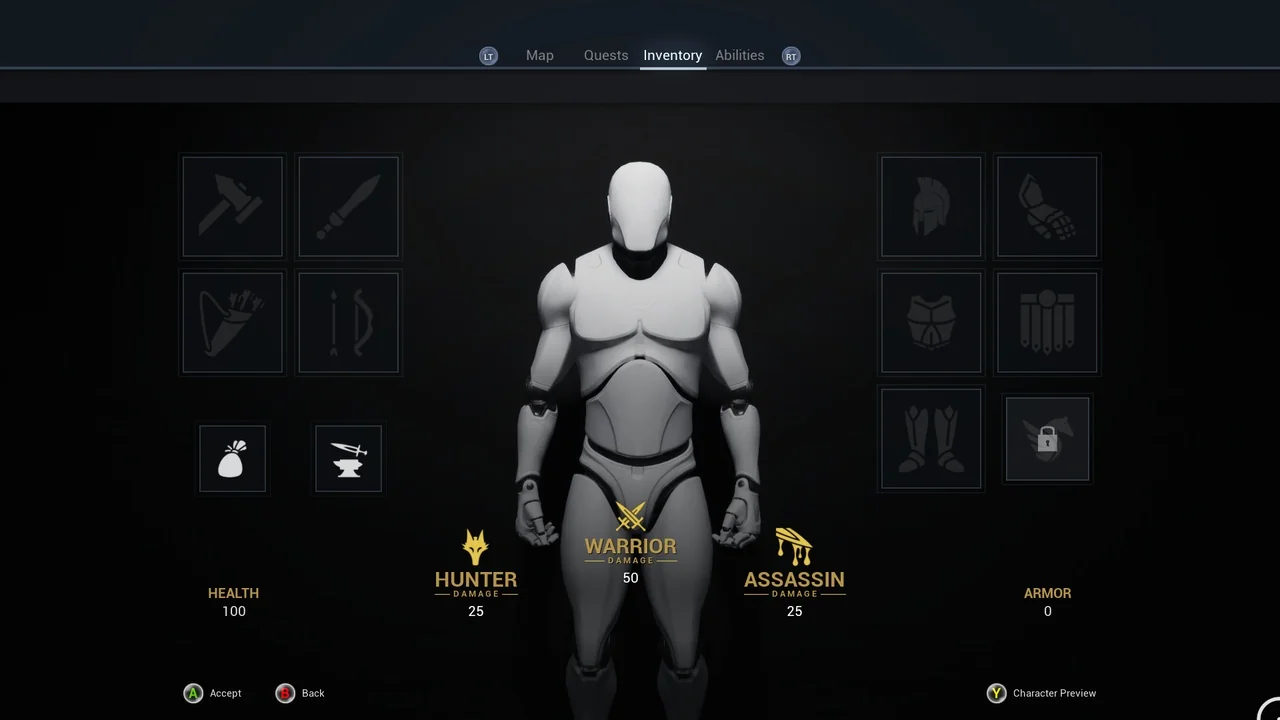
 RPG
RPG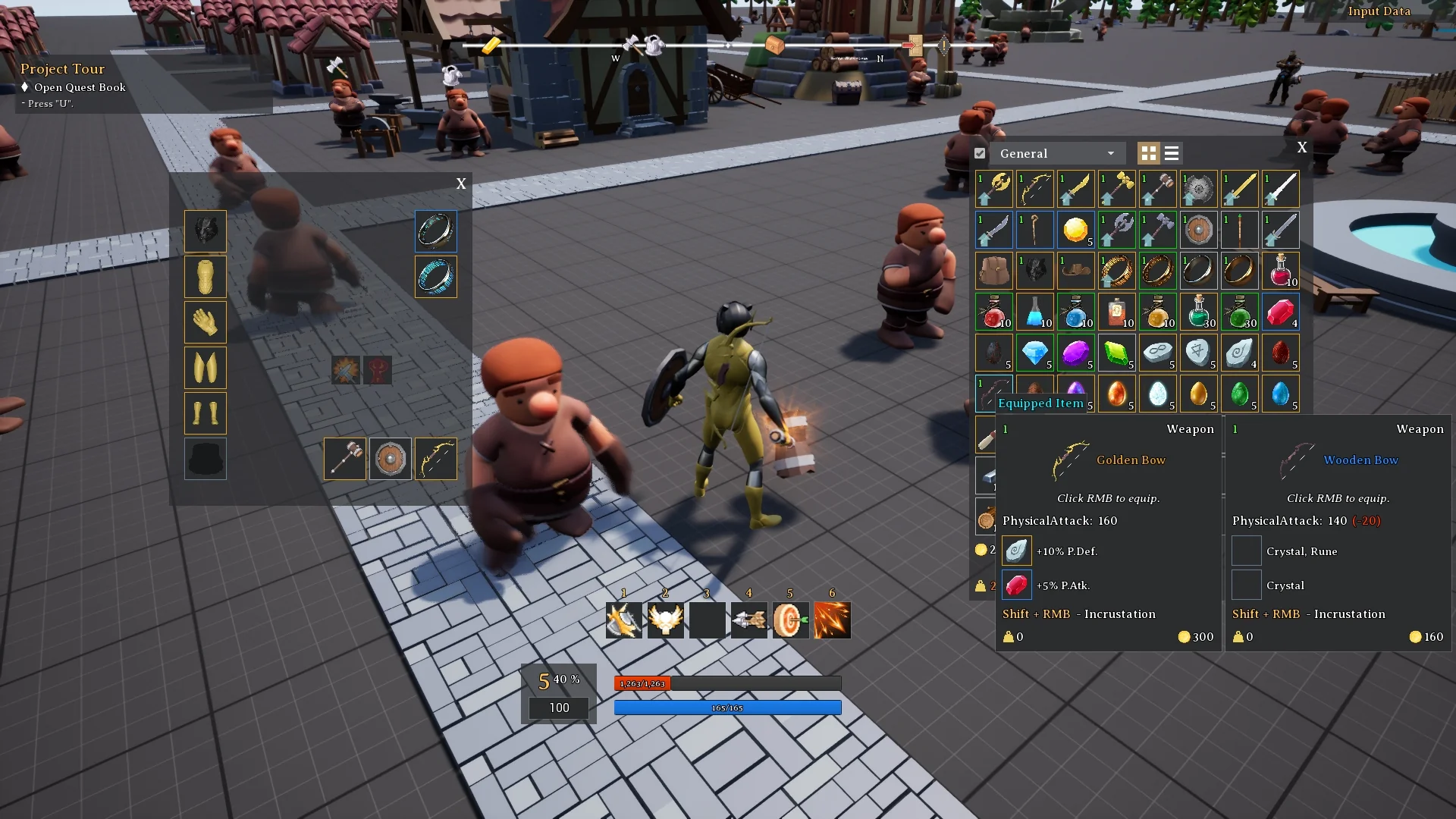 RPG
RPG RPG
RPG