"6ac84fdb0bd06614"{"id":"28288","slug":"huge-arpg","title":"Huge ARPG","category":"RPG","engine":"5.2+","assetVersion":"Engine version: 5.2+","engineVersion":"","tag":"RPG","accent":"blue","visual":"character","summary":"Huge ARPG packages a broad set of action RPG systems into one integrated game kit. It covers play modes, menus, inventory, quests, mounts, combat support, and progression-related systems that help shape a full gameplay loop.","platform":"Unreal Engine","publishedAt":"2026-05-06T16:44:53.000Z","updatedAt":"2026-05-06T16:44:54.000Z","sourceNotes":[],"fileContents":[],"compatibility":["Unreal Engine","Engine version: 5.2+"],"featuredImage":{"alt":"Huge ARPG","src":"https://3dcghub.com/wp-content/uploads/2026/05/8b181149ff89_43501a1c-97dd-48e0-8030-559f6590cba8.webp"},"hasDownloadLink":true,"downloads":0,"terms":[{"taxonomy":"category","slug":"rpg","name":"RPG"},{"taxonomy":"post_tag","slug":"characters","name":"Characters"},{"taxonomy":"post_tag","slug":"game-systems","name":"Game Systems"},{"taxonomy":"post_tag","slug":"ui","name":"UI"}],"galleryImages":[{"src":"https://3dcghub.com/wp-content/uploads/2026/05/42a219b30206_0a418c14-1bc8-45ea-bd3f-a0c709dbdb09.webp","alt":"Huge ARPG"},{"src":"https://3dcghub.com/wp-content/uploads/2026/05/0d4f076c1272_8630d1c1-af4b-49a0-a2e0-c05021f2bdcd.webp","alt":"Huge ARPG"},{"src":"https://3dcghub.com/wp-content/uploads/2026/05/1c59ea473623_4b0db953-70e1-442b-8806-1c3e38598f60.webp","alt":"Huge ARPG"},{"src":"https://3dcghub.com/wp-content/uploads/2026/05/e218d053db8d_cf01cdc1-60f2-4828-80b0-d9ea6cf046ae.webp","alt":"Huge ARPG"},{"src":"https://3dcghub.com/wp-content/uploads/2026/05/9170f31c5c0d_ea188c02-8086-43f7-9c9f-6b930154bc68.webp","alt":"Huge ARPG"},{"src":"https://3dcghub.com/wp-content/uploads/2026/05/6371e83a242e_7da63630-2f5b-4290-8d52-6cf2e6df0e16.webp","alt":"Huge ARPG"},{"src":"https://3dcghub.com/wp-content/uploads/2026/05/ef89b4806ee7_ca068962-2c53-4756-84d0-674bcbd70d41.webp","alt":"Huge ARPG"},{"src":"https://3dcghub.com/wp-content/uploads/2026/05/56991c05cecb_dc01ac07-798d-4af5-9e58-77b1a067f631.webp","alt":"Huge ARPG"},{"src":"https://3dcghub.com/wp-content/uploads/2026/05/c3dc487bba5d_3a173064-995f-4936-827f-ee37948f752b.webp","alt":"Huge ARPG"},{"src":"https://3dcghub.com/wp-content/uploads/2026/05/4560e579e0ee_5e132601-afc2-45a5-98ef-886c519707a3.webp","alt":"Huge ARPG"}],"accessPanel":{"kind":"resource","title":"Access this resource","eyebrow":"Free Download","message":"Log in or create a free account to start your download.","fileName":"Huge ARPG.7z","safetyNote":"All resources are 100% manually reviewed to eliminate all risks.","actionLabel":"Download Free","resourceType":"Resource archive"},"contentHtml":"\u003cp\u003eFantasy action RPG scenes need more than a character and a level. They need the surrounding game structure that lets players move from a main menu into combat, manage items, accept quests, ride through the world, and return later through a save system. Huge ARPG is positioned in that part of production: not as a single feature pack, but as an integrated gaming kit that brings several core ARPG systems together.\u003c/p\u003e \u003cp\u003eThe package includes both an online and offline system, which immediately places it in workflows where teams want to think beyond a single isolated gameplay test. Instead of only covering combat or only covering inventory, it combines multiple parts of the player experience into one project framework. That scope is what makes it relevant for developers building a fuller action RPG loop rather than assembling every gameplay layer from scratch.\u003c/p\u003e \u003ch2\u003eHuge ARPG covers the full player loop\u003c/h2\u003e\n\u003cp\u003eAt its core, Huge ARPG spans the systems players interact with before, during, and after moment-to-moment action. A full main menu handles the front-end side of the experience, while an advanced inventory and quest systems support progression and structure once players are inside the game. The inclusion of a save and load system extends that further, making the project feel aligned with longer-form play rather than a short standalone combat sample.\u003c/p\u003e \u003cp\u003eThose pieces matter in production because they reduce the gap between a mechanical prototype and a more complete playable build. A combat test can show whether attacks work; a project with menus, quests, inventory, and saving begins to resemble an actual RPG framework. Huge ARPG sits in that second category. It is meant for teams or creators who need interconnected gameplay support rather than one narrow mechanic.\u003c/p\u003e \u003ch2\u003eOnline and offline system, advanced inventory, and quests\u003c/h2\u003e\n\u003cp\u003eThe online and offline system is one of the clearest signs that this kit aims higher than a basic template. It supports different ways to approach play from within the same broader package, which can be useful when planning different testing or gameplay scenarios. Alongside that, the advanced inventory suggests a more developed item-management layer than a minimal placeholder interface.\u003c/p\u003e \u003cp\u003eQuest systems add another important production function. They give structure to world interaction and progression, helping connect exploration, combat, and rewards into a recognizable ARPG rhythm. In practice, this means Huge ARPG is not only about fighting enemies; it also addresses the systems that tell the player what to do, what to collect, and how to move through the experience.\u003c/p\u003e \u003cp\u003eCharacter attachments and weapons further support that structure. They point toward a setup where the playable character can be equipped and customized in ways that fit the genre. For anyone blocking out a fantasy RPG project, that combination of quests, equipment-related systems, and inventory management is where the kit starts to feel less like a collection of parts and more like a usable gameplay base.\u003c/p\u003e \u003ch2\u003eRiding your own animal and boss fight support\u003c/h2\u003e\n\u003cp\u003eHuge ARPG also reaches into the kinds of features that change how players move through a game world and how encounters are staged. Riding your own animal introduces a mount-style gameplay element, which can affect traversal, scale, and the feel of exploration. In a fantasy setting, that system can play a visible role in how travel is presented and how the game separates itself from a strictly on-foot experience.\u003c/p\u003e \u003cp\u003eCombat support is not limited to standard enemy behavior. The kit includes normal AI and boss fight functionality, giving it room for both routine encounters and larger set-piece battles. That split is useful in production terms because regular combat and boss combat often serve different purposes. One establishes the baseline action loop; the other tests pacing, pressure, and escalation. Having both present in the same kit gives creators a broader starting point when shaping enemy encounters.\u003c/p\u003e \u003ch2\u003eWhere Huge ARPG fits in a production workflow\u003c/h2\u003e\n\u003cp\u003eThis kind of package fits best when a project needs connected gameplay systems early, whether the goal is internal prototyping, building a feature testbed, or shaping a playable fantasy RPG framework with menus and progression already in place. Instead of spending the first phase wiring together unrelated components, a team can work from a kit that already includes front-end structure, progression systems, combat support, and player persistence.\u003c/p\u003e \u003cp\u003eThe resource is also supported by a showcase, tutorials, an image document, and a demo project. That matters for practical evaluation: it gives developers ways to inspect the project capabilities, review how systems are presented, and understand how the broader kit is intended to function.\u003c/p\u003e \u003cp\u003eFor projects that need an action RPG foundation with modular gameplay layers such as menus, quests, inventory, mounts, AI, boss encounters, and saving, Huge ARPG is most useful as a base to build from rather than a single isolated feature to drop into an otherwise unrelated setup.\u003c/p\u003e\n\n\u003ch2\u003eMore From The Same Workflow\u003c/h2\u003e\n\u003cul\u003e\n\u003cli\u003e\u003ca href=\"https://3dcghub.com/hospital-modular-building-props-and-characters/\" title=\"Hospital – modular building, props and characters\"\u003eHospital – modular building, props and characters\u003c/a\u003e\u003c/li\u003e\n\u003cli\u003e\u003ca href=\"https://3dcghub.com/rpg-fantasy-monster-bundle-6-4-rpg-fantasy-characters/\" title=\"RPG Fantasy Monster Bundle #6 – 4 RPG / Fantasy Characters\"\u003eRPG Fantasy Monster Bundle #6 – 4 RPG / Fantasy Characters\u003c/a\u003e\u003c/li\u003e\n\u003cli\u003e\u003ca href=\"https://3dcghub.com/1950s-characters-bundle-1950s-characters-bundle-1950-character-gangster-3d/\" title=\"1950s Characters Bundle ( 1950s Characters Bundle 1950 Character Gangster 3D )\"\u003e1950s Characters Bundle ( 1950s Characters Bundle 1950 Character Gangster 3D )\u003c/a\u003e\u003c/li\u003e\n\u003cli\u003e\u003ca href=\"https://3dcghub.com/bozo-stylized-modular-characters-base-pack/\" title=\"BoZo: Stylized Modular Characters – Base Pack\"\u003eBoZo: Stylized Modular Characters – Base Pack\u003c/a\u003e\u003c/li\u003e\n\u003cli\u003e\u003ca href=\"https://3dcghub.com/low-poly-characters-customizable-modular-male-and-female/\" title=\"LOW POLY CHARACTERS CUSTOMIZABLE/MODULAR ( MALE AND FEMALE )\"\u003eLOW POLY CHARACTERS CUSTOMIZABLE/MODULAR ( MALE AND FEMALE )\u003c/a\u003e\u003c/li\u003e\n\u003c/ul\u003e","contentTextLength":5406,"navigation":{"current":1316,"total":3181,"previous":{"id":"28302","slug":"junkyard-city","title":"Junkyard City","category":"Apocalyptic / Post-apocalyptic","platform":"Unreal Engine","updatedAt":"2026-05-06T16:56:45.000Z"},"next":{"id":"28275","slug":"horror-and-decay-vol-5-urban-surfaces","title":"Horror and Decay VOL.5 - Urban Surfaces","category":"Damage \u0026 Grunge","platform":"Unreal Engine","updatedAt":"2026-05-06T15:45:05.000Z"}},"relatedResources":[{"id":"1000249","slug":"modern-rpg-bundle-v7-0-1","title":"Modern RPG BUNDLE v7.0.1","category":"RPG","engine":"5.4+","assetVersion":"Asset Version: 6.1.1","engineVersion":"Engine Version: 5.4+","tag":"RPG","accent":"blue","visual":"mech","summary":"A comprehensive RPG framework featuring inventory systems, weapon modifications, complex vehicle mechanics, multiplayer menus, and MetaHuman compatibility.","platform":"Unreal Engine","publishedAt":"2026-06-30T20:57:03.116Z","updatedAt":"2026-06-30T20:57:03.116Z","sourceNotes":[],"fileContents":[],"compatibility":["Unreal Engine","Asset Version: 6.1.1","Engine Version: 5.4+"],"featuredImage":{"alt":"Modern RPG BUNDLE v7.0.1","src":"/wp-content/uploads/published/2026/06/8a8479d4c0b6-c35035a1-419b-41de-bdcb-0dbd98054c6d-1060ae143b.webp"},"hasDownloadLink":true,"downloads":5},{"id":"11780","slug":"advanced-arpg-combat-system","title":"Advanced ARPG Combat System","category":"RPG","engine":"5.0+","assetVersion":"Engine version: 5.0+","engineVersion":"Aseet Version:V3","tag":"RPG","accent":"blue","visual":"audio","summary":"The Advanced ARPG Combat System provides a robust, all-in-one Blueprint template for creating professional action RPGs. It features deep combat mechanics, advanced AI, and modular RPG systems.","platform":"Unreal Engine","publishedAt":"2026-03-05T18:39:51.000Z","updatedAt":"2026-04-19T15:48:07.000Z","sourceNotes":[],"fileContents":[],"compatibility":["Unreal Engine","Engine version: 5.0+","Aseet Version:V3"],"featuredImage":{"alt":"Advanced ARPG Combat System","src":"https://3dcghub.com/wp-content/uploads/2026/03/4730c2ae-e58e-4882-b568-9ed0f13aca2e.webp"},"hasDownloadLink":true,"downloads":1},{"id":"13428","slug":"fantasy-rpg-icons-500-fantasy-fantasy-rpg-icon-icon-symbol-symbol-rpg","title":"Fantasy RPG Icons (500+) ( Fantasy Fantasy Rpg Icon Icon Symbol Symbol Rpg )","category":"Tools, Objects \u0026 Decor","engine":"4.26+,5.0+","assetVersion":"Engine version: 4.26+,5.0+","engineVersion":"4.22","tag":"Tools","accent":"blue","visual":"luts","summary":"This comprehensive pack features over 500 highly detailed icons for fantasy role-playing games. It includes a variety of assets such as weapons, potions, and magical symbols for high-quality game interfaces.","platform":"Unreal Engine","publishedAt":"2026-03-10T17:02:21.000Z","updatedAt":"2026-04-19T15:46:28.000Z","sourceNotes":[],"fileContents":[],"compatibility":["Unreal Engine","Engine version: 4.26+,5.0+"],"featuredImage":{"alt":"Fantasy RPG Icons (500+) ( Fantasy Fantasy Rpg Icon Icon Symbol Symbol Rpg )","src":"https://3dcghub.com/wp-content/uploads/2026/03/83f5ee47-7faa-4b65-9f87-f6ed500faa00.webp"},"hasDownloadLink":true,"downloads":0}]}
RPG
Huge ARPG
Huge ARPG packages a broad set of action RPG systems into one integrated game kit. It covers play modes, menus, inventory, quests, mounts, combat support, and progression-related systems that help shape a full gameplay loop.
Category:Unreal Engine, RPGPlatform: Unreal EngineEngine version: 5.2+Published: May 6, 2026
RPG
Resource overview
Fantasy action RPG scenes need more than a character and a level. They need the surrounding game structure that lets players move from a main menu into combat, manage items, accept quests, ride through the world, and return later through a save system. Huge ARPG is positioned in that part of production: not as a single feature pack, but as an integrated gaming kit that brings several core ARPG systems together.
The package includes both an online and offline system, which immediately places it in workflows where teams want to think beyond a single isolated gameplay test. Instead of only covering combat or only covering inventory, it combines multiple parts of the player experience into one project framework. That scope is what makes it relevant for developers building a fuller action RPG loop rather than assembling every gameplay layer from scratch.
Huge ARPG covers the full player loop
At its core, Huge ARPG spans the systems players interact with before, during, and after moment-to-moment action. A full main menu handles the front-end side of the experience, while an advanced inventory and quest systems support progression and structure once players are inside the game. The inclusion of a save and load system extends that further, making the project feel aligned with longer-form play rather than a short standalone combat sample.
Those pieces matter in production because they reduce the gap between a mechanical prototype and a more complete playable build. A combat test can show whether attacks work; a project with menus, quests, inventory, and saving begins to resemble an actual RPG framework. Huge ARPG sits in that second category. It is meant for teams or creators who need interconnected gameplay support rather than one narrow mechanic.
Online and offline system, advanced inventory, and quests
The online and offline system is one of the clearest signs that this kit aims higher than a basic template. It supports different ways to approach play from within the same broader package, which can be useful when planning different testing or gameplay scenarios. Alongside that, the advanced inventory suggests a more developed item-management layer than a minimal placeholder interface.
Quest systems add another important production function. They give structure to world interaction and progression, helping connect exploration, combat, and rewards into a recognizable ARPG rhythm. In practice, this means Huge ARPG is not only about fighting enemies; it also addresses the systems that tell the player what to do, what to collect, and how to move through the experience.
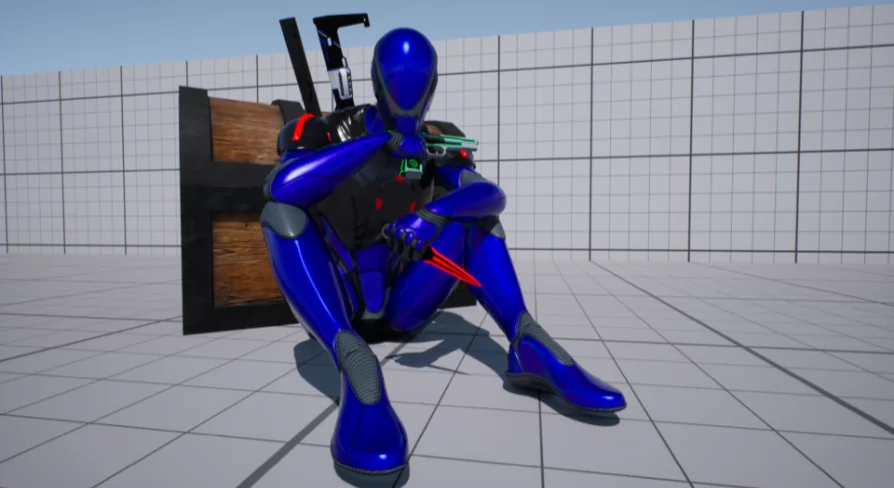
Character attachments and weapons further support that structure. They point toward a setup where the playable character can be equipped and customized in ways that fit the genre. For anyone blocking out a fantasy RPG project, that combination of quests, equipment-related systems, and inventory management is where the kit starts to feel less like a collection of parts and more like a usable gameplay base.
Riding your own animal and boss fight support
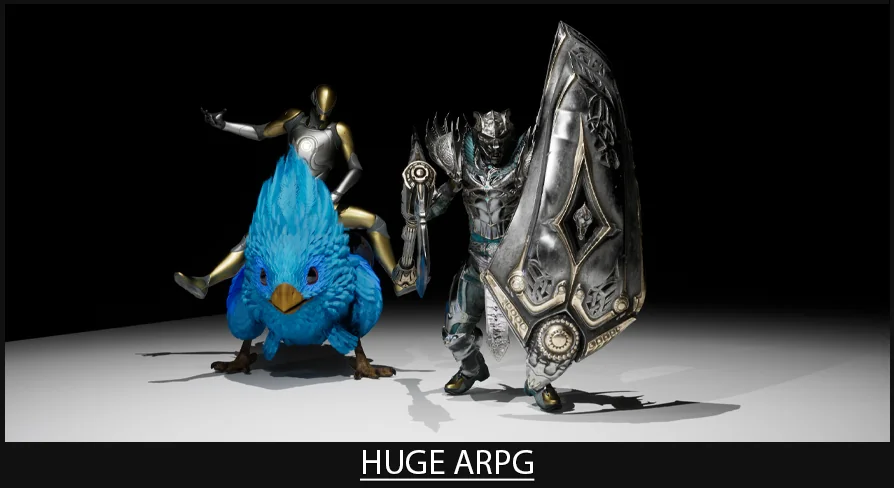
Huge ARPG also reaches into the kinds of features that change how players move through a game world and how encounters are staged. Riding your own animal introduces a mount-style gameplay element, which can affect traversal, scale, and the feel of exploration. In a fantasy setting, that system can play a visible role in how travel is presented and how the game separates itself from a strictly on-foot experience.
Combat support is not limited to standard enemy behavior. The kit includes normal AI and boss fight functionality, giving it room for both routine encounters and larger set-piece battles. That split is useful in production terms because regular combat and boss combat often serve different purposes. One establishes the baseline action loop; the other tests pacing, pressure, and escalation. Having both present in the same kit gives creators a broader starting point when shaping enemy encounters.
Where Huge ARPG fits in a production workflow
This kind of package fits best when a project needs connected gameplay systems early, whether the goal is internal prototyping, building a feature testbed, or shaping a playable fantasy RPG framework with menus and progression already in place. Instead of spending the first phase wiring together unrelated components, a team can work from a kit that already includes front-end structure, progression systems, combat support, and player persistence.
The resource is also supported by a showcase, tutorials, an image document, and a demo project. That matters for practical evaluation: it gives developers ways to inspect the project capabilities, review how systems are presented, and understand how the broader kit is intended to function.
For projects that need an action RPG foundation with modular gameplay layers such as menus, quests, inventory, mounts, AI, boss encounters, and saving, Huge ARPG is most useful as a base to build from rather than a single isolated feature to drop into an otherwise unrelated setup.
 RPG
RPG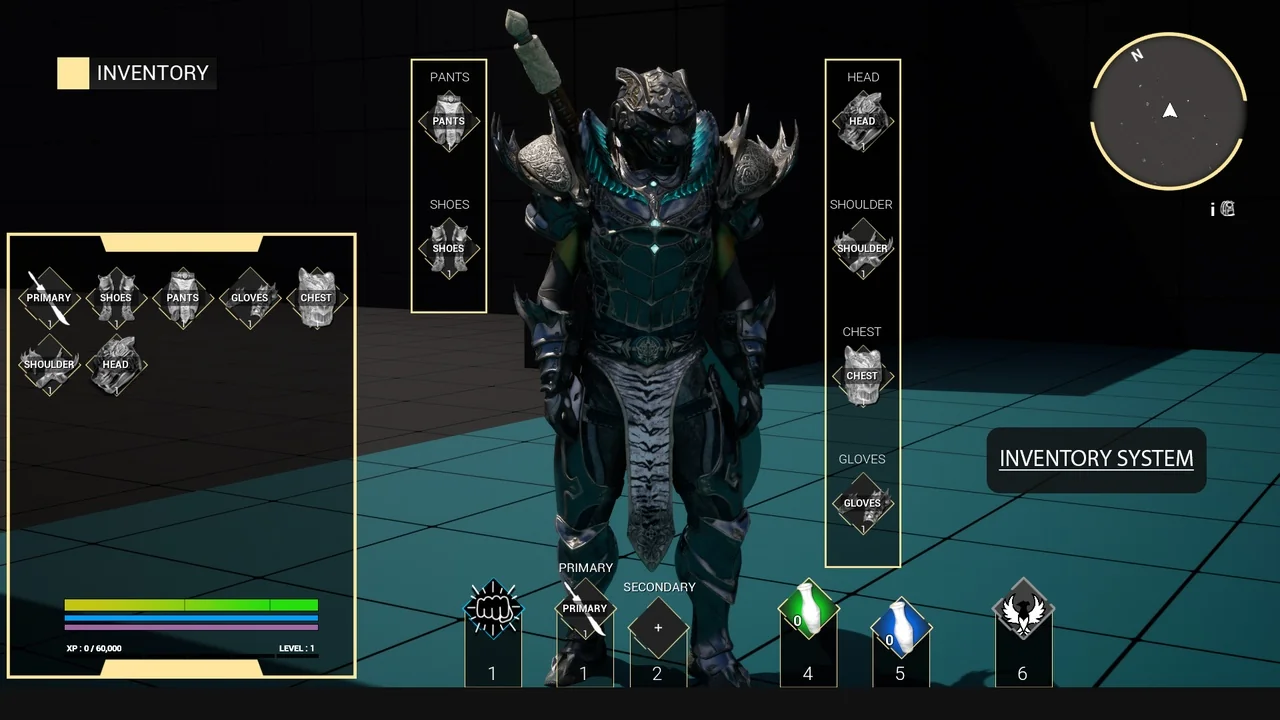
 RPG
RPG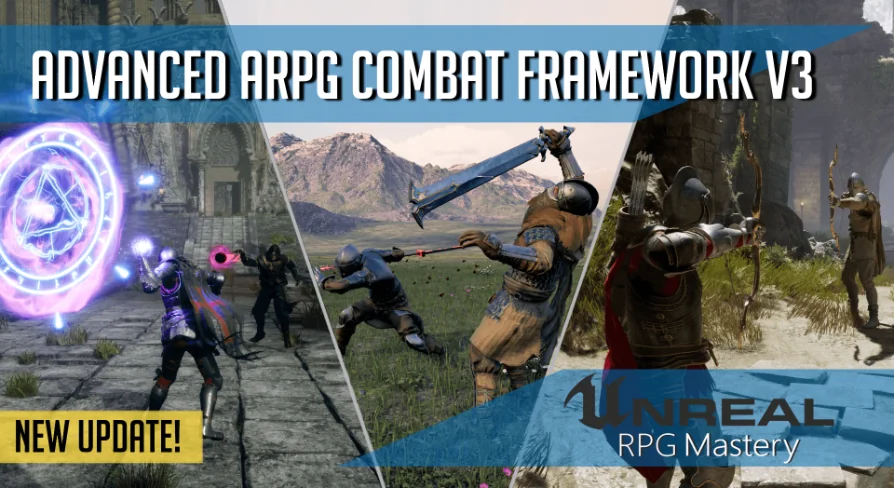 RPG
RPG Tools
Tools