"6ac84fdb0bd06614"{"id":"28302","slug":"junkyard-city","title":"Junkyard City","category":"Apocalyptic / Post-apocalyptic","engine":"4.26+,5.0+","assetVersion":"Engine version: 4.26+,5.0+","engineVersion":"","tag":"Apocalyptic","accent":"blue","visual":"city","summary":"Junkyard City focuses on a problem many environment artists run into: making ruined urban spaces feel dense, explorable, and coherent without hand-building every structure from scratch. Its modular parts, junkyard props, and interior-ready pieces make it su...","platform":"Unreal Engine","publishedAt":"2026-05-06T16:56:44.000Z","updatedAt":"2026-05-06T16:56:45.000Z","sourceNotes":[],"fileContents":[],"compatibility":["Unreal Engine","Engine version: 4.26+,5.0+"],"featuredImage":{"alt":"Junkyard City","src":"https://3dcghub.com/wp-content/uploads/2026/05/f0217b532e26_998e3a54-6d3b-4f41-955a-921831a2d3f5.webp"},"hasDownloadLink":true,"downloads":0,"terms":[{"taxonomy":"category","slug":"apocalyptic-post-apocalyptic","name":"Apocalyptic / Post-apocalyptic"},{"taxonomy":"post_tag","slug":"characters","name":"Characters"},{"taxonomy":"post_tag","slug":"environment","name":"Environment"},{"taxonomy":"post_tag","slug":"unreal-engine-5","name":"Unreal Engine 5"}],"galleryImages":[{"src":"https://3dcghub.com/wp-content/uploads/2026/05/5544efd30971_cb2ede3b-e742-4117-9757-936f668232f9.webp","alt":"Junkyard City"},{"src":"https://3dcghub.com/wp-content/uploads/2026/05/34118a3b38b3_9b1df496-55cb-4190-8377-4e23e006f8f8.webp","alt":"Junkyard City"},{"src":"https://3dcghub.com/wp-content/uploads/2026/05/1489da9ed0ff_746971cf-6189-49a8-a1ee-5cfa759d3f30.webp","alt":"Junkyard City"},{"src":"https://3dcghub.com/wp-content/uploads/2026/05/a557f909b84b_780c32d3-1594-4e6c-a54c-9bb794e2bccf.webp","alt":"Junkyard City"},{"src":"https://3dcghub.com/wp-content/uploads/2026/05/6c5da8b45da7_62e8920b-d8b1-44bd-b21a-6b252bd029a0.webp","alt":"Junkyard City"},{"src":"https://3dcghub.com/wp-content/uploads/2026/05/400879a97475_76953b0c-4b75-43f1-9b7d-9c4bb832b489.webp","alt":"Junkyard City"},{"src":"https://3dcghub.com/wp-content/uploads/2026/05/6b1987739534_7cde40c9-6196-4d16-880c-caf767a00f6c.webp","alt":"Junkyard City"},{"src":"https://3dcghub.com/wp-content/uploads/2026/05/6768db5a5996_abc8b330-7f60-4eb7-a813-2f32511133ce.webp","alt":"Junkyard City"},{"src":"https://3dcghub.com/wp-content/uploads/2026/05/30d17fc4240e_ff1193bd-bc34-445a-a293-ee1f613b3f8d.webp","alt":"Junkyard City"},{"src":"https://3dcghub.com/wp-content/uploads/2026/05/47bff3484832_64b15b3c-c0e0-42cc-97a0-7c40449977eb.webp","alt":"Junkyard City"}],"accessPanel":{"kind":"resource","title":"Access this resource","eyebrow":"Free Download","message":"Log in or create a free account to start your download.","fileName":"Content.7z","safetyNote":"All resources are 100% manually reviewed to eliminate all risks.","actionLabel":"Download Free","resourceType":"Resource archive"},"contentHtml":"\u003cp\u003eBlocking out a believable ruined district usually takes more than a few broken walls and scattered debris. The hard part is getting enough structure into the space so it reads as a place people once lived in, while still leaving room for gameplay routes, environmental storytelling, and the layered mess that sells a post-apocalyptic setting. Junkyard City approaches that problem with a modular environment kit aimed at slum-like settlements, junkyard structures, and abandoned cityscapes.\u003c/p\u003e \u003cp\u003eThe set combines structural pieces and clutter in a way that supports both layout work and scene dressing. Walls, floors, rooftops, and detailed interiors give artists the foundation for explorable spaces, while wrecked vehicles, scrap piles, broken signs, makeshift homes, and loose debris push those spaces toward a harsher, lived-in tone.\u003c/p\u003e \u003ch2\u003eShaping abandoned streets with Junkyard City modules\u003c/h2\u003e\n\u003cp\u003eThe strongest use of Junkyard City is in how quickly it can turn an empty blockout into something that feels pieced together over time. Because it is fully modular and customizable, it can be arranged into tight alleys, improvised compounds, roof-connected walkways, or more open junkyard yards with scattered cover and visual breakup.\u003c/p\u003e \u003cp\u003eThat flexibility matters when a scene needs different levels of control. A cinematic setup may need a heavily framed street with layered silhouettes from rooftops, signs, and wreckage. A playable map may need a readable route structure, chokepoints, alternate paths, and buildings that can be entered and exited without the environment losing its visual identity. Since the kit includes walls, floors, rooftops, and interiors, it supports both broad layout decisions and smaller assembly work inside individual structures.\u003c/p\u003e \u003cp\u003eThe slum-like angle also gives the pack a distinct visual direction. Makeshift homes and junkyard construction imply a space assembled from whatever materials were available, which suits settlements that have grown around salvage, scarcity, or collapse. That makes it easier to build places that feel socially inhabited rather than simply destroyed.\u003c/p\u003e \u003ch2\u003eUsing wrecked cars, motorcycles, and scrap piles as scene anchors\u003c/h2\u003e\n\u003cp\u003eLarge environment kits often live or die by their prop selection. Junkyard City includes authentic junkyard props such as wrecked cars, motorcycles, scrap piles, broken signs, makeshift homes, and other debris. Those elements do more than fill empty ground. They create landmarks, shape pathing, and give ruined spaces a believable reason for their density.\u003c/p\u003e \u003cp\u003eWrecked cars and motorcycles can establish the first read of a location before the player or viewer reaches the architecture. A street choked with vehicles suggests abandonment, conflict, or scavenging pressure. Scrap piles can break up long sightlines and help form cover in a shooter map. Broken signs add vertical detail and reinforce the sense of a city that once had commercial or civic life. Makeshift homes shift the mood again, turning the same materials into evidence of survival and reuse rather than pure destruction.\u003c/p\u003e \u003cp\u003eBecause the prop set spans both heavy wreckage and smaller debris, it supports different scene scales. One area can lean into broad silhouettes and vehicle clusters for distance reads, while another can tighten into cluttered corners and improvised shelter details for close exploration. That range is especially useful when an environment needs to transition from exterior yards into interior rooms without feeling like two separate kits were used.\u003c/p\u003e \u003ch2\u003eJunkyard City interiors and exterior routes for gameplay\u003c/h2\u003e\n\u003cp\u003eJunkyard City is not limited to façade work. It is interior and exterior ready, which opens it up to more complete level layouts instead of only background dressing. Fully explorable spaces are often where post-apocalyptic environments gain their strongest character, since players can move from exposed streets into enclosed rooms that reveal how people adapted the space.\u003c/p\u003e \u003cp\u003eFor survival experiences, that can mean constructing compounds with defended entry points, sheltered interiors, and rooftop access. For shooter maps, interiors introduce route variation and short-range encounters that contrast with open exterior lanes. For cinematic environments, the ability to move from outside to inside helps maintain continuity in a sequence instead of cutting between unrelated sets. The detailed interiors are important here because they let buildings contribute more than silhouette; they become part of the navigable world.\u003c/p\u003e \u003cp\u003eThe stated fit for open-world games also makes sense with this layout range. An open-world district benefits from spaces that can be read at multiple distances: a recognizable exterior form from afar, clearer route logic on approach, and enough internal detail to reward exploration. A junkyard city setting gains a lot from that layered readability.\u003c/p\u003e \u003ch2\u003ePerformance, collisions, and lighting in a post-apocalyptic world\u003c/h2\u003e\n\u003cp\u003eOn the technical side, the pack includes LODs, lightmaps, and accurate collisions. Those are practical details rather than decorative bullet points. LODs help maintain smooth gameplay as scenes grow denser with structures and prop clutter. Lightmaps support cleaner baked lighting workflows where they are needed. Accurate collisions matter in any environment where debris, cover objects, and tight passages are part of navigation.\u003c/p\u003e \u003cp\u003eThe assets are also precisely scaled for Epic Skeleton interaction. That helps keep character movement and environmental proportion aligned, especially in spaces where cover height, doorway scale, and traversal reads need to feel consistent. In a modular city kit, scale accuracy does a lot of invisible work because it affects every assembled area.\u003c/p\u003e \u003cp\u003eLighting is another clear part of the intended presentation. Distance fields are recommended for improved lighting and shadow quality, and global illumination is also called out for the scene setup. The product supports Lumen for Unreal Engine 5.0+, which places it comfortably in workflows that want dynamic lighting to carry the atmosphere of rusted metal, narrow alleys, exposed rooftops, and debris-filled interiors. In this kind of environment, shadow depth and indirect light can strongly influence whether the city feels flat or genuinely oppressive.\u003c/p\u003e \u003cp\u003eJunkyard City fits productions that need an explorable ruined district rather than a handful of isolated props. It can serve open-world areas, survival locations, shooter maps, or cinematic backdrops where modular construction, heavy junkyard dressing, and interior access all need to work together inside one post-apocalyptic setting.\u003c/p\u003e\n\n\u003ch2\u003eRelated Resources Worth Checking\u003c/h2\u003e\n\u003cul\u003e\n\u003cli\u003e\u003ca href=\"https://3dcghub.com/1950s-characters-bundle-1950s-characters-bundle-1950-character-gangster-3d/\" title=\"1950s Characters Bundle ( 1950s Characters Bundle 1950 Character Gangster 3D )\"\u003e1950s Characters Bundle ( 1950s Characters Bundle 1950 Character Gangster 3D )\u003c/a\u003e\u003c/li\u003e\n\u003cli\u003e\u003ca href=\"https://3dcghub.com/character-rigged-npc-character-rigged-npc-rig-characters-animated-3d/\" title=\"Character / Rigged / NPC ( Character Rigged NPC Rig Characters Animated 3D )\"\u003eCharacter / Rigged / NPC ( Character Rigged NPC Rig Characters Animated 3D )\u003c/a\u003e\u003c/li\u003e\n\u003c/ul\u003e","contentTextLength":6794,"navigation":{"current":1315,"total":3181,"previous":{"id":"28306","slug":"mega-game-music-collection","title":"Mega Game Music Collection","category":"Music","platform":"Unreal Engine","updatedAt":"2026-05-06T17:25:30.000Z"},"next":{"id":"28288","slug":"huge-arpg","title":"Huge ARPG","category":"RPG","platform":"Unreal Engine","updatedAt":"2026-05-06T16:44:54.000Z"}},"relatedResources":[{"id":"6914","slug":"sharurs-apocalyptic-city","title":"Sharur's Apocalyptic City","category":"Apocalyptic / Post-apocalyptic","engine":"4.26+,5.0+","assetVersion":"Engine version: 4.26+,5.0+","engineVersion":"4.22","tag":"Apocalyptic","accent":"blue","visual":"city","summary":"Transform your game world with a comprehensive set of destroyed buildings and realistic debris. This pack is perfect for developers creating high-quality horror or survival titles.","platform":"Unreal Engine","publishedAt":"2026-02-20T16:04:36.000Z","updatedAt":"2026-04-19T15:56:05.000Z","sourceNotes":[],"fileContents":[],"compatibility":["Unreal Engine","Engine version: 4.26+,5.0+"],"featuredImage":{"alt":"Sharur's Apocalyptic City","src":"https://3dcghub.com/wp-content/uploads/2026/02/b4306d6d-bf99-4560-8a8c-a7cfcc09e717.webp"},"hasDownloadLink":true,"downloads":0},{"id":"6888","slug":"polygon-apocalypse-wasteland","title":"POLYGON - Apocalypse Wasteland","category":"Apocalyptic / Post-apocalyptic","engine":"4.26+,5.0+","assetVersion":"Engine version: 4.26+,5.0+","engineVersion":"4.26","tag":"Apocalyptic","accent":"blue","visual":"city","summary":"Build a massive, stylized dystopian world with the POLYGON - Apocalypse Wasteland asset pack. Featuring modular weapons, unique vehicles, and rigged characters, it is perfect for any survival or action game.","platform":"Unreal Engine","publishedAt":"2026-02-20T15:54:20.000Z","updatedAt":"2026-04-19T15:56:06.000Z","sourceNotes":[],"fileContents":[],"compatibility":["Unreal Engine","Engine version: 4.26+,5.0+"],"featuredImage":{"alt":"POLYGON - Apocalypse Wasteland","src":"https://3dcghub.com/wp-content/uploads/2026/02/dcf73dc6-d3a9-4bc4-bc6d-026b632a6155.webp"},"hasDownloadLink":true,"downloads":2},{"id":"6905","slug":"post-apocalypse-city","title":"Post-apocalypse city","category":"Apocalyptic / Post-apocalyptic","engine":"5.3+","assetVersion":"Engine version: 5.3+","engineVersion":"5.3","tag":"Apocalyptic","accent":"blue","visual":"city","summary":"Transform your game world with this massive environment bundle featuring over 1700 meshes. This collection combines industrial zones and city squares with full support for modern Unreal Engine 5 features.","platform":"Unreal Engine","publishedAt":"2026-02-20T15:58:38.000Z","updatedAt":"2026-04-19T15:56:06.000Z","sourceNotes":[],"fileContents":[],"compatibility":["Unreal Engine","Engine version: 5.3+"],"featuredImage":{"alt":"Post-apocalypse city","src":"https://3dcghub.com/wp-content/uploads/2026/02/3f376d0a-fae3-44b1-a02f-62e645ebf3e2.webp"},"hasDownloadLink":true,"downloads":3}]}
Apocalyptic
Junkyard City
Junkyard City focuses on a problem many environment artists run into: making ruined urban spaces feel dense, explorable, and coherent without hand-building every structure from scratch. Its modular parts, junkyard props, and interior-ready pieces make it su...
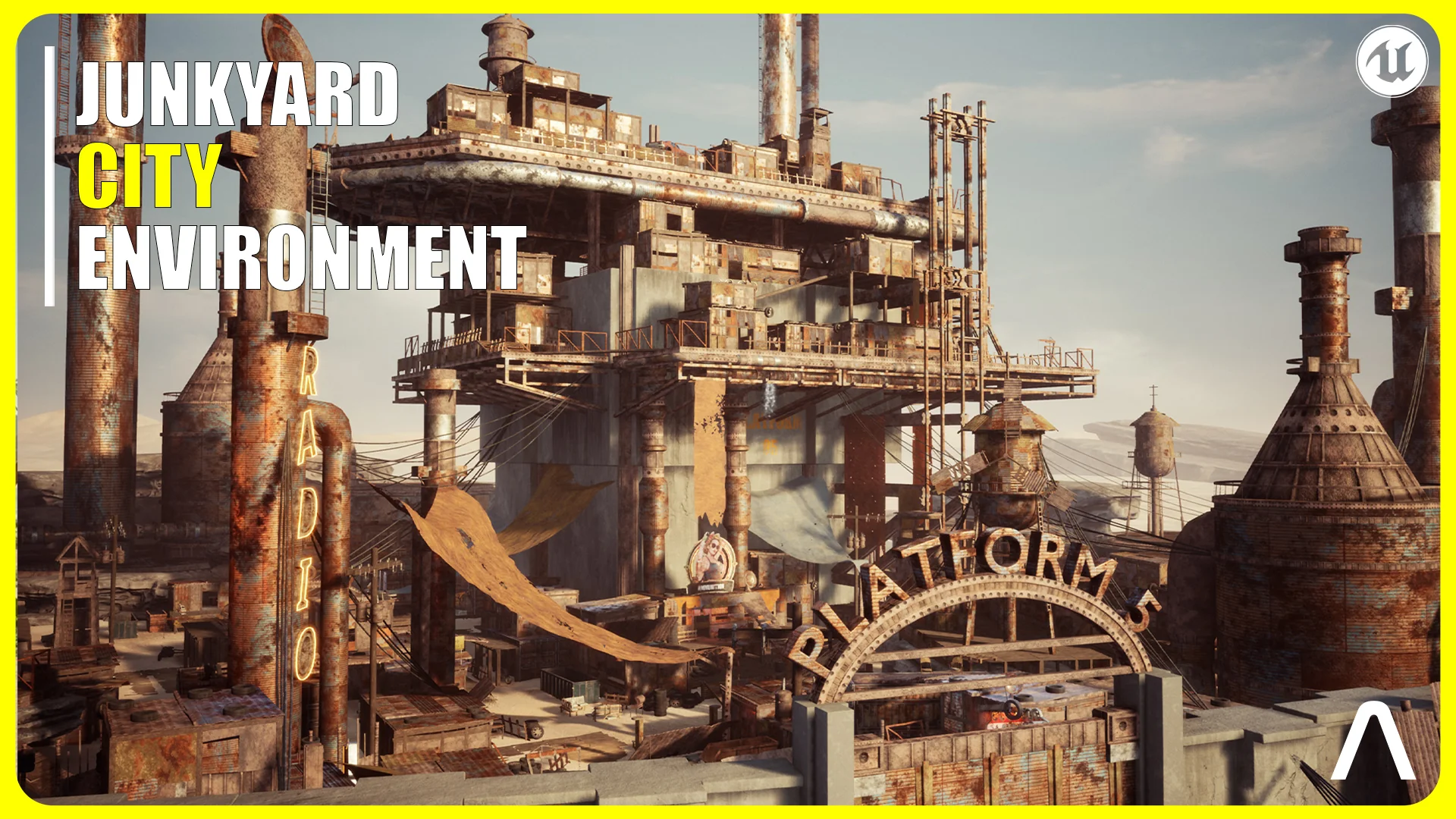
Blocking out a believable ruined district usually takes more than a few broken walls and scattered debris. The hard part is getting enough structure into the space so it reads as a place people once lived in, while still leaving room for gameplay routes, environmental storytelling, and the layered mess that sells a post-apocalyptic setting. Junkyard City approaches that problem with a modular environment kit aimed at slum-like settlements, junkyard structures, and abandoned cityscapes.
The set combines structural pieces and clutter in a way that supports both layout work and scene dressing. Walls, floors, rooftops, and detailed interiors give artists the foundation for explorable spaces, while wrecked vehicles, scrap piles, broken signs, makeshift homes, and loose debris push those spaces toward a harsher, lived-in tone.
Shaping abandoned streets with Junkyard City modules
The strongest use of Junkyard City is in how quickly it can turn an empty blockout into something that feels pieced together over time. Because it is fully modular and customizable, it can be arranged into tight alleys, improvised compounds, roof-connected walkways, or more open junkyard yards with scattered cover and visual breakup.
That flexibility matters when a scene needs different levels of control. A cinematic setup may need a heavily framed street with layered silhouettes from rooftops, signs, and wreckage. A playable map may need a readable route structure, chokepoints, alternate paths, and buildings that can be entered and exited without the environment losing its visual identity. Since the kit includes walls, floors, rooftops, and interiors, it supports both broad layout decisions and smaller assembly work inside individual structures.
The slum-like angle also gives the pack a distinct visual direction. Makeshift homes and junkyard construction imply a space assembled from whatever materials were available, which suits settlements that have grown around salvage, scarcity, or collapse. That makes it easier to build places that feel socially inhabited rather than simply destroyed.
Using wrecked cars, motorcycles, and scrap piles as scene anchors
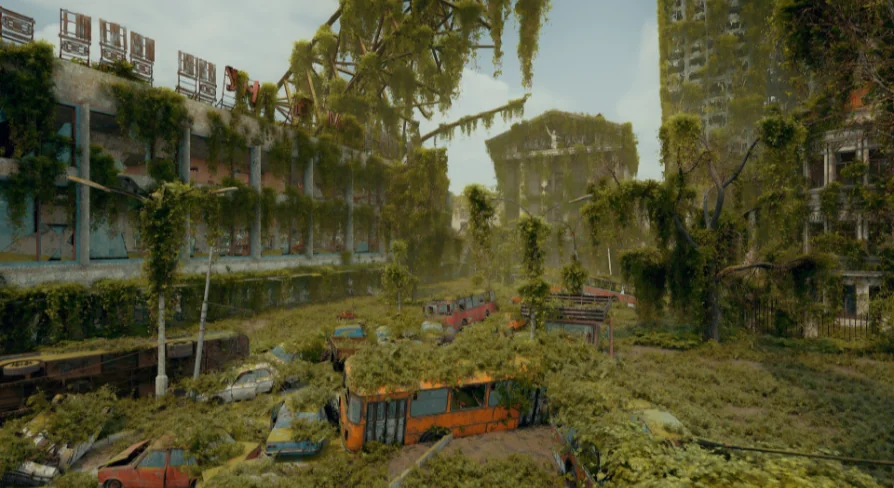
Large environment kits often live or die by their prop selection. Junkyard City includes authentic junkyard props such as wrecked cars, motorcycles, scrap piles, broken signs, makeshift homes, and other debris. Those elements do more than fill empty ground. They create landmarks, shape pathing, and give ruined spaces a believable reason for their density.
Wrecked cars and motorcycles can establish the first read of a location before the player or viewer reaches the architecture. A street choked with vehicles suggests abandonment, conflict, or scavenging pressure. Scrap piles can break up long sightlines and help form cover in a shooter map. Broken signs add vertical detail and reinforce the sense of a city that once had commercial or civic life. Makeshift homes shift the mood again, turning the same materials into evidence of survival and reuse rather than pure destruction.
Because the prop set spans both heavy wreckage and smaller debris, it supports different scene scales. One area can lean into broad silhouettes and vehicle clusters for distance reads, while another can tighten into cluttered corners and improvised shelter details for close exploration. That range is especially useful when an environment needs to transition from exterior yards into interior rooms without feeling like two separate kits were used.
Junkyard City interiors and exterior routes for gameplay
Junkyard City is not limited to façade work. It is interior and exterior ready, which opens it up to more complete level layouts instead of only background dressing. Fully explorable spaces are often where post-apocalyptic environments gain their strongest character, since players can move from exposed streets into enclosed rooms that reveal how people adapted the space.
For survival experiences, that can mean constructing compounds with defended entry points, sheltered interiors, and rooftop access. For shooter maps, interiors introduce route variation and short-range encounters that contrast with open exterior lanes. For cinematic environments, the ability to move from outside to inside helps maintain continuity in a sequence instead of cutting between unrelated sets. The detailed interiors are important here because they let buildings contribute more than silhouette; they become part of the navigable world.
The stated fit for open-world games also makes sense with this layout range. An open-world district benefits from spaces that can be read at multiple distances: a recognizable exterior form from afar, clearer route logic on approach, and enough internal detail to reward exploration. A junkyard city setting gains a lot from that layered readability.
Performance, collisions, and lighting in a post-apocalyptic world
On the technical side, the pack includes LODs, lightmaps, and accurate collisions. Those are practical details rather than decorative bullet points. LODs help maintain smooth gameplay as scenes grow denser with structures and prop clutter. Lightmaps support cleaner baked lighting workflows where they are needed. Accurate collisions matter in any environment where debris, cover objects, and tight passages are part of navigation.
The assets are also precisely scaled for Epic Skeleton interaction. That helps keep character movement and environmental proportion aligned, especially in spaces where cover height, doorway scale, and traversal reads need to feel consistent. In a modular city kit, scale accuracy does a lot of invisible work because it affects every assembled area.
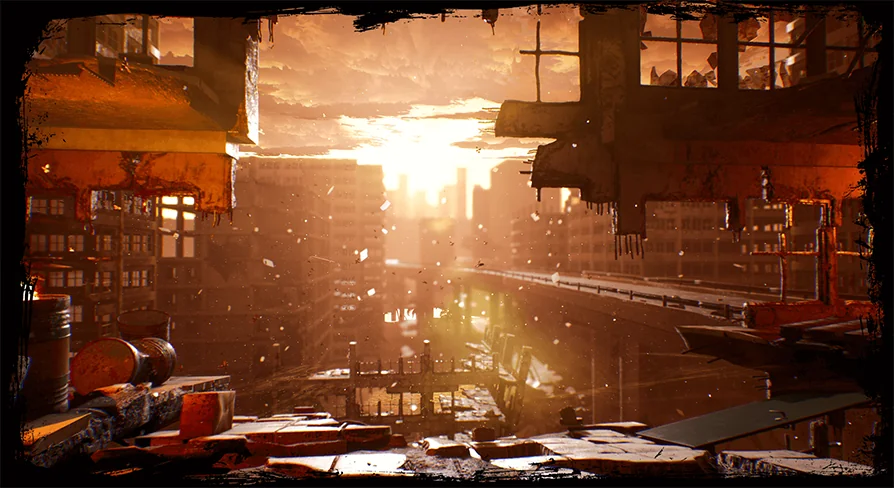
Lighting is another clear part of the intended presentation. Distance fields are recommended for improved lighting and shadow quality, and global illumination is also called out for the scene setup. The product supports Lumen for Unreal Engine 5.0+, which places it comfortably in workflows that want dynamic lighting to carry the atmosphere of rusted metal, narrow alleys, exposed rooftops, and debris-filled interiors. In this kind of environment, shadow depth and indirect light can strongly influence whether the city feels flat or genuinely oppressive.
Junkyard City fits productions that need an explorable ruined district rather than a handful of isolated props. It can serve open-world areas, survival locations, shooter maps, or cinematic backdrops where modular construction, heavy junkyard dressing, and interior access all need to work together inside one post-apocalyptic setting.
 Apocalyptic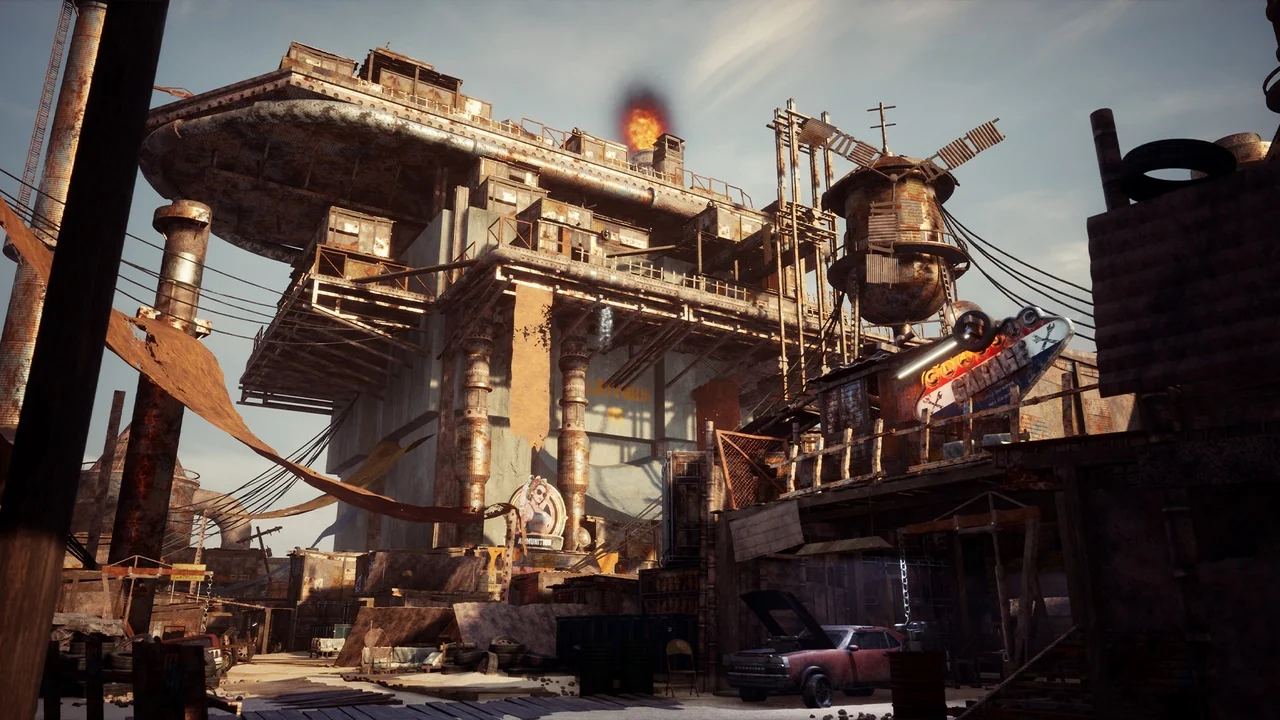
 Apocalyptic
 Apocalyptic
 Apocalyptic