"7b46a695175d8694"{"id":"1001475","slug":"ultimate-hit-reaction-system","title":"Ultimate Hit Reaction System","category":"Gameplay Features","engine":"5.6+","assetVersion":"","engineVersion":"Engine Version: 5.6+","tag":"Gameplay Features","accent":"blue","visual":"mech","summary":"A deep dive into the Ultimate Hit Reaction System for Unreal Engine, covering its 168 mocap animations, Chooser Tables, Motion Warping, and IK integration.","platform":"Unreal Engine","publishedAt":"2026-10-08T08:28:50.048Z","updatedAt":"2026-10-08T08:28:50.048Z","sourceNotes":[],"fileContents":[],"compatibility":["Unreal Engine","Engine Version: 5.6+"],"featuredImage":{"alt":"Ultimate Hit Reaction System","src":"/wp-content/uploads/published/2026/10/8833d5e34c3d-c4d6cc46-3a57-4651-a1d2-e8585976b5ea-a14898b9cd.webp"},"hasDownloadLink":true,"downloads":0,"terms":[{"taxonomy":"category","slug":"gameplay-features","name":"Gameplay Features"}],"galleryImages":[{"src":"/wp-content/uploads/published/2026/10/7a3d64edac10-a7a9f396-35ac-4557-8df1-862f6f51ee88-41771339a9.webp","alt":"Ultimate Hit Reaction System"},{"src":"/wp-content/uploads/published/2026/10/12bf22c956bb-677b1451-d17b-479b-8d52-fa55f18d186f-a902586580.webp","alt":"Ultimate Hit Reaction System"},{"src":"/wp-content/uploads/published/2026/10/c9b6184df959-5565dc31-5690-4048-a854-b74fdd9e3834-d14bdab894.webp","alt":"Ultimate Hit Reaction System"},{"src":"/wp-content/uploads/published/2026/10/17adbee65ea9-8adaf88b-ba45-4780-b171-52a8a2fb8ba9-f5bcbbd902.webp","alt":"Ultimate Hit Reaction System"},{"src":"/wp-content/uploads/published/2026/10/2a0149f252a5-6288944a-c66c-4d4d-b494-0d3ee95babe9-c41467fdb8.webp","alt":"Ultimate Hit Reaction System"},{"src":"/wp-content/uploads/published/2026/10/f1a4addbe47d-465570a1-7784-4014-a87f-ff7904d2a823-295d0a17f6.webp","alt":"Ultimate Hit Reaction System"},{"src":"/wp-content/uploads/published/2026/10/922c677775d2-9ea66059-057f-45fd-9753-d2581390ba2e-34caa88b17.webp","alt":"Ultimate Hit Reaction System"},{"src":"/wp-content/uploads/published/2026/10/1ac52b75f321-45f40c9e-6aec-4043-a13d-71202b9f8b57-b58ee0aebe.webp","alt":"Ultimate Hit Reaction System"},{"src":"/wp-content/uploads/published/2026/10/1f479cd93d2a-8caa2e10-2c53-458f-82e6-4cfa6f508db4-546f9e40c3.webp","alt":"Ultimate Hit Reaction System"},{"src":"/wp-content/uploads/published/2026/10/fa38f5a4d07f-77d1df22-f5b5-4e8b-983e-57c5cb36f629-9cfe0f0d2b.webp","alt":"Ultimate Hit Reaction System"}],"accessPanel":{"kind":"resource","title":"Download this resource","eyebrow":"Free Download","message":"Log in or create a free account to start your download.","fileName":"Content.7z","safetyNote":"Resources are manually reviewed before listing to improve quality and reduce obvious risks.","actionLabel":"Download Free","resourceType":"Resource archive"},"contentHtml":"\u003ch2\u003eIntegrating the Ultimate Hit Reaction System via Blueprints and Chooser Tables\u003c/h2\u003e\u003cp\u003eSetting up character damage feedback typically demands extensive state-machine scripting and manual blend tree wiring. The Ultimate Hit Reaction System approaches this problem through an architecture built entirely on Blueprints and Chooser DataTables. For developers possessing a foundational understanding of Unreal Engine animation pipelines, standard integration takes roughly thirty minutes and eliminates the need for direct C++ coding.\u003c/p\u003e\u003cp\u003eThe underlying framework operates through the UltimateHitreactionPlugin, which is supplied directly as a project file. Rather than hard-coding branches for incoming damage, designers configure parameters directly inside Chooser Tables. This data-driven layer maps distinct impact events to the character's animation graph, determining how incoming strikes query the database, process damage attributes, and trigger the corresponding reaction curves without manual state switching.\u003c/p\u003e\u003cp\u003eBecause the setup is decoupled from proprietary codebases, logic adjustments remain visual and modular. Tweaking reaction thresholds, adjusting timing parameters, or expanding tables to support specialized entity classes occurs entirely within the editor's visual interface. This architecture also standardizes combat feedback across projects, establishing a uniform pipeline that functions out of the box with multiplayer network replication.\u003c/p\u003e\u003ch2\u003eEvaluating the 168 Motion-Captured Animations and Directional Sets\u003c/h2\u003e\u003cp\u003eCombat feel depends heavily on animation variety and precise physical directionality. The framework ships with a complete library of 168 motion-captured animation clips, eliminating the need to source or re-target external impact assets. These clips address impacts across six spatial vectors: front, back, left, right, up, and down.\u003c/p\u003e\u003cp\u003eEach directional angle is stratified into four distinct intensity levels to reflect varying weapon types, skill impacts, or projectile forces:\u003c/p\u003e\u003cul\u003e\u003cli\u003e\u003cstrong\u003eLight:\u003c/strong\u003e Subtle flinches and upper-body partial hits that allow characters to maintain combat tempo without breaking flow entirely.\u003c/li\u003e\u003cli\u003e\u003cstrong\u003eMedium:\u003c/strong\u003e Noticeable staggers and directional balance disruptions that convey solid physical contact.\u003c/li\u003e\u003cli\u003e\u003cstrong\u003eHeavy:\u003c/strong\u003e Severe impacts, deep stumbles, and heavy momentum shifts suited for critical strikes and heavy weaponry.\u003c/li\u003e\u003cli\u003e\u003cstrong\u003eExplosion:\u003c/strong\u003e High-force launches, knockdowns, and violent momentum displacements triggered by explosive or area-of-effect forces.\u003c/li\u003e\u003c/ul\u003e\u003cp\u003eBeyond standard directional flinches, the collection incorporates partial-body hit reactions, directional falls, mid-air launches, knockdown sequences, and multi-stage combo impacts. The smart switching logic evaluates the incoming damage vector alongside strike intensity to automatically select and execute the corresponding animation, removing the burden of authoring complex directional math within individual character Blueprints.\u003c/p\u003e\u003ch2\u003eMotion Warping Alignment, IK Feedback, and Experimental Physics Control\u003c/h2\u003e\u003cp\u003eRaw animation playback can sometimes lead to foot sliding or mismatched strike locations when combat geometry varies. The Ultimate Hit Reaction System leverages Unreal Engine's native Motion Warping framework to dynamically adapt animation roots during runtime. Motion Warping recalculates trajectory paths, hit directions, and exact landing points, ensuring that displacement reactions such as falls and knockbacks track accurately with environmental obstacles and terrain contours.\u003c/p\u003e\u003cp\u003eProcedural animation layers further enhance physical believability. The framework incorporates inverse kinematics (IK) feedback to add secondary physical responses on top of the primary motion capture data. When a strike connects, IK adjustments pull and orient limbs toward the point of impact, preventing animations from looking rigid or disconnected from dynamic hit locations.\u003c/p\u003e\u003cp\u003eFor developers seeking deeper physical interaction, the package features an experimental Physics Control module. This toggleable component introduces physical simulation directly into the active animation playback, allowing skeletal mesh joints to blend between rigid keyframed motion and dynamic physical simulation during violent impacts. Because the module is fully optional, teams can enable it for heavy encounters while retaining strictly kinematic playback for performance-critical scenarios.\u003c/p\u003e\u003ch2\u003eHandling Transitions from Combo Impacts to Ragdoll Death\u003c/h2\u003e\u003cp\u003eUnified transition logic governs the life cycle of hit responses all the way into terminal defeat. In many combat pipelines, death sequences operate under an entirely separate state machine, creating visual pops when a character transitions from a stagger into a death pose. The Ultimate Hit Reaction System unifies this behavior by bridging hit states directly into integrated death sequences.\u003c/p\u003e\u003cp\u003eCharacters support several distinct termination behaviors depending on the final blow:\u003c/p\u003e\u003cul\u003e\u003cli\u003e\u003cstrong\u003eInstant Collapse:\u003c/strong\u003e On-the-spot drops and crumple animations for fatal strikes delivered without heavy directional force.\u003c/li\u003e\u003cli\u003e\u003cstrong\u003eKnockback-to-Death:\u003c/strong\u003e Continuous momentum arcs that propel the character backward or downward through a heavy impact state directly into a final resting pose.\u003c/li\u003e\u003cli\u003e\u003cstrong\u003eActive Ragdoll State:\u003c/strong\u003e Seamless physics activation upon zero health, allowing characters to crumple dynamically against slopes, ledges, or incoming physics volumes.\u003c/li\u003e\u003c/ul\u003e\u003cp\u003eThese death flows maintain state continuity by reading directly from the preceding damage data. If an entity receives an explosive launch or a heavy directional blow on the killing frame, the transition respects that momentum rather than resetting the skeleton to an arbitrary standing death clip.\u003c/p\u003e\u003ch2\u003eMultiplayer Replication and Skeleton Compatibility\u003c/h2\u003e\u003cp\u003eThe system is engineered for humanoid characters and diverse creatures, making it directly applicable to playable protagonists, standard combat NPCs, and complex boss encounters. Skeletal meshes rigged to standard humanoid proportions can utilize the Chooser Table mappings with minimal retargeting adjustments, while the data-driven framework maintains compatibility across related assets like the Ultimate Hit Reaction Animation - Light set.\u003c/p\u003e\u003cp\u003eMultiplayer network replication is integrated directly into the Chooser Table execution model. Because impact parameters and directional states are processed as data payloads rather than local client animations, damage events, knockbacks, and state transitions synchronize reliably across server and client boundaries without desynchronizing character positions.\u003c/p\u003e\u003cp\u003eIterative refinements to the core logic have addressed nuanced combat behaviors. System updates resolved light and heavy hit stacking issues to prevent rapid-fire strikes from interrupting or breaking character hit states prematurely. Specific directional assets, including upper-body reactions like Light_Back_Chest and Light_Front_Chest, have been tuned alongside explosion trajectory calculations to ensure stable aerial tracking and smooth recovery poses.\u003c/p\u003e\u003cp\u003eBy combining 168 motion-captured clips, native Motion Warping, IK-driven limb adjustments, and a zero-code Chooser DataTable workflow, the Ultimate Hit Reaction System provides a production-ready combat foundation suited for single-player action titles and replicated multiplayer environments alike.\u003c/p\u003e\n\n\u003ch2\u003eContinue Browsing Similar Packs\u003c/h2\u003e\n\u003cul\u003e\n\u003cli\u003e\u003ca href=\"https://3dcghub.com/true-fighting-game-engine/\" title=\"TRUE Fighting Game Engine\"\u003eTRUE Fighting Game Engine\u003c/a\u003e\u003c/li\u003e\n\u003cli\u003e\u003ca href=\"https://3dcghub.com/ultimate-spell-system/\" title=\"Ultimate Spell System\"\u003eUltimate Spell System\u003c/a\u003e\u003c/li\u003e\n\u003cli\u003e\u003ca href=\"https://3dcghub.com/ultimate-interaction-manager/\" title=\"Ultimate Interaction Manager\"\u003eUltimate Interaction Manager\u003c/a\u003e\u003c/li\u003e\n\u003cli\u003e\u003ca href=\"https://3dcghub.com/ultimate-character-customization/\" title=\"Ultimate Character Customization\"\u003eUltimate Character Customization\u003c/a\u003e\u003c/li\u003e\n\u003cli\u003e\u003ca href=\"https://3dcghub.com/ultimate-quest-manager/\" title=\"Ultimate Quest Manager\"\u003eUltimate Quest Manager\u003c/a\u003e\u003c/li\u003e\n\u003c/ul\u003e","contentTextLength":7394,"navigation":{"current":72,"total":3481,"previous":{"id":"1001476","slug":"22-zombie-walk-motion-pack-by-jkmotion","title":"22 Zombie Walk Motion Pack by JKMotion","category":"Locomotion / Gaits","platform":"Unreal Engine","updatedAt":"2026-10-08T08:31:59.053Z"},"next":{"id":"1001474","slug":"volcano-3d-vdb-pack","title":"Volcano 3D VDB Pack","category":"Fire \u0026 Explosions","platform":"Unreal Engine","updatedAt":"2026-10-08T08:25:41.080Z"}},"relatedResources":[{"id":"27803","slug":"true-fighting-game-engine","title":"TRUE Fighting Game Engine","category":"Gameplay Features","engine":"5.5+","assetVersion":"Engine version: 5.5+","engineVersion":"Asset Version:1.6.2","tag":"Gameplay Features","accent":"blue","visual":"animation","summary":"TRUE Fighting Game Engine focuses on getting a fighting game scene moving quickly, from character selection to attacks, hit reactions, and multiplayer play. Its feature set covers both setup work and the moment-to-moment feel of combat, with support for 2.5...","platform":"Unreal Engine","publishedAt":"2026-04-29T06:07:36.000Z","updatedAt":"2026-04-29T06:07:37.000Z","sourceNotes":[],"fileContents":[],"compatibility":["Unreal Engine","Engine version: 5.5+","Asset Version: 1.6.2"],"featuredImage":{"alt":"TRUE Fighting Game Engine","src":"https://3dcghub.com/wp-content/uploads/2026/04/bd8f97d07537_6587df2c-727a-45b1-892a-3f3ed68e341b.webp"},"hasDownloadLink":true,"downloads":2},{"id":"1001307","slug":"ultimate-spell-system","title":"Ultimate Spell System","category":"Gameplay Features","engine":"5.1+","assetVersion":"","engineVersion":"Engine Version: 5.1+","tag":"Gameplay Features","accent":"blue","visual":"mech","summary":"Explore the Ultimate Spell System, an advanced magic framework featuring Niagara integration, multiplayer support, mana, shields, and spellbook mechanics.","platform":"Unreal Engine","publishedAt":"2026-10-02T06:21:12.194Z","updatedAt":"2026-10-02T06:21:12.194Z","sourceNotes":[],"fileContents":[],"compatibility":["Unreal Engine","Engine Version: 5.1+"],"featuredImage":{"alt":"Ultimate Spell System","src":"/wp-content/uploads/published/2026/10/b765acfa374d-8db4a436-8f55-46de-a8d5-84bd16177dcd-b3cdaaff6f.webp"},"hasDownloadLink":true,"downloads":0},{"id":"1001306","slug":"ultimate-interaction-manager","title":"Ultimate Interaction Manager","category":"Gameplay Features","engine":"5.0+","assetVersion":"","engineVersion":"Engine Version: 5.0+","tag":"Gameplay Features","accent":"blue","visual":"mech","summary":"An in-depth look at Ultimate Interaction Manager, covering its component architecture, server replication, dynamic widget pool markers, and UE 5.7 status.","platform":"Unreal Engine","publishedAt":"2026-10-02T06:20:16.462Z","updatedAt":"2026-10-02T06:20:16.462Z","sourceNotes":[],"fileContents":[],"compatibility":["Unreal Engine","Engine Version: 5.0+"],"featuredImage":{"alt":"Ultimate Interaction Manager","src":"/wp-content/uploads/published/2026/10/eb0c915dbe73-3ff46653-0438-44e1-99c8-609e83960f18-3cca55c0f0.webp"},"hasDownloadLink":true,"downloads":0}]}
Gameplay Features
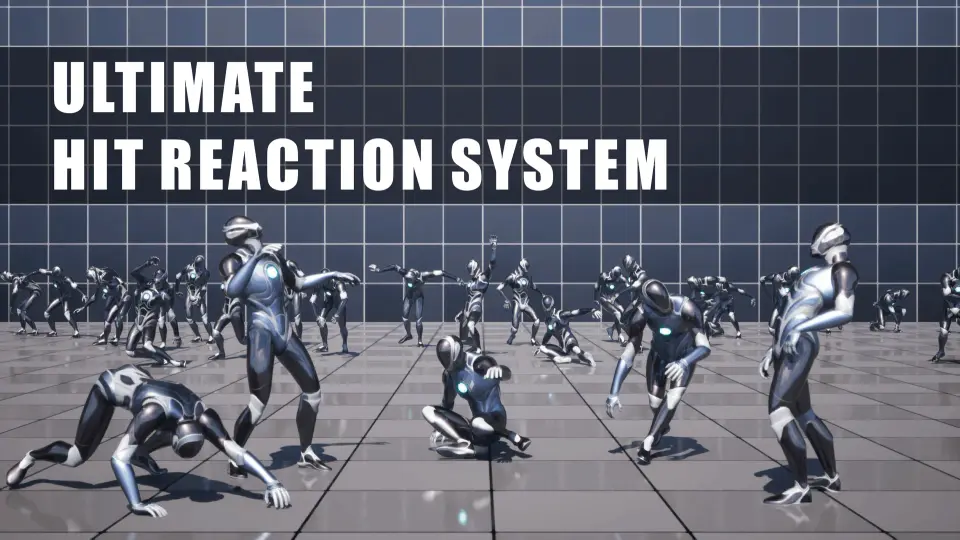
Ultimate Hit Reaction System
A deep dive into the Ultimate Hit Reaction System for Unreal Engine, covering its 168 mocap animations, Chooser Tables, Motion Warping, and IK integration.
Integrating the Ultimate Hit Reaction System via Blueprints and Chooser Tables
Setting up character damage feedback typically demands extensive state-machine scripting and manual blend tree wiring. The Ultimate Hit Reaction System approaches this problem through an architecture built entirely on Blueprints and Chooser DataTables. For developers possessing a foundational understanding of Unreal Engine animation pipelines, standard integration takes roughly thirty minutes and eliminates the need for direct C++ coding.
The underlying framework operates through the UltimateHitreactionPlugin, which is supplied directly as a project file. Rather than hard-coding branches for incoming damage, designers configure parameters directly inside Chooser Tables. This data-driven layer maps distinct impact events to the character's animation graph, determining how incoming strikes query the database, process damage attributes, and trigger the corresponding reaction curves without manual state switching.
Because the setup is decoupled from proprietary codebases, logic adjustments remain visual and modular. Tweaking reaction thresholds, adjusting timing parameters, or expanding tables to support specialized entity classes occurs entirely within the editor's visual interface. This architecture also standardizes combat feedback across projects, establishing a uniform pipeline that functions out of the box with multiplayer network replication.
Evaluating the 168 Motion-Captured Animations and Directional Sets
Combat feel depends heavily on animation variety and precise physical directionality. The framework ships with a complete library of 168 motion-captured animation clips, eliminating the need to source or re-target external impact assets. These clips address impacts across six spatial vectors: front, back, left, right, up, and down.
Each directional angle is stratified into four distinct intensity levels to reflect varying weapon types, skill impacts, or projectile forces:
Light: Subtle flinches and upper-body partial hits that allow characters to maintain combat tempo without breaking flow entirely.
Medium: Noticeable staggers and directional balance disruptions that convey solid physical contact.
Heavy: Severe impacts, deep stumbles, and heavy momentum shifts suited for critical strikes and heavy weaponry.
Explosion: High-force launches, knockdowns, and violent momentum displacements triggered by explosive or area-of-effect forces.
Beyond standard directional flinches, the collection incorporates partial-body hit reactions, directional falls, mid-air launches, knockdown sequences, and multi-stage combo impacts. The smart switching logic evaluates the incoming damage vector alongside strike intensity to automatically select and execute the corresponding animation, removing the burden of authoring complex directional math within individual character Blueprints.
Motion Warping Alignment, IK Feedback, and Experimental Physics Control
Raw animation playback can sometimes lead to foot sliding or mismatched strike locations when combat geometry varies. The Ultimate Hit Reaction System leverages Unreal Engine's native Motion Warping framework to dynamically adapt animation roots during runtime. Motion Warping recalculates trajectory paths, hit directions, and exact landing points, ensuring that displacement reactions such as falls and knockbacks track accurately with environmental obstacles and terrain contours.
Procedural animation layers further enhance physical believability. The framework incorporates inverse kinematics (IK) feedback to add secondary physical responses on top of the primary motion capture data. When a strike connects, IK adjustments pull and orient limbs toward the point of impact, preventing animations from looking rigid or disconnected from dynamic hit locations.
For developers seeking deeper physical interaction, the package features an experimental Physics Control module. This toggleable component introduces physical simulation directly into the active animation playback, allowing skeletal mesh joints to blend between rigid keyframed motion and dynamic physical simulation during violent impacts. Because the module is fully optional, teams can enable it for heavy encounters while retaining strictly kinematic playback for performance-critical scenarios.
Handling Transitions from Combo Impacts to Ragdoll Death
Unified transition logic governs the life cycle of hit responses all the way into terminal defeat. In many combat pipelines, death sequences operate under an entirely separate state machine, creating visual pops when a character transitions from a stagger into a death pose. The Ultimate Hit Reaction System unifies this behavior by bridging hit states directly into integrated death sequences.
Characters support several distinct termination behaviors depending on the final blow:
Instant Collapse: On-the-spot drops and crumple animations for fatal strikes delivered without heavy directional force.
Knockback-to-Death: Continuous momentum arcs that propel the character backward or downward through a heavy impact state directly into a final resting pose.
Active Ragdoll State: Seamless physics activation upon zero health, allowing characters to crumple dynamically against slopes, ledges, or incoming physics volumes.
These death flows maintain state continuity by reading directly from the preceding damage data. If an entity receives an explosive launch or a heavy directional blow on the killing frame, the transition respects that momentum rather than resetting the skeleton to an arbitrary standing death clip.
Multiplayer Replication and Skeleton Compatibility
The system is engineered for humanoid characters and diverse creatures, making it directly applicable to playable protagonists, standard combat NPCs, and complex boss encounters. Skeletal meshes rigged to standard humanoid proportions can utilize the Chooser Table mappings with minimal retargeting adjustments, while the data-driven framework maintains compatibility across related assets like the Ultimate Hit Reaction Animation - Light set.
Multiplayer network replication is integrated directly into the Chooser Table execution model. Because impact parameters and directional states are processed as data payloads rather than local client animations, damage events, knockbacks, and state transitions synchronize reliably across server and client boundaries without desynchronizing character positions.
Iterative refinements to the core logic have addressed nuanced combat behaviors. System updates resolved light and heavy hit stacking issues to prevent rapid-fire strikes from interrupting or breaking character hit states prematurely. Specific directional assets, including upper-body reactions like Light_Back_Chest and Light_Front_Chest, have been tuned alongside explosion trajectory calculations to ensure stable aerial tracking and smooth recovery poses.
By combining 168 motion-captured clips, native Motion Warping, IK-driven limb adjustments, and a zero-code Chooser DataTable workflow, the Ultimate Hit Reaction System provides a production-ready combat foundation suited for single-player action titles and replicated multiplayer environments alike.
 Gameplay Features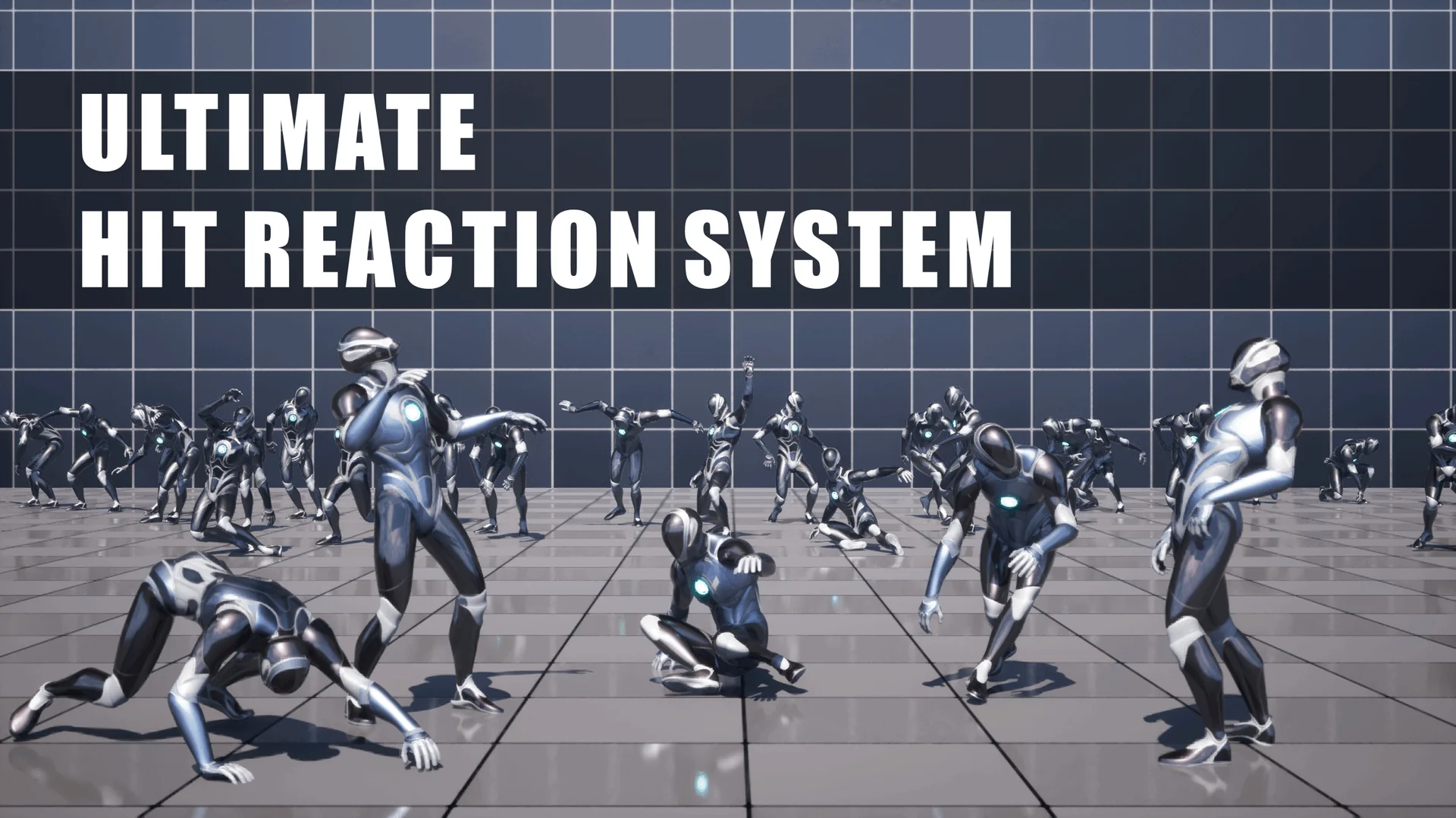
 Gameplay Features
 Gameplay Features
 Gameplay Features