"1c2c8b66743036b4"{"id":"1001711","slug":"ultimate-horse-system-horse-horse-riding-horse-system-mount-rideable-horse","title":"Ultimate Horse System (Horse, Horse Riding, Horse System, Mount, Rideable Horse)","category":"Gameplay Features","engine":"5.1+","assetVersion":"","engineVersion":"Engine Version: 5.1+","tag":"Gameplay Features","accent":"blue","visual":"mech","summary":"Explore the Ultimate Horse System for Unreal Engine, featuring full network replication, modular saddles, Foot IK, water interaction, and custom rider support.","platform":"Unreal Engine","publishedAt":"2026-10-14T17:15:39.983Z","updatedAt":"2026-10-14T17:15:39.983Z","sourceNotes":[],"fileContents":[],"compatibility":["Unreal Engine","Engine Version: 5.1+"],"featuredImage":{"alt":"Ultimate Horse System (Horse, Horse Riding, Horse System, Mount, Rideable Horse)","src":"/wp-content/uploads/published/2026/10/6dc76c7660f2-d252bb16-9c4e-4df7-8a68-0bb86ab4c882-eca349b4ab.webp"},"hasDownloadLink":true,"downloads":0,"terms":[{"taxonomy":"category","slug":"gameplay-features","name":"Gameplay Features"}],"galleryImages":[{"src":"/wp-content/uploads/published/2026/10/b2be34e034bb-62e34646-b2b9-468a-a008-bbc195d85b04-fc3f70e1cf.webp","alt":"Ultimate Horse System (Horse, Horse Riding, Horse System, Mount, Rideable Horse)"},{"src":"/wp-content/uploads/published/2026/10/20aae648862c-5265982e-1653-4a9e-ace6-01d15dcb56f3-02538dcb2e.webp","alt":"Ultimate Horse System (Horse, Horse Riding, Horse System, Mount, Rideable Horse)"},{"src":"/wp-content/uploads/published/2026/10/689cb1ff2956-f4517c5f-1ca6-4717-81be-b8cab0f85782-add6959400.webp","alt":"Ultimate Horse System (Horse, Horse Riding, Horse System, Mount, Rideable Horse)"},{"src":"/wp-content/uploads/published/2026/10/134d64ce37f6-216f3ae6-e385-4dc9-90c8-851431b74f23-c8de8a2fde.webp","alt":"Ultimate Horse System (Horse, Horse Riding, Horse System, Mount, Rideable Horse)"},{"src":"/wp-content/uploads/published/2026/10/0168c2e02d91-5515f983-1013-4bf7-b28e-0a7da1d16286-ba8d438e9f.webp","alt":"Ultimate Horse System (Horse, Horse Riding, Horse System, Mount, Rideable Horse)"},{"src":"/wp-content/uploads/published/2026/10/b987c995d203-4fb1775d-5603-4331-b491-9f1bab649b70-aa9951c160.webp","alt":"Ultimate Horse System (Horse, Horse Riding, Horse System, Mount, Rideable Horse)"},{"src":"/wp-content/uploads/published/2026/10/cecf2ae4d509-50577393-c248-48d8-a295-9e2e2a4caa26-cd85ed1bcc.webp","alt":"Ultimate Horse System (Horse, Horse Riding, Horse System, Mount, Rideable Horse)"},{"src":"/wp-content/uploads/published/2026/10/3328ac127825-0eaa6b4b-201e-41ee-b901-e3dbae0f670f-99251750f7.webp","alt":"Ultimate Horse System (Horse, Horse Riding, Horse System, Mount, Rideable Horse)"},{"src":"/wp-content/uploads/published/2026/10/2e3896e536cd-d6cb31a5-3c7a-4422-adeb-710e82b841aa-2039655654.webp","alt":"Ultimate Horse System (Horse, Horse Riding, Horse System, Mount, Rideable Horse)"},{"src":"/wp-content/uploads/published/2026/10/7ee81c2009ef-1825d7a5-b6c6-48a7-934e-5a089b8466e6-dd020019a6.webp","alt":"Ultimate Horse System (Horse, Horse Riding, Horse System, Mount, Rideable Horse)"}],"accessPanel":{"kind":"resource","title":"Download this resource","eyebrow":"Free Download","message":"Log in or create a free account to start your download.","fileName":"Content.7z","safetyNote":"Resources are manually reviewed before listing to improve quality and reduce obvious risks.","actionLabel":"Download Free","resourceType":"Resource archive"},"contentHtml":"\u003cp\u003eOpen-world Western adventures, medieval war epics, and stylized fantasy quests frequently rely on mounts to anchor exploration and scale large environments. Implementing a responsive, believable quadruped mount often presents technical hurdles, particularly when balancing custom rider geometry, camera shifts, physics interactions, and multiplayer networking. The Ultimate Horse System addresses these demands in Unreal Engine 5 by delivering a ready-to-use locomotion and riding foundation built to cut down configuration time and integrate into existing project pipelines.\u003c/p\u003e \u003ch2\u003eFirst-Person to Third-Person Horse Riding and Input Setup\u003c/h2\u003e\n\u003cp\u003eGameplay perspectives dictate how players experience mounted movement. In high-speed chases across plains or rugged terrain, a third-person camera offers clear environmental awareness, revealing both the mount and its surroundings. In contrast, tense scouting sequences or narrative-heavy moments often benefit from a direct, first-person viewpoint from the saddle. This horse system supports seamless perspective switching between first-person and third-person modes, letting players toggle views dynamically without interrupting movement flow or breaking animation states.\u003c/p\u003e\n\u003cp\u003eControl schemes are mapped directly for immediate gamepad play. Native controller support covers both PlayStation 5 and Xbox gamepads out of the box, allowing smooth steering, acceleration, and handling straight from the editor. For developers working within Unreal Engine 5.0, utilizing these input behaviors requires activating the engine's Enhanced Input plugin to ensure all button mappings and analog axes register properly.\u003c/p\u003e \u003ch2\u003eFull Network Replication and Custom Character Swapping\u003c/h2\u003e\n\u003cp\u003eMultiplayer titles require mount states, rider attachments, and visual customization to synchronize reliably across client and server nodes. The package provides full replication out of the box, ensuring that movement vectors, animation cues, and visual adjustments update across all connected players. When a rider mounts up, shifts perspectives, accelerates into a gallop, or changes equipment, those updates replicate over the network to maintain a unified game state without desynchronization artifacts.\u003c/p\u003e\n\u003cp\u003eProjects rarely use the exact same character mesh across different productions. While the system functions immediately when using the included default character, it is structured to allow developers to swap in their own custom rider models. Integration documentation guides the step-by-step process of re-targeting or socketing unique character skeletons to the saddle, adjusting rider poses, and ensuring that character blueprints communicate cleanly with the horse movement logic. A dedicated playable demo configuration based on the Advanced Locomotion System (ALS) is also provided, demonstrating how the mount system interfaces with advanced humanoid movement frameworks.\u003c/p\u003e \u003ch2\u003eModular Saddle System and Skin Customization\u003c/h2\u003e\n\u003cp\u003eVisual variety prevents equine companions from appearing identical across an entire game world. The asset incorporates a modular saddle system focused on Western configurations alongside support for Medieval and Realistic themes. Developers can break down saddles into modular props and distinct texture sets, making it straightforward to build unique harness configurations for NPCs or build in-game gear upgrade paths where players customize their own saddles piece by piece. A dedicated medieval armor update expands this flexibility into military and fantasy settings, providing barded gear suitable for knights and battlefield mounts.\u003c/p\u003e\n\u003cp\u003eUnderneath the tack, the horse meshes utilize a specialized fur and sheen shader designed to capture realistic light falloff. As the animal moves through variable lighting conditions, light reacts to the coat fibers to simulate natural hide and hair luster. Visual variety spans across realistic and stylized art directions:\u003c/p\u003e\n\u003cul\u003e \u003cli\u003eTen realistic horse coat skins to match authentic equestrian breeds.\u003c/li\u003e \u003cli\u003eEight distinct mane colors that can be paired across different coat types.\u003c/li\u003e \u003cli\u003eSeven stylized skin variants, including pattern options like a zebra coat, catering to non-photorealistic visual styles.\u003c/li\u003e\n\u003c/ul\u003e \u003ch2\u003eProcedural Animations, Foot IK, and Water Interaction\u003c/h2\u003e\n\u003cp\u003eConvincing equine movement depends heavily on how the animal and its rider interact with physical surfaces and gear. The package utilizes procedural animation techniques alongside keyframed cycles to generate fluid transitions across changing movement states. To eliminate visual detachment between the rider and the mount's equipment, the system implements practical Foot IK (Inverse Kinematics). Foot IK locks the rider's boots directly into the stirrups, holding the feet firmly in place regardless of the horse's gait, torso pitch, or banking angles during sharp turns.\u003c/p\u003e\n\u003cp\u003eEnvironmental reactivity extends directly into Unreal Engine's native systems. To run the demo levels properly, the engine's Water plugin must be enabled. Once active, mounts seamlessly interact with water bodies, reacting to depth and surface transitions as they traverse rivers, lakes, and flooded terrain without requiring external surface-detection patches.\u003c/p\u003e \u003ch2\u003eAudio Design, Screen Effects, and Production Integration\u003c/h2\u003e\n\u003cp\u003eAuditory feedback and visual speed cues give weight to quadruped locomotion. The system includes a full suite of sound effects containing everything heard in the playable demonstrations, such as realistic neighs, whinnies, and thunderous galloping hooves that adjust according to movement speed. Visual pacing is reinforced through dedicated footstep particle VFX triggered as the hooves strike surfaces, complemented by high-speed screen lines that activate during fast sprints to emphasize acceleration. For combat-focused workflows, the system also maintains compatibility with Realistic Blood VFX Niagara systems to handle impact responses during combat encounters.\u003c/p\u003e\n\u003cp\u003eTeams building single-player frontier games, multiplayer medieval campaigns, or stylized exploration adventures can leverage the combination of built-in replication, modular props, and procedural adjustments to bypass months of fundamental mount development and focus on world design.\u003c/p\u003e\n\n\u003ch2\u003eContinue Browsing Similar Packs\u003c/h2\u003e\n\u003cul\u003e\n\u003cli\u003e\u003ca href=\"https://3dcghub.com/complete-horse-riding-system-rideable-mount/\" title=\"Complete Horse Riding System: Rideable Mount\"\u003eComplete Horse Riding System: Rideable Mount\u003c/a\u003e\u003c/li\u003e\n\u003cli\u003e\u003ca href=\"https://3dcghub.com/ultimate-spell-system/\" title=\"Ultimate Spell System\"\u003eUltimate Spell System\u003c/a\u003e\u003c/li\u003e\n\u003cli\u003e\u003ca href=\"https://3dcghub.com/interactive-water-ocean-and-swim-systems/\" title=\"Interactive Water, Ocean and Swim Systems\"\u003eInteractive Water, Ocean and Swim Systems\u003c/a\u003e\u003c/li\u003e\n\u003cli\u003e\u003ca href=\"https://3dcghub.com/riding-system-in-blueprints-multiplayer/\" title=\"Riding System in Blueprints (Multiplayer)\"\u003eRiding System in Blueprints (Multiplayer)\u003c/a\u003e\u003c/li\u003e\n\u003cli\u003e\u003ca href=\"https://3dcghub.com/ultimate-hit-reaction-system/\" title=\"Ultimate Hit Reaction System\"\u003eUltimate Hit Reaction System\u003c/a\u003e\u003c/li\u003e\n\u003c/ul\u003e","contentTextLength":6367,"navigation":{"current":4,"total":3651,"previous":{"id":"1001712","slug":"visus-city-vol-2","title":"Visus City Vol 2","category":"Cities","platform":"Unreal Engine","updatedAt":"2026-10-14T17:16:38.123Z"},"next":{"id":"1001710","slug":"tornado-fx-vdb","title":"Tornado FX VDB","category":"Weather","platform":"Unreal Engine","updatedAt":"2026-10-14T17:14:38.510Z"}},"relatedResources":[{"id":"10692","slug":"complete-horse-riding-system-rideable-mount","title":"Complete Horse Riding System: Rideable Mount","category":"Gameplay Features","engine":"5.2+","assetVersion":"Engine version: 5.2+","engineVersion":"5.0","tag":"Gameplay Features","accent":"blue","visual":"luts","summary":"Enhance your game world with a professional horse riding system featuring realistic gaits, advanced control rigs, and seamless multiplayer integration.","platform":"Unreal Engine","publishedAt":"2026-03-03T15:59:02.000Z","updatedAt":"2026-04-19T15:49:57.000Z","sourceNotes":[],"fileContents":[],"compatibility":["Unreal Engine","Engine version: 5.2+"],"featuredImage":{"alt":"Complete Horse Riding System: Rideable Mount","src":"https://3dcghub.com/wp-content/uploads/2026/03/1e386b17-6431-4495-af9d-f6ad54f248b0.webp"},"hasDownloadLink":true,"downloads":2},{"id":"1001307","slug":"ultimate-spell-system","title":"Ultimate Spell System","category":"Gameplay Features","engine":"5.1+","assetVersion":"","engineVersion":"Engine Version: 5.1+","tag":"Gameplay Features","accent":"blue","visual":"mech","summary":"Explore the Ultimate Spell System, an advanced magic framework featuring Niagara integration, multiplayer support, mana, shields, and spellbook mechanics.","platform":"Unreal Engine","publishedAt":"2026-10-02T06:21:12.194Z","updatedAt":"2026-10-02T06:21:12.194Z","sourceNotes":[],"fileContents":[],"compatibility":["Unreal Engine","Engine Version: 5.1+"],"featuredImage":{"alt":"Ultimate Spell System","src":"/wp-content/uploads/published/2026/10/b765acfa374d-8db4a436-8f55-46de-a8d5-84bd16177dcd-b3cdaaff6f.webp"},"hasDownloadLink":true,"downloads":0},{"id":"10993","slug":"interactive-water-ocean-and-swim-systems","title":"Interactive Water, Ocean and Swim Systems","category":"Gameplay Features","engine":"5.4+","assetVersion":"Engine version: 5.4+","engineVersion":"5.3","tag":"Gameplay Features","accent":"blue","visual":"animation","summary":"Discover a robust 3-in-1 solution for creating interactive aquatic environments. This system features advanced shaders, realistic buoyancy, and complete multiplayer support for swimming above and below the surface.","platform":"Unreal Engine","publishedAt":"2026-03-03T16:40:07.000Z","updatedAt":"2026-04-19T15:49:53.000Z","sourceNotes":[],"fileContents":[],"compatibility":["Unreal Engine","Engine version: 5.4+"],"featuredImage":{"alt":"Interactive Water, Ocean and Swim Systems","src":"https://3dcghub.com/wp-content/uploads/2026/03/5bc7b9ab-1622-4a70-a72e-efdf2f38bc9a.webp"},"hasDownloadLink":true,"downloads":2}]}
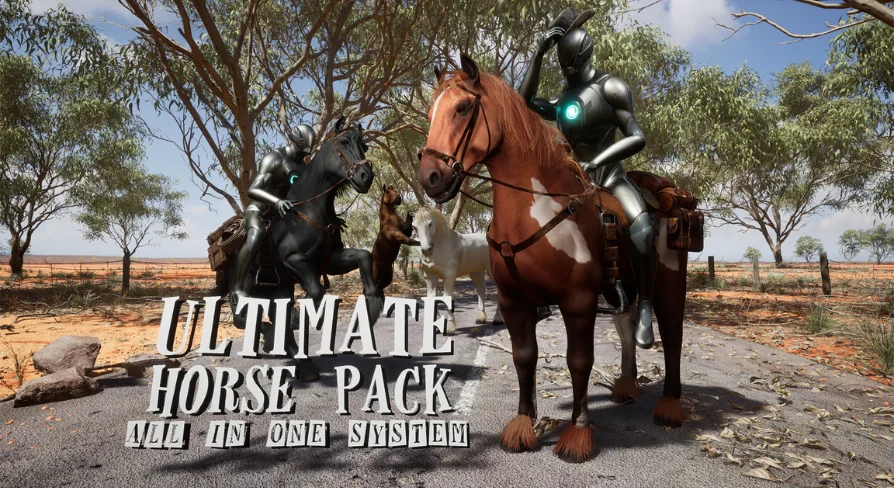
Explore the Ultimate Horse System for Unreal Engine, featuring full network replication, modular saddles, Foot IK, water interaction, and custom rider support.
Open-world Western adventures, medieval war epics, and stylized fantasy quests frequently rely on mounts to anchor exploration and scale large environments. Implementing a responsive, believable quadruped mount often presents technical hurdles, particularly when balancing custom rider geometry, camera shifts, physics interactions, and multiplayer networking. The Ultimate Horse System addresses these demands in Unreal Engine 5 by delivering a ready-to-use locomotion and riding foundation built to cut down configuration time and integrate into existing project pipelines.
First-Person to Third-Person Horse Riding and Input Setup
Gameplay perspectives dictate how players experience mounted movement. In high-speed chases across plains or rugged terrain, a third-person camera offers clear environmental awareness, revealing both the mount and its surroundings. In contrast, tense scouting sequences or narrative-heavy moments often benefit from a direct, first-person viewpoint from the saddle. This horse system supports seamless perspective switching between first-person and third-person modes, letting players toggle views dynamically without interrupting movement flow or breaking animation states.
Control schemes are mapped directly for immediate gamepad play. Native controller support covers both PlayStation 5 and Xbox gamepads out of the box, allowing smooth steering, acceleration, and handling straight from the editor. For developers working within Unreal Engine 5.0, utilizing these input behaviors requires activating the engine's Enhanced Input plugin to ensure all button mappings and analog axes register properly.
Full Network Replication and Custom Character Swapping
Multiplayer titles require mount states, rider attachments, and visual customization to synchronize reliably across client and server nodes. The package provides full replication out of the box, ensuring that movement vectors, animation cues, and visual adjustments update across all connected players. When a rider mounts up, shifts perspectives, accelerates into a gallop, or changes equipment, those updates replicate over the network to maintain a unified game state without desynchronization artifacts.
Projects rarely use the exact same character mesh across different productions. While the system functions immediately when using the included default character, it is structured to allow developers to swap in their own custom rider models. Integration documentation guides the step-by-step process of re-targeting or socketing unique character skeletons to the saddle, adjusting rider poses, and ensuring that character blueprints communicate cleanly with the horse movement logic. A dedicated playable demo configuration based on the Advanced Locomotion System (ALS) is also provided, demonstrating how the mount system interfaces with advanced humanoid movement frameworks.
Modular Saddle System and Skin Customization
Visual variety prevents equine companions from appearing identical across an entire game world. The asset incorporates a modular saddle system focused on Western configurations alongside support for Medieval and Realistic themes. Developers can break down saddles into modular props and distinct texture sets, making it straightforward to build unique harness configurations for NPCs or build in-game gear upgrade paths where players customize their own saddles piece by piece. A dedicated medieval armor update expands this flexibility into military and fantasy settings, providing barded gear suitable for knights and battlefield mounts.
Underneath the tack, the horse meshes utilize a specialized fur and sheen shader designed to capture realistic light falloff. As the animal moves through variable lighting conditions, light reacts to the coat fibers to simulate natural hide and hair luster. Visual variety spans across realistic and stylized art directions:
Ten realistic horse coat skins to match authentic equestrian breeds.
Eight distinct mane colors that can be paired across different coat types.
Seven stylized skin variants, including pattern options like a zebra coat, catering to non-photorealistic visual styles.
Procedural Animations, Foot IK, and Water Interaction
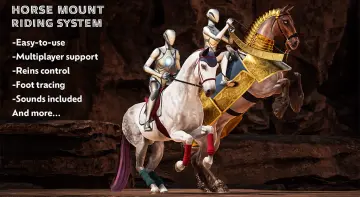
Convincing equine movement depends heavily on how the animal and its rider interact with physical surfaces and gear. The package utilizes procedural animation techniques alongside keyframed cycles to generate fluid transitions across changing movement states. To eliminate visual detachment between the rider and the mount's equipment, the system implements practical Foot IK (Inverse Kinematics). Foot IK locks the rider's boots directly into the stirrups, holding the feet firmly in place regardless of the horse's gait, torso pitch, or banking angles during sharp turns.
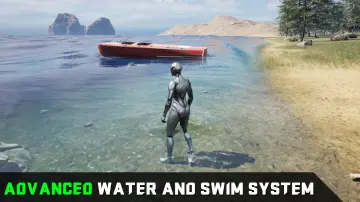
Environmental reactivity extends directly into Unreal Engine's native systems. To run the demo levels properly, the engine's Water plugin must be enabled. Once active, mounts seamlessly interact with water bodies, reacting to depth and surface transitions as they traverse rivers, lakes, and flooded terrain without requiring external surface-detection patches.
Audio Design, Screen Effects, and Production Integration
Auditory feedback and visual speed cues give weight to quadruped locomotion. The system includes a full suite of sound effects containing everything heard in the playable demonstrations, such as realistic neighs, whinnies, and thunderous galloping hooves that adjust according to movement speed. Visual pacing is reinforced through dedicated footstep particle VFX triggered as the hooves strike surfaces, complemented by high-speed screen lines that activate during fast sprints to emphasize acceleration. For combat-focused workflows, the system also maintains compatibility with Realistic Blood VFX Niagara systems to handle impact responses during combat encounters.
Teams building single-player frontier games, multiplayer medieval campaigns, or stylized exploration adventures can leverage the combination of built-in replication, modular props, and procedural adjustments to bypass months of fundamental mount development and focus on world design.
 Gameplay Features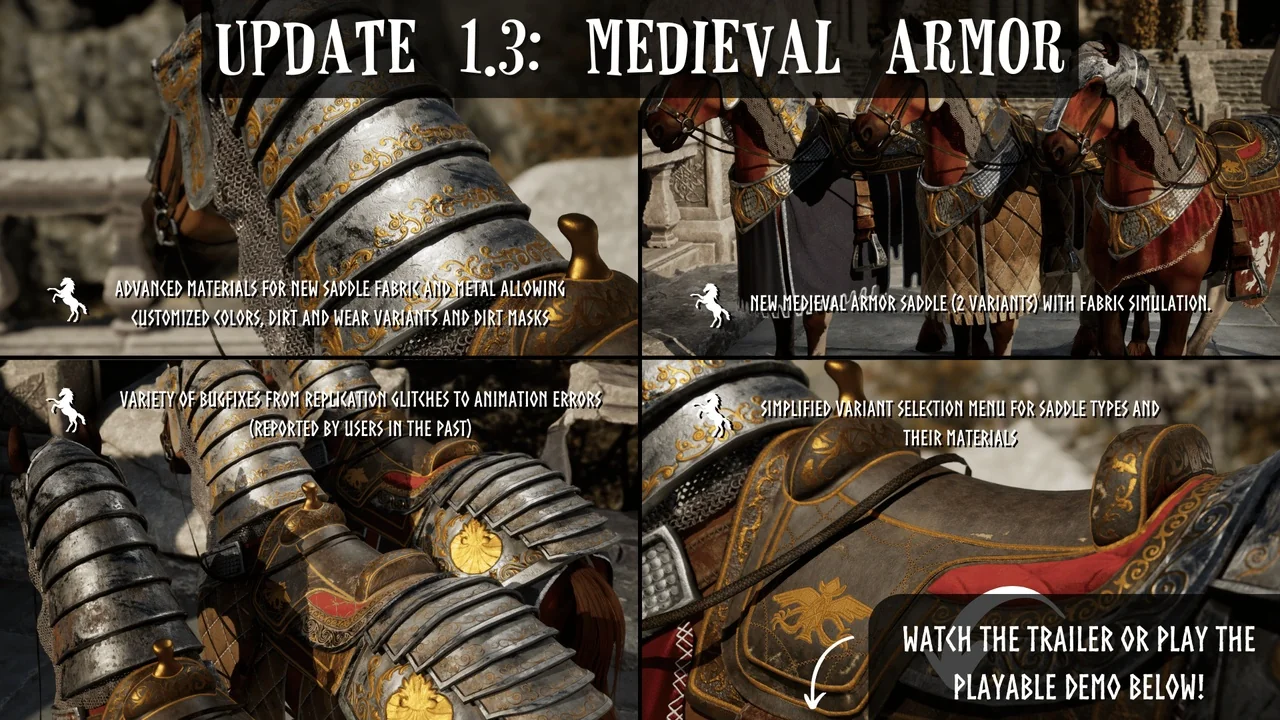
 Gameplay Features
 Gameplay Features
 Gameplay Features