"7b46a695175d8694"{"id":"1001476","slug":"22-zombie-walk-motion-pack-by-jkmotion","title":"22 Zombie Walk Motion Pack by JKMotion","category":"Locomotion / Gaits","engine":"5.0+","assetVersion":"","engineVersion":"Engine Version: 5.0+","tag":"Locomotion / Gaits","accent":"blue","visual":"animation","summary":"Explore the 22 Zombie Walk Motion Pack by JKMotion, featuring 4-step looping walk cycles, linear root motion workflows, and UE4 and UE5 Mannequin support.","platform":"Unreal Engine","publishedAt":"2026-10-08T08:31:59.053Z","updatedAt":"2026-10-08T08:31:59.053Z","sourceNotes":[],"fileContents":[],"compatibility":["Unreal Engine","Engine Version: 5.0+"],"featuredImage":{"alt":"22 Zombie Walk Motion Pack by JKMotion","src":"/wp-content/uploads/published/2026/10/dbe64a96bc86-ae7a8344-a5a3-4b20-a7cd-77a69ebd1d55-5edd0795fc.webp"},"hasDownloadLink":true,"downloads":0,"terms":[{"taxonomy":"category","slug":"locomotion-gaits","name":"Locomotion / Gaits"}],"galleryImages":[{"src":"/wp-content/uploads/published/2026/10/8fc780501c2e-42a173d4-fc03-498c-9a97-65bf2dc99a4a-c5f8e2d0a4.webp","alt":"22 Zombie Walk Motion Pack by JKMotion"},{"src":"/wp-content/uploads/published/2026/10/56311352223f-33b9a938-2754-4e7b-abaa-a8c412b836ec-d59cadec6c.webp","alt":"22 Zombie Walk Motion Pack by JKMotion"},{"src":"/wp-content/uploads/published/2026/10/9a579b9c3d98-0bcdd0a8-5849-4c0e-8b2f-750070cc3014-797506347e.webp","alt":"22 Zombie Walk Motion Pack by JKMotion"},{"src":"/wp-content/uploads/published/2026/10/6181b4328ab4-a0da4f0a-2992-49bb-808c-fa2e4d927ce6-eae6d8ac8e.webp","alt":"22 Zombie Walk Motion Pack by JKMotion"},{"src":"/wp-content/uploads/published/2026/10/3c590f950838-936390e4-ec08-412b-b508-3bbfac74b479-f7b033245a.webp","alt":"22 Zombie Walk Motion Pack by JKMotion"},{"src":"/wp-content/uploads/published/2026/10/974caec8bb39-77d3e647-3d3c-4b68-8cb2-005b31145375-112e651a49.webp","alt":"22 Zombie Walk Motion Pack by JKMotion"},{"src":"/wp-content/uploads/published/2026/10/b0da1e61e2e9-a0f02e26-b5b0-4f61-9d3c-c50472409537-ddfc5534b3.webp","alt":"22 Zombie Walk Motion Pack by JKMotion"},{"src":"/wp-content/uploads/published/2026/10/d9fedf7045cb-702044a0-3f0f-42f3-883d-5b64847894fe-8694a58460.webp","alt":"22 Zombie Walk Motion Pack by JKMotion"},{"src":"/wp-content/uploads/published/2026/10/ac1a29cf67b1-6450fa07-a48b-4d63-a18c-d3c899b42a72-0be59888ad.webp","alt":"22 Zombie Walk Motion Pack by JKMotion"},{"src":"/wp-content/uploads/published/2026/10/355210654f3b-d154be69-f6c7-4840-b536-40738ca2f865-84fe0221b2.webp","alt":"22 Zombie Walk Motion Pack by JKMotion"}],"accessPanel":{"kind":"resource","title":"Download this resource","eyebrow":"Free Download","message":"Log in or create a free account to start your download.","fileName":"Content.7z","safetyNote":"Resources are manually reviewed before listing to improve quality and reduce obvious risks.","actionLabel":"Download Free","resourceType":"Resource archive"},"contentHtml":"\u003cp\u003eA shambling undead horde loses its sense of dread the moment characters step in mechanical unison or glide across terrain with noticeable foot sliding. Undead locomotion requires an erratic, uncoordinated cadence to look unsettling, marked by dragging limbs, uneven balance, and irregular stride intervals. The 22 Zombie Walk Motion Pack targets this specific visual challenge by delivering 22 distinct motion capture walk cycles built to make individual creatures and expansive crowds appear legitimately menacing in real-time environments.\u003c/p\u003e \u003ch2\u003eFour-Step Looping in the 22 Zombie Walk Motion Cycles\u003c/h2\u003e\n\u003cp\u003eStandard humanoid walk cycles in game development often rely on basic two-step loops: one forward movement with the left leg and one with the right. While efficient for disciplined soldiers or standard player avatars, two-step loops quickly reveal artificial repetition when applied to decaying creatures. An uneven gait or dragging foot requires time to complete its cadence before repeating.\u003c/p\u003e \u003cp\u003eMost of the cycles in this pack feature four-step looping. Doubling the step count inside a single loop introduces much higher visual variation into every locomotion cycle. Instead of snapping back to the initial pose after a single stride pair, the character moves through an extended sequence of weight shifts, stumble recoveries, and asymmetrical steps. This extended duration makes the motions appear substantially more dynamic and realistic, effectively masking loop points during prolonged player chases or continuous cinematic tracking shots.\u003c/p\u003e \u003cp\u003eEvery clip in the pack is perfectly looped. The transitions from the end of the fourth step back into the first frame are seamless, preventing pops, snapping limbs, or abrupt hip re-alignments when an animation state loops continuously in a locomotion state machine.\u003c/p\u003e \u003ch2\u003eHandling Foot Sliding with Linear RootMotion Assets\u003c/h2\u003e\n\u003cp\u003eIntegrating walking animations into games generally presents a choice between full root motion—where the animation's root bone drives the in-game capsule velocity—and capsule-driven movement, where game code dictates forward speed while the animation plays in place. Capsule-driven systems often introduce foot sliding when the animation's translation rate drifts away from the programmed movement speed of the character.\u003c/p\u003e \u003cp\u003eThe pack directly addresses this challenge through dedicated assets stored in the \u003ccode\u003eRootmotion_linear\u003c/code\u003e Directory. These animations are tailored for setups where game logic controls movement rather than native root motion, but where foot sliding still needs to be eliminated.\u003c/p\u003e \u003cp\u003eImplementing this workflow involves a precise, straightforward configuration inside the Unreal Engine animation editor:\u003c/p\u003e\n\u003cul\u003e \u003cli\u003eNavigate to the \u003ccode\u003eRootmotion_linear\u003c/code\u003e Folder and open the desired walk animation asset in the animation viewer.\u003c/li\u003e \u003cli\u003eEnable the Force Root Lock check box within the animation settings to prevent the character model from translating away from the capsule origin while playing.\u003c/li\u003e \u003cli\u003eIdentify the linear translation speed of the original root motion data.\u003c/li\u003e \u003cli\u003eSet the zombie character's movement component walk speed to match that exact translation velocity.\u003c/li\u003e\n\u003c/ul\u003e \u003cp\u003eBy locking the root and synchronizing the Character Movement Component's forward velocity with the original recorded travel rate, feet plant firmly against the ground plane without slipping, yielding the visual stability of full root motion within standard capsule navigation.\u003c/p\u003e \u003ch2\u003eRig Compatibility Across UE4 and UE5 Mannequin Skeletons\u003c/h2\u003e\n\u003cp\u003eProjects across different development cycles rely on different skeletal standards. This collection provides native assets configured for both the Unreal Engine 4 Mannequin skeleton and the Unreal Engine 5 Mannequin rig. Having assets pre-saved across both standards simplifies setup, whether working with legacy character setups or the current retargeting pipelines introduced in newer engine releases.\u003c/p\u003e \u003cp\u003eSkeletal accuracy includes specific maintenance for auxiliary bones. An engine update resolved an IKFoot alignment issue on the UE4 Mannequin version, ensuring inverse kinematics setups for foot placement function cleanly without abnormal bone rotations or snapping. This allows secondary foot placement systems, such as ground trace IK on uneven terrain and staircases, to calculate correct offsets directly against the provided walk poses.\u003c/p\u003e \u003ch2\u003eDeployment Across Crowd Navigation and Cinematic Scenes\u003c/h2\u003e\n\u003cp\u003eThe pack serves two distinct production roles: background horde staging and direct in-game locomotion. In background crowd setups, dispersing 22 distinct walk motions across an AI swarm avoids the uniform marching appearance common in mass zombie encounters. Because the animations vary in stride posture, limping severity, and lateral sway, individual actors within the horde maintain visual independence even when traveling along similar navigation paths.\u003c/p\u003e \u003cp\u003eFor cinematic scenes, the continuous four-step motion capture loops provide sufficient duration to stage long camera passes without obvious repetition. The capture data maintains the weight and momentum shifts of real physical movement, preserving the organic dread needed for narrative cutscenes or environmental horror set pieces.\u003c/p\u003e \u003cp\u003eLocomotion cycles represent only one half of character behavioral states. When creatures pause, lurk in corners, or wait for trigger volumes, pairing these walking variations with complementary cycles—such as the creator's 65 Zombie Idle Animation Pack—allows animators to build clean state machines that transition fluidly from restless stationary poses into full-stride pursuing walks.\u003c/p\u003e \u003ch2\u003ePractical Value for Character and Animation Pipelines\u003c/h2\u003e\n\u003cp\u003eTeams building horror games, creature encounters, or cinematic horde sequences gain immediate value from assets that solve technical friction up front. With 22 ready-to-use motions, four-step cadence variations, direct fixes for UE4 IKFoot setups, and an explicit linear root motion configuration to stop foot sliding, the pack provides practical, grounded tools for bringing terrifying undead motion into real-time pipelines.\u003c/p\u003e\n\n\u003ch2\u003eExplore Similar Assets\u003c/h2\u003e\n\u003cul\u003e\n\u003cli\u003e\u003ca href=\"https://3dcghub.com/zombie-movement-and-modular-interaction-animations/\" title=\"Zombie Movement and Modular Interaction Animations\"\u003eZombie Movement and Modular Interaction Animations\u003c/a\u003e\u003c/li\u003e\n\u003cli\u003e\u003ca href=\"https://3dcghub.com/stairs-set/\" title=\"Stairs Set\"\u003eStairs Set\u003c/a\u003e\u003c/li\u003e\n\u003cli\u003e\u003ca href=\"https://3dcghub.com/use-phone/\" title=\"Use Phone\"\u003eUse Phone\u003c/a\u003e\u003c/li\u003e\n\u003cli\u003e\u003ca href=\"https://3dcghub.com/mocap-online-free-animation-pack-unreal-3d-character-animations-for-fab-market/\" title=\"MoCap Online Free Animation Pack | UNREAL 3D Character Animations for FAB Market\"\u003eMoCap Online Free Animation Pack | UNREAL 3D Character Animations for FAB Market\u003c/a\u003e\u003c/li\u003e\n\u003cli\u003e\u003ca href=\"https://3dcghub.com/roll-and-dash-animation/\" title=\"Roll and Dash Animation\"\u003eRoll and Dash Animation\u003c/a\u003e\u003c/li\u003e\n\u003c/ul\u003e","contentTextLength":6205,"navigation":{"current":71,"total":3481,"previous":{"id":"1001477","slug":"cmc-mover-shooter-controller-v2-1","title":"CMC / Mover Shooter Controller v2.1","category":"Shooter","platform":"Unreal Engine","updatedAt":"2026-10-08T08:34:50.839Z"},"next":{"id":"1001475","slug":"ultimate-hit-reaction-system","title":"Ultimate Hit Reaction System","category":"Gameplay Features","platform":"Unreal Engine","updatedAt":"2026-10-08T08:28:50.048Z"}},"relatedResources":[{"id":"1001175","slug":"zombie-movement-and-modular-interaction-animations","title":"Zombie Movement and Modular Interaction Animations","category":"Locomotion / Gaits","engine":"5.0+","assetVersion":"","engineVersion":"Engine Version: 5.0+","tag":"Locomotion / Gaits","accent":"blue","visual":"animation","summary":"Explore Zombie Movement and Modular Interaction Animations, featuring 34 motion clips with wounded locomotion, paired grab sequences, and crawl attacks.","platform":"Unreal Engine","publishedAt":"2026-09-17T03:47:54.048Z","updatedAt":"2026-09-17T03:47:54.048Z","sourceNotes":[],"fileContents":[],"compatibility":["Unreal Engine","Engine Version: 5.0+"],"featuredImage":{"alt":"Zombie Movement and Modular Interaction Animations","src":"/wp-content/uploads/published/2026/09/13eb6b01a562-5c1e2ffa-4ec9-4fab-ae0a-72c010372724-88412b8dd5.webp"},"hasDownloadLink":true,"downloads":2},{"id":"1000889","slug":"stairs-set","title":"Stairs Set","category":"Locomotion / Gaits","engine":"5.0+","assetVersion":"","engineVersion":"Engine Version: 5.0+","tag":"Locomotion / Gaits","accent":"blue","visual":"animation","summary":"Walk and jog stair climbing animations for UE5 Male Mannequin, with Root Motion and In-Place variants, FBX and MotionBuilder source files, and IK bones. 40 file","platform":"Unreal Engine","publishedAt":"2026-08-05T18:23:59.885Z","updatedAt":"2026-08-05T18:23:59.885Z","sourceNotes":[],"fileContents":[],"compatibility":["Unreal Engine","Engine Version: 5.0+"],"featuredImage":{"alt":"Stairs Set","src":"/wp-content/uploads/published/2026/08/1b482e4877cc-cc7bdabb-dd65-4265-9310-b44696bd6e43-2a288748c7.webp"},"hasDownloadLink":true,"downloads":3},{"id":"1001025","slug":"use-phone","title":"Use Phone","category":"Locomotion / Gaits","engine":"5.2+","assetVersion":"","engineVersion":"Engine Version: 5.2+","tag":"Locomotion / Gaits","accent":"blue","visual":"animation","summary":"39 looping Mecanim-compatible humanoid motion capture animations for phone use, covering sit, stand, walk, lie down, and running postures.","platform":"Unreal Engine","publishedAt":"2026-08-23T05:48:40.633Z","updatedAt":"2026-08-23T05:48:40.633Z","sourceNotes":[],"fileContents":[],"compatibility":["Unreal Engine","Engine Version: 5.2+"],"featuredImage":{"alt":"Use Phone","src":"/wp-content/uploads/published/2026/08/c1c79082396c-ff444a7e-f6c1-411f-af02-32371da0e89f-1d1850d52b.webp"},"hasDownloadLink":true,"downloads":1}]}
Locomotion / Gaits
22 Zombie Walk Motion Pack by JKMotion
Explore the 22 Zombie Walk Motion Pack by JKMotion, featuring 4-step looping walk cycles, linear root motion workflows, and UE4 and UE5 Mannequin support.
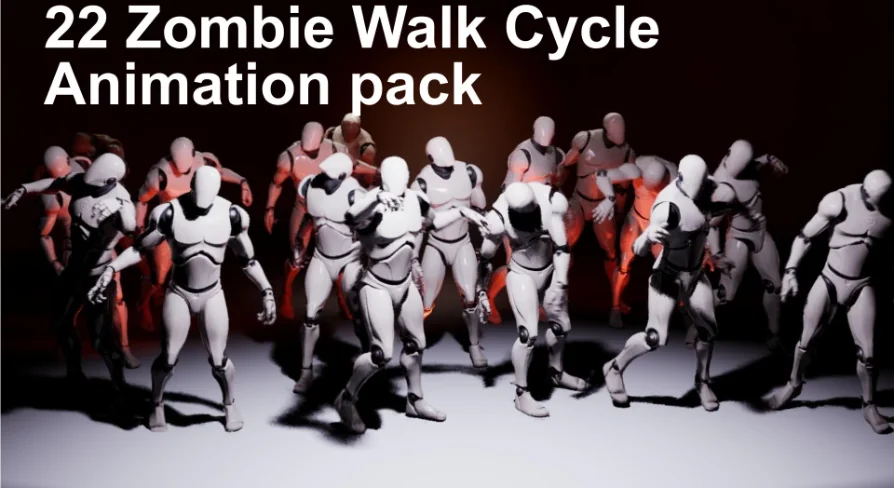
A shambling undead horde loses its sense of dread the moment characters step in mechanical unison or glide across terrain with noticeable foot sliding. Undead locomotion requires an erratic, uncoordinated cadence to look unsettling, marked by dragging limbs, uneven balance, and irregular stride intervals. The 22 Zombie Walk Motion Pack targets this specific visual challenge by delivering 22 distinct motion capture walk cycles built to make individual creatures and expansive crowds appear legitimately menacing in real-time environments.
Four-Step Looping in the 22 Zombie Walk Motion Cycles
Standard humanoid walk cycles in game development often rely on basic two-step loops: one forward movement with the left leg and one with the right. While efficient for disciplined soldiers or standard player avatars, two-step loops quickly reveal artificial repetition when applied to decaying creatures. An uneven gait or dragging foot requires time to complete its cadence before repeating.
Most of the cycles in this pack feature four-step looping. Doubling the step count inside a single loop introduces much higher visual variation into every locomotion cycle. Instead of snapping back to the initial pose after a single stride pair, the character moves through an extended sequence of weight shifts, stumble recoveries, and asymmetrical steps. This extended duration makes the motions appear substantially more dynamic and realistic, effectively masking loop points during prolonged player chases or continuous cinematic tracking shots.
Every clip in the pack is perfectly looped. The transitions from the end of the fourth step back into the first frame are seamless, preventing pops, snapping limbs, or abrupt hip re-alignments when an animation state loops continuously in a locomotion state machine.
Handling Foot Sliding with Linear RootMotion Assets
Integrating walking animations into games generally presents a choice between full root motion—where the animation's root bone drives the in-game capsule velocity—and capsule-driven movement, where game code dictates forward speed while the animation plays in place. Capsule-driven systems often introduce foot sliding when the animation's translation rate drifts away from the programmed movement speed of the character.
The pack directly addresses this challenge through dedicated assets stored in the Rootmotion_linear Directory. These animations are tailored for setups where game logic controls movement rather than native root motion, but where foot sliding still needs to be eliminated.
Implementing this workflow involves a precise, straightforward configuration inside the Unreal Engine animation editor:
Navigate to the Rootmotion_linear Folder and open the desired walk animation asset in the animation viewer.
Enable the Force Root Lock check box within the animation settings to prevent the character model from translating away from the capsule origin while playing.
Identify the linear translation speed of the original root motion data.
Set the zombie character's movement component walk speed to match that exact translation velocity.
By locking the root and synchronizing the Character Movement Component's forward velocity with the original recorded travel rate, feet plant firmly against the ground plane without slipping, yielding the visual stability of full root motion within standard capsule navigation.
Rig Compatibility Across UE4 and UE5 Mannequin Skeletons
Projects across different development cycles rely on different skeletal standards. This collection provides native assets configured for both the Unreal Engine 4 Mannequin skeleton and the Unreal Engine 5 Mannequin rig. Having assets pre-saved across both standards simplifies setup, whether working with legacy character setups or the current retargeting pipelines introduced in newer engine releases.
Skeletal accuracy includes specific maintenance for auxiliary bones. An engine update resolved an IKFoot alignment issue on the UE4 Mannequin version, ensuring inverse kinematics setups for foot placement function cleanly without abnormal bone rotations or snapping. This allows secondary foot placement systems, such as ground trace IK on uneven terrain and staircases, to calculate correct offsets directly against the provided walk poses.
Deployment Across Crowd Navigation and Cinematic Scenes
The pack serves two distinct production roles: background horde staging and direct in-game locomotion. In background crowd setups, dispersing 22 distinct walk motions across an AI swarm avoids the uniform marching appearance common in mass zombie encounters. Because the animations vary in stride posture, limping severity, and lateral sway, individual actors within the horde maintain visual independence even when traveling along similar navigation paths.
For cinematic scenes, the continuous four-step motion capture loops provide sufficient duration to stage long camera passes without obvious repetition. The capture data maintains the weight and momentum shifts of real physical movement, preserving the organic dread needed for narrative cutscenes or environmental horror set pieces.
Locomotion cycles represent only one half of character behavioral states. When creatures pause, lurk in corners, or wait for trigger volumes, pairing these walking variations with complementary cycles—such as the creator's 65 Zombie Idle Animation Pack—allows animators to build clean state machines that transition fluidly from restless stationary poses into full-stride pursuing walks.
Practical Value for Character and Animation Pipelines
Teams building horror games, creature encounters, or cinematic horde sequences gain immediate value from assets that solve technical friction up front. With 22 ready-to-use motions, four-step cadence variations, direct fixes for UE4 IKFoot setups, and an explicit linear root motion configuration to stop foot sliding, the pack provides practical, grounded tools for bringing terrifying undead motion into real-time pipelines.
 Locomotion / Gaits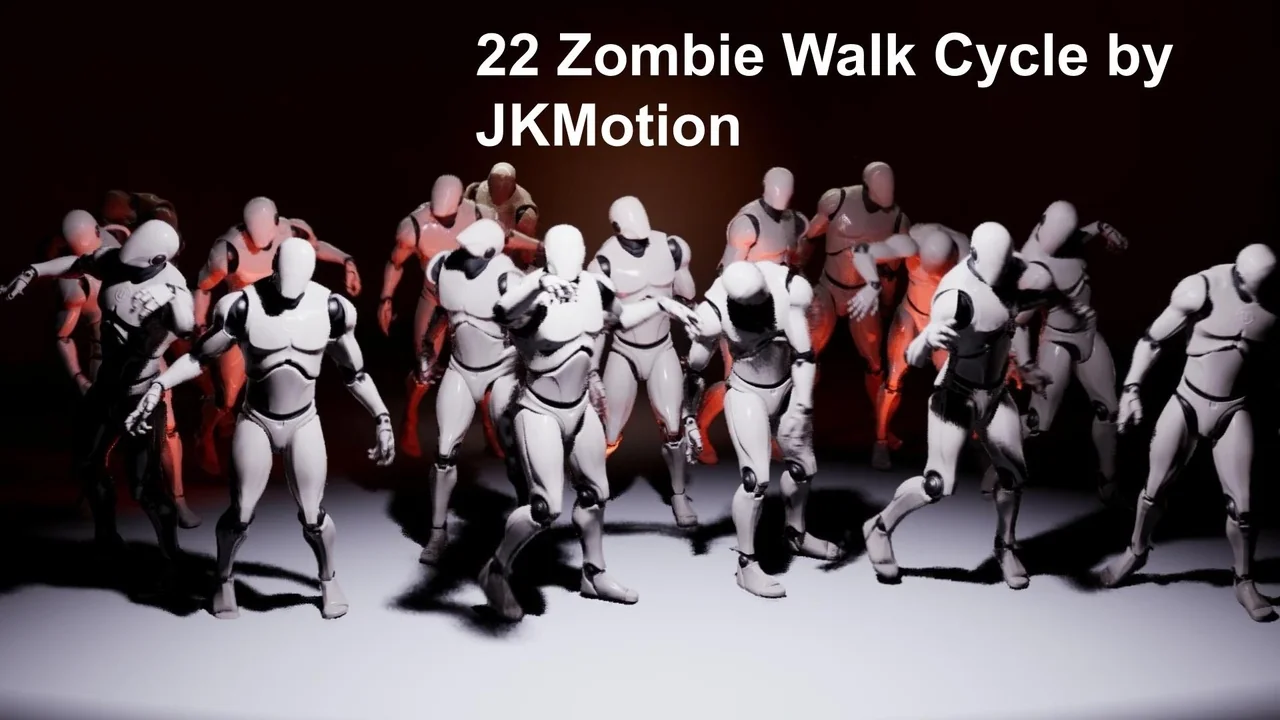
 Locomotion / Gaits
 Locomotion / Gaits
 Locomotion / Gaits