"7b46a695175d8694"{"id":"1001477","slug":"cmc-mover-shooter-controller-v2-1","title":"CMC / Mover Shooter Controller v2.1","category":"Shooter","engine":"5.7+","assetVersion":"","engineVersion":"Engine Version: 5.7+","tag":"Shooter","accent":"blue","visual":"mech","summary":"Explore the CMC / Mover Shooter Controller v2.1, featuring dual locomotion architecture, GASP compatibility, modular inventory, and authority-based revival.","platform":"Unreal Engine","publishedAt":"2026-10-08T08:34:50.839Z","updatedAt":"2026-10-08T08:34:50.839Z","sourceNotes":[],"fileContents":[],"compatibility":["Unreal Engine","Engine Version: 5.7+"],"featuredImage":{"alt":"CMC / Mover Shooter Controller v2.1","src":"/wp-content/uploads/published/2026/10/10c3e270da90-89bad21e-de41-4655-b551-51533b247c25-8dc25de595.webp"},"hasDownloadLink":true,"downloads":1,"terms":[{"taxonomy":"category","slug":"shooter","name":"Shooter"}],"galleryImages":[{"src":"/wp-content/uploads/published/2026/10/b7402a719838-cd4e05ed-4436-45dd-aa68-82d784719263-a903d1e87f.webp","alt":"CMC / Mover Shooter Controller v2.1"},{"src":"/wp-content/uploads/published/2026/10/1a6f2dc8c088-4d57b1bc-a570-492a-a41f-18b54221a201-5814d1d472.webp","alt":"CMC / Mover Shooter Controller v2.1"},{"src":"/wp-content/uploads/published/2026/10/7e9443598e56-46863be9-bf3e-42bf-a08f-12fd8e463af4-580c83865d.webp","alt":"CMC / Mover Shooter Controller v2.1"},{"src":"/wp-content/uploads/published/2026/10/0073927fbbc1-1c3d5c3f-604f-44d3-93d9-3e01490e34b1-442af24517.webp","alt":"CMC / Mover Shooter Controller v2.1"},{"src":"/wp-content/uploads/published/2026/10/a2a4d0b8c0eb-4b179d15-432c-4d13-bdfa-cc45f6847790-9dc37a97ca.webp","alt":"CMC / Mover Shooter Controller v2.1"},{"src":"/wp-content/uploads/published/2026/10/3a05e9f2e6dc-d5b07f74-576b-4bf4-9692-82aa8680ced9-859b0430cc.webp","alt":"CMC / Mover Shooter Controller v2.1"},{"src":"/wp-content/uploads/published/2026/10/cf51044e92b7-8d51aeff-5331-4656-abe6-d0658676cada-cc8e61db7f.webp","alt":"CMC / Mover Shooter Controller v2.1"},{"src":"/wp-content/uploads/published/2026/10/7a62aaf0a8a2-f44d4807-a7ca-41a6-b4be-21eec5d4c69d-1c286ddf38.webp","alt":"CMC / Mover Shooter Controller v2.1"},{"src":"/wp-content/uploads/published/2026/10/b3e7336c6f1e-7b8c027b-0aab-4f98-8328-d1387f17a0e7-db75f383b2.webp","alt":"CMC / Mover Shooter Controller v2.1"}],"accessPanel":{"kind":"resource","title":"Download this resource","eyebrow":"Free Download","message":"Log in or create a free account to start your download.","fileName":"CMC Mover Shooter Controller v2.1.7z","safetyNote":"Resources are manually reviewed before listing to improve quality and reduce obvious risks.","actionLabel":"Download Free","resourceType":"Resource archive"},"contentHtml":"\u003cp\u003eThird-person tactical arenas, cover-to-cover combat zones, and sprawling multiplayer battlegrounds require solid character control long before visual polish begins. Building these spaces demands responsive movement, synchronized weapons, and steady network replication that can survive intense firefights. CMC / Mover Shooter Controller v2.1 targets this production phase directly, providing a pre-configured architecture designed to bypass the repetitive setup of low-level shooter mechanics.\u003c/p\u003e \u003ch2\u003eDual Locomotion Foundations: Character Movement Component and Mover System\u003c/h2\u003e\n\u003cp\u003eLocomotion handling forms the backbone of any responsive shooter, yet modern development frequently bridges two distinct paradigms. Projects must balance the proven, legacy Character Movement Component (CMC) against the modular architecture of the newer Mover system. This controller resolves that division by providing native support for both frameworks simultaneously within a unified Blueprints toolkit.\u003c/p\u003e\n\u003cp\u003eBy accommodating both CMC and the Mover framework, the template gives teams freedom over their locomotion layer. Developers can maintain standard network prediction routines through the classic CMC setup or transition toward the data-driven decoupling offered by the Mover component. Because the underlying network synchronization is already replicated and organized across both systems, the character retains expected movement fidelity, turn rates, and velocity handling regardless of which movement backbone is selected for the project.\u003c/p\u003e \u003ch2\u003ePreserving GASP Features and Project Structure\u003c/h2\u003e\n\u003cp\u003eA persistent risk when integrating third-party controller templates is the disruption of existing animation logic and directory structures. This template bypasses common refactoring hurdles by retaining direct compatibility with base GASP features. Teams integrating the setup do not need to rewrite base locomotion states, dismantle existing state machines, or reconfigure underlying animation blueprints.\u003c/p\u003e\n\u003cp\u003eNon-destructive integration extends directly to the asset tree. The file naming conventions and original folder layout are deliberately preserved, preventing conflicts when importing the toolkit into active development repositories. Because integration does not demand fundamental logic alterations, the controller drops cleanly into current production pipelines without breaking downstream dependencies or invalidating established object references.\u003c/p\u003e \u003ch2\u003eInventory Framework, Multi-Grenade Systems, and Combat Pickups\u003c/h2\u003e\n\u003cp\u003eThe controller moves beyond pure locomotion to establish an active combat loop through a modular inventory framework. Rather than restricting equipment to basic weapon slots, the inventory system organizes items into distinct operational classes:\u003c/p\u003e\n\u003cul\u003e \u003cli\u003e\u003cstrong\u003eWeapons and Attachments:\u003c/strong\u003e Replicated handling for primary and secondary firearms alongside dedicated weapon accessory states.\u003c/li\u003e \u003cli\u003e\u003cstrong\u003eMulti-Grenade Support:\u003c/strong\u003e A dedicated ordinance pipeline capable of managing varying throwable types, trajectory setups, and detonation behaviors.\u003c/li\u003e \u003cli\u003e\u003cstrong\u003eAmmo Reserves and Munition Boxes:\u003c/strong\u003e Dedicated ammunition pooling paired with interactive in-world containers for field replenishment.\u003c/li\u003e \u003cli\u003e\u003cstrong\u003eConsumables:\u003c/strong\u003e Inventory slots structured to govern player recovery items, field supplies, and contextual gear.\u003c/li\u003e\n\u003c/ul\u003e\n\u003cp\u003eField interaction is supported through functional weapon pickups and interactive munition boxes, backed by detailed equipment models included directly in the template. These elements allow a project to deploy an immediate gameplay loop encompassing looting, reloading, throwable deployment, and gear cycling with no supplementary gameplay frameworks required.\u003c/p\u003e \u003ch2\u003eReplicated Health Architecture and Authority-Based Revival\u003c/h2\u003e\n\u003cp\u003eCompetitive and cooperative third-person shooters hinge heavily on accurate hit registration and life-state management. The health and damage architecture in this toolkit is engineered around strict server-authoritative rules. Damage calculation, status tracking, and player downing resolve on the server to prevent synchronization mismatches or state desync during high-frequency firefights.\u003c/p\u003e\n\u003cp\u003eIntegrated authority-based revival builds directly upon this damage pipeline. When a player’s health drops to zero, the controller handles the transition into a downed state, manages interactable triage logic, and executes full character revival strictly under host authority. This structure guarantees that down-and-revive mechanics integrate reliably into multiplayer match flows without client-side exploitation or interrupted state replication.\u003c/p\u003e \u003ch2\u003eEvaluating Implementation in Third-Person Shooter Projects\u003c/h2\u003e\n\u003cp\u003eDeploying CMC / Mover Shooter Controller v2.1 is most practical for teams initiating a new third-person shooter or those refactoring an existing project to utilize modern multiplayer standards. The modular blueprint organization allows specific sub-systems—such as the multi-grenade logic, weapon pickup framework, or authority-based health states—to be isolated or customized independently from the locomotion controllers.\u003c/p\u003e\n\u003cp\u003eBecause the template bridges established Character Movement workflows with the evolving Mover paradigm while leaving base GASP configurations intact, it operates as an adaptable production scaffold. Teams can focus engineering hours on distinct weapon tuning, creative game modes, and custom interaction design rather than rebuilding fundamental multiplayer locomotion and inventory infrastructure from scratch.\u003c/p\u003e\n\n\u003ch2\u003eExplore Similar Assets\u003c/h2\u003e\n\u003cul\u003e\n\u003cli\u003e\u003ca href=\"https://3dcghub.com/fps-multiplayer-controller/\" title=\"FPS Multiplayer Controller\"\u003eFPS Multiplayer Controller\u003c/a\u003e\u003c/li\u003e\n\u003cli\u003e\u003ca href=\"https://3dcghub.com/first-person-shooter-kit/\" title=\"First Person Shooter Kit\"\u003eFirst Person Shooter Kit\u003c/a\u003e\u003c/li\u003e\n\u003cli\u003e\u003ca href=\"https://3dcghub.com/zombie-shooter-kit-v2-12-unreal-engine-5-starter-pack/\" title=\"Zombie Shooter Kit v2.12 - UNREAL ENGINE 5 Starter Pack\"\u003eZombie Shooter Kit v2.12 - UNREAL ENGINE 5 Starter Pack\u003c/a\u003e\u003c/li\u003e\n\u003cli\u003e\u003ca href=\"https://3dcghub.com/advanced-third-person-shooter-project/\" title=\"Advanced Third Person Shooter Project\"\u003eAdvanced Third Person Shooter Project\u003c/a\u003e\u003c/li\u003e\n\u003cli\u003e\u003ca href=\"https://3dcghub.com/fps-multiplayer-shooter-v3/\" title=\"FPS Multiplayer shooter v3\"\u003eFPS Multiplayer shooter v3\u003c/a\u003e\u003c/li\u003e\n\u003c/ul\u003e","contentTextLength":5592,"navigation":{"current":70,"total":3481,"previous":{"id":"1001478","slug":"dual-sword-animation-pack","title":"Dual Sword Animation Pack","category":"Combat","platform":"Unreal Engine","updatedAt":"2026-10-08T08:41:55.140Z"},"next":{"id":"1001476","slug":"22-zombie-walk-motion-pack-by-jkmotion","title":"22 Zombie Walk Motion Pack by JKMotion","category":"Locomotion / Gaits","platform":"Unreal Engine","updatedAt":"2026-10-08T08:31:59.053Z"}},"relatedResources":[{"id":"1001436","slug":"fps-multiplayer-controller","title":"FPS Multiplayer Controller","category":"Shooter","engine":"5.4+","assetVersion":"","engineVersion":"Engine Version: 5.4+","tag":"Shooter","accent":"blue","visual":"mech","summary":"Build networked first-person shooters in Unreal Engine 5 with replicated weapons, MetaHuman animation support, dynamic gun handling, and loadout benches.","platform":"Unreal Engine","publishedAt":"2026-10-07T08:29:53.920Z","updatedAt":"2026-10-07T08:29:53.920Z","sourceNotes":[],"fileContents":[],"compatibility":["Unreal Engine","Engine Version: 5.4+"],"featuredImage":{"alt":"FPS Multiplayer Controller","src":"/wp-content/uploads/published/2026/10/541757ac162a-b8b106b4-85dc-43f2-b340-a4517862fe57-13e6e45d73.webp"},"hasDownloadLink":true,"downloads":0},{"id":"12018","slug":"first-person-shooter-kit","title":"First Person Shooter Kit","category":"Shooter","engine":"5.6+","assetVersion":"Engine version: 5.6+","engineVersion":"4.20","tag":"Shooter","accent":"blue","visual":"animation","summary":"Build professional action games with the First Person Shooter Kit. This framework offers advanced weapon handling, diverse game modes, and full controller support for modern developers.","platform":"Unreal Engine","publishedAt":"2026-03-06T16:31:06.000Z","updatedAt":"2026-04-19T15:48:04.000Z","sourceNotes":[],"fileContents":[],"compatibility":["Unreal Engine"],"featuredImage":{"alt":"First Person Shooter Kit","src":"https://3dcghub.com/wp-content/uploads/2026/03/d20df2f2-9803-4f72-8759-6751667a2a51.webp"},"hasDownloadLink":true,"downloads":1},{"id":"1001097","slug":"zombie-shooter-kit-v2-12-unreal-engine-5-starter-pack","title":"Zombie Shooter Kit v2.12 - UNREAL ENGINE 5 Starter Pack","category":"Shooter","engine":"5.7+","assetVersion":"Asset Version: 2.11","engineVersion":"Engine Version: 5.7+","tag":"Shooter","accent":"blue","visual":"mech","summary":"Blueprint-based UE5 starter for survival shooters: replicated multiplayer, zombies and human AI, jigsaw inventory, crafting, vehicles, weather, and G.A.S.P. Loc","platform":"Unreal Engine","publishedAt":"2026-09-06T02:45:34.766Z","updatedAt":"2026-09-06T02:45:34.766Z","sourceNotes":[],"fileContents":[],"compatibility":["Unreal Engine","Asset Version: 2.11","Engine Version: 5.7+"],"featuredImage":{"alt":"Zombie Shooter Kit v2.12 - UNREAL ENGINE 5 Starter Pack","src":"/wp-content/uploads/published/2026/09/1d7d8e00baab-vqwonz-9f5e01b28f.webp"},"hasDownloadLink":true,"downloads":10}]}
Shooter
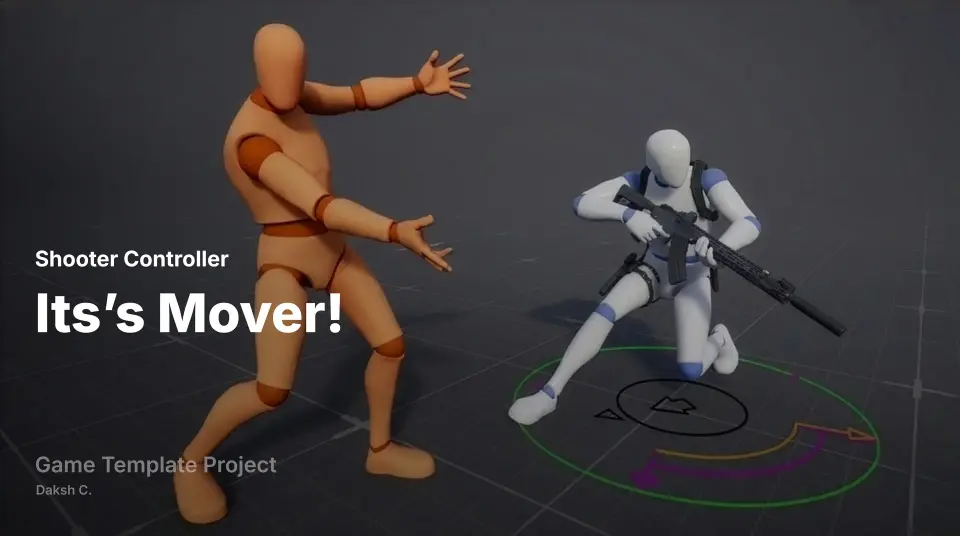
CMC / Mover Shooter Controller v2.1
Explore the CMC / Mover Shooter Controller v2.1, featuring dual locomotion architecture, GASP compatibility, modular inventory, and authority-based revival.
Category:Unreal Engine,ShooterPlatform: Unreal EngineEngine Version: 5.7+Published: Oct 8, 2026
Shooter
Resource overview
Third-person tactical arenas, cover-to-cover combat zones, and sprawling multiplayer battlegrounds require solid character control long before visual polish begins. Building these spaces demands responsive movement, synchronized weapons, and steady network replication that can survive intense firefights. CMC / Mover Shooter Controller v2.1 targets this production phase directly, providing a pre-configured architecture designed to bypass the repetitive setup of low-level shooter mechanics.
Dual Locomotion Foundations: Character Movement Component and Mover System
Locomotion handling forms the backbone of any responsive shooter, yet modern development frequently bridges two distinct paradigms. Projects must balance the proven, legacy Character Movement Component (CMC) against the modular architecture of the newer Mover system. This controller resolves that division by providing native support for both frameworks simultaneously within a unified Blueprints toolkit.
By accommodating both CMC and the Mover framework, the template gives teams freedom over their locomotion layer. Developers can maintain standard network prediction routines through the classic CMC setup or transition toward the data-driven decoupling offered by the Mover component. Because the underlying network synchronization is already replicated and organized across both systems, the character retains expected movement fidelity, turn rates, and velocity handling regardless of which movement backbone is selected for the project.
Preserving GASP Features and Project Structure
A persistent risk when integrating third-party controller templates is the disruption of existing animation logic and directory structures. This template bypasses common refactoring hurdles by retaining direct compatibility with base GASP features. Teams integrating the setup do not need to rewrite base locomotion states, dismantle existing state machines, or reconfigure underlying animation blueprints.
Non-destructive integration extends directly to the asset tree. The file naming conventions and original folder layout are deliberately preserved, preventing conflicts when importing the toolkit into active development repositories. Because integration does not demand fundamental logic alterations, the controller drops cleanly into current production pipelines without breaking downstream dependencies or invalidating established object references.
Inventory Framework, Multi-Grenade Systems, and Combat Pickups
The controller moves beyond pure locomotion to establish an active combat loop through a modular inventory framework. Rather than restricting equipment to basic weapon slots, the inventory system organizes items into distinct operational classes:
Weapons and Attachments: Replicated handling for primary and secondary firearms alongside dedicated weapon accessory states.
Multi-Grenade Support: A dedicated ordinance pipeline capable of managing varying throwable types, trajectory setups, and detonation behaviors.
Ammo Reserves and Munition Boxes: Dedicated ammunition pooling paired with interactive in-world containers for field replenishment.
Consumables: Inventory slots structured to govern player recovery items, field supplies, and contextual gear.
Field interaction is supported through functional weapon pickups and interactive munition boxes, backed by detailed equipment models included directly in the template. These elements allow a project to deploy an immediate gameplay loop encompassing looting, reloading, throwable deployment, and gear cycling with no supplementary gameplay frameworks required.
Replicated Health Architecture and Authority-Based Revival
Competitive and cooperative third-person shooters hinge heavily on accurate hit registration and life-state management. The health and damage architecture in this toolkit is engineered around strict server-authoritative rules. Damage calculation, status tracking, and player downing resolve on the server to prevent synchronization mismatches or state desync during high-frequency firefights.
Integrated authority-based revival builds directly upon this damage pipeline. When a player’s health drops to zero, the controller handles the transition into a downed state, manages interactable triage logic, and executes full character revival strictly under host authority. This structure guarantees that down-and-revive mechanics integrate reliably into multiplayer match flows without client-side exploitation or interrupted state replication.
Evaluating Implementation in Third-Person Shooter Projects
Deploying CMC / Mover Shooter Controller v2.1 is most practical for teams initiating a new third-person shooter or those refactoring an existing project to utilize modern multiplayer standards. The modular blueprint organization allows specific sub-systems—such as the multi-grenade logic, weapon pickup framework, or authority-based health states—to be isolated or customized independently from the locomotion controllers.
Because the template bridges established Character Movement workflows with the evolving Mover paradigm while leaving base GASP configurations intact, it operates as an adaptable production scaffold. Teams can focus engineering hours on distinct weapon tuning, creative game modes, and custom interaction design rather than rebuilding fundamental multiplayer locomotion and inventory infrastructure from scratch.
 Shooter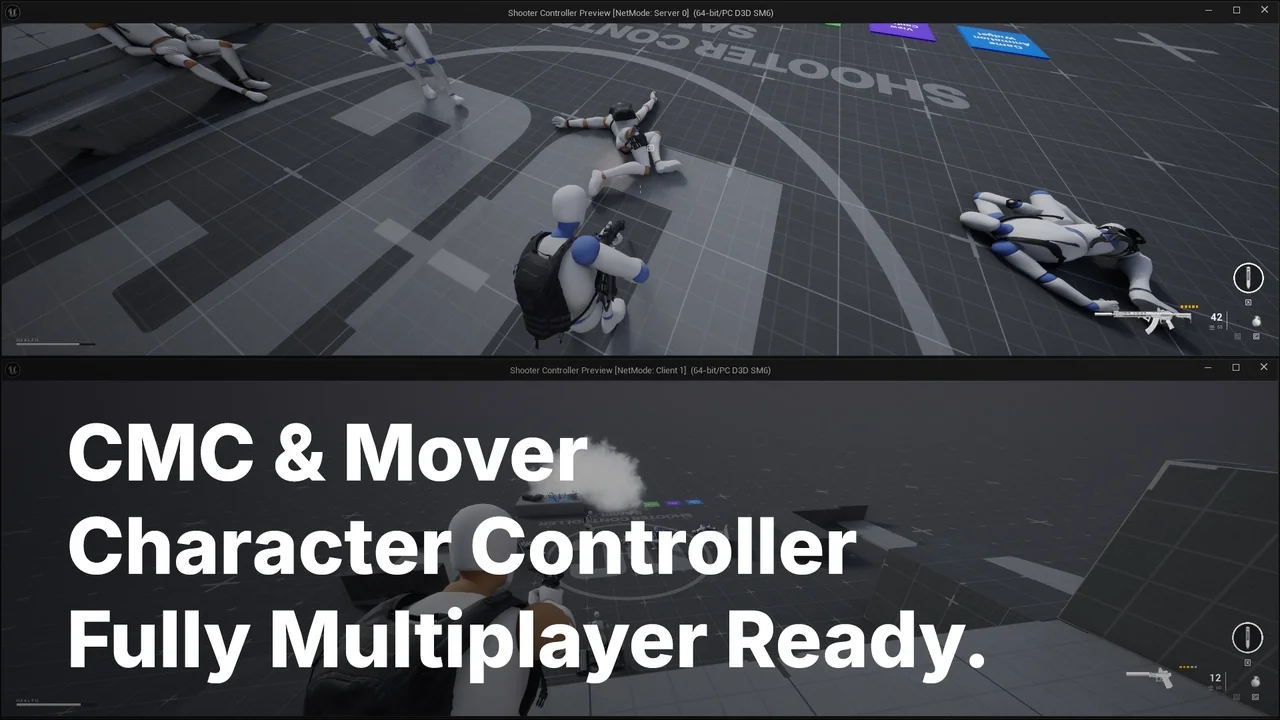
 Shooter
 Shooter
 Shooter