"7b46a695175d8694"{"id":"1001491","slug":"vr-hands-grab-system-legacy-version","title":"VR Hands Grab System (Legacy version)","category":"Weapons \u0026 Combat","engine":"5.1+","assetVersion":"","engineVersion":"Engine Version: 5.1+","tag":"Weapons \u0026 Combat","accent":"blue","visual":"mech","summary":"Explore the VR Hands Grab System for Unreal Engine, featuring procedural finger position prediction, throwable items, and template migration workflows.","platform":"Unreal Engine","publishedAt":"2026-10-08T10:07:52.665Z","updatedAt":"2026-10-08T10:07:52.665Z","sourceNotes":[],"fileContents":[],"compatibility":["Unreal Engine","Engine Version: 5.1+"],"featuredImage":{"alt":"VR Hands Grab System (Legacy version)","src":"/wp-content/uploads/published/2026/10/cff0c5141d78-3c74e371-3ed1-4a16-92dd-508b486ee9c9-afb9ea9b79.webp"},"hasDownloadLink":true,"downloads":0,"terms":[{"taxonomy":"category","slug":"weapons-and-combat","name":"Weapons \u0026 Combat"}],"galleryImages":[{"src":"/wp-content/uploads/published/2026/10/3da8f051415a-a17be277-07f1-4d33-aeaa-4037647b8fa7-be495d9f6d.webp","alt":"VR Hands Grab System (Legacy version)"},{"src":"/wp-content/uploads/published/2026/10/0151a44e8653-4302b280-114d-428d-b4ba-8f97e2f312cb-09ed906baf.webp","alt":"VR Hands Grab System (Legacy version)"},{"src":"/wp-content/uploads/published/2026/10/723e6ceafd4f-a8699b08-5532-4eb6-9d33-65a5199e42c4-69979da29f.webp","alt":"VR Hands Grab System (Legacy version)"},{"src":"/wp-content/uploads/published/2026/10/cba12b90d08c-f89818d8-aaf8-4a54-9710-c64ce5da5288-1a5aed09d4.webp","alt":"VR Hands Grab System (Legacy version)"},{"src":"/wp-content/uploads/published/2026/10/4777a3acf8b2-da3d5df5-cfbb-461a-b2e1-17e825df2ed4-00f64fb6b0.webp","alt":"VR Hands Grab System (Legacy version)"},{"src":"/wp-content/uploads/published/2026/10/3fe6207c2b07-43f221a1-0c4c-40e0-bc98-0e0935215127-924c39a894.webp","alt":"VR Hands Grab System (Legacy version)"},{"src":"/wp-content/uploads/published/2026/10/a7bee779169e-336239c6-50b2-4c5d-81cb-c9bd8eb02ca3-01cf683a5d.webp","alt":"VR Hands Grab System (Legacy version)"},{"src":"/wp-content/uploads/published/2026/10/94875e640e11-a935a972-0294-45d4-ba37-38faf8309ff1-d7088f041b.webp","alt":"VR Hands Grab System (Legacy version)"},{"src":"/wp-content/uploads/published/2026/10/419ea85ddaf6-f0a44dde-737c-4162-8fa6-9e076680251b-7f2f5881b2.webp","alt":"VR Hands Grab System (Legacy version)"},{"src":"/wp-content/uploads/published/2026/10/3f499e4bbbae-c4584a40-aa1a-4d66-9c46-e9547fd3c644-d00e72a9d3.webp","alt":"VR Hands Grab System (Legacy version)"}],"accessPanel":{"kind":"resource","title":"Download this resource","eyebrow":"Free Download","message":"Log in or create a free account to start your download.","fileName":"VR Hands Grab System (Legacy version).7z","safetyNote":"Resources are manually reviewed before listing to improve quality and reduce obvious risks.","actionLabel":"Download Free","resourceType":"Resource archive"},"contentHtml":"\u003ch2\u003eHand Animation Bottlenecks in VR Game Development\u003c/h2\u003e\u003cp\u003eVirtual reality titles rely heavily on physical object handling to establish player presence. In conventional VR development pipelines, supporting even a modest arsenal of interactive props demands a grueling animation workload. Every weapon, handle, switch, and throwable tool traditionally requires custom skeletal mesh keyframes or discrete hand pose sockets tailored to specific geometric contours. When a player reaches for a distinct hilt or spherical canister, the hand model must conform convincingly to the surface without clipping or floating awkwardly in space.\u003c/p\u003e\u003cp\u003eThis manual workflow scales poorly as prop counts expand. Crafting and testing unique hand poses for dozens of individual assets consumes time that could otherwise be spent tuning gameplay logic, physics responses, or level design. Systems capable of dynamic surface adaptation remove that production barrier entirely. By shifting interaction from pre-baked skeletal animations to real-time spatial calculations, developers can integrate interactive props directly into a project without tasking 3D animators with endless hand-keyframing routines.\u003c/p\u003e\u003ch2\u003eFinger Position Prediction via the Grab Component\u003c/h2\u003e\u003cp\u003eAt the center of this framework is the dedicated Grab Component. When a player's virtual hand approaches an interactive mesh, the component predicts finger placement dynamically against the object's surface contours. Instead of switching between static pose states, the system reads the collision geometry of the targeted object and positions the digital fingers to match where they naturally make contact.\u003c/p\u003e\u003cp\u003eThis automated surface resolution significantly accelerates project timelines. When an item is tagged or configured with the grab system, the Blueprint script handles digit conformation upon pickup. The core objective is eliminating the requirement to build bespoke hand poses for individual items. Whether an object features flat bevels, curved surfaces, or irregular mechanical seams, the Grab Component calculates the interaction dynamically. This gives a consistent tactile interaction that maintains physical coherence without bloating the project's animation asset library.\u003c/p\u003e\u003ch2\u003eThrowable Items and Spinning Assist Implementation\u003c/h2\u003e\u003cp\u003eDynamic grabbing is only one half of physics-driven interaction; releasing and throwing items presents its own set of technical hurdles in virtual reality. Weapon handling in VR frequently struggles with release velocity calculations, often causing thrown weapons to tumble haphazardly or miss player intentions due to hardware latency or erratic controller tracking.\u003c/p\u003e\u003cp\u003eTo address this challenge directly, the system incorporates specialized logic for throwable items. Both the included axe and knife examples come equipped with a built-in spinning assist mechanic. When thrown, the script stabilizes weapon rotation along its expected ballistic path, helping blades rotate cleanly toward targets in a predictable arc. For experiences targeting strict simulation standards or advanced skill ceilings, this rotation aid can be completely disabled. Turning off spinning assist allows hardcore knife and axe throwers to rely purely on unassisted physics and manual release momentum.\u003c/p\u003e\u003ch2\u003eInteractive Prop Logic: Axes, Knives, Grenades, Guns, and Levers\u003c/h2\u003e\u003cp\u003eTo demonstrate the versatility of the Grab Component across different interaction paradigms, the package includes five functional example items:\u003c/p\u003e\u003cul\u003e\u003cli\u003e\u003cstrong\u003eAxe:\u003c/strong\u003e Serves as a heavy throwable tool, balanced to showcase dynamic grip placement and directional spinning assist behavior during flight.\u003c/li\u003e\u003cli\u003e\u003cstrong\u003eKnife:\u003c/strong\u003e Functions as a lightweight throwable blade, configured for rapid handling, precision release, and togglable rotational aid.\u003c/li\u003e\u003cli\u003e\u003cstrong\u003eGrenade:\u003c/strong\u003e Demonstrates spherical and rounded prop grasping, showcasing how finger tips conform around curved surfaces without manual pose keyframing.\u003c/li\u003e\u003cli\u003e\u003cstrong\u003eGun:\u003c/strong\u003e Represents handheld firearm ergonomics, providing a reference for static directional grips and pointing orientation in VR space.\u003c/li\u003e\u003cli\u003e\u003cstrong\u003eLever:\u003c/strong\u003e Illustrates constrained mechanical manipulation, demonstrating how dynamic hand placement functions when interacting with anchored, non-throwable scene elements.\u003c/li\u003e\u003c/ul\u003e\u003cp\u003eThese props cover the primary functional archetypes found in virtual reality gameplay: sharp throwables, handheld projectile weapons, rounded utility explosives, and static physical controls. Rather than serving merely as visual placeholders, they validate how the underlying Blueprint scripts handle both free-floating physics bodies and fixed mechanical hinges.\u003c/p\u003e\u003ch2\u003eVR Template Migration from UE 4.26 to UE 5.4\u003c/h2\u003e\u003cp\u003eBecause engine versions introduce major architectural updates to input systems and rendering pipelines, maintaining interaction stability across engine generations is crucial. This package provides structured migration paths supported by video tutorials spanning several distinct Unreal Engine VR templates.\u003c/p\u003e\u003cp\u003eDevelopers can integrate the setup directly into older projects using the migration workflow for the Unreal Engine 4.26 VR Template. For teams transitioning to modern architectures, separate migration guidance is provided for Unreal Engine 4.27 and early Unreal Engine 5 environments. Further documentation covers updates through Unreal Engine 5.3 and Unreal Engine 5.4, allowing teams to move the Blueprint logic smoothly into recent project setups.\u003c/p\u003e\u003cp\u003eAs VR interaction frameworks evolve toward advanced systems—including modern OpenXR plugin compliance and comprehensive procedural weapon mechanics featuring projectile visual effects and reloading cycles—the foundational logic of dynamic finger prediction remains essential. Understanding how the Grab Component bridges legacy 4.26 architectures and modern UE5 standards allows technical designers to build resilient physical interfaces without rewriting core input logic from scratch.\u003c/p\u003e\u003ch2\u003eWorkflows Benefiting from the VR Hands Grab System\u003c/h2\u003e\u003cp\u003eThe VR Hands Grab System serves technical designers, solo developers, and prototyping teams who need robust physical interactions without the overhead of dedicated 3D animation departments. When building combat sandboxes, escape rooms, or puzzle environments filled with diverse props, manually rigging hand poses for every unique lever or blade is an inefficient use of resources.\u003c/p\u003e\u003cp\u003eBy utilizing automatic finger prediction alongside customizable throwing assists, creators can drop interactive props into Unreal Engine scenes and achieve immediate, functional physical feedback. The included examples and multi-version migration paths make it a practical Blueprint framework for testing physics interactions, accelerating iteration times, and establishing tactile VR gameplay mechanics.\u003c/p\u003e\n\n\u003ch2\u003eExplore Similar Assets\u003c/h2\u003e\n\u003cul\u003e\n\u003cli\u003e\u003ca href=\"https://3dcghub.com/weapon-kit/\" title=\"Weapon Kit\"\u003eWeapon Kit\u003c/a\u003e\u003c/li\u003e\n\u003cli\u003e\u003ca href=\"https://3dcghub.com/medieval-weapons-bundle-medieval-weapons-melee-weapons-fantasy-weapons/\" title=\"Medieval Weapons Bundle (Medieval Weapons, Melee Weapons, Fantasy Weapons)\"\u003eMedieval Weapons Bundle (Medieval Weapons, Melee Weapons, Fantasy Weapons)\u003c/a\u003e\u003c/li\u003e\n\u003cli\u003e\u003ca href=\"https://3dcghub.com/handy-hands-pack-vr-hands-megapack/\" title=\"Handy Hands Pack - VR Hands Megapack\"\u003eHandy Hands Pack - VR Hands Megapack\u003c/a\u003e\u003c/li\u003e\n\u003cli\u003e\u003ca href=\"https://3dcghub.com/fps-toolkit-lite/\" title=\"FPS Toolkit Lite\"\u003eFPS Toolkit Lite\u003c/a\u003e\u003c/li\u003e\n\u003cli\u003e\u003ca href=\"https://3dcghub.com/safe-house-vol-1-supplies-and-guns-nanite-and-low-poly/\" title=\"Safe House VOL.1 - Supplies and Guns (Nanite and Low Poly)\"\u003eSafe House VOL.1 - Supplies and Guns (Nanite and Low Poly)\u003c/a\u003e\u003c/li\u003e\n\u003c/ul\u003e","contentTextLength":6883,"navigation":{"current":56,"total":3481,"previous":{"id":"1001492","slug":"kitbash3d-warfare","title":"KitBash3D Warfare","category":"Military / Warzone","platform":"Unreal Engine","updatedAt":"2026-10-08T12:49:54.024Z"},"next":{"id":"1001490","slug":"the-pine-environment-foliage-island-pcg-nature-river-nature-nature-biom","title":"The Pine Environment ( Foliage Island PCG Nature River Nature Nature Biom )","category":"Forest \u0026 Jungle","platform":"Unreal Engine","updatedAt":"2026-10-08T10:04:47.716Z"}},"relatedResources":[{"id":"1000242","slug":"weapon-kit","title":"Weapon Kit","category":"Weapons \u0026 Combat","engine":"4.26+,5.0+","assetVersion":"","engineVersion":"Engine Version: 4.26+,5.0+","tag":"Weapons \u0026 Combat","accent":"blue","visual":"mech","summary":"A comprehensive framework for skeletal weapons featuring modular attachments, Blueprint ballistics, network replication, and VR hand tracking mechanics.","platform":"Unreal Engine","publishedAt":"2026-06-30T19:31:45.576Z","updatedAt":"2026-06-30T19:31:45.576Z","sourceNotes":[],"fileContents":[],"compatibility":["Unreal Engine","Engine Version: 4.26+,5.0+"],"featuredImage":{"alt":"Weapon Kit","src":"https://media.fab.com/image_previews/gallery_images/a00056a4-8cb5-4df3-86c2-6f7c4271afde/917a1d81-34e6-4783-b8b4-85cc010db98a.png"},"hasDownloadLink":true,"downloads":1},{"id":"1000377","slug":"medieval-weapons-bundle-medieval-weapons-melee-weapons-fantasy-weapons","title":"Medieval Weapons Bundle (Medieval Weapons, Melee Weapons, Fantasy Weapons)","category":"Weapons \u0026 Combat","engine":"5.0+","assetVersion":"","engineVersion":"Engine Version: 5.0+","tag":"Weapons \u0026 Combat","accent":"blue","visual":"mech","summary":"Equip your Unreal Engine projects with 34 historically accurate melee weapons, featuring VR support, 1st/3rd person playable demos, and blood vertex painting.","platform":"Unreal Engine","publishedAt":"2026-07-06T18:33:38.427Z","updatedAt":"2026-07-06T18:33:38.427Z","sourceNotes":[],"fileContents":[],"compatibility":["Unreal Engine","Engine Version: 5.0+"],"featuredImage":{"alt":"Medieval Weapons Bundle (Medieval Weapons, Melee Weapons, Fantasy Weapons)","src":"/wp-content/uploads/published/2026/07/9fffc62216e4-ca417b73-0363-4857-bc21-5ba69efdaf3d-6fe1c7f570.webp"},"hasDownloadLink":true,"downloads":0},{"id":"1000161","slug":"handy-hands-pack-vr-hands-megapack","title":"Handy Hands Pack - VR Hands Megapack","category":"Tools, Objects \u0026 Decor","engine":"4.26+,5.0+","assetVersion":"","engineVersion":"Engine Version: 4.26+,5.0+","tag":"Tools","accent":"blue","visual":"mech","summary":"A VR hand collection for Unreal projects with 8 original hand types, 42 variation examples, pose animations, and a ghost-style fresnel effect.","platform":"Unreal Engine","publishedAt":"2026-06-18T22:50:11.623Z","updatedAt":"2026-06-18T22:50:11.623Z","sourceNotes":[],"fileContents":[],"compatibility":["Unreal Engine","Engine Version: 4.26+,5.0+"],"featuredImage":{"alt":"Handy Hands Pack - VR Hands Megapack","src":"/wp-content/uploads/published/2026/06/10e89b08a7ce-8d85ad00-174d-4f16-b62a-a35b6de37888-a338db2b0c.webp"},"hasDownloadLink":true,"downloads":1}]}
Weapons & Combat
VR Hands Grab System (Legacy version)
Explore the VR Hands Grab System for Unreal Engine, featuring procedural finger position prediction, throwable items, and template migration workflows.
Virtual reality titles rely heavily on physical object handling to establish player presence. In conventional VR development pipelines, supporting even a modest arsenal of interactive props demands a grueling animation workload. Every weapon, handle, switch, and throwable tool traditionally requires custom skeletal mesh keyframes or discrete hand pose sockets tailored to specific geometric contours. When a player reaches for a distinct hilt or spherical canister, the hand model must conform convincingly to the surface without clipping or floating awkwardly in space.
This manual workflow scales poorly as prop counts expand. Crafting and testing unique hand poses for dozens of individual assets consumes time that could otherwise be spent tuning gameplay logic, physics responses, or level design. Systems capable of dynamic surface adaptation remove that production barrier entirely. By shifting interaction from pre-baked skeletal animations to real-time spatial calculations, developers can integrate interactive props directly into a project without tasking 3D animators with endless hand-keyframing routines.
Finger Position Prediction via the Grab Component
At the center of this framework is the dedicated Grab Component. When a player's virtual hand approaches an interactive mesh, the component predicts finger placement dynamically against the object's surface contours. Instead of switching between static pose states, the system reads the collision geometry of the targeted object and positions the digital fingers to match where they naturally make contact.
This automated surface resolution significantly accelerates project timelines. When an item is tagged or configured with the grab system, the Blueprint script handles digit conformation upon pickup. The core objective is eliminating the requirement to build bespoke hand poses for individual items. Whether an object features flat bevels, curved surfaces, or irregular mechanical seams, the Grab Component calculates the interaction dynamically. This gives a consistent tactile interaction that maintains physical coherence without bloating the project's animation asset library.
Throwable Items and Spinning Assist Implementation
Dynamic grabbing is only one half of physics-driven interaction; releasing and throwing items presents its own set of technical hurdles in virtual reality. Weapon handling in VR frequently struggles with release velocity calculations, often causing thrown weapons to tumble haphazardly or miss player intentions due to hardware latency or erratic controller tracking.
To address this challenge directly, the system incorporates specialized logic for throwable items. Both the included axe and knife examples come equipped with a built-in spinning assist mechanic. When thrown, the script stabilizes weapon rotation along its expected ballistic path, helping blades rotate cleanly toward targets in a predictable arc. For experiences targeting strict simulation standards or advanced skill ceilings, this rotation aid can be completely disabled. Turning off spinning assist allows hardcore knife and axe throwers to rely purely on unassisted physics and manual release momentum.
Interactive Prop Logic: Axes, Knives, Grenades, Guns, and Levers
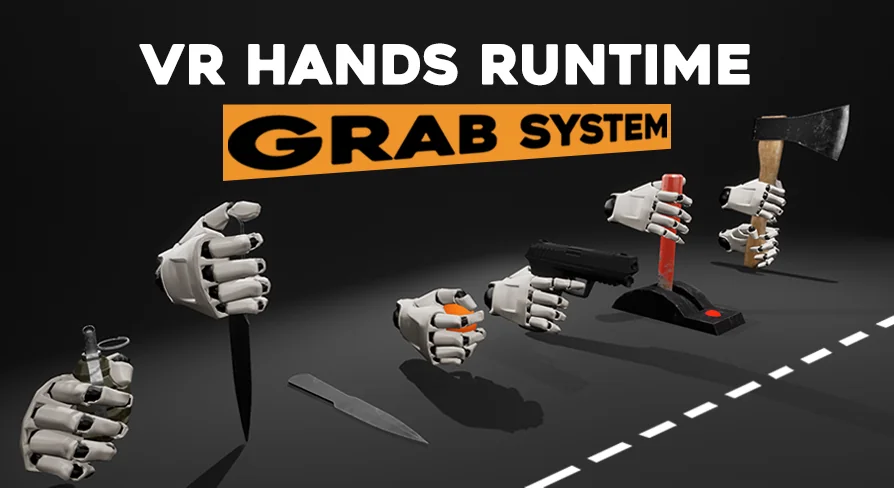
To demonstrate the versatility of the Grab Component across different interaction paradigms, the package includes five functional example items:
Axe: Serves as a heavy throwable tool, balanced to showcase dynamic grip placement and directional spinning assist behavior during flight.
Knife: Functions as a lightweight throwable blade, configured for rapid handling, precision release, and togglable rotational aid.
Grenade: Demonstrates spherical and rounded prop grasping, showcasing how finger tips conform around curved surfaces without manual pose keyframing.
Gun: Represents handheld firearm ergonomics, providing a reference for static directional grips and pointing orientation in VR space.
Lever: Illustrates constrained mechanical manipulation, demonstrating how dynamic hand placement functions when interacting with anchored, non-throwable scene elements.
These props cover the primary functional archetypes found in virtual reality gameplay: sharp throwables, handheld projectile weapons, rounded utility explosives, and static physical controls. Rather than serving merely as visual placeholders, they validate how the underlying Blueprint scripts handle both free-floating physics bodies and fixed mechanical hinges.
VR Template Migration from UE 4.26 to UE 5.4
Because engine versions introduce major architectural updates to input systems and rendering pipelines, maintaining interaction stability across engine generations is crucial. This package provides structured migration paths supported by video tutorials spanning several distinct Unreal Engine VR templates.
Developers can integrate the setup directly into older projects using the migration workflow for the Unreal Engine 4.26 VR Template. For teams transitioning to modern architectures, separate migration guidance is provided for Unreal Engine 4.27 and early Unreal Engine 5 environments. Further documentation covers updates through Unreal Engine 5.3 and Unreal Engine 5.4, allowing teams to move the Blueprint logic smoothly into recent project setups.
As VR interaction frameworks evolve toward advanced systems—including modern OpenXR plugin compliance and comprehensive procedural weapon mechanics featuring projectile visual effects and reloading cycles—the foundational logic of dynamic finger prediction remains essential. Understanding how the Grab Component bridges legacy 4.26 architectures and modern UE5 standards allows technical designers to build resilient physical interfaces without rewriting core input logic from scratch.
Workflows Benefiting from the VR Hands Grab System
The VR Hands Grab System serves technical designers, solo developers, and prototyping teams who need robust physical interactions without the overhead of dedicated 3D animation departments. When building combat sandboxes, escape rooms, or puzzle environments filled with diverse props, manually rigging hand poses for every unique lever or blade is an inefficient use of resources.
By utilizing automatic finger prediction alongside customizable throwing assists, creators can drop interactive props into Unreal Engine scenes and achieve immediate, functional physical feedback. The included examples and multi-version migration paths make it a practical Blueprint framework for testing physics interactions, accelerating iteration times, and establishing tactile VR gameplay mechanics.
 Weapons & Combat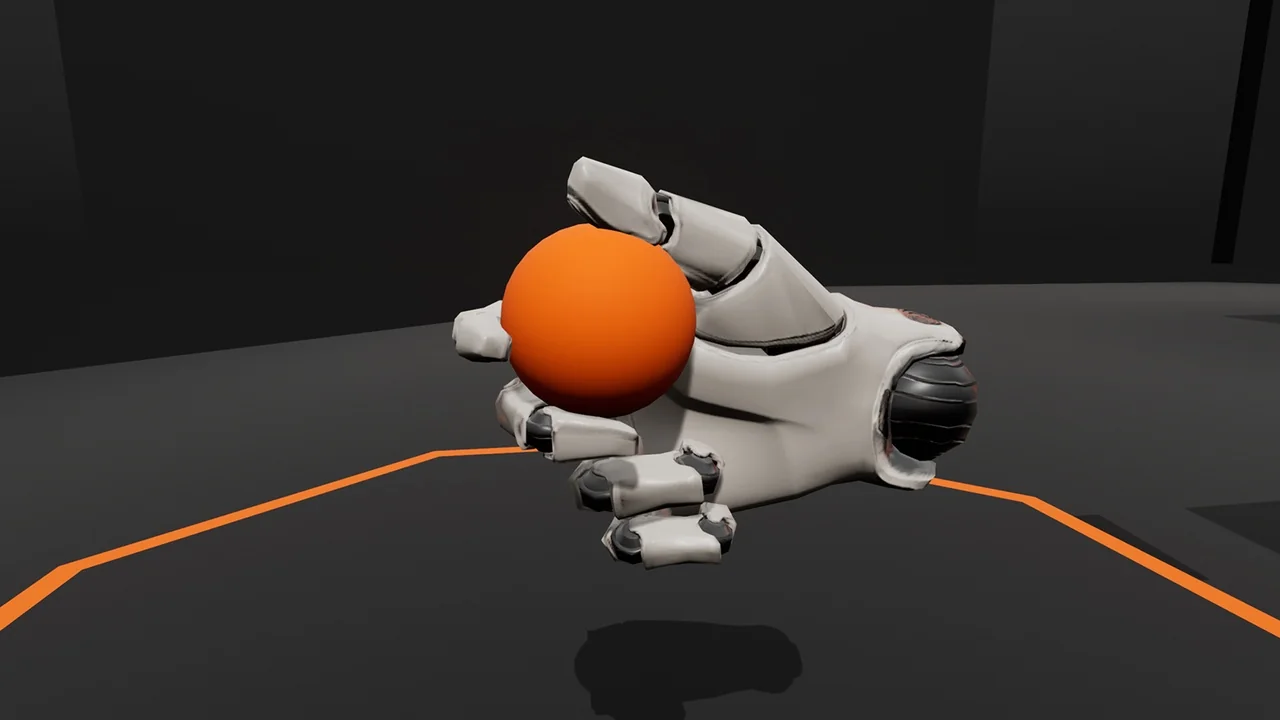
 Weapons & Combat
 Weapons & Combat
 Tools
Tools