"7b46a695175d8694"{"id":"1001492","slug":"kitbash3d-warfare","title":"KitBash3D Warfare","category":"Military / Warzone","engine":"4.26+,5.0+","assetVersion":"","engineVersion":"Engine Version: 4.26+,5.0+","tag":"Military / Warzone","accent":"blue","visual":"mech","summary":"Construct detailed modern war zones with 314 tactical models, 105 PBR materials, heavy artillery, and fortified command structures.","platform":"Unreal Engine","publishedAt":"2026-10-08T12:49:54.024Z","updatedAt":"2026-10-08T12:49:54.024Z","sourceNotes":[],"fileContents":[],"compatibility":["Unreal Engine","Engine Version: 4.26+,5.0+"],"featuredImage":{"alt":"KitBash3D Warfare","src":"/wp-content/uploads/published/2026/10/68b1a2ff41b9-war-web-set-gallery-01-9482a9074f.webp"},"hasDownloadLink":true,"downloads":0,"terms":[{"taxonomy":"category","slug":"military-warzone","name":"Military / Warzone"}],"galleryImages":[{"src":"/wp-content/uploads/published/2026/10/bc0fe9a1aa6c-war-web-set-gallery-02-2bc5ec9b1b.webp","alt":"KitBash3D Warfare"},{"src":"/wp-content/uploads/published/2026/10/e521a7fba348-war-web-set-gallery-03-5a3f52d0ba.webp","alt":"KitBash3D Warfare"},{"src":"/wp-content/uploads/published/2026/10/d96515821211-war-web-set-gallery-04-8001c0d133.webp","alt":"KitBash3D Warfare"},{"src":"/wp-content/uploads/published/2026/10/905566a83092-war-web-set-gallery-05-9af846f068.webp","alt":"KitBash3D Warfare"},{"src":"/wp-content/uploads/published/2026/10/bb975f54a692-war-web-set-gallery-06-77160a68b3.webp","alt":"KitBash3D Warfare"},{"src":"/wp-content/uploads/published/2026/10/01007be2a817-war-web-set-gallery-07-3ff37146d1.webp","alt":"KitBash3D Warfare"},{"src":"/wp-content/uploads/published/2026/10/7944f3cc780a-war-web-set-gallery-08-775c5f313d.webp","alt":"KitBash3D Warfare"},{"src":"/wp-content/uploads/published/2026/10/d06a7e7cf81f-war-web-set-gallery-09-7268b85aae.webp","alt":"KitBash3D Warfare"}],"accessPanel":{"kind":"resource","title":"Download this resource","eyebrow":"Free Download","message":"Log in or create a free account to start your download.","fileName":"KitBash3D Warfare.7z","safetyNote":"Resources are manually reviewed before listing to improve quality and reduce obvious risks.","actionLabel":"Download Free","resourceType":"Resource archive"},"contentHtml":"\u003cp\u003eConstructing believable frontline combat zones requires an aesthetic balance between deliberate military engineering and raw, hurried improvisation. Forward outposts rarely appear pristine; they exist in states of wear, makeshift reinforcement, and constant tactical rearrangement. Modern battlefields require everything from hasty perimeter walls to reinforced operations hubs that look as though they were erected under fire or converted from civilian relics. With 314 individual models and 105 PBR materials spanning a total density of 20.4 million polygons, this collection provides the architectural scale and granular props needed to dress contested zones, downed aircraft crash sites, and forward operating bases.\u003c/p\u003e \u003ch2\u003eStaging Contested Compounds with Repurposed Infrastructure\u003c/h2\u003e\n\u003cp\u003eCombat environments often center on modified civil architecture that has been retrofitted for strategic survival. The collection supplies large-scale structural cornerstones such as a Repurposed Observatory, a Rebuilt Outpost, and a Military Reused Gas Station, each communicating the friction of modern ground warfare. These buildings pair with dedicated utilitarian architecture, including Military Office Buildings, an Outskirt Communications Building, and Makeshift Emergency Houses, allowing environment artists to assemble multi-tiered combat perimeters.\u003c/p\u003e\n\u003cp\u003eTo establish the boundaries of an occupied compound, artists can link defensive barriers with functional logistics stations. Structures such as the Mobile Wall, Guarded Water Tower, and multiple configurations of Metal Barricades delineate control zones, while Military Makeshift Entrances frame vehicle checkpoints. Deep inside base lines, pieces like the Bunker, Military Hideout, and Temporary HQ Command Center serve as heavily fortified anchors capable of anchoring wide visual compositions. When depicting the aftermath of a dynamic firefight or breach, the inclusion of a Military Downed Chopper introduces an immediate narrative focal point around which defensive lines or recovery operations can be staged.\u003c/p\u003e \u003ch2\u003eCommand Hubs, Defense Towers, and Tactical Communications\u003c/h2\u003e\n\u003cp\u003eModern military operations depend on persistent intelligence gathering and mobile telemetry, which are reflected throughout the communication assets in the kit. The collection provides the Outskirt Communications Building, a Dedicated Communication Tower, and a Military Temporary Communications Center to establish high-priority signals hubs. For tracking incoming aerial threats and coordinating ground movements, artists can place the Mobile Radar, Mobile Surveillance Radar, and Military Ground Observer stations across compound rooftops or surrounding ridgelines.\u003c/p\u003e\n\u003cp\u003eDefense networks are reinforced by active detection and perimeter suppression units. Deployable Remote Turrets and Machine Gun Turrets create choke points along fortified barricades, while Security Cameras and roof-mounted Satellite dishes complete the communication web. Drone operations are also accounted for through dedicated Military Drone Stations and tactical Drone units, allowing creators to convey persistent unmanned reconnaissance operations over contested airspace.\u003c/p\u003e \u003ch2\u003eHeavy Artillery, Missile Launchers, and Field Armaments\u003c/h2\u003e\n\u003cp\u003eSustained combat environments demand heavy ordnance staging to convey fire superiority. The set supplies standalone Military Artillery pieces, Military Missile Launchers, and elevated Missile Racks capable of sitting behind defensive berms or inside dedicated industrial hangars. Support infrastructure for these weapon systems is extensive, featuring designated Artillery Containers, individual Artillery Rounds, and diverse Missiles alongside stacks of Ammo Boxes and spare magazines.\u003c/p\u003e\n\u003cp\u003eOn an individual operative scale, the asset library extends down to infantry weapons and hand-held gear. Ground staging can incorporate Assault Rifles, precision Sniper Rifles across two distinct variants, Glock sidearms, loose bullets, and Grenades. For irregular combat staging or insurgent encampments, Molotov cocktails provide a contrast against standard-issue armaments. Positioning these weapons alongside toolboxes, artillery containers, and ammunition crates gives armories, vehicle workshops, and staging points a lived-in, actively supplied visual identity.\u003c/p\u003e \u003ch2\u003eLogistics Hangars and Everyday Frontline Survival Details\u003c/h2\u003e\n\u003cp\u003eLarge bases require comprehensive maintenance and shelter facilities to keep ground units functional. The kit includes several spacious operational structures, such as Military Helicopter Hangar A, Military Helicopter Hangar B, a Military Rooftop Hangar, and a Military Vehicle Workshop. These larger bays can be paired with Military Temporary Garages, Mobile Barracks, and Military Storage Buildings to form expansive service depots. Mobile transit elements, such as the Military Depo Truck and Remote Transport, establish grounded logistics routes between supply hangars and outer fortifications.\u003c/p\u003e\n\u003cp\u003eBeyond structural frames, dressing believable interiors relies heavily on low-level clutter that indicates prolonged human presence under stressful conditions. Medical operations can be assembled using Field Stretchers, Gurneys, and Oxygen Tanks, creating emergency triage hubs inside an HQ Tent or field hospital. Maintenance scenes gain visual authenticity through generators, gas pumps, gas tanks of multiple scales, fire-rated fuel jugs, dumpsters, ladders, and scattered tire piles.\u003c/p\u003e\n\u003cp\u003eLiving spaces within the base are fleshed out with items that suggest down-time between operations. Quarters can be filled with folding tables, dry erase boards, computer towers, laptops, office phones, and portable televisions. Details like sleeping bags, folding chairs, cardboard boxes, plastic crates, and water jugs sit alongside personal diversions such as playing cards, betting chips, and newspaper stands, grounding the tactical installation in genuine human habitability.\u003c/p\u003e \u003ch2\u003eHardware Guidelines and Environment Assembly\u003c/h2\u003e\n\u003cp\u003eHandling a scene collection of 20.4 million polygons requires suitable system resources to maintain smooth viewport responsiveness during staging. The recommended minimum hardware baseline for working with this tier of asset volume includes a 6-core processor, a dedicated GPU with at least 8 GB of VRAM, 32 GB of system RAM, and roughly 15 GB of storage space per kit installation. These specifications ensure that dense multi-asset environments can be shaded and rendered without severe memory bottlenecks.\u003c/p\u003e\n\u003cp\u003eThe kit structure provides distinct advantages depending on how individual pipelines ingest geometry and surface materials. For standalone DCC applications, included layout scenes provide complete scene assemblies straight out of the box, whereas integrations into game engines like Unreal Engine and Unity rely on direct placement workflows since pre-arranged layout scenes are omitted for those two platforms. When working with modular base planning, individual props and PBR materials can be isolated and organized through Cargo, enabling single-click import procedures to quickly populate both sprawling military complexes and focused trench networks.\u003c/p\u003e\n\n\u003ch2\u003eContinue Browsing Similar Packs\u003c/h2\u003e\n\u003cul\u003e\n\u003cli\u003e\u003ca href=\"https://3dcghub.com/middle-east/\" title=\"Middle East\"\u003eMiddle East\u003c/a\u003e\u003c/li\u003e\n\u003cli\u003e\u003ca href=\"https://3dcghub.com/battlefield-kit-desert-environment-military-warzone-village/\" title=\"Battlefield Kit - Desert Environment (Military, Warzone Village)\"\u003eBattlefield Kit - Desert Environment (Military, Warzone Village)\u003c/a\u003e\u003c/li\u003e\n\u003cli\u003e\u003ca href=\"https://3dcghub.com/military-airport-military-base-military-props-military/\" title=\"Military Airport (Military Base, Military Props, Military )\"\u003eMilitary Airport (Military Base, Military Props, Military )\u003c/a\u003e\u003c/li\u003e\n\u003cli\u003e\u003ca href=\"https://3dcghub.com/ww2-warzone-environment-megapack-w-destructedbuildings-props-warzone-ww2/\" title=\"WW2 Warzone Environment Megapack ( w DestructedBuildings / Props, Warzone WW2 )\"\u003eWW2 Warzone Environment Megapack ( w DestructedBuildings / Props, Warzone WW2 )\u003c/a\u003e\u003c/li\u003e\n\u003cli\u003e\u003ca href=\"https://3dcghub.com/great-war-trenches/\" title=\"Great War Trenches\"\u003eGreat War Trenches\u003c/a\u003e\u003c/li\u003e\n\u003c/ul\u003e","contentTextLength":7379,"navigation":{"current":55,"total":3481,"previous":{"id":"1001493","slug":"mesh-ops-mesh-operations-plugin","title":"Mesh Ops - Mesh Operations Plugin","category":"Engine Tools","platform":"Unreal Engine","updatedAt":"2026-10-08T12:57:50.878Z"},"next":{"id":"1001491","slug":"vr-hands-grab-system-legacy-version","title":"VR Hands Grab System (Legacy version)","category":"Weapons \u0026 Combat","platform":"Unreal Engine","updatedAt":"2026-10-08T10:07:52.665Z"}},"relatedResources":[{"id":"1000380","slug":"middle-east","title":"Middle East","category":"Military / Warzone","engine":"4.26+,5.0+","assetVersion":"","engineVersion":"Engine Version: 4.26+,5.0+","tag":"Military / Warzone","accent":"blue","visual":"mech","summary":"A detailed look at building Middle Eastern urban environments using modular architecture, spline-based electricity grids, and grayscale-driven wall textures.","platform":"Unreal Engine","publishedAt":"2026-07-07T07:30:18.989Z","updatedAt":"2026-07-07T07:30:18.989Z","sourceNotes":[],"fileContents":[],"compatibility":["Unreal Engine","Engine Version: 4.26+,5.0+"],"featuredImage":{"alt":"Middle East","src":"/wp-content/uploads/published/2026/07/3bb3ed1db432-c1407341-268b-4d19-81d9-87d0bdb3985b-3d1f2c0696.webp"},"hasDownloadLink":true,"downloads":0},{"id":"9270","slug":"battlefield-kit-desert-environment-military-warzone-village","title":"Battlefield Kit - Desert Environment (Military, Warzone Village)","category":"Military / Warzone","engine":"4.26+,5.0+","assetVersion":"Engine version: 4.26+,5.0+","engineVersion":"4.22","tag":"Military / Warzone","accent":"blue","visual":"city","summary":"Create immersive desert warzones with the Battlefield Kit. This pack features modular mud-brick huts, landscape auto-materials, and a blend of military and domestic props.","platform":"Unreal Engine","publishedAt":"2026-03-01T16:19:14.000Z","updatedAt":"2026-04-19T15:51:16.000Z","sourceNotes":[],"fileContents":[],"compatibility":["Unreal Engine","Engine version: 4.26+,5.0+"],"featuredImage":{"alt":"Battlefield Kit - Desert Environment (Military, Warzone Village)","src":"https://3dcghub.com/wp-content/uploads/2026/03/f5746b9c-705c-4cc3-b07a-0855e2c6794f.webp"},"hasDownloadLink":true,"downloads":0},{"id":"9296","slug":"military-airport-military-base-military-props-military","title":"Military Airport (Military Base, Military Props, Military )","category":"Military / Warzone","engine":"4.26+,5.0+","assetVersion":"Engine version: 4.26+,5.0+","engineVersion":"4.26","tag":"Military / Warzone","accent":"blue","visual":"city","summary":"Create immersive military environments with the Military Airport pack. This collection includes high-quality assets, tileable materials, and pre-built assemblies for games and cinematics.","platform":"Unreal Engine","publishedAt":"2026-03-01T16:23:02.000Z","updatedAt":"2026-04-19T15:51:15.000Z","sourceNotes":[],"fileContents":[],"compatibility":["Unreal Engine","Engine version: 4.26+,5.0+"],"featuredImage":{"alt":"Military Airport (Military Base, Military Props, Military )","src":"https://3dcghub.com/wp-content/uploads/2026/03/249ef659-e8fb-4065-8032-a77ad2ae28a4.webp"},"hasDownloadLink":true,"downloads":0}]}
Military / Warzone
KitBash3D Warfare
Construct detailed modern war zones with 314 tactical models, 105 PBR materials, heavy artillery, and fortified command structures.
Constructing believable frontline combat zones requires an aesthetic balance between deliberate military engineering and raw, hurried improvisation. Forward outposts rarely appear pristine; they exist in states of wear, makeshift reinforcement, and constant tactical rearrangement. Modern battlefields require everything from hasty perimeter walls to reinforced operations hubs that look as though they were erected under fire or converted from civilian relics. With 314 individual models and 105 PBR materials spanning a total density of 20.4 million polygons, this collection provides the architectural scale and granular props needed to dress contested zones, downed aircraft crash sites, and forward operating bases.
Staging Contested Compounds with Repurposed Infrastructure
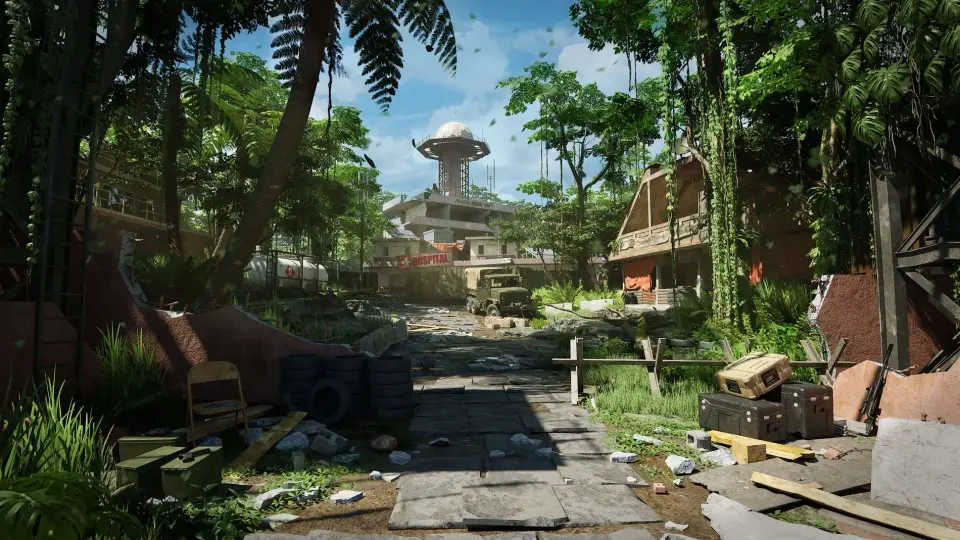
Combat environments often center on modified civil architecture that has been retrofitted for strategic survival. The collection supplies large-scale structural cornerstones such as a Repurposed Observatory, a Rebuilt Outpost, and a Military Reused Gas Station, each communicating the friction of modern ground warfare. These buildings pair with dedicated utilitarian architecture, including Military Office Buildings, an Outskirt Communications Building, and Makeshift Emergency Houses, allowing environment artists to assemble multi-tiered combat perimeters.
To establish the boundaries of an occupied compound, artists can link defensive barriers with functional logistics stations. Structures such as the Mobile Wall, Guarded Water Tower, and multiple configurations of Metal Barricades delineate control zones, while Military Makeshift Entrances frame vehicle checkpoints. Deep inside base lines, pieces like the Bunker, Military Hideout, and Temporary HQ Command Center serve as heavily fortified anchors capable of anchoring wide visual compositions. When depicting the aftermath of a dynamic firefight or breach, the inclusion of a Military Downed Chopper introduces an immediate narrative focal point around which defensive lines or recovery operations can be staged.
Command Hubs, Defense Towers, and Tactical Communications
Modern military operations depend on persistent intelligence gathering and mobile telemetry, which are reflected throughout the communication assets in the kit. The collection provides the Outskirt Communications Building, a Dedicated Communication Tower, and a Military Temporary Communications Center to establish high-priority signals hubs. For tracking incoming aerial threats and coordinating ground movements, artists can place the Mobile Radar, Mobile Surveillance Radar, and Military Ground Observer stations across compound rooftops or surrounding ridgelines.
Defense networks are reinforced by active detection and perimeter suppression units. Deployable Remote Turrets and Machine Gun Turrets create choke points along fortified barricades, while Security Cameras and roof-mounted Satellite dishes complete the communication web. Drone operations are also accounted for through dedicated Military Drone Stations and tactical Drone units, allowing creators to convey persistent unmanned reconnaissance operations over contested airspace.
Heavy Artillery, Missile Launchers, and Field Armaments
Sustained combat environments demand heavy ordnance staging to convey fire superiority. The set supplies standalone Military Artillery pieces, Military Missile Launchers, and elevated Missile Racks capable of sitting behind defensive berms or inside dedicated industrial hangars. Support infrastructure for these weapon systems is extensive, featuring designated Artillery Containers, individual Artillery Rounds, and diverse Missiles alongside stacks of Ammo Boxes and spare magazines.
On an individual operative scale, the asset library extends down to infantry weapons and hand-held gear. Ground staging can incorporate Assault Rifles, precision Sniper Rifles across two distinct variants, Glock sidearms, loose bullets, and Grenades. For irregular combat staging or insurgent encampments, Molotov cocktails provide a contrast against standard-issue armaments. Positioning these weapons alongside toolboxes, artillery containers, and ammunition crates gives armories, vehicle workshops, and staging points a lived-in, actively supplied visual identity.
Logistics Hangars and Everyday Frontline Survival Details
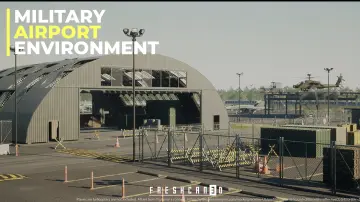
Large bases require comprehensive maintenance and shelter facilities to keep ground units functional. The kit includes several spacious operational structures, such as Military Helicopter Hangar A, Military Helicopter Hangar B, a Military Rooftop Hangar, and a Military Vehicle Workshop. These larger bays can be paired with Military Temporary Garages, Mobile Barracks, and Military Storage Buildings to form expansive service depots. Mobile transit elements, such as the Military Depo Truck and Remote Transport, establish grounded logistics routes between supply hangars and outer fortifications.
Beyond structural frames, dressing believable interiors relies heavily on low-level clutter that indicates prolonged human presence under stressful conditions. Medical operations can be assembled using Field Stretchers, Gurneys, and Oxygen Tanks, creating emergency triage hubs inside an HQ Tent or field hospital. Maintenance scenes gain visual authenticity through generators, gas pumps, gas tanks of multiple scales, fire-rated fuel jugs, dumpsters, ladders, and scattered tire piles.
Living spaces within the base are fleshed out with items that suggest down-time between operations. Quarters can be filled with folding tables, dry erase boards, computer towers, laptops, office phones, and portable televisions. Details like sleeping bags, folding chairs, cardboard boxes, plastic crates, and water jugs sit alongside personal diversions such as playing cards, betting chips, and newspaper stands, grounding the tactical installation in genuine human habitability.
Hardware Guidelines and Environment Assembly
Handling a scene collection of 20.4 million polygons requires suitable system resources to maintain smooth viewport responsiveness during staging. The recommended minimum hardware baseline for working with this tier of asset volume includes a 6-core processor, a dedicated GPU with at least 8 GB of VRAM, 32 GB of system RAM, and roughly 15 GB of storage space per kit installation. These specifications ensure that dense multi-asset environments can be shaded and rendered without severe memory bottlenecks.
The kit structure provides distinct advantages depending on how individual pipelines ingest geometry and surface materials. For standalone DCC applications, included layout scenes provide complete scene assemblies straight out of the box, whereas integrations into game engines like Unreal Engine and Unity rely on direct placement workflows since pre-arranged layout scenes are omitted for those two platforms. When working with modular base planning, individual props and PBR materials can be isolated and organized through Cargo, enabling single-click import procedures to quickly populate both sprawling military complexes and focused trench networks.
 Military / Warzone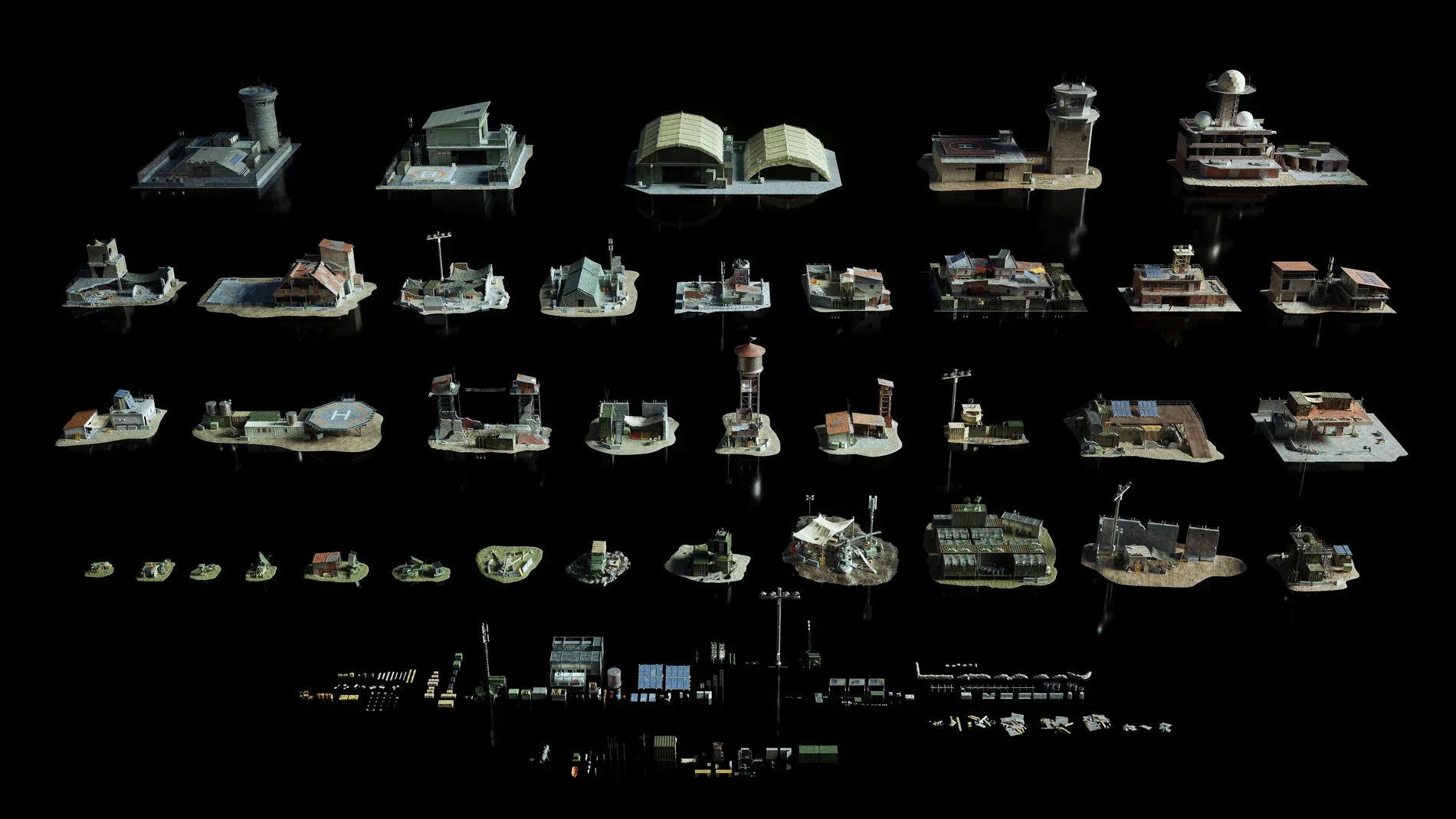
 Military / Warzone
 Military / Warzone
 Military / Warzone