"c14ff6bd758dadb1"{"id":"1001775","slug":"ww2-german-bunker","title":"WW2 German Bunker","category":"Military / Warzone","engine":"4.24+,5.0+","assetVersion":"","engineVersion":"Engine Version: 4.24+,5.0+","tag":"Military / Warzone","accent":"blue","visual":"mech","summary":"Explore the WW2 German Bunker asset pack, featuring around 40 authentic lowpoly interior assets, interactive openable crates, and MRAO texture masks.","platform":"Unreal Engine","publishedAt":"2026-10-20T03:23:51.964Z","updatedAt":"2026-10-20T03:23:51.964Z","sourceNotes":[],"fileContents":[],"compatibility":["Unreal Engine","Engine Version: 4.24+,5.0+"],"featuredImage":{"alt":"WW2 German Bunker","src":"/wp-content/uploads/published/2026/10/ece8666c5de8-0cef4515-8808-44e2-8cf5-fe0d914bcaa6-88d5a6996e.webp"},"hasDownloadLink":true,"downloads":0,"terms":[{"taxonomy":"category","slug":"military-warzone","name":"Military / Warzone"}],"galleryImages":[{"src":"/wp-content/uploads/published/2026/10/2815214b4a96-c63f61cb-a37d-4e04-86a4-430cda235de3-04e68ed84f.webp","alt":"WW2 German Bunker"},{"src":"/wp-content/uploads/published/2026/10/305e19b776c2-172f64dc-c50e-4a1a-8018-87b40a946b16-1382c2dd1a.webp","alt":"WW2 German Bunker"},{"src":"/wp-content/uploads/published/2026/10/0d5dee6c85c2-4b94cef3-c761-4599-a86c-6c926d0bd598-96d42aad72.webp","alt":"WW2 German Bunker"},{"src":"/wp-content/uploads/published/2026/10/da4605c72beb-26a03f0a-6cb7-40cc-a6e5-0f82f5cbdb9c-d81025aa17.webp","alt":"WW2 German Bunker"},{"src":"/wp-content/uploads/published/2026/10/cb0c7735e834-96875b36-dabf-4eb8-aa42-39e3637dd444-4c5253a82d.webp","alt":"WW2 German Bunker"},{"src":"/wp-content/uploads/published/2026/10/af21955f099b-44a2b751-c41a-492e-8f7e-96d6775c353d-9bab806373.webp","alt":"WW2 German Bunker"},{"src":"/wp-content/uploads/published/2026/10/9f18f9ff4190-7049228d-373d-4ab4-9b16-13191d779e5d-7e874d343c.webp","alt":"WW2 German Bunker"},{"src":"/wp-content/uploads/published/2026/10/0c31cf9a2234-5875f432-6ba5-4899-8b60-31dd94ae1da6-ed9429a7a5.webp","alt":"WW2 German Bunker"},{"src":"/wp-content/uploads/published/2026/10/078c4dbdafdd-dd2b45c4-c1d3-4c9f-bb8d-b6da5c0553d9-ec19927563.webp","alt":"WW2 German Bunker"}],"accessPanel":{"kind":"resource","title":"Download this resource","eyebrow":"Free Download","message":"Log in or create a free account to start your download.","fileName":"Content.7z","safetyNote":"Resources are manually reviewed before listing to improve quality and reduce obvious risks.","actionLabel":"Download Free","resourceType":"Resource archive"},"contentHtml":"\u003ch2\u003eConstructing Wartime Interiors with WW2 German Bunker Assets\u003c/h2\u003e\u003cp\u003eDepicting subterranean fortifications and defensive strongpoints requires an intentional selection of environmental props that reflect the utilitarian reality of mid-twentieth-century military operations. The WW2 German Bunker collection centers on this specific aesthetic, delivering approximately 40 historically authentic assets tailored primarily for interior compositions. Instead of presenting sprawling outdoor terrain, the focus is squarely placed on the claustrophobic, reinforced quarters where personnel managed logistics, communications, and defense during World War 2.\u003c/p\u003e\u003cp\u003eInterior bunker scenes depend heavily on the believable placement of utilitarian objects. Within fortified concrete walls, space was inherently limited, requiring personnel to pack supplies systematically. By providing dedicated assets such as storage containers, seating, workspace items, and specialized military equipment, this pack allows level designers and environment artists to construct believable command posts, armories, living quarters, and subterranean observation posts. The lowpoly construction paired with realistic surface styling ensures that each prop integrates smoothly into real-time environments without burdening rendering budgets.\u003c/p\u003e\u003ch2\u003eFunctional Storage and Openable Crates for Interactive Environments\u003c/h2\u003e\u003cp\u003eA key visual and practical element in any military staging post is the presence of supply containers. The collection incorporates a variety of ammunition crates and boxes that establish the operational purpose of a bunker interior. Stacking these elements creates natural barricades, defensive covers, or logistical hubs within a level layout. Because defensive positions relied on steady resupply, setting clusters of wooden and metal containers near entryways or defensive slits reflects historically accurate staging.\u003c/p\u003e\u003cp\u003eBeyond purely static decoration, an essential mechanical feature of this pack is that all crates can be opened. This functional element bridges the gap between passive environment dressing and active gameplay support. In tactical action games, survival experiences, or historical simulations, containers serve as prime interaction points where players search for munitions, supplies, or mission-critical objectives. Having functional, articulated lids eliminates the need to author secondary destruction or interaction states from scratch. Level designers can place closed containers to preserve visual tidiness or leave them propped open to indicate a hastily abandoned post, an active resupply depot, or a ransacked outpost.\u003c/p\u003e\u003cp\u003eThe inclusion of loose ammunition and grenades expands on this storage functionality. Rather than restricting ordnance to sealed boxes, developers can place loose grenades and rounds directly onto shelves, operational desks, or adjacent to open containers. This micro-level detail enriches storytelling by suggesting recent activity or imminent combat readiness within the bunker interior.\u003c/p\u003e\u003ch2\u003eStaging Command Posts with German Furniture and Field Radios\u003c/h2\u003e\u003cp\u003eCommand spaces within bunker complexes served as communication nodes and administrative centers for stationed forces. The WW2 German Bunker package addresses these administrative areas through dedicated German furniture and radio equipment. Furnishing bunker rooms with accurate tables, chairs, and consoles breaks up the monotony of blank concrete and reinforces the daily routines of soldiers stationed underground.\u003c/p\u003e\u003cp\u003eRadio communication plays a central thematic role in wartime environments. Positioned atop field desks or integrated into communication centers, the included radio equipment visually anchors strategic headquarters and intelligence rooms. Such equipment naturally draws the player's eye, making it ideal as a focal point for narrative delivery, objective tracking, or atmospheric sound placement. When paired with period-appropriate furniture, these components form complete operational stations, letting developers construct briefing rooms, listening posts, and office quarters that reflect historical authenticity.\u003c/p\u003e\u003ch2\u003eMaterials Optimization and MRAO Texture Masks\u003c/h2\u003e\u003cp\u003eVisual fidelity and performance in complex interior spaces depend fundamentally on material efficiency. In newer revisions of the package, the materials underwent targeted optimization to streamline rendering. A major component of this refinement is the integration of MRAO texture masks, which pack Metallic, Roughness, and Ambient Occlusion data into distinct channels of a single texture map.\u003c/p\u003e\u003cp\u003eUtilizing channel-packed MRAO maps reduces texture memory consumption and minimizes texture sampler overhead in modern rendering engines. Metallic values clearly define the boundary between weathered metal latches, ammunition casings, and painted metal furniture versus porous surfaces. Roughness maps convey the dry, worn tactile quality of aged wood, raw metal edges, and matte finishes typical of military gear. Meanwhile, embedded Ambient Occlusion details emphasize crevices, panel recesses, handle joints, and structural seams, preserving micro-depth even in dim or diffuse indoor lighting scenarios.\u003c/p\u003e\u003cp\u003eAlongside material restructuring, asset organization was streamlined by properly renaming all assets within the pack. Clear, standardized naming conventions prevent asset collisions in growing project hierarchies and make it straightforward for teams to search, filter, and assign props across multiple scenes.\u003c/p\u003e\u003ch2\u003eLighting Updates and Version Compatibility\u003c/h2\u003e\u003cp\u003eLighting is arguably the most decisive factor in establishing the oppressive, confined mood characteristic of subterranean shelters. The asset pack includes revised scenes featuring newly configured lighting arrangements. These pre-configured scenes serve as immediate references for showcasing how the lowpoly geometry and MRAO materials respond to directional and localized interior light sources. Artists can study the interplay between localized bulb fixtures, lantern glow, or harsh spotlighting against the surfaces of the furniture, open crates, and radio gear.\u003c/p\u003e\u003cp\u003eRegarding engine workflows, the recommended use is specifically focused on version 4.24 and older releases. While modern revisions introduced optimized materials, updated lighting setups, and unified naming, staying aligned with the 4.24 guideline helps ensure stability and prevents potential translation issues with legacy shader setups or lightmap bakes. Additionally, the collection is noted for its compatibility with Medieval Armory, offering cross-thematic utility for creators working with diverse prop libraries.\u003c/p\u003e\u003ch2\u003eProject Fit and Practical Application\u003c/h2\u003e\u003cp\u003eWW2 German Bunker delivers a concise, purposeful kit of roughly 40 items built to solve the specific challenge of military interior design. By combining authentic German furniture, functional openable crates, detailed ammunition, grenades, and radio hardware, it supplies the necessary components to build evocative wartime shelters, firing points, and underground installations. The combination of lowpoly modeling, MRAO material efficiency, and realistic design makes it a dependable toolkit for historical simulations, stealth operations, and story-driven interior environments.\u003c/p\u003e\n\n\u003ch2\u003eRelated Resources Worth Checking\u003c/h2\u003e\n\u003cul\u003e\n\u003cli\u003e\u003ca href=\"https://3dcghub.com/ww2-germany-weapons/\" title=\"WW2 Germany Weapons\"\u003eWW2 Germany Weapons\u003c/a\u003e\u003c/li\u003e\n\u003cli\u003e\u003ca href=\"https://3dcghub.com/ww2-warzone-environment-megapack-w-destructedbuildings-props-warzone-ww2/\" title=\"WW2 Warzone Environment Megapack ( w DestructedBuildings / Props, Warzone WW2 )\"\u003eWW2 Warzone Environment Megapack ( w DestructedBuildings / Props, Warzone WW2 )\u003c/a\u003e\u003c/li\u003e\n\u003cli\u003e\u003ca href=\"https://3dcghub.com/the-bunker-package/\" title=\"The Bunker Package\"\u003eThe Bunker Package\u003c/a\u003e\u003c/li\u003e\n\u003cli\u003e\u003ca href=\"https://3dcghub.com/kitbash3d-warfare/\" title=\"KitBash3D Warfare\"\u003eKitBash3D Warfare\u003c/a\u003e\u003c/li\u003e\n\u003cli\u003e\u003ca href=\"https://3dcghub.com/middle-east/\" title=\"Middle East\"\u003eMiddle East\u003c/a\u003e\u003c/li\u003e\n\u003c/ul\u003e","contentTextLength":7395,"navigation":{"current":8,"total":3719,"previous":{"id":"1001776","slug":"counter-attack","title":"Counter Attack","category":"Combat","platform":"Unreal Engine","updatedAt":"2026-10-20T03:24:17.652Z"},"next":{"id":"1001774","slug":"wooden-houses","title":"Wooden houses","category":"Towns \u0026 Villages","platform":"Unreal Engine","updatedAt":"2026-10-20T03:23:02.608Z"}},"relatedResources":[{"id":"5506","slug":"ww2-germany-weapons","title":"WW2 Germany Weapons","category":"Weapons \u0026 Combat","engine":"4.26+,5.0+","assetVersion":"Engine version: 4.26+,5.0+","engineVersion":"4.26","tag":"Weapons \u0026 Combat","accent":"blue","visual":"city","summary":"Enhance your historical shooter with this realistic WW2 German weapon pack. Featuring 5 animated guns with high-quality PBR textures for game development.","platform":"Unreal Engine","publishedAt":"2026-02-15T15:35:54.000Z","updatedAt":"2026-04-19T15:56:56.000Z","sourceNotes":[],"fileContents":[],"compatibility":["Unreal Engine","Engine version: 4.26+,5.0+"],"featuredImage":{"alt":"WW2 Germany Weapons","src":"https://3dcghub.com/wp-content/uploads/2026/02/eb836f48-9462-4f7c-9a0c-8938316f45cd.webp"},"hasDownloadLink":true,"downloads":2},{"id":"1000180","slug":"ww2-warzone-environment-megapack-w-destructedbuildings-props-warzone-ww2","title":"WW2 Warzone Environment Megapack ( w DestructedBuildings / Props, Warzone WW2 )","category":"Military / Warzone","engine":"5.1+","assetVersion":"","engineVersion":"Engine Version: 5.1+","tag":"Military / Warzone","accent":"blue","visual":"city","summary":"A large Unreal Engine WW2 environment pack with 800+ Nanite meshes, destroyed building variants, vehicles, VFX, decals, ULAT, and a showcase map.","platform":"Unreal Engine","publishedAt":"2026-06-20T09:17:09.390Z","updatedAt":"2026-06-20T09:17:09.390Z","sourceNotes":[],"fileContents":[],"compatibility":["Unreal Engine","Engine Version: 5.1+"],"featuredImage":{"alt":"WW2 Warzone Environment Megapack ( w DestructedBuildings / Props, Warzone WW2 )","src":"/wp-content/uploads/published/2026/06/4ac4b02f1dd0-cd09fcd6-1975-40be-838c-69fa674454e3-26af197a18.webp"},"hasDownloadLink":true,"downloads":1},{"id":"9323","slug":"the-bunker-package","title":"The Bunker Package","category":"Military / Warzone","engine":"4.26+,5.0+","assetVersion":"Engine version: 4.26+,5.0+","engineVersion":"4.10","tag":"Military / Warzone","accent":"blue","visual":"city","summary":"Create immersive and realistic underground environments with The Bunker Package. This collection of modular brushes and props is perfect for military-themed levels and FPS games.","platform":"Unreal Engine","publishedAt":"2026-03-01T16:27:55.000Z","updatedAt":"2026-04-19T15:51:15.000Z","sourceNotes":[],"fileContents":[],"compatibility":["Unreal Engine","Engine version: 4.26+,5.0+"],"featuredImage":{"alt":"The Bunker Package","src":"https://3dcghub.com/wp-content/uploads/2026/03/1d79e6d4-4bbd-489a-ae60-293b909dd6d4.webp"},"hasDownloadLink":true,"downloads":2}]}
Military / Warzone
WW2 German Bunker
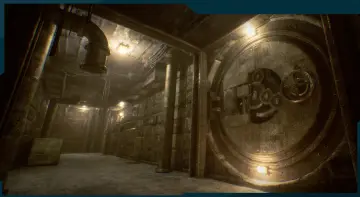
Explore the WW2 German Bunker asset pack, featuring around 40 authentic lowpoly interior assets, interactive openable crates, and MRAO texture masks.
Constructing Wartime Interiors with WW2 German Bunker Assets
Depicting subterranean fortifications and defensive strongpoints requires an intentional selection of environmental props that reflect the utilitarian reality of mid-twentieth-century military operations. The WW2 German Bunker collection centers on this specific aesthetic, delivering approximately 40 historically authentic assets tailored primarily for interior compositions. Instead of presenting sprawling outdoor terrain, the focus is squarely placed on the claustrophobic, reinforced quarters where personnel managed logistics, communications, and defense during World War 2.
Interior bunker scenes depend heavily on the believable placement of utilitarian objects. Within fortified concrete walls, space was inherently limited, requiring personnel to pack supplies systematically. By providing dedicated assets such as storage containers, seating, workspace items, and specialized military equipment, this pack allows level designers and environment artists to construct believable command posts, armories, living quarters, and subterranean observation posts. The lowpoly construction paired with realistic surface styling ensures that each prop integrates smoothly into real-time environments without burdening rendering budgets.
Functional Storage and Openable Crates for Interactive Environments
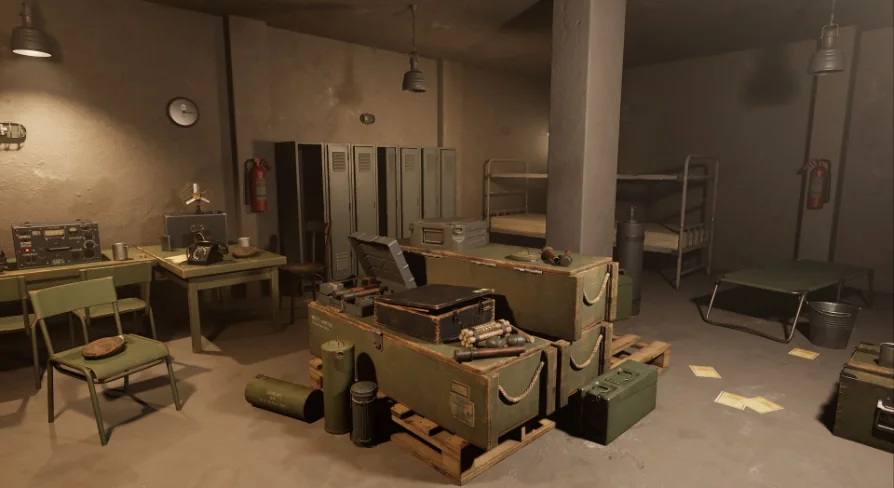
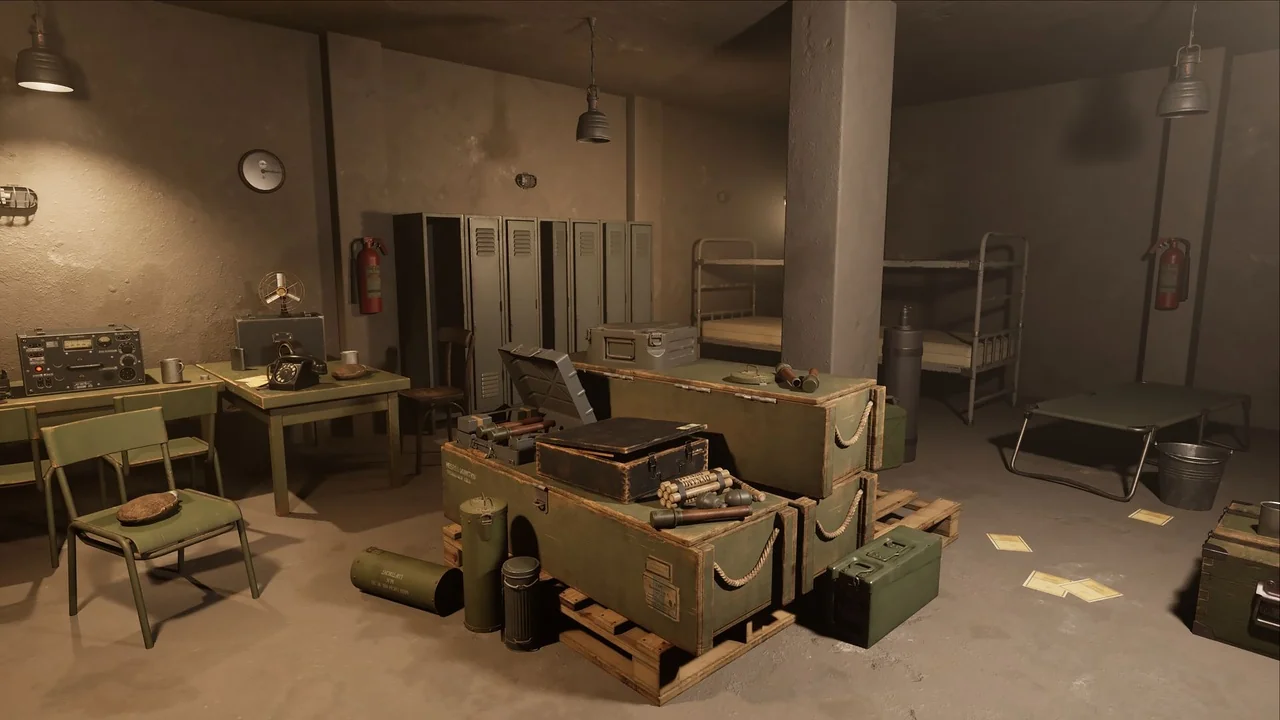
A key visual and practical element in any military staging post is the presence of supply containers. The collection incorporates a variety of ammunition crates and boxes that establish the operational purpose of a bunker interior. Stacking these elements creates natural barricades, defensive covers, or logistical hubs within a level layout. Because defensive positions relied on steady resupply, setting clusters of wooden and metal containers near entryways or defensive slits reflects historically accurate staging.
Beyond purely static decoration, an essential mechanical feature of this pack is that all crates can be opened. This functional element bridges the gap between passive environment dressing and active gameplay support. In tactical action games, survival experiences, or historical simulations, containers serve as prime interaction points where players search for munitions, supplies, or mission-critical objectives. Having functional, articulated lids eliminates the need to author secondary destruction or interaction states from scratch. Level designers can place closed containers to preserve visual tidiness or leave them propped open to indicate a hastily abandoned post, an active resupply depot, or a ransacked outpost.
The inclusion of loose ammunition and grenades expands on this storage functionality. Rather than restricting ordnance to sealed boxes, developers can place loose grenades and rounds directly onto shelves, operational desks, or adjacent to open containers. This micro-level detail enriches storytelling by suggesting recent activity or imminent combat readiness within the bunker interior.
Staging Command Posts with German Furniture and Field Radios
Command spaces within bunker complexes served as communication nodes and administrative centers for stationed forces. The WW2 German Bunker package addresses these administrative areas through dedicated German furniture and radio equipment. Furnishing bunker rooms with accurate tables, chairs, and consoles breaks up the monotony of blank concrete and reinforces the daily routines of soldiers stationed underground.
Radio communication plays a central thematic role in wartime environments. Positioned atop field desks or integrated into communication centers, the included radio equipment visually anchors strategic headquarters and intelligence rooms. Such equipment naturally draws the player's eye, making it ideal as a focal point for narrative delivery, objective tracking, or atmospheric sound placement. When paired with period-appropriate furniture, these components form complete operational stations, letting developers construct briefing rooms, listening posts, and office quarters that reflect historical authenticity.
Materials Optimization and MRAO Texture Masks
Visual fidelity and performance in complex interior spaces depend fundamentally on material efficiency. In newer revisions of the package, the materials underwent targeted optimization to streamline rendering. A major component of this refinement is the integration of MRAO texture masks, which pack Metallic, Roughness, and Ambient Occlusion data into distinct channels of a single texture map.
Utilizing channel-packed MRAO maps reduces texture memory consumption and minimizes texture sampler overhead in modern rendering engines. Metallic values clearly define the boundary between weathered metal latches, ammunition casings, and painted metal furniture versus porous surfaces. Roughness maps convey the dry, worn tactile quality of aged wood, raw metal edges, and matte finishes typical of military gear. Meanwhile, embedded Ambient Occlusion details emphasize crevices, panel recesses, handle joints, and structural seams, preserving micro-depth even in dim or diffuse indoor lighting scenarios.
Alongside material restructuring, asset organization was streamlined by properly renaming all assets within the pack. Clear, standardized naming conventions prevent asset collisions in growing project hierarchies and make it straightforward for teams to search, filter, and assign props across multiple scenes.
Lighting Updates and Version Compatibility
Lighting is arguably the most decisive factor in establishing the oppressive, confined mood characteristic of subterranean shelters. The asset pack includes revised scenes featuring newly configured lighting arrangements. These pre-configured scenes serve as immediate references for showcasing how the lowpoly geometry and MRAO materials respond to directional and localized interior light sources. Artists can study the interplay between localized bulb fixtures, lantern glow, or harsh spotlighting against the surfaces of the furniture, open crates, and radio gear.
Regarding engine workflows, the recommended use is specifically focused on version 4.24 and older releases. While modern revisions introduced optimized materials, updated lighting setups, and unified naming, staying aligned with the 4.24 guideline helps ensure stability and prevents potential translation issues with legacy shader setups or lightmap bakes. Additionally, the collection is noted for its compatibility with Medieval Armory, offering cross-thematic utility for creators working with diverse prop libraries.
Project Fit and Practical Application
WW2 German Bunker delivers a concise, purposeful kit of roughly 40 items built to solve the specific challenge of military interior design. By combining authentic German furniture, functional openable crates, detailed ammunition, grenades, and radio hardware, it supplies the necessary components to build evocative wartime shelters, firing points, and underground installations. The combination of lowpoly modeling, MRAO material efficiency, and realistic design makes it a dependable toolkit for historical simulations, stealth operations, and story-driven interior environments.
 Military / Warzone
 Weapons & Combat
 Military / Warzone
 Military / Warzone