"7b46a695175d8694"{"id":"1001494","slug":"suburbs-vol-9-kitchen-appliances-nanite-and-low-poly","title":"Suburbs VOL.9 - Kitchen Appliances (Nanite and Low Poly)","category":"Tools, Objects \u0026 Decor","engine":"5.1+","assetVersion":"","engineVersion":"Engine Version: 5.1+","tag":"Tools","accent":"blue","visual":"mech","summary":"Explore Suburbs VOL.9 - Kitchen Appliances featuring 100 Nanite and low-poly meshes, 4K channel-packed textures, master materials, and Lumen support in UE5.","platform":"Unreal Engine","publishedAt":"2026-10-08T12:59:10.109Z","updatedAt":"2026-10-08T12:59:10.109Z","sourceNotes":[],"fileContents":[],"compatibility":["Unreal Engine","Engine Version: 5.1+"],"featuredImage":{"alt":"Suburbs VOL.9 - Kitchen Appliances (Nanite and Low Poly)","src":"/wp-content/uploads/published/2026/10/3979285da268-cfab6cc0-906e-4d64-b5c0-261f887167a6-7b5e04d362.webp"},"hasDownloadLink":true,"downloads":1,"terms":[{"taxonomy":"category","slug":"tools-objects-and-decor","name":"Tools, Objects \u0026 Decor"}],"galleryImages":[{"src":"/wp-content/uploads/published/2026/10/7d9419b0807c-5c888a04-ce89-4f23-af43-477de231bfee-c05d3bdc9a.webp","alt":"Suburbs VOL.9 - Kitchen Appliances (Nanite and Low Poly)"},{"src":"/wp-content/uploads/published/2026/10/c925bf706a4f-b75ec5b2-6a4a-47fe-a609-e6fcad138664-5fcb9e0f41.webp","alt":"Suburbs VOL.9 - Kitchen Appliances (Nanite and Low Poly)"},{"src":"/wp-content/uploads/published/2026/10/9798e40847cc-da90dd74-3354-487f-b143-4206dea7d434-0f3902f6d4.webp","alt":"Suburbs VOL.9 - Kitchen Appliances (Nanite and Low Poly)"},{"src":"/wp-content/uploads/published/2026/10/e5c170ddc1f2-7f156ffc-c25c-4a70-b88e-cf90288531fa-4dfaf05bfb.webp","alt":"Suburbs VOL.9 - Kitchen Appliances (Nanite and Low Poly)"},{"src":"/wp-content/uploads/published/2026/10/4572c9205d3e-b32adeed-d093-4445-9503-2920f1ad7f52-b563e8d28c.webp","alt":"Suburbs VOL.9 - Kitchen Appliances (Nanite and Low Poly)"},{"src":"/wp-content/uploads/published/2026/10/6affa28178d7-13d81505-c360-456c-87ff-a2dec238261d-81f1bb6da2.webp","alt":"Suburbs VOL.9 - Kitchen Appliances (Nanite and Low Poly)"},{"src":"/wp-content/uploads/published/2026/10/42fe3b6c7571-d29ed94c-5e9a-4d85-878d-4fdbd1e8e52e-d897e35d34.webp","alt":"Suburbs VOL.9 - Kitchen Appliances (Nanite and Low Poly)"},{"src":"/wp-content/uploads/published/2026/10/8401a38169d5-077ea713-64c8-4fd5-bcfd-e0f40e752f52-139d01e6b9.webp","alt":"Suburbs VOL.9 - Kitchen Appliances (Nanite and Low Poly)"},{"src":"/wp-content/uploads/published/2026/10/d366df7e46d0-f547634b-461f-417c-97b1-8eb65cecd26a-af66d526fe.webp","alt":"Suburbs VOL.9 - Kitchen Appliances (Nanite and Low Poly)"},{"src":"/wp-content/uploads/published/2026/10/4e9de1045269-94426c8f-556b-4cec-83f8-0d6b05197080-1ef15af522.webp","alt":"Suburbs VOL.9 - Kitchen Appliances (Nanite and Low Poly)"}],"accessPanel":{"kind":"resource","title":"Download this resource","eyebrow":"Free Download","message":"Log in or create a free account to start your download.","fileName":"Content.7z","safetyNote":"Resources are manually reviewed before listing to improve quality and reduce obvious risks.","actionLabel":"Download Free","resourceType":"Resource archive"},"contentHtml":"\u003ch2\u003eKitchen Appliances in 1970s, 1980s, and Post-Apocalyptic Environments\u003c/h2\u003e\u003cp\u003eDomestic spaces define the emotional atmosphere of environmental storytelling. Whether outfitting an abandoned residential interior, building an authentic 1970s family home, or constructing an eerie horror basement, the authenticity of large appliances anchors the space. Suburbs VOL.9 - Kitchen Appliances addresses this specific production requirement by focusing on period-specific hardware, from vintage refrigerators and dishwashers to standalone washers and utility machines.\u003c/p\u003e\u003cp\u003eIn horror and post-apocalyptic projects, domestic settings often serve as the first point of contact for players before tension escalates. Kitchens and laundry rooms tell immediate stories about the inhabitants through worn surfaces, dated designs, and heavy mechanical shapes typical of mid-to-late twentieth-century manufacturing. Because retro kitchen appliances rely on distinct physical silhouettes—boxy bodies, exterior latches, mechanical dials, and stamped metal handles—generic modern props rarely fit those environments. Having dedicated 1970s and 1980s designs allows environment artists to establish a believable era without relying on anachronistic modern shapes.\u003c/p\u003e\u003cp\u003eBeyond horror and decay, clean historical reconstruction projects also require period-accurate appliances. Suburban interiors from past decades carry specific visual languages that cannot be simulated simply by recoloring modern flat-panel hardware. The bulky contours, ribbed back panels, and mechanical footprints represented in this collection provide set dressing that integrates directly into historical or stylized suburban environments.\u003c/p\u003e\u003ch2\u003eDual Mesh Delivery: Nanite Meshes and Low Poly Variants\u003c/h2\u003e\u003cp\u003eOne structural challenge in modern Unreal Engine environment production is balancing next-generation geometry against platforms requiring traditional polygonal budgets. This collection addresses pipeline flexibility by supplying 100 meshes split evenly between high-density Nanite representations and standard low-poly game models, along with mesh variants.\u003c/p\u003e\u003cp\u003eFor projects taking advantage of Unreal Engine 5's virtualized geometry pipeline, the Nanite assets allow artists to retain full polygonal density without baking down essential structural contours. The curved corners of antique refrigerators, the segmented controls of dishwashers, and the stamped vents on utility washers retain their geometric silhouettes even when viewed from extreme close-up angles during narrative sequences or first-person inspection.\u003c/p\u003e\u003cp\u003eProjects targeting fixed performance boundaries or platforms operating without Nanite can deploy the included low-poly variants. These meshes retain the exact visual character and footprint of their dense counterparts, ensuring that blocking, collision, and layout work remain identical regardless of which mesh format a studio incorporates into its rendering path. Furthermore, the inclusion of variant meshes gives level dressers the ability to repeat primary appliances across multiple rooms or residential units without creating immediate visual monotony.\u003c/p\u003e\u003cp\u003eAll assets are fully detailed from every side. Back panels, recessed coil bays, hoses, and base frames are modeled rather than left open or hollowed out. This makes the collection viable for chaotic setups where appliances are tipped over in an abandoned hallway, pulled away from walls during repairs, or loaded onto moving trucks in narrative sets.\u003c/p\u003e\u003ch2\u003e4K Channel-Packed Textures and Master Material Customization\u003c/h2\u003e\u003cp\u003eSurface definition across the appliance collection is handled through high-fidelity 4K texture sets, accommodating close camera inspection without texture blurring. Materials are structured around a master material system designed to govern the majority of props throughout the package, ensuring uniform shading performance across the entire domestic prop inventory.\u003c/p\u003e\u003cp\u003eMemory efficiency is preserved through packed texture channels. Roughness, metalness, and ambient occlusion are combined into a single channel-packed texture map (Roughness | Metalness | Ambient Occlusion). This packing strategy minimizes texture sample calls within Unreal Engine shaders, preserving texture memory bandwidth during dense interior scenes where numerous distinct props share screen space.\u003c/p\u003e\u003cp\u003eTo assist with environmental integration, the master material exposes targeted property overrides, allowing artists to make granular adjustments on an instance-by-instance basis:\u003c/p\u003e\u003cul\u003e\u003cli\u003eAlbedo tinting controls allow clean white enamel, dated avocado green, harvest gold, or industrial tones to be dialed into any mesh without re-exporting base textures.\u003c/li\u003e\u003cli\u003eDirect roughness modification enables control over surface reflectivity, letting artists vary between freshly polished enamel, greasy grime, or weathered matte finishes.\u003c/li\u003e\u003cli\u003eNormal strength adjustments allow fine surface stamping, seam depth, and micro-details to be balanced against room lighting.\u003c/li\u003e\u003cli\u003eMaterial parameters accommodate both showroom-clean presentations and dilapidated set dressing through simple parameter switches.\u003c/li\u003e\u003c/ul\u003e\u003ch2\u003eLighting Integration with Unreal Engine 5 Lumen and Look Up Tables\u003c/h2\u003e\u003cp\u003eLighting behavior in enclosed suburban kitchens relies heavily on accurate bounce lighting and tight specular falloff against metallic and enameled surfaces. Suburbs VOL.9 - Kitchen Appliances is built with full support for Lumen global illumination and reflections in Unreal Engine 5.0 and newer versions.\u003c/p\u003e\u003cp\u003eBecause the models are detailed completely on all faces and feature proper material definitions, Lumen calculates secondary bounces realistically off broad refrigerator panels, recessed dishwasher cavities, and washer lids. Light passing through narrow door frames or bouncing off vinyl flooring interacts naturally with the enameled metal and exposed mechanical surfaces of each appliance.\u003c/p\u003e\u003cp\u003eThe package also incorporates a realistic post-process configuration paired with a Look Up Table (LUT). This post-process setup is tuned to harmonize the contrast, dynamic range, and color balance across the appliances, giving interior scenes a cohesive visual base immediately upon loading. Level designers can retain this look for instant cinematic framing or use it as a calibrated starting point to match an existing project's proprietary color grading.\u003c/p\u003e\u003ch2\u003eCustom Branding and Production Utility\u003c/h2\u003e\u003cp\u003eAsset usability in commercial development often hinges on legal clearances. Real-world appliance brands carry registered trademarks, copyrighted model names, and protected badge designs that can disrupt a commercial release. All appliances in this collection feature custom-designed studio branding and original labels, eliminating potential trademark and intellectual property conflicts.\u003c/p\u003e\u003cp\u003eThis design choice allows commercial games, film cinematics, and interactive visualizations to incorporate these appliances directly into final consumer builds without requiring art teams to inspect, paint out, or replace logos on washers, refrigerators, or dishwashers.\u003c/p\u003e\u003cp\u003eCreated by the artists at Dekogon Studios, Suburbs VOL.9 - Kitchen Appliances is intended for environment artists, narrative level designers, and architectural visualization teams who need reliable, era-accurate appliances that work inside modern Unreal Engine lighting pipelines straight out of the box.\u003c/p\u003e\n\n\u003ch2\u003eExplore Similar Assets\u003c/h2\u003e\n\u003cul\u003e\n\u003cli\u003e\u003ca href=\"https://3dcghub.com/suburbs-vol-1-wall-decor-nanite-and-low-poly/\" title=\"Suburbs VOL.1 - Wall Decor (Nanite and Low Poly)\"\u003eSuburbs VOL.1 - Wall Decor (Nanite and Low Poly)\u003c/a\u003e\u003c/li\u003e\n\u003cli\u003e\u003ca href=\"https://3dcghub.com/suburbs-vol-20-vending-and-service-nanite-and-low-poly/\" title=\"Suburbs VOL.20 - Vending and Service (Nanite and Low Poly)\"\u003eSuburbs VOL.20 - Vending and Service (Nanite and Low Poly)\u003c/a\u003e\u003c/li\u003e\n\u003cli\u003e\u003ca href=\"https://3dcghub.com/jobsite-vol-4-police-station/\" title=\"Jobsite VOL.4 - Police Station\"\u003eJobsite VOL.4 - Police Station\u003c/a\u003e\u003c/li\u003e\n\u003cli\u003e\u003ca href=\"https://3dcghub.com/boatyard-vol-7-fishing-nanite-and-low-poly/\" title=\"Boatyard VOL.7 - Fishing (Nanite and Low Poly)\"\u003eBoatyard VOL.7 - Fishing (Nanite and Low Poly)\u003c/a\u003e\u003c/li\u003e\n\u003cli\u003e\u003ca href=\"https://3dcghub.com/signage-vol-1-town-and-city-nanite-and-low-poly/\" title=\"Signage VOL.1 - Town and City (Nanite and Low Poly)\"\u003eSignage VOL.1 - Town and City (Nanite and Low Poly)\u003c/a\u003e\u003c/li\u003e\n\u003c/ul\u003e","contentTextLength":7549,"navigation":{"current":52,"total":3481,"previous":{"id":"1001495","slug":"sports-and-gym-equipment-vol-1","title":"Sports and Gym Equipment VOL.1","category":"Sports","platform":"Unreal Engine","updatedAt":"2026-10-08T13:03:41.286Z"},"next":{"id":"15092","slug":"tile-based-minimap","title":"Tile Based Minimap","category":"Gameplay Features","platform":"Unreal Engine","updatedAt":"2026-10-08T12:57:55.645Z"}},"relatedResources":[{"id":"1001457","slug":"suburbs-vol-1-wall-decor-nanite-and-low-poly","title":"Suburbs VOL.1 - Wall Decor (Nanite and Low Poly)","category":"Tools, Objects \u0026 Decor","engine":"5.1+","assetVersion":"","engineVersion":"Engine Version: 5.1+","tag":"Tools","accent":"blue","visual":"mech","summary":"Suburbs VOL.1 - Wall Decor provides 130 Unreal Engine meshes split between Nanite and low-poly versions with 4K textures and full Lumen support.","platform":"Unreal Engine","publishedAt":"2026-10-08T00:59:33.447Z","updatedAt":"2026-10-08T00:59:33.447Z","sourceNotes":[],"fileContents":[],"compatibility":["Unreal Engine","Engine Version: 5.1+"],"featuredImage":{"alt":"Suburbs VOL.1 - Wall Decor (Nanite and Low Poly)","src":"/wp-content/uploads/published/2026/10/74ebc1534289-9813391a-2ad8-44af-9171-1001780b8321-c5e3107822.webp"},"hasDownloadLink":true,"downloads":0},{"id":"1000490","slug":"suburbs-vol-20-vending-and-service-nanite-and-low-poly","title":"Suburbs VOL.20 - Vending and Service (Nanite and Low Poly)","category":"Tools, Objects \u0026 Decor","engine":"5.1+","assetVersion":"","engineVersion":"Engine Version: 5.1+","tag":"Tools","accent":"blue","visual":"mech","summary":"Suburbs VOL.20 - Vending and Service (Nanite and Low Poly) provides 80 Unreal Engine meshes with 4K textures, master materials with tintable paint, and Lumen su","platform":"Unreal Engine","publishedAt":"2026-07-13T02:53:38.784Z","updatedAt":"2026-07-13T02:53:38.784Z","sourceNotes":[],"fileContents":[],"compatibility":["Unreal Engine","Engine Version: 5.1+"],"featuredImage":{"alt":"Suburbs VOL.20 - Vending and Service (Nanite and Low Poly)","src":"/wp-content/uploads/published/2026/07/f2014d3f577d-7de7cc9d-5da0-4624-ba4d-e901911a9e0e-c6acf61af7.webp"},"hasDownloadLink":true,"downloads":1},{"id":"1000628","slug":"jobsite-vol-4-police-station","title":"Jobsite VOL.4 - Police Station","category":"Tools, Objects \u0026 Decor","engine":"5.1+","assetVersion":"","engineVersion":"Engine Version: 5.1+","tag":"Tools","accent":"blue","visual":"mech","summary":"Dekogon's Unreal Engine police station asset pack delivers 191 nanite and low-poly meshes with 4K textures, master materials, and full Lumen support for realist","platform":"Unreal Engine","publishedAt":"2026-07-21T14:07:16.209Z","updatedAt":"2026-07-21T14:07:16.209Z","sourceNotes":[],"fileContents":[],"compatibility":["Unreal Engine","Engine Version: 5.1+"],"featuredImage":{"alt":"Jobsite VOL.4 - Police Station","src":"/wp-content/uploads/published/2026/07/ba144698b65e-e94e9e10-d43e-4189-ac0b-21e582a6bbdc-fb985f98a7.webp"},"hasDownloadLink":true,"downloads":0}]}
Tools
Suburbs VOL.9 - Kitchen Appliances (Nanite and Low Poly)
Explore Suburbs VOL.9 - Kitchen Appliances featuring 100 Nanite and low-poly meshes, 4K channel-packed textures, master materials, and Lumen support in UE5.
Kitchen Appliances in 1970s, 1980s, and Post-Apocalyptic Environments
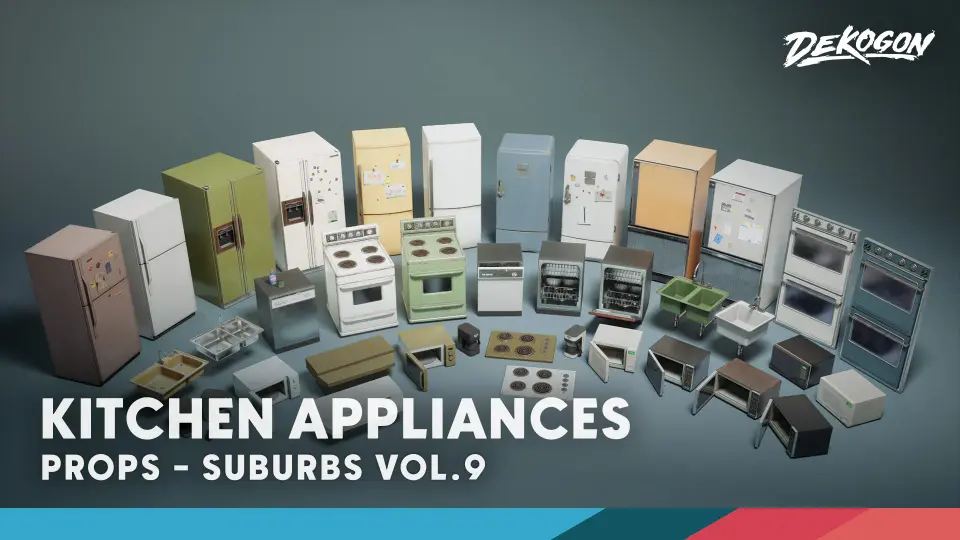
Domestic spaces define the emotional atmosphere of environmental storytelling. Whether outfitting an abandoned residential interior, building an authentic 1970s family home, or constructing an eerie horror basement, the authenticity of large appliances anchors the space. Suburbs VOL.9 - Kitchen Appliances addresses this specific production requirement by focusing on period-specific hardware, from vintage refrigerators and dishwashers to standalone washers and utility machines.
In horror and post-apocalyptic projects, domestic settings often serve as the first point of contact for players before tension escalates. Kitchens and laundry rooms tell immediate stories about the inhabitants through worn surfaces, dated designs, and heavy mechanical shapes typical of mid-to-late twentieth-century manufacturing. Because retro kitchen appliances rely on distinct physical silhouettes—boxy bodies, exterior latches, mechanical dials, and stamped metal handles—generic modern props rarely fit those environments. Having dedicated 1970s and 1980s designs allows environment artists to establish a believable era without relying on anachronistic modern shapes.
Beyond horror and decay, clean historical reconstruction projects also require period-accurate appliances. Suburban interiors from past decades carry specific visual languages that cannot be simulated simply by recoloring modern flat-panel hardware. The bulky contours, ribbed back panels, and mechanical footprints represented in this collection provide set dressing that integrates directly into historical or stylized suburban environments.
Dual Mesh Delivery: Nanite Meshes and Low Poly Variants
One structural challenge in modern Unreal Engine environment production is balancing next-generation geometry against platforms requiring traditional polygonal budgets. This collection addresses pipeline flexibility by supplying 100 meshes split evenly between high-density Nanite representations and standard low-poly game models, along with mesh variants.
For projects taking advantage of Unreal Engine 5's virtualized geometry pipeline, the Nanite assets allow artists to retain full polygonal density without baking down essential structural contours. The curved corners of antique refrigerators, the segmented controls of dishwashers, and the stamped vents on utility washers retain their geometric silhouettes even when viewed from extreme close-up angles during narrative sequences or first-person inspection.
Projects targeting fixed performance boundaries or platforms operating without Nanite can deploy the included low-poly variants. These meshes retain the exact visual character and footprint of their dense counterparts, ensuring that blocking, collision, and layout work remain identical regardless of which mesh format a studio incorporates into its rendering path. Furthermore, the inclusion of variant meshes gives level dressers the ability to repeat primary appliances across multiple rooms or residential units without creating immediate visual monotony.
All assets are fully detailed from every side. Back panels, recessed coil bays, hoses, and base frames are modeled rather than left open or hollowed out. This makes the collection viable for chaotic setups where appliances are tipped over in an abandoned hallway, pulled away from walls during repairs, or loaded onto moving trucks in narrative sets.
4K Channel-Packed Textures and Master Material Customization
Surface definition across the appliance collection is handled through high-fidelity 4K texture sets, accommodating close camera inspection without texture blurring. Materials are structured around a master material system designed to govern the majority of props throughout the package, ensuring uniform shading performance across the entire domestic prop inventory.
Memory efficiency is preserved through packed texture channels. Roughness, metalness, and ambient occlusion are combined into a single channel-packed texture map (Roughness | Metalness | Ambient Occlusion). This packing strategy minimizes texture sample calls within Unreal Engine shaders, preserving texture memory bandwidth during dense interior scenes where numerous distinct props share screen space.
To assist with environmental integration, the master material exposes targeted property overrides, allowing artists to make granular adjustments on an instance-by-instance basis:
Albedo tinting controls allow clean white enamel, dated avocado green, harvest gold, or industrial tones to be dialed into any mesh without re-exporting base textures.
Direct roughness modification enables control over surface reflectivity, letting artists vary between freshly polished enamel, greasy grime, or weathered matte finishes.
Normal strength adjustments allow fine surface stamping, seam depth, and micro-details to be balanced against room lighting.
Material parameters accommodate both showroom-clean presentations and dilapidated set dressing through simple parameter switches.
Lighting Integration with Unreal Engine 5 Lumen and Look Up Tables
Lighting behavior in enclosed suburban kitchens relies heavily on accurate bounce lighting and tight specular falloff against metallic and enameled surfaces. Suburbs VOL.9 - Kitchen Appliances is built with full support for Lumen global illumination and reflections in Unreal Engine 5.0 and newer versions.
Because the models are detailed completely on all faces and feature proper material definitions, Lumen calculates secondary bounces realistically off broad refrigerator panels, recessed dishwasher cavities, and washer lids. Light passing through narrow door frames or bouncing off vinyl flooring interacts naturally with the enameled metal and exposed mechanical surfaces of each appliance.
The package also incorporates a realistic post-process configuration paired with a Look Up Table (LUT). This post-process setup is tuned to harmonize the contrast, dynamic range, and color balance across the appliances, giving interior scenes a cohesive visual base immediately upon loading. Level designers can retain this look for instant cinematic framing or use it as a calibrated starting point to match an existing project's proprietary color grading.
Custom Branding and Production Utility
Asset usability in commercial development often hinges on legal clearances. Real-world appliance brands carry registered trademarks, copyrighted model names, and protected badge designs that can disrupt a commercial release. All appliances in this collection feature custom-designed studio branding and original labels, eliminating potential trademark and intellectual property conflicts.
This design choice allows commercial games, film cinematics, and interactive visualizations to incorporate these appliances directly into final consumer builds without requiring art teams to inspect, paint out, or replace logos on washers, refrigerators, or dishwashers.
Created by the artists at Dekogon Studios, Suburbs VOL.9 - Kitchen Appliances is intended for environment artists, narrative level designers, and architectural visualization teams who need reliable, era-accurate appliances that work inside modern Unreal Engine lighting pipelines straight out of the box.
 Tools
Tools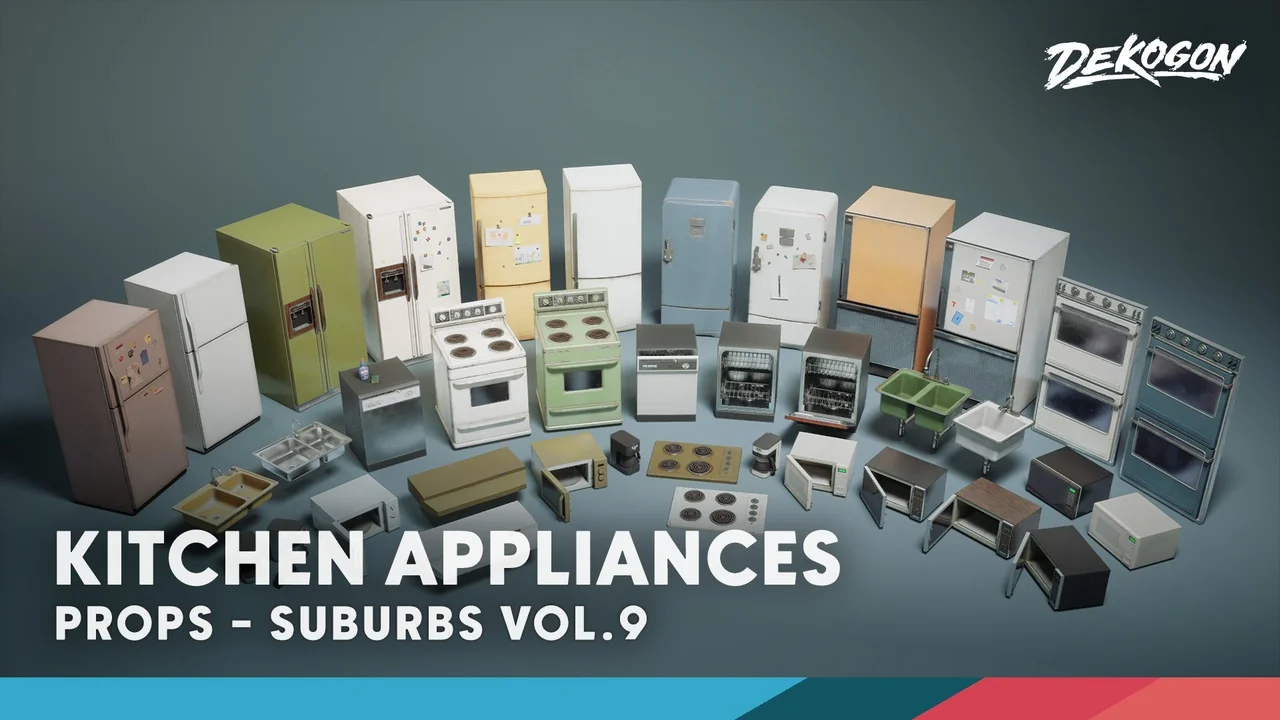
 Tools
Tools Tools
Tools Tools
Tools