"0148f1904a9b0d16"{"id":"1002580","slug":"clay-pots-pack","title":"Clay Pots Pack","category":"Tools, Objects \u0026 Decor","engine":"5.0+","assetVersion":"","engineVersion":"Engine Version: 5.0+","tag":"Tools","accent":"blue","visual":"mech","summary":"Examine the Clay Pots Pack featuring 25 unique clay vessels in Nanite and low-poly formats with 4K PBR textures for games, cinematics, and VR.","platform":"Unreal Engine","indexPolicy":"index","publishedAt":"2026-11-14T05:17:45.880Z","updatedAt":"2026-11-14T05:17:45.880Z","sourceNotes":[],"fileContents":[],"compatibility":["Unreal Engine","Engine Version: 5.0+"],"featuredImage":{"alt":"Clay Pots Pack","src":"/wp-content/uploads/published/2026/11/38be6bb989e9-2ab8c97a-ea08-4b6e-beeb-0ff970af165a-15c5aedaf5.webp"},"hasDownloadLink":true,"downloads":0,"terms":[{"taxonomy":"category","slug":"tools-objects-and-decor","name":"Tools, Objects \u0026 Decor"}],"galleryImages":[{"src":"/wp-content/uploads/published/2026/11/5caf98cdd84e-3342cf10-04f0-4e52-8b82-ff138960ed70-64090fe77b.webp","alt":"Clay Pots Pack"},{"src":"/wp-content/uploads/published/2026/11/a613173e0f49-d0992f6a-b404-4de7-9e04-9439f8865b91-b6fe352c8a.webp","alt":"Clay Pots Pack"},{"src":"/wp-content/uploads/published/2026/11/8ded646f16e9-cc3c0fdf-f163-4264-94af-6466c836304f-12822fd6d0.webp","alt":"Clay Pots Pack"},{"src":"/wp-content/uploads/published/2026/11/9668c26955cb-20b2bbfe-35b7-4ca1-a591-51afdb5d9410-dbd7486ea3.webp","alt":"Clay Pots Pack"},{"src":"/wp-content/uploads/published/2026/11/a44197ef2705-d47a5870-6a45-404b-b8f1-42d39bfdeab6-197c56a405.webp","alt":"Clay Pots Pack"},{"src":"/wp-content/uploads/published/2026/11/5e37cdee20e4-84f557d6-b347-4d09-aeb3-849fae8ba7ec-97b3e08ac8.webp","alt":"Clay Pots Pack"},{"src":"/wp-content/uploads/published/2026/11/7ab0ebedcfe1-cbaac4b7-52a9-450f-bac8-416596dc692d-68457e4224.webp","alt":"Clay Pots Pack"},{"src":"/wp-content/uploads/published/2026/11/9fdc2b83dbab-e2e42866-817e-4063-87b9-14efda928ce1-a58f36fbb3.webp","alt":"Clay Pots Pack"},{"src":"/wp-content/uploads/published/2026/11/d9b346b0ccd8-a80fa5c6-2d15-4a3d-9bfa-96b56ca30373-fad05ce0d5.webp","alt":"Clay Pots Pack"},{"src":"/wp-content/uploads/published/2026/11/eeaf2b14b56d-70c36c70-c68e-4633-9a87-3c930e59dd58-c5350edc82.webp","alt":"Clay Pots Pack"}],"accessPanel":{"kind":"resource","title":"Get this resource","eyebrow":"Free resource","message":"Download this resource in your browser.","fileName":"Content.7z","safetyNote":"Resources are manually reviewed before listing to improve quality and reduce obvious risks.","actionLabel":"Get this resource","resourceType":"Resource archive","versions":[]},"contentHtml":"\u003ch2\u003eIntegrating the Dual-Mesh Pipeline for the Clay Pots Pack\u003c/h2\u003e\n\u003cp\u003eSetting up 3D environment dressing often forces a hard choice between geometric fidelity and rendering overhead. The Clay Pots Pack addresses this distribution dilemma directly by supplying every single one of its 25 unique vessels in two distinct structural configurations: a Nanite-enabled high-density mesh and an optimized low-poly counterpart. Integrating these assets into an active production begins with determining the target rendering budget and engine framework. Unreal Engine 5 projects leveraging Nanite can deploy the high-poly representations straight into the viewport, allowing micro-surface depth, carved edges, and curved silhouettes to render without traditional geometric faceting or manual level-of-detail stepping.\u003c/p\u003e\n\u003cp\u003eWorkflows targeting platforms with strict draw-call thresholds, virtual reality setups, or vast background dressing scenarios can implement the low-poly variants instead. These lighter meshes retain the silhouette definition established by the handcrafted primary forms while dramatically lowering processing demands. Because both mesh types share the identical texturing structure, switching between the Nanite and low-poly assets does not disrupt material assignments or scene composition. Environment artists can stage initial level blockouts or test placement density with the low-poly meshes, then swap in the Nanite assets for portfolio renders, hero prop compositions, or virtual production stages where foreground camera scrutiny demands absolute fidelity.\u003c/p\u003e \u003ch2\u003eSilhouette Variety Across the 25 Clay Vessels\u003c/h2\u003e\n\u003cp\u003ePopulating believable prop clusters in historical or fantasy scenes requires a wide range of silhouettes to prevent the eye from registering repeated objects. Within the collection, 25 individual designs provide distinct profiles, ensuring that clusters of containers appear assembled over time rather than cloned from a single mold. The collection spans foundational utility items and ceremonial vessels, encompassing deep jars, tall urns, classical amphoras, wide shallow bowls, pouring pitchers, and ornamented decorative pieces.\u003c/p\u003e\n\u003cp\u003eEach pot brings individual handling features and structural variations. Vessels are differentiated through diverse handle placements—from dual-looped amphora necks to single-handle jug designs—alongside varying lip diameters, base tapers, and belly contours. When dressing a crowded desert bazaar, medieval tavern storeroom, or archaeological excavation site, grouping broad bowls alongside slender amphoras breaks up horizontal ground planes. By rotating and combining these distinct functional shapes, large decorative arrangements can fill extensive room perimeters, market stalls, or temple steps while completely mitigating the visual fatigue caused by repeated geometry.\u003c/p\u003e \u003ch2\u003e4K Texture Packing and Terracotta Surface Craft\u003c/h2\u003e\n\u003cp\u003eVisual storytelling in historical props relies heavily on surface authenticity, wear patterns, and the tactile quality of fired earth. Every asset in the collection is surfaced with dedicated 4096 × 4096 PBR texture sets engineered to maintain readability across both extreme close-ups and wide cinematic sweeps. The material workflow is built on three core map outputs: Base Color, Normal, and a channel-packed RMA texture that bundles Roughness, Metallic, and Ambient Occlusion into the red, green, and blue color channels.\u003c/p\u003e\n\u003cp\u003eThis packed channel structure keeps memory footprints efficient within real-time game engines while providing precise material separation. The Base Color map captures the natural chromatic variations found in baked earth, from pale sun-bleached ceramics and reddish terracotta tones to aged, soot-stained clay. Overlaid across these earthy base layers are hand-painted motifs, decorative borders, and regional patterns that hint at distinct cultural origins. The Normal and RMA maps translate physical wear directly to the engine's lighting model: carved ornamentation, recessed engravings, chipped rims, and porous micro-textures catch specular highlights and throw subtle self-shadows. The variations stored in the roughness channel ensure that weathered, dry clay reflects light diffusely, while glazed surfaces or smoothed painted sections exhibit tighter, authentic specular response.\u003c/p\u003e \u003ch2\u003eStaging Pots in Historical Reconstructions and Fantasy Interiors\u003c/h2\u003e\n\u003cp\u003eThe contextual breadth of the 25 designs allows them to sit naturally across a broad spectrum of time periods, environments, and narrative themes. In historical reconstructions and archaeological visualizations, the authentic aging and traditional clay finishes make the vessels suitable for ancient settlements, dusty desert environments, and active dig sites. Placed within tombs, ruins, or subterranean catacombs, the urns and sealed jars serve as functional burial goods or long-forgotten storage containers.\u003c/p\u003e\n\u003cp\u003eFor stylized or realistic fantasy games, the vessels effortlessly adapt to medieval village markets, wizardly laboratories, tavern basements, and sacred temple interiors. Their detailed, multi-angle readability ensures that players can inspect them up close during exploration, adventure gameplay, or narrative dialogue sequences without exposing low-resolution texture stretching or hollow underside geometry. Outside interactive game scenes, the pack serves cultural and educational productions, providing ready-to-render artifacts for virtual museum exhibits, historical documentaries, and cinematic background dressing where realistic material response under changing lighting conditions is mandatory.\u003c/p\u003e \u003ch2\u003eProduction Readiness from Real-Time VR to Virtual Production\u003c/h2\u003e\n\u003cp\u003eThe creation of realistic terracotta assets involves balancing expressive sculptural details with clean texture layout. Alongside the completed in-engine assets, the developer provides an asset pack trailer and a modeling and texturing timelapse tutorial, giving technical and visual insight into how these handcrafted clay surfaces, painted motifs, and aged finishes were constructed from concept to final export. Reviewing the production process demonstrates how complex surface carvings and worn patinas are achieved before being translated into 4K PBR texture maps.\u003c/p\u003e\n\u003cp\u003eWhether deployed in expansive virtual production environments, cinematic animations, architectural background set dressing, or interactive real-time worlds, the collection delivers a ready-to-use balance between aesthetic character and technical flexibility. Environment artists, cinematic lighters, and level designers can transition directly from high-end Unreal Engine 5 Nanite rendering to performance-conscious low-poly deployment without sacrificing the distinct character, historical weight, and weathered craftsmanship embedded in each vessel.\u003c/p\u003e\n\n\u003ch2\u003eExplore Similar Assets\u003c/h2\u003e\n\u003cul\u003e\n\u003cli\u003e\u003ca href=\"https://3dcghub.com/vintage-scifi-pack-vol-13-collumn/\" rel=\"noopener noreferrer\"\u003eVintage SciFi Pack VOL 13 Collumn\u003c/a\u003e\u003c/li\u003e\n\u003cli\u003e\u003ca href=\"https://3dcghub.com/rpg-fantasy-crystals-kit/\" rel=\"noopener noreferrer\"\u003eRPG Fantasy Crystals KIT\u003c/a\u003e\u003c/li\u003e\n\u003cli\u003e\u003ca href=\"https://3dcghub.com/suburbs-vol-9-kitchen-appliances-nanite-and-low-poly/\" rel=\"noopener noreferrer\"\u003eSuburbs VOL.9 - Kitchen Appliances (Nanite and Low Poly)\u003c/a\u003e\u003c/li\u003e\n\u003cli\u003e\u003ca href=\"https://3dcghub.com/suburbs-vol-1-wall-decor-nanite-and-low-poly/\" rel=\"noopener noreferrer\"\u003eSuburbs VOL.1 - Wall Decor (Nanite and Low Poly)\u003c/a\u003e\u003c/li\u003e\n\u003cli\u003e\u003ca href=\"https://3dcghub.com/dragon-portal/\" rel=\"noopener noreferrer\"\u003eDragon Portal\u003c/a\u003e\u003c/li\u003e\n\u003c/ul\u003e","contentTextLength":6949,"navigation":{"current":69,"total":4543,"previous":{"id":"1002581","slug":"dark-knight-male-and-female","title":"Dark Knight - Male and Female","category":"Humans","platform":"Unreal Engine","updatedAt":"2026-11-14T05:18:57.769Z"},"next":{"id":"1002579","slug":"assassin","title":"Assassin","category":"Characters \u0026 Creatures","platform":"Unreal Engine","updatedAt":"2026-11-14T05:15:51.187Z"}},"relatedResources":[{"id":"1002611","slug":"wooden-props-environment-pack","title":"Wooden props environment pack","category":"Tools, Objects \u0026 Decor","engine":"5.0+","assetVersion":"","engineVersion":"Engine Version: 5.0+","tag":"Tools","accent":"blue","visual":"city","summary":"Examine the technical layout, 10.24 texel density, 4K textures, collision setup, and modular timber pieces in the Wooden props environment pack.","platform":"Unreal Engine","indexPolicy":"index","publishedAt":"2026-11-14T06:10:37.608Z","updatedAt":"2026-11-14T06:10:37.608Z","sourceNotes":[],"fileContents":[],"compatibility":["Unreal Engine","Engine Version: 5.0+"],"featuredImage":{"alt":"Wooden props environment pack","src":"/wp-content/uploads/published/2026/11/befbe9e38914-97b915f9-7e7d-470d-bead-8c5ace4fd2fe-e10621e5b4.webp"},"hasDownloadLink":true,"downloads":0},{"id":"1002606","slug":"stylized-fantasy-pottery-and-vessels-22-low-poly-game-ready-assets","title":"Stylized Fantasy Pottery \u0026 Vessels: 22 Low-Poly Game-Ready Assets","category":"Tools, Objects \u0026 Decor","engine":"5.0+","assetVersion":"","engineVersion":"Engine Version: 5.0+","tag":"Tools","accent":"blue","visual":"mech","summary":"Explore the 22 low-poly models in Stylized Fantasy Pottery \u0026 Vessels, featuring triangle counts, Blender material setup, and PBR styling details.","platform":"Unreal Engine","indexPolicy":"index","publishedAt":"2026-11-14T06:02:50.961Z","updatedAt":"2026-11-14T06:02:50.961Z","sourceNotes":[],"fileContents":[],"compatibility":["Unreal Engine","Engine Version: 5.0+"],"featuredImage":{"alt":"Stylized Fantasy Pottery \u0026 Vessels: 22 Low-Poly Game-Ready Assets","src":"/wp-content/uploads/published/2026/11/a07d2d32e673-dd702d22-e998-4d1c-b5bc-239af772c671-1551f67324.webp"},"hasDownloadLink":true,"downloads":0},{"id":"1002259","slug":"vintage-scifi-pack-vol-13-collumn","title":"Vintage SciFi Pack VOL 13 Collumn","category":"Tools, Objects \u0026 Decor","engine":"5.0+","assetVersion":"","engineVersion":"Engine Version: 5.0+","tag":"Tools","accent":"blue","visual":"mech","summary":"Vintage SciFi Pack VOL 13 Collumn features Nanite support for Unreal Engine 5.0+ and Substance Painter PBR textures for alien, space, and horror environments.","platform":"Unreal Engine","indexPolicy":"index","publishedAt":"2026-10-29T16:19:57.954Z","updatedAt":"2026-10-29T16:19:57.954Z","sourceNotes":[],"fileContents":[],"compatibility":["Unreal Engine","Engine Version: 5.0+"],"featuredImage":{"alt":"Vintage SciFi Pack VOL 13 Collumn","src":"/wp-content/uploads/published/2026/10/f6cfce2f6ff6-74c8a433-0b94-42c7-bc7f-99489fe8630b-620dbcc613.webp"},"hasDownloadLink":true,"downloads":0}]}
Tools
Clay Pots Pack
Examine the Clay Pots Pack featuring 25 unique clay vessels in Nanite and low-poly formats with 4K PBR textures for games, cinematics, and VR.
Integrating the Dual-Mesh Pipeline for the Clay Pots Pack
Setting up 3D environment dressing often forces a hard choice between geometric fidelity and rendering overhead. The Clay Pots Pack addresses this distribution dilemma directly by supplying every single one of its 25 unique vessels in two distinct structural configurations: a Nanite-enabled high-density mesh and an optimized low-poly counterpart. Integrating these assets into an active production begins with determining the target rendering budget and engine framework. Unreal Engine 5 projects leveraging Nanite can deploy the high-poly representations straight into the viewport, allowing micro-surface depth, carved edges, and curved silhouettes to render without traditional geometric faceting or manual level-of-detail stepping.
Workflows targeting platforms with strict draw-call thresholds, virtual reality setups, or vast background dressing scenarios can implement the low-poly variants instead. These lighter meshes retain the silhouette definition established by the handcrafted primary forms while dramatically lowering processing demands. Because both mesh types share the identical texturing structure, switching between the Nanite and low-poly assets does not disrupt material assignments or scene composition. Environment artists can stage initial level blockouts or test placement density with the low-poly meshes, then swap in the Nanite assets for portfolio renders, hero prop compositions, or virtual production stages where foreground camera scrutiny demands absolute fidelity.
Silhouette Variety Across the 25 Clay Vessels
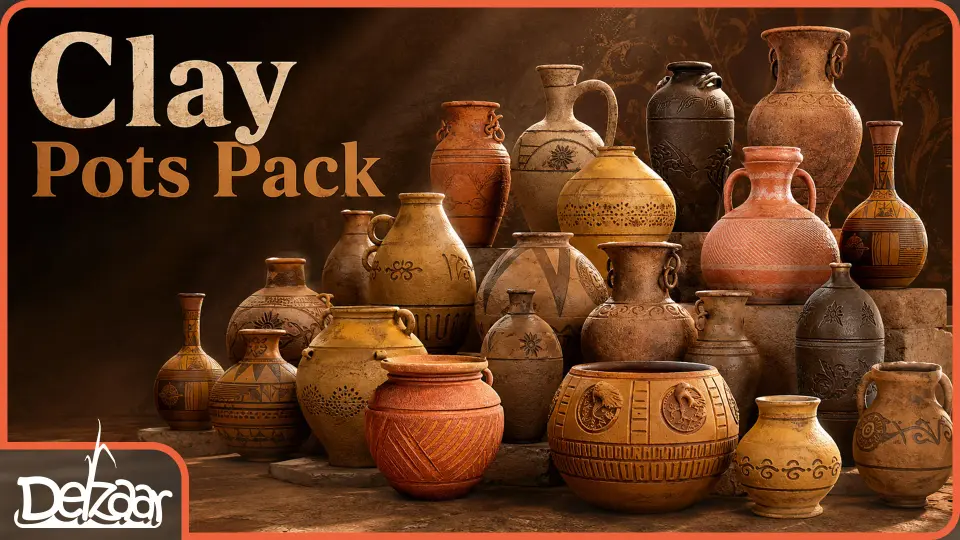
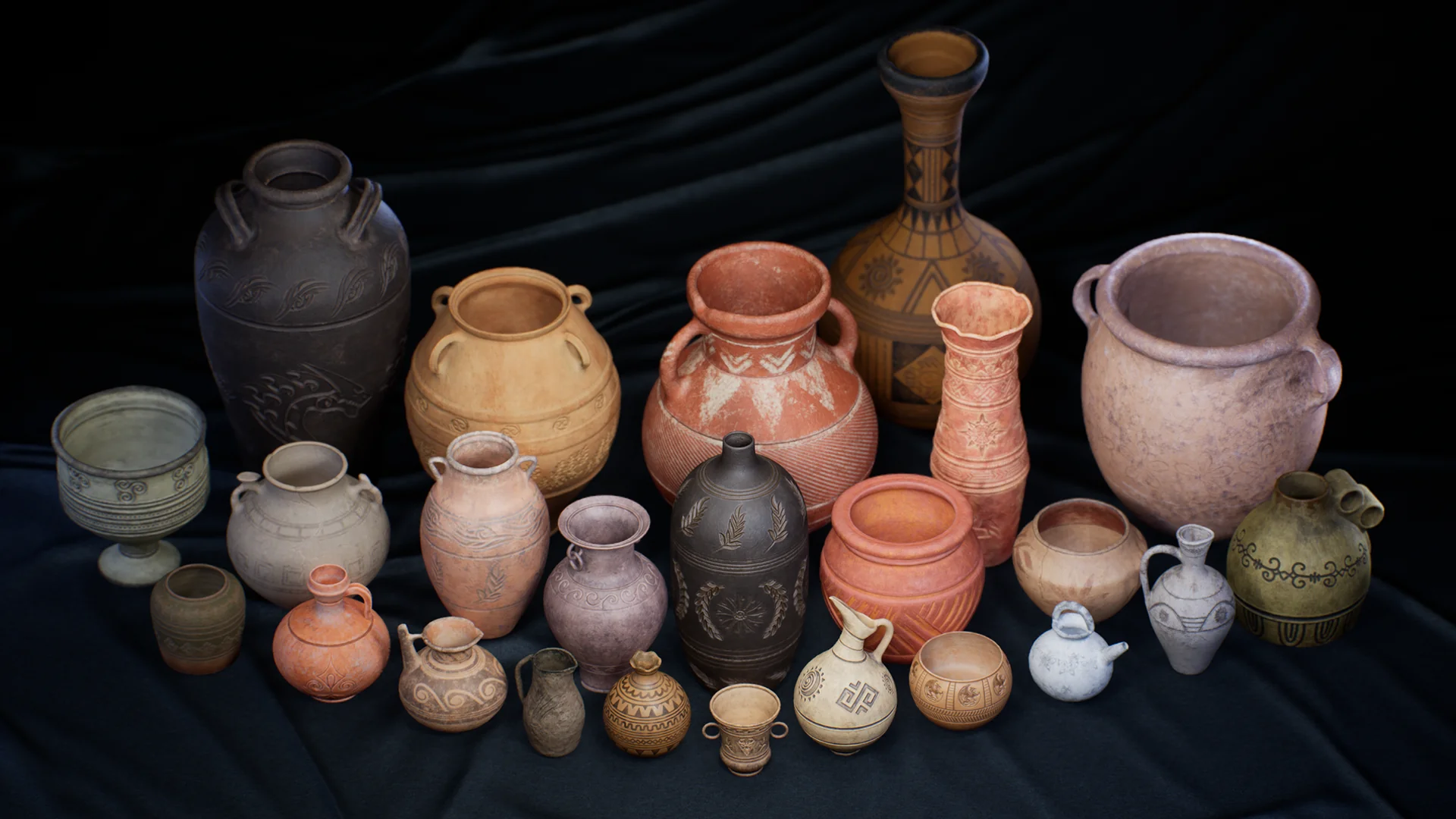
Populating believable prop clusters in historical or fantasy scenes requires a wide range of silhouettes to prevent the eye from registering repeated objects. Within the collection, 25 individual designs provide distinct profiles, ensuring that clusters of containers appear assembled over time rather than cloned from a single mold. The collection spans foundational utility items and ceremonial vessels, encompassing deep jars, tall urns, classical amphoras, wide shallow bowls, pouring pitchers, and ornamented decorative pieces.
Each pot brings individual handling features and structural variations. Vessels are differentiated through diverse handle placements—from dual-looped amphora necks to single-handle jug designs—alongside varying lip diameters, base tapers, and belly contours. When dressing a crowded desert bazaar, medieval tavern storeroom, or archaeological excavation site, grouping broad bowls alongside slender amphoras breaks up horizontal ground planes. By rotating and combining these distinct functional shapes, large decorative arrangements can fill extensive room perimeters, market stalls, or temple steps while completely mitigating the visual fatigue caused by repeated geometry.
4K Texture Packing and Terracotta Surface Craft
Visual storytelling in historical props relies heavily on surface authenticity, wear patterns, and the tactile quality of fired earth. Every asset in the collection is surfaced with dedicated 4096 × 4096 PBR texture sets engineered to maintain readability across both extreme close-ups and wide cinematic sweeps. The material workflow is built on three core map outputs: Base Color, Normal, and a channel-packed RMA texture that bundles Roughness, Metallic, and Ambient Occlusion into the red, green, and blue color channels.
This packed channel structure keeps memory footprints efficient within real-time game engines while providing precise material separation. The Base Color map captures the natural chromatic variations found in baked earth, from pale sun-bleached ceramics and reddish terracotta tones to aged, soot-stained clay. Overlaid across these earthy base layers are hand-painted motifs, decorative borders, and regional patterns that hint at distinct cultural origins. The Normal and RMA maps translate physical wear directly to the engine's lighting model: carved ornamentation, recessed engravings, chipped rims, and porous micro-textures catch specular highlights and throw subtle self-shadows. The variations stored in the roughness channel ensure that weathered, dry clay reflects light diffusely, while glazed surfaces or smoothed painted sections exhibit tighter, authentic specular response.
Staging Pots in Historical Reconstructions and Fantasy Interiors
The contextual breadth of the 25 designs allows them to sit naturally across a broad spectrum of time periods, environments, and narrative themes. In historical reconstructions and archaeological visualizations, the authentic aging and traditional clay finishes make the vessels suitable for ancient settlements, dusty desert environments, and active dig sites. Placed within tombs, ruins, or subterranean catacombs, the urns and sealed jars serve as functional burial goods or long-forgotten storage containers.
For stylized or realistic fantasy games, the vessels effortlessly adapt to medieval village markets, wizardly laboratories, tavern basements, and sacred temple interiors. Their detailed, multi-angle readability ensures that players can inspect them up close during exploration, adventure gameplay, or narrative dialogue sequences without exposing low-resolution texture stretching or hollow underside geometry. Outside interactive game scenes, the pack serves cultural and educational productions, providing ready-to-render artifacts for virtual museum exhibits, historical documentaries, and cinematic background dressing where realistic material response under changing lighting conditions is mandatory.
Production Readiness from Real-Time VR to Virtual Production
The creation of realistic terracotta assets involves balancing expressive sculptural details with clean texture layout. Alongside the completed in-engine assets, the developer provides an asset pack trailer and a modeling and texturing timelapse tutorial, giving technical and visual insight into how these handcrafted clay surfaces, painted motifs, and aged finishes were constructed from concept to final export. Reviewing the production process demonstrates how complex surface carvings and worn patinas are achieved before being translated into 4K PBR texture maps.
Whether deployed in expansive virtual production environments, cinematic animations, architectural background set dressing, or interactive real-time worlds, the collection delivers a ready-to-use balance between aesthetic character and technical flexibility. Environment artists, cinematic lighters, and level designers can transition directly from high-end Unreal Engine 5 Nanite rendering to performance-conscious low-poly deployment without sacrificing the distinct character, historical weight, and weathered craftsmanship embedded in each vessel.
 Tools
 Tools
 Tools
 Tools