"0148f1904a9b0d16"{"id":"1002611","slug":"wooden-props-environment-pack","title":"Wooden props environment pack","category":"Tools, Objects \u0026 Decor","engine":"5.0+","assetVersion":"","engineVersion":"Engine Version: 5.0+","tag":"Tools","accent":"blue","visual":"city","summary":"Examine the technical layout, 10.24 texel density, 4K textures, collision setup, and modular timber pieces in the Wooden props environment pack.","platform":"Unreal Engine","indexPolicy":"index","publishedAt":"2026-11-14T06:10:37.608Z","updatedAt":"2026-11-14T06:10:37.608Z","sourceNotes":[],"fileContents":[],"compatibility":["Unreal Engine","Engine Version: 5.0+"],"featuredImage":{"alt":"Wooden props environment pack","src":"/wp-content/uploads/published/2026/11/befbe9e38914-97b915f9-7e7d-470d-bead-8c5ace4fd2fe-e10621e5b4.webp"},"hasDownloadLink":true,"downloads":0,"terms":[{"taxonomy":"category","slug":"tools-objects-and-decor","name":"Tools, Objects \u0026 Decor"}],"galleryImages":[{"src":"/wp-content/uploads/published/2026/11/3414fbdc44ef-1fef64ec-9ee1-4606-9a89-02c732dce45c-c904f62898.webp","alt":"Wooden props environment pack"},{"src":"/wp-content/uploads/published/2026/11/6b6ae33dc774-f93650f8-e8b8-4915-9816-96f25556a59f-ea3c56b401.webp","alt":"Wooden props environment pack"},{"src":"/wp-content/uploads/published/2026/11/245d544213b5-dad0456d-aa26-48f7-b4cb-c2ef4fd70470-d4ddffd471.webp","alt":"Wooden props environment pack"},{"src":"/wp-content/uploads/published/2026/11/d9150f3dad67-5b013213-fb91-428d-acd5-dca75b9e284c-326e5d7c2a.webp","alt":"Wooden props environment pack"},{"src":"/wp-content/uploads/published/2026/11/77b9792af28a-4b60945d-a654-4c35-89eb-e27e32cb59f6-1c6835b594.webp","alt":"Wooden props environment pack"},{"src":"/wp-content/uploads/published/2026/11/47d21bb75d3c-521d9351-86cc-450d-bd03-c2b156c3d771-c93658ee3a.webp","alt":"Wooden props environment pack"},{"src":"/wp-content/uploads/published/2026/11/8bbc8a4df1ec-782369d0-3b89-4099-9b57-02b0152d1758-eeeeee45ac.webp","alt":"Wooden props environment pack"},{"src":"/wp-content/uploads/published/2026/11/1bc3b8ff281c-5ce7d260-4152-4656-b142-530a142b46e7-e71f1717f0.webp","alt":"Wooden props environment pack"}],"accessPanel":{"kind":"resource","title":"Get this resource","eyebrow":"Free resource","message":"Download this resource in your browser.","fileName":"Content.7z","safetyNote":"Resources are manually reviewed before listing to improve quality and reduce obvious risks.","actionLabel":"Get this resource","resourceType":"Resource archive","versions":[]},"contentHtml":"\u003cp\u003eConstructing believable rustic scenes demands timber elements that balance visual fidelity with modular freedom. When assembling medieval fortifications, fantasy outposts, or grounded historical hamlets, environment artists face the constant friction of making repetitive wooden structures feel handcrafted. The Wooden props environment pack directly addresses this challenge by combining pre-assembled modular constructions with loose, fundamental structural components, allowing level designers to populate wilderness environments, working villages, and fortified defensive perimeters without visual uniformity.\u003c/p\u003e \u003ch2\u003eStructural Assembly Using Wooden Modular Prefabs and Discrete Timber\u003c/h2\u003e\n\u003cp\u003eLevel composition generally stalls when artists must choose between rigid, pre-built structures that look identical across a map or completely loose, raw pieces that take hours to assemble into simple shacks. This collection resolves that trade-off by shipping both finished modular prefabs and separated wooden parts. Designers gain access to distinct planks, vertical pillars, and raw logs alongside the larger assemblies, opening distinct avenues for both rapid greyboxing and detailed hero placement.\u003c/p\u003e \u003cp\u003eThe separated components serve as the foundational grammar of structural carpentry. Individual logs provide the mass needed to establish retaining walls, heavy foundation posts, defensive palisades, and rough-hewn framing. Upright pillars establish vertical rhythm along pathways, interior support networks, or exterior covered walkways. Loose planks allow for fine dressing: patching damaged roofs, reinforcing barricades, laying uneven floorboards across damp ground, or constructing makeshift walkways over rugged terrain.\u003c/p\u003e \u003cp\u003eWorking with individual planks and pillars means that damage and wear can be communicated geometrically rather than relying solely on texture blending. An artist can pull a single plank from a modular wall prefab, rotate it to mimic rot or structural collapse, and lean a loose log against the frame to suggest emergency field repairs. Because the package includes all assets showcased across its visual demonstrations, the pre-assembled constructions demonstrate exactly how these singular timber parts snap together into cohesive larger forms.\u003c/p\u003e \u003ch2\u003eTexel Density Consistency Across Wooden Props and Structural Assets\u003c/h2\u003e\n\u003cp\u003eOne of the primary failure points in modular environment design is texel density drift. When small props carry extremely high surface detail while adjoining structural framing appears blurry or stretched, the visual hierarchy collapses immediately. Every asset in this collection is constructed to a standardized 10.24 texel density, anchored by 4096x4096 textures.\u003c/p\u003e \u003cp\u003eThis strict adherence to 10.24 texel density ensures that whether a camera inspects a massive timber pillar or a narrow loose plank, the perceived grain resolution, edge bevels, and micro-surface details remain completely uniform. High-resolution 4096x4096 texture maps provide ample headroom for realistic wood surfaces, resolving tactile features such as radial cut marks, split fibers, weathering grooves, bark ridges, and surface oxidation without pixelation under close inspection.\u003c/p\u003e \u003cp\u003eIn practice, predictable texel density simplifies world composition. Environment artists can place a tiny piece of scrap lumber directly adjacent to a primary load-bearing prefab without noticing any disparity in surface crispness. This uniformity is vital for first-person and close third-person perspectives, where player positioning brings the camera within inches of doorways, structural supports, and defensive barriers.\u003c/p\u003e \u003ch2\u003eLOD Architecture and Collision Setup Across the Environment Pack\u003c/h2\u003e\n\u003cp\u003eEnvironmental density should never compromise runtime performance or player traversal. Real-time game engines require robust optimization behind complex wooden geometry, particularly when structures incorporate dense grain silhouettes, rounded log profiles, and irregular plank edges. All assets across the collection ship with dedicated Levels of Detail (LODs) and pre-configured collision meshes.\u003c/p\u003e \u003cp\u003eThe inclusion of complete LOD chains guarantees that scenes populated with extensive fences, sprawling wooden settlements, or complex log structures can scale cleanly across rendering distances. As structures recede from the camera, geometric complexity steps down predictably, reducing polygon draw overhead while maintaining the essential silhouette of timber framing, roofs, and vertical supports. This is particularly valuable in vast open-world maps where sightlines extend across fields, valleys, or fortified perimeter walls.\u003c/p\u003e \u003cp\u003eIntegrated collision meshes eliminate the tedious, error-prone phase of manually wrapping complex timber geometry in the engine. Because collisions are established out of the box, designers can place modular prefabs and individual logs directly into playable volumes with full support for player blocking, AI path navigation, projectile impacts, and physics interactions. Characters will not snag on invisible geometry or clip through uneven log fences, ensuring responsive physical gameplay immediately upon asset placement.\u003c/p\u003e \u003ch2\u003eStylistic Versatility from Medieval Settlements to Hybrid Winter Environments\u003c/h2\u003e\n\u003cp\u003eWhile the realistic style inherently suits medieval encampments and rustic fantasy settlements, the pack also demonstrates direct compatibility with modern industrial settings, specifically pairing with the SOSNOVKA/COCHOBKA - Winter concrete blocks environment. This cross-compatibility opens up compelling environmental storytelling opportunities that bridge disparate architectural eras.\u003c/p\u003e \u003cp\u003eIn historical and fantasy contexts, the timber parts speak directly to utilitarian construction: trade outposts, logging camps, village markets, and timber-framed bastions. The realistic surface finish preserves the authentic weight of heavy carpentry without leaning into exaggerated, stylized proportions. Designers can convey honest, period-accurate timber framing that fits seamlessly alongside stonework, thatch, or earthworks.\u003c/p\u003e \u003cp\u003eWhen placed into the context of brutalist or industrial spaces—such as the SOSNOVKA/COCHOBKA winter concrete complex—the wooden constructions transform into temporary utilitarian interventions. Rough planks and heavy logs can be staged as makeshift structural shoring inside crumbling concrete basements, improvised walkways spanning frozen mud, scaffolding erected against weathered pre-cast concrete slabs, or security barricades sealing off industrial access points. The organic, weathered quality of the wood provides immediate narrative contrast against cold, prefabricated concrete, suggesting human occupation, resource scarcity, and rapid tactical fortification in harsh winter climates.\u003c/p\u003e \u003ch2\u003ePractical Implementation and Scene Construction\u003c/h2\u003e\n\u003cp\u003eDeploying these wooden assets efficiently relies on understanding the relationship between the pre-built prefabs and the standalone lumber units. A structured assembly workflow keeps environments readable, believable, and quick to iterate:\u003c/p\u003e \u003cul\u003e \u003cli\u003e\u003cstrong\u003ePrimary Volume Blocking:\u003c/strong\u003e Establish the main spatial footprint by placing complete modular prefabs to define rooms, major defensive barriers, or overarching roofing frames.\u003c/li\u003e \u003cli\u003e\u003cstrong\u003eFraming and Support Extensions:\u003c/strong\u003e Use the heavy pillars and logs to ground the structures into the terrain, adding extra vertical columns where terrain slopes demand visible structural underpinning.\u003c/li\u003e \u003cli\u003e\u003cstrong\u003eSurface Modification and Dressing:\u003c/strong\u003e Layer individual planks over walkways, rooftops, and barricades to break up repeating patterns and create irregular, hand-built visual accents.\u003c/li\u003e \u003cli\u003e\u003cstrong\u003eScatter and Narrative Detailing:\u003c/strong\u003e Distribute single logs, loose boards, and timber fragments around work areas, construction sites, or damaged zones to imply ongoing activity and wear.\u003c/li\u003e\n\u003c/ul\u003e \u003cp\u003eBy relying on a standardized 10.24 texel density, comprehensive LODs, and functional collisions, the pack removes the technical friction often associated with assembling dense timber scenery. Whether constructing an isolated medieval homestead or fortifying an abandoned concrete installation in a freezing climate, the assets provide the modular building blocks necessary to execute grounded, realistic woodwork.\u003c/p\u003e\n\n\u003ch2\u003eMore From The Same Workflow\u003c/h2\u003e\n\u003cul\u003e\n\u003cli\u003e\u003ca href=\"https://3dcghub.com/scifi-capsules-props-3/\" rel=\"noopener noreferrer\"\u003eSciFi Capsules Props 3\u003c/a\u003e\u003c/li\u003e\n\u003cli\u003e\u003ca href=\"https://3dcghub.com/american-bar/\" rel=\"noopener noreferrer\"\u003eAmerican Bar\u003c/a\u003e\u003c/li\u003e\n\u003cli\u003e\u003ca href=\"https://3dcghub.com/survival-horror-inventory-props-pack/\" rel=\"noopener noreferrer\"\u003eSurvival Horror Inventory Props Pack\u003c/a\u003e\u003c/li\u003e\n\u003cli\u003e\u003ca href=\"https://3dcghub.com/sci-fi-shrine-props-vol-5/\" rel=\"noopener noreferrer\"\u003eSci-Fi Shrine props VOL 5\u003c/a\u003e\u003c/li\u003e\n\u003cli\u003e\u003ca href=\"https://3dcghub.com/modular-hut-pack/\" rel=\"noopener noreferrer\"\u003eModular Hut Pack\u003c/a\u003e\u003c/li\u003e\n\u003c/ul\u003e","contentTextLength":8305,"navigation":{"current":38,"total":4543,"previous":{"id":"1002612","slug":"elf-arden-stylized-medieval-elven-warrior-animated-rpg-character-hero-56-2","title":"Elf Arden - Stylized Medieval Elven Warrior - Animated RPG Character Hero - #56","category":"Humans","platform":"Unreal Engine","updatedAt":"2026-11-14T06:11:57.068Z"},"next":{"id":"1002610","slug":"wood-monster","title":"Wood Monster","category":"Characters \u0026 Creatures","platform":"Unreal Engine","updatedAt":"2026-11-14T06:09:28.327Z"}},"relatedResources":[{"id":"1002193","slug":"scifi-capsules-props-3","title":"SciFi Capsules Props 3","category":"Tools, Objects \u0026 Decor","engine":"4.20+,5.0+","assetVersion":"","engineVersion":"Engine Version: 4.20+,5.0+","tag":"Tools","accent":"blue","visual":"mech","summary":"Discover SciFi Capsules Props 3, featuring 14 game-ready capsules, 9 caps, dual-material glass setups, and blueprints for rapid level variation.","platform":"Unreal Engine","indexPolicy":"index","publishedAt":"2026-10-29T14:37:02.306Z","updatedAt":"2026-10-29T14:37:02.306Z","sourceNotes":[],"fileContents":[],"compatibility":["Unreal Engine","Engine Version: 4.20+,5.0+"],"featuredImage":{"alt":"SciFi Capsules Props 3","src":"/wp-content/uploads/published/2026/10/62c1867b2e52-01ebe196-49ba-4cd7-bcc3-ad0adddd9b4f-bdc88a98f8.webp"},"hasDownloadLink":true,"downloads":1},{"id":"4691","slug":"medieval-props-vol-3-farm","title":"Medieval Props Vol 3 Farm","category":"Tools, Objects \u0026 Decor","engine":"4.26+,5.0+","assetVersion":"Engine version: 4.26+,5.0+","engineVersion":"4.22","tag":"Tools","accent":"blue","visual":"mech","summary":"Enhance your fantasy environment with this optimized medieval farm props pack. Features master materials and texture atlases for high-quality game development.","platform":"Unreal Engine","indexPolicy":"noindex","publishedAt":"2026-02-13T09:18:10.000Z","updatedAt":"2026-11-14T10:16:37.997Z","sourceNotes":[],"fileContents":[],"compatibility":["Unreal Engine","Engine version: 4.26+,5.0+"],"featuredImage":{"alt":"Medieval Props Vol 3 Farm","src":"https://3dcghub.com/wp-content/uploads/2026/02/55a9061a-deab-4722-8e94-d97f39f56a9e.webp"},"hasDownloadLink":true,"downloads":0},{"id":"1001946","slug":"american-bar","title":"American Bar","category":"Tools, Objects \u0026 Decor","engine":"4.26+,5.0+","assetVersion":"","engineVersion":"Engine Version: 4.26+,5.0+","tag":"Tools","accent":"blue","visual":"mech","summary":"Configure the American Bar game props kit with custom materials on static mesh surfaces and manage surface adjustments through object properties.","platform":"Unreal Engine","indexPolicy":"index","publishedAt":"2026-10-24T11:20:17.570Z","updatedAt":"2026-10-24T11:20:17.570Z","sourceNotes":[],"fileContents":[],"compatibility":["Unreal Engine","Engine Version: 4.26+,5.0+"],"featuredImage":{"alt":"American Bar","src":"/wp-content/uploads/published/2026/10/5568197c90f3-e1a448bb-84b8-4700-ae13-10824c578603-ca43e406ad.webp"},"hasDownloadLink":true,"downloads":1}]}
Tools
Wooden props environment pack
Examine the technical layout, 10.24 texel density, 4K textures, collision setup, and modular timber pieces in the Wooden props environment pack.
Constructing believable rustic scenes demands timber elements that balance visual fidelity with modular freedom. When assembling medieval fortifications, fantasy outposts, or grounded historical hamlets, environment artists face the constant friction of making repetitive wooden structures feel handcrafted. The Wooden props environment pack directly addresses this challenge by combining pre-assembled modular constructions with loose, fundamental structural components, allowing level designers to populate wilderness environments, working villages, and fortified defensive perimeters without visual uniformity.
Structural Assembly Using Wooden Modular Prefabs and Discrete Timber
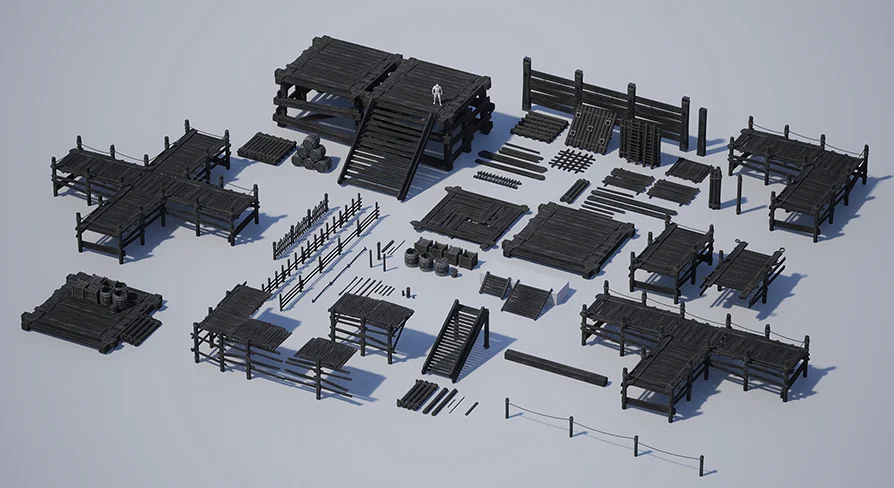
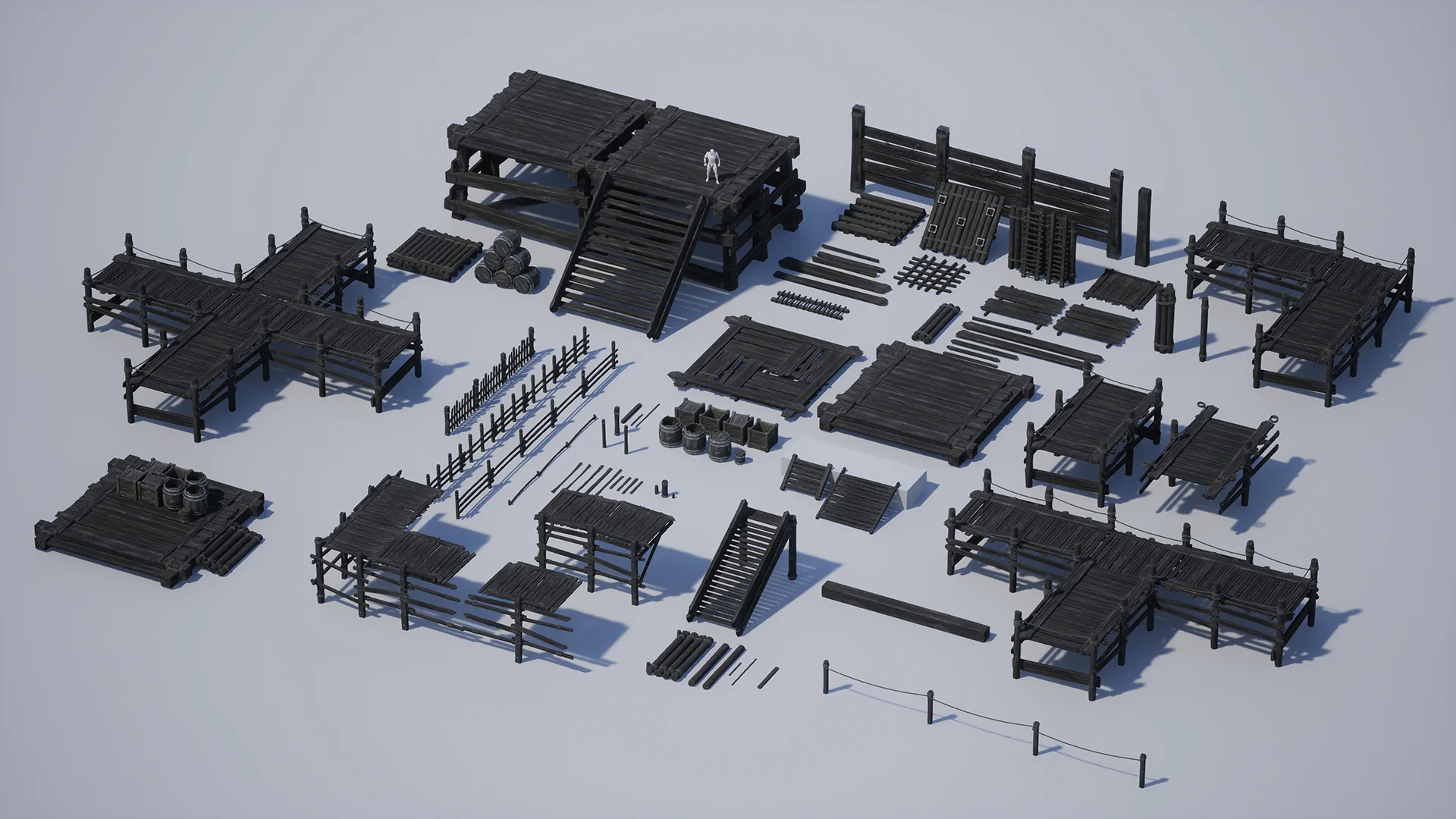
Level composition generally stalls when artists must choose between rigid, pre-built structures that look identical across a map or completely loose, raw pieces that take hours to assemble into simple shacks. This collection resolves that trade-off by shipping both finished modular prefabs and separated wooden parts. Designers gain access to distinct planks, vertical pillars, and raw logs alongside the larger assemblies, opening distinct avenues for both rapid greyboxing and detailed hero placement.
The separated components serve as the foundational grammar of structural carpentry. Individual logs provide the mass needed to establish retaining walls, heavy foundation posts, defensive palisades, and rough-hewn framing. Upright pillars establish vertical rhythm along pathways, interior support networks, or exterior covered walkways. Loose planks allow for fine dressing: patching damaged roofs, reinforcing barricades, laying uneven floorboards across damp ground, or constructing makeshift walkways over rugged terrain.
Working with individual planks and pillars means that damage and wear can be communicated geometrically rather than relying solely on texture blending. An artist can pull a single plank from a modular wall prefab, rotate it to mimic rot or structural collapse, and lean a loose log against the frame to suggest emergency field repairs. Because the package includes all assets showcased across its visual demonstrations, the pre-assembled constructions demonstrate exactly how these singular timber parts snap together into cohesive larger forms.
Texel Density Consistency Across Wooden Props and Structural Assets
One of the primary failure points in modular environment design is texel density drift. When small props carry extremely high surface detail while adjoining structural framing appears blurry or stretched, the visual hierarchy collapses immediately. Every asset in this collection is constructed to a standardized 10.24 texel density, anchored by 4096x4096 textures.
This strict adherence to 10.24 texel density ensures that whether a camera inspects a massive timber pillar or a narrow loose plank, the perceived grain resolution, edge bevels, and micro-surface details remain completely uniform. High-resolution 4096x4096 texture maps provide ample headroom for realistic wood surfaces, resolving tactile features such as radial cut marks, split fibers, weathering grooves, bark ridges, and surface oxidation without pixelation under close inspection.
In practice, predictable texel density simplifies world composition. Environment artists can place a tiny piece of scrap lumber directly adjacent to a primary load-bearing prefab without noticing any disparity in surface crispness. This uniformity is vital for first-person and close third-person perspectives, where player positioning brings the camera within inches of doorways, structural supports, and defensive barriers.
LOD Architecture and Collision Setup Across the Environment Pack
Environmental density should never compromise runtime performance or player traversal. Real-time game engines require robust optimization behind complex wooden geometry, particularly when structures incorporate dense grain silhouettes, rounded log profiles, and irregular plank edges. All assets across the collection ship with dedicated Levels of Detail (LODs) and pre-configured collision meshes.
The inclusion of complete LOD chains guarantees that scenes populated with extensive fences, sprawling wooden settlements, or complex log structures can scale cleanly across rendering distances. As structures recede from the camera, geometric complexity steps down predictably, reducing polygon draw overhead while maintaining the essential silhouette of timber framing, roofs, and vertical supports. This is particularly valuable in vast open-world maps where sightlines extend across fields, valleys, or fortified perimeter walls.
Integrated collision meshes eliminate the tedious, error-prone phase of manually wrapping complex timber geometry in the engine. Because collisions are established out of the box, designers can place modular prefabs and individual logs directly into playable volumes with full support for player blocking, AI path navigation, projectile impacts, and physics interactions. Characters will not snag on invisible geometry or clip through uneven log fences, ensuring responsive physical gameplay immediately upon asset placement.
Stylistic Versatility from Medieval Settlements to Hybrid Winter Environments
While the realistic style inherently suits medieval encampments and rustic fantasy settlements, the pack also demonstrates direct compatibility with modern industrial settings, specifically pairing with the SOSNOVKA/COCHOBKA - Winter concrete blocks environment. This cross-compatibility opens up compelling environmental storytelling opportunities that bridge disparate architectural eras.
In historical and fantasy contexts, the timber parts speak directly to utilitarian construction: trade outposts, logging camps, village markets, and timber-framed bastions. The realistic surface finish preserves the authentic weight of heavy carpentry without leaning into exaggerated, stylized proportions. Designers can convey honest, period-accurate timber framing that fits seamlessly alongside stonework, thatch, or earthworks.
When placed into the context of brutalist or industrial spaces—such as the SOSNOVKA/COCHOBKA winter concrete complex—the wooden constructions transform into temporary utilitarian interventions. Rough planks and heavy logs can be staged as makeshift structural shoring inside crumbling concrete basements, improvised walkways spanning frozen mud, scaffolding erected against weathered pre-cast concrete slabs, or security barricades sealing off industrial access points. The organic, weathered quality of the wood provides immediate narrative contrast against cold, prefabricated concrete, suggesting human occupation, resource scarcity, and rapid tactical fortification in harsh winter climates.
Practical Implementation and Scene Construction
Deploying these wooden assets efficiently relies on understanding the relationship between the pre-built prefabs and the standalone lumber units. A structured assembly workflow keeps environments readable, believable, and quick to iterate:
Primary Volume Blocking: Establish the main spatial footprint by placing complete modular prefabs to define rooms, major defensive barriers, or overarching roofing frames.
Framing and Support Extensions: Use the heavy pillars and logs to ground the structures into the terrain, adding extra vertical columns where terrain slopes demand visible structural underpinning.
Surface Modification and Dressing: Layer individual planks over walkways, rooftops, and barricades to break up repeating patterns and create irregular, hand-built visual accents.
Scatter and Narrative Detailing: Distribute single logs, loose boards, and timber fragments around work areas, construction sites, or damaged zones to imply ongoing activity and wear.
By relying on a standardized 10.24 texel density, comprehensive LODs, and functional collisions, the pack removes the technical friction often associated with assembling dense timber scenery. Whether constructing an isolated medieval homestead or fortifying an abandoned concrete installation in a freezing climate, the assets provide the modular building blocks necessary to execute grounded, realistic woodwork.
 Tools
 Tools
 Tools
 Tools