"0148f1904a9b0d16"{"id":"1002579","slug":"assassin","title":"Assassin","category":"Characters \u0026 Creatures","engine":"5.0+","assetVersion":"","engineVersion":"Engine Version: 5.0+","tag":"Characters","accent":"blue","visual":"character","summary":"Modular medieval male Assassin character built on the UE4 skeleton with MetaHuman head support, cloth simulation, modular armor, and 20 combat animations.","platform":"Unreal Engine","indexPolicy":"index","publishedAt":"2026-11-14T05:15:51.187Z","updatedAt":"2026-11-14T05:15:51.187Z","sourceNotes":[],"fileContents":[],"compatibility":["Unreal Engine","Engine Version: 5.0+"],"featuredImage":{"alt":"Assassin","src":"/wp-content/uploads/published/2026/11/86b31e741d47-a4916846-e7cd-4f32-b6c2-760065a06e7f-0fe66d0ff9.webp"},"hasDownloadLink":true,"downloads":0,"terms":[{"taxonomy":"category","slug":"characters-and-creatures","name":"Characters \u0026 Creatures"}],"galleryImages":[{"src":"/wp-content/uploads/published/2026/11/d760e09ee753-941b6679-11f5-4c11-b06a-b1f79ded1505-de98d00dca.webp","alt":"Assassin"},{"src":"/wp-content/uploads/published/2026/11/92906a1b96b5-46a0227e-6b6a-495e-8d8f-8c5f208f7e8b-0580582e27.webp","alt":"Assassin"},{"src":"/wp-content/uploads/published/2026/11/c9b0c137c418-a0e3e555-29c2-4895-939d-7974818752cf-ee7677dd80.webp","alt":"Assassin"},{"src":"/wp-content/uploads/published/2026/11/6aefd0bba30d-827ef8bb-dfb3-435b-ab58-146c589989a1-55503896d0.webp","alt":"Assassin"},{"src":"/wp-content/uploads/published/2026/11/87c52932ea6b-cb8f0eaf-c4f2-48fc-890a-a79db8e4459a-b13ad10042.webp","alt":"Assassin"},{"src":"/wp-content/uploads/published/2026/11/caafa70fd836-2c3303f5-78c3-4142-bdfb-fdc799870806-7cfab01775.webp","alt":"Assassin"},{"src":"/wp-content/uploads/published/2026/11/f8ee43ac79e2-c2b06329-c277-43de-9f69-7540d67f8680-72a6098842.webp","alt":"Assassin"},{"src":"/wp-content/uploads/published/2026/11/dc7b3cc26740-60ea62f8-1af6-4cb8-88cc-d114b4cce50d-57287c208e.webp","alt":"Assassin"},{"src":"/wp-content/uploads/published/2026/11/81978ed93bd5-6435a247-3404-4af0-9287-dc25446e8de2-4106d7dfd5.webp","alt":"Assassin"},{"src":"/wp-content/uploads/published/2026/11/afb17b7b8702-6cc6de66-64fa-4aa8-9803-271b075ce793-3ce54fadf7.webp","alt":"Assassin"}],"accessPanel":{"kind":"resource","title":"Get this resource","eyebrow":"Free resource","message":"Download this resource in your browser.","fileName":"Content.7z","safetyNote":"Resources are manually reviewed before listing to improve quality and reduce obvious risks.","actionLabel":"Get this resource","resourceType":"Resource archive","versions":[]},"contentHtml":"\u003ch2\u003ePopulating Medieval Infiltration Scenes\u003c/h2\u003e\u003cp\u003eDarkened fortress walls, winding stone alleys, and dense historical environments demand human characters that look equipped for silent movement and sudden violence. This male character asset fulfills that exact visual footprint, presenting a grounded medieval operative outfitted in functional leather gear. Designed as a dedicated infiltrator, scout, or lethal rogue, the model bridges the gap between historical combat realism and dynamic fantasy action. Equipped with both close-quarters and ranged weaponry—specifically a sword and a crossbow—the character can take on roles ranging from a stealthy single-player protagonist to a faction-based adversary patrolling garrison battlements.\u003c/p\u003e\u003cp\u003eBecause the character is built with modularity in mind, it avoids the rigid limitations of single-piece monolithic meshes. Developers building stealth games, tactical role-playing adventures, or action brawlers often encounter situations where individual enemy ranks or customized heroes must show variation. The asset addresses this production demand by isolating its geometry into independent segments, allowing different configurations without disrupting the underlying anatomical proportions or the base skin setup.\u003c/p\u003e\u003ch2\u003eThe Assassin Modular Assembly and Mesh Separation\u003c/h2\u003e\u003cp\u003eModularity forms the structural core of the asset. Rather than welding clothing, gear, and flesh into one immutable silhouette, the model isolates its components into separate mesh parts. This division allows developers to selectively strip or swap components depending on the needs of a specific level or encounter. A character entering a crowded tavern can shed heavy exterior defensive gear, while an operative on an active assassination contract can bear full leather protection alongside holstered armaments.\u003c/p\u003e\u003cp\u003eDynamic movement is supported directly through integrated cloth physics simulation. Capes, tunics, or hanging leather flaps in historical character designs frequently run the risk of clipping against legs during sudden turns or acrobatic maneuvers. By enabling cloth simulation across the flexible elements of the outfit, the mesh parts drape and sway naturally in response to acceleration, jumps, and direction changes, avoiding stiff baked movement. This level of physical responsiveness works in tandem with the visual material setup, where creators can combine different skin tones and clothing colors to generate multiple distinct combatants from a unified geometric foundation.\u003c/p\u003e\u003ch2\u003eArmor Layering, Weaponry, and Polygon Budgets\u003c/h2\u003e\u003cp\u003eReal-time performance hinges on disciplined polygon distribution, especially in scenes hosting multiple active combatants or elaborate architectural geometry. The asset balances surface silhouette detail with strict optimization, landing at an aggregate total of 27,802 polygons across all components. Rather than lumping this density into a single opaque stat, the geometry is divided logically between the base human body, the protective outfitting, and the tactical armaments.\u003c/p\u003e\u003cp\u003eThe base human body mesh accounts for 10,134 polygons, 20,240 vertices, and 11,516 triangles. This provides enough topological density across the limbs, torso, and joints to sustain fluid deformation through deep crouches, runs, and swings without introducing pinching artifacts. The protective leather armor pieces hold the majority of the detail, totaling 15,615 polygons, 24,661 vertices, and 31,302 triangles. This allocation gives buckles, straps, layered padding, and leather seams clean, physical silhouettes that hold up under close camera framing. Finally, the weapon set—comprising the sword and crossbow—is modeled at 2,053 polygons, 1,974 vertices, and 3,020 triangles, offering sharp, game-ready weaponry that conserves rendering overhead during chaotic melee scuffles.\u003c/p\u003e\u003ch2\u003eLocomotion, Combat Scripting, and Assassin Skeleton Rigging\u003c/h2\u003e\u003cp\u003eRigging and animation compatibility dictate how quickly a 3D asset transitions from a viewport asset into a playable entity. The character is natively rigged to the standard UE4 Skeleton and delivered in an A-pose, having been verified through tests against the Epic skeleton hierarchy. This architecture ensures immediate synergy with established Unreal animation graphs, custom retargeting chains, and community locomotion libraries without demanding bone-mapping rebuilds.\u003c/p\u003e\u003cp\u003eA core set of 20 gameplay animations is included out of the box, spanning idle, directional transit, combat strikes, and reaction states:\u003c/p\u003e\u003cul\u003e\u003cli\u003e\u003cstrong\u003eLocomotion:\u003c/strong\u003e Two walk animations, one run animation, two walk-back cycles, one walk-left cycle, one walk-right cycle, and a jump animation.\u003c/li\u003e\u003cli\u003e\u003cstrong\u003eMelee and Combat:\u003c/strong\u003e Five distinct attack animations covering varied swing and strike cadences.\u003c/li\u003e\u003cli\u003e\u003cstrong\u003eIdles and Reactions:\u003c/strong\u003e Two idle states, three hit reaction variations, and two death sequences.\u003c/li\u003e\u003c/ul\u003e\u003cp\u003eThe inclusion of dedicated directional walking clips—forward, backward, left, and right—permits rapid assembly of responsive strafe blend spaces. Paired with scripts and an Animation Blueprint setup, the model can instantly handle 8-way directional navigation in tactical combat arenas. The multiple hit reactions and death variations provide sufficient variety to prevent combat engagements from feeling repetitive when fighting groups of opponents.\u003c/p\u003e\u003ch2\u003eMetaHuman Head Integration and Visual Variations\u003c/h2\u003e\u003cp\u003eA distinctive feature of the character is its native compatibility with MetaHuman heads. While the model functions fully as a standalone male character, developers who want ultra-high-fidelity facial capture, realistic groom systems, or deep emotional performance can attach a MetaHuman head directly to the body mesh. This eliminates the technical bottleneck often encountered when attempting to marry advanced facial rigs with third-party stylized or historical outfits.\u003c/p\u003e\u003cp\u003eTo support visual diversity across crowds or distinct squad roles, the asset features four distinct skin color variations. These skin alternatives work alongside the ability to combine skin and clothing colors, opening up practical options for character rosters. A designer can assign one skin and clothing palette to an allied operative, while utilizing alternate tones and leather dyes to mark out enemy scouts, elite skirmishers, or low-tier grunts across a campaign.\u003c/p\u003e\u003ch2\u003eImplementation and Runtime Deployment\u003c/h2\u003e\u003cp\u003eDeploying the model into an active project pipeline involves connecting its modular parts into a unified character blueprint, configuring the weapon sockets for the sword and crossbow, and linking the locomotion inputs to the included Animation Blueprint. Because the skeleton maps directly to standard UE4 proportions, existing gameplay logic, weapon-swapping scripts, and character state machines can drive the model immediately.\u003c/p\u003e\u003cp\u003eThe asset serves teams that need a production-ready, low-poly male rogue with clean modularity, built-in cloth simulation, and flexible facial pipeline options. With its verified bone hierarchy, pre-built directional locomotion sets, and dedicated leather aesthetic, the character stands ready for deployment across medieval, stealth, and dark fantasy game environments.\u003c/p\u003e\n\n\u003ch2\u003eExplore Similar Assets\u003c/h2\u003e\n\u003cul\u003e\n\u003cli\u003e\u003ca href=\"https://3dcghub.com/eastern-assassin/\" rel=\"noopener noreferrer\"\u003eEastern Assassin\u003c/a\u003e\u003c/li\u003e\n\u003cli\u003e\u003ca href=\"https://3dcghub.com/assassin-girl-modular/\" rel=\"noopener noreferrer\"\u003eAssassin Girl Modular\u003c/a\u003e\u003c/li\u003e\n\u003cli\u003e\u003ca href=\"https://3dcghub.com/modular-medieval-npc-metahuman-male-female/\" rel=\"noopener noreferrer\"\u003eModular Medieval NPC - Metahuman - Male/Female\u003c/a\u003e\u003c/li\u003e\n\u003cli\u003e\u003ca href=\"https://3dcghub.com/medieval-armour-metahuman-male-female/\" rel=\"noopener noreferrer\"\u003eMedieval Armour - Metahuman - Male/Female\u003c/a\u003e\u003c/li\u003e\n\u003cli\u003e\u003ca href=\"https://3dcghub.com/assassin-girl/\" rel=\"noopener noreferrer\"\u003eAssassin Girl\u003c/a\u003e\u003c/li\u003e\n\u003c/ul\u003e","contentTextLength":7257,"navigation":{"current":70,"total":4543,"previous":{"id":"1002580","slug":"clay-pots-pack","title":"Clay Pots Pack","category":"Tools, Objects \u0026 Decor","platform":"Unreal Engine","updatedAt":"2026-11-14T05:17:45.880Z"},"next":{"id":"1002578","slug":"armored-stone-golem-dark-fantasy-boss","title":"Armored Stone Golem - Dark Fantasy Boss","category":"Characters \u0026 Creatures","platform":"Unreal Engine","updatedAt":"2026-11-14T05:14:45.881Z"}},"relatedResources":[{"id":"1000987","slug":"eastern-assassin","title":"Eastern Assassin","category":"Characters \u0026 Creatures","engine":"4.26+,5.0+","assetVersion":"","engineVersion":"Engine Version: 4.26+,5.0+","tag":"Characters","accent":"blue","visual":"character","summary":"Realistic medieval Eastern assassin character with PBR modular build, facial morph targets, animation blueprint, and SciFi Soldier compatibility.","platform":"Unreal Engine","indexPolicy":"index","publishedAt":"2026-08-18T06:25:15.937Z","updatedAt":"2026-08-18T06:25:15.937Z","sourceNotes":[],"fileContents":[],"compatibility":["Unreal Engine","Engine Version: 4.26+,5.0+"],"featuredImage":{"alt":"Eastern Assassin","src":"/wp-content/uploads/published/2026/08/d94b6800beef-a786ea83-46cd-4bd2-88ca-050f1b2bca2d-19c248fcfc.webp"},"hasDownloadLink":true,"downloads":3},{"id":"1000421","slug":"assassin-girl-modular","title":"Assassin Girl Modular","category":"Humans","engine":"4.27,5.0+","assetVersion":"","engineVersion":"Engine Version: 4.27,5.0+","tag":"Humans","accent":"blue","visual":"mech","summary":"Modular rigged female assassin character with Epic Skeleton, facial blendshapes, PBR 4K textures, and Unreal Engine physics. Includes dagger and multiple body t","platform":"Unreal Engine","indexPolicy":"index","publishedAt":"2026-07-09T20:16:25.138Z","updatedAt":"2026-07-09T20:16:25.138Z","sourceNotes":[],"fileContents":[],"compatibility":["Unreal Engine","Engine Version: 4.27,5.0+"],"featuredImage":{"alt":"Assassin Girl Modular","src":"/wp-content/uploads/published/2026/07/571d57f12c7f-2b2ffcf1-fa74-4d6a-81c3-00378fd516a0-1a49c79810.webp"},"hasDownloadLink":true,"downloads":4},{"id":"1000651","slug":"modular-medieval-npc-metahuman-male-female","title":"Modular Medieval NPC - Metahuman - Male/Female","category":"Characters \u0026 Creatures","engine":"5.0+","assetVersion":"","engineVersion":"Engine Version: 5.0+","tag":"Characters","accent":"blue","visual":"character","summary":"Modular medieval NPC system with MetaHuman support, parametric clothing, UE5 Mannequin rig conversion, and Blueprints for NPCs, player characters, and an in-gam","platform":"Unreal Engine","indexPolicy":"index","publishedAt":"2026-07-21T19:10:45.900Z","updatedAt":"2026-07-21T19:10:45.900Z","sourceNotes":[],"fileContents":[],"compatibility":["Unreal Engine","Engine Version: 5.0+"],"featuredImage":{"alt":"Modular Medieval NPC - Metahuman - Male/Female","src":"/wp-content/uploads/published/2026/07/b9a07620d89f-a159ceef-b6c6-4ed0-b507-e0154e526184-0f8e05b036.webp"},"hasDownloadLink":true,"downloads":9}]}
Characters
Assassin
Modular medieval male Assassin character built on the UE4 skeleton with MetaHuman head support, cloth simulation, modular armor, and 20 combat animations.
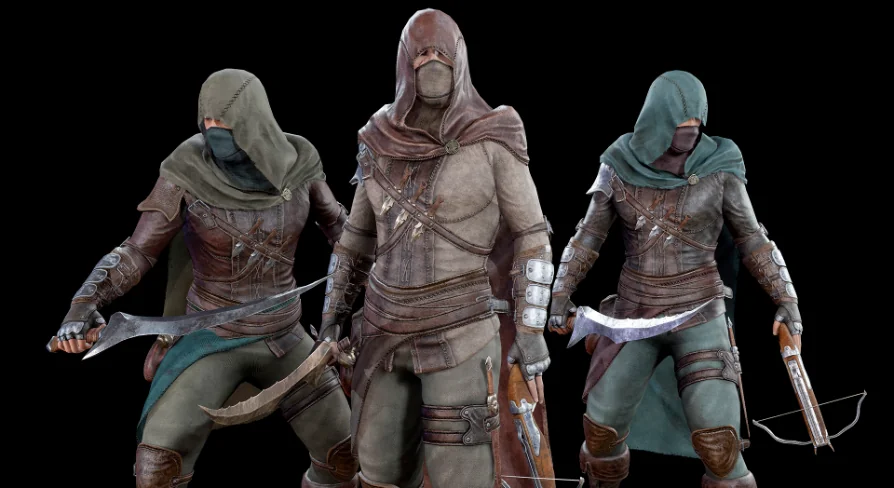
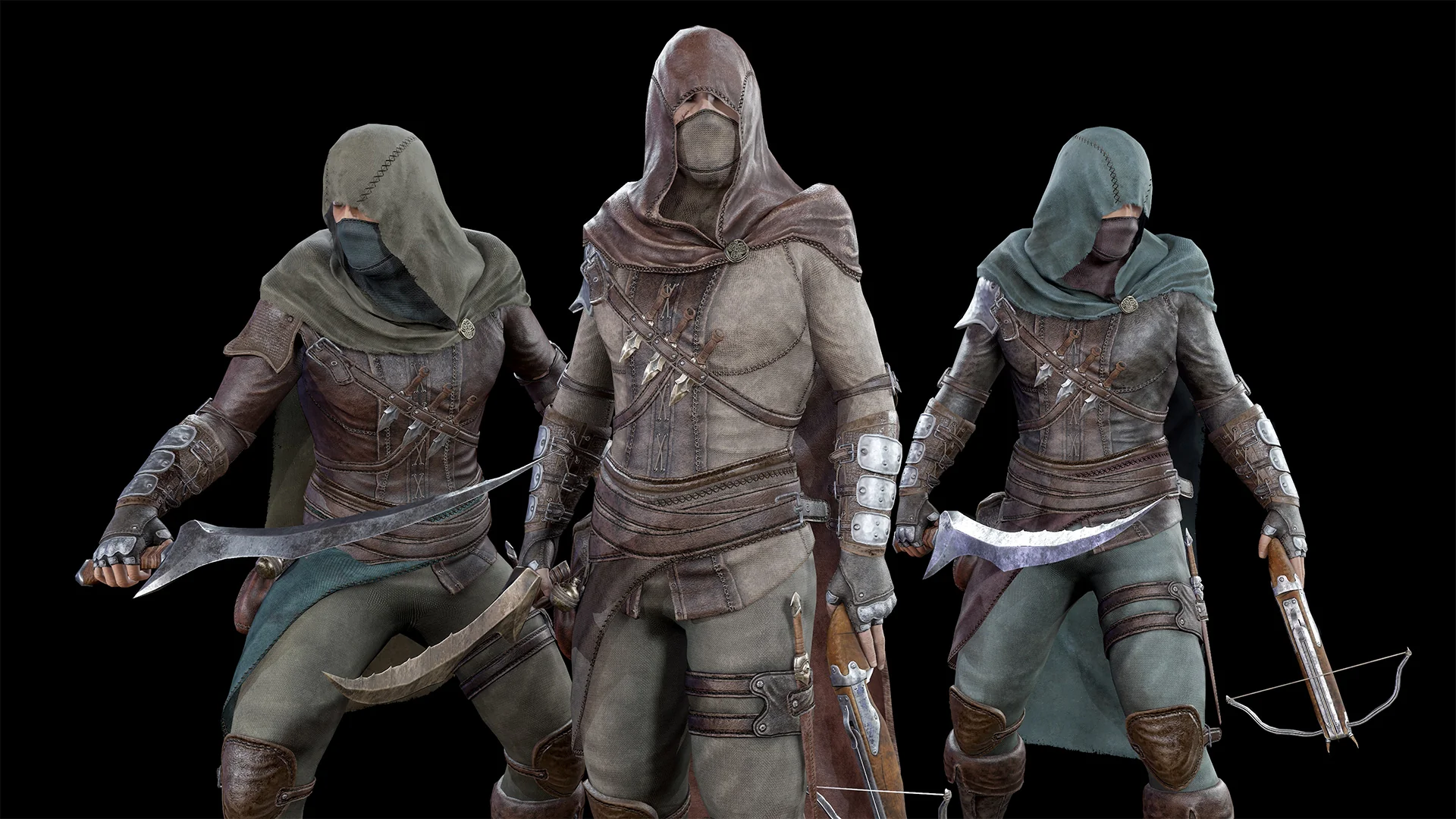
Darkened fortress walls, winding stone alleys, and dense historical environments demand human characters that look equipped for silent movement and sudden violence. This male character asset fulfills that exact visual footprint, presenting a grounded medieval operative outfitted in functional leather gear. Designed as a dedicated infiltrator, scout, or lethal rogue, the model bridges the gap between historical combat realism and dynamic fantasy action. Equipped with both close-quarters and ranged weaponry—specifically a sword and a crossbow—the character can take on roles ranging from a stealthy single-player protagonist to a faction-based adversary patrolling garrison battlements.
Because the character is built with modularity in mind, it avoids the rigid limitations of single-piece monolithic meshes. Developers building stealth games, tactical role-playing adventures, or action brawlers often encounter situations where individual enemy ranks or customized heroes must show variation. The asset addresses this production demand by isolating its geometry into independent segments, allowing different configurations without disrupting the underlying anatomical proportions or the base skin setup.
The Assassin Modular Assembly and Mesh Separation
Modularity forms the structural core of the asset. Rather than welding clothing, gear, and flesh into one immutable silhouette, the model isolates its components into separate mesh parts. This division allows developers to selectively strip or swap components depending on the needs of a specific level or encounter. A character entering a crowded tavern can shed heavy exterior defensive gear, while an operative on an active assassination contract can bear full leather protection alongside holstered armaments.
Dynamic movement is supported directly through integrated cloth physics simulation. Capes, tunics, or hanging leather flaps in historical character designs frequently run the risk of clipping against legs during sudden turns or acrobatic maneuvers. By enabling cloth simulation across the flexible elements of the outfit, the mesh parts drape and sway naturally in response to acceleration, jumps, and direction changes, avoiding stiff baked movement. This level of physical responsiveness works in tandem with the visual material setup, where creators can combine different skin tones and clothing colors to generate multiple distinct combatants from a unified geometric foundation.
Armor Layering, Weaponry, and Polygon Budgets
Real-time performance hinges on disciplined polygon distribution, especially in scenes hosting multiple active combatants or elaborate architectural geometry. The asset balances surface silhouette detail with strict optimization, landing at an aggregate total of 27,802 polygons across all components. Rather than lumping this density into a single opaque stat, the geometry is divided logically between the base human body, the protective outfitting, and the tactical armaments.
The base human body mesh accounts for 10,134 polygons, 20,240 vertices, and 11,516 triangles. This provides enough topological density across the limbs, torso, and joints to sustain fluid deformation through deep crouches, runs, and swings without introducing pinching artifacts. The protective leather armor pieces hold the majority of the detail, totaling 15,615 polygons, 24,661 vertices, and 31,302 triangles. This allocation gives buckles, straps, layered padding, and leather seams clean, physical silhouettes that hold up under close camera framing. Finally, the weapon set—comprising the sword and crossbow—is modeled at 2,053 polygons, 1,974 vertices, and 3,020 triangles, offering sharp, game-ready weaponry that conserves rendering overhead during chaotic melee scuffles.
Locomotion, Combat Scripting, and Assassin Skeleton Rigging
Rigging and animation compatibility dictate how quickly a 3D asset transitions from a viewport asset into a playable entity. The character is natively rigged to the standard UE4 Skeleton and delivered in an A-pose, having been verified through tests against the Epic skeleton hierarchy. This architecture ensures immediate synergy with established Unreal animation graphs, custom retargeting chains, and community locomotion libraries without demanding bone-mapping rebuilds.
A core set of 20 gameplay animations is included out of the box, spanning idle, directional transit, combat strikes, and reaction states:
Locomotion: Two walk animations, one run animation, two walk-back cycles, one walk-left cycle, one walk-right cycle, and a jump animation.
Melee and Combat: Five distinct attack animations covering varied swing and strike cadences.
Idles and Reactions: Two idle states, three hit reaction variations, and two death sequences.
The inclusion of dedicated directional walking clips—forward, backward, left, and right—permits rapid assembly of responsive strafe blend spaces. Paired with scripts and an Animation Blueprint setup, the model can instantly handle 8-way directional navigation in tactical combat arenas. The multiple hit reactions and death variations provide sufficient variety to prevent combat engagements from feeling repetitive when fighting groups of opponents.
MetaHuman Head Integration and Visual Variations
A distinctive feature of the character is its native compatibility with MetaHuman heads. While the model functions fully as a standalone male character, developers who want ultra-high-fidelity facial capture, realistic groom systems, or deep emotional performance can attach a MetaHuman head directly to the body mesh. This eliminates the technical bottleneck often encountered when attempting to marry advanced facial rigs with third-party stylized or historical outfits.
To support visual diversity across crowds or distinct squad roles, the asset features four distinct skin color variations. These skin alternatives work alongside the ability to combine skin and clothing colors, opening up practical options for character rosters. A designer can assign one skin and clothing palette to an allied operative, while utilizing alternate tones and leather dyes to mark out enemy scouts, elite skirmishers, or low-tier grunts across a campaign.
Implementation and Runtime Deployment
Deploying the model into an active project pipeline involves connecting its modular parts into a unified character blueprint, configuring the weapon sockets for the sword and crossbow, and linking the locomotion inputs to the included Animation Blueprint. Because the skeleton maps directly to standard UE4 proportions, existing gameplay logic, weapon-swapping scripts, and character state machines can drive the model immediately.
The asset serves teams that need a production-ready, low-poly male rogue with clean modularity, built-in cloth simulation, and flexible facial pipeline options. With its verified bone hierarchy, pre-built directional locomotion sets, and dedicated leather aesthetic, the character stands ready for deployment across medieval, stealth, and dark fantasy game environments.
 Characters
 Characters
 Humans
 Characters