"fa182e0cd0a6ea73"{"id":"1000651","slug":"modular-medieval-npc-metahuman-male-female","title":"Modular Medieval NPC - Metahuman - Male/Female","category":"Characters \u0026 Creatures","engine":"5.0+","assetVersion":"","engineVersion":"Engine Version: 5.0+","tag":"Characters","accent":"blue","visual":"character","summary":"Modular medieval NPC system with MetaHuman support, parametric clothing, UE5 Mannequin rig conversion, and Blueprints for NPCs, player characters, and an in-gam","platform":"Unreal Engine","publishedAt":"2026-07-21T19:10:45.900Z","updatedAt":"2026-07-21T19:10:45.900Z","sourceNotes":[],"fileContents":[],"compatibility":["Unreal Engine","Engine Version: 5.0+"],"featuredImage":{"alt":"Modular Medieval NPC - Metahuman - Male/Female","src":"/wp-content/uploads/published/2026/07/b9a07620d89f-a159ceef-b6c6-4ed0-b507-e0154e526184-0f8e05b036.webp"},"hasDownloadLink":true,"downloads":5,"terms":[{"taxonomy":"category","slug":"characters-and-creatures","name":"Characters \u0026 Creatures"}],"galleryImages":[{"src":"/wp-content/uploads/published/2026/07/e338246ac44d-292e18fc-9360-435d-9a3e-de27f9ed35bd-d91576a76f.webp","alt":"Modular Medieval NPC - Metahuman - Male/Female"},{"src":"/wp-content/uploads/published/2026/07/68c2c9ce0fce-c0d9ced0-5131-4ca9-95c2-ff2b63d37552-4eae2a2888.webp","alt":"Modular Medieval NPC - Metahuman - Male/Female"},{"src":"/wp-content/uploads/published/2026/07/660fb01ede1a-9db0ff2d-8261-43b5-891a-5cd26fd901f1-ede3b68d30.webp","alt":"Modular Medieval NPC - Metahuman - Male/Female"},{"src":"/wp-content/uploads/published/2026/07/ca684ca5a13a-50d069ed-7314-4e50-acb2-86b248a44c9d-54bc8602a6.webp","alt":"Modular Medieval NPC - Metahuman - Male/Female"},{"src":"/wp-content/uploads/published/2026/07/6934810e7377-4804d34b-297f-4a07-a946-6331e49dde2f-daa2c95576.webp","alt":"Modular Medieval NPC - Metahuman - Male/Female"},{"src":"/wp-content/uploads/published/2026/07/78b433d81207-275a6ca0-5fa4-4f49-91b6-1199505c7e51-c87278de64.webp","alt":"Modular Medieval NPC - Metahuman - Male/Female"},{"src":"/wp-content/uploads/published/2026/07/fe93f71c40c5-70d9a8d1-c4a1-4424-a60e-1e2b096e017f-703ec1357e.webp","alt":"Modular Medieval NPC - Metahuman - Male/Female"},{"src":"/wp-content/uploads/published/2026/07/8fea52aa8ea4-0bac4c4c-44a7-4a6a-bfe8-a74b09545ee5-44c42f0e79.webp","alt":"Modular Medieval NPC - Metahuman - Male/Female"},{"src":"/wp-content/uploads/published/2026/07/440144c5851d-0449ac60-68f8-4e25-a2e4-c2bcffff07c6-ef948c7a1c.webp","alt":"Modular Medieval NPC - Metahuman - Male/Female"},{"src":"/wp-content/uploads/published/2026/07/455f87ebe542-9ae94f5a-31f0-45f6-ac2c-e32e9c709fc2-fe4a67a388.webp","alt":"Modular Medieval NPC - Metahuman - Male/Female"}],"accessPanel":{"kind":"resource","title":"Download this resource","eyebrow":"Free Download","message":"Log in or create a free account to start your download.","fileName":"Content.7z","safetyNote":"Resources are manually reviewed before listing to improve quality and reduce obvious risks.","actionLabel":"Download Free","resourceType":"Resource archive"},"contentHtml":"\u003ch2\u003eMetaHuman Integration and the November 2025 Clothing Update\u003c/h2\u003e\u003cp\u003eThe most recent update to the Modular Medieval NPC system introduced parametric clothing components built for experimental MetaHuman Creator outfits. This addition represents a shift in how the asset handles character apparel, moving toward a more flexible model where dresses and garments are no longer rigidly bound to a single body type. Because the clothing is parametric, swapping dresses between genders becomes a more straightforward process, allowing for less restrictive assembly when dressing different character compositions.\u003c/p\u003e\u003cp\u003eThe creator notes that the MetaHuman clothing system itself is expected to change over time. As Epic updates the standards and toolsets surrounding MetaHuman, the components here will need to adapt. The commitment from the developer is to keep adjusting these parametric components to align with new MetaHuman standards as they emerge. This means the clothing setup is not a static implementation but one that tracked alongside ongoing platform changes.\u003c/p\u003e\u003ch2\u003eBringing Body and Head Data Through Quixel Bridge\u003c/h2\u003e\u003cp\u003eMetaHuman support in this asset has been an evolving process. The initial MetaHuman tal(nr w) support was added in October 2021, establishing the foundational workflow for getting high-fidelity characters into the project. The process requires migrating Body and Head assets from the MetaHuman Creator through Quixel Bridge rather than publishing data directly from the MetaHuman Creator itself. Epic's licensing restrictions prevent direct publishing of MetaHuman data, so Quixel Bridge serves as the necessary pipeline for bringing those assets into Unreal Engine.\u003c/p\u003e\u003cp\u003eOnce the assets are in the project, an important setup step remains. The Control Rig must be manually assigned to the SK (Skeletal) Files. This assignment step is critical for animation and rigging workflows to function properly with the migrated MetaHuman data. The MetaHuman port itself was positioned as a Beta feature initially, establishing the skeleton structure and workflows before full integration was locked in.\u003c/p\u003e\u003ch2\u003eUE5 Mannequin Rig Conversion and Legacy Mesh Support\u003c/h2\u003e\u003cp\u003eThe May 2022 UE5 update converted the modular components to the new UE5 Mannequin rig structure, bringing the skeletal system in line with Unreal Engine 5 standards. The female MetaHuman tal(nr w) in this system is slightly smaller than Quinn, the standard female MetaHuman reference, but both use the same bone structure. This shared bone structure ensures animation compatibility across the different character builds.\u003c/p\u003e\u003cp\u003eDespite the UE5 rig conversion, the older UE4 Mannequin meshes remain included for existing customers. The in-game Editor component specifically continues to run on UE4 Skeletal meshes, and the updated UE5 mesh port has not been applied to the Editor component. This means that while the core modular assets have been brought forward to the UE5 rig standard, the character editor tooling still operates on the legacy mesh structure.\u003c/p\u003e\u003ch2\u003eModular Assembly for Medieval Character Populations\u003c/h2\u003e\u003cp\u003eAt its core, the Modular Medieval NPC system provides a large library of interchangeable character parts. Multiple hats, hairs, heads, chests, arms, and legs can be assembled into unique compositions. This modular approach serves a practical production need: populating medieval environments with distinct characters without requiring a unique asset for every single NPC.\u003c/p\u003e\u003cp\u003eThe variety of parts supports different social strata within a medieval setting. A beggar, a rich townsman, or a regular citizen can each be assembled from the available pieces. The tag associations reinforce this range, with specific references to Blacksmith, Royal, Monk, Merchant, Seller, Villager, Peasant, and Priest. These tags reflect the intended character archetypes the modular system can produce. The items are also not restricted to NPC use; the provided equipment can serve as Player Character gear as well.\u003c/p\u003e\u003ch3\u003eMaterial and Texture System for Equipment\u003c/h3\u003e\u003cp\u003eEach piece of equipment in the system uses a master material paired with a mask texture. This setup allows for detailed visual tweaking on a per-item basis. The mask texture approach means that color and material variations can be controlled through texture masks rather than requiring separate unique materials for every visual variant of an item. This keeps the material footprint smaller while still providing the customization depth needed for a modular character system.\u003c/p\u003e\u003ch2\u003eSkeleton Compatibility and Weapon Grip Alignment\u003c/h2\u003e\u003cp\u003eThe skeletal meshes delivered with the pack are skinned to the UE4 skeleton. This decision was made for compatibility with other asset packs, specifically citing weapon animation sets as an example. By maintaining the UE4 skeleton binding, the modular equipment can interface with existing animation libraries that were based on that skeleton standard.\u003c/p\u003e\u003cp\u003eHand grip alignment is also handled deliberately. The main-hand and off-hand pivots are aligned to the hand grip positions on the skeleton. This ensures that when weapons or tools are attached to the character, the grip positions match the expected orientation for animation playback. The Blueprint system further prepares main-hand and off-hand slots to receive external data, meaning weapons or held items can be slotted in through the Blueprint configuration.\u003c/p\u003e\u003ch2\u003eBlueprint Implementations and the Customizable Character System\u003c/h2\u003e\u003cp\u003eThe pack includes the main Customizable Character Blueprint as its central component. Alongside this primary Blueprint, the developer has provided NPC, Player Character, and Character Editor Blueprint examples. Each of these example Blueprints implements the full range of assets and their customization options, serving as functional references for how to wire the modular system into different gameplay contexts.\u003c/p\u003e\u003cp\u003eThe Character Editor Blueprint runs on the UE4 Skeletal meshes, providing an in-editor tool for assembling and visualizing character compositions. The NPC Blueprint demonstrates non-player character setup, the Player Character Blueprint shows the equipment system in a controllable character context, and the Character Editor Blueprint offers the interface for adjusting the modular parts.\u003c/p\u003e\u003ch3\u003eCompatibility With Other Medieval Packs\u003c/h3\u003e\u003cp\u003eProduction workflows often combine multiple asset packs, and this system has been structured with that in mind. The Medieval NPC system is noted as compatible with the Medieval NPC \u0026 Armour and RPG Bundle packs. The skeleton standard, material approach, and Blueprint slot preparation all contribute to making this asset functional as part of a larger medieval production toolkit rather than an isolated character solution.\u003c/p\u003e\n\n\u003ch2\u003eRelated Resources Worth Checking\u003c/h2\u003e\n\u003cul\u003e\n\u003cli\u003e\u003ca href=\"https://3dcghub.com/goofy-npc/\" title=\"Goofy NPC\"\u003eGoofy NPC\u003c/a\u003e\u003c/li\u003e\n\u003cli\u003e\u003ca href=\"https://3dcghub.com/medieval-armour-metahuman-male-female/\" title=\"Medieval Armour - Metahuman - Male/Female\"\u003eMedieval Armour - Metahuman - Male/Female\u003c/a\u003e\u003c/li\u003e\n\u003cli\u003e\u003ca href=\"https://3dcghub.com/character-customization-male/\" title=\"Character Customization: Male\"\u003eCharacter Customization: Male\u003c/a\u003e\u003c/li\u003e\n\u003cli\u003e\u003ca href=\"https://3dcghub.com/npc-charaters-kids-pack/\" title=\"NPC Charaters Kids (Pack)\"\u003eNPC Charaters Kids (Pack)\u003c/a\u003e\u003c/li\u003e\n\u003cli\u003e\u003ca href=\"https://3dcghub.com/black-girl-zahira-african-female-character-npc-vrhc/\" title=\"Black Girl Zahira African Female Character NPC VRHC\"\u003eBlack Girl Zahira African Female Character NPC VRHC\u003c/a\u003e\u003c/li\u003e\n\u003c/ul\u003e","contentTextLength":6850,"navigation":{"current":1284,"total":3789,"previous":{"id":"1000652","slug":"mountain-temple-japanese-temple-ancient-temple-temple-shrine-feudal-japan","title":"Mountain Temple (Japanese Temple, Ancient Temple, Temple Shrine, Feudal Japan)","category":"Temple","platform":"Unreal Engine","updatedAt":"2026-07-21T19:17:13.891Z"},"next":{"id":"1000650","slug":"modular-destroyed-buildings-modular-house-houses-modular-building-building","title":"Modular Destroyed Buildings (Modular House, Houses, Modular Building, Building)","category":"Military / Warzone","platform":"Unreal Engine","updatedAt":"2026-07-21T19:03:03.489Z"}},"relatedResources":[{"id":"1000715","slug":"western-npc-metahuman","title":"Western NPC - Metahuman","category":"Characters \u0026 Creatures","engine":"5.0+","assetVersion":"","engineVersion":"Engine Version: 5.0+","tag":"Characters","accent":"blue","visual":"character","summary":"Parametric MetaHuman clothing component for UE5 Mannequin. Modular Western NPC assembly with costume, legs, arms, head, hair, beard. Includes Victorian and cowb","platform":"Unreal Engine","publishedAt":"2026-07-24T11:47:34.725Z","updatedAt":"2026-07-24T11:47:34.725Z","sourceNotes":[],"fileContents":[],"compatibility":["Unreal Engine","Engine Version: 5.0+"],"featuredImage":{"alt":"Western NPC - Metahuman","src":"/wp-content/uploads/published/2026/07/568e5b20a5df-d4918928-d57d-4af1-aeaa-ed2675af2f1d-c0e2cbc7d9.webp"},"hasDownloadLink":true,"downloads":6},{"id":"1000615","slug":"goofy-npc","title":"Goofy NPC","category":"Characters \u0026 Creatures","engine":"5.4+","assetVersion":"","engineVersion":"Engine Version: 5.4+","tag":"Characters","accent":"blue","visual":"character","summary":"A rigged, MetaHuman-compatible Unreal Engine character asset with modular clothing, customizable materials, 52 ARKit blendshapes, and preset goofy characters.","platform":"Unreal Engine","publishedAt":"2026-07-20T20:43:34.110Z","updatedAt":"2026-07-20T20:43:34.110Z","sourceNotes":[],"fileContents":[],"compatibility":["Unreal Engine","Engine Version: 5.4+"],"featuredImage":{"alt":"Goofy NPC","src":"/wp-content/uploads/published/2026/07/d000632e0282-83d22a0a-83f4-4668-bbd2-061db77532bd-2b2171de8d.webp"},"hasDownloadLink":true,"downloads":0},{"id":"3013","slug":"medieval-armour-metahuman-male-female","title":"Medieval Armour - Metahuman - Male/Female","category":"Characters \u0026 Creatures","engine":"5.0+","assetVersion":"Engine version: 5.0+","engineVersion":"5.0","tag":"Characters","accent":"blue","visual":"character","summary":"Enhance your game with this modular Medieval Armour pack. Fully compatible with MetaHuman and Unreal Engine 5, featuring customizable knight and soldier sets.","platform":"Unreal Engine","publishedAt":"2026-02-07T16:24:55.000Z","updatedAt":"2026-04-19T15:57:43.000Z","sourceNotes":[],"fileContents":[],"compatibility":["Unreal Engine","Engine version: 5.0+"],"featuredImage":{"alt":"Medieval Armour - Metahuman - Male/Female","src":"https://3dcghub.com/wp-content/uploads/2026/02/a9674880-5e39-4e2c-8bce-51cab7294e45.webp"},"hasDownloadLink":true,"downloads":9}]}
Characters
Modular Medieval NPC - Metahuman - Male/Female
Modular medieval NPC system with MetaHuman support, parametric clothing, UE5 Mannequin rig conversion, and Blueprints for NPCs, player characters, and an in-gam
MetaHuman Integration and the November 2025 Clothing Update
The most recent update to the Modular Medieval NPC system introduced parametric clothing components built for experimental MetaHuman Creator outfits. This addition represents a shift in how the asset handles character apparel, moving toward a more flexible model where dresses and garments are no longer rigidly bound to a single body type. Because the clothing is parametric, swapping dresses between genders becomes a more straightforward process, allowing for less restrictive assembly when dressing different character compositions.
The creator notes that the MetaHuman clothing system itself is expected to change over time. As Epic updates the standards and toolsets surrounding MetaHuman, the components here will need to adapt. The commitment from the developer is to keep adjusting these parametric components to align with new MetaHuman standards as they emerge. This means the clothing setup is not a static implementation but one that tracked alongside ongoing platform changes.
Bringing Body and Head Data Through Quixel Bridge
MetaHuman support in this asset has been an evolving process. The initial MetaHuman tal(nr w) support was added in October 2021, establishing the foundational workflow for getting high-fidelity characters into the project. The process requires migrating Body and Head assets from the MetaHuman Creator through Quixel Bridge rather than publishing data directly from the MetaHuman Creator itself. Epic's licensing restrictions prevent direct publishing of MetaHuman data, so Quixel Bridge serves as the necessary pipeline for bringing those assets into Unreal Engine.
Once the assets are in the project, an important setup step remains. The Control Rig must be manually assigned to the SK (Skeletal) Files. This assignment step is critical for animation and rigging workflows to function properly with the migrated MetaHuman data. The MetaHuman port itself was positioned as a Beta feature initially, establishing the skeleton structure and workflows before full integration was locked in.
UE5 Mannequin Rig Conversion and Legacy Mesh Support
The May 2022 UE5 update converted the modular components to the new UE5 Mannequin rig structure, bringing the skeletal system in line with Unreal Engine 5 standards. The female MetaHuman tal(nr w) in this system is slightly smaller than Quinn, the standard female MetaHuman reference, but both use the same bone structure. This shared bone structure ensures animation compatibility across the different character builds.
Despite the UE5 rig conversion, the older UE4 Mannequin meshes remain included for existing customers. The in-game Editor component specifically continues to run on UE4 Skeletal meshes, and the updated UE5 mesh port has not been applied to the Editor component. This means that while the core modular assets have been brought forward to the UE5 rig standard, the character editor tooling still operates on the legacy mesh structure.
Modular Assembly for Medieval Character Populations
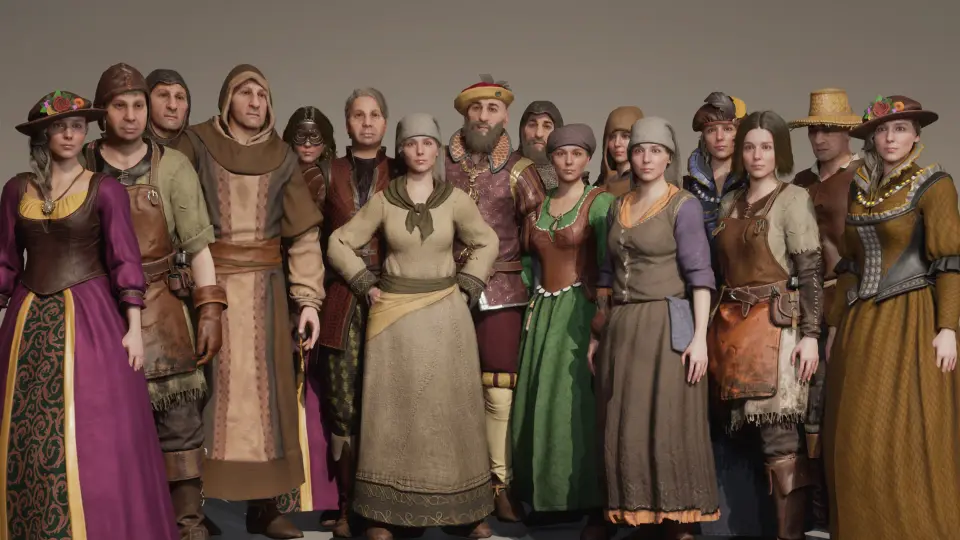
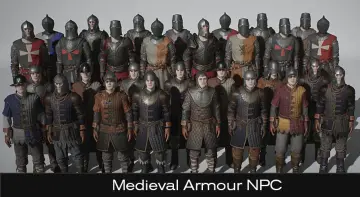
At its core, the Modular Medieval NPC system provides a large library of interchangeable character parts. Multiple hats, hairs, heads, chests, arms, and legs can be assembled into unique compositions. This modular approach serves a practical production need: populating medieval environments with distinct characters without requiring a unique asset for every single NPC.
The variety of parts supports different social strata within a medieval setting. A beggar, a rich townsman, or a regular citizen can each be assembled from the available pieces. The tag associations reinforce this range, with specific references to Blacksmith, Royal, Monk, Merchant, Seller, Villager, Peasant, and Priest. These tags reflect the intended character archetypes the modular system can produce. The items are also not restricted to NPC use; the provided equipment can serve as Player Character gear as well.
Material and Texture System for Equipment
Each piece of equipment in the system uses a master material paired with a mask texture. This setup allows for detailed visual tweaking on a per-item basis. The mask texture approach means that color and material variations can be controlled through texture masks rather than requiring separate unique materials for every visual variant of an item. This keeps the material footprint smaller while still providing the customization depth needed for a modular character system.
Skeleton Compatibility and Weapon Grip Alignment
The skeletal meshes delivered with the pack are skinned to the UE4 skeleton. This decision was made for compatibility with other asset packs, specifically citing weapon animation sets as an example. By maintaining the UE4 skeleton binding, the modular equipment can interface with existing animation libraries that were based on that skeleton standard.
Hand grip alignment is also handled deliberately. The main-hand and off-hand pivots are aligned to the hand grip positions on the skeleton. This ensures that when weapons or tools are attached to the character, the grip positions match the expected orientation for animation playback. The Blueprint system further prepares main-hand and off-hand slots to receive external data, meaning weapons or held items can be slotted in through the Blueprint configuration.
Blueprint Implementations and the Customizable Character System
The pack includes the main Customizable Character Blueprint as its central component. Alongside this primary Blueprint, the developer has provided NPC, Player Character, and Character Editor Blueprint examples. Each of these example Blueprints implements the full range of assets and their customization options, serving as functional references for how to wire the modular system into different gameplay contexts.
The Character Editor Blueprint runs on the UE4 Skeletal meshes, providing an in-editor tool for assembling and visualizing character compositions. The NPC Blueprint demonstrates non-player character setup, the Player Character Blueprint shows the equipment system in a controllable character context, and the Character Editor Blueprint offers the interface for adjusting the modular parts.
Compatibility With Other Medieval Packs
Production workflows often combine multiple asset packs, and this system has been structured with that in mind. The Medieval NPC system is noted as compatible with the Medieval NPC & Armour and RPG Bundle packs. The skeleton standard, material approach, and Blueprint slot preparation all contribute to making this asset functional as part of a larger medieval production toolkit rather than an isolated character solution.
 Characters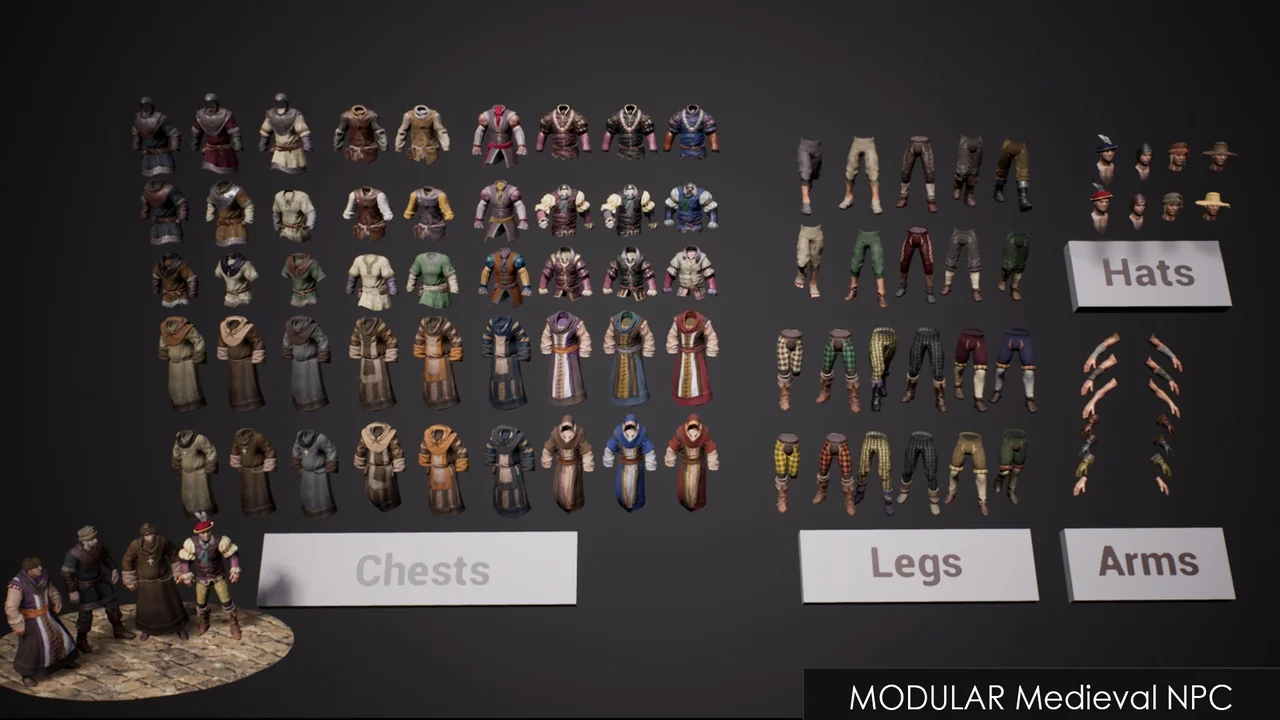
 Characters
 Characters
 Characters