"c14ff6bd758dadb1"{"id":"1000615","slug":"goofy-npc","title":"Goofy NPC","category":"Characters \u0026 Creatures","engine":"5.4+","assetVersion":"","engineVersion":"Engine Version: 5.4+","tag":"Characters","accent":"blue","visual":"character","summary":"A rigged, MetaHuman-compatible Unreal Engine character asset with modular clothing, customizable materials, 52 ARKit blendshapes, and preset goofy characters.","platform":"Unreal Engine","publishedAt":"2026-07-20T20:43:34.110Z","updatedAt":"2026-07-20T20:43:34.110Z","sourceNotes":[],"fileContents":[],"compatibility":["Unreal Engine","Engine Version: 5.4+"],"featuredImage":{"alt":"Goofy NPC","src":"/wp-content/uploads/published/2026/07/d000632e0282-83d22a0a-83f4-4668-bbd2-061db77532bd-2b2171de8d.webp"},"hasDownloadLink":true,"downloads":0,"terms":[{"taxonomy":"category","slug":"characters-and-creatures","name":"Characters \u0026 Creatures"}],"galleryImages":[{"src":"/wp-content/uploads/published/2026/07/8596e4da7cb4-5a5f0477-51ef-4ef0-9527-46d05bc92b35-68c0f64d63.webp","alt":"Goofy NPC"},{"src":"/wp-content/uploads/published/2026/07/11381d171d80-c121dad4-1141-42d0-a2a6-e095c515dc3b-8bf451b8d4.webp","alt":"Goofy NPC"},{"src":"/wp-content/uploads/published/2026/07/c6f448056bff-e8e9fe63-ec35-4758-9a28-c0c6ff84f6a1-84002e9e27.webp","alt":"Goofy NPC"},{"src":"/wp-content/uploads/published/2026/07/d80204fe353a-51fa6635-39c7-4458-b88e-5f28272d8206-e5f874d393.webp","alt":"Goofy NPC"},{"src":"/wp-content/uploads/published/2026/07/9b1ec833b31c-e67fa509-7bcf-4d08-88b8-fe9645f8e12c-d5cc188c10.webp","alt":"Goofy NPC"},{"src":"/wp-content/uploads/published/2026/07/3b15d90ee6d7-4919332f-a7b0-427d-b41e-0747e28e816f-35925f0abc.webp","alt":"Goofy NPC"},{"src":"/wp-content/uploads/published/2026/07/26e5e2682c34-220ed265-5466-406f-850b-9f5b79e363af-3952528c60.webp","alt":"Goofy NPC"},{"src":"/wp-content/uploads/published/2026/07/3be62c265d28-3f0e2049-1596-4445-bf9a-63e1a5e2fd15-2b9a1b7eff.webp","alt":"Goofy NPC"},{"src":"/wp-content/uploads/published/2026/07/7f06614f5e6e-441da005-da8a-47b9-8d86-7363df60cfed-9d35b5ac23.webp","alt":"Goofy NPC"},{"src":"/wp-content/uploads/published/2026/07/709af9f94c16-def11bd2-4617-4a60-94bc-35b9683bfb37-2dd96639ad.webp","alt":"Goofy NPC"}],"accessPanel":{"kind":"resource","title":"Download this resource","eyebrow":"Free Download","message":"Log in or create a free account to start your download.","fileName":"Content.7z","safetyNote":"Resources are manually reviewed before listing to improve quality and reduce obvious risks.","actionLabel":"Download Free","resourceType":"Resource archive"},"contentHtml":"\u003cp\u003ePopulating a game world with memorable background characters often means choosing between rigging them properly and making them visually interesting. Goofy NPC is built to slot directly into an existing Unreal Engine male mannequin skeleton, giving developers a rigged, MetaHuman-compatible character that doubles as comic relief without requiring custom animation work or additional bones.\u003c/p\u003e \u003ch2\u003eThe Goofy NPC Character Package Contents\u003c/h2\u003e\n\u003cp\u003eAt its core, the package provides a full base body mesh, but the real value comes from its modularity. The developer has broken the body down into 18 separated pieces, allowing for targeted visibility adjustments or swaps without hiding the entire figure. This separation is what makes the clothing system work — hide the body parts that would clip through a garment and leave the rest visible.\u003c/p\u003e\n\u003cp\u003eFor wardrobe, the package includes a weird t-shirt with customizable graphic, a backward tank top, boxer shorts, and sneakers. Headwear options consist of a bucket helmet available as both a skeletal mesh and a static mesh, plus a plunger accessory that can be worn straight on the head, sideways on the head, or used standalone as a static mesh prop.\u003c/p\u003e \u003ch3\u003eRigging Built on the Manny Skeleton\u003c/h3\u003e\n\u003cp\u003eNo custom bones were added to this rig. The character is based entirely on the UE5 male mannequin (Manny) skeleton, which means it will play nicely with any existing Manny-based animation sets or retargeted clips a studio already owns. IK bones are included, and the rig supports the MetaHuman skeleton natively. For studios working across different body proportions, the asset supports Tall, Masculine, and Medium body types.\u003c/p\u003e\n\u003cp\u003eFacial animation is covered by 52 ARKit blendshapes, making the character compatible with common facial capture workflows and real-time lip-sync systems. The character is not sold with included animations, but the rig is production-ready for any external motion data formatted for the Epic skeleton.\u003c/p\u003e \u003ch2\u003eCustomizing Clothes and Accessories in the Material Instance Editor\u003c/h2\u003e\n\u003cp\u003eMaterial flexibility is one of the package's strongest features. Each clothing and accessory piece uses a master material paired with masks. This setup allows developers to customize colors, patterns, and roughness values directly in the material instance editor. Instead of baking unique textures for every color variant, the mask-driven system lets you produce dozens of looks from a single asset set. With 11 materials and 14 material instances provided, there is immediate out-of-the-box variety before any customization begins.\u003c/p\u003e\n\u003cp\u003eTexture support is substantial. The package ships with 54 textures, mostly at 2048x2048 resolution, providing enough detail for close-quarters scenes while keeping memory overhead reasonable for a crowd or NPC asset.\u003c/p\u003e \u003ch3\u003eMetaHuman Compatible Clothes and Clipping Workflow\u003c/h3\u003e\n\u003cp\u003eThe clothing assets are MetaHuman compatible. The developer notes that to avoid clipping, the body mesh underneath the clothes needs to be hidden. This modular approach allows for a wide range of visual combinations using the 5 preset characters included in the package.\u003c/p\u003e\n\u003cp\u003eFor integration, the asset is compatible with the Muscular Man (BodyBuilder) body type. All preview images were rendered in Unreal Engine, confirming the visual fidelity directly within the target platform.\u003c/p\u003e \u003ch2\u003eVertex Counts for Production Optimization\u003c/h2\u003e\n\u003cp\u003eUnderstanding the polygon distribution allows developers to plan scene budgets effectively. The base body carries the heaviest load at 23,856 vertices. The bucket helmet follows with 5,089 vertices, closely supported by the weird t-shirt at 5,254 vertices. The backward tank top requires 3,489 vertices, while the boxer shorts utilize 3,526 vertices. The sneaker mesh contains 2,265 vertices, and the standalone plunger static mesh is the lightest element at 1,549 vertices.\u003c/p\u003e\n\u003cp\u003eThese polygon counts indicate a character made for clear visibility in-game rather than purely as a distant background element. The relatively high vertex count on the base body allows for proper deformation, accommodating rapid pose transitions.\u003c/p\u003e \u003ch3\u003ePlatform Support and Final Implementation Notes\u003c/h3\u003e\n\u003cp\u003eThe character package supports development on both Windows and Mac platforms. It does not include documentation, so developers will need to rely on the component structure and the material instance editor to guide their workflow.\u003c/p\u003e\n\u003cp\u003eThe MetaHuman body and specific clothes utilized in the preview images are not included in the downloadable package. Developers will need to supply their own MetaHuman components if they wish to replicate the exact preview setup.\u003c/p\u003e \u003cp\u003eFor game developers looking to inject humor into their Unreal Engine projects without sacrificing technical standards, this asset provides a production-ready foundation. The combination of standard rigging, mask-based materials, and intentional modular design creates a reliable workflow for generating varied, animated NPC characters quickly.\u003c/p\u003e\n\n\u003ch2\u003eContinue Browsing Similar Packs\u003c/h2\u003e\n\u003cul\u003e\n\u003cli\u003e\u003ca href=\"https://3dcghub.com/a-c-s-u-mantis/\" title=\"A.C.S.U. \u0026quot;MANTIS\u0026quot;\"\u003eA.C.S.U. \u0026quot;MANTIS\u0026quot;\u003c/a\u003e\u003c/li\u003e\n\u003cli\u003e\u003ca href=\"https://3dcghub.com/survival-npc-maria-mimi-estrada/\" title=\"Survival NPC - Maria \u0026quot;Mimi\u0026quot; Estrada\"\u003eSurvival NPC - Maria \u0026quot;Mimi\u0026quot; Estrada\u003c/a\u003e\u003c/li\u003e\n\u003cli\u003e\u003ca href=\"https://3dcghub.com/ue5-rigged-npc-creator/\" title=\"UE5 Rigged NPC Creator\"\u003eUE5 Rigged NPC Creator\u003c/a\u003e\u003c/li\u003e\n\u003cli\u003e\u003ca href=\"https://3dcghub.com/character-rigged-npc-character-rigged-npc-rig-characters-animated-3d/\" title=\"Character / Rigged / NPC ( Character Rigged NPC Rig Characters Animated 3D )\"\u003eCharacter / Rigged / NPC ( Character Rigged NPC Rig Characters Animated 3D )\u003c/a\u003e\u003c/li\u003e\n\u003cli\u003e\u003ca href=\"https://3dcghub.com/character-customization-male/\" title=\"Character Customization: Male\"\u003eCharacter Customization: Male\u003c/a\u003e\u003c/li\u003e\n\u003c/ul\u003e","contentTextLength":5140,"navigation":{"current":1245,"total":3719,"previous":{"id":"1000616","slug":"hair-for-days","title":"Hair For Days","category":"Variety","platform":"Unreal Engine","updatedAt":"2026-07-20T20:50:38.651Z"},"next":{"id":"1000614","slug":"generic-combat-system-advanced-gas-based-multiplayer-combat-framework","title":"Generic Combat System - Advanced GAS based Multiplayer combat framework.","category":"Game Mechanics","platform":"Unreal Engine","updatedAt":"2026-07-20T20:41:12.096Z"}},"relatedResources":[{"id":"1452","slug":"a-c-s-u-mantis","title":"A.C.S.U. \"MANTIS\"","category":"Characters \u0026 Creatures","engine":"5.0+","assetVersion":"Engine version: 5.0+","engineVersion":"4.24","tag":"Characters","accent":"blue","visual":"character","summary":"Enhance your sci-fi game with the A.C.S.U. Mantis, a high-quality robotic soldier for Unreal Engine. Features 4K textures, multiple skins, and UE4 rigging.","platform":"Unreal Engine","publishedAt":"2026-02-06T18:30:12.000Z","updatedAt":"2026-04-19T15:58:10.000Z","sourceNotes":[],"fileContents":[],"compatibility":["Unreal Engine","Engine version: 5.0+"],"featuredImage":{"alt":"A.C.S.U. \"MANTIS\"","src":"https://3dcghub.com/wp-content/uploads/2026/02/86641504-ab89-4ac8-9178-076398f52dd9.webp"},"hasDownloadLink":true,"downloads":0},{"id":"1000550","slug":"survival-npc-maria-mimi-estrada","title":"Survival NPC - Maria \"Mimi\" Estrada","category":"Characters \u0026 Creatures","engine":"4.26+,5.0+","assetVersion":"","engineVersion":"Engine Version: 4.26+,5.0+","tag":"Characters","accent":"blue","visual":"character","summary":"AAA hero character with digital human pipeline, 8k textures, mocap animations, blendshapes, loadout accessories, and example maps for cinematic survival scenes.","platform":"Unreal Engine","publishedAt":"2026-07-15T06:11:10.481Z","updatedAt":"2026-07-15T06:11:10.481Z","sourceNotes":[],"fileContents":[],"compatibility":["Unreal Engine","Engine Version: 4.26+,5.0+"],"featuredImage":{"alt":"Survival NPC - Maria \"Mimi\" Estrada","src":"/wp-content/uploads/published/2026/07/7f6b7129a96f-53d4412e-1050-4c0d-afe0-d397fceb5e05-62c91f2044.webp"},"hasDownloadLink":true,"downloads":0},{"id":"1000715","slug":"western-npc-metahuman","title":"Western NPC - Metahuman","category":"Characters \u0026 Creatures","engine":"5.0+","assetVersion":"","engineVersion":"Engine Version: 5.0+","tag":"Characters","accent":"blue","visual":"character","summary":"Parametric MetaHuman clothing component for UE5 Mannequin. Modular Western NPC assembly with costume, legs, arms, head, hair, beard. Includes Victorian and cowb","platform":"Unreal Engine","publishedAt":"2026-07-24T11:47:34.725Z","updatedAt":"2026-07-24T11:47:34.725Z","sourceNotes":[],"fileContents":[],"compatibility":["Unreal Engine","Engine Version: 5.0+"],"featuredImage":{"alt":"Western NPC - Metahuman","src":"/wp-content/uploads/published/2026/07/568e5b20a5df-d4918928-d57d-4af1-aeaa-ed2675af2f1d-c0e2cbc7d9.webp"},"hasDownloadLink":true,"downloads":6}]}
Characters
Goofy NPC
A rigged, MetaHuman-compatible Unreal Engine character asset with modular clothing, customizable materials, 52 ARKit blendshapes, and preset goofy characters.
Populating a game world with memorable background characters often means choosing between rigging them properly and making them visually interesting. Goofy NPC is built to slot directly into an existing Unreal Engine male mannequin skeleton, giving developers a rigged, MetaHuman-compatible character that doubles as comic relief without requiring custom animation work or additional bones.
The Goofy NPC Character Package Contents
At its core, the package provides a full base body mesh, but the real value comes from its modularity. The developer has broken the body down into 18 separated pieces, allowing for targeted visibility adjustments or swaps without hiding the entire figure. This separation is what makes the clothing system work — hide the body parts that would clip through a garment and leave the rest visible.
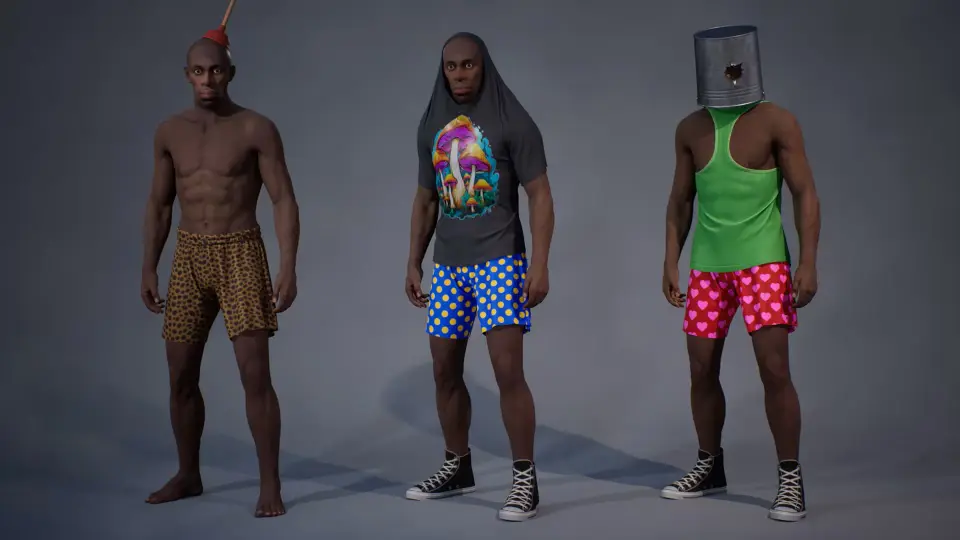
For wardrobe, the package includes a weird t-shirt with customizable graphic, a backward tank top, boxer shorts, and sneakers. Headwear options consist of a bucket helmet available as both a skeletal mesh and a static mesh, plus a plunger accessory that can be worn straight on the head, sideways on the head, or used standalone as a static mesh prop.
Rigging Built on the Manny Skeleton
No custom bones were added to this rig. The character is based entirely on the UE5 male mannequin (Manny) skeleton, which means it will play nicely with any existing Manny-based animation sets or retargeted clips a studio already owns. IK bones are included, and the rig supports the MetaHuman skeleton natively. For studios working across different body proportions, the asset supports Tall, Masculine, and Medium body types.
Facial animation is covered by 52 ARKit blendshapes, making the character compatible with common facial capture workflows and real-time lip-sync systems. The character is not sold with included animations, but the rig is production-ready for any external motion data formatted for the Epic skeleton.
Customizing Clothes and Accessories in the Material Instance Editor
Material flexibility is one of the package's strongest features. Each clothing and accessory piece uses a master material paired with masks. This setup allows developers to customize colors, patterns, and roughness values directly in the material instance editor. Instead of baking unique textures for every color variant, the mask-driven system lets you produce dozens of looks from a single asset set. With 11 materials and 14 material instances provided, there is immediate out-of-the-box variety before any customization begins.
Texture support is substantial. The package ships with 54 textures, mostly at 2048x2048 resolution, providing enough detail for close-quarters scenes while keeping memory overhead reasonable for a crowd or NPC asset.
MetaHuman Compatible Clothes and Clipping Workflow
The clothing assets are MetaHuman compatible. The developer notes that to avoid clipping, the body mesh underneath the clothes needs to be hidden. This modular approach allows for a wide range of visual combinations using the 5 preset characters included in the package.
For integration, the asset is compatible with the Muscular Man (BodyBuilder) body type. All preview images were rendered in Unreal Engine, confirming the visual fidelity directly within the target platform.
Vertex Counts for Production Optimization
Understanding the polygon distribution allows developers to plan scene budgets effectively. The base body carries the heaviest load at 23,856 vertices. The bucket helmet follows with 5,089 vertices, closely supported by the weird t-shirt at 5,254 vertices. The backward tank top requires 3,489 vertices, while the boxer shorts utilize 3,526 vertices. The sneaker mesh contains 2,265 vertices, and the standalone plunger static mesh is the lightest element at 1,549 vertices.
These polygon counts indicate a character made for clear visibility in-game rather than purely as a distant background element. The relatively high vertex count on the base body allows for proper deformation, accommodating rapid pose transitions.
Platform Support and Final Implementation Notes
The character package supports development on both Windows and Mac platforms. It does not include documentation, so developers will need to rely on the component structure and the material instance editor to guide their workflow.
The MetaHuman body and specific clothes utilized in the preview images are not included in the downloadable package. Developers will need to supply their own MetaHuman components if they wish to replicate the exact preview setup.
For game developers looking to inject humor into their Unreal Engine projects without sacrificing technical standards, this asset provides a production-ready foundation. The combination of standard rigging, mask-based materials, and intentional modular design creates a reliable workflow for generating varied, animated NPC characters quickly.
 Characters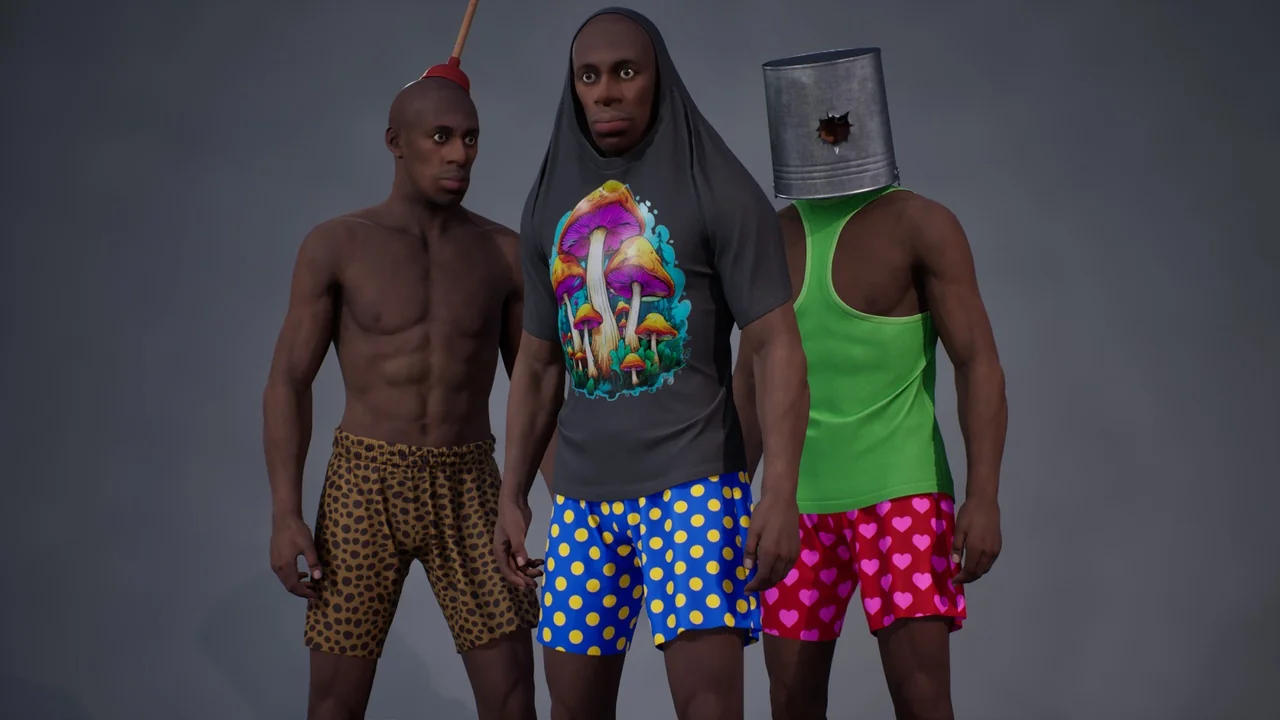
 Characters
 Characters
 Characters