"0148f1904a9b0d16"{"id":"1002606","slug":"stylized-fantasy-pottery-and-vessels-22-low-poly-game-ready-assets","title":"Stylized Fantasy Pottery \u0026 Vessels: 22 Low-Poly Game-Ready Assets","category":"Tools, Objects \u0026 Decor","engine":"5.0+","assetVersion":"","engineVersion":"Engine Version: 5.0+","tag":"Tools","accent":"blue","visual":"mech","summary":"Explore the 22 low-poly models in Stylized Fantasy Pottery \u0026 Vessels, featuring triangle counts, Blender material setup, and PBR styling details.","platform":"Unreal Engine","indexPolicy":"index","publishedAt":"2026-11-14T06:02:50.961Z","updatedAt":"2026-11-14T06:02:50.961Z","sourceNotes":[],"fileContents":[],"compatibility":["Unreal Engine","Engine Version: 5.0+"],"featuredImage":{"alt":"Stylized Fantasy Pottery \u0026 Vessels: 22 Low-Poly Game-Ready Assets","src":"/wp-content/uploads/published/2026/11/a07d2d32e673-dd702d22-e998-4d1c-b5bc-239af772c671-1551f67324.webp"},"hasDownloadLink":true,"downloads":0,"terms":[{"taxonomy":"category","slug":"tools-objects-and-decor","name":"Tools, Objects \u0026 Decor"}],"galleryImages":[{"src":"/wp-content/uploads/published/2026/11/53d69e26c397-ada7d6d4-643f-474e-9a15-623bcb600013-7e0eb353b5.webp","alt":"Stylized Fantasy Pottery \u0026 Vessels: 22 Low-Poly Game-Ready Assets"},{"src":"/wp-content/uploads/published/2026/11/16f6e0b09fa8-cea79b61-676a-4b0f-a0ff-c7a17f51ee20-21595fea83.webp","alt":"Stylized Fantasy Pottery \u0026 Vessels: 22 Low-Poly Game-Ready Assets"},{"src":"/wp-content/uploads/published/2026/11/113cc0776f73-0931ed6c-9542-40fc-9e52-4e3cbf9a25ed-7afe4205a7.webp","alt":"Stylized Fantasy Pottery \u0026 Vessels: 22 Low-Poly Game-Ready Assets"},{"src":"/wp-content/uploads/published/2026/11/62a1fc0df9c3-623f6a59-9f3b-4f9f-aacb-703f28943ef8-b095c60bd5.webp","alt":"Stylized Fantasy Pottery \u0026 Vessels: 22 Low-Poly Game-Ready Assets"},{"src":"/wp-content/uploads/published/2026/11/e8774d4d394a-ca5a29d6-d9ca-42fd-97c2-83588c31a487-39ddf9963f.webp","alt":"Stylized Fantasy Pottery \u0026 Vessels: 22 Low-Poly Game-Ready Assets"},{"src":"/wp-content/uploads/published/2026/11/0fda33ddd9a3-046ee639-1aa6-46f3-95c7-d36db29ad59a-ec1239c4f8.webp","alt":"Stylized Fantasy Pottery \u0026 Vessels: 22 Low-Poly Game-Ready Assets"},{"src":"/wp-content/uploads/published/2026/11/5336c7f202af-fda38da0-3a39-412a-9d9a-c2a4163effc4-a5f6810bbb.webp","alt":"Stylized Fantasy Pottery \u0026 Vessels: 22 Low-Poly Game-Ready Assets"},{"src":"/wp-content/uploads/published/2026/11/09154eb467d2-d727c8e8-2ed7-414d-a0d8-e870a511f5cc-3cb664a91f.webp","alt":"Stylized Fantasy Pottery \u0026 Vessels: 22 Low-Poly Game-Ready Assets"},{"src":"/wp-content/uploads/published/2026/11/b67d98ab601c-524ec544-6f13-48f0-914b-1b1475697d85-275d31ba9f.webp","alt":"Stylized Fantasy Pottery \u0026 Vessels: 22 Low-Poly Game-Ready Assets"},{"src":"/wp-content/uploads/published/2026/11/e3bce7644be7-622bd45c-4231-4218-9148-b2d0293a761f-855e11b059.webp","alt":"Stylized Fantasy Pottery \u0026 Vessels: 22 Low-Poly Game-Ready Assets"}],"accessPanel":{"kind":"resource","title":"Get this resource","eyebrow":"Free resource","message":"Download this resource in your browser.","fileName":"Content.7z","safetyNote":"Resources are manually reviewed before listing to improve quality and reduce obvious risks.","actionLabel":"Get this resource","resourceType":"Resource archive","versions":[]},"contentHtml":"\u003cp\u003ePopulating medieval taverns, ancient ruins, arcane workshops, and Victorian interiors requires secondary set dressing that establishes mood without exhausting real-time budgets. Container props serve as foundational elements for level design, functioning equally well as interactive loot containers, table clutter, or environmental accents. The collection of twenty-two game-ready meshes provides an array of stylized containers ranging from utilitarian storage to elaborate, creature-themed vessels.\u003c/p\u003e \u003ch2\u003eZoomorphic Sculptures Across Fantasy Pottery\u003c/h2\u003e \u003cp\u003eSeveral pieces in the set incorporate animal motifs and sculptural figures directly into their functional forms. Rather than relying entirely on smooth geometric profiles, these models integrate defined silhouettes tailored for stylized, cartoon, or fantasy-themed projects. Zoomorphic design appears prominently across the drinking and planter props, each modeled with its own dedicated triangle allocation:\u003c/p\u003e \u003cul\u003e \u003cli\u003e\u003cstrong\u003eOctopus_Planter (6,492 Tris):\u003c/strong\u003e Representing the densest model in the package, this piece utilizes its polygon budget to articulate multiple winding tentacles and a bulbous receptacle suitable for foliage or floral dressing.\u003c/li\u003e \u003cli\u003e\u003cstrong\u003eDragon_Barrel (2,470 Tris):\u003c/strong\u003e A storage vessel combining barrel banding with dragon ornamentation, bridging traditional medieval storage with creature accents.\u003c/li\u003e \u003cli\u003e\u003cstrong\u003eLion_Cup (3,807 Tris):\u003c/strong\u003e A ceremonial or luxury drinking vessel modeled with feline facial anatomy worked into the body of the cup.\u003c/li\u003e \u003cli\u003e\u003cstrong\u003eBoar_Cup (3,174 Tris):\u003c/strong\u003e Designed around aggressive tusked features, lending an earthy, tavern-ready silhouette to character tabletops.\u003c/li\u003e \u003cli\u003e\u003cstrong\u003eOwl_Cup (2,582 Tris):\u003c/strong\u003e A stylized cup featuring avian facial plates and plumage contours, balancing character styling against a controlled surface count.\u003c/li\u003e \u003cli\u003e\u003cstrong\u003eGargoyle_Urn (3,302 Tris):\u003c/strong\u003e A darker, Gothic-leaning vessel integrating stony demonic visage features suitable for crypts and temple sanctums.\u003c/li\u003e \u003cli\u003e\u003cstrong\u003eHorned-urn (776 Tris):\u003c/strong\u003e A compact urn featuring protruding horns, maintaining a striking profile at under eight hundred triangles.\u003c/li\u003e\n\u003c/ul\u003e \u003cp\u003eBy blending figurative sculpture with functional hollow vessels, these pieces allow world builders to inject narrative flavor into banquets, alchemy benches, or decorative niches without relying purely on texture trickery to sell complex contours.\u003c/p\u003e \u003ch2\u003eClassical Shapes and Minimalist Vessels\u003c/h2\u003e \u003cp\u003eAlongside the ornate character pieces, the collection contains a broad selection of historical, minimalist, and classical container silhouettes. These props recreate established antiquarian forms, providing authentic shapes recognizable from ancient Mediterranean and historical storage traditions:\u003c/p\u003e \u003cul\u003e \u003cli\u003e\u003cstrong\u003eSmall_Vase (266 Tris) and Round_Vase (238 Tris):\u003c/strong\u003e The two most lightweight assets in the set, ideal for dense background scattering across shelving units and merchant stalls.\u003c/li\u003e \u003cli\u003e\u003cstrong\u003eLekif (324 Tris):\u003c/strong\u003e Based on the classical Greek lekythos, this tall, slender vessel form provides vertical variation among smaller jars.\u003c/li\u003e \u003cli\u003e\u003cstrong\u003eOinohoa (462 Tris):\u003c/strong\u003e A curved wine jug featuring a defined spout and single handle, structured for pouring scenes and kitchen setups.\u003c/li\u003e \u003cli\u003e\u003cstrong\u003eJug (568 Tris):\u003c/strong\u003e A simple, grounded pitcher design suited for domestic medieval settings.\u003c/li\u003e \u003cli\u003e\u003cstrong\u003eAmphora (784 Tris):\u003c/strong\u003e The dual-handled storage classic used throughout ancient trading depots, basements, and port scenes.\u003c/li\u003e \u003cli\u003e\u003cstrong\u003ePithos (874 Tris):\u003c/strong\u003e A large-volume bulk storage jar, retaining an imposing silhouette while staying below nine hundred triangles.\u003c/li\u003e \u003cli\u003e\u003cstrong\u003eQuatrefoil_Urn (1,256 Tris):\u003c/strong\u003e A decorative container adopting geometric lobed architecture, functioning well in civilized, Victorian, or temple environments.\u003c/li\u003e \u003cli\u003e\u003cstrong\u003ePlanter_Urn (1,712 Tris):\u003c/strong\u003e An elevated garden or terrace vessel shaped to receive decorative plants and greenery.\u003c/li\u003e \u003cli\u003e\u003cstrong\u003eAncient_Urn (2,842 Tris) and Desert_Urn (3,549 Tris):\u003c/strong\u003e Heavily detailed standalone urns appropriate for dry tomb chambers, dusty ruins, or outdoor archaeological scenes.\u003c/li\u003e\n\u003c/ul\u003e \u003cp\u003eThe progression in complexity across these classical containers lets developers mix background clutter with foreground hero pieces. Small vases sit comfortably on background shelves without drawing excessive draw calls, while larger urns command focal points in archways or room corners.\u003c/p\u003e \u003ch2\u003eArcane Artifacts and Emissive Styling\u003c/h2\u003e \u003cp\u003eThe package extends past domestic and historical storage into the realm of magic, alchemy, and sorcery. Several assets provide immediate narrative hooks for wizard sanctums, ritual circles, and enchanting stations:\u003c/p\u003e \u003cul\u003e \u003cli\u003e\u003cstrong\u003eMagic_Bottle (3,757 Tris):\u003c/strong\u003e A detailed potion or reagent container structured with geometric flourishes that catch stylized shading.\u003c/li\u003e \u003cli\u003e\u003cstrong\u003eMagic_Stump (1,362 Tris):\u003c/strong\u003e An organic container resembling carved wood, blending forestry themes with magical utility.\u003c/li\u003e \u003cli\u003e\u003cstrong\u003eMagic_Kettle (1,396 Tris):\u003c/strong\u003e A specialized brewing pot or teapot tailored for herbal concoctions and cauldron-adjacent dressing.\u003c/li\u003e \u003cli\u003e\u003cstrong\u003eMagic_Lamp (572 Tris):\u003c/strong\u003e A classical oil-burning or genie-style lamp with sweeping lines, remaining remarkably lightweight.\u003c/li\u003e\n\u003c/ul\u003e \u003cp\u003eThe surface treatment relies on PBR materials that incorporate emissive properties alongside handpainted and cartoon visual cues. The inclusion of emissive components means props like lamps, arcane urns, and magical bottles can project glowing runes, magical fluid cores, or heating surfaces directly into scene lighting setups. This combination supports stylistic versatility, enabling the assets to sit comfortably in colorful, handpainted fantasy environments as well as PBR-lit stylized engines.\u003c/p\u003e \u003ch2\u003eLow-Poly Budgets Across the 22 Game-Ready Meshes\u003c/h2\u003e \u003cp\u003eManaging scene density requires a balanced spread of polygon budgets. In real-time rendering, secondary environmental clutter can quickly bloat vertex buffers if individual items are over-modeled. The twenty-two meshes in this collection exhibit a clear hierarchy of geometric investment, ranging from ultra-low background clutter to intricate hero focal pieces.\u003c/p\u003e \u003cp\u003eAt the bottom tier of geometry consumption, utility models such as the Round_Vase (238 Tris), Small_Vase (266 Tris), Lekif (324 Tris), and Oinohoa (462 Tris) demand minimal overhead. These can be multiplied across instances, filling shelves, crates, and markets across sprawling levels without stressing geometry pipelines.\u003c/p\u003e \u003cp\u003eThe middle tier, including the Jug (568 Tris), Magic_Lamp (572 Tris), Horned-urn (776 Tris), Amphora (784 Tris), Pithos (874 Tris), Quatrefoil_Urn (1,256 Tris), Magic_Stump (1,362 Tris), Magic_Kettle (1,396 Tris), and Planter_Urn (1,712 Tris), represents standard midground set dressing. These retain smooth circular profiles and visible structural detailing like handles, spouts, and rims when inspected at typical player camera distances.\u003c/p\u003e \u003cp\u003eThe high-detail tier reserves triangle budgets for elaborate focal items: Dragon_Barrel (2,470 Tris), Owl_Cup (2,582 Tris), Ancient_Urn (2,842 Tris), Boar_Cup (3,174 Tris), Gargoyle_Urn (3,302 Tris), Desert_Urn (3,549 Tris), Magic_Bottle (3,757 Tris), Lion_Cup (3,807 Tris), and Octopus_Planter (6,492 Tris). These models serve effectively as inspectable inventory items, puzzle interactables, or hero table props where distinct silhouettes and curved organic surfaces are viewed up close.\u003c/p\u003e \u003ch2\u003eMaterial Linking in the Blender Project\u003c/h2\u003e \u003cp\u003eThe asset package is supplied as a native Blender project complete with prepared materials. When working in Blender across different workstation configurations or directory structures, texture paths frequently need relocation to establish their proper connections.\u003c/p\u003e \u003cp\u003eTo display and edit the materials correctly inside Blender, point the project to the textures using the built-in path resolution tool. In the main menu, navigate to \u003cstrong\u003eFile \u0026gt; External Data \u0026gt; Find Missing Files\u003c/strong\u003e, then select the folder containing the accompanying image textures. Blender automatically parses the directory, maps the missing image nodes within each material shader, and restores the PBR surfaces, emissive passes, and handpainted color maps across all twenty-two objects.\u003c/p\u003e \u003cp\u003eThis automated linking process ensures that material node trees connect directly without requiring manual recreation of shader graphs. Once textures are assigned through Blender's internal data tools, the models are ready for scene assembly, layout modification, or export into external game engines tailored for low-poly, stylized, and medieval fantasy projects.\u003c/p\u003e\n\n\u003ch2\u003eMore From The Same Workflow\u003c/h2\u003e\n\u003cul\u003e\n\u003cli\u003e\u003ca href=\"https://3dcghub.com/clay-pots-pack/\" rel=\"noopener noreferrer\"\u003eClay Pots Pack\u003c/a\u003e\u003c/li\u003e\n\u003cli\u003e\u003ca href=\"https://3dcghub.com/suburbs-vol-9-kitchen-appliances-nanite-and-low-poly/\" rel=\"noopener noreferrer\"\u003eSuburbs VOL.9 - Kitchen Appliances (Nanite and Low Poly)\u003c/a\u003e\u003c/li\u003e\n\u003cli\u003e\u003ca href=\"https://3dcghub.com/suburbs-vol-1-wall-decor-nanite-and-low-poly/\" rel=\"noopener noreferrer\"\u003eSuburbs VOL.1 - Wall Decor (Nanite and Low Poly)\u003c/a\u003e\u003c/li\u003e\n\u003cli\u003e\u003ca href=\"https://3dcghub.com/dragon-portal/\" rel=\"noopener noreferrer\"\u003eDragon Portal\u003c/a\u003e\u003c/li\u003e\n\u003cli\u003e\u003ca href=\"https://3dcghub.com/holidays-vol-2-halloween-decor-nanite-and-low-poly/\" rel=\"noopener noreferrer\"\u003eHolidays VOL.2 - Halloween Decor (Nanite and Low Poly)\u003c/a\u003e\u003c/li\u003e\n\u003c/ul\u003e","contentTextLength":8416,"navigation":{"current":43,"total":4543,"previous":{"id":"1002607","slug":"stylized-harvest-farm-environment","title":"Stylized Harvest Farm Environment","category":"Environments","platform":"Unreal Engine","updatedAt":"2026-11-14T06:04:21.056Z"},"next":{"id":"1002605","slug":"stylized-fantasy-characters","title":"Stylized Fantasy Characters","category":"Humans","platform":"Unreal Engine","updatedAt":"2026-11-14T05:59:39.780Z"}},"relatedResources":[{"id":"1002580","slug":"clay-pots-pack","title":"Clay Pots Pack","category":"Tools, Objects \u0026 Decor","engine":"5.0+","assetVersion":"","engineVersion":"Engine Version: 5.0+","tag":"Tools","accent":"blue","visual":"mech","summary":"Examine the Clay Pots Pack featuring 25 unique clay vessels in Nanite and low-poly formats with 4K PBR textures for games, cinematics, and VR.","platform":"Unreal Engine","indexPolicy":"index","publishedAt":"2026-11-14T05:17:45.880Z","updatedAt":"2026-11-14T05:17:45.880Z","sourceNotes":[],"fileContents":[],"compatibility":["Unreal Engine","Engine Version: 5.0+"],"featuredImage":{"alt":"Clay Pots Pack","src":"/wp-content/uploads/published/2026/11/38be6bb989e9-2ab8c97a-ea08-4b6e-beeb-0ff970af165a-15c5aedaf5.webp"},"hasDownloadLink":true,"downloads":0},{"id":"1001494","slug":"suburbs-vol-9-kitchen-appliances-nanite-and-low-poly","title":"Suburbs VOL.9 - Kitchen Appliances (Nanite and Low Poly)","category":"Tools, Objects \u0026 Decor","engine":"5.1+","assetVersion":"","engineVersion":"Engine Version: 5.1+","tag":"Tools","accent":"blue","visual":"mech","summary":"Explore Suburbs VOL.9 - Kitchen Appliances featuring 100 Nanite and low-poly meshes, 4K channel-packed textures, master materials, and Lumen support in UE5.","platform":"Unreal Engine","indexPolicy":"index","publishedAt":"2026-10-08T12:59:10.109Z","updatedAt":"2026-10-08T12:59:10.109Z","sourceNotes":[],"fileContents":[],"compatibility":["Unreal Engine","Engine Version: 5.1+"],"featuredImage":{"alt":"Suburbs VOL.9 - Kitchen Appliances (Nanite and Low Poly)","src":"/wp-content/uploads/published/2026/10/3979285da268-cfab6cc0-906e-4d64-b5c0-261f887167a6-7b5e04d362.webp"},"hasDownloadLink":true,"downloads":1},{"id":"1001457","slug":"suburbs-vol-1-wall-decor-nanite-and-low-poly","title":"Suburbs VOL.1 - Wall Decor (Nanite and Low Poly)","category":"Tools, Objects \u0026 Decor","engine":"5.1+","assetVersion":"","engineVersion":"Engine Version: 5.1+","tag":"Tools","accent":"blue","visual":"mech","summary":"Suburbs VOL.1 - Wall Decor provides 130 Unreal Engine meshes split between Nanite and low-poly versions with 4K textures and full Lumen support.","platform":"Unreal Engine","indexPolicy":"index","publishedAt":"2026-10-08T00:59:33.447Z","updatedAt":"2026-10-08T00:59:33.447Z","sourceNotes":[],"fileContents":[],"compatibility":["Unreal Engine","Engine Version: 5.1+"],"featuredImage":{"alt":"Suburbs VOL.1 - Wall Decor (Nanite and Low Poly)","src":"/wp-content/uploads/published/2026/10/74ebc1534289-9813391a-2ad8-44af-9171-1001780b8321-c5e3107822.webp"},"hasDownloadLink":true,"downloads":1}]}
Tools
Stylized Fantasy Pottery & Vessels: 22 Low-Poly Game-Ready Assets
Explore the 22 low-poly models in Stylized Fantasy Pottery & Vessels, featuring triangle counts, Blender material setup, and PBR styling details.
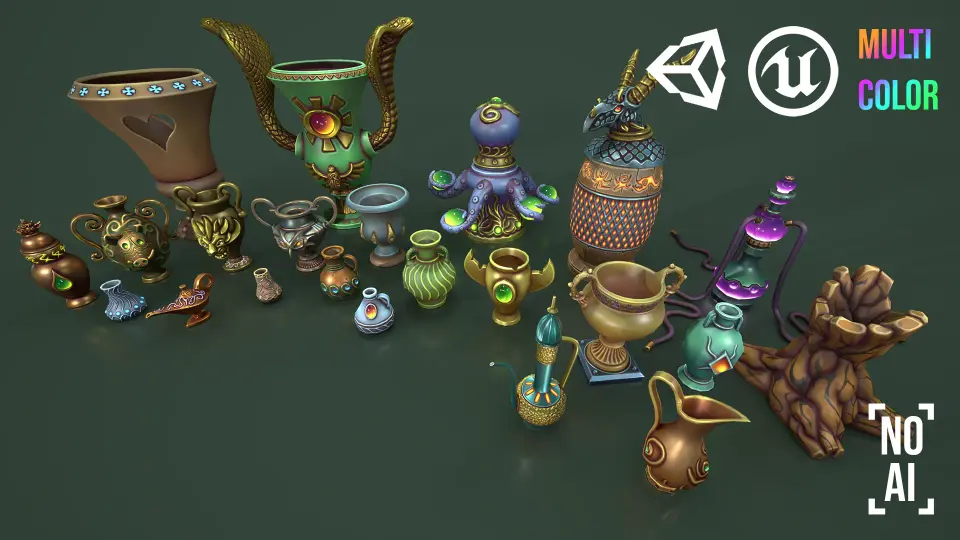
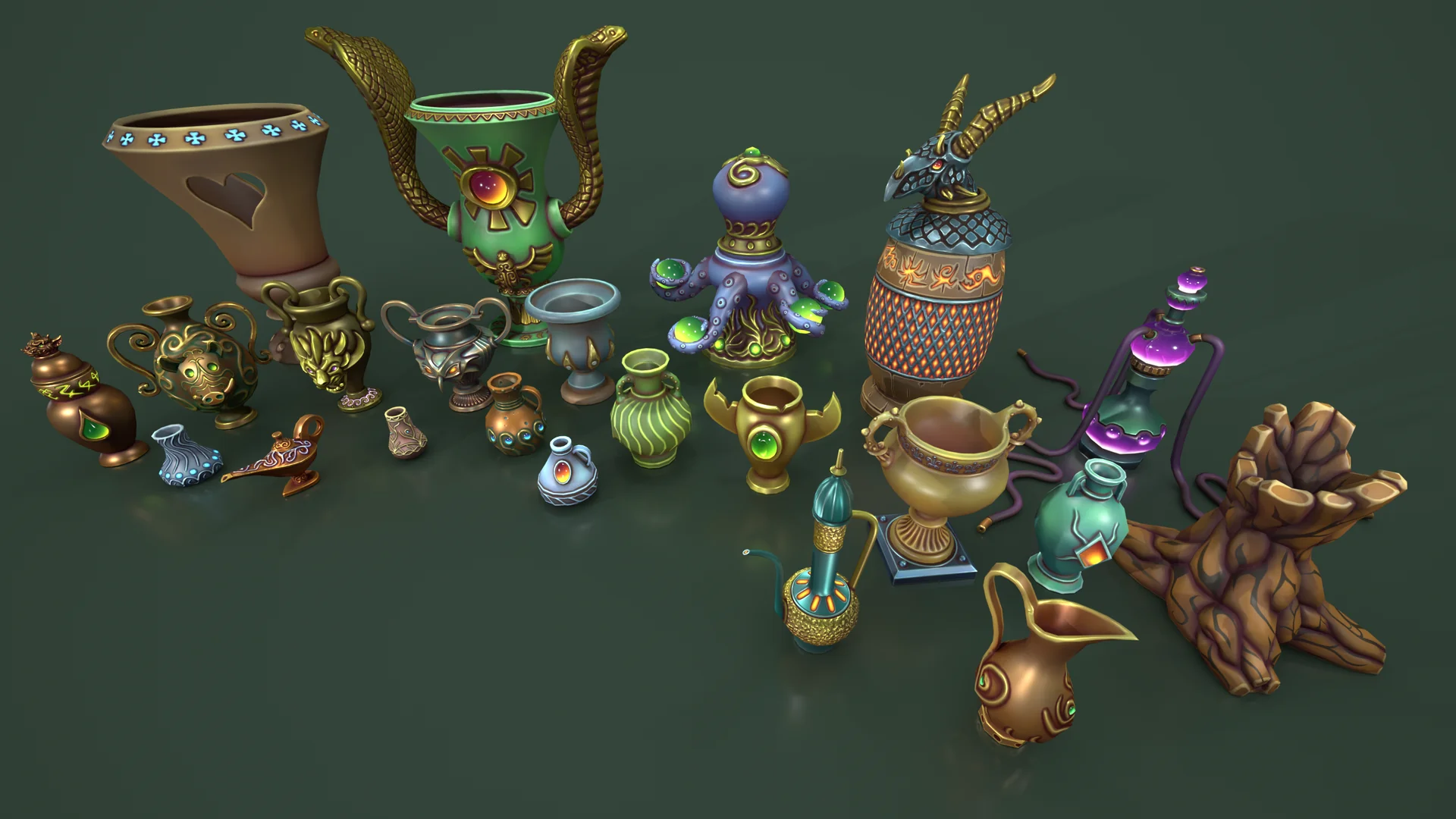
Populating medieval taverns, ancient ruins, arcane workshops, and Victorian interiors requires secondary set dressing that establishes mood without exhausting real-time budgets. Container props serve as foundational elements for level design, functioning equally well as interactive loot containers, table clutter, or environmental accents. The collection of twenty-two game-ready meshes provides an array of stylized containers ranging from utilitarian storage to elaborate, creature-themed vessels.
Zoomorphic Sculptures Across Fantasy Pottery
Several pieces in the set incorporate animal motifs and sculptural figures directly into their functional forms. Rather than relying entirely on smooth geometric profiles, these models integrate defined silhouettes tailored for stylized, cartoon, or fantasy-themed projects. Zoomorphic design appears prominently across the drinking and planter props, each modeled with its own dedicated triangle allocation:
Octopus_Planter (6,492 Tris): Representing the densest model in the package, this piece utilizes its polygon budget to articulate multiple winding tentacles and a bulbous receptacle suitable for foliage or floral dressing.
Dragon_Barrel (2,470 Tris): A storage vessel combining barrel banding with dragon ornamentation, bridging traditional medieval storage with creature accents.
Lion_Cup (3,807 Tris): A ceremonial or luxury drinking vessel modeled with feline facial anatomy worked into the body of the cup.
Boar_Cup (3,174 Tris): Designed around aggressive tusked features, lending an earthy, tavern-ready silhouette to character tabletops.
Owl_Cup (2,582 Tris): A stylized cup featuring avian facial plates and plumage contours, balancing character styling against a controlled surface count.
Gargoyle_Urn (3,302 Tris): A darker, Gothic-leaning vessel integrating stony demonic visage features suitable for crypts and temple sanctums.
Horned-urn (776 Tris): A compact urn featuring protruding horns, maintaining a striking profile at under eight hundred triangles.
By blending figurative sculpture with functional hollow vessels, these pieces allow world builders to inject narrative flavor into banquets, alchemy benches, or decorative niches without relying purely on texture trickery to sell complex contours.
Classical Shapes and Minimalist Vessels
Alongside the ornate character pieces, the collection contains a broad selection of historical, minimalist, and classical container silhouettes. These props recreate established antiquarian forms, providing authentic shapes recognizable from ancient Mediterranean and historical storage traditions:
Small_Vase (266 Tris) and Round_Vase (238 Tris): The two most lightweight assets in the set, ideal for dense background scattering across shelving units and merchant stalls.
Lekif (324 Tris): Based on the classical Greek lekythos, this tall, slender vessel form provides vertical variation among smaller jars.
Oinohoa (462 Tris): A curved wine jug featuring a defined spout and single handle, structured for pouring scenes and kitchen setups.
Jug (568 Tris): A simple, grounded pitcher design suited for domestic medieval settings.
Amphora (784 Tris): The dual-handled storage classic used throughout ancient trading depots, basements, and port scenes.
Pithos (874 Tris): A large-volume bulk storage jar, retaining an imposing silhouette while staying below nine hundred triangles.
Quatrefoil_Urn (1,256 Tris): A decorative container adopting geometric lobed architecture, functioning well in civilized, Victorian, or temple environments.
Planter_Urn (1,712 Tris): An elevated garden or terrace vessel shaped to receive decorative plants and greenery.
Ancient_Urn (2,842 Tris) and Desert_Urn (3,549 Tris): Heavily detailed standalone urns appropriate for dry tomb chambers, dusty ruins, or outdoor archaeological scenes.
The progression in complexity across these classical containers lets developers mix background clutter with foreground hero pieces. Small vases sit comfortably on background shelves without drawing excessive draw calls, while larger urns command focal points in archways or room corners.
Arcane Artifacts and Emissive Styling
The package extends past domestic and historical storage into the realm of magic, alchemy, and sorcery. Several assets provide immediate narrative hooks for wizard sanctums, ritual circles, and enchanting stations:
Magic_Bottle (3,757 Tris): A detailed potion or reagent container structured with geometric flourishes that catch stylized shading.
Magic_Stump (1,362 Tris): An organic container resembling carved wood, blending forestry themes with magical utility.
Magic_Kettle (1,396 Tris): A specialized brewing pot or teapot tailored for herbal concoctions and cauldron-adjacent dressing.
Magic_Lamp (572 Tris): A classical oil-burning or genie-style lamp with sweeping lines, remaining remarkably lightweight.
The surface treatment relies on PBR materials that incorporate emissive properties alongside handpainted and cartoon visual cues. The inclusion of emissive components means props like lamps, arcane urns, and magical bottles can project glowing runes, magical fluid cores, or heating surfaces directly into scene lighting setups. This combination supports stylistic versatility, enabling the assets to sit comfortably in colorful, handpainted fantasy environments as well as PBR-lit stylized engines.
Low-Poly Budgets Across the 22 Game-Ready Meshes
Managing scene density requires a balanced spread of polygon budgets. In real-time rendering, secondary environmental clutter can quickly bloat vertex buffers if individual items are over-modeled. The twenty-two meshes in this collection exhibit a clear hierarchy of geometric investment, ranging from ultra-low background clutter to intricate hero focal pieces.
At the bottom tier of geometry consumption, utility models such as the Round_Vase (238 Tris), Small_Vase (266 Tris), Lekif (324 Tris), and Oinohoa (462 Tris) demand minimal overhead. These can be multiplied across instances, filling shelves, crates, and markets across sprawling levels without stressing geometry pipelines.
The middle tier, including the Jug (568 Tris), Magic_Lamp (572 Tris), Horned-urn (776 Tris), Amphora (784 Tris), Pithos (874 Tris), Quatrefoil_Urn (1,256 Tris), Magic_Stump (1,362 Tris), Magic_Kettle (1,396 Tris), and Planter_Urn (1,712 Tris), represents standard midground set dressing. These retain smooth circular profiles and visible structural detailing like handles, spouts, and rims when inspected at typical player camera distances.
The high-detail tier reserves triangle budgets for elaborate focal items: Dragon_Barrel (2,470 Tris), Owl_Cup (2,582 Tris), Ancient_Urn (2,842 Tris), Boar_Cup (3,174 Tris), Gargoyle_Urn (3,302 Tris), Desert_Urn (3,549 Tris), Magic_Bottle (3,757 Tris), Lion_Cup (3,807 Tris), and Octopus_Planter (6,492 Tris). These models serve effectively as inspectable inventory items, puzzle interactables, or hero table props where distinct silhouettes and curved organic surfaces are viewed up close.
Material Linking in the Blender Project
The asset package is supplied as a native Blender project complete with prepared materials. When working in Blender across different workstation configurations or directory structures, texture paths frequently need relocation to establish their proper connections.
To display and edit the materials correctly inside Blender, point the project to the textures using the built-in path resolution tool. In the main menu, navigate to File > External Data > Find Missing Files, then select the folder containing the accompanying image textures. Blender automatically parses the directory, maps the missing image nodes within each material shader, and restores the PBR surfaces, emissive passes, and handpainted color maps across all twenty-two objects.
This automated linking process ensures that material node trees connect directly without requiring manual recreation of shader graphs. Once textures are assigned through Blender's internal data tools, the models are ready for scene assembly, layout modification, or export into external game engines tailored for low-poly, stylized, and medieval fantasy projects.
 Tools
 Tools
 Tools
 Tools