"c14ff6bd758dadb1"{"id":"1000628","slug":"jobsite-vol-4-police-station","title":"Jobsite VOL.4 - Police Station","category":"Tools, Objects \u0026 Decor","engine":"5.1+","assetVersion":"","engineVersion":"Engine Version: 5.1+","tag":"Tools","accent":"blue","visual":"mech","summary":"Dekogon's Unreal Engine police station asset pack delivers 191 nanite and low-poly meshes with 4K textures, master materials, and full Lumen support for realist","platform":"Unreal Engine","publishedAt":"2026-07-21T14:07:16.209Z","updatedAt":"2026-07-21T14:07:16.209Z","sourceNotes":[],"fileContents":[],"compatibility":["Unreal Engine","Engine Version: 5.1+"],"featuredImage":{"alt":"Jobsite VOL.4 - Police Station","src":"/wp-content/uploads/published/2026/07/ba144698b65e-e94e9e10-d43e-4189-ac0b-21e582a6bbdc-fb985f98a7.webp"},"hasDownloadLink":true,"downloads":0,"terms":[{"taxonomy":"category","slug":"tools-objects-and-decor","name":"Tools, Objects \u0026 Decor"}],"galleryImages":[{"src":"/wp-content/uploads/published/2026/07/61e0729d0c56-b73a3709-fe58-4e9b-9f17-f803aa47a5d4-e2e8727b54.webp","alt":"Jobsite VOL.4 - Police Station"},{"src":"/wp-content/uploads/published/2026/07/99a28e5d6332-e7b55c63-6cee-44e4-bfee-7f06b091c415-a6ab337ab6.webp","alt":"Jobsite VOL.4 - Police Station"},{"src":"/wp-content/uploads/published/2026/07/480e51b06409-7061cecd-36bd-458f-9976-b55f50dd54a1-e9fcaab1bb.webp","alt":"Jobsite VOL.4 - Police Station"},{"src":"/wp-content/uploads/published/2026/07/487af4a85dbf-69c43fa4-feed-4143-a66a-f597a2a8248e-e45cf21c40.webp","alt":"Jobsite VOL.4 - Police Station"},{"src":"/wp-content/uploads/published/2026/07/427dd333573b-58a76d8e-2167-4f06-a75b-a0d8f605a1f8-e38e8a01c9.webp","alt":"Jobsite VOL.4 - Police Station"},{"src":"/wp-content/uploads/published/2026/07/f256fd1a4832-800314f3-1e65-43bd-a56a-c4ecdc3fb454-a14e20a7be.webp","alt":"Jobsite VOL.4 - Police Station"},{"src":"/wp-content/uploads/published/2026/07/69651f09334a-43c41fb6-d729-435a-bfbb-941a990a111b-f1d5f71688.webp","alt":"Jobsite VOL.4 - Police Station"},{"src":"/wp-content/uploads/published/2026/07/1c84dc4d3fcb-3c7ad384-8083-4ab9-a89b-04b9ab037589-33ec411889.webp","alt":"Jobsite VOL.4 - Police Station"},{"src":"/wp-content/uploads/published/2026/07/e1d9094d367b-21ece786-afef-4592-9792-48f75f1ed2ac-03745b1eb9.webp","alt":"Jobsite VOL.4 - Police Station"},{"src":"/wp-content/uploads/published/2026/07/6fe028e31b4c-05249f81-57b1-435c-b312-b3663da8163d-b7a80c8786.webp","alt":"Jobsite VOL.4 - Police Station"}],"accessPanel":{"kind":"resource","title":"Download this resource","eyebrow":"Free Download","message":"Log in or create a free account to start your download.","fileName":"Content.7z","safetyNote":"Resources are manually reviewed before listing to improve quality and reduce obvious risks.","actionLabel":"Download Free","resourceType":"Resource archive"},"contentHtml":"\u003cp\u003eBuilding a believable law enforcement interior usually means juggling custom furniture, branded props, and the right balance of fidelity against performance. Jobsite VOL.4 - Police Station approaches that workload as a complete drop-in environment kit. Created by Dekogon Studios artists entirely inside Unreal Engine, the project ships with all assets, maps, and materials pictured, assembled to hit realistic AAA quality without forcing a team to hand-model every locker, bench, or badge.\u003c/p\u003e\n\u003cp\u003eThe pack supplies \u003ch2\u003eNanite Props and Low-Poly Alternates for Flexible Police Station Scenes\u003c/h2\u003e Every asset is constructed using nanite for high-quality fidelity polycounts, and each mesh also ships in a low-poly version. That split applies across the entire 191-piece mesh count. Rather than committing a project to one rendering path, the structure lets artists work in nanite for hero shots and cinematic playback, then drop to the low-poly alternates for distant rooms, mobile builds, or performance-sensitive sequences. The models stay fully detailed from all sides, which matters when cameras move through holding areas or circle reception desks.\u003c/p\u003e\n\u003cp\u003eNanite's per-pixel geometry suits the close-range props this kit emphasizes—badges, locker frames, cot structures, and government-office detailing. The low-poly counterparts mean the same art direction can hold up in wider gameplay contexts without a second modeling pass.\u003c/p\u003e\n\u003ch2\u003eMaterial Authoring and Channel-Packed Texture Workflow\u003c/h2\u003e\n\u003cp\u003eA master material setup controls the majority of props and models, which keeps the surface language consistent across the station’s rooms. Artists can adjust properties including roughness, albedo, and normals directly through exposed parameters rather than creating new material instances for every variation.\u003c/p\u003e\n\u003cp\u003eThe texture sets are high-quality 4K, built on channel-packed Roughness, Metalness, and Ambient Occlusion maps. Channel packing reduces the number of individually sampled maps, simplifying how props are shaded and helping maintain a cleaner material hierarchy across the furniture, cabinetry, and government-style fixtures. For a police station scene with many metal lockers, wood benches, and office cabinets sharing adjacent material families, that approach keeps the look unified.\u003c/p\u003e\n\u003ch2\u003eBuilding Government and Police Station Interiors\u003c/h2\u003e\n\u003cp\u003eThe asset selection points clearly toward municipal and law-enforcement interiors. Tags list Furniture, Townhall, File, Bench, Badge, Town, Flag, Police, Building, Hall, Cabinet, Wood, Cot, Government, and Locker. That vocabulary covers the practical objects actual stations rely on—evidence cabinets, booking benches, office file storage, staff lockers, and sleeping cots for extended shifts.\u003c/p\u003e\n\u003cp\u003eFlag and badge props add institutional identity to entrance halls and reception areas. The bench and cot props support areas where civilians wait or staff rest during long rotations. Cabinet and locker meshes anchor the back-of-house storage rooms and personal effects areas that make a station read as a working facility rather than a dressed set.\u003c/p\u003e\n\u003ch2\u003eCustom Branding and Rights-Clean Prop Labels\u003c/h2\u003e\n\u003cp\u003eAll branding and labels are custom made by the studio, leaving the product free of legal issues tied to real-world law enforcement marks or municipal seals. That clearance matters for shipped games, cinematic shorts, or interactive training scenes where uncertain branding rights can force late-stage content removal.\u003c/p\u003e\n\u003cp\u003eBecause the labels are original, artists can place badges, file folders, and signage directly into shots without retitling or obscuring logos. Projects that want to adjust the fictional department identity can still repaint or swap textures within Unreal, while the baseline props avoid any dependency on recognizable real-world marks.\u003c/p\u003e\n\u003ch2\u003eLumen, Post Process, and Look-Up Table Implementation\u003c/h2\u003e\n\u003cp\u003eThe product supports Lumen for Unreal Engine 5.0 and later, using the engine's documentation-driven pipeline for global illumination. Combined with the included realistic post-processing and Look Up Table, the station interiors can reach a warmed-over fluorescent lighting feel without building a custom grading stack from scratch.\u003c/p\u003e\n\u003cp\u003eFor developers targeting UE 5.0+, the Lumen support means the kit's nanite geometry and 4K textures already align with modern GI workflows. The low-poly alternates remain available for platforms where Lumen may not be active, giving teams a fallback while preserving the same material controls.\u003c/p\u003e\n\u003ch2\u003eWhere This Set Fits in a Production Pipeline\u003c/h2\u003e\n\u003cp\u003eThe content is optimized for games, built as an Unreal-native project rather than a port, and structured around consistent master material control. Teams prototyping interactive scenes can populate full police station interiors using the furniture, cabinet, locker, bench, cot, and government props, then move between nanite and low-poly versions as performance profiles clarify.\u003c/p\u003e\n\u003cp\u003eFor cinematic or visualization work, the 4K textures, channel-packed maps, and detailed-from-all-angles modeling hold up under close camera framing. The included post-process and LUT provide a starting grade, while Lumen support handles the indirect light that station fluorescents and windowed halls require. The pack functions as an environment foundation rather than a loose prop collection, slotting into Unreal Engine 5.0+ projects that need a credible, legally clean police station without producing every asset in-house.\u003c/p\u003e\n\n\u003ch2\u003eMore From The Same Workflow\u003c/h2\u003e\n\u003cul\u003e\n\u003cli\u003e\u003ca href=\"https://3dcghub.com/retro-police-station-environment-retro-police-station-police-interior-police/\" title=\"Retro Police Station Environment ( Retro Police Station Police Interior Police )\"\u003eRetro Police Station Environment ( Retro Police Station Police Interior Police )\u003c/a\u003e\u003c/li\u003e\n\u003cli\u003e\u003ca href=\"https://3dcghub.com/boatyard-vol-7-fishing-nanite-and-low-poly/\" title=\"Boatyard VOL.7 - Fishing (Nanite and Low Poly)\"\u003eBoatyard VOL.7 - Fishing (Nanite and Low Poly)\u003c/a\u003e\u003c/li\u003e\n\u003cli\u003e\u003ca href=\"https://3dcghub.com/suburbs-vol-20-vending-and-service-nanite-and-low-poly/\" title=\"Suburbs VOL.20 - Vending and Service (Nanite and Low Poly)\"\u003eSuburbs VOL.20 - Vending and Service (Nanite and Low Poly)\u003c/a\u003e\u003c/li\u003e\n\u003cli\u003e\u003ca href=\"https://3dcghub.com/mega-candles-pack/\" title=\"Mega Candles Pack\"\u003eMega Candles Pack\u003c/a\u003e\u003c/li\u003e\n\u003cli\u003e\u003ca href=\"https://3dcghub.com/signage-vol-1-town-and-city-nanite-and-low-poly/\" title=\"Signage VOL.1 - Town and City (Nanite and Low Poly)\"\u003eSignage VOL.1 - Town and City (Nanite and Low Poly)\u003c/a\u003e\u003c/li\u003e\n\u003c/ul\u003e","contentTextLength":5670,"navigation":{"current":1232,"total":3719,"previous":{"id":"1000629","slug":"jobsite-vol-12-office-nanite-and-low-poly","title":"Jobsite VOL.12 - Office (Nanite \u0026 Low Poly)","category":"Industrial","platform":"Unreal Engine","updatedAt":"2026-07-21T14:14:28.685Z"},"next":{"id":"1000627","slug":"jobsite-vol-3-postal-service-nanite-and-low-poly","title":"Jobsite VOL.3 - Postal Service (Nanite \u0026 Low Poly)","category":"Containers","platform":"Unreal Engine","updatedAt":"2026-07-21T13:56:03.805Z"}},"relatedResources":[{"id":"1001494","slug":"suburbs-vol-9-kitchen-appliances-nanite-and-low-poly","title":"Suburbs VOL.9 - Kitchen Appliances (Nanite and Low Poly)","category":"Tools, Objects \u0026 Decor","engine":"5.1+","assetVersion":"","engineVersion":"Engine Version: 5.1+","tag":"Tools","accent":"blue","visual":"mech","summary":"Explore Suburbs VOL.9 - Kitchen Appliances featuring 100 Nanite and low-poly meshes, 4K channel-packed textures, master materials, and Lumen support in UE5.","platform":"Unreal Engine","publishedAt":"2026-10-08T12:59:10.109Z","updatedAt":"2026-10-08T12:59:10.109Z","sourceNotes":[],"fileContents":[],"compatibility":["Unreal Engine","Engine Version: 5.1+"],"featuredImage":{"alt":"Suburbs VOL.9 - Kitchen Appliances (Nanite and Low Poly)","src":"/wp-content/uploads/published/2026/10/3979285da268-cfab6cc0-906e-4d64-b5c0-261f887167a6-7b5e04d362.webp"},"hasDownloadLink":true,"downloads":1},{"id":"1001457","slug":"suburbs-vol-1-wall-decor-nanite-and-low-poly","title":"Suburbs VOL.1 - Wall Decor (Nanite and Low Poly)","category":"Tools, Objects \u0026 Decor","engine":"5.1+","assetVersion":"","engineVersion":"Engine Version: 5.1+","tag":"Tools","accent":"blue","visual":"mech","summary":"Suburbs VOL.1 - Wall Decor provides 130 Unreal Engine meshes split between Nanite and low-poly versions with 4K textures and full Lumen support.","platform":"Unreal Engine","publishedAt":"2026-10-08T00:59:33.447Z","updatedAt":"2026-10-08T00:59:33.447Z","sourceNotes":[],"fileContents":[],"compatibility":["Unreal Engine","Engine Version: 5.1+"],"featuredImage":{"alt":"Suburbs VOL.1 - Wall Decor (Nanite and Low Poly)","src":"/wp-content/uploads/published/2026/10/74ebc1534289-9813391a-2ad8-44af-9171-1001780b8321-c5e3107822.webp"},"hasDownloadLink":true,"downloads":1},{"id":"1001634","slug":"holidays-vol-2-halloween-decor-nanite-and-low-poly","title":"Holidays VOL.2 - Halloween Decor (Nanite and Low Poly)","category":"Tools, Objects \u0026 Decor","engine":"5.1+","assetVersion":"","engineVersion":"Engine Version: 5.1+","tag":"Tools","accent":"blue","visual":"mech","summary":"Explore the Nanite and low-poly Halloween decor asset pack for Unreal Engine, featuring 84 meshes, 4K channel-packed textures, and full Lumen support.","platform":"Unreal Engine","publishedAt":"2026-10-13T02:12:12.386Z","updatedAt":"2026-10-13T02:12:12.386Z","sourceNotes":[],"fileContents":[],"compatibility":["Unreal Engine","Engine Version: 5.1+"],"featuredImage":{"alt":"Holidays VOL.2 - Halloween Decor (Nanite and Low Poly)","src":"/wp-content/uploads/published/2026/10/a94b92ac2c16-cd992b69-20d6-440f-8720-4b74f488cc2f-d4084d924e.webp"},"hasDownloadLink":true,"downloads":0}]}
Tools
Jobsite VOL.4 - Police Station
Dekogon's Unreal Engine police station asset pack delivers 191 nanite and low-poly meshes with 4K textures, master materials, and full Lumen support for realist
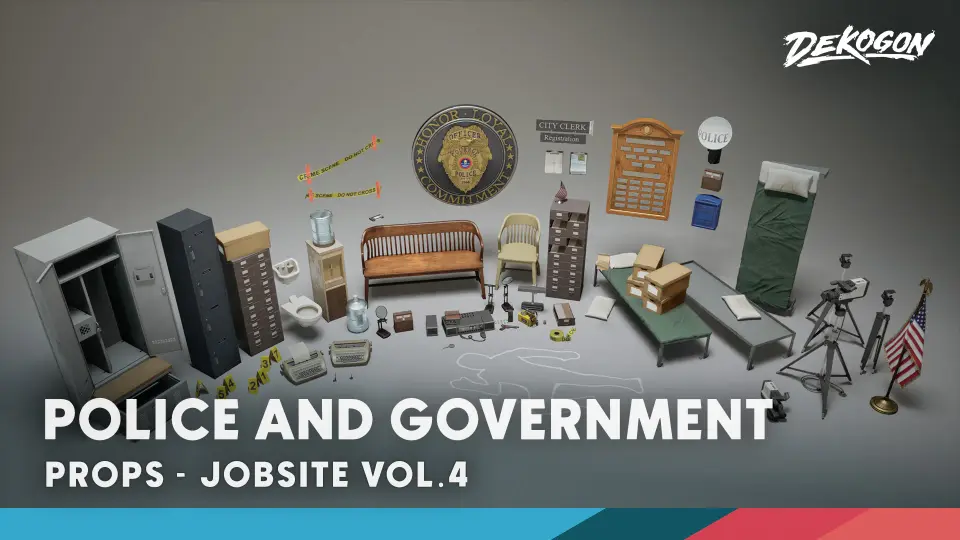
Building a believable law enforcement interior usually means juggling custom furniture, branded props, and the right balance of fidelity against performance. Jobsite VOL.4 - Police Station approaches that workload as a complete drop-in environment kit. Created by Dekogon Studios artists entirely inside Unreal Engine, the project ships with all assets, maps, and materials pictured, assembled to hit realistic AAA quality without forcing a team to hand-model every locker, bench, or badge.
The pack supplies
Nanite Props and Low-Poly Alternates for Flexible Police Station Scenes
Every asset is constructed using nanite for high-quality fidelity polycounts, and each mesh also ships in a low-poly version. That split applies across the entire 191-piece mesh count. Rather than committing a project to one rendering path, the structure lets artists work in nanite for hero shots and cinematic playback, then drop to the low-poly alternates for distant rooms, mobile builds, or performance-sensitive sequences. The models stay fully detailed from all sides, which matters when cameras move through holding areas or circle reception desks.
Nanite's per-pixel geometry suits the close-range props this kit emphasizes—badges, locker frames, cot structures, and government-office detailing. The low-poly counterparts mean the same art direction can hold up in wider gameplay contexts without a second modeling pass.
Material Authoring and Channel-Packed Texture Workflow
A master material setup controls the majority of props and models, which keeps the surface language consistent across the station’s rooms. Artists can adjust properties including roughness, albedo, and normals directly through exposed parameters rather than creating new material instances for every variation.
The texture sets are high-quality 4K, built on channel-packed Roughness, Metalness, and Ambient Occlusion maps. Channel packing reduces the number of individually sampled maps, simplifying how props are shaded and helping maintain a cleaner material hierarchy across the furniture, cabinetry, and government-style fixtures. For a police station scene with many metal lockers, wood benches, and office cabinets sharing adjacent material families, that approach keeps the look unified.
Building Government and Police Station Interiors
The asset selection points clearly toward municipal and law-enforcement interiors. Tags list Furniture, Townhall, File, Bench, Badge, Town, Flag, Police, Building, Hall, Cabinet, Wood, Cot, Government, and Locker. That vocabulary covers the practical objects actual stations rely on—evidence cabinets, booking benches, office file storage, staff lockers, and sleeping cots for extended shifts.
Flag and badge props add institutional identity to entrance halls and reception areas. The bench and cot props support areas where civilians wait or staff rest during long rotations. Cabinet and locker meshes anchor the back-of-house storage rooms and personal effects areas that make a station read as a working facility rather than a dressed set.
Custom Branding and Rights-Clean Prop Labels
All branding and labels are custom made by the studio, leaving the product free of legal issues tied to real-world law enforcement marks or municipal seals. That clearance matters for shipped games, cinematic shorts, or interactive training scenes where uncertain branding rights can force late-stage content removal.
Because the labels are original, artists can place badges, file folders, and signage directly into shots without retitling or obscuring logos. Projects that want to adjust the fictional department identity can still repaint or swap textures within Unreal, while the baseline props avoid any dependency on recognizable real-world marks.
Lumen, Post Process, and Look-Up Table Implementation
The product supports Lumen for Unreal Engine 5.0 and later, using the engine's documentation-driven pipeline for global illumination. Combined with the included realistic post-processing and Look Up Table, the station interiors can reach a warmed-over fluorescent lighting feel without building a custom grading stack from scratch.
For developers targeting UE 5.0+, the Lumen support means the kit's nanite geometry and 4K textures already align with modern GI workflows. The low-poly alternates remain available for platforms where Lumen may not be active, giving teams a fallback while preserving the same material controls.
Where This Set Fits in a Production Pipeline
The content is optimized for games, built as an Unreal-native project rather than a port, and structured around consistent master material control. Teams prototyping interactive scenes can populate full police station interiors using the furniture, cabinet, locker, bench, cot, and government props, then move between nanite and low-poly versions as performance profiles clarify.
For cinematic or visualization work, the 4K textures, channel-packed maps, and detailed-from-all-angles modeling hold up under close camera framing. The included post-process and LUT provide a starting grade, while Lumen support handles the indirect light that station fluorescents and windowed halls require. The pack functions as an environment foundation rather than a loose prop collection, slotting into Unreal Engine 5.0+ projects that need a credible, legally clean police station without producing every asset in-house.
 Tools
Tools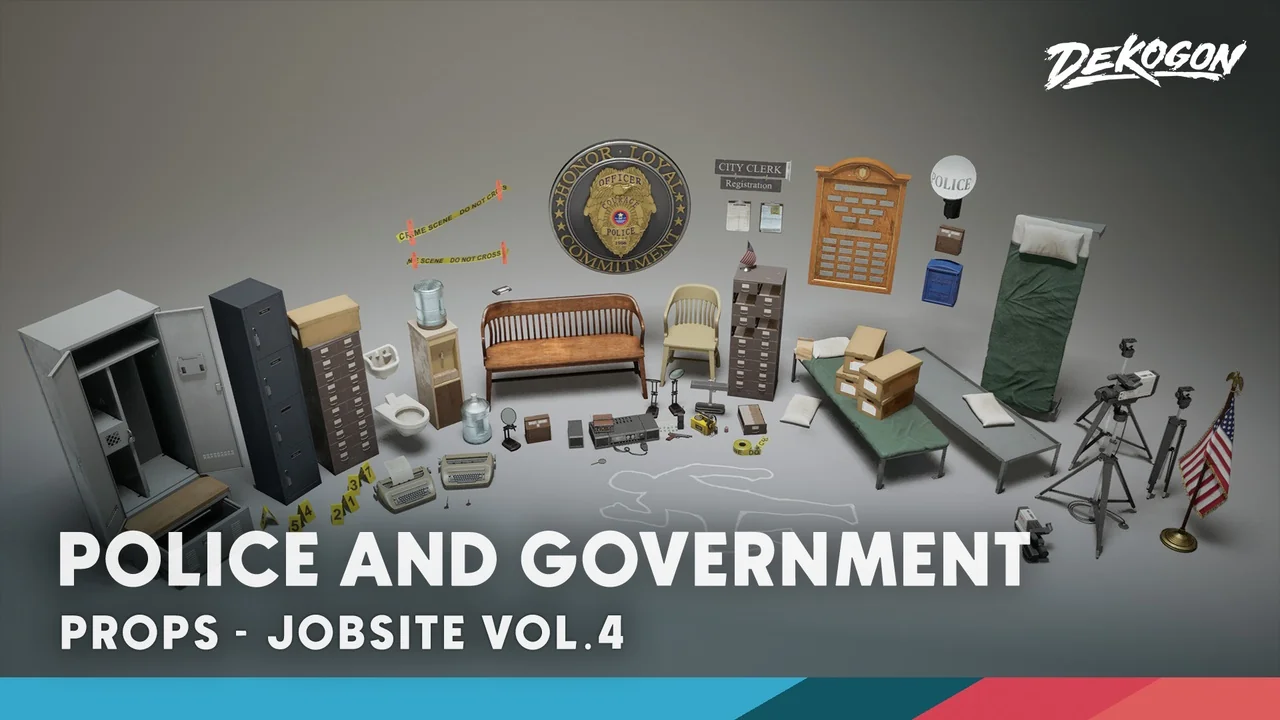
 Tools
Tools Tools
Tools Tools
Tools