"148d1066ed74e216"{"id":"1002948","slug":"roguelike-deckbuilder-toolkit","title":"Roguelike Deckbuilder Toolkit","category":"RPG","engine":"5.3+","assetVersion":"","engineVersion":"Engine Version: 5.3+","tag":"RPG","accent":"blue","visual":"mech","summary":"Explore the Roguelike Deckbuilder Toolkit, a modular Unreal Engine Blueprint framework featuring data-driven cards, node maps, and decoupled combat logic.","platform":"Unreal Engine","indexPolicy":"index","publishedAt":"2026-11-22T06:25:32.636Z","updatedAt":"2026-11-22T06:25:32.636Z","sourceNotes":[],"fileContents":[],"compatibility":["Unreal Engine","Engine Version: 5.3+"],"featuredImage":{"alt":"Roguelike Deckbuilder Toolkit","src":"/wp-content/uploads/published/2026/11/4e503a060d58-1a40fb47-22ce-4a61-bc63-51180d55b497-68e7cebabd.webp"},"fileSizeBytes":125467069,"hasDownloadLink":true,"downloads":0,"terms":[{"taxonomy":"category","slug":"rpg","name":"RPG"}],"galleryImages":[{"src":"/wp-content/uploads/published/2026/11/38dc64e98469-acc88462-ab8a-4ab7-a84e-529528a3cbbf-9259177720.webp","alt":"Roguelike Deckbuilder Toolkit"},{"src":"/wp-content/uploads/published/2026/11/8f6cb325ae3f-b73bba0b-9b0b-4e31-adea-fe8338417fe8-951f6bbc6c.webp","alt":"Roguelike Deckbuilder Toolkit"},{"src":"/wp-content/uploads/published/2026/11/23c0f0682c68-603d8e31-11c2-4e54-b6bb-af2257f7bacc-8cda10c95a.webp","alt":"Roguelike Deckbuilder Toolkit"},{"src":"/wp-content/uploads/published/2026/11/c6990a6d4066-5d439b46-9cf2-41ca-bbcb-1ccd9cbcd778-b0fd12af47.webp","alt":"Roguelike Deckbuilder Toolkit"},{"src":"/wp-content/uploads/published/2026/11/8e4fab48fefd-34c0084a-e3db-41f7-940c-3579e6ec0dc6-f3da933a79.webp","alt":"Roguelike Deckbuilder Toolkit"},{"src":"/wp-content/uploads/published/2026/11/25e813ece39d-a213c099-7024-4b3a-8553-4d9fbb4c4971-cf09507c85.webp","alt":"Roguelike Deckbuilder Toolkit"},{"src":"/wp-content/uploads/published/2026/11/bce3a701e8fe-44d50b90-9c6f-4d25-9691-ce59fbaa4a98-b167eb0f3b.webp","alt":"Roguelike Deckbuilder Toolkit"},{"src":"/wp-content/uploads/published/2026/11/7a18d6ca3a63-9a309ac8-a8a1-4449-ae67-63d738edacfd-32ce4bed39.webp","alt":"Roguelike Deckbuilder Toolkit"}],"accessPanel":{"kind":"resource","title":"Get this resource","safetyNote":"Resources are manually reviewed before listing to improve quality and reduce obvious risks.","fileName":"Roguelike Deckbuilder Toolkit.7z","resourceType":"Resource archive","versions":[]},"contentHtml":"\u003cp\u003eTurn-based tactical arenas, fraught combat runs, and interactive card-driven encounters form the core of the Roguelike Deckbuilder Toolkit. Drawing inspiration from classic titles within the deckbuilding genre, the framework establishes a foundation for authoring card interactions, entity behaviors, and persistent game cycles. Rather than binding presentation directly to mechanical rules, the asset relies on composition, data tables, and an isolated action processing structure to keep game flow completely independent of character animations and interface animations.\u003c/p\u003e \u003ch2\u003eConstructing Tactical Encounters with the Deckbuilder Framework\u003c/h2\u003e\n\u003cp\u003eCombat relies on a modular approach where rules and entity behaviors are assembled from components rather than rigid, monolithic scripts. Individual cards, minions, and artifacts are added and cataloged through data tables, with their active and passive characteristics dictated by modular actor components. This design allows new abilities to be assigned quickly by linking functional modules directly to card records without requiring rewrites of the core combat loop.\u003c/p\u003e \u003cp\u003eEnemy decision-making during encounters is controlled through a dedicated Attack Pattern Component. By configuring this component, developers specify precisely how AI-controlled minions evaluate available skills, prioritize targets, and queue moves each round. These planned actions surface directly to the player through an enemy intention system integrated within the user interface, reflecting intended strikes, defensive postures, or incoming status modifications before the turn resolves.\u003c/p\u003e \u003cp\u003eThe interface ecosystem covers card widgets, real-time status effect indicators, customizable tooltips, and custom card frames. Because status effects and entity statistics update through an underlying event network, the user interface remains responsive to changes during combat sequences, clearly communicating complex rule interactions as they trigger.\u003c/p\u003e \u003ch2\u003eSeparating Presentation from Logic via the Action Queue\u003c/h2\u003e\n\u003cp\u003eA central technical hurdle in digital card games involves coordinating sequential events—such as damage calculation, visual particle impacts, UI health updates, and conditional card draws—without desynchronizing the visual scene from game states. The framework resolves this by decoupling visuals from underlying logic using an Action Queue system alongside Blueprint composition.\u003c/p\u003e \u003cp\u003eWhen an ability executes, calculations occur within the logical framework, while corresponding visual actions—such as attacks, status updates, and entity reactions—are queued and processed smoothly in sequence. This separation guarantees that custom skeletal meshes, alternative sprite sets, or stylized interface elements can replace the default example visuals without interfering with numerical calculations or turn progression.\u003c/p\u003e \u003cp\u003eFacilitating these interactions between various Blueprint systems is a custom Event Dispatcher architecture. When an action executes, dispatchers broadcast signals that cards, combatants, UI layers, and passive artifacts can observe and respond to simultaneously. This structure accommodates layered gameplay conditions, such as triggering an artifact's healing effect whenever a specific card category is played, without creating tight dependencies between disparate actors.\u003c/p\u003e \u003ch2\u003eData-Driven Systems Across the Roguelike Campaign\u003c/h2\u003e\n\u003cp\u003eBeyond individual combat engagements, the project supplies full meta-game systems necessary to run a full gameplay session from start to finish. A complete game loop is present out of the box, containing functional saving and loading operations, persistent level transitions, and evaluated win and loss states.\u003c/p\u003e \u003cp\u003eProgression rewards between encounters are regulated by a reward manager. This system handles the distribution of new cards and artifacts according to preconfigured rarity tiers, allowing developers to balance run rewards through defined data entries. Players expand their active decks and passive inventory over the course of an outing, with newly acquired items integrating into the existing combat pools seamlessly.\u003c/p\u003e \u003cp\u003eA broad assortment of pre-built cards, minions, artifacts, and status effects is provided across the asset's data structures. These example assets serve as functional blueprints that demonstrate how to implement unique damage multipliers, defensive shields, periodic effects, and trigger-based passive enhancements within the wider gameplay flow.\u003c/p\u003e \u003ch2\u003eNavigation, Shops, and Events on the Node Map\u003c/h2\u003e\n\u003cp\u003eProgression outside of battles centers around an overworld node map system. Positioned between tactical combat stages, this map offers branching pathways that let players determine their route through a given run, deciding between standard encounters, specialized challenges, and recovery opportunities.\u003c/p\u003e \u003cp\u003eThe node map currently operates through hand-placed configurations rather than algorithmic procedural generation, giving creators precise control over branch layouts, progression pacing, and milestone placements across the journey. Embedded within this travel grid are dedicated story events and commercial shop nodes, expanding the campaign beyond strictly combat-focused scenarios.\u003c/p\u003e \u003cp\u003eShop encounters allow players to trade accrued resources for cards, artifacts, and services, whereas story events introduce situational decision points with varying outcomes. By routing these interactions through the framework's data-driven reward and stat pipelines, narrative choices can immediately modify player conditions, bestow items, or alter deck compositions.\u003c/p\u003e \u003ch2\u003eReference Assets and Integration in the Toolkit\u003c/h2\u003e\n\u003cp\u003eTo provide working reference material right away, the framework incorporates a variety of functional sample assets across art, animation, and typography. Card visuals feature portraits sourced from public domain classical paintings via Wikimedia Commons, framed inside custom-designed UI borders. Text display leverages the open-source typefaces Source Serif Pro and Source Sans Pro, both governed by the SIL Open Font License.\u003c/p\u003e \u003cp\u003eThree-dimensional combat entities utilize models and animations drawn from Epic Games releases: spider and troll entities originate from Infinity Blade Adversaries, while the player warrior model comes from Infinity Blade Warriors with accompanying combat animations taken from Paragon: Greystone. Explosive visual feedbacks incorporate particle setups adapted from the standard Unreal Engine Starter Content, alongside Creative Commons status icons created by Lorc, Delapouit, and Skoll from game-icons.net.\u003c/p\u003e \u003cp\u003eBecause all logic is decoupled from these specific assets, the included character models, particle effects, and icons exist primarily as functioning implementation templates. Teams can retain the core data-driven architecture, AI routines, and UI systems while cleanly substituting in their own 3D models, 2D illustrations, and custom thematic interfaces to fit their creative direction.\u003c/p\u003e\n\n\u003ch2\u003eExplore Similar Assets\u003c/h2\u003e\n\u003cul\u003e\n\u003cli\u003e\u003ca href=\"https://3dcghub.com/survivors-roguelike-multiplayer-game-template/\" rel=\"noopener noreferrer\"\u003eSurvivors Roguelike - Multiplayer Game Template\u003c/a\u003e\u003c/li\u003e\n\u003cli\u003e\u003ca href=\"https://3dcghub.com/open-world-rpg-toolkit/\" rel=\"noopener noreferrer\"\u003eOpen World RPG Toolkit\u003c/a\u003e\u003c/li\u003e\n\u003cli\u003e\u003ca href=\"https://3dcghub.com/advanced-turn-based-tile-toolkit/\" rel=\"noopener noreferrer\"\u003eAdvanced Turn Based Tile Toolkit\u003c/a\u003e\u003c/li\u003e\n\u003cli\u003e\u003ca href=\"https://3dcghub.com/top-down-rpg-template/\" rel=\"noopener noreferrer\"\u003eTop Down RPG Template\u003c/a\u003e\u003c/li\u003e\n\u003cli\u003e\u003ca href=\"https://3dcghub.com/action-rpg-multiplayer-starter-template/\" rel=\"noopener noreferrer\"\u003eAction RPG Multiplayer Starter Template\u003c/a\u003e\u003c/li\u003e\n\u003c/ul\u003e","contentTextLength":7095,"navigation":{"current":24,"total":4890,"previous":{"id":"1002949","slug":"smart-projectile","title":"Smart Projectile","category":"Action-Adventure","platform":"Unreal Engine","updatedAt":"2026-11-22T06:28:01.725Z"},"next":{"id":"1002947","slug":"xprojectile-multithreaded-ricochet-in-5-8-easy-to-use","title":"XProjectile - Multithreaded | Ricochet in 5.8 \u003e | Easy to use","category":"Engine Tools","platform":"Unreal Engine","updatedAt":"2026-11-21T23:37:32.896Z"}},"relatedResources":[{"id":"1001252","slug":"survivors-roguelike-multiplayer-game-template","title":"Survivors Roguelike - Multiplayer Game Template","category":"RPG","engine":"5.0+","assetVersion":"","engineVersion":"Engine Version: 5.0+","tag":"RPG","accent":"blue","visual":"mech","summary":"Build networked horde survival games with the Survivors Roguelike Multiplayer Game Template, featuring 100% blueprints, data tables, and lobby systems.","platform":"Unreal Engine","indexPolicy":"index","publishedAt":"2026-09-23T15:37:57.602Z","updatedAt":"2026-09-23T15:37:57.602Z","sourceNotes":[],"fileContents":[],"compatibility":["Unreal Engine","Engine Version: 5.0+"],"featuredImage":{"alt":"Survivors Roguelike - Multiplayer Game Template","src":"/wp-content/uploads/published/2026/09/b27123471922-984e7958-ec14-445f-a005-f0e4869053db-d656264a1b.webp"},"fileSizeBytes":782798397,"hasDownloadLink":true,"downloads":1},{"id":"1001250","slug":"open-world-rpg-toolkit","title":"Open World RPG Toolkit","category":"RPG","engine":"5.0+","assetVersion":"","engineVersion":"Engine Version: 5.0+","tag":"RPG","accent":"blue","visual":"mech","summary":"Explore the Open World RPG Toolkit, featuring 47 network-replicated blueprints covering quests, inventory, map setup, saves, and survival systems.","platform":"Unreal Engine","indexPolicy":"index","publishedAt":"2026-09-23T15:32:52.651Z","updatedAt":"2026-09-23T15:32:52.651Z","sourceNotes":[],"fileContents":[],"compatibility":["Unreal Engine","Engine Version: 5.0+"],"featuredImage":{"alt":"Open World RPG Toolkit","src":"/wp-content/uploads/published/2026/09/5cd2af69cae2-b06f35c2-d7a7-4212-8d3b-32855ff16e82-d90a9599f6.webp"},"fileSizeBytes":266355157,"hasDownloadLink":true,"downloads":1},{"id":"1001043","slug":"advanced-turn-based-tile-toolkit","title":"Advanced Turn Based Tile Toolkit","category":"RPG","engine":"5.3+","assetVersion":"Asset Version: 3.5.4","engineVersion":"Engine Version: 5.3+","tag":"RPG","accent":"blue","visual":"mech","summary":"A UE4 toolkit for turn-based tactics with grid pathfinding, square and hexagonal grids, tactical AI, visibility, multiplayer, and multiple example maps.","platform":"Unreal Engine","indexPolicy":"index","publishedAt":"2026-08-27T14:35:27.571Z","updatedAt":"2026-08-27T14:35:27.571Z","sourceNotes":[],"fileContents":[],"compatibility":["Unreal Engine","Asset Version: 3.5.4","Engine Version: 5.3+"],"featuredImage":{"alt":"Advanced Turn Based Tile Toolkit","src":"/wp-content/uploads/published/2026/08/0ce862fc44e6-a214e5d5-e57d-4591-ae11-96db49501f2d-402e714e02.webp"},"fileSizeBytes":654302272,"hasDownloadLink":true,"downloads":0}]}[{"id":4225,"sourceId":4225,"taxonomyId":4225,"taxonomy":"category","slug":"asset-library","name":"Asset Library","parentId":null,"count":4744,"hasChildren":true,"href":"/","seoTitle":"Free Game Assets Library | 3DCGHUB","seoDescription":"Browse free Unreal Engine, Unity, Blender assets and game development tutorials on 3DCGHUB with previews, compatibility notes, and secure downloads.","sitemapEnabled":true,"children":[{"id":4227,"sourceId":4227,"taxonomyId":4227,"taxonomy":"category","slug":"blender-add-ons-plugins","name":"Blender Add-ons \u0026 Plugins","parentId":4225,"count":10,"hasChildren":false,"href":"/category/blender-add-ons-plugins/","seoTitle":"Free Blender Add-ons \u0026 Plugins | 3DCGHUB","seoDescription":"Browse free Blender Add-ons \u0026 Plugins tools for Blender on 3DCGHUB: curated downloads with preview images, compatibility notes and secure download access.","sitemapEnabled":true},{"id":514,"sourceId":514,"taxonomyId":514,"taxonomy":"category","slug":"unity-2","name":"Unity","parentId":4225,"count":453,"hasChildren":true,"href":"/category/unity-2/","seoTitle":"Free Unity Assets | 3DCGHUB","seoDescription":"Browse free Unity resources on 3DCGHUB: curated downloads with preview images, compatibility notes and secure download access.","sitemapEnabled":true,"children":[{"id":523,"sourceId":523,"taxonomyId":523,"taxonomy":"category","slug":"2d","name":"2D","parentId":514,"count":1,"hasChildren":true,"href":"/category/2d/","seoTitle":"Free Unity 2D | 3DCGHUB","seoDescription":"Browse free 2D assets for Unity on 3DCGHUB: curated downloads with preview images, compatibility notes and secure download access.","sitemapEnabled":true},{"id":515,"sourceId":515,"taxonomyId":515,"taxonomy":"category","slug":"3d-unity-2","name":"3D","parentId":514,"count":162,"hasChildren":true,"href":"/category/3d-unity-2/","seoTitle":"Free Unity 3D Assets | 3DCGHUB","seoDescription":"Browse free 3D assets for Unity on 3DCGHUB: curated downloads with preview images, compatibility notes and secure download access.","sitemapEnabled":true},{"id":565,"sourceId":565,"taxonomyId":565,"taxonomy":"category","slug":"add-ons","name":"Add-Ons","parentId":514,"count":2,"hasChildren":false,"href":"/category/add-ons/","seoTitle":"Free Unity Add-Ons | 3DCGHUB","seoDescription":"Browse free Add-Ons assets for Unity on 3DCGHUB: curated downloads with preview images, compatibility notes and secure download access.","sitemapEnabled":true},{"id":529,"sourceId":529,"taxonomyId":529,"taxonomy":"category","slug":"audio-unity-2","name":"Audio","parentId":514,"count":1,"hasChildren":true,"href":"/category/audio-unity-2/","seoTitle":"Free Unity Audio | 3DCGHUB","seoDescription":"Browse free Audio for Unity on 3DCGHUB: curated downloads with preview images, compatibility notes and secure download access.","sitemapEnabled":true},{"id":557,"sourceId":557,"taxonomyId":557,"taxonomy":"category","slug":"templates","name":"Templates","parentId":514,"count":36,"hasChildren":true,"href":"/category/templates/","seoTitle":"Free Unity Templates | 3DCGHUB","seoDescription":"Browse free Unity project templates on 3DCGHUB. Starter kits with previews, compatibility notes, and secure download access.","sitemapEnabled":true},{"id":533,"sourceId":533,"taxonomyId":533,"taxonomy":"category","slug":"tools-unity-2","name":"Tools","parentId":514,"count":0,"hasChildren":true,"href":"/category/tools-unity-2/","sitemapEnabled":true},{"id":554,"sourceId":554,"taxonomyId":554,"taxonomy":"category","slug":"vfx-unity-2","name":"VFX","parentId":514,"count":4,"hasChildren":true,"href":"/category/vfx-unity-2/","seoTitle":"Free Unity VFX | 3DCGHUB","seoDescription":"Browse free VFX for Unity on 3DCGHUB: curated downloads with preview images, compatibility notes and secure download access.","sitemapEnabled":true}]},{"id":511,"sourceId":511,"taxonomyId":511,"taxonomy":"category","slug":"unreal-engine-2","name":"Unreal Engine","parentId":4225,"count":4282,"hasChildren":true,"href":"/category/unreal-engine-2/","seoTitle":"Free Unreal Engine Assets | 3DCGHUB","seoDescription":"Browse free Unreal Engine resources on 3DCGHUB: curated downloads with preview images, compatibility notes and secure download access.","sitemapEnabled":true,"children":[{"id":54,"sourceId":54,"taxonomyId":54,"taxonomy":"category","slug":"3d","name":"3D","parentId":511,"count":2428,"hasChildren":true,"href":"/category/3d/","seoTitle":"Free Unreal Engine 3D | 3DCGHUB","seoDescription":"Browse free 3D assets for Unreal Engine on 3DCGHUB: curated downloads with preview images, compatibility notes and secure download access.","sitemapEnabled":true},{"id":441,"sourceId":441,"taxonomyId":441,"taxonomy":"category","slug":"animations","name":"Animations","parentId":511,"count":245,"hasChildren":true,"href":"/category/animations/","seoTitle":"Free Unreal Engine Animations | 3DCGHUB","seoDescription":"Browse free Animations for Unreal Engine on 3DCGHUB: curated downloads with preview images, compatibility notes and secure download access.","sitemapEnabled":true},{"id":446,"sourceId":446,"taxonomyId":446,"taxonomy":"category","slug":"audio","name":"Audio","parentId":511,"count":63,"hasChildren":true,"href":"/category/audio/","seoTitle":"Free Unreal Engine Audio Resources | 3DCGHUB","seoDescription":"Browse free Unreal Engine audio resources including sound effects, voices, dialogue, and ambient sounds. Curated free downloads on 3DCGHUB.","sitemapEnabled":true},{"id":466,"sourceId":466,"taxonomyId":466,"taxonomy":"category","slug":"game-systems","name":"Game Systems","parentId":511,"count":356,"hasChildren":true,"href":"/category/game-systems/","seoTitle":"Free Unreal Engine Game Systems | 3DCGHUB","seoDescription":"Browse free Game Systems tools for Unreal Engine on 3DCGHUB: curated downloads with preview images, compatibility notes and secure download access.","sitemapEnabled":true},{"id":478,"sourceId":478,"taxonomyId":478,"taxonomy":"category","slug":"game-templates","name":"Game Templates","parentId":511,"count":150,"hasChildren":true,"href":"/category/game-templates/","seoTitle":"Free Unreal Engine Game Templates | 3DCGHUB","seoDescription":"Browse free Game Templates for Unreal Engine on 3DCGHUB: curated downloads with preview images, compatibility notes and secure download access.","sitemapEnabled":true},{"id":432,"sourceId":432,"taxonomyId":432,"taxonomy":"category","slug":"hdri","name":"HDRI","parentId":511,"count":6,"hasChildren":true,"href":"/category/hdri/","seoTitle":"Free Unreal Engine HDRI | 3DCGHUB","seoDescription":"Browse free Unreal Engine HDRI skies and lighting maps on 3DCGHUB. Environment lighting with previews and secure downloads.","sitemapEnabled":true},{"id":228,"sourceId":228,"taxonomyId":228,"taxonomy":"category","slug":"material-and-textures","name":"Material \u0026 Textures","parentId":511,"count":172,"hasChildren":true,"href":"/category/material-and-textures/","seoTitle":"Free Unreal Engine Material \u0026 Textures | 3DCGHUB","seoDescription":"Browse free Material \u0026 Textures for Unreal Engine on 3DCGHUB: curated downloads with preview images, compatibility notes and secure download access.","sitemapEnabled":true},{"id":298,"sourceId":298,"taxonomyId":298,"taxonomy":"category","slug":"sprites-and-flipbooks","name":"Sprites \u0026 Flipbooks","parentId":511,"count":17,"hasChildren":true,"href":"/category/sprites-and-flipbooks/","seoTitle":"Free Unreal Engine Sprites \u0026 Flipbooks | 3DCGHUB","seoDescription":"Browse free Sprites \u0026 Flipbooks assets for Unreal Engine on 3DCGHUB: curated downloads with preview images, compatibility notes and secure download access.","sitemapEnabled":true},{"id":489,"sourceId":489,"taxonomyId":489,"taxonomy":"category","slug":"tools-and-plugins","name":"Tools \u0026 Plugins","parentId":511,"count":390,"hasChildren":true,"href":"/category/tools-and-plugins/","seoTitle":"Free Unreal Engine Tools \u0026 Plugins | 3DCGHUB","seoDescription":"Browse free Tools \u0026 Plugins for Unreal Engine on 3DCGHUB: curated downloads with preview images, compatibility notes and secure download access.","sitemapEnabled":true},{"id":459,"sourceId":459,"taxonomyId":459,"taxonomy":"category","slug":"ui","name":"UI","parentId":511,"count":43,"hasChildren":true,"href":"/category/ui/","seoTitle":"Free Unreal Engine UI | 3DCGHUB","seoDescription":"Browse free UI for Unreal Engine on 3DCGHUB: curated downloads with preview images, compatibility notes and secure download access.","sitemapEnabled":true},{"id":450,"sourceId":450,"taxonomyId":450,"taxonomy":"category","slug":"vfx","name":"VFX","parentId":511,"count":412,"hasChildren":true,"href":"/category/vfx/","seoTitle":"Free Unreal Engine VFX | 3DCGHUB","seoDescription":"Browse free VFX for Unreal Engine on 3DCGHUB: curated downloads with preview images, compatibility notes and secure download access.","sitemapEnabled":true}]}]},{"id":4222,"sourceId":4222,"taxonomyId":4222,"taxonomy":"category","slug":"tutorial-library","name":"Tutorial Library","parentId":null,"count":117,"hasChildren":false,"href":"/tutorials/","seoTitle":"Free Game Development Tutorial Library | 3DCGHUB","seoDescription":"Browse free game development tutorials for Unreal Engine, Unity, Blender, and more on 3DCGHUB with practical workflows and secure downloads.","sitemapEnabled":true}]
Resource screenshots
1 / 8
Join our channel
Follow 3DCGHUB on Telegram for new resource drops, migration updates, and community notices.
Turn-based tactical arenas, fraught combat runs, and interactive card-driven encounters form the core of the Roguelike Deckbuilder Toolkit. Drawing inspiration from classic titles within the deckbuilding genre, the framework establishes a foundation for authoring card interactions, entity behaviors, and persistent game cycles. Rather than binding presentation directly to mechanical rules, the asset relies on composition, data tables, and an isolated action processing structure to keep game flow completely independent of character animations and interface animations.
Constructing Tactical Encounters with the Deckbuilder Framework
Combat relies on a modular approach where rules and entity behaviors are assembled from components rather than rigid, monolithic scripts. Individual cards, minions, and artifacts are added and cataloged through data tables, with their active and passive characteristics dictated by modular actor components. This design allows new abilities to be assigned quickly by linking functional modules directly to card records without requiring rewrites of the core combat loop.
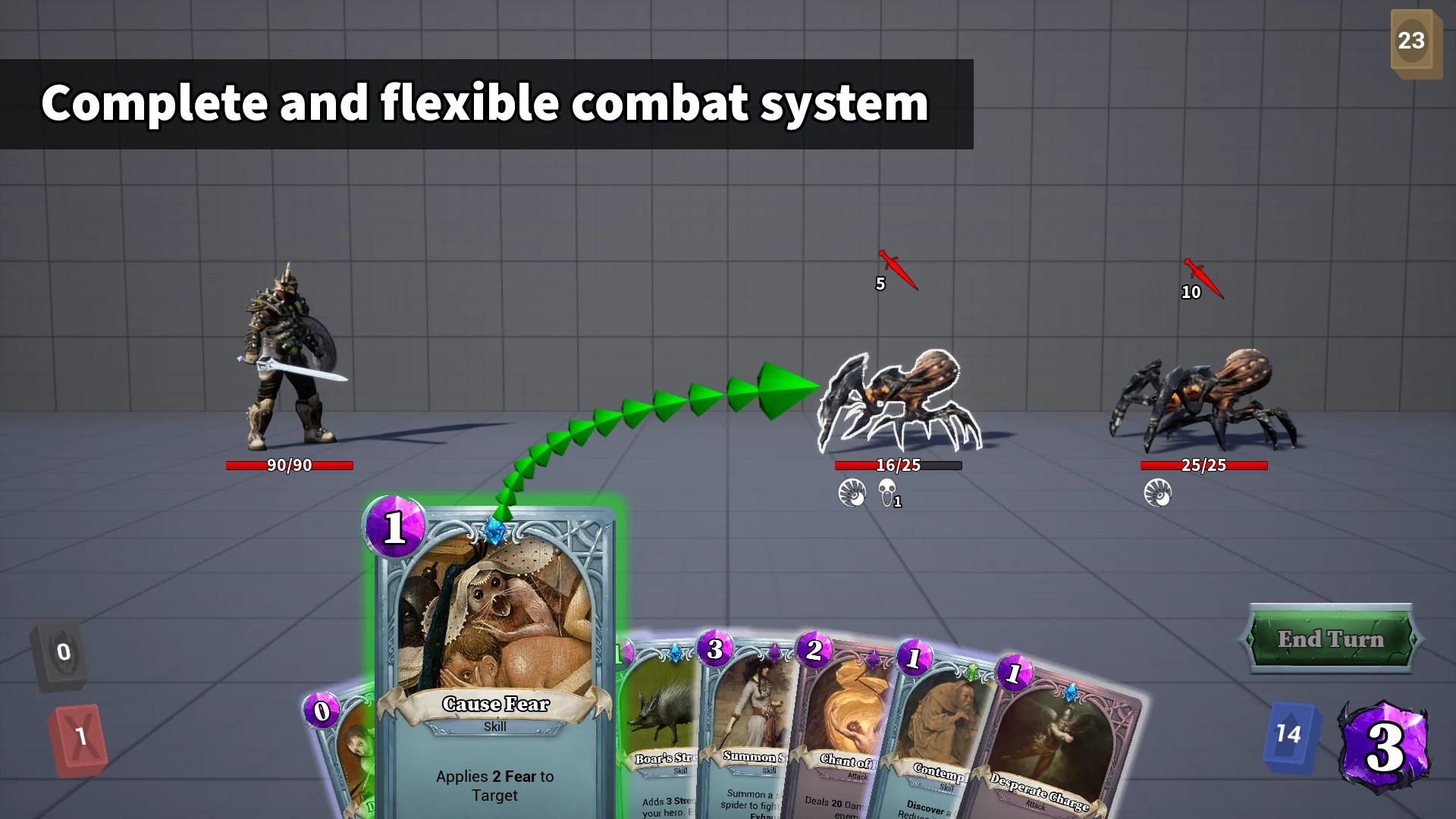
Enemy decision-making during encounters is controlled through a dedicated Attack Pattern Component. By configuring this component, developers specify precisely how AI-controlled minions evaluate available skills, prioritize targets, and queue moves each round. These planned actions surface directly to the player through an enemy intention system integrated within the user interface, reflecting intended strikes, defensive postures, or incoming status modifications before the turn resolves.
The interface ecosystem covers card widgets, real-time status effect indicators, customizable tooltips, and custom card frames. Because status effects and entity statistics update through an underlying event network, the user interface remains responsive to changes during combat sequences, clearly communicating complex rule interactions as they trigger.
Separating Presentation from Logic via the Action Queue
A central technical hurdle in digital card games involves coordinating sequential events—such as damage calculation, visual particle impacts, UI health updates, and conditional card draws—without desynchronizing the visual scene from game states. The framework resolves this by decoupling visuals from underlying logic using an Action Queue system alongside Blueprint composition.
When an ability executes, calculations occur within the logical framework, while corresponding visual actions—such as attacks, status updates, and entity reactions—are queued and processed smoothly in sequence. This separation guarantees that custom skeletal meshes, alternative sprite sets, or stylized interface elements can replace the default example visuals without interfering with numerical calculations or turn progression.
Facilitating these interactions between various Blueprint systems is a custom Event Dispatcher architecture. When an action executes, dispatchers broadcast signals that cards, combatants, UI layers, and passive artifacts can observe and respond to simultaneously. This structure accommodates layered gameplay conditions, such as triggering an artifact's healing effect whenever a specific card category is played, without creating tight dependencies between disparate actors.
Data-Driven Systems Across the Roguelike Campaign
Beyond individual combat engagements, the project supplies full meta-game systems necessary to run a full gameplay session from start to finish. A complete game loop is present out of the box, containing functional saving and loading operations, persistent level transitions, and evaluated win and loss states.
Progression rewards between encounters are regulated by a reward manager. This system handles the distribution of new cards and artifacts according to preconfigured rarity tiers, allowing developers to balance run rewards through defined data entries. Players expand their active decks and passive inventory over the course of an outing, with newly acquired items integrating into the existing combat pools seamlessly.
A broad assortment of pre-built cards, minions, artifacts, and status effects is provided across the asset's data structures. These example assets serve as functional blueprints that demonstrate how to implement unique damage multipliers, defensive shields, periodic effects, and trigger-based passive enhancements within the wider gameplay flow.
Navigation, Shops, and Events on the Node Map
Progression outside of battles centers around an overworld node map system. Positioned between tactical combat stages, this map offers branching pathways that let players determine their route through a given run, deciding between standard encounters, specialized challenges, and recovery opportunities.
The node map currently operates through hand-placed configurations rather than algorithmic procedural generation, giving creators precise control over branch layouts, progression pacing, and milestone placements across the journey. Embedded within this travel grid are dedicated story events and commercial shop nodes, expanding the campaign beyond strictly combat-focused scenarios.
Shop encounters allow players to trade accrued resources for cards, artifacts, and services, whereas story events introduce situational decision points with varying outcomes. By routing these interactions through the framework's data-driven reward and stat pipelines, narrative choices can immediately modify player conditions, bestow items, or alter deck compositions.
Reference Assets and Integration in the Toolkit
To provide working reference material right away, the framework incorporates a variety of functional sample assets across art, animation, and typography. Card visuals feature portraits sourced from public domain classical paintings via Wikimedia Commons, framed inside custom-designed UI borders. Text display leverages the open-source typefaces Source Serif Pro and Source Sans Pro, both governed by the SIL Open Font License.
Three-dimensional combat entities utilize models and animations drawn from Epic Games releases: spider and troll entities originate from Infinity Blade Adversaries, while the player warrior model comes from Infinity Blade Warriors with accompanying combat animations taken from Paragon: Greystone. Explosive visual feedbacks incorporate particle setups adapted from the standard Unreal Engine Starter Content, alongside Creative Commons status icons created by Lorc, Delapouit, and Skoll from game-icons.net.
Because all logic is decoupled from these specific assets, the included character models, particle effects, and icons exist primarily as functioning implementation templates. Teams can retain the core data-driven architecture, AI routines, and UI systems while cleanly substituting in their own 3D models, 2D illustrations, and custom thematic interfaces to fit their creative direction.
 RPG
 RPG
 RPG