"148d1066ed74e216"{"id":"1002947","slug":"xprojectile-multithreaded-ricochet-in-5-8-easy-to-use","title":"XProjectile - Multithreaded | Ricochet in 5.8 \u003e | Easy to use","category":"Engine Tools","engine":"4.27 - 5.4","assetVersion":"Asset Version: 1.0","engineVersion":"Engine Version: 4.27 - 5.4","tag":"Engine Tools","accent":"blue","visual":"mech","summary":"Explore XProjectile for Unreal Engine, featuring multithreaded projectile simulation, configurable physics, attachment support, and ricochets in 5.8+.","platform":"Unreal Engine","indexPolicy":"index","publishedAt":"2026-11-21T23:37:32.896Z","updatedAt":"2026-11-21T23:37:32.896Z","sourceNotes":[],"fileContents":[],"compatibility":["Unreal Engine","Asset Version: 1.0","Engine Version: 4.27 - 5.4"],"featuredImage":{"alt":"XProjectile - Multithreaded | Ricochet in 5.8 \u003e | Easy to use","src":"/wp-content/uploads/published/2026/11/ef40b7db848a-6310ff0a-3636-498d-b14e-205bcf07717b-795d97fe1a.webp"},"fileSizeBytes":381375,"hasDownloadLink":true,"downloads":0,"terms":[{"taxonomy":"category","slug":"engine-tools-tools-and-plugins","name":"Engine Tools"}],"galleryImages":[{"src":"/wp-content/uploads/published/2026/11/16c06d580dd2-5f4da749-5393-4d97-8a3a-6237f8fec73a-66dd0e72ac.webp","alt":"XProjectile - Multithreaded | Ricochet in 5.8 \u003e | Easy to use"},{"src":"/wp-content/uploads/published/2026/11/0a5d4c672d97-a3137c66-f4c6-446c-a501-d5247ca839a5-c803d5afe0.webp","alt":"XProjectile - Multithreaded | Ricochet in 5.8 \u003e | Easy to use"},{"src":"/wp-content/uploads/published/2026/11/3eb482202e67-9e107e03-6108-431c-9220-e4333cd18228-9cf5a58cd3.webp","alt":"XProjectile - Multithreaded | Ricochet in 5.8 \u003e | Easy to use"},{"src":"/wp-content/uploads/published/2026/11/cdfbca87c1ac-7f194f58-6e5f-4ccb-ac56-d7b8da4dbf95-75d97f6d4a.webp","alt":"XProjectile - Multithreaded | Ricochet in 5.8 \u003e | Easy to use"}],"accessPanel":{"kind":"resource","title":"Get this resource","safetyNote":"Resources are manually reviewed before listing to improve quality and reduce obvious risks.","fileName":"XProjectile - Multithreaded Ricochet in 5.8 Easy to use.7z","resourceType":"Resource archive","versions":[]},"contentHtml":"\u003ch2\u003eHandling High-Density Firefights with XProjectile Systems\u003c/h2\u003e\u003cp\u003eLarge-scale combat encounters in Unreal Engine often encounter severe performance bottlenecks when managing hundreds or thousands of individual ballistic entities. Traditional projectile implementations that rely purely on standard game-thread actor ticking can quickly saturate CPU frame budgets, leading to micro-stutters, delayed hit registration, and dropping frame rates. Projects featuring modern combat, anti-aircraft barrages, or high-volume automatic gunfire require a simulation model that treats bullets as lightweight, high-performance physical calculations rather than heavy, bloated scene objects. The XProjectile system tackles this issue directly by supplying an optimized projectile simulation pipeline built from the ground up for maximum execution efficiency.\u003c/p\u003e\u003cp\u003eBy structuring bullet movement around dedicated data processing rather than individual object overhead, developers can stage massive military engagements, chaotic sci-fi skirmishes, and persistent area-denial fire without sacrificing critical game-thread rendering time. The framework is designed to remain easy to use while handling the heavy lifting of trajectory tracking, collision checks, and visual synchronization behind the scenes.\u003c/p\u003e\u003ch2\u003eMultithreaded Trajectory and Ballistic Simulation Mechanics\u003c/h2\u003e\u003cp\u003eThe foundational core of the plugin is its multithreaded architecture. In standard engine workflows, updating hundreds of flying projectiles forces the main thread to compute linear velocities, step physics, trace lines against world geometry, and update transforms sequentially. When the fire rate multiplies across dozens of active combatants, this sequential processing stalls the frame loop. With multithreading, XProjectile shifts these continuous mathematical evaluations across available CPU worker threads, distributing mass calculations, position increments, and ballistic movement evenly across the hardware.\u003c/p\u003e\u003cp\u003eProcessing bullet physics across threads requires precise synchronization with the main game thread to guarantee that visual elements and gameplay-relevant impact events align accurately. The system ensures that background trajectory updates sync smoothly back to the scene, avoiding jitter, frame desynchronization, or missed collision boundaries even when velocities reach extreme speeds. This multithreaded execution keeps the game thread free to process core gameplay logic, artificial intelligence, animation states, and render command generation.\u003c/p\u003e\u003ch2\u003eConfiguring Physics, Collision Channels, and Cosmetic Attachments\u003c/h2\u003e\u003cp\u003eFine-tuning the physical properties of a projectile is handled through a clear set of core parameters, allowing teams to mimic anything from low-velocity artillery shells to hyper-fast kinetic rounds. Speed settings dictate how rapidly the projectile traverses the environment over time, giving full control over weapon profiles and projectile travel delay. Paired directly with speed is configurable gravity, which introduces realistic ballistic drop across distance. By increasing or decreasing the gravity value, developers can author flat, laser-like trajectories, standard bullet arcs, or exaggerated, high-angle mortar trajectories that plunge downward onto distant targets.\u003c/p\u003e\u003cp\u003eAccurate hit detection depends on clean collision channel management. The plugin lets designers specify exact collision channels for projectile traces, ensuring that rounds interact strictly with intended surface types, environmental geometry, and character hitboxes. This targeted filtering prevents bullets from colliding prematurely with player weapon barrels, allied pawns, or non-blocking atmospheric triggers, streamlining trace queries so the underlying multithreaded loop only checks against relevant world components.\u003c/p\u003e\u003cp\u003eBeyond pure mathematical simulation, combat requires rich visual and acoustic feedback. The package supports attaching an array of secondary elements directly to the simulated projectile:\u003c/p\u003e\u003cul\u003e\u003cli\u003e\u003cstrong\u003eActors:\u003c/strong\u003e Attach complete gameplay actors to carry sub-logic, custom interaction triggers, or nested components along the flight path.\u003c/li\u003e\u003cli\u003e\u003cstrong\u003eMeshes:\u003c/strong\u003e Bind static or skeletal geometry directly to the simulated point to render physical bullet casings, high-caliber shells, arrows, or warheads.\u003c/li\u003e\u003cli\u003e\u003cstrong\u003eParticles:\u003c/strong\u003e Connect cascade or particle emitters to generate dynamic smoke plumes, burning tracer ribbons, spark trails, or energy contrails.\u003c/li\u003e\u003cli\u003e\u003cstrong\u003eSounds:\u003c/strong\u003e Link audio components to play spatialized flyby audio, atmospheric whistling, or distinct buzzing effects as projectiles sweep past nearby cameras.\u003c/li\u003e\u003c/ul\u003e\u003cp\u003eThese modular attachments ensure that visual flair and auditory punch can be layered onto the lightweight physical simulation without breaking the performance advantages of the background threading model.\u003c/p\u003e\u003ch2\u003eXProjectile Ricochet Implementation across Unreal Engine Versions\u003c/h2\u003e\u003cp\u003eDeflection mechanics introduce tactical depth to projectile physics, converting flat impacts into unpredictable angular bounces across hard surfaces. Starting in Unreal Engine 5.8 and higher, the system integrates a dedicated ricochet framework. When high-speed rounds strike angled surfaces, glancing blows do not merely register terminal impacts; instead, the calculation determines the reflection angle and continues the projectile's trajectory along a secondary vector.\u003c/p\u003e\u003cp\u003eThis ricochet capability transforms indoor gunfights, tight urban corridors, and armored vehicle combat, making suppression fire, accidental friendly fire, and angled trick shots an organic part of the combat sandbox. The physics calculation adjusts based on surface interactions, carrying the projectile forward through multiple bounces until its speed dissipates or it hits a terminal collision. While earlier engine versions spanning from 4.26 through 5.7 provide the core multithreaded projectile simulation, speed modulation, and attachment framework, version 5.8 and above pushes dynamic ballistic realism further with this native ricochet pipeline.\u003c/p\u003e\u003ch2\u003eTarget Workflows and Production Environments\u003c/h2\u003e\u003cp\u003eDevelopment teams building fast-paced first-person shooters, third-person tactical games, vehicle-based combat arenas, and top-down bullet hell titles will benefit most from this setup. Building custom multithreaded bullet management from scratch involves writing complex C++ thread pools, lock-free queues, and custom collision sync solutions that are prone to race conditions and engine version deprecation. By deploying a pre-built, multithreaded structure that handles gravity, speed, traces, and visual attachments out of the box, developers eliminate weeks of low-level physics optimization.\u003c/p\u003e\u003cp\u003eWhether a project demands hundreds of glowing tracers filling the night sky during a base defense assault or a few precisely calibrated sniper bullets dropping over kilometers of open terrain, the tool scales effortlessly. Its ability to marry deep physical customization with minimal CPU overhead makes it an essential asset for any production striving for both high fidelity ballistics and stable frame rates.\u003c/p\u003e\n\n\u003ch2\u003eContinue Browsing Similar Packs\u003c/h2\u003e\n\u003cul\u003e\n\u003cli\u003e\u003ca href=\"https://3dcghub.com/advanced-flock-system-multithreaded-fish-ai-and-reactive-school-behavior/\" rel=\"noopener noreferrer\"\u003eAdvanced Flock System – Multithreaded Fish AI and Reactive School Behavior\u003c/a\u003e\u003c/li\u003e\n\u003cli\u003e\u003ca href=\"https://3dcghub.com/combo-graph/\" rel=\"noopener noreferrer\"\u003eCombo Graph\u003c/a\u003e\u003c/li\u003e\n\u003cli\u003e\u003ca href=\"https://3dcghub.com/eduquill-for-unreal-engine/\" rel=\"noopener noreferrer\"\u003eEduQuill for Unreal Engine – Safe Imports and Project Health Toolkit (UE 5.4–5.8)\u003c/a\u003e\u003c/li\u003e\n\u003cli\u003e\u003ca href=\"https://3dcghub.com/runtime-speech-recognizer-real-time-offline-ai/\" rel=\"noopener noreferrer\"\u003eRuntime Speech Recognizer (Real-Time, Offline, AI)\u003c/a\u003e\u003c/li\u003e\n\u003cli\u003e\u003ca href=\"https://3dcghub.com/blueprint-assist/\" rel=\"noopener noreferrer\"\u003eBlueprint Assist\u003c/a\u003e\u003c/li\u003e\n\u003c/ul\u003e","contentTextLength":7275,"navigation":{"current":25,"total":4890,"previous":{"id":"1002948","slug":"roguelike-deckbuilder-toolkit","title":"Roguelike Deckbuilder Toolkit","category":"RPG","platform":"Unreal Engine","updatedAt":"2026-11-22T06:25:32.636Z"},"next":{"id":"1002946","slug":"wall-hiding-system","title":"Wall Hiding System","category":"Gameplay Features","platform":"Unreal Engine","updatedAt":"2026-11-21T23:35:05.525Z"}},"relatedResources":[{"id":"14974","slug":"advanced-flock-system-multithreaded-fish-ai-and-reactive-school-behavior","title":"Advanced Flock System – Multithreaded Fish AI and Reactive School Behavior","category":"Gameplay Features","engine":"4.25-5.8","assetVersion":"v1.3-v1.3.8","engineVersion":"4.25-5.8","tag":"Gameplay Features","accent":"blue","visual":"character","summary":"Create realistic aquatic ecosystems with the Advanced Flock System. This multithreaded tool supports thousands of fish with reactive AI and obstacle avoidance.","platform":"Unreal Engine","indexPolicy":"noindex","publishedAt":"2026-03-12T07:12:35.000Z","updatedAt":"2026-11-14T10:16:42.307Z","sourceNotes":[],"fileContents":[],"compatibility":["Unreal Engine","Asset Version: v1.3-v1.3.8","Engine version: 4.25-5.8"],"featuredImage":{"alt":"Advanced Flock System – Multithreaded Fish AI and Reactive School Behavior","src":"https://3dcghub.com/wp-content/uploads/2026/03/9e2ee2df-b190-425e-bfdd-816e1f1cb4f1.webp"},"fileSizeBytes":355061880,"hasDownloadLink":true,"downloads":0},{"id":"13825","slug":"combo-graph","title":"Combo Graph","category":"Engine Tools","engine":"5.1 - 5.8","assetVersion":"Asset Version:1.4.0 - 1.6.1","engineVersion":"Engine version: 5.1 - 5.8","tag":"Engine Tools","accent":"blue","visual":"luts","summary":"Streamline your combat design with Combo Graph, a GAS-based Unreal Engine plugin. Use its node-based editor to create complex melee strings with multiplayer support and rapid prototyping tools.","platform":"Unreal Engine","indexPolicy":"noindex","publishedAt":"2026-03-11T10:10:59.000Z","updatedAt":"2026-08-24T05:32:39.634Z","sourceNotes":[],"fileContents":[],"compatibility":["Unreal Engine","Asset Version:1.4.0 - 1.6.1","Engine version: 5.1 - 5.8"],"featuredImage":{"alt":"Combo Graph","src":"https://3dcghub.com/wp-content/uploads/2026/03/11f09f07-e4bd-4cc8-9924-40b122bd6f3a.webp"},"fileSizeBytes":412158672,"hasDownloadLink":true,"downloads":2},{"id":"1002285","slug":"eduquill-for-unreal-engine","title":"EduQuill for Unreal Engine – Safe Imports and Project Health Toolkit (UE 5.4–5.8)","category":"Engine Tools","engine":"UE 5.4–5.8","assetVersion":"1.2.11","engineVersion":"UE 5.4–5.8","tag":"Engine Tools","accent":"blue","visual":"mech","summary":"EduQuill for Unreal Engine: reviewed imports and project health checks across UE 5.4–5.8 on Windows x64, plus no-login CC0 direct transfer and curated 3DCGHUB free/Pro sync.","platform":"Unreal Engine","indexPolicy":"noindex","publishedAt":"2026-11-03T16:15:25.353Z","updatedAt":"2026-11-18T19:00:44.375Z","sourceNotes":[],"fileContents":[],"compatibility":["Unreal Engine","Engine versions: 5.4–5.8","Windows x64","Service: 3DCGHUB"],"featuredImage":{"alt":"Project Doctor: findings with the reason, impact and a preview of each fix","src":"/wp-content/uploads/published/2026/11/4-project-doctor-caaffab62c.png"},"hasDownloadLink":false,"downloads":0}]}[{"id":4225,"sourceId":4225,"taxonomyId":4225,"taxonomy":"category","slug":"asset-library","name":"Asset Library","parentId":null,"count":4744,"hasChildren":true,"href":"/","seoTitle":"Free Game Assets Library | 3DCGHUB","seoDescription":"Browse free Unreal Engine, Unity, Blender assets and game development tutorials on 3DCGHUB with previews, compatibility notes, and secure downloads.","sitemapEnabled":true,"children":[{"id":4227,"sourceId":4227,"taxonomyId":4227,"taxonomy":"category","slug":"blender-add-ons-plugins","name":"Blender Add-ons \u0026 Plugins","parentId":4225,"count":10,"hasChildren":false,"href":"/category/blender-add-ons-plugins/","seoTitle":"Free Blender Add-ons \u0026 Plugins | 3DCGHUB","seoDescription":"Browse free Blender Add-ons \u0026 Plugins tools for Blender on 3DCGHUB: curated downloads with preview images, compatibility notes and secure download access.","sitemapEnabled":true},{"id":514,"sourceId":514,"taxonomyId":514,"taxonomy":"category","slug":"unity-2","name":"Unity","parentId":4225,"count":453,"hasChildren":true,"href":"/category/unity-2/","seoTitle":"Free Unity Assets | 3DCGHUB","seoDescription":"Browse free Unity resources on 3DCGHUB: curated downloads with preview images, compatibility notes and secure download access.","sitemapEnabled":true,"children":[{"id":523,"sourceId":523,"taxonomyId":523,"taxonomy":"category","slug":"2d","name":"2D","parentId":514,"count":1,"hasChildren":true,"href":"/category/2d/","seoTitle":"Free Unity 2D | 3DCGHUB","seoDescription":"Browse free 2D assets for Unity on 3DCGHUB: curated downloads with preview images, compatibility notes and secure download access.","sitemapEnabled":true},{"id":515,"sourceId":515,"taxonomyId":515,"taxonomy":"category","slug":"3d-unity-2","name":"3D","parentId":514,"count":162,"hasChildren":true,"href":"/category/3d-unity-2/","seoTitle":"Free Unity 3D Assets | 3DCGHUB","seoDescription":"Browse free 3D assets for Unity on 3DCGHUB: curated downloads with preview images, compatibility notes and secure download access.","sitemapEnabled":true},{"id":565,"sourceId":565,"taxonomyId":565,"taxonomy":"category","slug":"add-ons","name":"Add-Ons","parentId":514,"count":2,"hasChildren":false,"href":"/category/add-ons/","seoTitle":"Free Unity Add-Ons | 3DCGHUB","seoDescription":"Browse free Add-Ons assets for Unity on 3DCGHUB: curated downloads with preview images, compatibility notes and secure download access.","sitemapEnabled":true},{"id":529,"sourceId":529,"taxonomyId":529,"taxonomy":"category","slug":"audio-unity-2","name":"Audio","parentId":514,"count":1,"hasChildren":true,"href":"/category/audio-unity-2/","seoTitle":"Free Unity Audio | 3DCGHUB","seoDescription":"Browse free Audio for Unity on 3DCGHUB: curated downloads with preview images, compatibility notes and secure download access.","sitemapEnabled":true},{"id":557,"sourceId":557,"taxonomyId":557,"taxonomy":"category","slug":"templates","name":"Templates","parentId":514,"count":36,"hasChildren":true,"href":"/category/templates/","seoTitle":"Free Unity Templates | 3DCGHUB","seoDescription":"Browse free Unity project templates on 3DCGHUB. Starter kits with previews, compatibility notes, and secure download access.","sitemapEnabled":true},{"id":533,"sourceId":533,"taxonomyId":533,"taxonomy":"category","slug":"tools-unity-2","name":"Tools","parentId":514,"count":0,"hasChildren":true,"href":"/category/tools-unity-2/","sitemapEnabled":true},{"id":554,"sourceId":554,"taxonomyId":554,"taxonomy":"category","slug":"vfx-unity-2","name":"VFX","parentId":514,"count":4,"hasChildren":true,"href":"/category/vfx-unity-2/","seoTitle":"Free Unity VFX | 3DCGHUB","seoDescription":"Browse free VFX for Unity on 3DCGHUB: curated downloads with preview images, compatibility notes and secure download access.","sitemapEnabled":true}]},{"id":511,"sourceId":511,"taxonomyId":511,"taxonomy":"category","slug":"unreal-engine-2","name":"Unreal Engine","parentId":4225,"count":4282,"hasChildren":true,"href":"/category/unreal-engine-2/","seoTitle":"Free Unreal Engine Assets | 3DCGHUB","seoDescription":"Browse free Unreal Engine resources on 3DCGHUB: curated downloads with preview images, compatibility notes and secure download access.","sitemapEnabled":true,"children":[{"id":54,"sourceId":54,"taxonomyId":54,"taxonomy":"category","slug":"3d","name":"3D","parentId":511,"count":2428,"hasChildren":true,"href":"/category/3d/","seoTitle":"Free Unreal Engine 3D | 3DCGHUB","seoDescription":"Browse free 3D assets for Unreal Engine on 3DCGHUB: curated downloads with preview images, compatibility notes and secure download access.","sitemapEnabled":true},{"id":441,"sourceId":441,"taxonomyId":441,"taxonomy":"category","slug":"animations","name":"Animations","parentId":511,"count":245,"hasChildren":true,"href":"/category/animations/","seoTitle":"Free Unreal Engine Animations | 3DCGHUB","seoDescription":"Browse free Animations for Unreal Engine on 3DCGHUB: curated downloads with preview images, compatibility notes and secure download access.","sitemapEnabled":true},{"id":446,"sourceId":446,"taxonomyId":446,"taxonomy":"category","slug":"audio","name":"Audio","parentId":511,"count":63,"hasChildren":true,"href":"/category/audio/","seoTitle":"Free Unreal Engine Audio Resources | 3DCGHUB","seoDescription":"Browse free Unreal Engine audio resources including sound effects, voices, dialogue, and ambient sounds. Curated free downloads on 3DCGHUB.","sitemapEnabled":true},{"id":466,"sourceId":466,"taxonomyId":466,"taxonomy":"category","slug":"game-systems","name":"Game Systems","parentId":511,"count":356,"hasChildren":true,"href":"/category/game-systems/","seoTitle":"Free Unreal Engine Game Systems | 3DCGHUB","seoDescription":"Browse free Game Systems tools for Unreal Engine on 3DCGHUB: curated downloads with preview images, compatibility notes and secure download access.","sitemapEnabled":true},{"id":478,"sourceId":478,"taxonomyId":478,"taxonomy":"category","slug":"game-templates","name":"Game Templates","parentId":511,"count":150,"hasChildren":true,"href":"/category/game-templates/","seoTitle":"Free Unreal Engine Game Templates | 3DCGHUB","seoDescription":"Browse free Game Templates for Unreal Engine on 3DCGHUB: curated downloads with preview images, compatibility notes and secure download access.","sitemapEnabled":true},{"id":432,"sourceId":432,"taxonomyId":432,"taxonomy":"category","slug":"hdri","name":"HDRI","parentId":511,"count":6,"hasChildren":true,"href":"/category/hdri/","seoTitle":"Free Unreal Engine HDRI | 3DCGHUB","seoDescription":"Browse free Unreal Engine HDRI skies and lighting maps on 3DCGHUB. Environment lighting with previews and secure downloads.","sitemapEnabled":true},{"id":228,"sourceId":228,"taxonomyId":228,"taxonomy":"category","slug":"material-and-textures","name":"Material \u0026 Textures","parentId":511,"count":172,"hasChildren":true,"href":"/category/material-and-textures/","seoTitle":"Free Unreal Engine Material \u0026 Textures | 3DCGHUB","seoDescription":"Browse free Material \u0026 Textures for Unreal Engine on 3DCGHUB: curated downloads with preview images, compatibility notes and secure download access.","sitemapEnabled":true},{"id":298,"sourceId":298,"taxonomyId":298,"taxonomy":"category","slug":"sprites-and-flipbooks","name":"Sprites \u0026 Flipbooks","parentId":511,"count":17,"hasChildren":true,"href":"/category/sprites-and-flipbooks/","seoTitle":"Free Unreal Engine Sprites \u0026 Flipbooks | 3DCGHUB","seoDescription":"Browse free Sprites \u0026 Flipbooks assets for Unreal Engine on 3DCGHUB: curated downloads with preview images, compatibility notes and secure download access.","sitemapEnabled":true},{"id":489,"sourceId":489,"taxonomyId":489,"taxonomy":"category","slug":"tools-and-plugins","name":"Tools \u0026 Plugins","parentId":511,"count":390,"hasChildren":true,"href":"/category/tools-and-plugins/","seoTitle":"Free Unreal Engine Tools \u0026 Plugins | 3DCGHUB","seoDescription":"Browse free Tools \u0026 Plugins for Unreal Engine on 3DCGHUB: curated downloads with preview images, compatibility notes and secure download access.","sitemapEnabled":true},{"id":459,"sourceId":459,"taxonomyId":459,"taxonomy":"category","slug":"ui","name":"UI","parentId":511,"count":43,"hasChildren":true,"href":"/category/ui/","seoTitle":"Free Unreal Engine UI | 3DCGHUB","seoDescription":"Browse free UI for Unreal Engine on 3DCGHUB: curated downloads with preview images, compatibility notes and secure download access.","sitemapEnabled":true},{"id":450,"sourceId":450,"taxonomyId":450,"taxonomy":"category","slug":"vfx","name":"VFX","parentId":511,"count":412,"hasChildren":true,"href":"/category/vfx/","seoTitle":"Free Unreal Engine VFX | 3DCGHUB","seoDescription":"Browse free VFX for Unreal Engine on 3DCGHUB: curated downloads with preview images, compatibility notes and secure download access.","sitemapEnabled":true}]}]},{"id":4222,"sourceId":4222,"taxonomyId":4222,"taxonomy":"category","slug":"tutorial-library","name":"Tutorial Library","parentId":null,"count":117,"hasChildren":false,"href":"/tutorials/","seoTitle":"Free Game Development Tutorial Library | 3DCGHUB","seoDescription":"Browse free game development tutorials for Unreal Engine, Unity, Blender, and more on 3DCGHUB with practical workflows and secure downloads.","sitemapEnabled":true}]
Resource screenshots
1 / 4
Join our channel
Follow 3DCGHUB on Telegram for new resource drops, migration updates, and community notices.
Handling High-Density Firefights with XProjectile Systems
Large-scale combat encounters in Unreal Engine often encounter severe performance bottlenecks when managing hundreds or thousands of individual ballistic entities. Traditional projectile implementations that rely purely on standard game-thread actor ticking can quickly saturate CPU frame budgets, leading to micro-stutters, delayed hit registration, and dropping frame rates. Projects featuring modern combat, anti-aircraft barrages, or high-volume automatic gunfire require a simulation model that treats bullets as lightweight, high-performance physical calculations rather than heavy, bloated scene objects. The XProjectile system tackles this issue directly by supplying an optimized projectile simulation pipeline built from the ground up for maximum execution efficiency.
By structuring bullet movement around dedicated data processing rather than individual object overhead, developers can stage massive military engagements, chaotic sci-fi skirmishes, and persistent area-denial fire without sacrificing critical game-thread rendering time. The framework is designed to remain easy to use while handling the heavy lifting of trajectory tracking, collision checks, and visual synchronization behind the scenes.
Multithreaded Trajectory and Ballistic Simulation Mechanics
The foundational core of the plugin is its multithreaded architecture. In standard engine workflows, updating hundreds of flying projectiles forces the main thread to compute linear velocities, step physics, trace lines against world geometry, and update transforms sequentially. When the fire rate multiplies across dozens of active combatants, this sequential processing stalls the frame loop. With multithreading, XProjectile shifts these continuous mathematical evaluations across available CPU worker threads, distributing mass calculations, position increments, and ballistic movement evenly across the hardware.
Processing bullet physics across threads requires precise synchronization with the main game thread to guarantee that visual elements and gameplay-relevant impact events align accurately. The system ensures that background trajectory updates sync smoothly back to the scene, avoiding jitter, frame desynchronization, or missed collision boundaries even when velocities reach extreme speeds. This multithreaded execution keeps the game thread free to process core gameplay logic, artificial intelligence, animation states, and render command generation.
Configuring Physics, Collision Channels, and Cosmetic Attachments
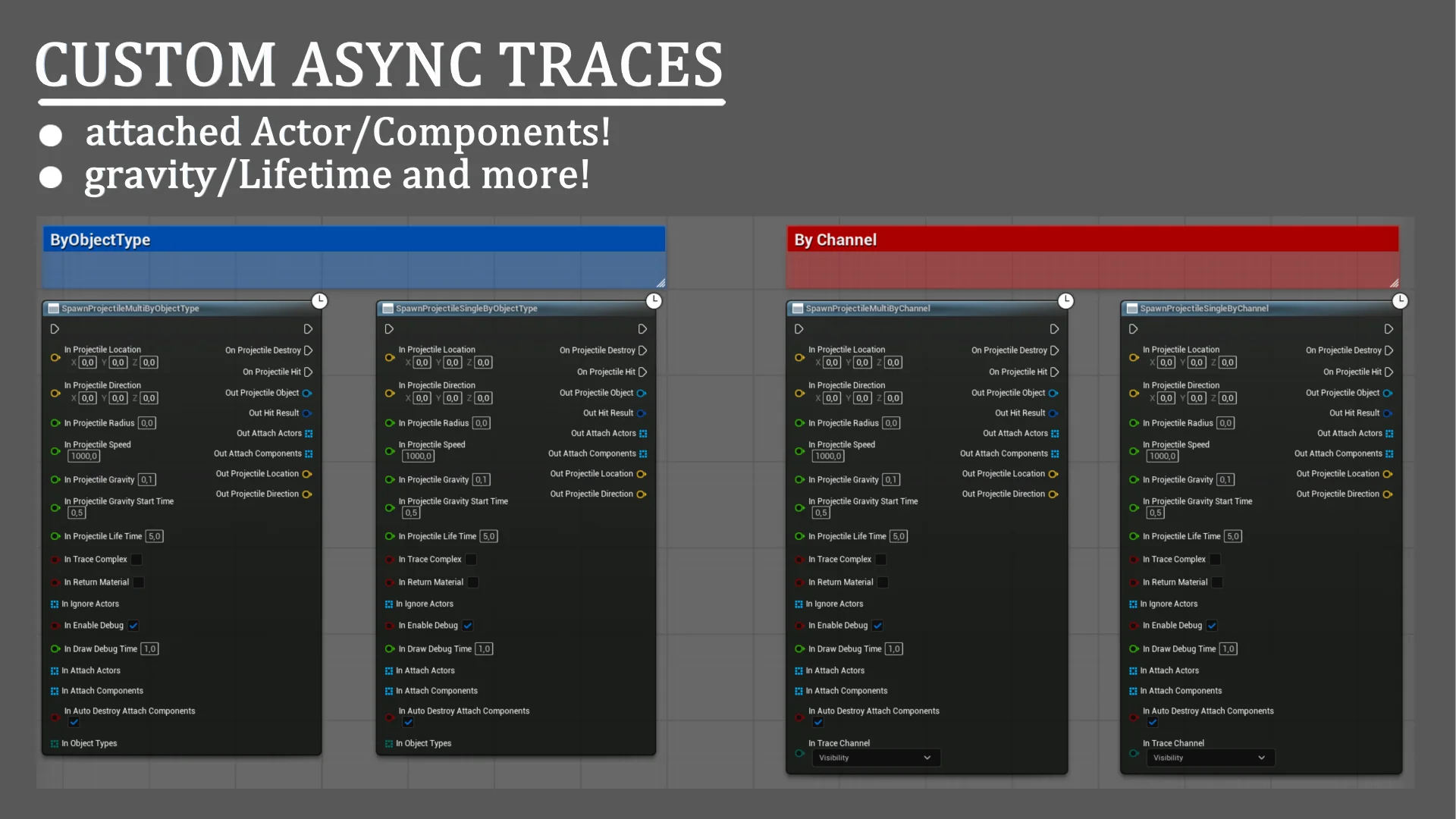
Fine-tuning the physical properties of a projectile is handled through a clear set of core parameters, allowing teams to mimic anything from low-velocity artillery shells to hyper-fast kinetic rounds. Speed settings dictate how rapidly the projectile traverses the environment over time, giving full control over weapon profiles and projectile travel delay. Paired directly with speed is configurable gravity, which introduces realistic ballistic drop across distance. By increasing or decreasing the gravity value, developers can author flat, laser-like trajectories, standard bullet arcs, or exaggerated, high-angle mortar trajectories that plunge downward onto distant targets.
Accurate hit detection depends on clean collision channel management. The plugin lets designers specify exact collision channels for projectile traces, ensuring that rounds interact strictly with intended surface types, environmental geometry, and character hitboxes. This targeted filtering prevents bullets from colliding prematurely with player weapon barrels, allied pawns, or non-blocking atmospheric triggers, streamlining trace queries so the underlying multithreaded loop only checks against relevant world components.
Beyond pure mathematical simulation, combat requires rich visual and acoustic feedback. The package supports attaching an array of secondary elements directly to the simulated projectile:
Actors: Attach complete gameplay actors to carry sub-logic, custom interaction triggers, or nested components along the flight path.
Meshes: Bind static or skeletal geometry directly to the simulated point to render physical bullet casings, high-caliber shells, arrows, or warheads.
Particles: Connect cascade or particle emitters to generate dynamic smoke plumes, burning tracer ribbons, spark trails, or energy contrails.
Sounds: Link audio components to play spatialized flyby audio, atmospheric whistling, or distinct buzzing effects as projectiles sweep past nearby cameras.
These modular attachments ensure that visual flair and auditory punch can be layered onto the lightweight physical simulation without breaking the performance advantages of the background threading model.
XProjectile Ricochet Implementation across Unreal Engine Versions
Deflection mechanics introduce tactical depth to projectile physics, converting flat impacts into unpredictable angular bounces across hard surfaces. Starting in Unreal Engine 5.8 and higher, the system integrates a dedicated ricochet framework. When high-speed rounds strike angled surfaces, glancing blows do not merely register terminal impacts; instead, the calculation determines the reflection angle and continues the projectile's trajectory along a secondary vector.
This ricochet capability transforms indoor gunfights, tight urban corridors, and armored vehicle combat, making suppression fire, accidental friendly fire, and angled trick shots an organic part of the combat sandbox. The physics calculation adjusts based on surface interactions, carrying the projectile forward through multiple bounces until its speed dissipates or it hits a terminal collision. While earlier engine versions spanning from 4.26 through 5.7 provide the core multithreaded projectile simulation, speed modulation, and attachment framework, version 5.8 and above pushes dynamic ballistic realism further with this native ricochet pipeline.
Target Workflows and Production Environments
Development teams building fast-paced first-person shooters, third-person tactical games, vehicle-based combat arenas, and top-down bullet hell titles will benefit most from this setup. Building custom multithreaded bullet management from scratch involves writing complex C++ thread pools, lock-free queues, and custom collision sync solutions that are prone to race conditions and engine version deprecation. By deploying a pre-built, multithreaded structure that handles gravity, speed, traces, and visual attachments out of the box, developers eliminate weeks of low-level physics optimization.
Whether a project demands hundreds of glowing tracers filling the night sky during a base defense assault or a few precisely calibrated sniper bullets dropping over kilometers of open terrain, the tool scales effortlessly. Its ability to marry deep physical customization with minimal CPU overhead makes it an essential asset for any production striving for both high fidelity ballistics and stable frame rates.
 Gameplay Features
 Engine Tools
 Engine Tools