"1a0e4ac4dc71d030"{"id":"1001252","slug":"survivors-roguelike-multiplayer-game-template","title":"Survivors Roguelike - Multiplayer Game Template","category":"RPG","engine":"5.0+","assetVersion":"","engineVersion":"Engine Version: 5.0+","tag":"RPG","accent":"blue","visual":"mech","summary":"Build networked horde survival games with the Survivors Roguelike Multiplayer Game Template, featuring 100% blueprints, data tables, and lobby systems.","platform":"Unreal Engine","publishedAt":"2026-09-23T15:37:57.602Z","updatedAt":"2026-09-23T15:37:57.602Z","sourceNotes":[],"fileContents":[],"compatibility":["Unreal Engine","Engine Version: 5.0+"],"featuredImage":{"alt":"Survivors Roguelike - Multiplayer Game Template","src":"/wp-content/uploads/published/2026/09/b27123471922-984e7958-ec14-445f-a005-f0e4869053db-d656264a1b.webp"},"hasDownloadLink":true,"downloads":0,"terms":[{"taxonomy":"category","slug":"rpg","name":"RPG"}],"galleryImages":[{"src":"/wp-content/uploads/published/2026/09/dd30452e71e0-103d0a55-2818-4d20-8c13-1fad3930bfcc-a8e4ba0a82.webp","alt":"Survivors Roguelike - Multiplayer Game Template"},{"src":"/wp-content/uploads/published/2026/09/65dd3a45039c-019681fd-4a25-4b7b-b7f6-73cbf7992730-92451e9004.webp","alt":"Survivors Roguelike - Multiplayer Game Template"},{"src":"/wp-content/uploads/published/2026/09/967a7fc411d3-b11d5ebf-8c79-4f87-9b56-48a3b0030912-a44a49c5ad.webp","alt":"Survivors Roguelike - Multiplayer Game Template"},{"src":"/wp-content/uploads/published/2026/09/56bc65cb12ec-0c19d503-52a8-4a80-b66b-59880a2f0006-3ecd5536bc.webp","alt":"Survivors Roguelike - Multiplayer Game Template"},{"src":"/wp-content/uploads/published/2026/09/1deff90c3ee4-f93544ba-6d0f-4a56-be6f-02f24255160e-c615781c44.webp","alt":"Survivors Roguelike - Multiplayer Game Template"},{"src":"/wp-content/uploads/published/2026/09/f9ef61f1b82f-56be0ee3-01c6-40b2-b2c0-54e14b07b0dc-8489dcd9a9.webp","alt":"Survivors Roguelike - Multiplayer Game Template"}],"accessPanel":{"kind":"resource","title":"Download this resource","eyebrow":"Free Download","message":"Log in or create a free account to start your download.","fileName":"Content.7z","safetyNote":"Resources are manually reviewed before listing to improve quality and reduce obvious risks.","actionLabel":"Download Free","resourceType":"Resource archive"},"contentHtml":"\u003cp\u003eA swarm of hostile actors moves toward the player characters while automated projectile bursts and area-of-effect abilities trigger at metered intervals. In a survivors-style roguelike, the game loop demands constant synchronization: enemies must spawn in precise pacing, collision volumes must resolve rapidly, experience gains must feed into a continuous level-up pipeline, and upgrade choices must alter player stats instantly. The Survivors Roguelike Multiplayer Game Template organizes these interlocked mechanics into a structured, fully visual architecture built entirely in Blueprints.\u003c/p\u003e \u003ch2\u003eBlueprint Architecture for Horde Survival and Progression\u003c/h2\u003e\n\u003cp\u003eDeveloping roguelike combat systems often involves juggling heavy actor updates with rapid ability sequencing. Because this template is authored using 100% Blueprints, every system is exposed directly in the visual node graph, eliminating the need to transition back and forth into C++ when iterating on core logic. Developers can trace logic paths straight from the player input and collision triggers into the underlying framework components.\u003c/p\u003e\n\u003cp\u003eThe core gameplay loop centers on three coordinated sub-systems:\u003c/p\u003e\n\u003cul\u003e \u003cli\u003e\u003cstrong\u003eThe Spawning System:\u003c/strong\u003e Governs how waves materialize around players, controlling target densities and managing wave cadence to maintain sustained combat pressure throughout a run.\u003c/li\u003e \u003cli\u003e\u003cstrong\u003eThe Ability System:\u003c/strong\u003e Executes active and passive combat skills, dictating how attacks deploy, calculate impact areas, and deliver dynamic effects against incoming groups.\u003c/li\u003e \u003cli\u003e\u003cstrong\u003eThe Level Up System:\u003c/strong\u003e Intercepts player progress during combat, recalculating thresholds and triggering upgrade interfaces so participants can branch their characters into distinct operational builds.\u003c/li\u003e\n\u003c/ul\u003e\n\u003cp\u003eBecause the logic is contained completely within Blueprint graphs, inspecting how abilities fire or how enemy waves escalate requires no specialized toolsets beyond the standard engine editor. Nodes pass execution lines from spawner timers to actor pools, allowing studios to modify enemy behaviors, adjust cooldown patterns, or rewrite targeting logic directly inside the asset graphs.\u003c/p\u003e \u003ch2\u003eConfiguring Upgrades and Item Scaling Through Data Tables\u003c/h2\u003e\n\u003cp\u003eRoguelike balancing is an exercise in constant mathematical tuning. Hard-coding variables into individual blueprints quickly leads to brittle balance workflows, especially when dozens of weapon behaviors, damage increments, and health pools need frequent adjustments. The template bypasses this friction by delegating numeric controls, item definitions, and system parameters to native data tables.\u003c/p\u003e\n\u003cp\u003eData tables act as the central ledger for the entire project. When designing a new character upgrade or tweaking an active skill, developers do not need to rewrite actor blueprints or rewire graph logic. Modifying base values, tier progressions, and scaling factors occurs within the tabular rows. This separation allows team members focused on game balancing to adjust projectile counts, area radiuses, and unlock criteria without risking breakages in the core Blueprint execution flow.\u003c/p\u003e\n\u003cp\u003eAdding new gear follows the same pipeline. If a project requires introducing an unconventional weapon type, the item definition can be registered directly inside the corresponding data structure. The underlying ability and inventory systems reference these rows to assign the appropriate stats, visual identifiers, and firing behaviors during active gameplay sessions.\u003c/p\u003e \u003ch2\u003eManaging Sessions with the Built-In Multiplayer Lobby\u003c/h2\u003e\n\u003cp\u003eAction-roguelikes in the survivors subgenre historically focused on solo play, but networked multiplayer alters how matches must be prepared and executed. Coordinating multiple players against relentless enemy waves requires robust pre-game organization. The template incorporates a dedicated, built-in multiplayer lobby system to manage the complete lifecycle of a play session before the map ever loads.\u003c/p\u003e\n\u003cp\u003eThe lobby facilitates clean matchmaking and team formation. Players can host sessions, set up matches, and invite friends directly into their lobby environment. From this shared staging area, the host can monitor readiness before launching all connected peers into the match instance together. By solving party formation and player staging within the template itself, teams do not have to assemble separate session-management networks from scratch just to test multiplayer combat.\u003c/p\u003e\n\u003cp\u003eOnce inside a match, the networked foundation maintains consistency across all participants. Experience gains, ability activations, and enemy wave events synchronize across the session, ensuring that all players experience the same escalation curve as the run intensifies.\u003c/p\u003e \u003ch2\u003eFrom Rift Loopers Foundation to Demo Asset Composition\u003c/h2\u003e\n\u003cp\u003eA template is most practical when its structural design has already survived production constraints. The underlying architecture of this template served as the foundation for the commercial release \u003cem\u003eRift Loopers\u003c/em\u003e, proving that its data management and Blueprint networks can scale to meet the functional requirements of a fully published title.\u003c/p\u003e\n\u003cp\u003eTo enable immediate testing and rapid prototyping right out of the box, the template is assembled with functional demonstration content. Developers can dive into a complete slice of gameplay without having to supply their own art and audio immediately. The origin of these demonstration elements is straightforward:\u003c/p\u003e\n\u003cul\u003e \u003cli\u003e\u003cstrong\u003eAbility Icons:\u003c/strong\u003e Provided courtesy of game-icons.net under the Creative Commons Attribution 3.0 (CC BY 3.0) license, incorporated without changes.\u003c/li\u003e \u003cli\u003e\u003cstrong\u003e3D Models, Meshes, and Textures:\u003c/strong\u003e Sourced from Epic Games free content to populate characters and environment elements during testing.\u003c/li\u003e \u003cli\u003e\u003cstrong\u003eVisual Effects, Animations, and Audio:\u003c/strong\u003e Derived from Epic Games free content to provide complete visual feedback and sonic impact across every weapon blast and enemy elimination.\u003c/li\u003e\n\u003c/ul\u003e\n\u003cp\u003eHaving functional art, sound, and visual indicators pre-wired into the Blueprints means that developers can test balance variations, multiplayer join flows, and horde density adjustments immediately, swapping in custom production assets only when they are ready.\u003c/p\u003e \u003ch2\u003eIntegrating Modular Equipment and Low Poly Weapons Arsenal\u003c/h2\u003e\n\u003cp\u003eBecause the template relies heavily on data-table-driven gear allocation, it transitions smoothly into stylized and modular pipelines. It features documented compatibility with the Low Poly Weapons Arsenal, allowing developers utilizing that collection to rapidly swap weapon meshes and socket attachments onto player characters.\u003c/p\u003e\n\u003cp\u003eIntegrating weapons involves linking the Low Poly Weapons Arsenal mesh references to the weapon definitions declared in the data tables. Because socket attachments and weapon firing origins align with the template's modular ability system, expanding the arsenal requires no fundamental re-engineering of the Blueprint code. Developers can scale their weapon rosters, introduce distinct visual silhouettes for high-tier upgrades, and maintain a consistent aesthetic across extensive multiplayer sessions.\u003c/p\u003e\n\u003cp\u003eFor development teams prototyping a cooperative action title, the template provides an established, battle-tested baseline. By uniting 100% Blueprint logic, tabular data tuning, an integrated multiplayer staging lobby, and a working demonstration combat loop, it handles the underlying technical plumbing so creators can focus on crafting unique abilities, enemy rosters, and run-based progression mechanics.\u003c/p\u003e\n\n\u003ch2\u003eMore From The Same Workflow\u003c/h2\u003e\n\u003cul\u003e\n\u003cli\u003e\u003ca href=\"https://3dcghub.com/flexible-combat-system/\" title=\"Flexible Combat System\"\u003eFlexible Combat System\u003c/a\u003e\u003c/li\u003e\n\u003cli\u003e\u003ca href=\"https://3dcghub.com/advanced-multiplayer-survival-templatev2/\" title=\"Advanced Multiplayer Survival TemplateV2\"\u003eAdvanced Multiplayer Survival TemplateV2\u003c/a\u003e\u003c/li\u003e\n\u003cli\u003e\u003ca href=\"https://3dcghub.com/action-rpg-template/\" title=\"Action RPG Template\"\u003eAction RPG Template\u003c/a\u003e\u003c/li\u003e\n\u003cli\u003e\u003ca href=\"https://3dcghub.com/easy-survival-rpg-v5/\" title=\"Easy Survival RPG V5\"\u003eEasy Survival RPG V5\u003c/a\u003e\u003c/li\u003e\n\u003cli\u003e\u003ca href=\"https://3dcghub.com/easy-topdown-template-v2-1-survival-action-shooter-top-down-rpg/\" title=\"Easy TopDown Template V2.1 | Survival Action Shooter Top Down RPG\"\u003eEasy TopDown Template V2.1 | Survival Action Shooter Top Down RPG\u003c/a\u003e\u003c/li\u003e\n\u003c/ul\u003e","contentTextLength":7559,"navigation":{"current":6,"total":3200,"previous":{"id":"1001253","slug":"turn-based-strategy-rpg-template","title":"Turn-Based Strategy RPG Template","category":"RPG","platform":"Unreal Engine","updatedAt":"2026-09-23T15:40:14.497Z"},"next":{"id":"1001251","slug":"procedural-level-generator","title":"Procedural Level Generator","category":"RPG","platform":"Unreal Engine","updatedAt":"2026-09-23T15:35:35.322Z"}},"relatedResources":[{"id":"11858","slug":"flexible-combat-system","title":"Flexible Combat System","category":"RPG","engine":"5.5+","assetVersion":"Engine version: 5.5+","engineVersion":"5.5","tag":"RPG","accent":"blue","visual":"audio","summary":"The Flexible Combat System is a comprehensive framework designed for high-end game development. It offers full customization, gamepad support, and multiplayer replication for creators of all levels.","platform":"Unreal Engine","publishedAt":"2026-03-05T19:02:58.000Z","updatedAt":"2026-04-19T15:48:06.000Z","sourceNotes":[],"fileContents":[],"compatibility":["Unreal Engine","Engine version: 5.5+"],"featuredImage":{"alt":"Flexible Combat System","src":"https://3dcghub.com/wp-content/uploads/2026/03/938328d5-2143-448d-8393-8ef0812c0c87.webp"},"hasDownloadLink":true,"downloads":8},{"id":"11798","slug":"advanced-multiplayer-survival-templatev2","title":"Advanced Multiplayer Survival TemplateV2","category":"RPG","engine":"5.5+","assetVersion":"Engine version: 5.5+","engineVersion":"Asset Version:V2","tag":"RPG","accent":"blue","visual":"character","summary":"Build a high-quality survival experience with the Advanced Multiplayer Survival TemplateV2. This comprehensive foundation includes essential systems like zombie AI, item crafting, and full multiplayer support.","platform":"Unreal Engine","publishedAt":"2026-03-05T19:00:24.000Z","updatedAt":"2026-04-19T15:48:07.000Z","sourceNotes":[],"fileContents":[],"compatibility":["Unreal Engine","Engine version: 5.5+","Asset Version: V2"],"featuredImage":{"alt":"Advanced Multiplayer Survival TemplateV2","src":"https://3dcghub.com/wp-content/uploads/2026/03/dbeacd86-ed41-4e46-bde4-64c9d1a5b350.webp"},"hasDownloadLink":true,"downloads":7},{"id":"11758","slug":"action-rpg-template","title":"Action RPG Template","category":"RPG","engine":"5.4+","assetVersion":"Engine version: 5.4+","engineVersion":"5.2","tag":"RPG","accent":"blue","visual":"mech","summary":"The Action RPG Template provides a feature-rich foundation for building complex role-playing games. It includes advanced AI, a deep ability system, and full multiplayer support.","platform":"Unreal Engine","publishedAt":"2026-03-05T18:37:57.000Z","updatedAt":"2026-04-19T15:48:07.000Z","sourceNotes":[],"fileContents":[],"compatibility":["Unreal Engine","Engine version: 5.4+"],"featuredImage":{"alt":"Action RPG Template","src":"https://3dcghub.com/wp-content/uploads/2026/03/662441eb-6898-48e4-9482-ac459f1156e7.webp"},"hasDownloadLink":true,"downloads":4}]}
RPG
Survivors Roguelike - Multiplayer Game Template
Build networked horde survival games with the Survivors Roguelike Multiplayer Game Template, featuring 100% blueprints, data tables, and lobby systems.
A swarm of hostile actors moves toward the player characters while automated projectile bursts and area-of-effect abilities trigger at metered intervals. In a survivors-style roguelike, the game loop demands constant synchronization: enemies must spawn in precise pacing, collision volumes must resolve rapidly, experience gains must feed into a continuous level-up pipeline, and upgrade choices must alter player stats instantly. The Survivors Roguelike Multiplayer Game Template organizes these interlocked mechanics into a structured, fully visual architecture built entirely in Blueprints.
Blueprint Architecture for Horde Survival and Progression
Developing roguelike combat systems often involves juggling heavy actor updates with rapid ability sequencing. Because this template is authored using 100% Blueprints, every system is exposed directly in the visual node graph, eliminating the need to transition back and forth into C++ when iterating on core logic. Developers can trace logic paths straight from the player input and collision triggers into the underlying framework components.
The core gameplay loop centers on three coordinated sub-systems:
The Spawning System: Governs how waves materialize around players, controlling target densities and managing wave cadence to maintain sustained combat pressure throughout a run.
The Ability System: Executes active and passive combat skills, dictating how attacks deploy, calculate impact areas, and deliver dynamic effects against incoming groups.
The Level Up System: Intercepts player progress during combat, recalculating thresholds and triggering upgrade interfaces so participants can branch their characters into distinct operational builds.
Because the logic is contained completely within Blueprint graphs, inspecting how abilities fire or how enemy waves escalate requires no specialized toolsets beyond the standard engine editor. Nodes pass execution lines from spawner timers to actor pools, allowing studios to modify enemy behaviors, adjust cooldown patterns, or rewrite targeting logic directly inside the asset graphs.
Configuring Upgrades and Item Scaling Through Data Tables
Roguelike balancing is an exercise in constant mathematical tuning. Hard-coding variables into individual blueprints quickly leads to brittle balance workflows, especially when dozens of weapon behaviors, damage increments, and health pools need frequent adjustments. The template bypasses this friction by delegating numeric controls, item definitions, and system parameters to native data tables.
Data tables act as the central ledger for the entire project. When designing a new character upgrade or tweaking an active skill, developers do not need to rewrite actor blueprints or rewire graph logic. Modifying base values, tier progressions, and scaling factors occurs within the tabular rows. This separation allows team members focused on game balancing to adjust projectile counts, area radiuses, and unlock criteria without risking breakages in the core Blueprint execution flow.
Adding new gear follows the same pipeline. If a project requires introducing an unconventional weapon type, the item definition can be registered directly inside the corresponding data structure. The underlying ability and inventory systems reference these rows to assign the appropriate stats, visual identifiers, and firing behaviors during active gameplay sessions.
Managing Sessions with the Built-In Multiplayer Lobby
Action-roguelikes in the survivors subgenre historically focused on solo play, but networked multiplayer alters how matches must be prepared and executed. Coordinating multiple players against relentless enemy waves requires robust pre-game organization. The template incorporates a dedicated, built-in multiplayer lobby system to manage the complete lifecycle of a play session before the map ever loads.
The lobby facilitates clean matchmaking and team formation. Players can host sessions, set up matches, and invite friends directly into their lobby environment. From this shared staging area, the host can monitor readiness before launching all connected peers into the match instance together. By solving party formation and player staging within the template itself, teams do not have to assemble separate session-management networks from scratch just to test multiplayer combat.
Once inside a match, the networked foundation maintains consistency across all participants. Experience gains, ability activations, and enemy wave events synchronize across the session, ensuring that all players experience the same escalation curve as the run intensifies.
From Rift Loopers Foundation to Demo Asset Composition
A template is most practical when its structural design has already survived production constraints. The underlying architecture of this template served as the foundation for the commercial release Rift Loopers, proving that its data management and Blueprint networks can scale to meet the functional requirements of a fully published title.
To enable immediate testing and rapid prototyping right out of the box, the template is assembled with functional demonstration content. Developers can dive into a complete slice of gameplay without having to supply their own art and audio immediately. The origin of these demonstration elements is straightforward:
Ability Icons: Provided courtesy of game-icons.net under the Creative Commons Attribution 3.0 (CC BY 3.0) license, incorporated without changes.
3D Models, Meshes, and Textures: Sourced from Epic Games free content to populate characters and environment elements during testing.
Visual Effects, Animations, and Audio: Derived from Epic Games free content to provide complete visual feedback and sonic impact across every weapon blast and enemy elimination.
Having functional art, sound, and visual indicators pre-wired into the Blueprints means that developers can test balance variations, multiplayer join flows, and horde density adjustments immediately, swapping in custom production assets only when they are ready.
Integrating Modular Equipment and Low Poly Weapons Arsenal
Because the template relies heavily on data-table-driven gear allocation, it transitions smoothly into stylized and modular pipelines. It features documented compatibility with the Low Poly Weapons Arsenal, allowing developers utilizing that collection to rapidly swap weapon meshes and socket attachments onto player characters.
Integrating weapons involves linking the Low Poly Weapons Arsenal mesh references to the weapon definitions declared in the data tables. Because socket attachments and weapon firing origins align with the template's modular ability system, expanding the arsenal requires no fundamental re-engineering of the Blueprint code. Developers can scale their weapon rosters, introduce distinct visual silhouettes for high-tier upgrades, and maintain a consistent aesthetic across extensive multiplayer sessions.
For development teams prototyping a cooperative action title, the template provides an established, battle-tested baseline. By uniting 100% Blueprint logic, tabular data tuning, an integrated multiplayer staging lobby, and a working demonstration combat loop, it handles the underlying technical plumbing so creators can focus on crafting unique abilities, enemy rosters, and run-based progression mechanics.
 RPG
RPG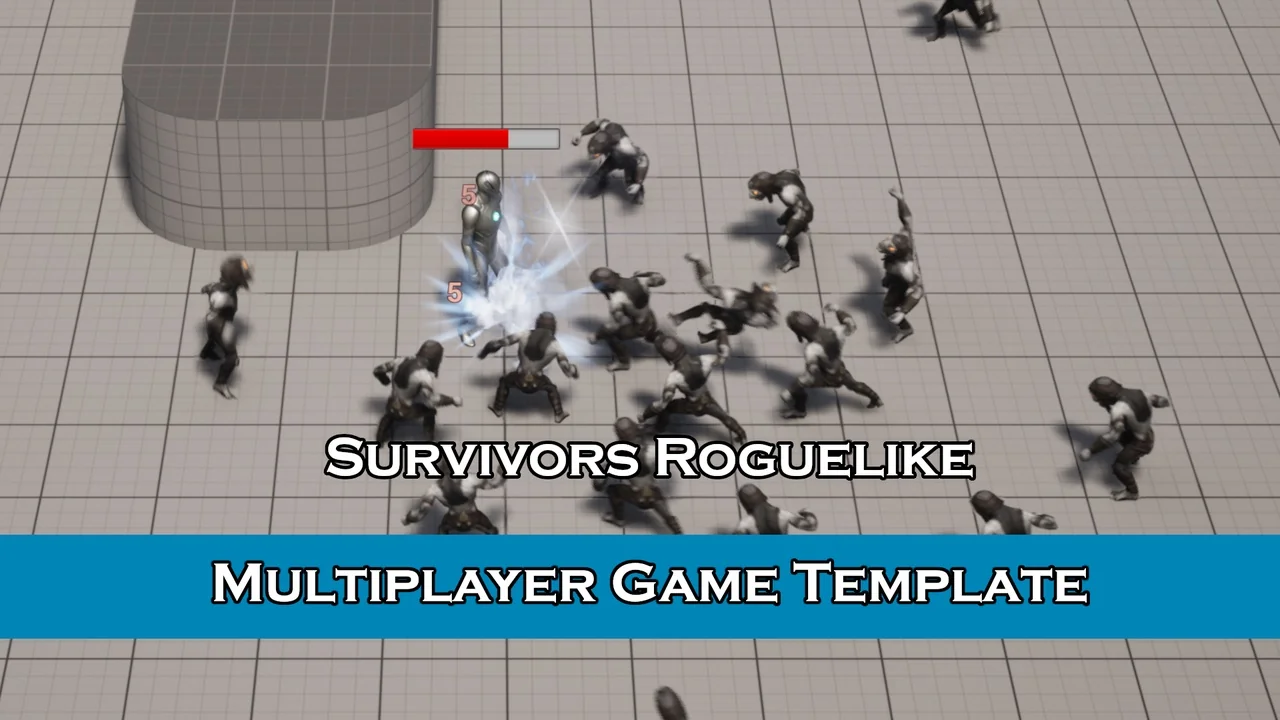
 RPG
RPG RPG
RPG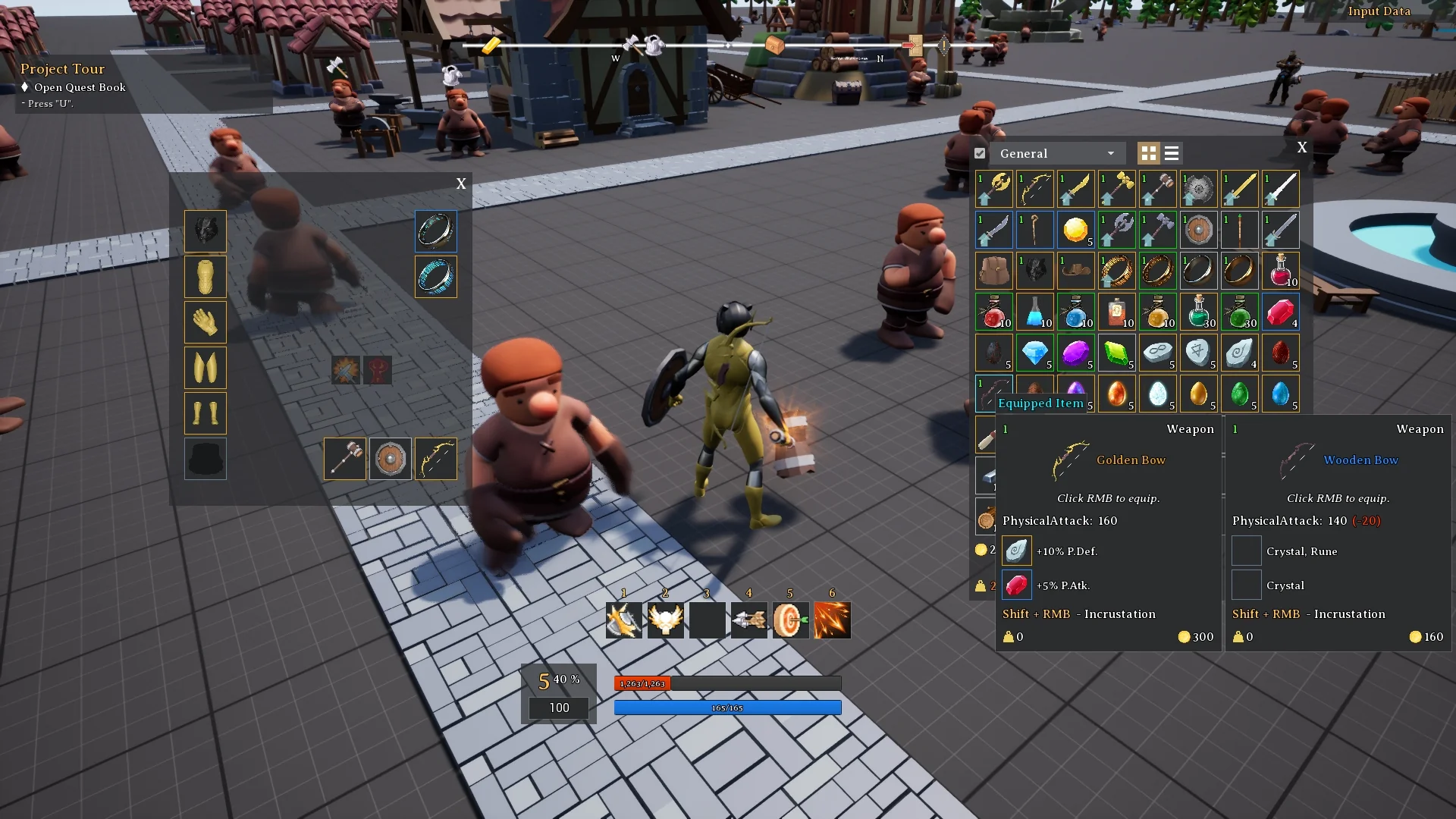 RPG
RPG