"1a0e4ac4dc71d030"{"id":"1001251","slug":"procedural-level-generator","title":"Procedural Level Generator","category":"RPG","engine":"5.0+","assetVersion":"","engineVersion":"Engine Version: 5.0+","tag":"RPG","accent":"blue","visual":"mech","summary":"Build complex environments with Procedural Level Generator, featuring streaming level room instancing, freeform modular sizing, and floor transitions.","platform":"Unreal Engine","publishedAt":"2026-09-23T15:35:35.322Z","updatedAt":"2026-09-23T15:35:35.322Z","sourceNotes":[],"fileContents":[],"compatibility":["Unreal Engine","Engine Version: 5.0+"],"featuredImage":{"alt":"Procedural Level Generator","src":"/wp-content/uploads/published/2026/09/c476c1d3aa08-4febf285-afb3-496b-9398-053c47badebf-781cec17f2.webp"},"hasDownloadLink":true,"downloads":0,"terms":[{"taxonomy":"category","slug":"rpg","name":"RPG"}],"galleryImages":[{"src":"/wp-content/uploads/published/2026/09/3f92567bfd81-d3cb41d6-61c1-4885-affd-7db9594236f0-eb5c1bb6f1.webp","alt":"Procedural Level Generator"},{"src":"/wp-content/uploads/published/2026/09/b8d9c17c466a-eaad9264-b3ad-408f-846d-490c89c70774-b13c05d458.webp","alt":"Procedural Level Generator"},{"src":"/wp-content/uploads/published/2026/09/b1a9d728f5b3-00f5a6eb-0d21-40b3-9063-c28d4d6c2793-ee01beffd2.webp","alt":"Procedural Level Generator"},{"src":"/wp-content/uploads/published/2026/09/9b36aeba5aef-43d23266-ce18-4a33-a8a5-dc5457e40fee-8c018d5c4f.webp","alt":"Procedural Level Generator"},{"src":"/wp-content/uploads/published/2026/09/34f00a311403-b62e3499-ac63-4685-a01d-67dc83fc6552-bbc73bdc7d.webp","alt":"Procedural Level Generator"},{"src":"/wp-content/uploads/published/2026/09/b14640fade70-6fec8301-5fa4-45da-af11-8495c47104c1-630bb6fdcb.webp","alt":"Procedural Level Generator"}],"accessPanel":{"kind":"resource","title":"Download this resource","eyebrow":"Free Download","message":"Log in or create a free account to start your download.","fileName":"Content.7z","safetyNote":"Resources are manually reviewed before listing to improve quality and reduce obvious risks.","actionLabel":"Download Free","resourceType":"Resource archive"},"contentHtml":"\u003ch2\u003eCombining Procedural Generation with Handcrafted Room Templates\u003c/h2\u003e\u003cp\u003eConstructing multi-room environments often forces a strict choice between entirely randomized architecture and painstakingly assembled manual geometry. Procedural Level Generator bridges this gap by letting creators load custom meshes and handcrafted room templates directly into the generator runtime. Each room exists on its own individual map, brought into the runtime world by creating an instance inside a streaming level. This architecture allows developers to combine automated spatial distribution with bespoke, handcrafted level design, assembling complex compounds that maintain deliberate art direction alongside algorithmic variance.\u003c/p\u003e\u003cp\u003eBecause templates are loaded as map instances, level designers can place hero assets, deliberate obstacle runs, and signature encounters in isolated spaces before assigning them to the generation pool. When the generator executes, it organizes these discrete map templates into a continuous environment. Visual progress during generation is communicated directly to the player through an integrated loading bar and generation progress bar, keeping asynchronous map assembly clear during setup phases.\u003c/p\u003e\u003ch2\u003eDimension Freedom Across Modular Walls, Floors, and Doors\u003c/h2\u003e\u003cp\u003eRigid grid requirements frequently limit procedural layout systems, forcing every mesh asset into matching bounding-box dimensions. This system operates without snapping to fixed mesh sizes. Modular elements including walls, floors, and doors can be incorporated at almost any dimension, granting project teams the leeway to swap in unique architectural styles without conforming to standardized square tiles.\u003c/p\u003e\u003cp\u003eThe modular framework enables straightforward replacement of default assets with project-specific geometry. Developers can assign custom structural components across floors, doorways, and vertical barriers without revising the underlying blueprint logic. Because the layout logic does not depend on uniform tile bounds, structural pieces can accommodate wide corridors, high ceilings, or asymmetric entryways. Swapping building components does not break the generation rules, which maintains flexibility when updating environmental themes across production stages.\u003c/p\u003e\u003ch2\u003eControlling World Size, Floor Counts, and Vertical Transitions\u003c/h2\u003e\u003cp\u003eThe generation process provides deep control over structural dimensions and verticality. Designers can fine-tune world generation through exposed parameters, determining the horizontal footprint by selecting the exact size of the side of the world. Beyond flat layouts, the system handles vertical environments by allowing creators to configure the total number of floors, establish the specific starting floor where the player enters, and tune the quantity of structural transitions connecting those elevations.\u003c/p\u003e\u003cp\u003eSetting up multi-story buildings, underground complexes, or tiered facilities relies on balancing these parameters. By manipulating the number of transitions between floors, developers dictate how open or restricted traversal becomes across elevations. A layout can be configured as a linear ascent with minimal inter-floor connections or as an interconnected vertical maze featuring multiple stairwells and routes. These parameters give projects distinct macro structures while preserving procedural variability inside each floor's boundaries.\u003c/p\u003e\u003ch2\u003eStreaming Level Optimization and Active Room Isolation\u003c/h2\u003e\u003cp\u003eLarge-scale procedural complexes can quickly overburden rendering and memory limits if handled as a single continuous scene. Procedural Level Generator leverages streaming levels to maintain stable performance across expansive layouts. Because rooms reside on their own map instances, the engine streams spatial geometry as needed rather than keeping every generated chamber resident simultaneously.\u003c/p\u003e\u003cp\u003ePerformance can be pushed further using the system's active room visibility setting. Enabling this option hides non-relevant spaces, displaying only the active room the player currently occupies. In performance-constrained projects or visually dense environments packed with props, this culling mechanism frees system overhead by rendering only the immediate space around the character, relying on the background streaming logic to surface adjacent spaces smoothly.\u003c/p\u003e\u003ch2\u003eNavigation Support, Teleporters, and Standard AI Integration\u003c/h2\u003e\u003cp\u003eAutonomous pathfinding and navigation work out of the box through integrated NavMesh support. The generator accommodates pathing volumes across procedural spaces, allowing ground-based navigation to resolve correctly once rooms are streamed into the world. Alongside navigation volumes, the framework ships with standard character and AI setups. Projects can adopt their own character controllers without navigating supplementary configuration routines or adjusting the generation code to match non-standard pawn templates.\u003c/p\u003e\u003cp\u003eRapid transit throughout the layout is managed by an integrated teleportation system. Teleporters provide instant transitions across rooms and between separate floors, eliminating the need to physically walk through intermediate corridors or vertical transition zones. This rapid movement capability integrates cleanly with the level streaming pipeline, ensuring that target destinations and relevant room instances are ready when the character shifts positions.\u003c/p\u003e\u003ch2\u003eState Persistence Across Player Position, Teleports, and Layouts\u003c/h2\u003e\u003cp\u003ePersistent game loops require reliable state tracking, particularly when worlds are built procedurally rather than statically authored. The built-in Save/Load system captures the state of the generated world, ensuring that spatial arrangements remain stable across play sessions. In addition to preserving the architectural layout, the system writes and restores player position coordinates and the operational state of active teleporters.\u003c/p\u003e\u003cp\u003eRetaining generated layouts alongside player tracking ensures that exploration progress, door states, and transit links do not scramble whenever a session pauses or reloads. Games requiring extended run structures, episodic saves, or persistent survival bases can leverage this persistence layer to anchor randomized structures over time.\u003c/p\u003e\u003ch2\u003eProduction Suitability\u003c/h2\u003e\u003cp\u003eThis Blueprint-based generation framework serves developers building room-based dungeon crawlers, multi-story tactical compounds, and interior exploration titles. Teams that require both the speed of automated room assembly and the visual control of handcrafted set pieces can structure complex, scalable indoor maps while maintaining tight control over performance, floor layouts, and player persistence.\u003c/p\u003e\n\n\u003ch2\u003eRelated Resources Worth Checking\u003c/h2\u003e\n\u003cul\u003e\n\u003cli\u003e\u003ca href=\"https://3dcghub.com/simple-tree-generator/\" title=\"Simple Tree Generator\"\u003eSimple Tree Generator\u003c/a\u003e\u003c/li\u003e\n\u003cli\u003e\u003ca href=\"https://3dcghub.com/procedural-city-generator-omniscape/\" title=\"Procedural City Generator – OmniScape\"\u003eProcedural City Generator – OmniScape\u003c/a\u003e\u003c/li\u003e\n\u003cli\u003e\u003ca href=\"https://3dcghub.com/decal-forge-v1-1-procedural-decal-generator/\" title=\"Decal Forge v1.1 - Procedural Decal Generator\"\u003eDecal Forge v1.1 - Procedural Decal Generator\u003c/a\u003e\u003c/li\u003e\n\u003cli\u003e\u003ca href=\"https://3dcghub.com/crossroad-generator/\" title=\"Crossroad Generator\"\u003eCrossroad Generator\u003c/a\u003e\u003c/li\u003e\n\u003cli\u003e\u003ca href=\"https://3dcghub.com/calysto-village-procedural-villages-farms-with-pcg/\" title=\"Calysto Village Procedural villages, farms with PCG\"\u003eCalysto Village Procedural villages, farms with PCG\u003c/a\u003e\u003c/li\u003e\n\u003c/ul\u003e","contentTextLength":6817,"navigation":{"current":7,"total":3200,"previous":{"id":"1001252","slug":"survivors-roguelike-multiplayer-game-template","title":"Survivors Roguelike - Multiplayer Game Template","category":"RPG","platform":"Unreal Engine","updatedAt":"2026-09-23T15:37:57.602Z"},"next":{"id":"1001250","slug":"open-world-rpg-toolkit","title":"Open World RPG Toolkit","category":"RPG","platform":"Unreal Engine","updatedAt":"2026-09-23T15:32:52.651Z"}},"relatedResources":[{"id":"14610","slug":"simple-tree-generator","title":"Simple Tree Generator","category":"Engine Tools","engine":"5.6 - 5.8","assetVersion":"Asset Version: 1.1","engineVersion":"Engine version: 5.6 - 5.8","tag":"Engine Tools","accent":"blue","visual":"audio","summary":"Simple Tree Generator is a powerful tool designed specifically for Unreal Engine 5. It enables developers to procedurally create diverse trees and bushes with just a few clicks.","platform":"Unreal Engine","publishedAt":"2026-03-11T18:36:43.000Z","updatedAt":"2026-09-17T02:13:52.813Z","sourceNotes":[],"fileContents":[],"compatibility":["Unreal Engine","Asset Version: 1.1","Engine version: 5.6 - 5.8"],"featuredImage":{"alt":"Simple Tree Generator","src":"https://3dcghub.com/wp-content/uploads/2026/03/4e3b784d-7198-46b5-a343-a73957e40875.webp"},"hasDownloadLink":true,"downloads":0},{"id":"1001121","slug":"procedural-city-generator-omniscape","title":"Procedural City Generator – OmniScape","category":"Procedural Systems","engine":"5.7 - 5.8","assetVersion":"Asset Version: 2.0","engineVersion":"Engine Version: 5.7 - 5.8","tag":"Procedural Systems","accent":"blue","visual":"city","summary":"Generate cities, towns, and ruins from one Unreal Engine panel with OmniScape. Live preview, five layout patterns, road hierarchies, and production-ready preset","platform":"Unreal Engine","publishedAt":"2026-09-07T13:02:45.053Z","updatedAt":"2026-09-07T13:02:45.053Z","sourceNotes":[],"fileContents":[],"compatibility":["Unreal Engine","Asset Version: 2.0","Engine Version: 5.7 - 5.8"],"featuredImage":{"alt":"Procedural City Generator – OmniScape","src":"/wp-content/uploads/published/2026/09/ebdcb6552420-0ec43ed5-0d32-4263-921b-c32c52d60e76-ce214ea98e.webp"},"hasDownloadLink":true,"downloads":0},{"id":"1000767","slug":"decal-forge-v1-1-procedural-decal-generator","title":"Decal Forge v1.1 - Procedural Decal Generator","category":"Gameplay Features","engine":"5.3+","assetVersion":"","engineVersion":"Engine Version: 5.3+","tag":"Gameplay Features","accent":"blue","visual":"mech","summary":"Decal Forge v1.1 brings blueprint-driven procedural decal authoring to Unreal Engine with Parallax Occlusion Mapping, triplanar projection, and angle-masking.","platform":"Unreal Engine","publishedAt":"2026-07-28T17:10:32.912Z","updatedAt":"2026-07-28T17:10:32.912Z","sourceNotes":[],"fileContents":[],"compatibility":["Unreal Engine","Engine Version: 5.3+"],"featuredImage":{"alt":"Decal Forge v1.1 - Procedural Decal Generator","src":"/wp-content/uploads/published/2026/07/48b6778b325d-e1514445-c8b5-4488-a099-c5900a600ae6-538f30b42c.webp"},"hasDownloadLink":true,"downloads":0}]}
RPG
Procedural Level Generator
Build complex environments with Procedural Level Generator, featuring streaming level room instancing, freeform modular sizing, and floor transitions.
Combining Procedural Generation with Handcrafted Room Templates
Constructing multi-room environments often forces a strict choice between entirely randomized architecture and painstakingly assembled manual geometry. Procedural Level Generator bridges this gap by letting creators load custom meshes and handcrafted room templates directly into the generator runtime. Each room exists on its own individual map, brought into the runtime world by creating an instance inside a streaming level. This architecture allows developers to combine automated spatial distribution with bespoke, handcrafted level design, assembling complex compounds that maintain deliberate art direction alongside algorithmic variance.
Because templates are loaded as map instances, level designers can place hero assets, deliberate obstacle runs, and signature encounters in isolated spaces before assigning them to the generation pool. When the generator executes, it organizes these discrete map templates into a continuous environment. Visual progress during generation is communicated directly to the player through an integrated loading bar and generation progress bar, keeping asynchronous map assembly clear during setup phases.
Dimension Freedom Across Modular Walls, Floors, and Doors
Rigid grid requirements frequently limit procedural layout systems, forcing every mesh asset into matching bounding-box dimensions. This system operates without snapping to fixed mesh sizes. Modular elements including walls, floors, and doors can be incorporated at almost any dimension, granting project teams the leeway to swap in unique architectural styles without conforming to standardized square tiles.
The modular framework enables straightforward replacement of default assets with project-specific geometry. Developers can assign custom structural components across floors, doorways, and vertical barriers without revising the underlying blueprint logic. Because the layout logic does not depend on uniform tile bounds, structural pieces can accommodate wide corridors, high ceilings, or asymmetric entryways. Swapping building components does not break the generation rules, which maintains flexibility when updating environmental themes across production stages.
Controlling World Size, Floor Counts, and Vertical Transitions
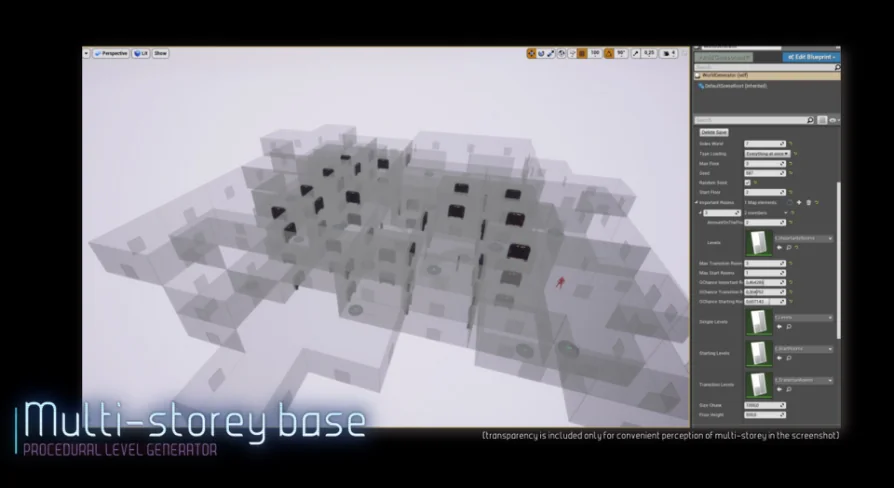
The generation process provides deep control over structural dimensions and verticality. Designers can fine-tune world generation through exposed parameters, determining the horizontal footprint by selecting the exact size of the side of the world. Beyond flat layouts, the system handles vertical environments by allowing creators to configure the total number of floors, establish the specific starting floor where the player enters, and tune the quantity of structural transitions connecting those elevations.
Setting up multi-story buildings, underground complexes, or tiered facilities relies on balancing these parameters. By manipulating the number of transitions between floors, developers dictate how open or restricted traversal becomes across elevations. A layout can be configured as a linear ascent with minimal inter-floor connections or as an interconnected vertical maze featuring multiple stairwells and routes. These parameters give projects distinct macro structures while preserving procedural variability inside each floor's boundaries.
Streaming Level Optimization and Active Room Isolation
Large-scale procedural complexes can quickly overburden rendering and memory limits if handled as a single continuous scene. Procedural Level Generator leverages streaming levels to maintain stable performance across expansive layouts. Because rooms reside on their own map instances, the engine streams spatial geometry as needed rather than keeping every generated chamber resident simultaneously.
Performance can be pushed further using the system's active room visibility setting. Enabling this option hides non-relevant spaces, displaying only the active room the player currently occupies. In performance-constrained projects or visually dense environments packed with props, this culling mechanism frees system overhead by rendering only the immediate space around the character, relying on the background streaming logic to surface adjacent spaces smoothly.
Navigation Support, Teleporters, and Standard AI Integration
Autonomous pathfinding and navigation work out of the box through integrated NavMesh support. The generator accommodates pathing volumes across procedural spaces, allowing ground-based navigation to resolve correctly once rooms are streamed into the world. Alongside navigation volumes, the framework ships with standard character and AI setups. Projects can adopt their own character controllers without navigating supplementary configuration routines or adjusting the generation code to match non-standard pawn templates.
Rapid transit throughout the layout is managed by an integrated teleportation system. Teleporters provide instant transitions across rooms and between separate floors, eliminating the need to physically walk through intermediate corridors or vertical transition zones. This rapid movement capability integrates cleanly with the level streaming pipeline, ensuring that target destinations and relevant room instances are ready when the character shifts positions.
State Persistence Across Player Position, Teleports, and Layouts
Persistent game loops require reliable state tracking, particularly when worlds are built procedurally rather than statically authored. The built-in Save/Load system captures the state of the generated world, ensuring that spatial arrangements remain stable across play sessions. In addition to preserving the architectural layout, the system writes and restores player position coordinates and the operational state of active teleporters.
Retaining generated layouts alongside player tracking ensures that exploration progress, door states, and transit links do not scramble whenever a session pauses or reloads. Games requiring extended run structures, episodic saves, or persistent survival bases can leverage this persistence layer to anchor randomized structures over time.
Production Suitability
This Blueprint-based generation framework serves developers building room-based dungeon crawlers, multi-story tactical compounds, and interior exploration titles. Teams that require both the speed of automated room assembly and the visual control of handcrafted set pieces can structure complex, scalable indoor maps while maintaining tight control over performance, floor layouts, and player persistence.
 RPG
RPG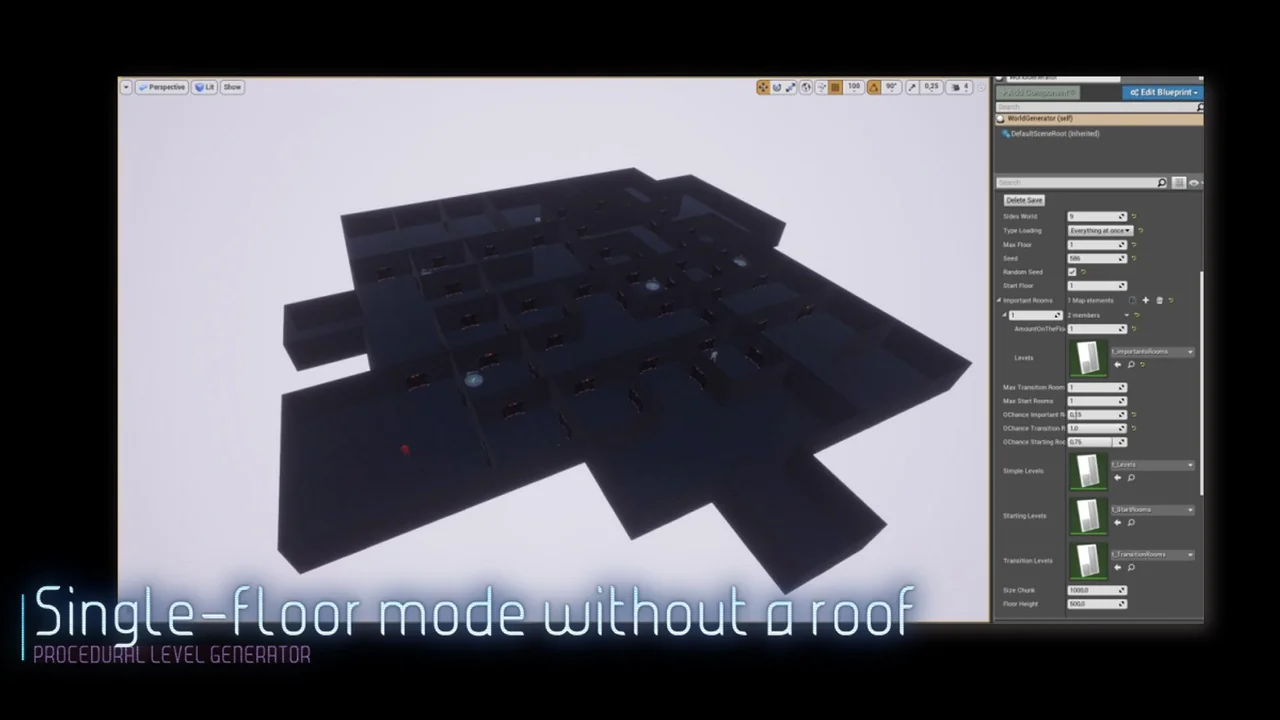
 Engine Tools
 Procedural Systems
 Gameplay Features