"b074fe356ef39c95"{"id":"1001031","slug":"easy-topdown-template-v2-1-survival-action-shooter-top-down-rpg","title":"Easy TopDown Template V2.1 | Survival Action Shooter Top Down RPG","category":"RPG","engine":"5.6+","assetVersion":"","engineVersion":"Engine Version: 5.6+","tag":"RPG","accent":"blue","visual":"mech","summary":"Production-ready top-down survival RPG template with replicated multiplayer, combat, inventory, building, AI, narrative systems, 280+ docs, and a V3 roadmap.","platform":"Unreal Engine","publishedAt":"2026-08-23T12:26:25.601Z","updatedAt":"2026-08-23T12:26:25.601Z","sourceNotes":[],"fileContents":[],"compatibility":["Unreal Engine","Engine Version: 5.6+"],"featuredImage":{"alt":"Easy TopDown Template V2.1 | Survival Action Shooter Top Down RPG","src":"/wp-content/uploads/published/2026/08/8044fdff0e95-28bfa536-f855-4e68-910b-00eda2dc37ec-911ae442b6.webp"},"hasDownloadLink":true,"downloads":7,"terms":[{"taxonomy":"category","slug":"rpg","name":"RPG"}],"galleryImages":[{"src":"/wp-content/uploads/published/2026/08/dec624c3dff8-d06ace6e-365b-45b0-a303-979b836c99ea-0b04916ee5.webp","alt":"Easy TopDown Template V2.1 | Survival Action Shooter Top Down RPG"},{"src":"/wp-content/uploads/published/2026/08/3acbecfa7fa7-e265f79b-be5d-40ce-9440-2598966eb89e-83aa8c87e1.webp","alt":"Easy TopDown Template V2.1 | Survival Action Shooter Top Down RPG"},{"src":"/wp-content/uploads/published/2026/08/7a1fa0d188ab-c09c635a-880a-4d66-89fd-cdda0e8fdae6-465e433016.webp","alt":"Easy TopDown Template V2.1 | Survival Action Shooter Top Down RPG"},{"src":"/wp-content/uploads/published/2026/08/edb00f044760-0919c5c6-9f2f-43e7-8e6f-06b83a4f27d0-c9c10d1927.webp","alt":"Easy TopDown Template V2.1 | Survival Action Shooter Top Down RPG"},{"src":"/wp-content/uploads/published/2026/08/2c0c5f6d7b57-580584e8-c072-4c6d-bfa1-6639793c27eb-5111f82ba9.webp","alt":"Easy TopDown Template V2.1 | Survival Action Shooter Top Down RPG"},{"src":"/wp-content/uploads/published/2026/08/04536a751cff-1643d726-6ad9-4d91-82c2-b38caac405d6-42271b43bd.webp","alt":"Easy TopDown Template V2.1 | Survival Action Shooter Top Down RPG"},{"src":"/wp-content/uploads/published/2026/08/35cf1840fba6-96a9a203-b49f-4984-8c41-355a54a0b63d-7b017f4597.webp","alt":"Easy TopDown Template V2.1 | Survival Action Shooter Top Down RPG"},{"src":"/wp-content/uploads/published/2026/08/52ccb2b1eede-44e5723b-25d1-4ecc-949d-546c957f0394-91c60f81e0.webp","alt":"Easy TopDown Template V2.1 | Survival Action Shooter Top Down RPG"},{"src":"/wp-content/uploads/published/2026/08/3d12e0e654c5-532b3ea6-1a82-461b-bd7c-1b9226523a91-179ffd7410.webp","alt":"Easy TopDown Template V2.1 | Survival Action Shooter Top Down RPG"},{"src":"/wp-content/uploads/published/2026/08/a905abf916ea-619daf22-7c65-45f9-a6aa-009f45addb46-37f7b2a282.webp","alt":"Easy TopDown Template V2.1 | Survival Action Shooter Top Down RPG"}],"accessPanel":{"kind":"resource","title":"Download this resource","eyebrow":"Free Download","message":"Log in or create a free account to start your download.","fileName":"ET21.7z","safetyNote":"Resources are manually reviewed before listing to improve quality and reduce obvious risks.","actionLabel":"Download Free","resourceType":"Resource archive"},"contentHtml":"\u003cp\u003eTop-down survival games force the same problem on every team: combat, inventory, building, AI, and networking all have to work together before the game can become playable. Most projects answer that by stitching together separate systems, and the seams become glue code that eats development time. Easy TopDown Template V2.1 is made to skip that phase. It is a modular Blueprint framework with replicated multiplayer, built for top-down survival, RPG, adventure, and action games. The pitch is direct: no missing systems, no glue code, everything replicated and ready out of the box.\u003c/p\u003e \u003cp\u003eThe template carries a 4/5 rating, a Discord community over 7,000 members, and a record of use in shipped games. It comes from the creators of Easy Survival RPG and has been maintained and updated since 2025. That maintenance matters as much as the feature list, because a template that stays current can be trusted inside a longer production cycle.\u003c/p\u003e \u003ch2\u003eMultiplayer from LAN to dedicated servers\u003c/h2\u003e \u003cp\u003eThe first major block is networking. Multiplayer support covers LAN, P2P, Steam, and dedicated servers, with server-side save and load. For a co-op top-down game, that range covers most deployment paths: LAN for local play, P2P for small friend sessions, Steam for matchmaking-driven online play, and a dedicated server for persistent or official worlds. Server-side save and load keeps progression and world state on the server, which is a strong foundation for a commercial project.\u003c/p\u003e \u003cp\u003eThe setup aim is to invite friends and play in minutes. The requirement list is short: the template asks for the OnlineSubsystemSteam and EnhancedInput plugins. That means a developer can drop into an Unreal Engine project without a chain of extra middleware.\u003c/p\u003e \u003ch2\u003eCombat, survival, and the character layer\u003c/h2\u003e \u003cp\u003eCombat in the template covers melee and ranged weapons, projectiles, traps, explosives, and damage zones. Those systems give a top-down action game its core verbs: close-range attacks, gunplay, placed hazards, and area-of-effect damage. The character layer sits under that combat. Stats, attributes, skills, leveling, hunger, thirst, weight, and death/respawn are all tracked, so progression and needs are part of the same framework instead of separate add-ons.\u003c/p\u003e \u003cp\u003eThe survival section extends this into non-combat gameplay with fishing, farming, mining, digging, woodcutting, and status effects. Taken together, these give a project the resource loops that keep a survival game moving between fights. A player can mine materials, farm food, and dig for resources, then use the gained assets to build or trade.\u003c/p\u003e \u003ch2\u003eInventory, building, AI, and narrative systems\u003c/h2\u003e \u003cp\u003eInventory and equipment cover jigsaw inventory, hotbar, equipment, durability, backpacks, and containers. These are the standard pieces of an item system: a grid-style inventory, quick slots, gear slots, degradation, and storage options. Building is included with modular snap-based construction, repair, upgrades, durability, and locks. That allows player-created shelters and bases to be maintained over time, with lockable access for co-op or PvP contexts.\u003c/p\u003e \u003cp\u003eThe AI and NPC block is sized for more than simple soldiers. It lists smart AI, factions, spawners, zombies, bandits, behavior trees, and ragdoll. Behavior trees give enemies structured decision-making, factions provide a layer of relationships, and spawners let the game world generate threats in controlled locations. Zombies and bandits are ready-made enemy archetypes. Narrative systems add dialogue trees and quest/journal systems, which let a project introduce NPCs with conversation and structured objectives without leaving the template.\u003c/p\u003e \u003cp\u003eThe presentation side includes a HUD, minimap, world map, flexible top-down camera, and enhanced input support. Stylized environments, water and swimming, and demo levels round out the package, so the template arrives with a recognizable look and testable scenes.\u003c/p\u003e \u003ch2\u003eDocumentation, debug tools, and what V3 adds\u003c/h2\u003e \u003cp\u003eDocumentation is one of the strongest signals here: 280+ pages. For an asset with multiplayer replication, combat, building, AI, and narrative systems, that documentation is what makes the framework approachable instead of intimidating. The template also lists modular Blueprints, data-driven systems, and debug tools as part of its developer-friendly architecture, which points to a codebase made for modification rather than for staying as a black box.\u003c/p\u003e \u003cp\u003eOn the roadmap, the headline item is third-person camera support in V3. The current version already has a flexible top-down camera, so V3 will add an alternative perspective. The project is actively maintained, with patch notes and a roadmap available. A team considering the template is not locking into a static snapshot; it is adopting a system that continues to change.\u003c/p\u003e \u003ch2\u003eWhere it fits in a production pipeline\u003c/h2\u003e \u003cp\u003eEasy TopDown Template fits a studio that wants to start development at the point where most prototypes stop. The feature set already handles the hard parts of a top-down survival game: replicated multiplayer, server-side saving, enemy AI, building, inventory, and character progression. For a small team or solo developer building a top-down survival, RPG, adventure, or action game, this removes the initial integration work and leaves more time for content and design.\u003c/p\u003e \u003cp\u003eThe template has shipped games behind it, which gives some confidence beyond a typical asset-pack. Combined with the documentation size, the active community, and the V3 roadmap, it looks less like a demo and more like a base for a commercial project. For teams already familiar with Unreal Engine Blueprints, the modular architecture and data-driven systems fit a workflow where systems are tweaked in data rather than rewritten in code.\u003c/p\u003e\n\n\u003ch2\u003eRelated Resources Worth Checking\u003c/h2\u003e\n\u003cul\u003e\n\u003cli\u003e\u003ca href=\"https://3dcghub.com/top-down-rpg-template/\" title=\"Top Down RPG Template\"\u003eTop Down RPG Template\u003c/a\u003e\u003c/li\u003e\n\u003cli\u003e\u003ca href=\"https://3dcghub.com/easy-survival-rpg-v5/\" title=\"Easy Survival RPG V5\"\u003eEasy Survival RPG V5\u003c/a\u003e\u003c/li\u003e\n\u003cli\u003e\u003ca href=\"https://3dcghub.com/advanced-multiplayer-survival-templatev2/\" title=\"Advanced Multiplayer Survival TemplateV2\"\u003eAdvanced Multiplayer Survival TemplateV2\u003c/a\u003e\u003c/li\u003e\n\u003cli\u003e\u003ca href=\"https://3dcghub.com/action-rpg-template/\" title=\"Action RPG Template\"\u003eAction RPG Template\u003c/a\u003e\u003c/li\u003e\n\u003cli\u003e\u003ca href=\"https://3dcghub.com/soulslike-framework-complete-soulslike-kit/\" title=\"Soulslike Framework - Complete Soulslike Kit\"\u003eSoulslike Framework - Complete Soulslike Kit\u003c/a\u003e\u003c/li\u003e\n\u003c/ul\u003e","contentTextLength":5892,"navigation":{"current":516,"total":3429,"previous":{"id":"8974","slug":"post-soviet-hostel","title":"Post Soviet Hostel","category":"Interior","platform":"Unreal Engine","updatedAt":"2026-08-23T13:06:38.716Z"},"next":{"id":"1001030","slug":"norway-spruce-tree-pack-picea-abies","title":"Norway Spruce Tree Pack, Picea Abies","category":"Trees","platform":"Unreal Engine","updatedAt":"2026-08-23T12:18:43.875Z"}},"relatedResources":[{"id":"11819","slug":"easy-survival-rpg-v5","title":"Easy Survival RPG V5","category":"RPG","engine":"5.1+,5.8+","assetVersion":"","engineVersion":"Engine Version: 5.1+,5.8+","tag":"RPG","accent":"blue","visual":"character","summary":"Easy Survival RPG V5 provides a battle-tested foundation for creating professional multiplayer games. This modular template includes everything from combat and crafting to advanced life simulation systems.","platform":"Unreal Engine","publishedAt":"2026-03-05T19:04:26.000Z","updatedAt":"2026-10-07T09:08:33.708Z","sourceNotes":[],"fileContents":[],"compatibility":["Unreal Engine","Engine Version: 5.1+,5.8+"],"featuredImage":{"alt":"Easy Survival RPG V5","src":"https://3dcghub.com/wp-content/uploads/2026/03/bcd7af22-1493-4aa2-8994-25e309eac033.webp"},"hasDownloadLink":true,"downloads":5},{"id":"1001250","slug":"open-world-rpg-toolkit","title":"Open World RPG Toolkit","category":"RPG","engine":"5.0+","assetVersion":"","engineVersion":"Engine Version: 5.0+","tag":"RPG","accent":"blue","visual":"mech","summary":"Explore the Open World RPG Toolkit, featuring 47 network-replicated blueprints covering quests, inventory, map setup, saves, and survival systems.","platform":"Unreal Engine","publishedAt":"2026-09-23T15:32:52.651Z","updatedAt":"2026-09-23T15:32:52.651Z","sourceNotes":[],"fileContents":[],"compatibility":["Unreal Engine","Engine Version: 5.0+"],"featuredImage":{"alt":"Open World RPG Toolkit","src":"/wp-content/uploads/published/2026/09/5cd2af69cae2-b06f35c2-d7a7-4212-8d3b-32855ff16e82-d90a9599f6.webp"},"hasDownloadLink":true,"downloads":0},{"id":"1000968","slug":"top-down-rpg-template","title":"Top Down RPG Template","category":"RPG","engine":"5.3+","assetVersion":"","engineVersion":"Engine Version: 5.3+","tag":"RPG","accent":"blue","visual":"mech","summary":"A Blueprint-only top-down RPG template for Unreal Engine with multiplayer, quests, crafting, inventory, AI combat, boss fights, and save/load systems.","platform":"Unreal Engine","publishedAt":"2026-08-15T14:14:08.269Z","updatedAt":"2026-08-15T14:14:08.269Z","sourceNotes":[],"fileContents":[],"compatibility":["Unreal Engine","Engine Version: 5.3+"],"featuredImage":{"alt":"Top Down RPG Template","src":"/wp-content/uploads/published/2026/08/e7b6b5ea7536-6c7c43af-314b-4c04-88f8-d4e2ddbb31d8-cf531ad050.webp"},"hasDownloadLink":true,"downloads":2}]}
RPG
Easy TopDown Template V2.1 | Survival Action Shooter Top Down RPG
Production-ready top-down survival RPG template with replicated multiplayer, combat, inventory, building, AI, narrative systems, 280+ docs, and a V3 roadmap.
Category:Unreal Engine,RPGPlatform: Unreal EngineEngine Version: 5.6+Published: Aug 23, 2026
RPG
Resource overview
Top-down survival games force the same problem on every team: combat, inventory, building, AI, and networking all have to work together before the game can become playable. Most projects answer that by stitching together separate systems, and the seams become glue code that eats development time. Easy TopDown Template V2.1 is made to skip that phase. It is a modular Blueprint framework with replicated multiplayer, built for top-down survival, RPG, adventure, and action games. The pitch is direct: no missing systems, no glue code, everything replicated and ready out of the box.
The template carries a 4/5 rating, a Discord community over 7,000 members, and a record of use in shipped games. It comes from the creators of Easy Survival RPG and has been maintained and updated since 2025. That maintenance matters as much as the feature list, because a template that stays current can be trusted inside a longer production cycle.
Multiplayer from LAN to dedicated servers
The first major block is networking. Multiplayer support covers LAN, P2P, Steam, and dedicated servers, with server-side save and load. For a co-op top-down game, that range covers most deployment paths: LAN for local play, P2P for small friend sessions, Steam for matchmaking-driven online play, and a dedicated server for persistent or official worlds. Server-side save and load keeps progression and world state on the server, which is a strong foundation for a commercial project.
The setup aim is to invite friends and play in minutes. The requirement list is short: the template asks for the OnlineSubsystemSteam and EnhancedInput plugins. That means a developer can drop into an Unreal Engine project without a chain of extra middleware.
Combat, survival, and the character layer
Combat in the template covers melee and ranged weapons, projectiles, traps, explosives, and damage zones. Those systems give a top-down action game its core verbs: close-range attacks, gunplay, placed hazards, and area-of-effect damage. The character layer sits under that combat. Stats, attributes, skills, leveling, hunger, thirst, weight, and death/respawn are all tracked, so progression and needs are part of the same framework instead of separate add-ons.
The survival section extends this into non-combat gameplay with fishing, farming, mining, digging, woodcutting, and status effects. Taken together, these give a project the resource loops that keep a survival game moving between fights. A player can mine materials, farm food, and dig for resources, then use the gained assets to build or trade.
Inventory, building, AI, and narrative systems
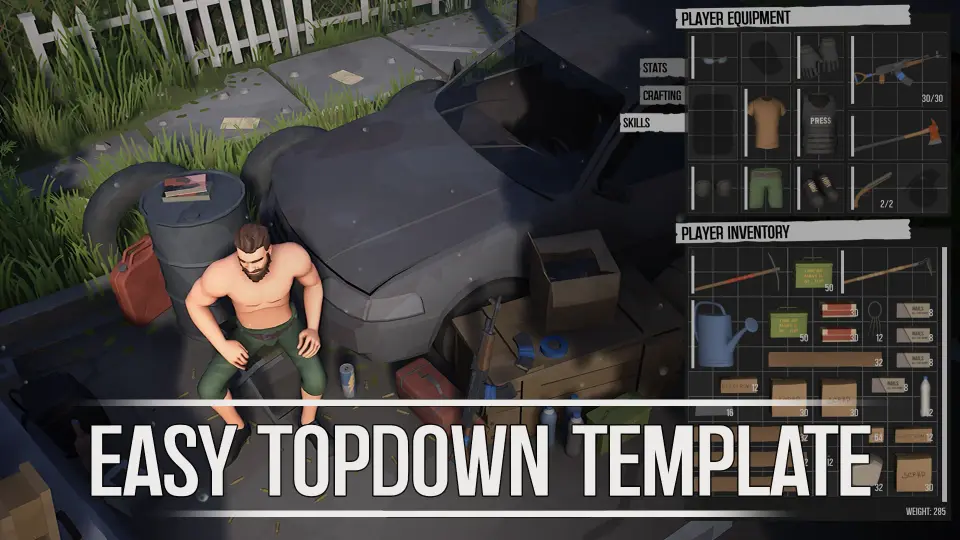
Inventory and equipment cover jigsaw inventory, hotbar, equipment, durability, backpacks, and containers. These are the standard pieces of an item system: a grid-style inventory, quick slots, gear slots, degradation, and storage options. Building is included with modular snap-based construction, repair, upgrades, durability, and locks. That allows player-created shelters and bases to be maintained over time, with lockable access for co-op or PvP contexts.
The AI and NPC block is sized for more than simple soldiers. It lists smart AI, factions, spawners, zombies, bandits, behavior trees, and ragdoll. Behavior trees give enemies structured decision-making, factions provide a layer of relationships, and spawners let the game world generate threats in controlled locations. Zombies and bandits are ready-made enemy archetypes. Narrative systems add dialogue trees and quest/journal systems, which let a project introduce NPCs with conversation and structured objectives without leaving the template.
The presentation side includes a HUD, minimap, world map, flexible top-down camera, and enhanced input support. Stylized environments, water and swimming, and demo levels round out the package, so the template arrives with a recognizable look and testable scenes.
Documentation, debug tools, and what V3 adds
Documentation is one of the strongest signals here: 280+ pages. For an asset with multiplayer replication, combat, building, AI, and narrative systems, that documentation is what makes the framework approachable instead of intimidating. The template also lists modular Blueprints, data-driven systems, and debug tools as part of its developer-friendly architecture, which points to a codebase made for modification rather than for staying as a black box.
On the roadmap, the headline item is third-person camera support in V3. The current version already has a flexible top-down camera, so V3 will add an alternative perspective. The project is actively maintained, with patch notes and a roadmap available. A team considering the template is not locking into a static snapshot; it is adopting a system that continues to change.
Where it fits in a production pipeline
Easy TopDown Template fits a studio that wants to start development at the point where most prototypes stop. The feature set already handles the hard parts of a top-down survival game: replicated multiplayer, server-side saving, enemy AI, building, inventory, and character progression. For a small team or solo developer building a top-down survival, RPG, adventure, or action game, this removes the initial integration work and leaves more time for content and design.
The template has shipped games behind it, which gives some confidence beyond a typical asset-pack. Combined with the documentation size, the active community, and the V3 roadmap, it looks less like a demo and more like a base for a commercial project. For teams already familiar with Unreal Engine Blueprints, the modular architecture and data-driven systems fit a workflow where systems are tweaked in data rather than rewritten in code.
 RPG
RPG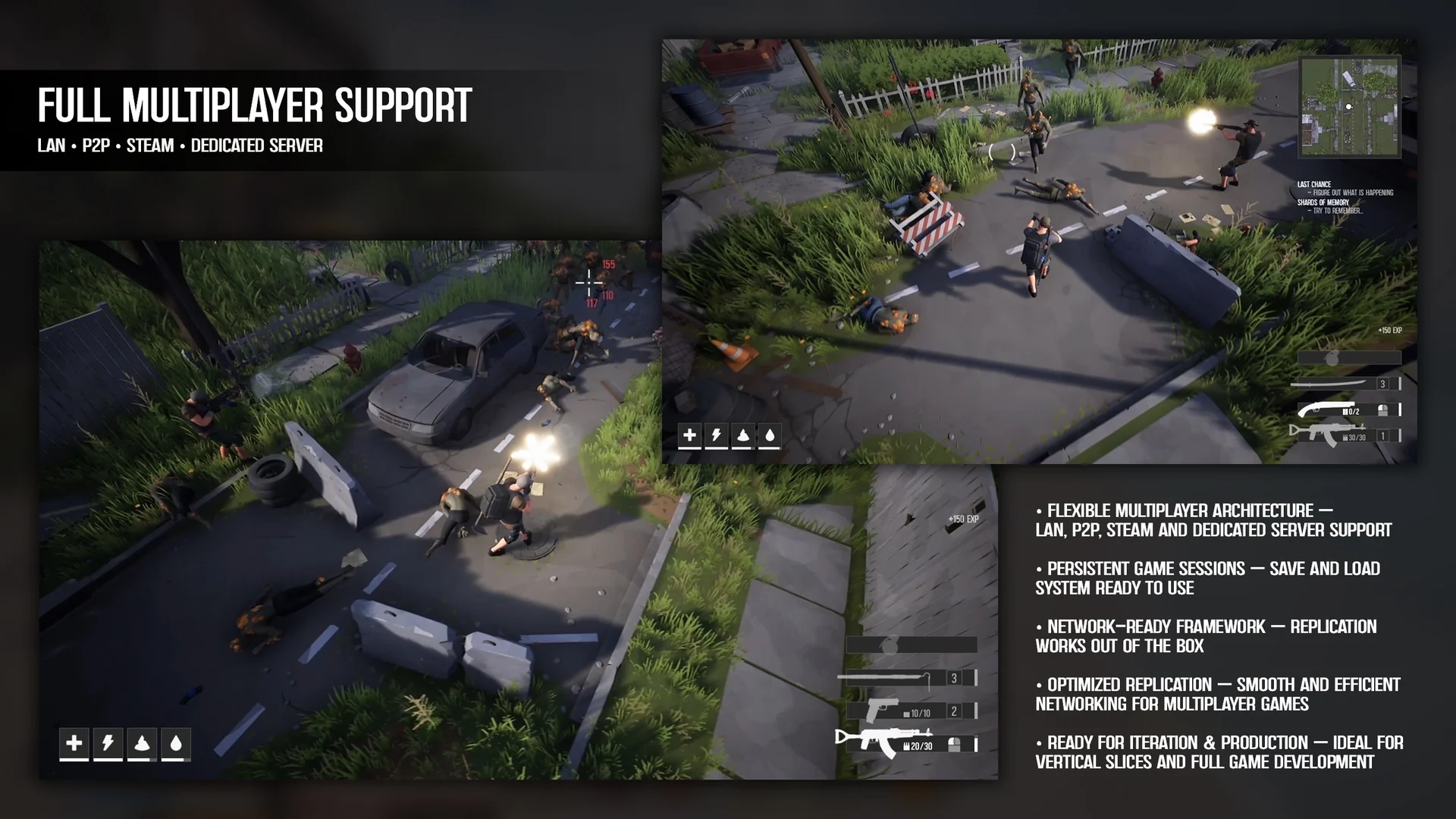
 RPG
RPG RPG
RPG RPG
RPG