"7e6fc58c410f2894"{"id":"1001043","slug":"advanced-turn-based-tile-toolkit","title":"Advanced Turn Based Tile Toolkit","category":"RPG","engine":"5.3+","assetVersion":"Asset Version: 3.5.4","engineVersion":"Engine Version: 5.3+","tag":"RPG","accent":"blue","visual":"mech","summary":"A UE4 toolkit for turn-based tactics with grid pathfinding, square and hexagonal grids, tactical AI, visibility, multiplayer, and multiple example maps.","platform":"Unreal Engine","publishedAt":"2026-08-27T14:35:27.571Z","updatedAt":"2026-08-27T14:35:27.571Z","sourceNotes":[],"fileContents":[],"compatibility":["Unreal Engine","Asset Version: 3.5.4","Engine Version: 5.3+"],"featuredImage":{"alt":"Advanced Turn Based Tile Toolkit","src":"/wp-content/uploads/published/2026/08/0ce862fc44e6-a214e5d5-e57d-4591-ae11-96db49501f2d-402e714e02.webp"},"hasDownloadLink":true,"downloads":0,"terms":[{"taxonomy":"category","slug":"rpg","name":"RPG"}],"galleryImages":[{"src":"/wp-content/uploads/published/2026/08/94076a614b6f-babb8294-0966-4b19-bf07-877a5578018c-e7fa65bbb0.webp","alt":"Advanced Turn Based Tile Toolkit"},{"src":"/wp-content/uploads/published/2026/08/50255250540c-7e43efcf-6cf9-4efa-842c-3b650dfdd7ab-ca61bfe52a.webp","alt":"Advanced Turn Based Tile Toolkit"},{"src":"/wp-content/uploads/published/2026/08/e65991f83d45-309b1528-277b-48fe-a5da-35b4f1ef3371-fa1d97db9f.webp","alt":"Advanced Turn Based Tile Toolkit"},{"src":"/wp-content/uploads/published/2026/08/c89f98f2f0e8-5f2d0846-1e92-4bac-84f5-0522a673c4b3-0f6a461b31.webp","alt":"Advanced Turn Based Tile Toolkit"},{"src":"/wp-content/uploads/published/2026/08/d6dbb6ffd761-063bb1cd-4ad0-4e1a-a2e1-374eaa9fa7d0-0fe7a89736.webp","alt":"Advanced Turn Based Tile Toolkit"},{"src":"/wp-content/uploads/published/2026/08/8db4127dfbb9-604b8a53-028e-4d38-a26e-2e19a5174035-f7cc7dfc2f.webp","alt":"Advanced Turn Based Tile Toolkit"},{"src":"/wp-content/uploads/published/2026/08/d6b1f0a6ce52-8a355d3a-f01a-4aa0-840d-c5cd47b7cf3c-4febda9f6c.webp","alt":"Advanced Turn Based Tile Toolkit"},{"src":"/wp-content/uploads/published/2026/08/eb6a93cf0f79-97bb5a48-a61b-495f-a4ce-d543dd0bee5a-8558a3fe7d.webp","alt":"Advanced Turn Based Tile Toolkit"}],"accessPanel":{"kind":"resource","title":"Download this resource","eyebrow":"Free Download","message":"Log in or create a free account to start your download.","fileName":"AdvancedTurnBasedTileTool.7z","safetyNote":"Resources are manually reviewed before listing to improve quality and reduce obvious risks.","actionLabel":"Download Free","resourceType":"Resource archive"},"contentHtml":"\u003cp\u003eBuilding a turn-based tactics game means assembling a long list of systems that have to work together: grid movement, pathfinding, AI decisions, visibility, and the rules around actions and turns. The Advanced Turn Based Tile Toolkit gathers those pieces into a single UE4 framework, with example projects that range from a tactical cover-and-stealth map to a top-down 2D dungeon crawler with fog of war.\u003c/p\u003e\n\u003cp\u003eThe toolkit is the result of years of consistent updates and improvements. It ships with multiple example projects, hours of video tutorials, and an active Discord community for questions and support. Everything is built with well-organized, commented blueprints, so the system can be customized even by non-programmers.\u003c/p\u003e\n\u003ch2\u003eGrids, Pathfinding, and Building Levels in the Viewport\u003c/h2\u003e\n\u003cp\u003eThe core of the toolkit is grid-based pathfinding with variable movement cost. That means tiles can carry different costs for movement, so a unit might cross open ground quickly but slow down in rough terrain. The system supports square and hexagonal grids, as well as multi-level overlapping grids. It also handles large grids, up to roughly 10,000 tiles by default, with ways to extend further if a project needs more.\u003c/p\u003e\n\u003cp\u003eLevels can be built directly in the UE4 viewport. You can place tiles by drag and drop or let an automatic algorithm generate the layout. That flexibility makes it practical to prototype a map quickly or hand-tune a specific section when the procedural result is not exactly what the design needs.\u003c/p\u003e\n\u003ch2\u003eTactical Depth: AI, Visibility, Cover, and Status Effects\u003c/h2\u003e\n\u003cp\u003eBeyond basic movement, the toolkit includes an intelligent tactical AI system. There is also a visibility system, so units have to actually see each other before they can act. The advanced turn-based tactics example map makes direct use of these systems with cover and stealth mechanics. The package then offers a map that plays more like a tactical shooter turned into a turn-based game than a simple grid-based attacker-and-defender demo.\u003c/p\u003e\n\u003cp\u003eThe tactical RPG map demonstrates a separate approach, with a stat and status effect system layered on top of the grid. That gives the toolkit room to handle both positioning-focused gameplay and character-driven progression. The top-down 2D dungeon crawler map is another distinct genre example, featuring fog of war and consumable items. That map also shows how the toolkit can handle a low-resolution spritesheet style, while the other examples use 3D models.\u003c/p\u003e\n\u003ch2\u003eCamera, Multiplayer, and Blueprint Flexibility\u003c/h2\u003e\n\u003cp\u003eThe toolkit includes a fully realized top-down camera that supports both mobile and keyboard input. That covers one of the often overlooked pieces of a strategy game: controlling the view over a large map. The camera works with the grid system and is built into the same Blueprint setup, so adjustments to movement or camera behavior stay close together.\u003c/p\u003e\n\u003cp\u003eMultiplayer is handled as a core feature rather than an afterthought. The toolkit is fully networked, which is important for a genre that often works well in multiplayer but is hard to retrofit once a prototype is already built. Because all systems are Blueprint-based and commented, the networking code is readable and can be modified without dropping down to C++.\u003c/p\u003e\n\u003cp\u003eThe toolkit is designed to be flexible and allow for many types of turn-based strategy games. That flexibility shows up in the range of example maps: a modern tactical game with cover, a fantasy tactical RPG, and a 2D dungeon crawler. The same underlying grid, pathfinding, and turn logic is reused across all three, with different rules layered on top.\u003c/p\u003e\n\u003ch2\u003eExample Maps and the Assets Behind Them\u003c/h2\u003e\n\u003cp\u003eThe example maps give each genre a working reference, but they also rely on external assets. The example maps use Creative Commons and Epic assets, and these are included in the toolkit. The 2D dungeon crawler map uses a spritesheet licensed under CC0, which means it is free to use commercially without attribution. The sprites were not created by the developer, and they are also available for download elsewhere. That map also includes music by Jon Lunde.\u003c/p\u003e\n\u003cp\u003eThe tactical game example uses 3D models by Invulse Games and icons from game-icons.net. The specific icons are credited to Delapouit (crosshair), Skoll (footsteps), and Lorc (all the rest). The strategy RPG map uses a tree, rock, sword, and monster model from Epic's Infinity Blade packs, as well as animations from Epic's Paragon characters.\u003c/p\u003e\n\u003cp\u003eFor a team that wants to keep the look of the examples, the included assets are ready to use. For a team that wants to go with a different art direction, the included content still serves as a reference for how the systems behave at different visual scales and camera distances.\u003c/p\u003e\n\u003ch2\u003eWorking From the Examples Into a Full Game\u003c/h2\u003e\n\u003cp\u003eThe practical starting point is the example project that most closely matches the game you are building. Because the Blueprints are commented and organized, changing the movement cost of a tile, altering the visibility range, or adding a new status effect can be done in the editor rather than writing code. The video tutorials and changelog track how the system has evolved and how each major feature works.\u003c/p\u003e\n\u003cp\u003eWhat sets this toolkit apart is that it does not force a single genre template. The same framework can be used for a hex-based strategy game, a grid-based tactical RPG, or a dungeon crawler with fog of war. The included examples are not just showcase scenes; they are maps that use the actual game systems, so they can be taken apart and reused piece by piece.\u003c/p\u003e\n\n\u003ch2\u003eExplore Similar Assets\u003c/h2\u003e\n\u003cul\u003e\n\u003cli\u003e\u003ca href=\"https://3dcghub.com/turn-based-jrpg-template/\" title=\"Turn-Based jRPG Template\"\u003eTurn-Based jRPG Template\u003c/a\u003e\u003c/li\u003e\n\u003cli\u003e\u003ca href=\"https://3dcghub.com/turn-based-tactic-starter-pack/\" title=\"Turn Based Tactic Starter Pack\"\u003eTurn Based Tactic Starter Pack\u003c/a\u003e\u003c/li\u003e\n\u003cli\u003e\u003ca href=\"https://3dcghub.com/procedural-turn-in-place-system/\" title=\"Procedural Turn in Place System\"\u003eProcedural Turn in Place System\u003c/a\u003e\u003c/li\u003e\n\u003cli\u003e\u003ca href=\"https://3dcghub.com/tile-based-minimap/\" title=\"Tile Based Minimap\"\u003eTile Based Minimap\u003c/a\u003e\u003c/li\u003e\n\u003cli\u003e\u003ca href=\"https://3dcghub.com/advanced-tactical-based-system/\" title=\"Advanced Tactical-based System\"\u003eAdvanced Tactical-based System\u003c/a\u003e\u003c/li\u003e\n\u003c/ul\u003e","contentTextLength":5680,"navigation":{"current":684,"total":3618,"previous":{"id":"1001044","slug":"ai-optimizer","title":"AI Optimizer","category":"Engine Tools","platform":"Unreal Engine","updatedAt":"2026-08-27T14:42:21.040Z"},"next":{"id":"1001042","slug":"advanced-third-person-shooter-project","title":"Advanced Third Person Shooter Project","category":"Shooter","platform":"Unreal Engine","updatedAt":"2026-08-27T14:32:21.775Z"}},"relatedResources":[{"id":"1001253","slug":"turn-based-strategy-rpg-template","title":"Turn-Based Strategy RPG Template","category":"RPG","engine":"5.0+","assetVersion":"","engineVersion":"Engine Version: 5.0+","tag":"RPG","accent":"blue","visual":"mech","summary":"Explore the Turn-Based Strategy RPG Template featuring square and hex grids, Blueprint architecture, elemental combat, quest systems, and AI mechanics.","platform":"Unreal Engine","publishedAt":"2026-09-23T15:40:14.497Z","updatedAt":"2026-09-23T15:40:14.497Z","sourceNotes":[],"fileContents":[],"compatibility":["Unreal Engine","Engine Version: 5.0+"],"featuredImage":{"alt":"Turn-Based Strategy RPG Template","src":"/wp-content/uploads/published/2026/09/33fb4f14422f-c8440a90-3434-4425-b9cc-f90eb9acad66-ef61d0e044.webp"},"hasDownloadLink":true,"downloads":0},{"id":"1000898","slug":"turn-based-jrpg-template","title":"Turn-Based jRPG Template","category":"RPG","engine":"5.4+","assetVersion":"Asset Version: 12.4.0","engineVersion":"Engine Version: 5.4+","tag":"RPG","accent":"blue","visual":"mech","summary":"A fully Blueprint-driven turn-based JRPG template with same-map exploration and battles, equipment visuals, quests, crafting, save/load, and mobile/console supp","platform":"Unreal Engine","publishedAt":"2026-08-06T04:55:52.266Z","updatedAt":"2026-08-06T04:55:52.266Z","sourceNotes":[],"fileContents":[],"compatibility":["Unreal Engine","Asset Version: 12.4.0","Engine Version: 5.4+"],"featuredImage":{"alt":"Turn-Based jRPG Template","src":"/wp-content/uploads/published/2026/08/32552b8463f9-c012103c-6661-4ee2-b632-47bd65648896-aa336cda0e.webp"},"hasDownloadLink":true,"downloads":0},{"id":"1001250","slug":"open-world-rpg-toolkit","title":"Open World RPG Toolkit","category":"RPG","engine":"5.0+","assetVersion":"","engineVersion":"Engine Version: 5.0+","tag":"RPG","accent":"blue","visual":"mech","summary":"Explore the Open World RPG Toolkit, featuring 47 network-replicated blueprints covering quests, inventory, map setup, saves, and survival systems.","platform":"Unreal Engine","publishedAt":"2026-09-23T15:32:52.651Z","updatedAt":"2026-09-23T15:32:52.651Z","sourceNotes":[],"fileContents":[],"compatibility":["Unreal Engine","Engine Version: 5.0+"],"featuredImage":{"alt":"Open World RPG Toolkit","src":"/wp-content/uploads/published/2026/09/5cd2af69cae2-b06f35c2-d7a7-4212-8d3b-32855ff16e82-d90a9599f6.webp"},"hasDownloadLink":true,"downloads":0}]}
RPG
Advanced Turn Based Tile Toolkit
A UE4 toolkit for turn-based tactics with grid pathfinding, square and hexagonal grids, tactical AI, visibility, multiplayer, and multiple example maps.
Building a turn-based tactics game means assembling a long list of systems that have to work together: grid movement, pathfinding, AI decisions, visibility, and the rules around actions and turns. The Advanced Turn Based Tile Toolkit gathers those pieces into a single UE4 framework, with example projects that range from a tactical cover-and-stealth map to a top-down 2D dungeon crawler with fog of war.
The toolkit is the result of years of consistent updates and improvements. It ships with multiple example projects, hours of video tutorials, and an active Discord community for questions and support. Everything is built with well-organized, commented blueprints, so the system can be customized even by non-programmers.
Grids, Pathfinding, and Building Levels in the Viewport
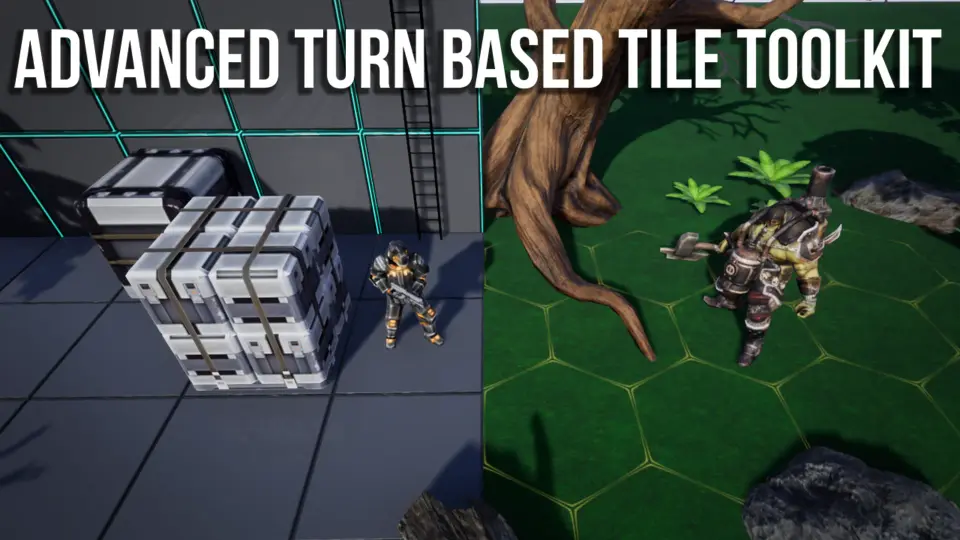
The core of the toolkit is grid-based pathfinding with variable movement cost. That means tiles can carry different costs for movement, so a unit might cross open ground quickly but slow down in rough terrain. The system supports square and hexagonal grids, as well as multi-level overlapping grids. It also handles large grids, up to roughly 10,000 tiles by default, with ways to extend further if a project needs more.
Levels can be built directly in the UE4 viewport. You can place tiles by drag and drop or let an automatic algorithm generate the layout. That flexibility makes it practical to prototype a map quickly or hand-tune a specific section when the procedural result is not exactly what the design needs.
Tactical Depth: AI, Visibility, Cover, and Status Effects
Beyond basic movement, the toolkit includes an intelligent tactical AI system. There is also a visibility system, so units have to actually see each other before they can act. The advanced turn-based tactics example map makes direct use of these systems with cover and stealth mechanics. The package then offers a map that plays more like a tactical shooter turned into a turn-based game than a simple grid-based attacker-and-defender demo.
The tactical RPG map demonstrates a separate approach, with a stat and status effect system layered on top of the grid. That gives the toolkit room to handle both positioning-focused gameplay and character-driven progression. The top-down 2D dungeon crawler map is another distinct genre example, featuring fog of war and consumable items. That map also shows how the toolkit can handle a low-resolution spritesheet style, while the other examples use 3D models.
Camera, Multiplayer, and Blueprint Flexibility
The toolkit includes a fully realized top-down camera that supports both mobile and keyboard input. That covers one of the often overlooked pieces of a strategy game: controlling the view over a large map. The camera works with the grid system and is built into the same Blueprint setup, so adjustments to movement or camera behavior stay close together.
Multiplayer is handled as a core feature rather than an afterthought. The toolkit is fully networked, which is important for a genre that often works well in multiplayer but is hard to retrofit once a prototype is already built. Because all systems are Blueprint-based and commented, the networking code is readable and can be modified without dropping down to C++.
The toolkit is designed to be flexible and allow for many types of turn-based strategy games. That flexibility shows up in the range of example maps: a modern tactical game with cover, a fantasy tactical RPG, and a 2D dungeon crawler. The same underlying grid, pathfinding, and turn logic is reused across all three, with different rules layered on top.
Example Maps and the Assets Behind Them
The example maps give each genre a working reference, but they also rely on external assets. The example maps use Creative Commons and Epic assets, and these are included in the toolkit. The 2D dungeon crawler map uses a spritesheet licensed under CC0, which means it is free to use commercially without attribution. The sprites were not created by the developer, and they are also available for download elsewhere. That map also includes music by Jon Lunde.
The tactical game example uses 3D models by Invulse Games and icons from game-icons.net. The specific icons are credited to Delapouit (crosshair), Skoll (footsteps), and Lorc (all the rest). The strategy RPG map uses a tree, rock, sword, and monster model from Epic's Infinity Blade packs, as well as animations from Epic's Paragon characters.
For a team that wants to keep the look of the examples, the included assets are ready to use. For a team that wants to go with a different art direction, the included content still serves as a reference for how the systems behave at different visual scales and camera distances.
Working From the Examples Into a Full Game
The practical starting point is the example project that most closely matches the game you are building. Because the Blueprints are commented and organized, changing the movement cost of a tile, altering the visibility range, or adding a new status effect can be done in the editor rather than writing code. The video tutorials and changelog track how the system has evolved and how each major feature works.
What sets this toolkit apart is that it does not force a single genre template. The same framework can be used for a hex-based strategy game, a grid-based tactical RPG, or a dungeon crawler with fog of war. The included examples are not just showcase scenes; they are maps that use the actual game systems, so they can be taken apart and reused piece by piece.
 RPG
RPG
 RPG
RPG RPG
RPG RPG
RPG