"7b46a695175d8694"{"id":"1001469","slug":"resistance-holdout","title":"Resistance Holdout","category":"Historical","engine":"5.4+","assetVersion":"","engineVersion":"Engine Version: 5.4+","tag":"Historical","accent":"blue","visual":"mech","summary":"Technical breakdown of Resistance Holdout for Unreal Engine, covering its 197 modular meshes, channel-packed RMAO textures, and material controls.","platform":"Unreal Engine","publishedAt":"2026-10-08T08:21:34.955Z","updatedAt":"2026-10-08T08:21:34.955Z","sourceNotes":[],"fileContents":[],"compatibility":["Unreal Engine","Engine Version: 5.4+"],"featuredImage":{"alt":"Resistance Holdout","src":"/wp-content/uploads/published/2026/10/29d767c154d3-e4f4be27-702c-4158-b840-4bbd99b3d781-874cfad622.webp"},"hasDownloadLink":true,"downloads":0,"terms":[{"taxonomy":"category","slug":"historical","name":"Historical"}],"galleryImages":[{"src":"/wp-content/uploads/published/2026/10/3f925e60d18a-db12094a-70d4-40d6-bba9-817674af1adb-7e6d88e16e.webp","alt":"Resistance Holdout"},{"src":"/wp-content/uploads/published/2026/10/d02f19f712df-1f66dd15-25a1-4202-b06b-090508e431c8-135a8145bd.webp","alt":"Resistance Holdout"},{"src":"/wp-content/uploads/published/2026/10/46acb2662fdd-a344219d-0623-4088-a2b9-d8f6d45d1020-0098cb0e20.webp","alt":"Resistance Holdout"},{"src":"/wp-content/uploads/published/2026/10/bc3a1d282d31-0aeae15e-e766-4aa7-857d-5d38eeb326f1-5882cc2a4b.webp","alt":"Resistance Holdout"},{"src":"/wp-content/uploads/published/2026/10/496bdf93bd26-e64a5430-6ae5-4411-9091-d4a46cd7c852-9c565c7f18.webp","alt":"Resistance Holdout"},{"src":"/wp-content/uploads/published/2026/10/ae834d2c5eb9-0c30e5ec-9f28-4724-bf02-840bb8219432-2361122bea.webp","alt":"Resistance Holdout"},{"src":"/wp-content/uploads/published/2026/10/87d4b4173d9c-f83b5663-cd64-4dee-86ff-24088f76460d-39637e0e38.webp","alt":"Resistance Holdout"},{"src":"/wp-content/uploads/published/2026/10/958ad42735a0-09840011-4a20-4963-9880-54910acb94ba-eaa98ca05c.webp","alt":"Resistance Holdout"},{"src":"/wp-content/uploads/published/2026/10/84d250a62829-42deb4c9-0ae3-4083-aa49-4ca25ae5b722-f35069ec88.webp","alt":"Resistance Holdout"},{"src":"/wp-content/uploads/published/2026/10/9955bd9180d9-b4831da0-9552-4fad-9415-9c5842d305d7-59c5615bd1.webp","alt":"Resistance Holdout"}],"accessPanel":{"kind":"resource","title":"Download this resource","eyebrow":"Free Download","message":"Log in or create a free account to start your download.","fileName":"Resistance Holdout.7z","safetyNote":"Resources are manually reviewed before listing to improve quality and reduce obvious risks.","actionLabel":"Download Free","resourceType":"Resource archive"},"contentHtml":"\u003ch2\u003eSetting Up the Resistance Holdout Scene in Unreal Engine\u003c/h2\u003e\u003cp\u003eDeploying the Resistance Holdout package into an active project introduces a complete environment framework with all constituent maps, assets, and master materials configured directly for Unreal Engine. Rather than requiring users to manually assemble shader networks or re-link detached map references, the environment arrives with its layout staged out of the box. Level designers can open the master showcase map immediately to inspect the intended spatial arrangement or extract individual building blocks into distinct sub-levels and gameplay spaces.\u003c/p\u003e\u003cp\u003eThe structural scope focuses on French architectural archetypes, leaning into dense urban exteriors, old apartment facades, and defensive wartime fortifications. Because the assets are structured to maintain realistic AAA visual standards while staying strictly within real-time rendering budgets, dropping the environment into an existing level does not require sweeping geometry passes or shader refactoring. Teams can immediately begin staging vantage points, blocking out navigation paths, or adjusting spatial scales for third-person or first-person camera perspectives.\u003c/p\u003e\u003ch2\u003eModular Construction Across 197 Meshes\u003c/h2\u003e\u003cp\u003eThe structural framework relies on an asset library containing 197 meshes. These pieces cover low-poly modular architectural components, structural exterior trims, building surfaces, and contextual environmental props that establish a French city setting. The modularity allows level artists to break apart the pre-assembled apartment and condo facades, reconfiguring them into varying city blocks, defensive chokepoints, or narrow European streets without visible seam mismatches.\u003c/p\u003e\u003cp\u003eBalancing polycounts against visual density remains central to how these 197 meshes function in runtime scenarios. Each asset adheres to a low-poly budget without sacrificing edge silhouettes, making the library suitable for performance-sensitive game projects. The meshes support multiple thematic directions, serving realistic modern or historic war scenarios while accommodating stylized or fantasy adjustments depending on world composition choices. Because the modules snap together cleanly, staging multi-story apartment exteriors or dilapidated urban compounds requires minimal custom geometry work.\u003c/p\u003e\u003ch2\u003eMaterial Pipeline and Channel Packed Shading Controls\u003c/h2\u003e\u003cp\u003eMaterial efficiency in Resistance Holdout is driven by an industry-standard channel-packing workflow. Roughness, metalness, and ambient occlusion data are condensed into single composite textures, occupying separate color channels to minimize texture memory overhead and reduce texture sampler calls in the shader graph:\u003c/p\u003e\u003cul\u003e\u003cli\u003eRed Channel: Ambient Occlusion\u003c/li\u003e\u003cli\u003eGreen Channel: Roughness\u003c/li\u003e\u003cli\u003eBlue Channel: Metalness\u003c/li\u003e\u003c/ul\u003e\u003cp\u003eConsolidating these surface properties into an RMAO mask allows the shaders to execute efficiently across dense scenes. Beyond basic map assignment, the master material system exposes deep parametric controls directly within material instances. Technical artists and lighters can manipulate roughness levels, albedo color tints, normal intensity, and tiling values per mesh instance without compiling new master shaders.\u003c/p\u003e\u003cp\u003eThe inclusion of subsurface scattering parameters is particularly valuable for realistic organic or semi-translucent surface responses within the scene. By dialing subsurface parameters alongside micro-tiling modifiers, artists can fine-tune surface density, stone weathering, and structural wear to match specific daylight angles or damp atmospheric settings.\u003c/p\u003e\u003ch2\u003eLighting Integration with Cinematic Post Process and LUT\u003c/h2\u003e\u003cp\u003eVisual fidelity in the package is unified through a dedicated cinematic post-process setup and a custom look-up table. The look-up table establishes consistent contrast, shadow depth, and mid-tone saturation across the scene, anchoring the gritty French exterior aesthetic without forcing artists to reconstruct grading profiles from scratch.\u003c/p\u003e\u003cp\u003eBecause the post-process volume interacts directly with the PBR-calibrated albedo and roughness maps, the environment retains balanced exposure values across varying camera angles. Lighters can adjust the weight of the look-up table or swap post-processing attributes to transition the mood from a stark war-torn street into a warmer urban evening. The pre-configured lighting balances strong directional sunlight against deep ambient occlusion in narrow alleyways, preserving readability across complex architectural silhouettes.\u003c/p\u003e\u003ch2\u003eExterior Dressing and Foliage VOL.23 Ivy Compatibility\u003c/h2\u003e\u003cp\u003ePopulating old building facades with organic wear is supported through direct compatibility with Foliage VOL.23 - Ivy (Low Poly). The modular exterior meshes, masonry walls, and window ledges provide natural anchoring surfaces for placing climbing ivy strands and ground-level overgrowth.\u003c/p\u003e\u003cp\u003eIntegrating low-poly ivy alongside the 197 architectural meshes enhances the environmental storytelling of an abandoned or contested holdout. The foliage assets blend naturally with the material system, matching the low-poly performance envelope while breaking up straight modular lines on apartment walls, stone arches, and street-level barricades.\u003c/p\u003e\u003ch2\u003eProduction Standards and Performance Readiness\u003c/h2\u003e\u003cp\u003eCreated by Dekogon Studios guest artist Abraham Agaton Lopez, the environment reflects rigorous production standards built specifically for game deployment. Every mesh, texture set, and lighting variable is optimized to preserve draw call efficiency and memory bandwidth while achieving AAA presentation standards. With its channel-packed textures, customizable material instances, and modular exterior flexibility, Resistance Holdout serves as a production-ready toolkit for building detailed urban levels directly inside Unreal Engine.\u003c/p\u003e\n\n\u003ch2\u003eContinue Browsing Similar Packs\u003c/h2\u003e\n\u003cul\u003e\n\u003cli\u003e\u003ca href=\"https://3dcghub.com/ancient-mountain-temple-nanite/\" title=\"Ancient Mountain Temple (Nanite)\"\u003eAncient Mountain Temple (Nanite)\u003c/a\u003e\u003c/li\u003e\n\u003cli\u003e\u003ca href=\"https://3dcghub.com/pharaoh-s-legacy-egyptian-temple-megapack/\" title=\"Pharaoh\u0026#039;s Legacy: Egyptian Temple Megapack\"\u003ePharaoh\u0026#039;s Legacy: Egyptian Temple Megapack\u003c/a\u003e\u003c/li\u003e\n\u003cli\u003e\u003ca href=\"https://3dcghub.com/gladiator-arena-environment-kit/\" title=\"Gladiator Arena Environment Kit\"\u003eGladiator Arena Environment Kit\u003c/a\u003e\u003c/li\u003e\n\u003cli\u003e\u003ca href=\"https://3dcghub.com/throne-room-environment-kit/\" title=\"Throne Room Environment Kit\"\u003eThrone Room Environment Kit\u003c/a\u003e\u003c/li\u003e\n\u003cli\u003e\u003ca href=\"https://3dcghub.com/ancient-mayan-ruins/\" title=\"Ancient Mayan Ruins\"\u003eAncient Mayan Ruins\u003c/a\u003e\u003c/li\u003e\n\u003c/ul\u003e","contentTextLength":5956,"navigation":{"current":78,"total":3481,"previous":{"id":"1001470","slug":"safe-house-vol-1-supplies-and-guns-nanite-and-low-poly","title":"Safe House VOL.1 - Supplies and Guns (Nanite and Low Poly)","category":"Weapons \u0026 Combat","platform":"Unreal Engine","updatedAt":"2026-10-08T08:22:20.673Z"},"next":{"id":"1001468","slug":"landscaping-garden-1","title":"Landscaping Garden 1","category":"Forest \u0026 Jungle","platform":"Unreal Engine","updatedAt":"2026-10-08T08:17:47.348Z"}},"relatedResources":[{"id":"1001331","slug":"ancient-mountain-temple-nanite","title":"Ancient Mountain Temple (Nanite)","category":"Historical","engine":"5.2+","assetVersion":"","engineVersion":"Engine Version: 5.2+","tag":"Historical","accent":"blue","visual":"mech","summary":"Detailed breakdown of the Ancient Mountain Temple package for Unreal Engine 5.0+, covering Nanite modular meshes, Lumen dynamic lighting, and 4K textures.","platform":"Unreal Engine","publishedAt":"2026-10-03T17:12:02.776Z","updatedAt":"2026-10-03T17:12:02.776Z","sourceNotes":[],"fileContents":[],"compatibility":["Unreal Engine","Engine Version: 5.2+"],"featuredImage":{"alt":"Ancient Mountain Temple (Nanite)","src":"/wp-content/uploads/published/2026/10/2ddd03aba3c6-c5c44e63-c1c3-4c4a-8cc2-42afd2fff140-1a24528ea5.webp"},"hasDownloadLink":true,"downloads":0},{"id":"1000962","slug":"pharaoh-s-legacy-egyptian-temple-megapack","title":"Pharaoh's Legacy: Egyptian Temple Megapack","category":"Historical","engine":"5.1+","assetVersion":"","engineVersion":"Engine Version: 5.1+","tag":"Historical","accent":"blue","visual":"mech","summary":"Over 300 Egyptian temple assets for UE 5.4, with Nanite/Lumen support, modular prefabs, and master materials. Epic Water and Volumetric plugins required.","platform":"Unreal Engine","publishedAt":"2026-08-14T16:36:17.986Z","updatedAt":"2026-08-14T16:36:17.986Z","sourceNotes":[],"fileContents":[],"compatibility":["Unreal Engine","Engine Version: 5.1+"],"featuredImage":{"alt":"Pharaoh's Legacy: Egyptian Temple Megapack","src":"/wp-content/uploads/published/2026/08/4ce06b0e30f6-34cb77c7-10e2-4330-b954-9b021c0df487-573e8d99ad.webp"},"hasDownloadLink":true,"downloads":1},{"id":"1000993","slug":"gladiator-arena-environment-kit","title":"Gladiator Arena Environment Kit","category":"Historical","engine":"5.0+","assetVersion":"","engineVersion":"Engine Version: 5.0+","tag":"Historical","accent":"blue","visual":"city","summary":"A Roman gladiator coliseum environment kit with themed meshes, PBR materials, a demo level, and Dragon Cave compatibility. Pillars, props, flags, and architectu","platform":"Unreal Engine","publishedAt":"2026-08-19T03:38:54.795Z","updatedAt":"2026-08-19T03:38:54.795Z","sourceNotes":[],"fileContents":[],"compatibility":["Unreal Engine","Engine Version: 5.0+"],"featuredImage":{"alt":"Gladiator Arena Environment Kit","src":"/wp-content/uploads/published/2026/08/e1b3dda14df1-273d0cae-e350-4a1a-97cb-4453038dcc7f-425a0b510f.webp"},"hasDownloadLink":true,"downloads":1}]}
Historical
Resistance Holdout
Technical breakdown of Resistance Holdout for Unreal Engine, covering its 197 modular meshes, channel-packed RMAO textures, and material controls.
Category:Unreal Engine,HistoricalPlatform: Unreal EngineEngine Version: 5.4+Published: Oct 8, 2026
Historical
Resource overview
Setting Up the Resistance Holdout Scene in Unreal Engine
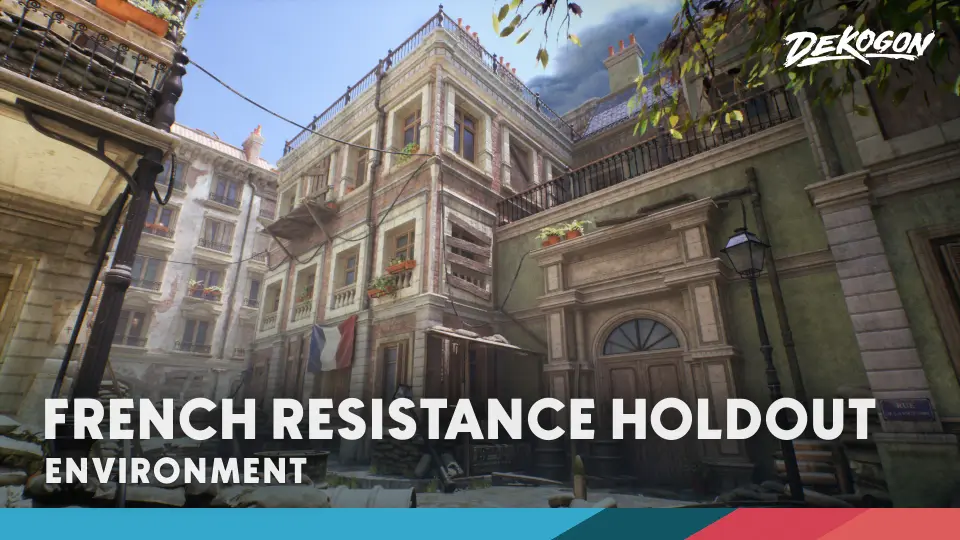
Deploying the Resistance Holdout package into an active project introduces a complete environment framework with all constituent maps, assets, and master materials configured directly for Unreal Engine. Rather than requiring users to manually assemble shader networks or re-link detached map references, the environment arrives with its layout staged out of the box. Level designers can open the master showcase map immediately to inspect the intended spatial arrangement or extract individual building blocks into distinct sub-levels and gameplay spaces.
The structural scope focuses on French architectural archetypes, leaning into dense urban exteriors, old apartment facades, and defensive wartime fortifications. Because the assets are structured to maintain realistic AAA visual standards while staying strictly within real-time rendering budgets, dropping the environment into an existing level does not require sweeping geometry passes or shader refactoring. Teams can immediately begin staging vantage points, blocking out navigation paths, or adjusting spatial scales for third-person or first-person camera perspectives.
Modular Construction Across 197 Meshes
The structural framework relies on an asset library containing 197 meshes. These pieces cover low-poly modular architectural components, structural exterior trims, building surfaces, and contextual environmental props that establish a French city setting. The modularity allows level artists to break apart the pre-assembled apartment and condo facades, reconfiguring them into varying city blocks, defensive chokepoints, or narrow European streets without visible seam mismatches.
Balancing polycounts against visual density remains central to how these 197 meshes function in runtime scenarios. Each asset adheres to a low-poly budget without sacrificing edge silhouettes, making the library suitable for performance-sensitive game projects. The meshes support multiple thematic directions, serving realistic modern or historic war scenarios while accommodating stylized or fantasy adjustments depending on world composition choices. Because the modules snap together cleanly, staging multi-story apartment exteriors or dilapidated urban compounds requires minimal custom geometry work.
Material Pipeline and Channel Packed Shading Controls
Material efficiency in Resistance Holdout is driven by an industry-standard channel-packing workflow. Roughness, metalness, and ambient occlusion data are condensed into single composite textures, occupying separate color channels to minimize texture memory overhead and reduce texture sampler calls in the shader graph:
Red Channel: Ambient Occlusion
Green Channel: Roughness
Blue Channel: Metalness
Consolidating these surface properties into an RMAO mask allows the shaders to execute efficiently across dense scenes. Beyond basic map assignment, the master material system exposes deep parametric controls directly within material instances. Technical artists and lighters can manipulate roughness levels, albedo color tints, normal intensity, and tiling values per mesh instance without compiling new master shaders.
The inclusion of subsurface scattering parameters is particularly valuable for realistic organic or semi-translucent surface responses within the scene. By dialing subsurface parameters alongside micro-tiling modifiers, artists can fine-tune surface density, stone weathering, and structural wear to match specific daylight angles or damp atmospheric settings.
Lighting Integration with Cinematic Post Process and LUT
Visual fidelity in the package is unified through a dedicated cinematic post-process setup and a custom look-up table. The look-up table establishes consistent contrast, shadow depth, and mid-tone saturation across the scene, anchoring the gritty French exterior aesthetic without forcing artists to reconstruct grading profiles from scratch.
Because the post-process volume interacts directly with the PBR-calibrated albedo and roughness maps, the environment retains balanced exposure values across varying camera angles. Lighters can adjust the weight of the look-up table or swap post-processing attributes to transition the mood from a stark war-torn street into a warmer urban evening. The pre-configured lighting balances strong directional sunlight against deep ambient occlusion in narrow alleyways, preserving readability across complex architectural silhouettes.
Exterior Dressing and Foliage VOL.23 Ivy Compatibility
Populating old building facades with organic wear is supported through direct compatibility with Foliage VOL.23 - Ivy (Low Poly). The modular exterior meshes, masonry walls, and window ledges provide natural anchoring surfaces for placing climbing ivy strands and ground-level overgrowth.
Integrating low-poly ivy alongside the 197 architectural meshes enhances the environmental storytelling of an abandoned or contested holdout. The foliage assets blend naturally with the material system, matching the low-poly performance envelope while breaking up straight modular lines on apartment walls, stone arches, and street-level barricades.
Production Standards and Performance Readiness
Created by Dekogon Studios guest artist Abraham Agaton Lopez, the environment reflects rigorous production standards built specifically for game deployment. Every mesh, texture set, and lighting variable is optimized to preserve draw call efficiency and memory bandwidth while achieving AAA presentation standards. With its channel-packed textures, customizable material instances, and modular exterior flexibility, Resistance Holdout serves as a production-ready toolkit for building detailed urban levels directly inside Unreal Engine.
 Historical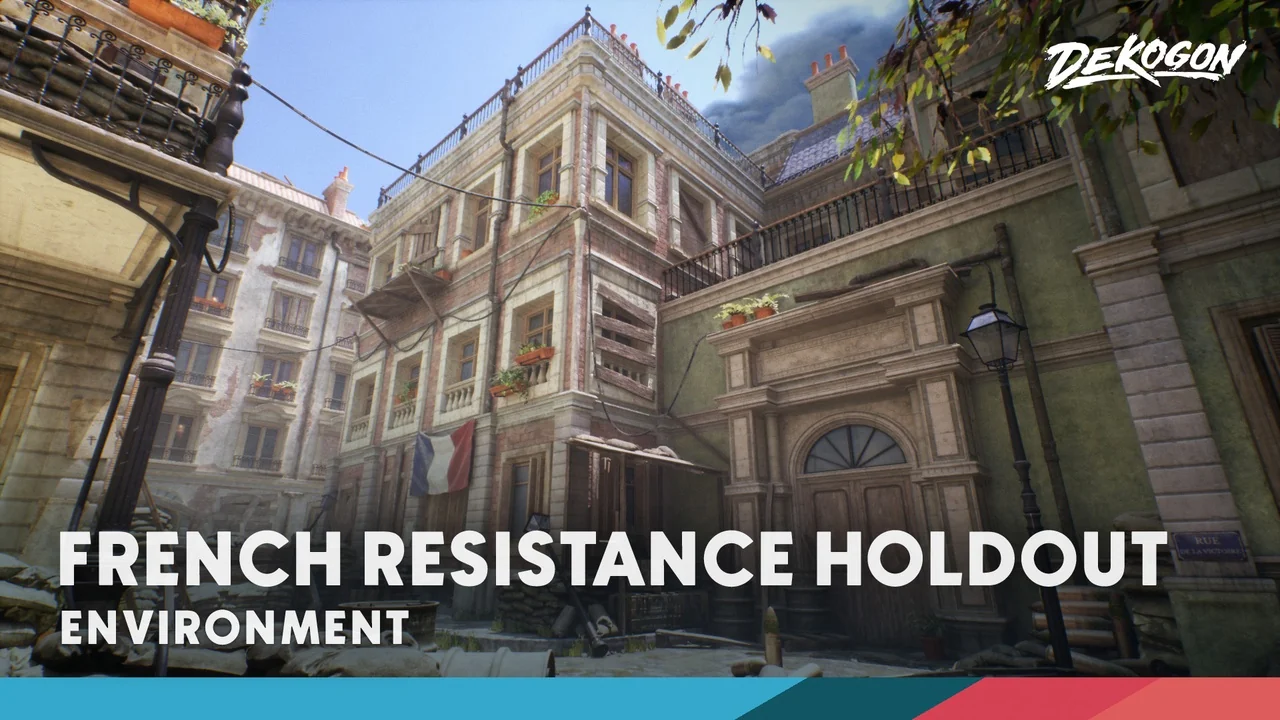
 Historical
 Historical
 Historical