"1f00f67f9253451b"{"id":"1000962","slug":"pharaoh-s-legacy-egyptian-temple-megapack","title":"Pharaoh's Legacy: Egyptian Temple Megapack","category":"Historical","engine":"5.1+","assetVersion":"","engineVersion":"Engine Version: 5.1+","tag":"Historical","accent":"blue","visual":"mech","summary":"Over 300 Egyptian temple assets for UE 5.4, with Nanite/Lumen support, modular prefabs, and master materials. Epic Water and Volumetric plugins required.","platform":"Unreal Engine","publishedAt":"2026-08-14T16:36:17.986Z","updatedAt":"2026-08-14T16:36:17.986Z","sourceNotes":[],"fileContents":[],"compatibility":["Unreal Engine","Engine Version: 5.1+"],"featuredImage":{"alt":"Pharaoh's Legacy: Egyptian Temple Megapack","src":"/wp-content/uploads/published/2026/08/4ce06b0e30f6-34cb77c7-10e2-4330-b954-9b021c0df487-573e8d99ad.webp"},"hasDownloadLink":true,"downloads":1,"terms":[{"taxonomy":"category","slug":"historical","name":"Historical"}],"galleryImages":[{"src":"/wp-content/uploads/published/2026/08/6121a9faa73f-b2f9ba4e-4a3f-4978-a486-3449da3d711f-c97ffae77c.webp","alt":"Pharaoh's Legacy: Egyptian Temple Megapack"},{"src":"/wp-content/uploads/published/2026/08/4482125ccba1-e261b658-8337-4782-8fc6-c674998a0b4f-974f04d9d8.webp","alt":"Pharaoh's Legacy: Egyptian Temple Megapack"},{"src":"/wp-content/uploads/published/2026/08/b3618709cd28-5e091506-6e8e-4451-9177-93567f0318b2-c9878847e6.webp","alt":"Pharaoh's Legacy: Egyptian Temple Megapack"},{"src":"/wp-content/uploads/published/2026/08/bdbcb9cbcb55-914c8909-d17b-4646-bf02-8900a6816f59-84e4f0372e.webp","alt":"Pharaoh's Legacy: Egyptian Temple Megapack"},{"src":"/wp-content/uploads/published/2026/08/6cfb1c4bbebe-1d6cf5c1-00ff-4e63-bf84-4fb35d048847-1894d8fff4.webp","alt":"Pharaoh's Legacy: Egyptian Temple Megapack"},{"src":"/wp-content/uploads/published/2026/08/f126fc0cc84e-523b285f-3d27-422c-87f2-5f192a86ff33-04bc77afc6.webp","alt":"Pharaoh's Legacy: Egyptian Temple Megapack"},{"src":"/wp-content/uploads/published/2026/08/e5d4198e89dc-c6bf2d8e-3c7d-4149-bd11-d2580148e83e-74d2ca791b.webp","alt":"Pharaoh's Legacy: Egyptian Temple Megapack"},{"src":"/wp-content/uploads/published/2026/08/f5bc076414b9-36e6b33b-842a-47d9-851f-91633d29f159-10c398a200.webp","alt":"Pharaoh's Legacy: Egyptian Temple Megapack"},{"src":"/wp-content/uploads/published/2026/08/e6b78a4c011a-9695d9ef-55cb-4d35-a610-0314b6ec98b0-8e5cd76d2a.webp","alt":"Pharaoh's Legacy: Egyptian Temple Megapack"},{"src":"/wp-content/uploads/published/2026/08/83801a64a1ee-061045d9-1eb2-4520-804e-d5ab8dc32490-41c0b1a34f.webp","alt":"Pharaoh's Legacy: Egyptian Temple Megapack"}],"accessPanel":{"kind":"resource","title":"Download this resource","eyebrow":"Free Download","message":"Log in or create a free account to start your download.","fileName":"Content.7z","safetyNote":"Resources are manually reviewed before listing to improve quality and reduce obvious risks.","actionLabel":"Download Free","resourceType":"Resource archive"},"contentHtml":"\u003cp\u003ePharaoh's Legacy: Egyptian Temple Megapack is a large environment collection for Unreal Engine based on a single, clearly defined subject: ancient Egypt. It brings together pyramids, temple interiors, tomb spaces, and an oasis into one project, with the goal of letting a developer populate a full level without assembling every block from scratch. The pack contains more than 300 crafted assets, which puts it closer to a small production library than a handful of decorative props.\u003c/p\u003e\u003ch2\u003eOver 300 Assets for an Ancient Egyptian Setting\u003c/h2\u003e\u003cp\u003eThe tags attached to the pack — pharaoh, oasis, tomb, Egyptian, level, temple, Egypt, pyramid, ancient, and city — map out the full range of the collection. A project can build monumental exteriors, place a tomb complex under the sand, and set a city district near a water source, all from the same asset family. The presentation leans into the atmosphere of ancient Egypt: towering pyramids, magnificent temples, and secrets that feel locked inside the stone. That gives the asset library a strong starting direction.\u003c/p\u003e\u003ch2\u003eThe Two Epic Plugins Needed Before Loading the Level\u003c/h2\u003e\u003cp\u003eBefore the pack shows what it can do, two Unreal Engine plugins have to be active. The oasis uses Epic's Water Plugin, and some of the cloud effects run on the Volumetric Plugin. Both are standard Epic plugins, so no extra download is needed, but they must be enabled in the project.\u003c/p\u003e\u003cp\u003eThe level named LV_Landscape can stay invisible until those plugins are switched on and the project is restarted. Anyone opening the pack for the first time should activate Water and Volumetric, restart, and then load the landscape level. Skipping that step can make the scene look broken or empty, even though the problem is just the missing plugin state.\u003c/p\u003e\u003ch2\u003eModular Temple Pieces, Prefabs, and Master Materials\u003c/h2\u003e\u003cp\u003eConstruction in the pack is based on modular design and prefabs. The modular pieces let a designer snap together walls, columns, and other architectural sections into a temple layout. Prefabs group related pieces into larger ready-to-place structures, so a full facade or interior section can drop into a level faster than placing each element individually.\u003c/p\u003e\u003cp\u003eThe pack's six central strengths are listed clearly: an extensive asset library, modular design and prefabs, Nanite and Lumen compatibility, powerful master materials, game-ready optimization, and comprehensive documentation. The master materials are the part that pushes this beyond a static mesh dump. Parameters can be adjusted for different visual effects, which means a stone wall used in a sunlit courtyard and the same wall inside a dark tomb can look completely different without new texture work.\u003c/p\u003e\u003ch2\u003eNanite, Lumen, and Optimized Scene Performance\u003c/h2\u003e\u003cp\u003eThe pack supports both Nanite and Lumen, two systems that shape how an Unreal Engine scene looks in 5.4. Nanite handles dense geometry like carved stone and complex temple details without the usual cost, while Lumen brings the kind of bounced lighting that suits wide desert and dark interior spaces.\u003c/p\u003e\u003cp\u003eThe optimization side is stated plainly as game-ready, with an emphasis on outstanding performance. That matters for a pack this size. More than 300 assets and a full landscape level could easily turn into a burden for a real-time project, so the pack is positioned for interactive use rather than only for static renders.\u003c/p\u003e\u003ch2\u003eShowcase Works: The Aaru and Nebu\u003c/h2\u003e\u003cp\u003eThe pack presents two showcase scenes: The Aaru and Nebu. Both were created as examples of what the asset set can produce, and they give a practical reference for the visual range of the collection. Instead of showing one temple in one lighting setup, the scenes demonstrate that the same library can be used for different compositions and moods.\u003c/p\u003e\u003ch2\u003eBest Suited for Egyptian Level Builders\u003c/h2\u003e\u003cp\u003eThis is a package for anyone responsible for building a level that feels like ancient Egypt. The tag list alone — tomb, oasis, pyramid, temple, city — covers the typical geography of an Egyptian-themed game or experience. A level designer can start with the modular temple prefabs, dress the space with the broader asset library, and use the master materials to tune the lighting reactions of every surface.\u003c/p\u003e\u003cp\u003eComprehensive documentation is part of the delivery. With a large asset library and a two-plugin prerequisite, documentation helps a new team get up to speed without hunting for answers. The pack is set up to handle the repetitive work of creating an ancient Egyptian environment: the plugin notes, the modular system, the material controls, and the performance checks are all part of the same package.\u003c/p\u003e\u003cp\u003eFor a small team, the advantage is in the breadth of the asset library. For an individual developer, it removes the need to hand-build pyramids and temple architecture from nothing. The pack's real strength is that it treats an ancient Egyptian environment as a full production task, not just a prop collection.\u003c/p\u003e\n\n\u003ch2\u003eExplore Similar Assets\u003c/h2\u003e\n\u003cul\u003e\n\u003cli\u003e\u003ca href=\"https://3dcghub.com/feudal-japan-megapack/\" title=\"Feudal Japan Megapack\"\u003eFeudal Japan Megapack\u003c/a\u003e\u003c/li\u003e\n\u003cli\u003e\u003ca href=\"https://3dcghub.com/ancient-mayan-ruins/\" title=\"Ancient Mayan Ruins\"\u003eAncient Mayan Ruins\u003c/a\u003e\u003c/li\u003e\n\u003cli\u003e\u003ca href=\"https://3dcghub.com/roman-volcanic-temple-ancient-medieval-village-greek-buildings-city-street/\" title=\"Roman Volcanic Temple ( Ancient Medieval Village Greek Buildings City Street )\"\u003eRoman Volcanic Temple ( Ancient Medieval Village Greek Buildings City Street )\u003c/a\u003e\u003c/li\u003e\n\u003cli\u003e\u003ca href=\"https://3dcghub.com/throne-room-environment-kit/\" title=\"Throne Room Environment Kit\"\u003eThrone Room Environment Kit\u003c/a\u003e\u003c/li\u003e\n\u003cli\u003e\u003ca href=\"https://3dcghub.com/medieval-village-megapack/\" title=\"Medieval Village Megapack\"\u003eMedieval Village Megapack\u003c/a\u003e\u003c/li\u003e\n\u003c/ul\u003e","contentTextLength":5074,"navigation":{"current":365,"total":3222,"previous":{"id":"1000963","slug":"realistic-starter-vfx-pack-vol-2","title":"Realistic Starter VFX Pack Vol 2","category":"Variety","platform":"Unreal Engine","updatedAt":"2026-08-15T11:13:19.886Z"},"next":{"id":"1000961","slug":"puppy-shepherd","title":"Puppy - Shepherd","category":"Animals","platform":"Unreal Engine","updatedAt":"2026-08-14T15:44:12.217Z"}},"relatedResources":[{"id":"1000458","slug":"feudal-japan-megapack","title":"Feudal Japan Megapack","category":"Historical","engine":"5.1+","assetVersion":"","engineVersion":"Engine Version: 5.1+","tag":"Historical","accent":"blue","visual":"mech","summary":"Feudal Japan Megapack for Unreal Engine delivers 400+ modular Nanite and Lumen compatible assets including temples, merchant shops, and vegetation set in Feudal","platform":"Unreal Engine","publishedAt":"2026-07-11T04:29:03.740Z","updatedAt":"2026-07-11T04:29:03.740Z","sourceNotes":[],"fileContents":[],"compatibility":["Unreal Engine","Engine Version: 5.1+"],"featuredImage":{"alt":"Feudal Japan Megapack","src":"/wp-content/uploads/published/2026/07/f0ff28597879-1f7ff01f-9b8d-4ff3-88c9-b5ef7ed22fdb-f183c3651b.webp"},"hasDownloadLink":true,"downloads":0},{"id":"25055","slug":"ancient-mayan-ruins","title":"Ancient Mayan Ruins","category":"Historical","engine":"5.2+","assetVersion":"Engine version: 5.2+","engineVersion":"5.2","tag":"Historical","accent":"blue","visual":"city","summary":"Ancient Mayan Ruins brings together weathered stone architecture, ruined temple forms, and jungle atmosphere in a compact environment. It fits historical and adventure scenes that need a clear ancient identity without a large level footprint.","platform":"Unreal Engine","publishedAt":"2026-04-18T16:36:05.000Z","updatedAt":"2026-04-20T06:12:33.000Z","sourceNotes":[],"fileContents":[],"compatibility":["Unreal Engine","Engine version: 5.2+"],"featuredImage":{"alt":"Ancient Mayan Ruins","src":"https://3dcghub.com/wp-content/uploads/2026/04/c004353b90eb_f01535e2-4bc8-4d12-bf45-2cb3c0a2f2ae.webp"},"hasDownloadLink":true,"downloads":0},{"id":"1001076","slug":"vp-temples-of-cambodia-ruins-exterior-and-interior","title":"[VP] Temples of Cambodia - Ruins exterior and interior","category":"Historical","engine":"5.1+","assetVersion":"","engineVersion":"Engine Version: 5.1+","tag":"Historical","accent":"blue","visual":"mech","summary":"A UE5 virtual production set with 225+ assets, photogrammetry meshes, Lumen and Nanite, and interior/exterior temple ruins for cinematic shoots.","platform":"Unreal Engine","publishedAt":"2026-09-04T15:20:59.646Z","updatedAt":"2026-09-04T15:20:59.646Z","sourceNotes":[],"fileContents":[],"compatibility":["Unreal Engine","Engine Version: 5.1+"],"featuredImage":{"alt":"[VP] Temples of Cambodia - Ruins exterior and interior","src":"/wp-content/uploads/published/2026/09/e98d07773c31-d1d31c30-c89a-4b52-b9d5-3b0aea0c63b8-bbd1ec4a04.webp"},"hasDownloadLink":true,"downloads":0}]}
Historical
Pharaoh's Legacy: Egyptian Temple Megapack
Over 300 Egyptian temple assets for UE 5.4, with Nanite/Lumen support, modular prefabs, and master materials. Epic Water and Volumetric plugins required.
Category:Unreal Engine,HistoricalPlatform: Unreal EngineEngine Version: 5.1+Published: Aug 14, 2026
Historical
Resource overview
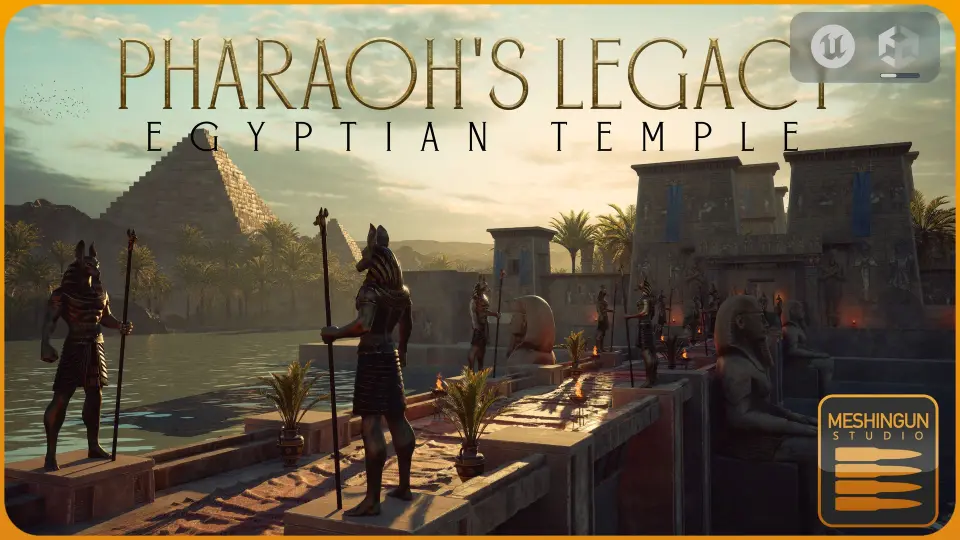
Pharaoh's Legacy: Egyptian Temple Megapack is a large environment collection for Unreal Engine based on a single, clearly defined subject: ancient Egypt. It brings together pyramids, temple interiors, tomb spaces, and an oasis into one project, with the goal of letting a developer populate a full level without assembling every block from scratch. The pack contains more than 300 crafted assets, which puts it closer to a small production library than a handful of decorative props.
Over 300 Assets for an Ancient Egyptian Setting
The tags attached to the pack — pharaoh, oasis, tomb, Egyptian, level, temple, Egypt, pyramid, ancient, and city — map out the full range of the collection. A project can build monumental exteriors, place a tomb complex under the sand, and set a city district near a water source, all from the same asset family. The presentation leans into the atmosphere of ancient Egypt: towering pyramids, magnificent temples, and secrets that feel locked inside the stone. That gives the asset library a strong starting direction.
The Two Epic Plugins Needed Before Loading the Level
Before the pack shows what it can do, two Unreal Engine plugins have to be active. The oasis uses Epic's Water Plugin, and some of the cloud effects run on the Volumetric Plugin. Both are standard Epic plugins, so no extra download is needed, but they must be enabled in the project.
The level named LV_Landscape can stay invisible until those plugins are switched on and the project is restarted. Anyone opening the pack for the first time should activate Water and Volumetric, restart, and then load the landscape level. Skipping that step can make the scene look broken or empty, even though the problem is just the missing plugin state.
Modular Temple Pieces, Prefabs, and Master Materials
Construction in the pack is based on modular design and prefabs. The modular pieces let a designer snap together walls, columns, and other architectural sections into a temple layout. Prefabs group related pieces into larger ready-to-place structures, so a full facade or interior section can drop into a level faster than placing each element individually.
The pack's six central strengths are listed clearly: an extensive asset library, modular design and prefabs, Nanite and Lumen compatibility, powerful master materials, game-ready optimization, and comprehensive documentation. The master materials are the part that pushes this beyond a static mesh dump. Parameters can be adjusted for different visual effects, which means a stone wall used in a sunlit courtyard and the same wall inside a dark tomb can look completely different without new texture work.
Nanite, Lumen, and Optimized Scene Performance
The pack supports both Nanite and Lumen, two systems that shape how an Unreal Engine scene looks in 5.4. Nanite handles dense geometry like carved stone and complex temple details without the usual cost, while Lumen brings the kind of bounced lighting that suits wide desert and dark interior spaces.
The optimization side is stated plainly as game-ready, with an emphasis on outstanding performance. That matters for a pack this size. More than 300 assets and a full landscape level could easily turn into a burden for a real-time project, so the pack is positioned for interactive use rather than only for static renders.
Showcase Works: The Aaru and Nebu
The pack presents two showcase scenes: The Aaru and Nebu. Both were created as examples of what the asset set can produce, and they give a practical reference for the visual range of the collection. Instead of showing one temple in one lighting setup, the scenes demonstrate that the same library can be used for different compositions and moods.
Best Suited for Egyptian Level Builders
This is a package for anyone responsible for building a level that feels like ancient Egypt. The tag list alone — tomb, oasis, pyramid, temple, city — covers the typical geography of an Egyptian-themed game or experience. A level designer can start with the modular temple prefabs, dress the space with the broader asset library, and use the master materials to tune the lighting reactions of every surface.
Comprehensive documentation is part of the delivery. With a large asset library and a two-plugin prerequisite, documentation helps a new team get up to speed without hunting for answers. The pack is set up to handle the repetitive work of creating an ancient Egyptian environment: the plugin notes, the modular system, the material controls, and the performance checks are all part of the same package.
For a small team, the advantage is in the breadth of the asset library. For an individual developer, it removes the need to hand-build pyramids and temple architecture from nothing. The pack's real strength is that it treats an ancient Egyptian environment as a full production task, not just a prop collection.
 Historical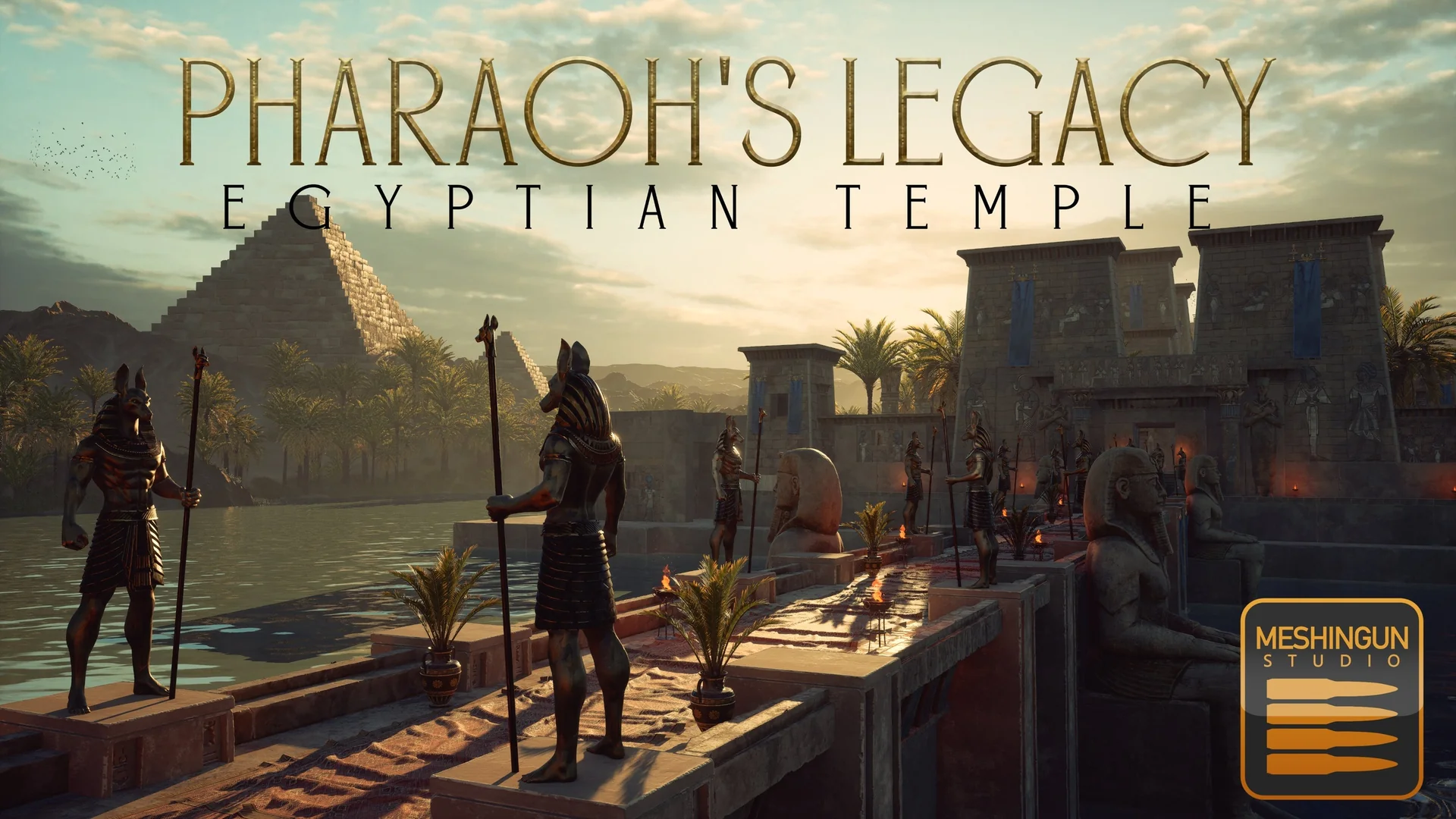
 Historical
 Historical
![[VP] Temples of Cambodia - Ruins exterior and interior](/_img/360/wp-content/uploads/published/2026/09/e98d07773c31-d1d31c30-c89a-4b52-b9d5-3b0aea0c63b8-bbd1ec4a04.webp) Historical
Historical