"d037b61901c110d2"{"id":"1002684","slug":"museum-environment-kit","title":"Museum Environment Kit","category":"Historical","engine":"5.0+","assetVersion":"","engineVersion":"Engine Version: 5.0+","tag":"Historical","accent":"blue","visual":"city","summary":"Construct realistic galleries and exhibitions with the Museum Environment Kit, featuring modular arch pieces, statues, paintings, PBR materials, Lumen, and Nani","platform":"Unreal Engine","indexPolicy":"index","publishedAt":"2026-11-16T22:35:37.511Z","updatedAt":"2026-11-16T22:35:37.511Z","sourceNotes":[],"fileContents":[],"compatibility":["Unreal Engine","Engine Version: 5.0+"],"featuredImage":{"alt":"Museum Environment Kit","src":"/wp-content/uploads/published/2026/11/e1994518f138-1a85935b-31c6-414b-a97f-b42e5f10c993-9e91125ddc.webp"},"fileSizeBytes":1591789593,"hasDownloadLink":true,"downloads":0,"terms":[{"taxonomy":"category","slug":"historical","name":"Historical"}],"galleryImages":[{"src":"/wp-content/uploads/published/2026/11/a7f75648fb25-f72eaa29-7eb4-4044-a7e2-37b91792498d-3c7e00ba9e.webp","alt":"Museum Environment Kit"},{"src":"/wp-content/uploads/published/2026/11/81e630a6ef21-94f9a3ab-e6ea-4a4f-9377-917e7197dbe5-5e2504d41d.webp","alt":"Museum Environment Kit"},{"src":"/wp-content/uploads/published/2026/11/249e7e3214b8-0221fe1b-fbd0-4d04-aa90-918374a715ae-930f98cd43.webp","alt":"Museum Environment Kit"},{"src":"/wp-content/uploads/published/2026/11/a94bf59291f6-4fb55056-42fd-43eb-83ef-0aeba62d522f-8c6f9bdd93.webp","alt":"Museum Environment Kit"},{"src":"/wp-content/uploads/published/2026/11/7bda1ab02357-98897203-c355-4f32-a8dc-d5a61dcbffc2-d07383425b.webp","alt":"Museum Environment Kit"},{"src":"/wp-content/uploads/published/2026/11/9c9d2008cb47-80e89c49-a876-4a17-ad02-413abe54292b-b372aded82.webp","alt":"Museum Environment Kit"},{"src":"/wp-content/uploads/published/2026/11/2fe5d68d6661-f533758a-0ac5-434b-9dcd-51214662870c-b6ce8bdff5.webp","alt":"Museum Environment Kit"},{"src":"/wp-content/uploads/published/2026/11/8477eb5b4097-05e1c3b1-b76f-45f5-9b27-f7386795dd11-5f62a33326.webp","alt":"Museum Environment Kit"},{"src":"/wp-content/uploads/published/2026/11/cf63200233ae-2283dd31-fbb2-4848-8639-0afc11d1f6ae-f32c7632c4.webp","alt":"Museum Environment Kit"},{"src":"/wp-content/uploads/published/2026/11/f98b429d25cc-38619707-60cc-4b65-a4f9-89f4d5ee3f8f-3d2eaf3df1.webp","alt":"Museum Environment Kit"}],"accessPanel":{"kind":"resource","title":"Get this resource","eyebrow":"Free resource","message":"Download this resource in your browser.","fileName":"Content.7z","safetyNote":"Resources are manually reviewed before listing to improve quality and reduce obvious risks.","actionLabel":"Get this resource","resourceType":"Resource archive","versions":[]},"contentHtml":"\u003cp\u003eIndoor cultural spaces rely on clear structural rhythm, spacious proportions, and refined artistic staging to convey a sense of prestige and history. Crafting these spaces for interactive media or visual productions requires an architectural framework capable of balancing grand open halls with detailed focal points. The Museum Environment Kit supplies this balance through a dedicated collection of modular components, architectural arch units, fine art props, and physical surface definitions engineered to assemble realistic museums, art galleries, and modern exhibition facilities.\u003c/p\u003e \u003ch2\u003eArchitectural Modular Assemblies in the Museum Environment\u003c/h2\u003e\n\u003cp\u003eSpatial composition inside a gallery dictates how visitors move, observe, and engage with displays. The Museum Environment Kit addresses this spatial requirement by offering a comprehensive system of modular pieces intended for flexible assembly. These modular blocks allow level designers and environment artists to construct custom levels that range from intimate private collection chambers to towering multistory atriums. The modular approach ensures that wall alignments, floor junctions, and ceiling transitions fit together cleanly across repeating structural grids, avoiding visual seams or misaligned boundaries.\u003c/p\u003e\n\u003cp\u003eComplementing the standard structural modules are specialized arch pieces that introduce classical, neoclassical, and modern interior transitions into a facility layout. Arch pieces serve both functional and aesthetic purposes within the architecture: they frame vistas into adjoining display wings, break up expansive hallway corridors, and support varied ceiling heights without demanding unique geometry for every threshold. By combining these arch elements with standard modular walls and flooring, creators can construct diverse interior pathways, winding historical exhibits, or expansive open-plan galleries while keeping the underlying visual language unified and structurally coherent.\u003c/p\u003e \u003ch2\u003eSurface Calibration and PBR Material Instances Across the Kit\u003c/h2\u003e\n\u003cp\u003eVisual authenticity in high-end interior spaces depends on how realistic surfaces respond to light. The Museum Environment Kit incorporates physically based rendering (PBR) materials along with a dedicated collection of material instances to govern surface characteristics. In high-traffic public institutions, surfaces span diverse tactile finishes, including polished stone flooring, smooth plaster partitions, reflective exhibition glass, carved stonework, and aged painting frames. The included PBR materials accurately reproduce these distinct surface responses under both direct fixtures and subtle ambient bounce light.\u003c/p\u003e\n\u003cp\u003eWorking with material instances provides extensive workflow advantages when detailing large architectural volumes. Rather than editing core shader graphs, artists can use exposed parameters within material instances to adjust roughness levels, tint variations, surface sheen, and color values across different gallery wings. This setup allows level creators to differentiate between modern white-cube exhibition rooms and historic neoclassical wings while drawing from the same underlying material framework. Material consistency across walls, arch structures, and floor plates guarantees that varying rooms still feel like part of a unified cultural complex.\u003c/p\u003e \u003ch2\u003eCurating Cultural Exhibitions with Statues and Paintings\u003c/h2\u003e\n\u003cp\u003eAn interior environment kit intended for cultural institutions requires convincing artistic displays to populate empty halls. The Museum Environment Kit includes a curated selection of interior props, statues, and framed paintings created specifically to serve as display pieces and focal markers. These assets allow creators to furnish sprawling corridors and prevent expansive halls from appearing vacant or sterile.\u003c/p\u003e\n\u003cp\u003eThe included statues feature detailed sculpted contours that interact naturally with spotlighting, casting intricate, soft shadows across pedestals and surrounding floor tiles. These sculptural props function effectively as central centerpieces in grand rotundas or as rhythmically placed dividers along symmetrical museum walkways. Alongside three-dimensional sculpture, the pack includes framed paintings intended for wall placement. These flat art props introduce color, narrative flavor, and historical context into exhibition spaces. Creators can arrange paintings in dense salon-style groupings for period-accurate historical exhibits or space them out evenly to achieve a clean, minimalist contemporary presentation.\u003c/p\u003e \u003ch2\u003eIllumination Dynamics Using Lumen and Nanite within the Environment\u003c/h2\u003e\n\u003cp\u003eModern interior scenes require advanced geometry handling and indirect illumination to communicate realistic volume and depth. The Museum Environment Kit is built to take full advantage of Nanite virtualization and Lumen dynamic global illumination. Nanite processes the complex geometric topology of architectural arch pieces, detailed moulding profiles, and sculpted statue surfaces directly, maintaining sharp physical contours without requiring aggressive level-of-detail transitions or geometric compromise at close distances.\u003c/p\u003e\n\u003cp\u003eLumen functions in close coordination with the kit’s PBR materials to resolve real-time light transport throughout the facility. In enclosed gallery environments, much of the visible atmosphere originates from indirect bounce: light striking a polished floor surface naturally scatters upwards, catching the underside of arches and gently illuminating framed paintings hung along adjacent walls. The combination of Lumen global illumination and Nanite geometry ensures that directional track lights, soft ceiling troffers, and expansive skylights cast soft, natural contact shadows and realistic ambient occlusion throughout every room configuration.\u003c/p\u003e \u003ch2\u003eProduction Applications Across Games, Films, and Presentations\u003c/h2\u003e\n\u003cp\u003eThe flexibility of the Museum Environment Kit makes it applicable across several distinct media formats. For game developers, the modular framework facilitates rapid prototyping and level design. Designers can quickly block out combat arenas, stealth infiltration spaces, puzzle-driven adventure environments, or atmospheric narrative walk-throughs using standardized wall and arch segments. Props, statues, and display stands can be deployed strategically to create visual cover, establish navigation sightlines, or direct player orientation through complex gallery layouts.\u003c/p\u003e\n\u003cp\u003eFor cinematic productions, animated shorts, and architectural presentations, the kit offers photorealistic interior fidelity out of the box. High-detail props and crisp structural geometry support extreme close-up camera work on art objects as easily as sweeping crane shots down monumental hallways. Virtual architectural demonstrations, client walkthroughs, and educational visualizations can showcase potential exhibition layouts or facility designs with realistic surface finishes, accurate physical lighting, and believable proportions.\u003c/p\u003e \u003ch2\u003eDeconstructing Assembly Workflows via the Museum Demo Level\u003c/h2\u003e\n\u003cp\u003eTo assist creators in understanding how all structural modules, props, arch pieces, and lighting setups interact in an active scene, the pack includes a fully configured demo level. This pre-assembled environment acts as a complete operational template, illustrating practical design approaches for gallery planning, art staging, and lighting placement.\u003c/p\u003e\n\u003cp\u003eBy exploring the included demo level, artists and developers can inspect the exact assembly techniques used to connect modular wall panels, anchor arch structures to ceiling planes, and distribute props naturally throughout open spaces. The demo level also provides a working reference for balancing Lumen light sources and material instances, demonstrating how spotlight intensity, bounce parameters, and floor roughness combine to create convincing exhibition rooms. Creators can use the demo level as a direct foundation to expand into larger custom levels, or dissect its structural hierarchy to incorporate individual assets into existing production pipelines.\u003c/p\u003e\n\n\u003ch2\u003eRelated Resources Worth Checking\u003c/h2\u003e\n\u003cul\u003e\n\u003cli\u003e\u003ca href=\"https://3dcghub.com/showroom-level-kit-11/\" rel=\"noopener noreferrer\"\u003eShowroom Level Kit 11\u003c/a\u003e\u003c/li\u003e\n\u003cli\u003e\u003ca href=\"https://3dcghub.com/gladiator-arena-environment-kit/\" rel=\"noopener noreferrer\"\u003eGladiator Arena Environment Kit\u003c/a\u003e\u003c/li\u003e\n\u003cli\u003e\u003ca href=\"https://3dcghub.com/throne-room-environment-kit/\" rel=\"noopener noreferrer\"\u003eThrone Room Environment Kit\u003c/a\u003e\u003c/li\u003e\n\u003cli\u003e\u003ca href=\"https://3dcghub.com/japanese-village-kit/\" rel=\"noopener noreferrer\"\u003eJapanese Village Kit\u003c/a\u003e\u003c/li\u003e\n\u003cli\u003e\u003ca href=\"https://3dcghub.com/fantasy-bundle-environment-kit-3-in-1/\" rel=\"noopener noreferrer\"\u003eFantasy Bundle Environment Kit 3 in 1\u003c/a\u003e\u003c/li\u003e\n\u003c/ul\u003e","contentTextLength":8197,"navigation":{"current":5,"total":4611,"previous":{"id":"1002685","slug":"palace-hall","title":"Palace Hall","category":"Historical","platform":"Unreal Engine","updatedAt":"2026-11-16T22:36:38.314Z"},"next":{"id":"1002683","slug":"modular-old-town","title":"Modular Old Town","category":"Historical","platform":"Unreal Engine","updatedAt":"2026-11-16T22:34:23.630Z"}},"relatedResources":[{"id":"1001557","slug":"showroom-level-kit-11","title":"Showroom Level Kit 11","category":"Historical","engine":"5.2+","assetVersion":"","engineVersion":"Engine Version: 5.2+","tag":"Historical","accent":"blue","visual":"mech","summary":"Showroom Level Kit 11 delivers a modular classic Baroque museum and gallery interior system optimized for Unreal Engine 5.2+ across PC, VR, and mobile.","platform":"Unreal Engine","indexPolicy":"index","publishedAt":"2026-10-10T03:48:40.285Z","updatedAt":"2026-10-10T03:48:40.285Z","sourceNotes":[],"fileContents":[],"compatibility":["Unreal Engine","Engine Version: 5.2+"],"featuredImage":{"alt":"Showroom Level Kit 11","src":"/wp-content/uploads/published/2026/10/911302bbfa14-a86e7205-78f7-4c3d-ae30-220831882929-8073f4ac2f.webp"},"fileSizeBytes":498624067,"hasDownloadLink":true,"downloads":0},{"id":"1000993","slug":"gladiator-arena-environment-kit","title":"Gladiator Arena Environment Kit","category":"Historical","engine":"5.0+","assetVersion":"","engineVersion":"Engine Version: 5.0+","tag":"Historical","accent":"blue","visual":"city","summary":"A Roman gladiator coliseum environment kit with themed meshes, PBR materials, a demo level, and Dragon Cave compatibility. Pillars, props, flags, and architectu","platform":"Unreal Engine","indexPolicy":"index","publishedAt":"2026-08-19T03:38:54.795Z","updatedAt":"2026-08-19T03:38:54.795Z","sourceNotes":[],"fileContents":[],"compatibility":["Unreal Engine","Engine Version: 5.0+"],"featuredImage":{"alt":"Gladiator Arena Environment Kit","src":"/wp-content/uploads/published/2026/08/e1b3dda14df1-273d0cae-e350-4a1a-97cb-4453038dcc7f-425a0b510f.webp"},"fileSizeBytes":2801981794,"hasDownloadLink":true,"downloads":3},{"id":"8434","slug":"throne-room-environment-kit","title":"Throne Room Environment Kit","category":"Historical","engine":"5.1+","assetVersion":"Engine version: 5.1+","engineVersion":"5.1","tag":"Historical","accent":"blue","visual":"city","summary":"Transform your digital worlds with a comprehensive kit designed for high-end visuals. This resource features modular architecture, detailed props, and custom PBR materials suitable for a wide range of creative projects.","platform":"Unreal Engine","indexPolicy":"noindex","publishedAt":"2026-02-23T17:17:15.000Z","updatedAt":"2026-04-19T15:55:27.000Z","sourceNotes":[],"fileContents":[],"compatibility":["Unreal Engine","Engine version: 5.1+"],"featuredImage":{"alt":"Throne Room Environment Kit","src":"https://3dcghub.com/wp-content/uploads/2026/02/1d5fa2fc-26d1-4a5f-a571-7758fe1799d9.webp"},"fileSizeBytes":2957903127,"hasDownloadLink":true,"downloads":1}]}
Resource screenshots
1 / 10
Historical
Museum Environment Kit
Construct realistic galleries and exhibitions with the Museum Environment Kit, featuring modular arch pieces, statues, paintings, PBR materials, Lumen, and Nani
Indoor cultural spaces rely on clear structural rhythm, spacious proportions, and refined artistic staging to convey a sense of prestige and history. Crafting these spaces for interactive media or visual productions requires an architectural framework capable of balancing grand open halls with detailed focal points. The Museum Environment Kit supplies this balance through a dedicated collection of modular components, architectural arch units, fine art props, and physical surface definitions engineered to assemble realistic museums, art galleries, and modern exhibition facilities.
Architectural Modular Assemblies in the Museum Environment
Spatial composition inside a gallery dictates how visitors move, observe, and engage with displays. The Museum Environment Kit addresses this spatial requirement by offering a comprehensive system of modular pieces intended for flexible assembly. These modular blocks allow level designers and environment artists to construct custom levels that range from intimate private collection chambers to towering multistory atriums. The modular approach ensures that wall alignments, floor junctions, and ceiling transitions fit together cleanly across repeating structural grids, avoiding visual seams or misaligned boundaries.
Complementing the standard structural modules are specialized arch pieces that introduce classical, neoclassical, and modern interior transitions into a facility layout. Arch pieces serve both functional and aesthetic purposes within the architecture: they frame vistas into adjoining display wings, break up expansive hallway corridors, and support varied ceiling heights without demanding unique geometry for every threshold. By combining these arch elements with standard modular walls and flooring, creators can construct diverse interior pathways, winding historical exhibits, or expansive open-plan galleries while keeping the underlying visual language unified and structurally coherent.
Surface Calibration and PBR Material Instances Across the Kit
Visual authenticity in high-end interior spaces depends on how realistic surfaces respond to light. The Museum Environment Kit incorporates physically based rendering (PBR) materials along with a dedicated collection of material instances to govern surface characteristics. In high-traffic public institutions, surfaces span diverse tactile finishes, including polished stone flooring, smooth plaster partitions, reflective exhibition glass, carved stonework, and aged painting frames. The included PBR materials accurately reproduce these distinct surface responses under both direct fixtures and subtle ambient bounce light.
Working with material instances provides extensive workflow advantages when detailing large architectural volumes. Rather than editing core shader graphs, artists can use exposed parameters within material instances to adjust roughness levels, tint variations, surface sheen, and color values across different gallery wings. This setup allows level creators to differentiate between modern white-cube exhibition rooms and historic neoclassical wings while drawing from the same underlying material framework. Material consistency across walls, arch structures, and floor plates guarantees that varying rooms still feel like part of a unified cultural complex.
Curating Cultural Exhibitions with Statues and Paintings
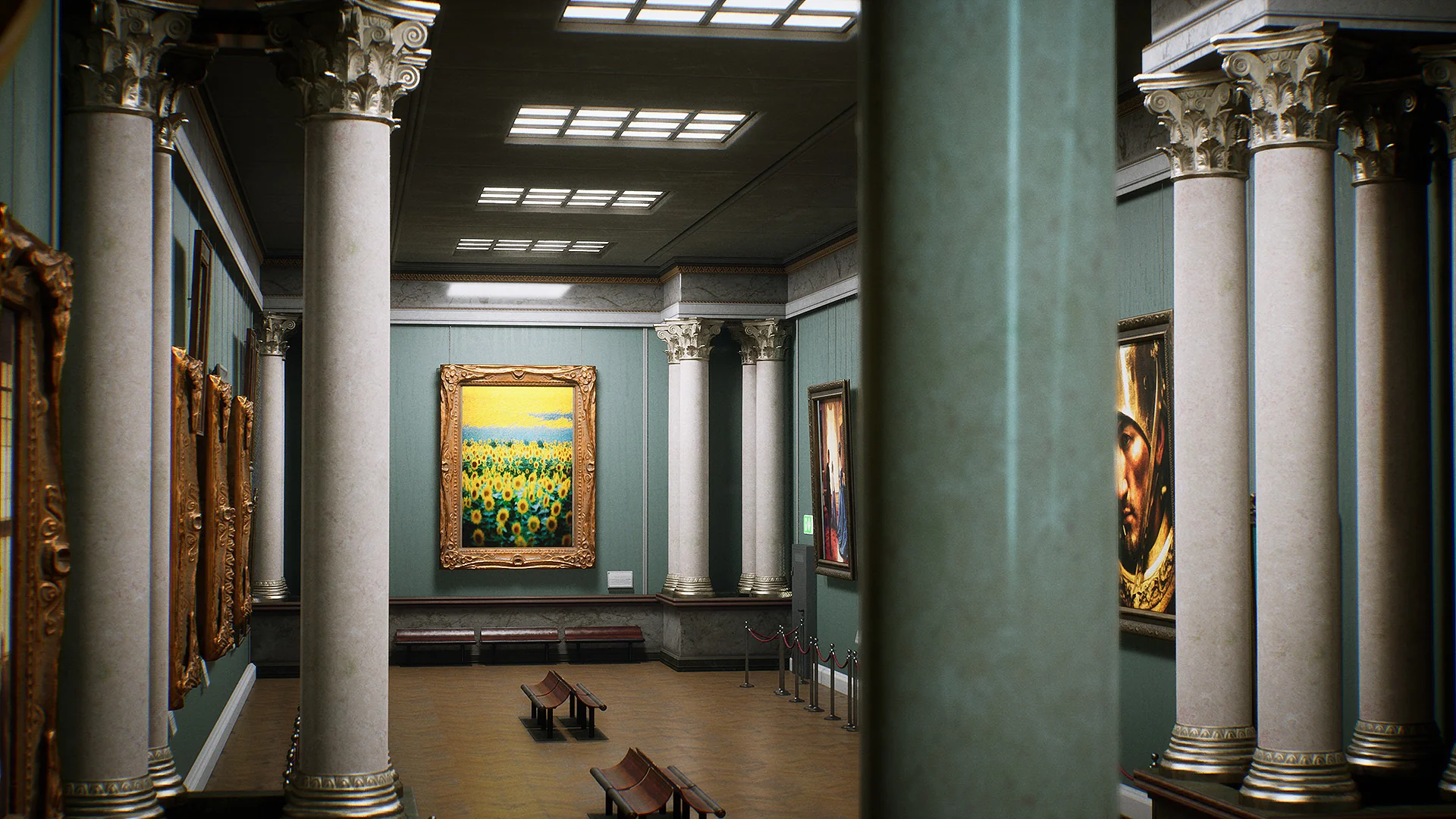
An interior environment kit intended for cultural institutions requires convincing artistic displays to populate empty halls. The Museum Environment Kit includes a curated selection of interior props, statues, and framed paintings created specifically to serve as display pieces and focal markers. These assets allow creators to furnish sprawling corridors and prevent expansive halls from appearing vacant or sterile.
The included statues feature detailed sculpted contours that interact naturally with spotlighting, casting intricate, soft shadows across pedestals and surrounding floor tiles. These sculptural props function effectively as central centerpieces in grand rotundas or as rhythmically placed dividers along symmetrical museum walkways. Alongside three-dimensional sculpture, the pack includes framed paintings intended for wall placement. These flat art props introduce color, narrative flavor, and historical context into exhibition spaces. Creators can arrange paintings in dense salon-style groupings for period-accurate historical exhibits or space them out evenly to achieve a clean, minimalist contemporary presentation.
Illumination Dynamics Using Lumen and Nanite within the Environment
Modern interior scenes require advanced geometry handling and indirect illumination to communicate realistic volume and depth. The Museum Environment Kit is built to take full advantage of Nanite virtualization and Lumen dynamic global illumination. Nanite processes the complex geometric topology of architectural arch pieces, detailed moulding profiles, and sculpted statue surfaces directly, maintaining sharp physical contours without requiring aggressive level-of-detail transitions or geometric compromise at close distances.
Lumen functions in close coordination with the kit’s PBR materials to resolve real-time light transport throughout the facility. In enclosed gallery environments, much of the visible atmosphere originates from indirect bounce: light striking a polished floor surface naturally scatters upwards, catching the underside of arches and gently illuminating framed paintings hung along adjacent walls. The combination of Lumen global illumination and Nanite geometry ensures that directional track lights, soft ceiling troffers, and expansive skylights cast soft, natural contact shadows and realistic ambient occlusion throughout every room configuration.
Production Applications Across Games, Films, and Presentations
The flexibility of the Museum Environment Kit makes it applicable across several distinct media formats. For game developers, the modular framework facilitates rapid prototyping and level design. Designers can quickly block out combat arenas, stealth infiltration spaces, puzzle-driven adventure environments, or atmospheric narrative walk-throughs using standardized wall and arch segments. Props, statues, and display stands can be deployed strategically to create visual cover, establish navigation sightlines, or direct player orientation through complex gallery layouts.
For cinematic productions, animated shorts, and architectural presentations, the kit offers photorealistic interior fidelity out of the box. High-detail props and crisp structural geometry support extreme close-up camera work on art objects as easily as sweeping crane shots down monumental hallways. Virtual architectural demonstrations, client walkthroughs, and educational visualizations can showcase potential exhibition layouts or facility designs with realistic surface finishes, accurate physical lighting, and believable proportions.
Deconstructing Assembly Workflows via the Museum Demo Level
To assist creators in understanding how all structural modules, props, arch pieces, and lighting setups interact in an active scene, the pack includes a fully configured demo level. This pre-assembled environment acts as a complete operational template, illustrating practical design approaches for gallery planning, art staging, and lighting placement.
By exploring the included demo level, artists and developers can inspect the exact assembly techniques used to connect modular wall panels, anchor arch structures to ceiling planes, and distribute props naturally throughout open spaces. The demo level also provides a working reference for balancing Lumen light sources and material instances, demonstrating how spotlight intensity, bounce parameters, and floor roughness combine to create convincing exhibition rooms. Creators can use the demo level as a direct foundation to expand into larger custom levels, or dissect its structural hierarchy to incorporate individual assets into existing production pipelines.
 Historical
 Historical
 Historical