"d037b61901c110d2"{"id":"1002664","slug":"fantasy-bundle-environment-kit-3-in-1","title":"Fantasy Bundle Environment Kit 3 in 1","category":"Historical","engine":"5.0+","assetVersion":"","engineVersion":"Engine Version: 5.0+","tag":"Historical","accent":"blue","visual":"city","summary":"Build realistic medieval and fantasy levels with the Fantasy Bundle Environment Kit 3 in 1, featuring modular castle, cave, and landscape assets.","platform":"Unreal Engine","indexPolicy":"index","publishedAt":"2026-11-16T22:11:55.493Z","updatedAt":"2026-11-16T22:11:55.493Z","sourceNotes":[],"fileContents":[],"compatibility":["Unreal Engine","Engine Version: 5.0+"],"featuredImage":{"alt":"Fantasy Bundle Environment Kit 3 in 1","src":"/wp-content/uploads/published/2026/11/c88ed7480000-9af583a8-dcc8-413c-9fbf-d61c78d6dac6-abd69d6886.webp"},"fileSizeBytes":5263837330,"hasDownloadLink":true,"downloads":0,"terms":[{"taxonomy":"category","slug":"historical","name":"Historical"}],"galleryImages":[{"src":"/wp-content/uploads/published/2026/11/00b50a05778d-cfd5c215-9915-4522-ade8-8251214cc4d0-8ad01b0159.webp","alt":"Fantasy Bundle Environment Kit 3 in 1"},{"src":"/wp-content/uploads/published/2026/11/2b36880331e7-a44abffc-92e1-4320-91c5-84bdb000da15-b06ef5e5a4.webp","alt":"Fantasy Bundle Environment Kit 3 in 1"},{"src":"/wp-content/uploads/published/2026/11/286168e17f08-a73adc19-0e31-42ac-a7ae-0b896557125c-c22fc787dd.webp","alt":"Fantasy Bundle Environment Kit 3 in 1"},{"src":"/wp-content/uploads/published/2026/11/fc7045c19202-28b19f95-41ce-4a93-823e-739c8140b49b-81e0c8dfa7.webp","alt":"Fantasy Bundle Environment Kit 3 in 1"},{"src":"/wp-content/uploads/published/2026/11/3acbbb3e70c3-fb5c806d-d025-40e7-8794-2215b6032bdf-cdb0dfa099.webp","alt":"Fantasy Bundle Environment Kit 3 in 1"},{"src":"/wp-content/uploads/published/2026/11/1c73cc4cea21-e219b8c7-dd2d-4102-98ef-84584703fd71-15cc160304.webp","alt":"Fantasy Bundle Environment Kit 3 in 1"},{"src":"/wp-content/uploads/published/2026/11/77e8cfd8591f-cde550af-6f42-4659-b6b5-e2734a2fcdbe-b4eb75a913.webp","alt":"Fantasy Bundle Environment Kit 3 in 1"},{"src":"/wp-content/uploads/published/2026/11/3c813ef23eae-e7719ca8-c26a-4837-9cfb-f63f4bcc4ae7-2d9656ecc4.webp","alt":"Fantasy Bundle Environment Kit 3 in 1"},{"src":"/wp-content/uploads/published/2026/11/023e69ea24f6-bc88fcfc-eb9d-4493-bd7a-969364b7b889-9deb6ab3a7.webp","alt":"Fantasy Bundle Environment Kit 3 in 1"},{"src":"/wp-content/uploads/published/2026/11/1d27b61e60c1-5aef20b8-8c5e-4d35-b36b-67b440f7e896-d72b85dbf0.webp","alt":"Fantasy Bundle Environment Kit 3 in 1"}],"accessPanel":{"kind":"resource","title":"Get this resource","eyebrow":"Free resource","message":"Download this resource in your browser.","fileName":"Content.7z","safetyNote":"Resources are manually reviewed before listing to improve quality and reduce obvious risks.","actionLabel":"Get this resource","resourceType":"Resource archive","versions":[]},"contentHtml":"\u003cp\u003eConstructing believable medieval and fantasy spaces requires balancing architectural structure with natural environmental variety. The Fantasy Bundle Environment Kit 3 in 1 addresses this workflow by bringing three AAA game environments together into a single unified collection. Centered around realistic visual fidelity and low-poly construction, the package supplies creators with structural base pieces, organic elements, dressing assets, and surface materials needed to assemble fully realized levels from the ground up.\u003c/p\u003e \u003ch2\u003eConstructing Levels Across the Fantasy Bundle\u003c/h2\u003e\n\u003cp\u003eAt the core of the bundle are three distinct environment settings configured for fantasy and medieval role-playing games. These settings cover fundamental locations commonly required across adventure titles: fortified stone castles, organic subterranean caves, and natural open landscapes. Rather than providing non-functional backdrop models, each included environment offers the necessary structural pieces to establish contiguous, playable spaces. This layout allows level designers to connect exterior terrain smoothly to heavy castle gates, defensive stone walls, and deep underground cavern networks.\u003c/p\u003e\n\u003cp\u003eThe scope of having three complete settings enables coherent world layouts and extended navigation paths. A level can begin on an open landscape hillside, lead players through the fortified courtyards and interiors of a stone castle, and then descend through ruined foundations into a dark cave system. Because all three environments share a unified realistic art direction and physical-based rendering (PBR) texture setup, transitions between natural rock faces and hand-carved stone walls feel cohesive rather than disjointed, maintaining visual consistency across changing scenes.\u003c/p\u003e\n\u003cp\u003eThe combination of these environments also helps maintain consistent scale across diverse areas. When transitioning from massive stone keeps into constricted underground tunnels, structural scaling can often become unbalanced if assets originate from mismatched packs. Here, the architectural scale, natural cavern heights, and landscape dimensions are designed to align cleanly, allowing level creators to draft realistic sightlines, vertical drops, and varied exploration routes without having to manually re-scale mismatched geometry.\u003c/p\u003e \u003ch2\u003eModular Architecture for Castle and Cave Environment Kit Workflows\u003c/h2\u003e\n\u003cp\u003eThe architectural assembly across the kit relies on modular base pieces. In level design pipelines, modularity governs how rapidly an environment artist can iterate on structural layouts, pathing, and line-of-sight metrics. The modular castle and stone pieces enable flexible structural layouts, making it straightforward to construct defensive ramparts, towers, perimeter walls, grand entryways, and narrow corridors that fit together without visible seam lines or awkward geometry intersections.\u003c/p\u003e\n\u003cp\u003eThis modular logic extends directly into the cave environments. Building natural underground spaces presents distinct challenges compared to geometric architecture, as natural subterranean rock walls require irregular silhouettes that conceal repetitive alignment grids. The kit provides base cave pieces that assemble to form winding tunnels, large hollow caverns, narrow passages, and natural elevation shifts. By combining these structural pieces, designers can construct complex multi-level dungeons, underground hideouts, and winding cavern routes suited for RPG exploration.\u003c/p\u003e\n\u003cp\u003eBecause the underlying assets utilize a low-poly modeling standard, these large structures and subterranean environments can be built at significant scale while remaining efficient for real-time game performance. Level artists can block out expansive fortress walls, multi-tier battlements, and expansive cave chambers without overburdening geometric budgets, leaving ample performance headroom for scene lighting, visual effects, and gameplay elements.\u003c/p\u003e \u003ch2\u003eSurface Realism with Blended Materials, Decals, and Stone Elements\u003c/h2\u003e\n\u003cp\u003eLarge stone surfaces and rocky terrain models can often suffer from visible texture repetition when applied across wide playable areas. To resolve this issue, the kit provides blended materials, PBR textures, and surface decals that introduce natural variety and breakup across repetitive surfaces. Blended materials allow environment artists to paint smooth transitions between distinct surfaces directly onto geometry and terrain, blending rough rock with soil, weathered stone with accumulated dirt, or cut masonry with patches of moss.\u003c/p\u003e\n\u003cp\u003eDecals offer a dedicated method for introducing localized micro-detail across the modular geometry. By projecting decals onto modular castle masonry, floor flagstones, or rough cave rock faces, artists can add specific surface variations such as localized water stains, surface cracks, accumulated grime, chipped edges, and mineral deposits. This surface treatment ensures that identical modular wall units or rock meshes placed next to each other appear distinct and weathered by their specific surroundings.\u003c/p\u003e\n\u003cp\u003eThe PBR material definition ensures that stone, rock, and earth react consistently under dynamic lighting conditions. Light bounces accurately off damp cave walls, rough stone masonry, and dry landscape soil, reinforcing the physical weight and density of the architecture. This material fidelity guarantees that whether an area is lit by open landscape sunlight, flickering castle sconces, or dim subterranean bioluminescence, the surfaces maintain realistic roughness, depth, and material properties.\u003c/p\u003e \u003ch2\u003eDressing Spaces with Kit Props, Set Pieces, and Foliage\u003c/h2\u003e\n\u003cp\u003eOnce structural layouts are established using the modular base pieces, scene dressing transforms bare geometric layouts into narrative-rich spaces. The bundle provides a selection of set pieces and dressing props designed to outfit castle rooms, military outposts, and underground encampments. These props add evidence of occupation, fort life, or abandonment, giving players visual context as they navigate through fortress halls or rocky cavern hideaways.\u003c/p\u003e\n\u003cp\u003eOutdoor landscape areas and natural stone formations rely on foliage assets to soften harsh transition lines and integrate solid geometry into the surrounding ground. The inclusion of grass assets allows designers to populate open ground, fill crevices between stone pavers, and feather the contact edges where massive boulders and modular castle walls meet the terrain. Scattering grass and small props around large stone bases prevents meshes from appearing detached from the ground surface, producing grounded environmental composition throughout the level.\u003c/p\u003e\n\u003cp\u003eSet pieces also serve as focal points within large, open rooms or vast cavern halls. Rather than relying solely on repetitive architectural patterns, level artists can position larger dressing assemblies to break up empty floor space, establish natural cover points for combat encounters, or guide player navigation toward exits and key points of interest. This layer of set decoration bridges the gap between raw modular construction and a living game world.\u003c/p\u003e \u003ch2\u003eLevel Production for Realistic Medieval and Fantasy RPGs\u003c/h2\u003e\n\u003cp\u003eThe collection supports developers building action-RPGs, dungeon crawlers, and medieval exploration titles where atmospheric fidelity and spatial variety are central to the player experience. Because the package contains both base structural pieces for large-scale construction and detailing assets like props, grass, decals, and blended materials, it provides the essential components required to take a level from initial greybox blocking to finished environment dressing.\u003c/p\u003e\n\u003cp\u003eDesigners can begin by using the modular stone and cave pieces to establish core gameplay spaces, verifying movement timings, choke points, and vertical navigation before moving into the visual refinement phase. Once gameplay metrics are settled, the combination of blended stone materials, decals, set pieces, and foliage allows teams to rapidly detail the world. By supplying the architectural base, natural elements, and dressing layers within three thematic environments, the kit provides a cohesive foundation for building expansive fantasy realms.\u003c/p\u003e\n\n\u003ch2\u003eRelated Resources Worth Checking\u003c/h2\u003e\n\u003cul\u003e\n\u003cli\u003e\u003ca href=\"https://3dcghub.com/throne-room-environment-kit/\" rel=\"noopener noreferrer\"\u003eThrone Room Environment Kit\u003c/a\u003e\u003c/li\u003e\n\u003cli\u003e\u003ca href=\"https://3dcghub.com/market-street-environment-kit/\" rel=\"noopener noreferrer\"\u003eMarket Street Environment Kit\u003c/a\u003e\u003c/li\u003e\n\u003cli\u003e\u003ca href=\"https://3dcghub.com/grand-bazaar-bundle/\" rel=\"noopener noreferrer\"\u003eGrand Bazaar - Bundle\u003c/a\u003e\u003c/li\u003e\n\u003cli\u003e\u003ca href=\"https://3dcghub.com/showroom-level-kit-11/\" rel=\"noopener noreferrer\"\u003eShowroom Level Kit 11\u003c/a\u003e\u003c/li\u003e\n\u003cli\u003e\u003ca href=\"https://3dcghub.com/gladiator-arena-environment-kit/\" rel=\"noopener noreferrer\"\u003eGladiator Arena Environment Kit\u003c/a\u003e\u003c/li\u003e\n\u003c/ul\u003e","contentTextLength":8308,"navigation":{"current":25,"total":4611,"previous":{"id":"1002665","slug":"fantasy-interior-environment-fantasy-interior-library-interior-fantasy-3d","title":"Fantasy Interior Environment ( Fantasy Interior Library Interior Fantasy 3D )","category":"Fantasy","platform":"Unreal Engine","updatedAt":"2026-11-16T22:12:55.177Z"},"next":{"id":"1002663","slug":"fantastic-dungeon-pack","title":"FANTASTIC - Dungeon Pack","category":"Dungeon","platform":"Unreal Engine","updatedAt":"2026-11-16T22:10:00.416Z"}},"relatedResources":[{"id":"8434","slug":"throne-room-environment-kit","title":"Throne Room Environment Kit","category":"Historical","engine":"5.1+","assetVersion":"Engine version: 5.1+","engineVersion":"5.1","tag":"Historical","accent":"blue","visual":"city","summary":"Transform your digital worlds with a comprehensive kit designed for high-end visuals. This resource features modular architecture, detailed props, and custom PBR materials suitable for a wide range of creative projects.","platform":"Unreal Engine","indexPolicy":"noindex","publishedAt":"2026-02-23T17:17:15.000Z","updatedAt":"2026-04-19T15:55:27.000Z","sourceNotes":[],"fileContents":[],"compatibility":["Unreal Engine","Engine version: 5.1+"],"featuredImage":{"alt":"Throne Room Environment Kit","src":"https://3dcghub.com/wp-content/uploads/2026/02/1d5fa2fc-26d1-4a5f-a571-7758fe1799d9.webp"},"fileSizeBytes":2957903127,"hasDownloadLink":true,"downloads":1},{"id":"8407","slug":"market-street-environment-kit","title":"Market Street Environment Kit","category":"Historical","engine":"5.1+","assetVersion":"Engine version: 5.1+","engineVersion":"5.1","tag":"Historical","accent":"blue","visual":"city","summary":"The Market Street Environment Kit provides a versatile collection of modular assets for building vibrant market scenes. Whether you are working on a realistic historical project or a stylized fantasy world, this kit offers everything you need.","platform":"Unreal Engine","indexPolicy":"noindex","publishedAt":"2026-02-23T17:11:56.000Z","updatedAt":"2026-04-19T15:55:28.000Z","sourceNotes":[],"fileContents":[],"compatibility":["Unreal Engine","Engine version: 5.1+"],"featuredImage":{"alt":"Market Street Environment Kit","src":"https://3dcghub.com/wp-content/uploads/2026/02/9b78fb92-baac-4e68-938c-7105f050eb35.webp"},"fileSizeBytes":2294561189,"hasDownloadLink":true,"downloads":0},{"id":"1002684","slug":"museum-environment-kit","title":"Museum Environment Kit","category":"Historical","engine":"5.0+","assetVersion":"","engineVersion":"Engine Version: 5.0+","tag":"Historical","accent":"blue","visual":"city","summary":"Construct realistic galleries and exhibitions with the Museum Environment Kit, featuring modular arch pieces, statues, paintings, PBR materials, Lumen, and Nani","platform":"Unreal Engine","indexPolicy":"index","publishedAt":"2026-11-16T22:35:37.511Z","updatedAt":"2026-11-16T22:35:37.511Z","sourceNotes":[],"fileContents":[],"compatibility":["Unreal Engine","Engine Version: 5.0+"],"featuredImage":{"alt":"Museum Environment Kit","src":"/wp-content/uploads/published/2026/11/e1994518f138-1a85935b-31c6-414b-a97f-b42e5f10c993-9e91125ddc.webp"},"fileSizeBytes":1591789593,"hasDownloadLink":true,"downloads":0}]}
Resource screenshots
1 / 10
Historical
Fantasy Bundle Environment Kit 3 in 1
Build realistic medieval and fantasy levels with the Fantasy Bundle Environment Kit 3 in 1, featuring modular castle, cave, and landscape assets.
Constructing believable medieval and fantasy spaces requires balancing architectural structure with natural environmental variety. The Fantasy Bundle Environment Kit 3 in 1 addresses this workflow by bringing three AAA game environments together into a single unified collection. Centered around realistic visual fidelity and low-poly construction, the package supplies creators with structural base pieces, organic elements, dressing assets, and surface materials needed to assemble fully realized levels from the ground up.
Constructing Levels Across the Fantasy Bundle
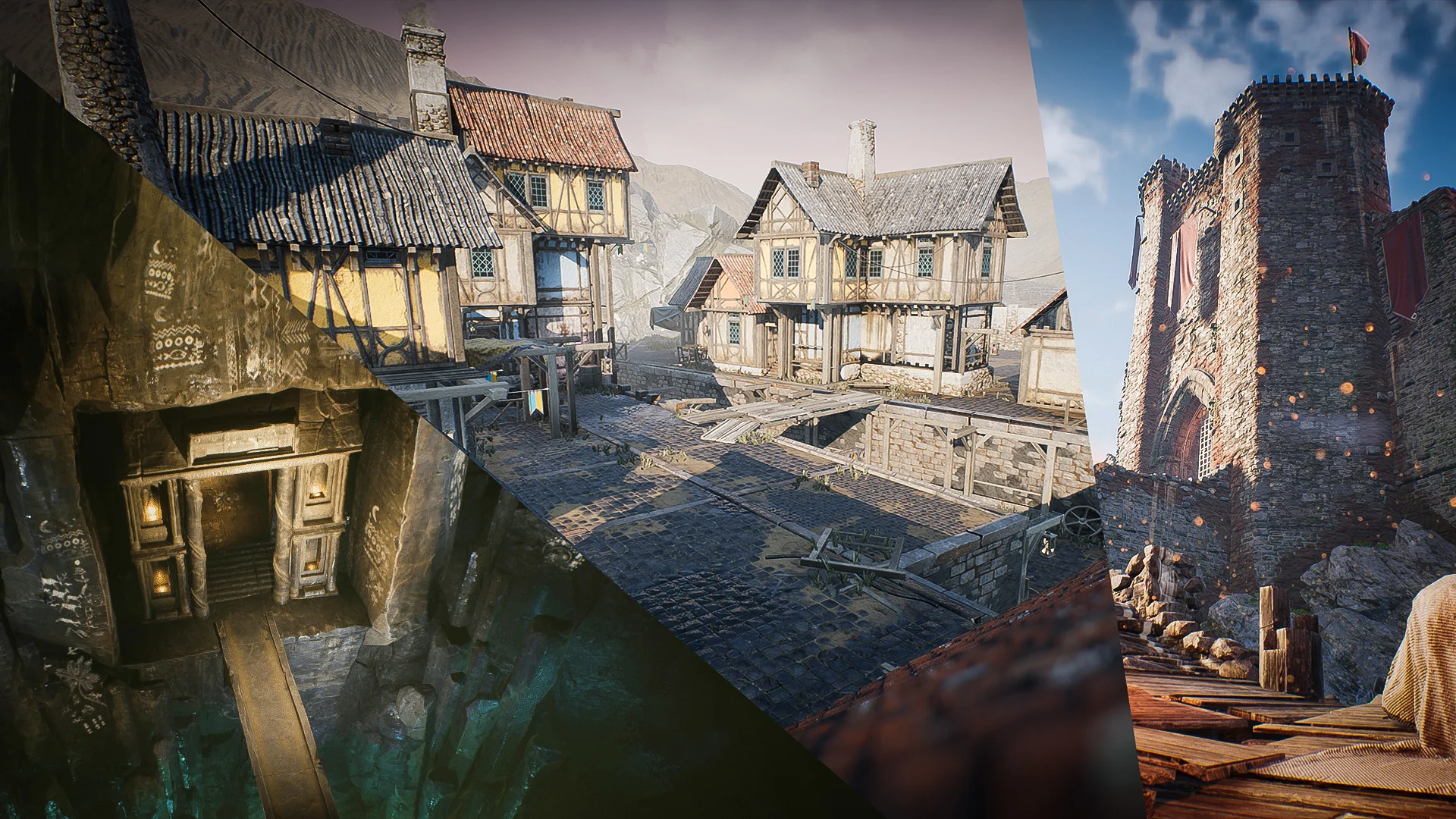
At the core of the bundle are three distinct environment settings configured for fantasy and medieval role-playing games. These settings cover fundamental locations commonly required across adventure titles: fortified stone castles, organic subterranean caves, and natural open landscapes. Rather than providing non-functional backdrop models, each included environment offers the necessary structural pieces to establish contiguous, playable spaces. This layout allows level designers to connect exterior terrain smoothly to heavy castle gates, defensive stone walls, and deep underground cavern networks.
The scope of having three complete settings enables coherent world layouts and extended navigation paths. A level can begin on an open landscape hillside, lead players through the fortified courtyards and interiors of a stone castle, and then descend through ruined foundations into a dark cave system. Because all three environments share a unified realistic art direction and physical-based rendering (PBR) texture setup, transitions between natural rock faces and hand-carved stone walls feel cohesive rather than disjointed, maintaining visual consistency across changing scenes.
The combination of these environments also helps maintain consistent scale across diverse areas. When transitioning from massive stone keeps into constricted underground tunnels, structural scaling can often become unbalanced if assets originate from mismatched packs. Here, the architectural scale, natural cavern heights, and landscape dimensions are designed to align cleanly, allowing level creators to draft realistic sightlines, vertical drops, and varied exploration routes without having to manually re-scale mismatched geometry.
Modular Architecture for Castle and Cave Environment Kit Workflows
The architectural assembly across the kit relies on modular base pieces. In level design pipelines, modularity governs how rapidly an environment artist can iterate on structural layouts, pathing, and line-of-sight metrics. The modular castle and stone pieces enable flexible structural layouts, making it straightforward to construct defensive ramparts, towers, perimeter walls, grand entryways, and narrow corridors that fit together without visible seam lines or awkward geometry intersections.
This modular logic extends directly into the cave environments. Building natural underground spaces presents distinct challenges compared to geometric architecture, as natural subterranean rock walls require irregular silhouettes that conceal repetitive alignment grids. The kit provides base cave pieces that assemble to form winding tunnels, large hollow caverns, narrow passages, and natural elevation shifts. By combining these structural pieces, designers can construct complex multi-level dungeons, underground hideouts, and winding cavern routes suited for RPG exploration.
Because the underlying assets utilize a low-poly modeling standard, these large structures and subterranean environments can be built at significant scale while remaining efficient for real-time game performance. Level artists can block out expansive fortress walls, multi-tier battlements, and expansive cave chambers without overburdening geometric budgets, leaving ample performance headroom for scene lighting, visual effects, and gameplay elements.
Surface Realism with Blended Materials, Decals, and Stone Elements
Large stone surfaces and rocky terrain models can often suffer from visible texture repetition when applied across wide playable areas. To resolve this issue, the kit provides blended materials, PBR textures, and surface decals that introduce natural variety and breakup across repetitive surfaces. Blended materials allow environment artists to paint smooth transitions between distinct surfaces directly onto geometry and terrain, blending rough rock with soil, weathered stone with accumulated dirt, or cut masonry with patches of moss.
Decals offer a dedicated method for introducing localized micro-detail across the modular geometry. By projecting decals onto modular castle masonry, floor flagstones, or rough cave rock faces, artists can add specific surface variations such as localized water stains, surface cracks, accumulated grime, chipped edges, and mineral deposits. This surface treatment ensures that identical modular wall units or rock meshes placed next to each other appear distinct and weathered by their specific surroundings.
The PBR material definition ensures that stone, rock, and earth react consistently under dynamic lighting conditions. Light bounces accurately off damp cave walls, rough stone masonry, and dry landscape soil, reinforcing the physical weight and density of the architecture. This material fidelity guarantees that whether an area is lit by open landscape sunlight, flickering castle sconces, or dim subterranean bioluminescence, the surfaces maintain realistic roughness, depth, and material properties.
Dressing Spaces with Kit Props, Set Pieces, and Foliage
Once structural layouts are established using the modular base pieces, scene dressing transforms bare geometric layouts into narrative-rich spaces. The bundle provides a selection of set pieces and dressing props designed to outfit castle rooms, military outposts, and underground encampments. These props add evidence of occupation, fort life, or abandonment, giving players visual context as they navigate through fortress halls or rocky cavern hideaways.
Outdoor landscape areas and natural stone formations rely on foliage assets to soften harsh transition lines and integrate solid geometry into the surrounding ground. The inclusion of grass assets allows designers to populate open ground, fill crevices between stone pavers, and feather the contact edges where massive boulders and modular castle walls meet the terrain. Scattering grass and small props around large stone bases prevents meshes from appearing detached from the ground surface, producing grounded environmental composition throughout the level.
Set pieces also serve as focal points within large, open rooms or vast cavern halls. Rather than relying solely on repetitive architectural patterns, level artists can position larger dressing assemblies to break up empty floor space, establish natural cover points for combat encounters, or guide player navigation toward exits and key points of interest. This layer of set decoration bridges the gap between raw modular construction and a living game world.
Level Production for Realistic Medieval and Fantasy RPGs
The collection supports developers building action-RPGs, dungeon crawlers, and medieval exploration titles where atmospheric fidelity and spatial variety are central to the player experience. Because the package contains both base structural pieces for large-scale construction and detailing assets like props, grass, decals, and blended materials, it provides the essential components required to take a level from initial greybox blocking to finished environment dressing.
Designers can begin by using the modular stone and cave pieces to establish core gameplay spaces, verifying movement timings, choke points, and vertical navigation before moving into the visual refinement phase. Once gameplay metrics are settled, the combination of blended stone materials, decals, set pieces, and foliage allows teams to rapidly detail the world. By supplying the architectural base, natural elements, and dressing layers within three thematic environments, the kit provides a cohesive foundation for building expansive fantasy realms.
 Historical
 Historical
 Historical